
Yealink business mobility · SIP · DECT · Tanzania
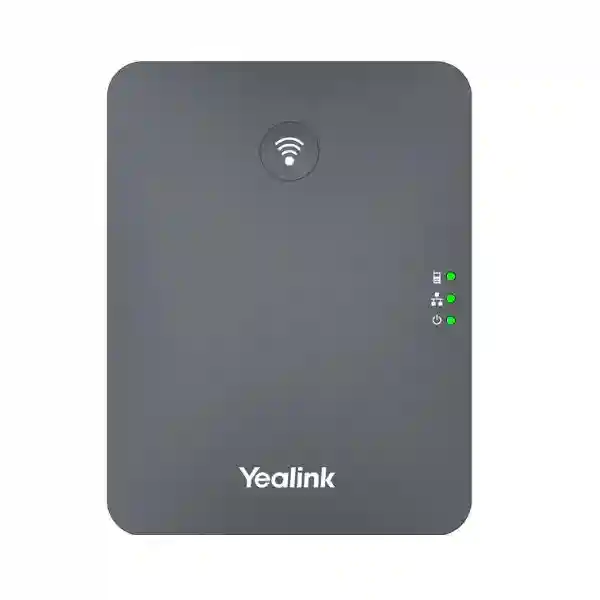
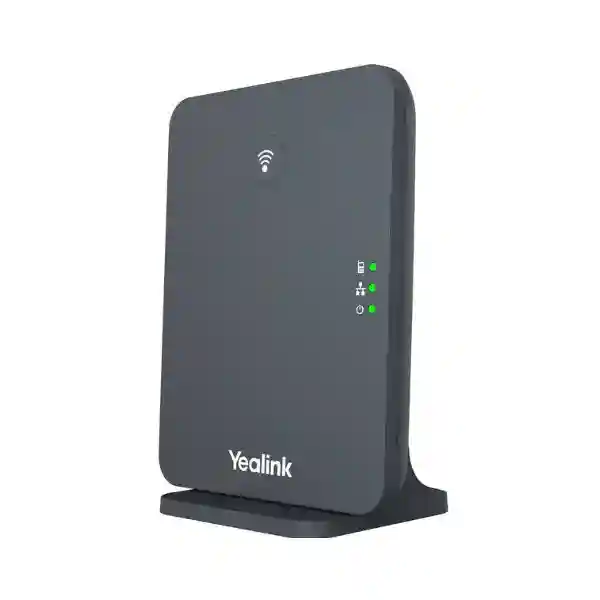
Yealink W70B DECT IP Base Station
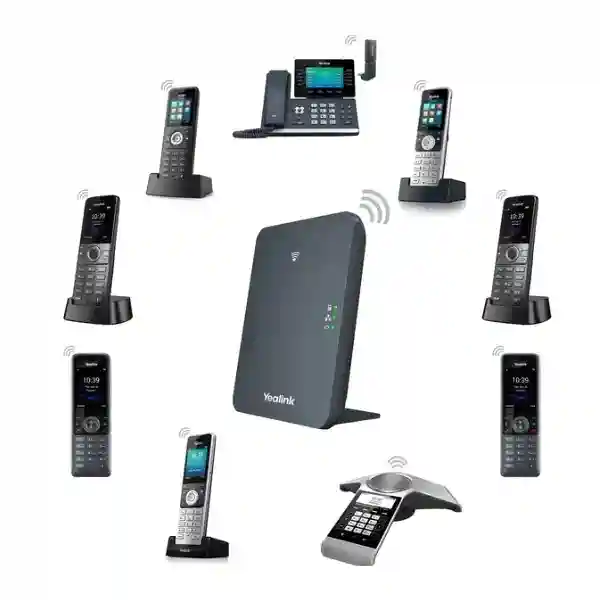
The Yealink W70B DECT IP Base Station gives small and medium-sized organizations a practical way to extend SIP calling beyond fixed desk phones. One W70B can register up to 10 compatible Yealink DECT handsets or supported DECT headsets, handle up to 10 SIP accounts and support up to 20 simultaneous calls. It connects to the LAN through a 10/100 Ethernet interface, can be powered by IEEE 802.3af PoE or the supplied power adapter, and supports business-focused security including TLS and SRTP. For offices, clinics, schools, warehouses, hospitality environments, service counters and operational teams in Tanzania, the W70B is especially useful where staff need to move while remaining reachable on their business extension.
What the Yealink W70B solves
Traditional desk phones work well for employees who stay at one workstation, but many business roles require movement. Warehouse supervisors walk between receiving and storage areas, clinic staff move between rooms, hotel teams circulate through guest-service spaces, technicians move around workshops, and managers often spend much of the day away from their desk. The W70B addresses this gap by connecting compatible cordless Yealink DECT endpoints to a SIP or IP PBX environment through one networked base station. Users can retain an extension identity while moving within the designed DECT coverage area.
The product is a single-cell DECT platform rather than a multi-cell roaming system. That distinction matters during planning. Yealink specifies ideal-condition range of up to 50 metres indoors and 300 metres outdoors, but real coverage depends heavily on building materials, floors, walls, metal shelving, machinery, interference and installation position. The W70B supports up to six RT30 repeaters per base station when additional coverage is needed, but buyers requiring seamless handover across multiple base stations should evaluate Yealink multi-cell alternatives rather than assuming several W70B units will behave as one roaming system.
Capacity
Up to 10 SIP accounts, 10 supported handsets or DECT headsets and 20 simultaneous calls help a single base serve a compact business voice environment.
Deployment
Auto-provisioning through TFTP, FTP, HTTP, HTTPS and Yealink RPS, plus PnP support, helps IT teams standardize deployment and maintenance.
Security
TLS, SRTP, HTTPS, digest authentication, AES-protected configuration files and supported SHA algorithms help secure signaling, media and management.
Power
The 10/100 Ethernet interface supports IEEE 802.3af PoE Class 1, simplifying placement when a suitable PoE switch is available.
Verified Yealink W70B specifications
| Area | W70B detail |
|---|---|
| SIP capacity | Up to 10 SIP accounts |
| Concurrent calls | Up to 20 simultaneous calls |
| Endpoints | Up to 10 compatible Yealink DECT handsets or supported DECT headsets |
| Repeaters | Up to 6 Yealink RT30 repeaters per base station |
| Network | 1 × RJ45 10/100M Ethernet, static or DHCP IP, VLAN 802.1Q/802.1p, 802.1x, LLDP, STUN, UDP/TCP/TLS |
| Power | IEEE 802.3af PoE Class 1 or Yealink AC adapter |
| Security | TLS 1.0/1.2/1.3, SRTP, HTTPS, digest authentication, AES configuration encryption, SHA256/SHA384/SHA512 |
| Mounting | Desktop or wall mount |
| Ideal range | Up to 50 m indoors and 300 m outdoors in ideal conditions |
| Dimensions | 130 × 100 × 25.1 mm |
Compatibility and buying guidance
Yealink lists compatibility with current and legacy endpoints including W71H, W74H, W73H, W78H, W56H, W59R and W57R handsets, supported conference devices such as CP930W and CP935W, selected Yealink DECT headsets, and T54W with DD10K. Compatibility can vary by firmware and endpoint function, so a quotation should specify the exact handset or headset models rather than simply stating “DECT compatible.” Yealink explicitly states that its DECT implementation is not compatible with third-party DECT devices. Buyers replacing an older base should therefore verify every existing handset model before procurement.
For a broader communication project, review FourTeck Tanzania’s integrated IT and IP telephony portfolio, which explains how PBX, voice endpoints, PoE switching, VLANs and network infrastructure fit together. UAE buyers can also review the FourTeck Yealink business communications range; customers with regional projects can use FourTeck Kenya and FourTeck Uganda as relevant regional technology references.
Deployment checklist before ordering
Confirm how many users need cordless voice access, how many concurrent conversations are expected and whether one base can satisfy the required capacity.
Record the IP PBX, hosted SIP platform or SIP service, account count, authentication requirements, codecs and any provisioning method required.
Identify walls, floors, metal racks, cold rooms, equipment areas and outdoor spaces that may reduce practical radio range.
Confirm that the switch port supports 802.3af PoE if you want one-cable power and data. Otherwise plan an AC outlet near the selected base position.
Yealink W70B DECT IP Base Station Tanzania
For Tanzanian organizations evaluating cordless VoIP, the Yealink W70B fits a common requirement: staff need to move around a site while retaining a business extension, but the project does not require a large enterprise multi-cell architecture. A single W70B can serve up to 10 compatible endpoints and 10 SIP accounts, making it appropriate for compact offices, retail operations, clinics, hospitality back-office teams, schools, workshops, small warehouses and service businesses. The most important buying decision is not simply whether the published range sounds sufficient; it is whether the building layout, user movement and expected call concurrency fit a single-cell design.
In Tanzania, many voice projects combine existing LAN infrastructure with a new IP PBX or SIP service. The W70B’s PoE support can simplify deployment where managed switches already provide 802.3af power. Where PoE is unavailable, the supplied AC adapter can be used, but the base still requires Ethernet connectivity to the voice network. For stable call quality, planners should consider voice VLANs, Quality of Service, switch capacity, DHCP or static addressing, firewall policies and the path from the LAN to the SIP platform. The W70B supports VLAN tagging and common network controls, which helps it fit into a properly segmented business network rather than being treated as an unmanaged standalone appliance.
Coverage should be validated for the actual Tanzanian site. Reinforced concrete, several floors, metal shelving, industrial equipment and dense walls may reduce practical range well below ideal-condition figures. Up to six RT30 repeaters can extend coverage in suitable layouts, but repeaters should not be used as a substitute for multi-cell architecture when users require seamless roaming and handover across a large campus. For procurement, provide FourTeck with the number of users, exact handset choices, PBX or SIP platform, floor plan or approximate site dimensions, PoE availability and expected simultaneous calls. This information makes the quotation more useful and reduces the risk of ordering incompatible endpoints or insufficient coverage hardware.
Yealink W70B DECT IP Base Station Dar es Salaam
Businesses in Dar es Salaam often need mobile voice communication across reception areas, showrooms, offices, stockrooms, clinics, hotels and service facilities where employees are not permanently seated. The Yealink W70B can connect compatible cordless Yealink DECT handsets to a SIP-based business phone system while centralizing the network connection at the base station. This is useful for teams that want a recognizable extension number and business call features without installing a wired desk phone at every point where a user may work.
For a Dar es Salaam deployment, base placement should be selected around real user movement. Mounting the W70B centrally and away from heavy obstruction can improve radio coverage. Before installation, consider reinforced walls, lift cores, server rooms, warehouse racking, machinery and separate buildings. If staff move between a front office and a nearby stock area, one well-positioned base plus an RT30 repeater may be sufficient, subject to a site check. If staff must roam continuously across multiple floors or large buildings, a Yealink multi-cell system may be the better architecture. The W70B itself is single cell and does not provide multi-base handover.
Network preparation also matters. Dar es Salaam offices using managed switching can connect the W70B to a voice VLAN and provide IEEE 802.3af PoE from the access switch. This avoids placing a power adapter at the base location and can make UPS-backed voice service easier when the PoE switch is protected. SIP registration details, firewall rules, DNS/NTP availability, outbound proxy requirements and codec policies should be checked before go-live. When requesting a quotation, buyers should specify required handset models, quantity, whether rugged endpoints are needed, number of expected simultaneous calls, PBX platform and whether the project is new or an upgrade. That lets FourTeck focus the proposal on compatibility and system design instead of only unit price.
Yealink W70B DECT IP Base Station Mwanza
The Yealink W70B is a practical option for Mwanza businesses that want cordless business extensions inside a defined office, clinic, retail, hospitality or light-industrial environment. It can register up to 10 supported Yealink DECT endpoints and up to 10 SIP accounts, with capacity for 20 simultaneous calls. This means the sizing conversation should focus on both user count and call behavior. Ten registered users do not automatically mean ten concurrent calls are required, but customer-facing teams, dispatch operations and service desks may have higher peaks than administrative offices.
For Mwanza sites, radio coverage should be treated as an engineering consideration rather than a fixed promise. Yealink’s ideal figures provide a useful reference, but walls, concrete, storage racks, equipment, glass partitions and outdoor transitions change real performance. A warehouse office with open internal space may behave very differently from a multi-room clinic of the same floor area. The W70B supports RT30 repeaters, so coverage can be extended when the topology is suitable. Where continuous mobility spans several distant areas, it may be more cost-effective to evaluate a proper multi-cell DECT system from the beginning.
Integration with an existing PBX should be checked before purchase. The W70B uses SIP and supports centralized provisioning options including HTTP/HTTPS and Yealink RPS, making it suitable for standardized deployment by IT teams. VLAN support, 802.1x, LLDP, TLS and SRTP provide useful controls in managed networks. Buyers should share the current PBX model or hosted platform, network topology, PoE switch availability and handset preference when asking for a quote. This helps determine whether the W70B can be introduced into the current environment with minimal change or whether a broader voice-network adjustment is advisable.
Yealink W70B DECT IP Base Station Arusha
Arusha organizations in tourism, hospitality, professional services, education, healthcare and operations often have teams that move between guest-facing and back-office areas. The Yealink W70B supports cordless SIP communication for this type of workflow while keeping administration centralized at the base. Instead of relying on personal mobile numbers for internal movement, businesses can provision supported Yealink handsets with business extensions, call-transfer features, voicemail notification and other SIP/PBX functions according to the connected platform.
Hotels, lodges and service facilities should pay special attention to building geometry. Guest-room blocks, thick walls, gardens, service corridors and separate structures can make a nominal range number misleading. The W70B is best treated as a single-cell solution for a defined coverage zone. Up to six RT30 repeaters can be supported, but the deployment still needs careful placement. Where staff must move across a large property and maintain active calls without interruption, Yealink multi-cell systems deserve comparison before the order is finalized.
From a procurement perspective, an Arusha quotation should identify how many handsets are required, which roles need rugged or standard devices, the number of concurrent calls, the IP PBX or hosted SIP provider, network switch model and whether PoE is available. The W70B supports 802.3af PoE, so an appropriately powered switch can simplify installation and centralize backup power. Security-conscious organizations can use supported TLS and SRTP features when these are also configured on the SIP platform. FourTeck can use these details to help buyers separate hardware quantity from solution design, which is particularly important when coverage, PBX compatibility and network readiness are more significant than the base-station unit itself.
Yealink W70B DECT IP Base Station Dodoma
In Dodoma, the W70B can suit offices, administrative facilities, consultancies, educational organizations, clinics and growing businesses that want mobile extensions within a controlled site. Its ability to support up to 10 SIP accounts and 20 simultaneous calls provides useful headroom for a small-to-medium cordless voice group. A receptionist may remain on a wired IP phone while managers, support staff or facilities personnel use DECT handsets registered to the W70B, allowing different endpoint types to coexist on the same IP PBX.
The network should be designed so voice traffic remains predictable. A managed PoE switch is often the cleanest installation method because the W70B accepts IEEE 802.3af power over the same cable used for Ethernet. Voice VLANs can separate telephony from general client traffic, while QoS and correct uplink design help protect call quality when the network is busy. TLS and SRTP can be used when supported by the overall SIP environment, and HTTPS can be used for management and provisioning. These controls are valuable for organizations that want cordless convenience without abandoning standard network governance.
Dodoma buyers should also think ahead about expansion. If the initial requirement is five or six handsets in one floor, the W70B may provide a straightforward starting point. If the organization expects to expand into multiple wings, additional floors or adjacent buildings, it is worth comparing the cost of repeaters and single-cell limitations with a multi-cell DECT design before purchasing. FourTeck can prepare a more relevant quotation when the request includes floor layout, expected growth, PBX platform, existing switches and preferred handset models. This reduces the chance of buying a base that meets today’s user count but not tomorrow’s coverage needs.
Yealink W70B DECT IP Base Station UAE
For UAE organizations, the Yealink W70B is a compact single-cell DECT IP base designed for business environments where users need cordless SIP calling within a defined office or operational area. Typical applications include retail stockrooms, clinics, small warehouses, hospitality service areas, workshops and offices where users move frequently. The W70B’s capacity of up to 10 SIP accounts, 10 compatible Yealink endpoints and 20 simultaneous calls makes it easy to compare against the expected size of the mobile user group.
UAE projects often place strong emphasis on standardized endpoint management and structured networks. The W70B supports provisioning through common protocols and Yealink RPS, and it can be connected to managed switching with VLAN, LLDP and 802.1x support. IEEE 802.3af PoE simplifies ceiling, wall or centrally located placement when the access switch supplies power. For security, TLS, SRTP, HTTPS and encrypted configuration options can be incorporated when the connected PBX or SIP service supports the same mechanisms.
Coverage planning remains essential in high-density offices, concrete buildings, warehouses with racking and mixed indoor/outdoor work areas. The W70B supports RT30 repeaters, but it is not a substitute for Yealink’s multi-cell platforms where users require continuous handover across large sites. Buyers in the UAE can also review FourTeck’s Yealink portfolio through the linked Yealink business communications page for related handsets, conference endpoints and other models. A useful RFQ should state the number of cordless users, building layout, desired handset model, PBX platform, PoE availability and whether there are special requirements such as rugged devices, headsets or conference endpoints.
Yealink W70B DECT IP Base Station Uganda
Ugandan businesses can use the W70B to add cordless SIP extensions to an IP PBX without running a separate network cable to every mobile user position. One base can support up to 10 compatible Yealink DECT endpoints and 10 SIP accounts. This works well for small offices, healthcare settings, hospitality operations, retail sites, stores and service teams where employees move within a defined coverage area but still need PBX-based calling, transfer and extension features.
A Uganda deployment should begin with coverage and compatibility rather than price alone. Yealink’s published ideal range is up to 50 metres indoors and 300 metres outdoors, but construction materials and local site conditions have a major impact. The W70B supports up to six RT30 repeaters for suitable coverage extension. However, organizations planning several large zones or seamless movement between separate buildings should compare the W70B with multi-cell DECT options. That design check can prevent later replacement when growth exceeds single-cell capability.
The W70B integrates with standard SIP environments and supports PoE, VLANs, secure management and centralized provisioning. For a regional organization with Uganda operations, FourTeck Uganda provides a useful technology contact point for PBX, network and communications planning. When preparing procurement information, include exact handset models, user quantity, number of expected simultaneous calls, PBX or SIP provider, switch model, PoE budget and layout. If existing Yealink handsets are being reused, list each handset model because third-party DECT compatibility should not be assumed and older Yealink models may have limitations.
Yealink W70B DECT IP Base Station Kampala
Kampala offices and commercial facilities often need staff to remain reachable while moving between reception, meeting areas, stockrooms and support spaces. The W70B provides a single-cell DECT layer for a SIP phone system, allowing supported Yealink cordless endpoints to use centralized business extensions. It is especially relevant when a company already has an IP PBX and wants mobility for selected roles rather than replacing the entire desk-phone estate.
Network readiness should be reviewed as part of the deployment. The W70B has one 10/100 Ethernet interface and supports IEEE 802.3af PoE Class 1. Connecting it to a managed PoE switch can simplify physical installation and let the base share centrally backed-up power where the network rack uses a UPS. VLAN tagging, LLDP, 802.1x and secure protocols can fit into a managed office network. Correct SIP routing, firewall settings, DNS and time services should be validated with the PBX or service provider before users are migrated.
Kampala sites with dense walls, several floors or warehouse shelving need practical RF planning. A central base location can improve results, and RT30 repeaters may extend coverage where appropriate. The W70B does not provide multi-base handover, so a growing organization should compare single-cell economics against multi-cell alternatives. For quotation preparation, document user roles, number of cordless devices, expected simultaneous conversations, physical coverage areas and whether the customer requires standard, rugged, conference or headset endpoints. This transforms the purchasing discussion from “one base station” into a properly scoped cordless voice solution.
Yealink W70B DECT IP Base Station Arua
For businesses and organizations in Arua, the Yealink W70B can support a compact cordless business voice deployment where staff need freedom of movement inside offices, clinics, stores, educational facilities or service environments. Because the base works with SIP accounts, it can connect mobile users into an IP PBX environment rather than operating as an isolated consumer cordless phone system. Up to 10 supported Yealink endpoints can register to the base, with capacity for up to 20 simultaneous calls.
In smaller regional sites, simplifying infrastructure can be valuable. The W70B’s PoE capability allows data and power to arrive over one Ethernet cable from a compatible 802.3af switch, reducing the need for a nearby wall adapter. If the network switch and PBX are protected by UPS, this can also help keep the cordless calling layer powered during short interruptions, depending on the wider network design. Administrators can use browser configuration or centralized provisioning methods, which is useful when a business wants consistent settings across several sites.
Radio conditions still determine whether one base is enough. Internal walls, metal storage, equipment and site layout can restrict practical range. RT30 repeaters may extend a suitable single-cell deployment, but large-area roaming should prompt evaluation of multi-cell Yealink architecture. Arua buyers requesting a quotation should provide the exact location type, approximate dimensions, number of rooms or floors, handset count, SIP provider or PBX model and current switch details. Compatibility should be confirmed especially when reusing older handsets, because the W70B is intended for compatible Yealink DECT devices rather than third-party DECT endpoints.
Yealink W70B DECT IP Base Station Mbarara
Mbarara businesses can deploy the Yealink W70B where cordless voice is needed for mobile teams but a large multi-cell system would be unnecessary. Healthcare, hospitality, education, retail, warehousing and office environments can benefit when users need their business extension while moving between nearby work areas. The base supports up to 10 SIP accounts and a supported endpoint group of up to 10 devices, giving smaller organizations room to start with a few users and expand within the single-cell capacity.
A good Mbarara deployment separates three questions: PBX compatibility, network readiness and radio coverage. The PBX or hosted SIP platform must support the required accounts and calling features. The LAN should provide stable connectivity, with PoE, VLAN and QoS considered where available. The base should then be placed where radio coverage aligns with user movement. Yealink states ideal-condition ranges, but physical construction and interference change real-world performance. RT30 repeaters can help in some layouts, but their use should be planned rather than added blindly after weak coverage appears.
For secure deployments, the W70B supports TLS and SRTP along with HTTPS and encrypted configuration functions, subject to corresponding support on the SIP platform. IT teams can also use RPS and common provisioning protocols for easier rollout. A procurement request should include the exact number and type of handsets, anticipated concurrent calls, PBX details, whether PoE is available and any expansion plans. By including growth expectations, buyers can decide whether the W70B offers the right long-term balance or whether a multi-cell Yealink platform would provide better scalability.
Yealink W70B DECT IP Base Station Gulu
The W70B is suitable for Gulu organizations that need a manageable cordless extension system for a defined work area. Instead of routing every conversation through personal mobile phones, compatible Yealink DECT handsets can register to business SIP accounts and participate in the organization’s IP PBX call flow. This can improve consistency for reception, service, administrative and operational teams because calls remain associated with business extensions and PBX rules.
Capacity planning is straightforward but should not be skipped. The base supports up to 10 SIP accounts, 10 compatible DECT endpoints and 20 simultaneous calls. If a project expects rapid growth beyond this scale or requires several bases with live-call handover, a multi-cell design is more appropriate. If the requirement is concentrated within one office, clinic, store or operational building, the W70B plus carefully planned repeaters can be efficient.
For Gulu sites, it is useful to combine the voice discussion with the network assessment. The W70B supports PoE, VLANs, 802.1x, LLDP, secure SIP transport and centralized provisioning. These features are most valuable when the access switch, firewall and PBX are configured accordingly. Buyers should therefore include network and PBX details in an RFQ rather than asking only for a hardware price. Site dimensions, construction type, existing handset models, PoE availability, user roles and expected concurrency provide enough information to begin a meaningful design conversation and reduce the chance of compatibility or coverage surprises after purchase.
Yealink W70B DECT IP Base Station Kenya
Kenyan businesses evaluating Yealink cordless VoIP can use the W70B as a compact single-cell base for up to 10 compatible endpoints. It fits small and medium-sized offices, shops, clinics, hospitality sites and warehouse teams where a limited group needs to carry business extensions while moving. The base can support up to 20 simultaneous calls, so its call-processing capacity is generous relative to the endpoint count, but PBX and SIP trunk capacity must still be sized separately.
Kenya deployments should verify exact handset compatibility, especially when upgrading an older Yealink DECT estate. Current Yealink documentation lists multiple supported W-series handsets and selected headsets and conference endpoints, while Yealink also states that third-party DECT devices are not compatible. A buyer replacing an old base should therefore list the model number of every handset before assuming reuse. Firmware levels and specific functions such as no-perception upgrade can also vary by endpoint.
Coverage should be assessed from the actual site rather than from theoretical distance alone. Office partitions, reinforced concrete, warehouse racking and multiple floors can shorten effective range. The W70B supports up to six RT30 repeaters, but customers needing multi-base roaming should evaluate Yealink’s multi-cell systems. FourTeck Kenya can serve as a regional reference for wider PBX, networking and communication requirements. A good quotation request includes handset quantity, PBX platform, concurrent-call expectation, coverage area, PoE switch details and planned growth, allowing the recommendation to account for both present users and future expansion.
Yealink W70B DECT IP Base Station Kuwait
Kuwait businesses can use the W70B for cordless SIP communication in small and medium-sized environments where staff need mobility but do not require enterprise-scale multi-cell roaming. Typical applications include clinics, offices, workshops, retail support teams, storerooms and hospitality back-office areas. One base can register up to 10 supported Yealink endpoints and 10 SIP accounts, with up to 20 simultaneous calls.
A structured network allows the W70B to deliver more value. IEEE 802.3af PoE can simplify installation, while VLAN, LLDP and 802.1x support help integrate the base into managed LAN policies. Secure SIP deployments can use TLS and SRTP where supported by the PBX or service provider. Provisioning through HTTP/HTTPS, RPS and other supported methods makes it practical for IT teams that prefer standardized templates instead of configuring each unit manually.
The physical environment should drive the radio plan. Thick concrete, equipment rooms, storage areas and several floors may require repeaters or a different architecture. Up to six RT30 repeaters can be associated with a W70B, but multi-cell systems should be considered for larger facilities with continuous roaming requirements. Kuwait procurement teams should specify the exact Yealink handsets or headsets required, PBX platform, current network equipment, desired call features and estimated growth. This allows the supplier to quote a complete working set rather than a base station that later needs unplanned accessories or endpoint changes.
Yealink W70B DECT IP Base Station Ghana
For Ghanaian organizations, the W70B can be a useful bridge between a SIP-based business phone system and staff who need to move within a site. It supports up to 10 compatible Yealink DECT handsets or supported DECT headsets, up to 10 SIP accounts and up to 20 simultaneous calls. That makes it relevant for offices, healthcare environments, schools, retail operations, hospitality sites and compact warehouse facilities.
The decision should be based on more than endpoint count. Radio coverage needs to match the building. Yealink publishes ideal-condition ranges, but practical performance depends on construction and interference. Where one base does not quite cover the required area, RT30 repeaters can extend the system. Where the site consists of several floors, buildings or large operational zones and users expect active-call mobility throughout, a multi-cell Yealink solution should be evaluated before committing to a single-cell platform.
From an IT perspective, the W70B supports PoE, VLAN tagging, secure signaling and media, browser configuration and centralized provisioning. These capabilities help it fit into a managed network rather than being treated as an isolated cordless phone accessory. Ghana procurement teams should provide the PBX model or hosted SIP platform, handset models, user quantity, expected concurrency, site dimensions and PoE availability. If the organization is standardizing communication across several branches, also provide the branch count and whether settings should be duplicated. This information helps determine whether each branch can use an independent W70B or whether a different architecture would simplify administration.
Yealink W70B DECT IP Base Station Nigeria
Nigerian businesses can deploy the Yealink W70B as a compact cordless SIP platform for mobile staff in defined office and operational areas. Its support for up to 10 compatible DECT endpoints, 10 SIP accounts and 20 simultaneous calls makes it suitable for small and medium-sized teams where people frequently leave their desk but still need a business extension. Common use cases include clinics, retail floors, stockrooms, hospitality back offices, workshops and service operations.
Power and network design deserve attention. PoE lets the base receive power and data through one Ethernet connection from an 802.3af switch, which can simplify cable planning and centralize UPS support where the network rack is protected. VLAN and QoS policies can help isolate and prioritize voice traffic, while TLS and SRTP can be used in a compatible secure SIP configuration. Administrators can use Yealink provisioning mechanisms to reduce manual configuration where multiple units are deployed across separate branches.
Nigeria projects with larger premises should distinguish between coverage extension and true multi-cell roaming. RT30 repeaters can extend a single W70B’s coverage in appropriate layouts, but users who need seamless handover across multiple base areas should consider Yealink multi-cell platforms. An RFQ should include branch or site location, number of cordless users, existing PBX, handset types, switch/PoE details, expected concurrent calls and growth plans. This makes it easier to identify whether the W70B is a right-sized choice or whether the requirement is already beyond single-cell scale.
Yealink W70B DECT IP Base Station Seychelles
Organizations in Seychelles can use the Yealink W70B where staff need cordless SIP calling around an office, hotel service area, clinic, retail site or compact operations facility. Up to 10 supported Yealink DECT endpoints can register to one base, backed by up to 10 SIP accounts and 20 simultaneous calls. This gives smaller sites a clean way to add mobility while keeping the voice service integrated with a PBX rather than relying on separate consumer cordless lines.
Hospitality and multi-building properties should be especially careful with radio design. A W70B is a single-cell system, and ideal-condition distance figures do not guarantee full coverage through concrete walls, service cores, outdoor transitions or separate structures. Up to six RT30 repeaters can help in appropriate topologies, but a multi-cell platform should be considered when staff must remain on an active call while moving over a larger resort or campus. Early comparison can prevent a small initial hardware saving from creating an operational limitation later.
Network integration can be straightforward when PoE switching and a properly configured SIP environment are already available. The base supports VLANs, common provisioning methods, TLS, SRTP and secure management functions. Seychelles buyers should include the physical site layout, number of handsets, exact endpoint models, PBX or hosted SIP platform, PoE availability and desired extension behavior in the quotation request. For hotels and service environments, it is also useful to distinguish guest-facing roles, engineering staff, housekeeping, security and management because these teams may need different handset durability, audio and accessory choices even when they share the same base platform.
Frequently asked questions
How many handsets can the Yealink W70B support?
Yealink specifies support for up to 10 compatible DECT handsets or supported DECT headsets on one W70B. The exact endpoint model should be checked before purchase.
How many simultaneous calls are supported?
The W70B supports up to 20 simultaneous calls. Actual usable call capacity also depends on the PBX, SIP accounts, trunk capacity and network.
Does the W70B support PoE?
Yes. It supports IEEE 802.3af PoE Class 1 through its 10/100 Ethernet interface, allowing one Ethernet cable to carry network connectivity and power from a compatible PoE switch.
Can I use third-party DECT handsets?
Yealink states that its DECT technology is not compatible with third-party DECT devices. Confirm the exact Yealink handset or headset model before ordering.
Can the range be extended?
Yes. Yealink supports up to six RT30 repeaters per W70B. Repeaters can extend a single-cell deployment, but large sites requiring multi-base roaming should consider a Yealink multi-cell system.
What information should I send for a quotation?
Send the number of users, handset models, PBX or SIP platform, expected simultaneous calls, building layout or coverage dimensions, PoE availability, branch count and any rugged, headset or conference-device requirements.
Quotation checklist and decision recap
Choose the W70B when you need a single-cell Yealink DECT base for up to 10 compatible endpoints and the site can be covered by one base, optionally assisted by RT30 repeaters. Move the discussion toward a multi-cell platform when users need active-call roaming across several large coverage zones or when future growth is likely to exceed single-cell limits.
For the fastest technical review, prepare: handset quantity and exact models; PBX or hosted SIP service; SIP account count; simultaneous-call expectation; switch model and PoE availability; voice VLAN details; floor plan or coverage dimensions; wall and racking conditions; required call features; expansion plan; and whether the project is a new installation or migration from an older Yealink base.
Consult FourTeck Tanzania about Yealink W70B
FourTeck can help structure a Yealink W70B requirement around handset compatibility, SIP registration, PBX integration, PoE switching, VLAN design, base placement, repeaters and future growth. A technically complete request reduces back-and-forth and makes it easier to compare the W70B with other Yealink DECT options where the site is larger than a single-cell deployment.




Reviews
There are no reviews yet.