
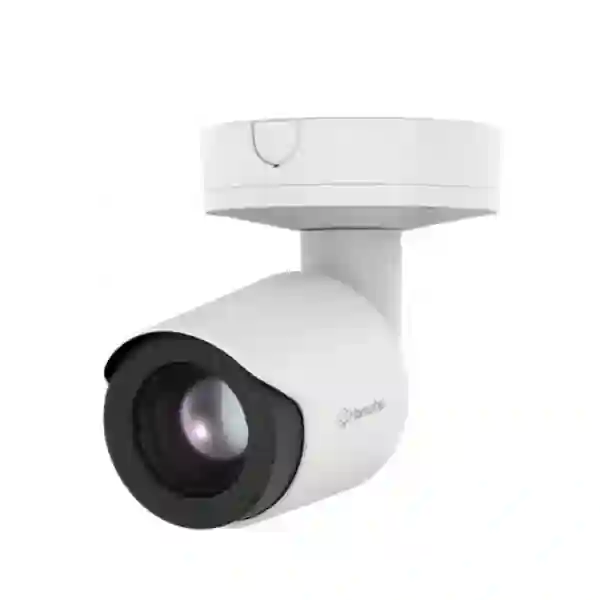
HANWHA VISION • AI THERMAL NETWORK CAMERA
Hanwha Vision TNO-C4080T: 60 mm AI Thermal Camera for Long-Range Security
Need a defined long-distance perimeter or waterfront view after dark? The Hanwha Vision TNO-C4080T combines a native VGA thermal detector, a narrow telephoto field of view and analytics for people, vehicles and vessels. It is designed for detection-oriented security projects, not as a substitute for a wide-angle colour camera or a guaranteed identification device.
For a Tanzania project, compare the intended target distances and scene geometry with the published technical limits, then request a site-based suitability review and project quotation from FourTeck Tanzania. Local price and availability require confirmation.
Quick technical specifications
The specifications below are based on Hanwha Vision’s official product information for the exact TNO-C4080T model. Confirm any region-dependent configuration and firmware behaviour before ordering.
| Feature | Manufacturer specification or design note |
|---|---|
| Sensor | Uncooled microbolometer, 640 × 480; pixel size 17 µm |
| Video resolutions | 1280 × 960 (upscaled), 640 × 480, 640 × 360, 320 × 240 |
| Thermal spectrum | 8–14 µm |
| NETD | ≤16 mK at 25 °C, F1.0 per manufacturer test description |
| Optics | 60 mm, F1.15, fixed athermalized lens |
| Field of view | 10.3° horizontal; 7.7° vertical; 12.8° diagonal |
| Minimum object distance | 92 m |
| Frame rate | Up to 30 fps / 25 fps (60 Hz / 50 Hz) H.265/H.264; MJPEG up to 30 fps |
| Compression and streams | H.265, H.264, MJPEG; multiple streaming profiles |
| AI categories | Person, vehicle, vessel |
| Analytics | Object detection; line crossing/direction; area events; tamper and temperature-change events |
| Standards and integration | ONVIF S, G, T, M; SUNAPI; RTSP and selected secure networking interfaces |
| Edge storage | One microSD/SDHC/SDXC slot; manufacturer-listed capacity up to 1 TB |
| Power | IEEE 802.3af PoE Class 3 or 12 V DC |
| Maximum power | PoE 7.8 W; 12 V DC 8.1 W |
| Protection | IP66, IP67, IK10; NEMA 250 Type 4X listed |
| Operating temperature | -40 °C to +60 °C per manufacturer conditions |
| Dimensions and weight | Approximately Ø107.3 × 275 mm; 2.1 kg |
| AI detection reference | Person up to 508 m; vehicle up to 724 m; vessel up to 1,732 m, specified conditions |
| DRI reference | Johnson’s Criteria figures differ from AI detection and do not guarantee classification or identity |
Who should consider this thermal camera?
The Hanwha Vision TNO-C4080T is most relevant when a security team needs to notice warm targets at distance rather than read a number plate or identify a face. Examples include a long fence beyond conventional lighting, a large industrial boundary with unlit sections, or a controlled waterfront where personnel want alerts for people, vehicles and vessels. It is a specialist long-lens observation device. Its value comes from selecting the right scene, not merely choosing a camera with strong numbers on a specification sheet.
A useful procurement question is: what must an operator know when the alarm arrives? If the priority is discovering activity along a distant approach, thermal imaging with AI classification may be appropriate. If the response team must recognize an individual, read markings on a truck, verify colours or preserve facial evidence, combine the thermal camera with suitable visible-light coverage. The recommended design depends on what the operator must detect, verify, record and do next.
For projects in Tanzania, start with a drawing of the protected area, the nearest and farthest target zones, likely access routes and the required response time. Establish where power, network backhaul and monitoring staff will be available. Those practical details help determine whether the 60 mm field of view and proposed camera positions match the site. A product quote should follow this assessment rather than lead it.
How thermal imaging helps after dark
A thermal camera senses long-wave infrared radiation rather than relying on reflected visible light. People, engines, vessels and surrounding objects can have different thermal signatures, creating contrast even when an ordinary colour camera has little useful illumination. This changes the monitoring task: the operator looks for suspicious activity and target movement rather than relying only on an illuminated photograph. It does not make objects transparent or eliminate all environmental limitations.
Thermal performance depends on the temperature difference between a target and its background. A warm road, hot roof, sun-heated wall or cool person at particular times can reduce useful contrast. Heavy rainfall, dense mist, water vapour and obstructions may also affect visibility. A target hidden behind a solid wall is not automatically visible. Trees, structures and terrain can still block the required line of sight.
This means the best thermal-camera demonstration uses the exact observation period and target conditions expected in service. A camera looking across a hot industrial yard at sunset can behave differently from one facing the same area shortly before dawn. Plan test walks, vehicle passes and operator review at more than one time. Thermal imaging can strengthen a layered security system, but scene design and field testing remain essential.
Why the 60 mm telephoto lens matters
The TNO-C4080T uses a fixed 60 mm athermalized lens with a manufacturer-listed horizontal field of view of approximately 10.3°, vertical field of view of 7.7° and diagonal field of view of 12.8°. This is a relatively narrow view selected for detailed coverage of distant areas. It suits a defined stretch of perimeter or approach corridor more naturally than a nearby loading yard requiring broad situational awareness.
A narrow field of view introduces a significant design trade-off. Distant targets occupy more image area than they would with a wider lens, but less surrounding territory is visible at any one moment. One camera cannot cover every direction merely because it has a long lens. If the protected zone includes several gates, bends or approaches, specify additional viewpoints or an overview camera rather than assuming a single mounting point covers the entire boundary.
The manufacturer lists a minimum object distance of 92 m for this lens. Check nearby coverage requirements carefully: a camera positioned to observe distant traffic may be unsuitable for a guardhouse entrance immediately below it. Mechanical pan, tilt and rotation ranges described for mounting adjustment should not be confused with powered PTZ patrol capability. The lens is fixed, so the final aiming direction and mounting stability deserve careful attention.
Understand VGA sensor resolution and upscaling
The native detector is a 640 × 480 uncooled microbolometer. The supported video resolutions include 640 × 480, 640 × 360, 320 × 240 and an upscaled 1280 × 960 output. An upscaled picture can be convenient for display, but it does not turn a VGA sensor into a native 1.2-megapixel thermal detector. Evaluating target detail based on the original thermal information is more meaningful than relying on the larger pixel dimensions alone.
Selection should begin with how many useful detector pixels are likely to cover a person, vehicle or vessel at the desired distance. The answer depends on the target’s size, lens angle, target orientation and distance. A distant object that is technically visible may still be too small or ambiguous for a particular operator response. The appropriate acceptance test should use meaningful target categories, not only screenshots with a large output resolution shown in the corner.
Recorded footage and live streams also need to be reviewed on the actual workstation or video management system. Compression, scaling, monitor size and operator viewing conditions can change what an incident looks like in practice. Specify a stream setting that preserves the relevant thermal information while remaining manageable on the available network. Consider the operational goal before choosing a resolution from the menu.
What thermal sensitivity tells a buyer
Hanwha Vision specifies thermal sensitivity of no more than 16 mK NETD under its stated test conditions. NETD is a measure of how small a temperature difference a thermal imaging system can distinguish under defined conditions; a lower figure generally suggests finer sensitivity. It is useful for understanding how the camera may separate subtle heat differences, but it is not a promise that every hidden person or distant vehicle will be reliably detected.
Sensitivity interacts with optics, scene contrast, atmospheric conditions, object dimensions, motion and analytics thresholds. It is therefore best treated as one part of a wider performance discussion. The ability to perceive subtle differences does not imply that the system produces a certified absolute temperature measurement or can safely replace an industrial fire-alarm system. The product also includes temperature-change analytics, but that feature should not be represented as calibrated process thermography without explicit supporting documentation.
In procurement discussions, ask suppliers to explain the anticipated scene, target type and alarm outcome instead of referring only to NETD. For example, a security manager may want to detect a person crossing an open field while ignoring movement along a public road. The more precisely the acceptance target is defined, the easier it becomes to test whether the thermal sensitivity, field of view and analytics settings work together.
AI classification and useful event rules
The camera’s manufacturer-listed AI object classes include person, vehicle and vessel. Supported intelligent events include object detection, virtual-line crossing and direction, and virtual-area events such as intrusion, loitering, enter, exit, appear and disappear. These capabilities are designed to make thermal observation more actionable. Rather than watching a continuous stream all night, a configured system can help operators focus on specified activity in a chosen zone.
An appropriate virtual line might run across a fenced approach, whereas a virtual area might define the space immediately inside a restricted boundary. Directional rules can be useful when traffic is allowed to leave an area but entry in the opposite direction requires attention. Vessel classification may support monitoring of an approach near a waterfront. The important distinction is that the camera produces data for the security workflow; the rules, escalation policy and validation process are still the operator’s responsibility.
The quality of an AI alert depends on object size, heat contrast, angle of travel, partial obstruction and the configuration selected for the scene. Classification is not infallible. Before acceptance, test intended targets and common sources of nuisance alarms at the expected distances. Agree whether an alert should trigger recording, a guard notification or a second-camera verification, and decide who is responsible for investigating it.
AI detection distance is not the same as visual identification
Hanwha Vision lists indicative AI detection distances of up to 508 m for a person, 724 m for a vehicle and 1,732 m for a vessel under its defined conditions. These figures are useful starting points for discussing reach, but they are not universal on-site guarantees. Different terrain, rainfall, target dimensions, background contrast, speed, angle and obstruction can reduce practical performance. A supplier should explain the assumptions behind every quoted range.
The manufacturer also provides longer distance figures under Johnson’s Criteria, including person detection at 2,130 m and vehicle detection at 5,444 m. These relate to image-resolution-based detect, recognize and identify criteria, not to a promise that the camera’s AI will classify the same subjects at those distances. Mixing the two types of numbers can result in an underdesigned security system. It is especially important not to interpret the word identification in a thermal DRI table as facial identity confirmation.
For a purchase specification, define the required outcome in plain language: alert when an adult walks across a particular zone, distinguish a moving vehicle from background activity or flag a vessel approaching a boundary. Then choose representative test objects and distances. This gives everyone a consistent basis for commissioning and makes the system’s practical limits more visible to the buyer.
Practical use at ports and coastal facilities
Thermal imaging can be valuable near waterfronts where a security team needs awareness of vessel movement or activity along a dark shoreline. The TNO-C4080T includes vessel classification, which differentiates it from thermal products designed only for people and road vehicles. A long lens can suit an observation point aimed at a defined water approach. The actual monitored area must still be plotted against the narrow horizontal angle and local visibility conditions.
Coastal scenes can create distinctive challenges. Reflections, rain, sea spray, changing water temperatures, waves and atmospheric haze can affect how targets appear. Small craft and larger ships are not interchangeable test objects. Where a site has mixed water and land traffic, the intended alert categories and exclusion zones should be documented separately. A monitoring team also needs a clear decision about when a thermal detection should prompt another camera or patrol to provide visual verification.
Buyers should not assume that a published vessel-distance figure establishes maritime detection coverage for every boat, sea state or mounting height. A responsible installation plan includes stable support, corrosion-conscious mounting hardware, suitable cable entries, service access and inspection arrangements. The camera’s listed environmental ratings are useful, but they do not remove the need for site-specific installation design.
Long perimeter and industrial-site examples
A long fence surrounding storage tanks, processing buildings or a logistics compound can create surveillance gaps when lighting is limited or conventional cameras are positioned too far away. The TNO-C4080T may be useful where the security team wants to know that a warm target has entered a restricted stretch before the target reaches a gate or building. The precise benefit comes from correctly aiming a narrow thermal view along a meaningful approach.
At a transport or utility location, a camera might watch a trackside boundary, a distant service road or an isolated equipment approach. Here the buyer should consider permitted movement as carefully as prohibited movement. Maintenance vehicles, authorized workers and neighbouring public activity can cause legitimate detections. Good analytics configuration needs to map the site’s operational behaviour, not simply draw the largest possible alarm zone.
Industrial buyers should separate early perimeter warning from other functions such as worker safety, machinery inspection and process-temperature monitoring. A security-oriented thermal camera is not automatically an approved instrument for any of those other functions. Where multiple objectives exist, document each separately and identify complementary equipment rather than relying on a single device for unrelated duties.
Design the coverage before selecting quantities
A sound camera layout starts with a plan or marked satellite image of the site and the areas that must be observed. Identify entry routes, fence corners, low points, berms, buildings, tree cover and areas that become obstructed by parked vehicles. The goal is to establish complete useful coverage of the risk zones, not to fill the drawing with attractive range circles. Every proposed camera position needs a stated purpose.
For a 60 mm lens, mark the horizontal field of view at the nearest and farthest intended distances. A small angular change can move the field significantly over a long range. Also consider the vertical angle so an elevated camera is not pointed above or below the area of interest. If the distance between important targets is large, additional cameras or a different focal length may be more appropriate than attempting to compromise on one direction.
Make room for maintenance and for the facilities required to support the camera. Mounting, earthing, surge protection, switching, fibre links and local service access can be as important as the imaging device. For a competitive comparison, ask each bidder to mark the same target positions and expected detection outcomes on the same drawing. That makes proposals easier to evaluate fairly.
A site-survey checklist for Tanzania projects
Before quoting a completed solution, the project team should confirm the intended camera location, mounting height, target distance and network route. A survey should also show which areas are private or public, whether trees or buildings could obscure the line of sight, and where regular lawful movements occur. These details help prevent alarm rules from conflicting with normal operations. The assessment should be based on the actual facility rather than assumptions about its region.
Check whether a compatible PoE network port or 12 V DC supply is available, how cables will be protected, and how the network will continue operating during an outage. Understand the local maintenance arrangement, personnel authorised to access camera settings and the destination for recorded footage. Where backhaul is shared with office traffic, obtain a realistic bandwidth plan and agree on traffic priorities.
A useful survey report includes a sketch of coverage, photographs of mounting positions, a target-distance table, power and network responsibilities, environmental concerns and an acceptance-test plan. These outputs help the buyer compare equipment and labour quotations. They also make later troubleshooting easier because the original operational assumptions are documented.
Outdoor durability and site conditions
The TNO-C4080T is listed with IP66 and IP67 ingress-protection ratings, IK10 impact protection and a NEMA 250 Type 4X environmental designation. Hanwha Vision also specifies an operating temperature range of -40 °C to +60 °C, subject to the manufacturer’s conditions. These are meaningful engineering specifications for exposed mounting locations, but their full benefit depends on correct assembly and installation.
Weatherproofing does not remove installation risk. Cable glands, junction boxes, seals, mounting adapters, bends in conduit and exposed connectors require attention. A poorly terminated cable can compromise an otherwise rugged camera. Strong wind can also produce movement in a long-lens view even when the housing itself remains intact. Brackets and poles must be sufficiently rigid for the chosen elevation and expected conditions.
For coastal or high-dust sites, specify a sensible inspection schedule covering the front window, fasteners and cable entries. Salt deposits, contamination and physical damage can affect visibility or serviceability. Ask for mounting materials appropriate to the environment, and confirm whether any optional accessories are required for the chosen arrangement. Ratings should be interpreted using the manufacturer’s stated test conditions rather than treated as unlimited immunity to all outdoor hazards.
Mounting, aiming and the fixed-lens limitation
The camera body measures approximately 107.3 mm in diameter by 275 mm long and has a manufacturer-listed weight of about 2.1 kg. These dimensions help installers plan brackets and enclosures, but the complete load includes mounting parts and environmental forces. A camera installed on a flexible mast can shift the distant scene more than expected, so structural stiffness and alignment are especially important for a telephoto view.
The listed mechanical adjustment ranges allow an installer to position the field of view during setup. They are not evidence of remote pan-tilt-zoom tracking. If an operator needs to steer a camera from a control room, review an appropriate motorised camera or pair this thermal unit with a separate remotely controlled camera. A fixed observation direction can be an advantage when the requirement is a stable, auditable alert zone.
During commissioning, use actual targets at the planned distances to verify the final alignment. Recheck the image after all covers are closed and cables are secured. Record the mounting orientation and configured zones so later maintenance can restore the same scene. A clear handover photograph is often more useful than simply stating that the camera was installed at the correct height.
Power planning: PoE or 12 V DC
Hanwha Vision lists IEEE 802.3af Class 3 PoE and 12 V DC as supported power inputs. The manufacturer specifies maximum consumption of approximately 7.8 W using PoE and 8.1 W using 12 V DC. These figures should be incorporated into the overall power design along with switching losses and any other devices on the same circuit. The switch’s total PoE budget matters when several cameras share one cabinet.
PoE may simplify a network installation by carrying data and power over the appropriate network cabling. Nevertheless, cable distance, conductor quality, routing and surge exposure require proper engineering. For remote sites, the installer may need fibre conversion, a local PoE switch or another designed network extension method. Do not assume that a long cable run is acceptable just because the camera’s power consumption is relatively modest.
Discuss how operators should respond during a mains outage. If uninterrupted recording or alerting is required, the camera, switch, upstream network devices and recording system may all need suitable backup power. Test that the entire alert route survives the intended outage period; protecting only the camera is insufficient. Power and network resilience should be written into the project specification.
Network streaming and bandwidth choices
The device supports H.265, H.264 and MJPEG compression, with up to 30 frames per second at the listed resolutions in applicable modes. It also supports multiple streaming profiles, permitting different configurations for live monitoring and recording. This flexibility can help operators balance image quality and network capacity, but the best settings depend on scene complexity, retention requirements and the wider system.
A practical network plan accounts for the number of cameras, simultaneous viewers, recording bitrates, uplink capacity and periods of motion or thermal noise. Thermal scenes can change significantly as the environment heats and cools, so a bitrate chosen from a short demonstration may not reflect a full day of recording. Include sensible allowances and monitor actual network consumption after installation. Avoid a configuration that looks clear in a test but overwhelms a remote link in operation.
The camera provides a network interface and supports established protocols, including RTSP and secure communication options. A security VLAN, controlled management access and documented IP-address plan can improve maintainability. Before connecting the equipment to enterprise infrastructure, confirm addressing, ports, time synchronisation, logging, firmware-management ownership and network-security policies with the responsible IT team.
Recording, evidence handling and retention
The TNO-C4080T supports recording-related integration with a wider system and a microSD/SDHC/SDXC slot for edge storage, with a manufacturer-listed maximum card capacity of 1 TB. The actual footage retained depends on the installed card, codec, frame rate, bit rate, event rules and recording schedule. Maximum card capacity is not a guarantee of a particular number of days of continuous recording.
Clarify whether the site needs continuous recording, event-triggered clips, or both. Event-only policies can reduce storage demand, but they may leave gaps in context before and after an alert. Continuous recording requires appropriate storage planning and reliable time settings. If footage could become evidence, document who may export it, how timestamps are checked and which system keeps the authoritative copy.
Edge storage can be valuable for some network interruptions, but it must be tested with the chosen management system. Buyers should verify how an NVR or VMS handles reconnection, backfilling, alarms and card failure. Retention periods and data-access rules should follow the organisation’s legal and operational requirements; they should not be assumed from the camera model alone.
Integration with existing security systems
Hanwha Vision lists ONVIF profiles S, G, T and M along with a SUNAPI interface and common networking protocols. These provide integration possibilities for IP video and metadata, yet the presence of a profile does not guarantee that every third-party recorder will display every AI category, event or search function. The exact recorder software, firmware versions and licence arrangement should be checked before the purchase order.
For a new installation, identify the video management platform, desired live views, alarm types, storage policy and operator workflows. For an existing installation, ask the system integrator to demonstrate the exact event path: camera detection, event transmission, VMS display, recording bookmark and operator acknowledgement. A basic live video stream is only one part of effective integration.
Where another camera is expected to verify a thermal alert, confirm whether the VMS can display both views together and whether an event can trigger the desired operator screen. Avoid promising automatic handover or PTZ control until the full device pairing has been tested. Interoperability should be demonstrated against the buyer’s actual acceptance criteria, not inferred solely from protocol logos.
Cybersecurity requirements for connected cameras
The manufacturer describes security functions including encrypted firmware, secure boot, signed firmware, network authentication options, HTTPS and secure real-time transport. It also lists device certificates and storage-protection features. These capabilities are valuable for an enterprise deployment, but no camera can be considered secure solely because its specification contains security features. Configuration and lifecycle management remain essential.
Before going live, establish named administrators, strong authentication, least-privilege accounts and a defined change-control process. Disable unnecessary services where practical, restrict management access to approved networks and verify the organisation’s requirements for firmware updates. Camera timestamps, device logs and event records should be accessible to the team responsible for incident response. A dedicated camera network may be appropriate depending on site architecture.
Ask the supplier who will maintain firmware compatibility with the VMS and who will respond to a published security advisory. Confirm how credentials are stored, transferred and changed during handover. For remote administration, use the buyer’s approved secure access arrangements rather than exposing a management interface casually to the public internet. A secure commissioning checklist provides more practical protection than unsupported promises of invulnerability.
Reduce nuisance alarms through careful configuration
A thermal camera that reports every warm moving object may overwhelm its operators. The useful goal is not the highest possible number of alerts; it is a manageable set of timely events with clear operational meaning. Start by defining which approach routes are sensitive, which directions of movement matter and which legitimate movements should not create incidents. Those choices should be agreed with the people who actually monitor the site.
Use appropriately sized virtual areas and lines instead of drawing one large zone over everything visible. Keep public roads, busy working spaces or normal vessel routes outside the restricted rule where the geometry allows. Review both daytime and nighttime footage after initial configuration. Heat sources, environmental transitions, partial target visibility and moving backgrounds may need tuning rather than simply increasing sensitivity.
During commissioning, record representative detection and false-alarm results. Test more than one target direction and speed, and document any area where the camera cannot make a reliable distinction. Provide guards with an escalation guide that explains what an alert means, what supporting view to inspect and when to dispatch a response. This turns analytics from a product feature into a usable security process.
A repeatable acceptance-testing plan
Agree on test criteria before equipment is delivered. The plan should name each required observation area, target class, approximate distance, direction of approach and expected response. If a buyer expects person alerts at a distant perimeter, use a representative person walking at normal speed along the actual route. A stationary test object alone will not demonstrate how the configured analytics behave during an intrusion.
For vehicles and vessels, consider shape, speed, route and partial occlusion. Test authorised movements as well as prohibited ones to understand nuisance-alarm behaviour. Carry out suitable checks at more than one time of day and under relevant ambient conditions, without making dangerous or impractical weather testing a condition of handover. Video snapshots, timestamps and configuration records can form the basis of an acceptance report.
The report should distinguish between target visibility, AI classification, alarm delivery and recording success. A target may appear on screen without producing the intended event. Similarly, an event may be generated but fail to reach a control-room application because of network or software configuration. Separating these outcomes makes faults easier to diagnose and ensures that a successful demonstration covers the full operator workflow.
Thermal camera versus visible-light camera
A visible-light IP camera usually provides better contextual detail for colours, clothing, vehicle markings and faces when suitable illumination and resolution are available. A thermal camera can make warm targets stand out when visible-light contrast is poor. Neither technology solves every security problem. Choosing between them should begin with the intended response: detecting activity, recognizing a type of object, identifying a person or retaining detailed evidence.
For a distant open boundary, thermal monitoring can be a useful first layer. A separate optical view may then help an operator confirm whether the event is suspicious. Near an entrance, an optical camera may be the main evidence device while the thermal unit watches a different distant approach. In some locations, a carefully designed visible-light system may meet the entire requirement without needing thermal imaging at all.
The 60 mm TNO-C4080T is especially important to evaluate as part of this mixed system because its narrow field does not provide the same overview as a short focal-length lens. Ask for a camera schedule that shows the specific role of every device. Avoid paying for duplicated coverage while leaving an unobserved access route.
Where a different thermal model may fit better
Hanwha Vision’s wider thermal range includes alternative focal lengths and related frame-rate variants. A shorter lens is generally worth evaluating when the target area is closer or the scene needs wider coverage. A longer lens can assist with distant targets but imposes a narrower field. The correct choice depends on coverage geometry and target detail, not on treating one lens length as universally better.
The similarly named TNO-C4082T is a distinct model and is described by the manufacturer as an 8 fps variant. Do not substitute it for the TNO-C4080T without confirming the customer’s frame-rate requirements and the exact regional product being quoted. Likewise, do not apply specifications from a different lens version to the 60 mm unit merely because products are in the same family.
If a project includes both a nearby gate and a far boundary, a combination of lens types might give better coverage than repeating one camera everywhere. An integrator should show comparative views or calculations for the actual distances. This helps prevent unnecessary equipment costs while making camera performance easier to defend during procurement review.
Important limitations to document
Thermal imagery does not provide ordinary colour information. It is not a face-identification or number-plate-reading solution by default, and the native sensor resolution is 640 × 480 even when the output is upscaled. The fixed 60 mm lens is comparatively narrow and has a published minimum object distance of 92 m. These characteristics are central to product suitability and should be communicated before equipment is ordered.
Environmental performance is not unconditional. Dense rain, atmospheric effects, hot backgrounds, obstructions and mounting instability can reduce the usable scene. AI person, vehicle and vessel categories are valuable aids, but they do not guarantee a correct classification for every target. Manufacturer maximum-distance numbers describe defined test contexts and should be treated as design references that require validation at the actual site.
Do not assume that temperature-change analytics provide calibrated temperature measurements, that the fixed camera can perform motorised PTZ operations, or that third-party VMS compatibility is complete without testing. Finally, listed global certifications are not proof of a Tanzania-specific regulatory approval, import eligibility or project authorisation. Those matters must be checked separately where applicable.
What to request in a quotation
A useful quotation should state the exact model number TNO-C4080T, the required quantity, proposed mounting arrangement and any additional accessories. It should identify which components are supplied, which are installation services and which are subject to confirmation. Ask the vendor to show whether power supplies, PoE switching, network equipment, storage, software licences, cabling and protective hardware are included or excluded.
Request confirmation of the intended field of view and target distances. If the contractor claims a particular detection outcome, ask for the assumed scene conditions and the commissioning test that will be used to prove it. Include requirements for video management integration, event rules, storage retention, cybersecurity configuration, operator training and handover documentation where they are part of the intended scope.
For a Tanzania procurement, price in Tanzanian shillings, local availability, lead time, warranty terms and service scope should be stated explicitly in a verified commercial quote rather than invented in public product content. Also clarify whether installation, transport, taxes, maintenance and future support are part of the offer. This makes quotations comparable and reduces later variation claims.
Maintenance and operational ownership
A camera deployment continues to require attention after the installer leaves. Assign ownership for cleaning and inspecting the camera window, checking mounts and cable entries, reviewing alarms and validating recording availability. Long-lens alignment may require a recheck after major maintenance or environmental exposure. A stable image and accurate alert zone are ongoing operational requirements rather than a one-time commissioning achievement.
Define who may change analytics rules and how changes will be recorded. A temporary construction area, new parking layout or relocated fence can alter the scene enough to affect alerts. If adjustments are made, repeat the relevant detection tests instead of assuming the previous acceptance result still applies. A documented baseline helps investigators understand why an event was or was not generated.
Maintenance planning should include firmware review, password and certificate management, storage-health checks, network monitoring and confirmation that backup power remains functional. The precise frequency depends on the site’s risk and environment. The buyer should request a maintenance proposal suited to the deployment rather than accepting a generic promise of zero upkeep.
Questions for a technical evaluation meeting
Ask the project team to identify the single most important detection scenario and the action that should follow an alarm. Is a person expected to cross a particular perimeter at night? Is a moving vehicle approaching a controlled yard? Is the requirement to notice a vessel near a defined maritime boundary? A clearly prioritised scenario makes it easier to select a lens, plan analytics and define acceptance tests.
Next, ask for the nearest and farthest target distances, the camera’s proposed mounting height, the available power method and the planned VMS. Identify any optical camera that will provide supporting identification or detailed evidence. Confirm how the operator will receive alerts and whether the system can record the event and its surrounding context under expected network conditions.
Finally, review project assumptions: site access, civil works, mounting hardware, training, retention policy and any regulatory checks. A design that answers these questions is more useful than a list of camera specifications with no operating context. FourTeck Tanzania can use this information to discuss suitability and prepare a request for quotation, subject to its confirmed commercial and service arrangements.
Frequently asked buyer questions
Is the TNO-C4080T a normal CCTV camera or a thermal camera?
It is a thermal network camera. It senses thermal radiation with a native VGA microbolometer rather than capturing ordinary visible-light colour video. It can support security detection after dark, but it will not replace a suitable optical camera where face detail, colours or markings are essential. The buyer should define whether detecting a person or identifying that person is the real requirement.
Does the camera offer true 1280 × 960 thermal resolution?
No. The native thermal detector is 640 × 480. The manufacturer supports video output upscaled to 1280 × 960, which can be useful for display or processing. Upscaling does not create the same source detail as a native sensor of that size. Compare target performance using the actual sensing resolution and the required distances.
How far away can its AI detect a person?
Hanwha Vision provides an indicative figure of up to 508 m for AI person detection under defined conditions. Real performance depends on target size, scene contrast, weather, lens alignment, partial obstructions and analytics configuration. Treat the figure as a planning reference and request a site-specific field test for the proposed security boundary.
Can it classify boats as well as vehicles?
Yes. The published AI target classes include person, vehicle and vessel. This makes the camera a candidate for a defined waterfront observation area. It does not mean that every craft or movement will produce a reliable alert at any distance or in all sea conditions. The vessel types and target ranges should be tested for the intended site.
Is it appropriate for a nearby entrance gate?
Possibly not as the principal camera. The 60 mm lens has a narrow 10.3° horizontal angle and a specified minimum object distance of 92 m. A nearby gate may need a shorter focal length or an optical overview camera. The TNO-C4080T is usually better evaluated for a defined, more distant viewing direction.
Can the operator remotely pan and zoom this unit?
Do not treat the mechanical mounting-adjustment ranges as powered PTZ movement. The camera has a fixed 60 mm lens. For an operation that requires remote tracking or changing viewpoints from the control room, discuss a suitable PTZ unit or complementary camera and verify the control-system integration before procurement.
What power supply does it require?
The manufacturer lists IEEE 802.3af Class 3 PoE or 12 V DC. It reports maximum consumption of about 7.8 W on PoE and 8.1 W on 12 V DC. The complete solution still needs a correctly designed switch, cable route, surge protection and backup-power plan where continuity matters. Confirm the final power design with the installer.
Will it integrate with an existing NVR or VMS?
The device lists ONVIF profiles S, G, T and M and other network interfaces. These indicate integration possibilities, but event metadata, alarms, edge recording and management features can vary between third-party systems and software versions. Verify the exact recorder and firmware combination, preferably with a practical test of the intended alarm workflow.
Does the camera automatically detect a fire or measure temperature?
It includes temperature-change detection among its analytics, but that should not be confused with verified fire-alarm certification or calibrated temperature-measurement capability. Do not use this camera as a substitute for a dedicated life-safety or industrial temperature-monitoring system without independent, application-specific evidence and approval.
Is the camera weatherproof?
Hanwha Vision lists IP66 and IP67 protection, IK10 impact resistance and NEMA 250 Type 4X among its environmental specifications. These make it a strong candidate for exposed locations, but real durability still depends on properly fitted cable entries, stable mounting, suitable accessories and sensible inspection. Marine or dusty sites may require particular care.
Is pricing or stock confirmed for Tanzania?
This page does not state a verified local price, stock quantity, delivery time or installation commitment. Request a current quotation for the exact model and intended configuration, and ask the seller to specify any accessories, services, warranty details and commercial conditions. This avoids relying on outdated or inappropriate figures from another market.
What information should I send when requesting a quote?
Provide the location type, intended use, a sketch of the target area, nearest and farthest target distances, expected mounting position, quantity, power and network availability, current VMS or recorder, and any special requirements for alarms or retention. These details allow a more meaningful technical discussion than a model number alone.
Request a TNO-C4080T technical discussion and quotation
Tell FourTeck Tanzania which area must be monitored, the relevant target classes and distances, the intended quantity and your existing network or video-management platform. Ask for confirmation of product availability, accessories, commercial terms and any available project services. A site-specific design and demonstrable acceptance criteria provide a stronger basis for procurement than an unqualified maximum-range figure.
Suggested next step: request a quote for the exact Hanwha Vision TNO-C4080T 60 mm AI thermal network camera. No price, stock or local service commitment is implied by this description.




Reviews
There are no reviews yet.