
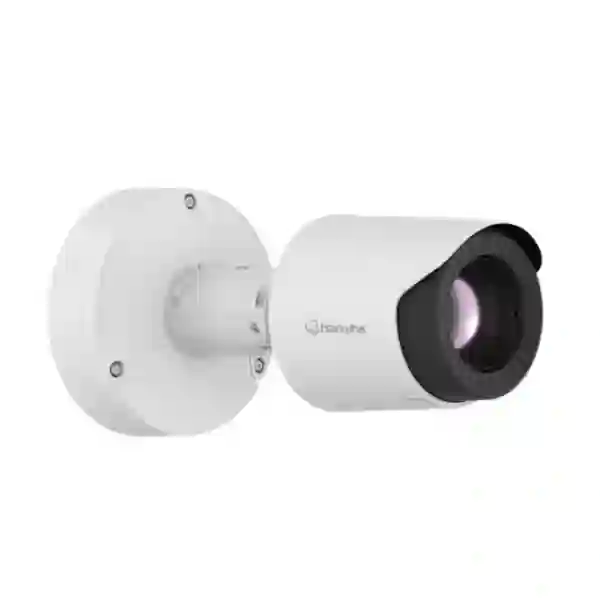
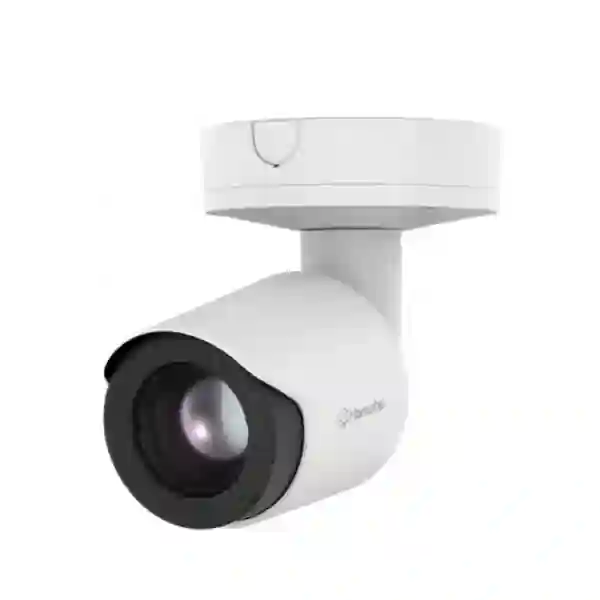
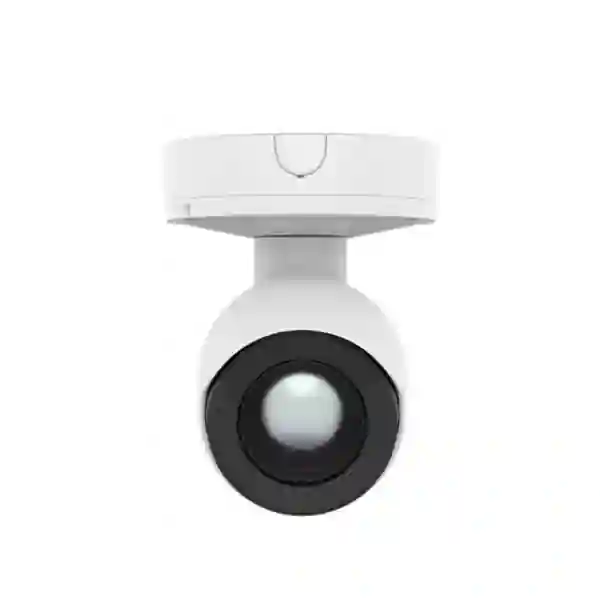
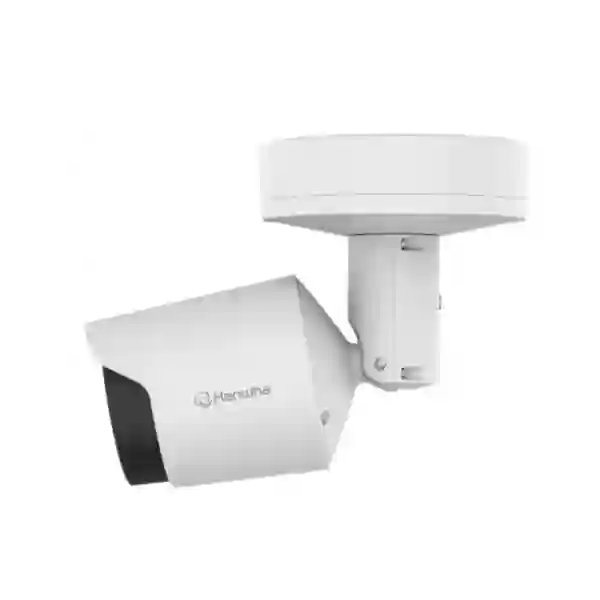
Hanwha TNO-C4082T Thermal Camera for Long-Range Security
A 60 mm fixed-lens VGA AI thermal camera built for targeted perimeter, infrastructure and waterfront monitoring. Evaluate the real detection task, not just the longest figure on a specification sheet.
Choose the right thermal camera for the right boundary
If your security brief calls for early awareness along a distant fence line, restricted access corridor, waterfront or industrial boundary, the Hanwha TNO-C4082T thermal camera is a model worth assessing. It combines a 640 × 480 thermal detector, a narrow 60 mm view and AI classification for people, vehicles and vessels. That makes its purpose quite different from a wide-view CCTV camera used to inspect entrances at close range. Ask for a camera-placement assessment and an exact-model quotation before committing to a specification.
The essential buying distinction is between seeing that a thermal object is present, classifying its type, and identifying detailed visual evidence. This camera can support the first two functions within the conditions of its design; it is not a replacement for all visible-light evidence cameras. The published maximum rate of 8 frames per second and minimum object distance of 92 metres must also fit the site. This guide explains the opportunities, limitations and checks that make the eventual purchase decision meaningful.
Technical specifications at a glance
These are model-level characteristics published by Hanwha Vision. Actual project coverage, VMS support, pricing, accessory choices and performance in local conditions must be validated for the intended installation. Native sensor resolution is separated from the upscaled stream, and AI distances are kept distinct from DRI metrics.
Note: Manufacturer ranges are reference specifications, not a site-specific service-level commitment. Confirm current documentation for your supplied revision.
Who this camera is for
The Hanwha TNO-C4082T thermal camera is designed for security teams evaluating a fixed, long-range view of an exposed perimeter rather than a conventional close-up CCTV scene. Its 60 mm lens concentrates the camera’s attention into a relatively narrow area at distance, while the thermal sensor visualises differences in emitted heat. That combination can be valuable where an approach route, fence line, waterfront, or other distant entry corridor needs persistent observation. Before placing an order, confirm the distances, the target types, the alerting objective, and the actual scene geometry.
A successful procurement decision starts with the question the camera must answer. Is the system intended to flag someone entering a restricted strip of land, classify a vehicle moving along an access corridor, or provide early awareness of a vessel approaching a protected waterfront? Those requirements are not interchangeable. Person, vehicle, and vessel analytics are supported, but reliable operational alerts depend on scene design, environmental conditions, target presentation, and configuration. The best installation is one in which the monitoring operator understands what an event means and what action follows.
Buyers in Tanzania assessing industrial security, logistics infrastructure, large compounds, or coastal assets should use this page as a technical planning guide, not as a claim of local stock or installed performance. The product specifications below are based on Hanwha Vision model information. A site survey and a project-specific quotation remain necessary to validate mounting, network connectivity, recorder compatibility, accessories, and procurement conditions. The camera is particularly worth considering when a broad daytime picture is less important than detecting thermal activity in a defined distant zone.
What the model actually delivers
Hanwha Vision identifies the TNO-C4082T as a VGA AI telephoto thermal camera. It uses a 640 × 480 uncooled microbolometer and a fixed, athermalised 60 mm lens. The published horizontal angle of view is approximately 10.3 degrees, with a vertical angle of about 7.7 degrees. These numbers describe a targeted viewing cone rather than an all-purpose overview. The camera is a fixed bullet-style device; listed pan, tilt, and rotation ranges describe installation adjustment and do not make it a remotely steerable PTZ unit.
Video streams are offered at several output resolutions, including upscaled 1280 × 960, while the underlying sensor remains 640 × 480. Its maximum published frame rate is 8 frames per second for H.265, H.264, and MJPEG. This should be evaluated deliberately where operators expect very smooth motion or intend to follow fast-moving objects visually. The camera supports thermal monitoring and AI-assisted classification, not the colour images, faces, and number plates typically expected from visible-light CCTV.
At an engineering level, the fit comes from matching a high-sensitivity thermal sensor with a long focal length and purpose-built event analytics. It is not simply a standard security camera with a night mode. Procurement teams should confirm whether the project also needs visible-light identification cameras, a wider context view, a recording platform, lighting, or physical alarm devices. Thermal and optical cameras often address different stages of the same security response rather than replacing each other.
Why thermal imaging changes the monitoring problem
Conventional day and night cameras depend on visible light or active illumination to form their pictures. Thermal cameras respond to long-wave infrared radiation, creating an image from apparent thermal contrast rather than surface colour. This is useful for discovering a warm moving subject against a cooler background, particularly where installing floodlights is undesirable or lighting is inconsistent. It does not mean that every target will always be obvious: hot backgrounds, reflected conditions, atmospheric effects, obstructions, and low contrast can make interpretation more difficult.
A thermal camera’s strength is awareness, especially along access routes with little visual texture. Operators can look for an approaching person or vehicle and then use another camera or a ground response to establish detailed identity. A thermal image is not a substitute for evidential colour footage where the objective is to identify clothing colours, registration plates, facial features, or branding. Project designs should define which sensor generates the first alert and which device provides confirmation.
When evaluating this model, ask where the camera will look at dawn, after rain, and during the warmest part of the day. A trial across representative conditions can reveal whether relevant subjects retain enough contrast. A good scene is defined by the likely target, its expected path, its background, and the distances involved. The camera specification tells the team what the device is designed to do, while field testing establishes what the particular site can reasonably expect.
60 mm telephoto lens and field of view
The 60 mm focal length is one of the defining characteristics of this model. It provides a narrow thermal view intended to concentrate detail on more distant portions of a scene. The manufacturer’s listed 10.3-degree horizontal and 7.7-degree vertical fields of view help an engineer estimate coverage at a given distance. The angle stays fixed; the visible width of the scene increases with distance, so an area that looks well framed at the far fence may leave a nearby approach outside the picture.
Use a scaled site plan to mark the intended monitoring corridor, desired event line, poles or structures that could support the camera, and likely paths of people or vehicles. Pay attention to changes in terrain elevation, vegetation growth, and the difference between a camera pointed along a fence and one looking across it. A narrow lens can serve a defined corridor very well while missing a subject entering outside its angular coverage. This is a geometric limitation, not a software fault.
For a large perimeter, one long-lens thermal camera should not automatically be assumed to cover every angle. Multiple viewpoints or a companion wide-angle camera may be needed to maintain context. When the risk lies close to a building or gate, a shorter focal length from the same broader product family may be more appropriate, subject to separate model verification. Lens selection should follow the security geometry and required classification distance, not a general preference for the longest quoted range.
Native resolution and upscaled output
The native thermal imaging device has 640 × 480 detector elements. Hanwha Vision also lists an output option of 1280 × 960, which is an upscaled format. Upscaling changes the size at which an image can be displayed or processed, but it does not create new physical detector samples at the sensor. This distinction matters when comparing product quotations, especially if one supplier prominently advertises the larger output dimensions without explaining the sensor’s underlying resolution.
The published selectable output resolutions also include 640 × 480, 640 × 360, and 320 × 240. Network planners can assess how the chosen resolution, codec, frame rate, scene activity, and compression settings affect storage and streaming requirements. A larger output stream is not necessarily the most operationally useful stream; a clean, correctly framed thermal view with appropriate alert rules can matter more than headline pixel dimensions. Assess recorded evidence and live operator display quality together.
The maximum 8 fps rate is an explicit characteristic of the TNO-C4082T, and should not be confused with specifications for other products in the family. It can be adequate for many monitoring and classification applications but differs noticeably from a 25 or 30 fps conventional CCTV feed. Where rapid movement, smooth tracking, or frame-by-frame analysis is critical, the frame-rate requirement should be part of the acceptance criteria before purchase.
Thermal sensitivity and realistic contrast
Hanwha publishes a noise-equivalent temperature difference, or NETD, of no more than 16 mK under its specified test conditions. NETD is a way of describing how subtle a thermal difference the sensor can distinguish under a reference setup. A smaller number indicates the potential to resolve finer temperature contrast, but it is not a promise of a fixed detection distance or a guarantee of reliable classification in every scene. Lens, weather, background, target size, and image processing all influence operational results.
The sensor works in the 8–14 micrometre spectral range. This is relevant because the system does not need visible illumination to form a thermal picture. However, it should not be described as seeing through walls, dense objects, or all weather without degradation. Heavy precipitation, mist, heat shimmer, and strongly heated surfaces may affect the apparent contrast of subjects and the confidence of classification. On-site trials remain important for high-consequence installations.
Temperature-change detection appears among the manufacturer’s listed analytics, but this feature should not be treated as a verified calibrated thermometer or a fire-safety instrument. If the project requires accurate temperature measurement, regulatory fire detection, or process-control thermography, request the applicable dedicated performance documentation and select equipment for that purpose. The TNO-C4082T is being presented here primarily as an AI thermal security camera intended for scene awareness and event detection.
AI classification and the meaning of an event
The camera’s published AI object classes are person, vehicle, and vessel. These categories help a security team distinguish likely target types from generic movement. Object detection, virtual lines, and virtual areas can support workflows such as crossing, direction, intrusion, entry, exit, appearance, disappearance, and loitering, according to the manufacturer’s analytics list. Correct setup requires a clear understanding of where events are meaningful and what the monitoring centre can do with the information.
A person crossing a prohibited section of a fence may be an urgent event, while a vehicle on a permitted access road may only merit recording. The same class of object can therefore generate different responses depending on location, direction, time of day, and operating policy. Avoid enabling every possible rule at once. Begin with a few high-value events, test them in day and night conditions, and review whether they produce actionable alerts rather than an unmanageable stream of notifications.
AI classification is an aid to human security operations, not an infallible judgement. A person partly obscured by foliage, an unusually shaped vehicle, or a vessel at an unexpected orientation could challenge detection. False alarms and missed detections should be part of the commissioning conversation, with a documented method to adjust rules. Buyers should ask for sample alert behaviour, operator training, and a process for improving analytics after the site becomes operational.
Turning analytics into useful alarm zones
Virtual zones work best when they follow a clear security boundary and avoid predictable background movement. For example, a rule aimed at detecting entry into a restricted compound should not include the neighbouring public road if lawful traffic would continuously trigger it. A virtual line can be set to detect travel in a chosen direction, while an area rule may suit a specific yard or approach. The appropriate configuration depends on the camera angle and the real paths of interest.
Include the physical context in the setup: moving tree branches, animals, changing water reflections, exhaust plumes, busy transport routes, and site machinery can all complicate interpretation. AI classification may reduce irrelevant alerts but is not a replacement for careful framing. A useful commissioning record describes each analytics rule, its location, the type of target it should detect, and what an operator should see when it triggers. This record makes later troubleshooting much more effective.
The manufacturer’s event options include network-disconnect and case-tamper triggers, alongside several ways to send notifications or recordings. Integrators should decide which alarm routes are supported by the selected management system and available network services. An event that stays only on the camera may offer little value if guards need centralized awareness. Test the complete path from a physical movement in the scene to a visible, acknowledged operator event.
Published AI detection distances: use them carefully
Hanwha Vision lists model-specific AI detection distances of up to 508 metres for a person, 724 metres for a vehicle, and 1,732 metres for a vessel. The published reference target dimensions are approximately 1.8 metres for a person, 1.45 metres for a vehicle, and 2.4 metres above the waterline for a vessel. These figures are useful starting points for feasibility discussions, but they are not a guarantee that every relevant target will be identified or alarmed at those distances in Tanzania.
Distance is only one variable. A person standing fully exposed may be more readily classified than someone partially hidden by equipment. A vessel’s thermal profile may change with its size, orientation, engine state, and sea conditions. The background behind a vehicle can change between morning and afternoon. Designers should ask whether the published distance meets the exact alert objective, and then test an appropriate target across the real approach path before accepting the configuration.
For a demanding project, separate three questions: can the scene show that something is present; can the analytics classify it as the required object type; and can the operations team respond in time? The required warning distance should be determined by access routes and response times, not simply copied from a brochure. A practical acceptance plan records desired classification performance in a representative range of lighting, weather, and site-activity conditions.
Why DRI figures are not the same as AI ranges
The manufacturer’s DRI table uses Johnson-style pixel-density criteria and quotes much greater theoretical detection distances: approximately 2,130 metres for a person and 5,444 metres for a vehicle. Its recognition and identification values are lower and use different criteria. These DRI numbers describe an optical assessment framework, not the same operational measure as the published person, vehicle, and vessel AI detection distances. Mixing them together would give a buyer an unrealistic picture of what an automatic security alert is guaranteed to achieve.
For example, the fact that a human-sized thermal target might satisfy a theoretical detection pixel threshold at a long distance does not prove that the camera’s AI will confidently classify that person under every operating condition. It also does not mean the target’s individual identity is visible. In thermal security, ‘identification’ under a DRI convention is not synonymous with facial identification or evidential recognition of an individual. Those are separate requirements requiring other sensors or procedures.
When comparing tenders, ask suppliers to identify the exact distance metric behind every claim. Record whether each number concerns presence detection, target classification, recognition according to a defined criterion, or a field-tested alert under project conditions. For this model, the conservative procurement approach is to treat the manufacturer AI ranges as distinct model data and validate the final site geometry and response workflow through a commissioning trial.
Coastal and waterfront surveillance
A distinguishing use case for this model is maritime observation, because vessel classification is listed alongside person and vehicle detection. Along a protected waterfront, a camera might monitor an approach corridor, a pier’s external boundary, or movement toward a restricted landing area. Thermal imagery can be helpful when conventional visible-light scenes are dark or highly variable. The objective should still be clearly bounded: an operator needs to know where a detected vessel is relevant and what follow-up camera or patrol can confirm it.
Waterfront surveillance requires additional planning beyond nominal detection distance. Wave conditions, spray, atmospheric moisture, warm or cool water backgrounds, vessel height above the waterline, and the camera’s elevation may change what is visible. Harbours with many authorized craft need rules that distinguish unusual approach behaviour from normal movement. Do not interpret vessel classification as an automatic determination of vessel identity, cargo, ownership, intent, or permission to enter.
For projects in Tanzania, coastal deployment should be designed around the specific asset and operating environment rather than a broad promise of maritime coverage. Check corrosion exposure, access for maintenance, lightning and surge protection, stable power, and the route by which alerts reach duty staff. The manufacturer’s environmental ratings are relevant to enclosure durability, but installation accessories and mounting methods also need suitable selection for actual shoreline conditions.
Industrial yards, logistics sites and extended boundaries
A large industrial site may contain valuable materials, plant, and equipment separated by long stretches of fence or open ground. The TNO-C4082T is a candidate for watching a defined distant approach rather than providing a detailed image of every corner. The AI person and vehicle classes can support perimeter-crossing or restricted-area alerts while the thermal view gives operators an alternative to relying entirely on floodlights. Effective design uses the camera as one component of a layered security system.
For a logistics facility, consider how legitimate deliveries, staff transfers, forklifts, parked vehicles, and service routes affect alarm design. A camera looking across an active yard may generate less useful information than one aimed at a prohibited boundary. Clearly mark the zones where movement is authorized and where it should be treated as an exception. If the site relies on a guard response, the alarm workflow must include a location description precise enough for a responder to find the event.
Construction details matter as much as the surveillance features. A pole may sway under wind, cranes or stacked materials may interrupt the line of sight, and vegetation may grow into a previously clear view. The engineering survey should cover mounting height, cabling path, safe access, environmental exposure, and recording requirements. These practical decisions determine whether the camera’s long-range capability translates into a repeatable security outcome.
Transport corridors and infrastructure protection
Transport assets and utility compounds often require observation over a specific narrow corridor, access road, embankment, or boundary. A telephoto thermal view may be appropriate where the risk is located at a meaningful distance and conventional cameras would require difficult illumination arrangements. The relevant outcome could be detecting someone approaching restricted equipment, a vehicle entering a secured route, or an unexpected presence outside normal working hours. Each scenario needs its own target and alarm definition.
Do not assume a single camera will understand the entire road or infrastructure network. The device has a bounded, narrow field of view; curved routes, level changes, and near-field blind spots may require multiple viewpoints. The low maximum frame rate also deserves attention if the project is focused on high-speed movement rather than general presence detection. For transport projects, engineers should check the speed and direction of likely targets and ensure that an alert remains useful at the selected frame rate.
Any system attached to operational infrastructure should be integrated under the asset owner’s technical and safety rules. The camera’s published environmental and electrical figures do not by themselves establish local installation approval, railway compliance, critical-infrastructure certification, or compatibility with a particular control platform. Confirm cable protection, earthing, surge management, backup power, cyber access, and handover procedures with the responsible operator before committing to the design.
Planning a Tanzania project without unsupported assumptions
Tanzania-based buyers may be assessing facilities with different levels of site power reliability, network reach, environmental exposure, and security staffing. Those conditions are project variables, not claims about an entire region or the availability of a particular service. A useful first step is to document the site’s specific power source, network topology, camera mounting options, exposure conditions, target approach paths, and staffing arrangements. This avoids specifying an advanced thermal device that cannot be supported reliably at the intended installation point.
A procurement brief should identify whether the site uses local recording, centralized video management, or a combination. It should also specify who maintains the cameras, how software is updated, and who responds to alerts outside normal hours. Internet access should not automatically be assumed for a remote site; the design may need secure local operation and controlled remote connections. If an uplink is planned, obtain actual bandwidth and availability information for the exact location instead of relying on a general connectivity claim.
For FourTeck Tanzania content, no local price, stock position, delivery promise, regulatory status, installation territory, or warranty offer is stated without listing-specific evidence. Buyers should request those commercial details in a written quotation. The camera’s international product specifications support preliminary engineering, but the final offer should specify the supplied model, accessories, compatible software, taxes where applicable, and any service obligations in plain terms.
Camera placement and line-of-sight survey
A long-range thermal camera should be positioned so its intended target path stays visible within the sensor’s relatively narrow view. Begin by plotting the perimeter and the most likely approach routes, then mark what a person, vehicle, or vessel would look like at the nearest and farthest required points. Consider how terrain, wall height, vegetation, parked vehicles, and fixed equipment might block the view. A camera that is mechanically installed at a convenient location is not necessarily installed at the correct operational location.
Mounting height can improve visibility over some barriers but may also make a target appear smaller in a more steeply angled image. Higher is not automatically better. Site teams should examine security risk, maintenance access, pole stability, and line-of-sight together. Near a waterfront, an elevated view may simplify observation of an approach channel, but distance and target position still determine whether there are useful thermal pixels on the subject. The correct elevation is an engineering decision.
Before final sign-off, capture test footage of representative targets moving through the selected zones. Include approaches from different directions and conditions, not only a single demonstration at midday. Verify that the thermal picture remains interpretable, that the intended line or area rules trigger, and that nearby benign activity does not overwhelm operators. Record the final camera aim and configuration so future maintenance does not inadvertently alter the surveillance coverage.
The minimum object distance matters
One specification that can be overlooked is the published minimum object distance of approximately 92 metres. Together with the telephoto field of view, this indicates that the model is built for stand-off viewing, not for detailed observation of subjects immediately beneath a pole or a few metres from the device. Do not select the TNO-C4082T for a narrow indoor passage or close entrance simply because its thermal performance sounds attractive.
For sites needing both close and distant observation, divide the security task into zones. A shorter-lens camera may cover the near gate or broad yard, while the 60 mm model monitors a longer corridor. Visible-light cameras can add context where personnel need colour video, identifiable faces, or registration plates. The objective is not to accumulate cameras unnecessarily; it is to ensure that each important approach has a sensor that can actually frame and interpret the relevant target.
Ask the integrator to provide a coverage sketch with the nearest and farthest useful operating distances, event boundaries, and blind spots. The drawing should relate those distances to physical features that operators recognize. If the intended threat route crosses the near field, make sure an alternate view is available. This small amount of planning can prevent an expensive mismatch between a long-range product and a predominantly short-range problem.
Weather resistance and physical protection
Hanwha lists IP66 and IP67 ingress protection, IK10 impact resistance, NEMA 4X enclosure classification, and several environmental tests for the model. It also publishes an operating temperature range of -40 °C to +60 °C under the specified conditions. These characteristics are relevant to exposed outdoor installations, but they do not eliminate the need to choose suitable mounting parts, cable seals, junctions, conduit and protective infrastructure for the project environment.
The housing rating should be considered alongside installation quality. An incorrectly sealed cable entry, poor grounding, unsupported pole, or vulnerable external connector can undermine a well-rated device. In hot locations, engineers should evaluate direct sun exposure and local enclosure temperature; in wet or coastal locations, consider salt exposure and planned inspections. Insect activity, dust accumulation, vegetation, and physical tampering can also affect long-term use. Maintenance plans should address the complete camera assembly.
The manufacturer’s cited certifications are model specifications, not proof of automatic approval by every local regulator or acceptance body. Projects with formal technical approval requirements should obtain the applicable evidence for the exact scope. Similarly, weather resistance does not imply that heavy rain or mist will leave thermal detection unchanged. Environmental ratings describe equipment robustness, while detection performance depends on atmospheric and scene conditions as well.
Power design and resilience
The published electrical options are IEEE 802.3af Class 3 Power over Ethernet and 12 V DC. Hanwha lists a maximum consumption of 7.8 W on PoE and 8.1 W on 12 V DC, with typical figures slightly lower. Those are device-level reference values; a full project power budget must also account for network switches, recording equipment, optional accessories, cable losses, and any other components. Verify the selected power mode before sourcing switches or site power supplies.
For remote mounting points, inspect the entire link from the power source to the camera. Decide where surge protection, grounding, UPS support, and service isolation are needed under the project’s electrical design. If the operational requirement is continuous perimeter monitoring, short power interruptions may be unacceptable even though they are unrelated to the camera’s optical capability. A design review should state how alarms, recording, and networking behave during supply failures and after power is restored.
Choose infrastructure that a site technician can maintain safely. Mark camera circuits, keep drawings current, and document the correct supply standard. A power design that depends on an unverified local service or an undersized switching budget can make a capable camera unreliable. When obtaining a quotation, ask which power accessories are included, whether separate supplies are needed, and how the installed system will be tested under realistic site conditions.
Networking and bandwidth planning
The camera includes a shielded RJ-45 Ethernet interface supporting 10/100/1000BASE-T and offers H.265, H.264, and MJPEG video encoding. Its WiseStream smart codec can help optimize video delivery, but actual bandwidth depends on the selected settings and scene activity. The manufacturer also lists up to five streaming profiles and multicast support. These features make it possible to plan different live-view and recording streams, provided the chosen viewing and recording systems support the intended configuration.
Do not use a generic bandwidth figure as a substitute for measurement. Record a sample stream at the chosen resolution, frame rate, codec, bitrate-control mode, and event settings. Then estimate both normal traffic and concurrent viewing or playback loads. Sites with constrained links may choose to keep recording near the camera or local recorder and send selected alarms to another location. The camera’s interface capabilities alone do not establish an end-to-end remote monitoring service.
Network design should include an addressing plan, switch ports, secure segmentation, time synchronization, fault reporting, and an operational policy for remote access. Ask whether the video management system needs direct access to the camera, a recorder, or a relay service. Verify any firewall rules without exposing devices unnecessarily to the public internet. Testing should include loss and restoration of network connectivity and confirmation that recordings and alerts behave as intended.
Edge recording and retention decisions
Hanwha publishes one microSD, microSDHC, or microSDXC slot with support for a card of up to 1 TB. This creates an option for edge storage, but the presence of a slot does not mean a card is included or that an entire retention requirement can be met without calculation. Recording duration depends on effective bitrate, the selected streams, event activity, compression, and the recording mode. A secure storage plan should also consider card endurance and maintenance procedures.
The manufacturer’s event actions include recording to local media or network storage under relevant configurations. Buyers should confirm exact compatibility with their firmware, card selection, management platform, and retention policy. Some installations need continuous recording for audit purposes; others prioritize event clips backed by a centralized system. Make the decision explicit and ensure that loss of connectivity does not silently remove the evidence expected by the operator.
Recording is only useful when it can be retrieved, reviewed, and preserved appropriately. Test time stamps, search functions, export procedures, access permissions, and backup expectations. A large-capacity memory card may be convenient but should not become the only evidence path for a high-risk perimeter. Define retention duration and handling requirements in the system specification, with particular attention to organizational security policies and applicable privacy obligations.
Interoperability with an existing surveillance system
The official specification lists ONVIF Profiles S, G, T, and M, as well as Hanwha’s SUNAPI interface and its Open Platform. These capabilities can facilitate integration into a broader surveillance environment, but the presence of a standard does not prove that every feature will operate identically in any third-party recorder or VMS. Camera discovery, live video, playback, analytics metadata, event subscriptions, and alarm actions may have different levels of implementation support.
Before purchase, list the features that the actual control room requires. A basic live feed may be easy to integrate, while a classified vessel event or a specific smart alarm may need testing against the intended VMS version. Ask the system integrator to document successful event delivery from this model, including the response seen by the operator. If the project depends on an existing installation, the acceptance test should take place on that architecture rather than on a different demonstration platform.
Interoperability planning also covers user accounts, clock synchronization, recording profiles, software updates, and fault monitoring. Avoid assuming that an interface standard supplies a complete cyber policy or a finished operational workflow. The value lies in making useful information appear in the correct place for the responsible team. Confirm firmware requirements, licences where applicable, and ongoing support arrangements as part of the final specification.
Cybersecurity considerations for a network camera
This is an IP-connected device and should be treated as part of the site’s managed network, not as an isolated appliance. Hanwha lists features including signed and encrypted firmware, secure boot, HTTPS communication, IEEE 802.1X authentication options, access controls, logging, and encrypted SD-card storage. The presence of these features provides tools for a secure deployment, but the project’s actual security posture depends on configuration, network architecture, administrator practices, and maintenance.
A commissioning checklist should require strong unique credentials, only necessary accounts, restricted management access, accurate time settings, and an approved firmware baseline. Review which protocols and network services must be enabled for the selected VMS, and disable unnecessary exposure. Remote administration should follow the organization’s access policy instead of placing a camera management interface directly on the open internet. Keep a record of settings for future audits and troubleshooting.
Cyber maintenance is an ongoing responsibility. Assign ownership for checking manufacturer security notices, evaluating firmware updates, maintaining backups of configurations, and removing obsolete credentials. Test changes before deploying them across critical monitoring points. Where the site has formal security or privacy requirements, involve the responsible IT and risk teams in design approval. Product security functions are a useful foundation, not a claim that the entire surveillance solution is automatically compliant or risk-free.
Designing a practical response workflow
The value of a thermal alert is measured by what happens next. When a person is classified near a restricted boundary, does the operator receive a recognizable location, a time-stamped image, a short clip, or a live view? Can that operator request confirmation from another camera or alert a guard with an unambiguous instruction? A deployment that produces impressive technical demonstrations but unclear alarms may not improve actual protection.
Define alert categories before commissioning. A person crossing an outer warning line might prompt verification, while intrusion into a protected zone could require immediate escalation. Vehicle events may need different handling during scheduled deliveries, and vessel events may be relevant only within a specified waterfront boundary. The system should make these distinctions operationally clear. Ask the integrator to show how each camera event appears in the selected VMS and how it is acknowledged.
Operational training should cover thermal-image interpretation, expected limitations, routine false-alert review, and correct response to lost connectivity or camera tampering. A security guard should not have to infer where a distant thermal target is located from an unfamiliar view. Map labels, camera naming, and escalation instructions can make a greater practical difference than adding additional analytics rules without training. Include these deliverables in the project acceptance process.
A sensible implementation sequence
First, write a short threat and coverage statement: which asset matters, what type of target is relevant, what intrusion path is expected, and how much warning is needed. Second, survey the physical line of sight and determine whether the 60 mm fixed view fits the geometry. Third, choose mounting, power, cabling, and network arrangements that remain serviceable. These steps should be completed before assuming a number of cameras or making an equipment order.
Next, decide how video and alarms will be managed. Confirm the existing recorder or VMS, the relevant ONVIF or native interfaces, recording retention, user access, and incident workflow. The integrator should identify accessories and licences that might be required and provide a bill of materials that distinguishes included equipment from optional items. At this stage, verify any commercial facts such as availability, lead time, warranty coverage, and the final price through a formal quotation.
Finally, test and tune the installed system with representative targets. Use documented scenarios for person, vehicle, and vessel alerts as relevant, not only a visual picture check. Train operators, record the final configuration, and establish a maintenance and incident-review schedule. A complete implementation moves from risk definition to site survey, system design, installation, integration, testing, and ongoing ownership, rather than treating installation of the camera as the finish line.
What to test before accepting the installation
Acceptance should begin with an agreed target and route. For example, a person may walk along a defined section of outer boundary and cross a virtual line at several distances. The operator should confirm whether the expected alert appears, whether its object class is useful, and whether the target can be located quickly. Repeat testing under representative conditions and record exceptions. Do not extrapolate a single successful demonstration into a general guarantee of all-weather performance.
For a vehicle-oriented deployment, include different approach directions, speeds, and positions within the field of view. A waterfront test should use an appropriate vessel and a route relevant to the protected area. Also check benign activity near the boundary to assess nuisance alarms. A useful test result records the target type, approximate distance, conditions, configuration, event outcome, and operator response. This gives the owner a baseline for future adjustments.
Acceptance should also cover non-visual functions: camera reboot, power restoration, network interruption, recording retrieval, time accuracy, access permissions, and alarm notification. Inspect mounting security and cable sealing, confirm the correct product model and firmware, and retain the final coverage diagrams. When a requirement cannot be met, document a mitigation such as an additional camera, a changed rule, or a redesigned viewpoint. Buying success is measured against the agreed protection task.
When another camera may be a better fit
The TNO-C4082T is not automatically the best camera simply because it offers a long focal length and detailed thermal analytics. If the required scene is broad, close, and crowded, the narrow field of view and minimum object distance may be unsuitable. If the security goal is reading number plates or identifying faces, an optical camera with appropriate lighting and optics should be considered. If smooth monitoring of fast movement is central, the 8 fps maximum needs particular scrutiny.
Some sites need a wider thermal camera for near-field detection, and others need a mixture of thermal and colour devices. A single high-performance telephoto thermal camera may leave important gaps if the route curves or crosses several levels. In more complex applications, fixed views may need to work with separate PTZ or wide-angle cameras so operators can place an event in context. The actual architecture should follow a coverage and response assessment rather than marketing terminology.
A temperature-change analytic should also not be confused with calibrated thermography or a certified fire alarm. If the requirement is process temperature measurement, temperature thresholds with defined accuracy, or statutory life-safety detection, those needs should drive a separate equipment selection. Being clear about what the model is not designed to replace helps buyers build systems that are safer, more understandable, and easier to maintain.
Long-term ownership and maintenance
A camera system remains useful only if its original coverage and alerting assumptions remain valid. Schedule periodic checks for lens obstruction, changed vegetation, altered site structures, mounting movement, and unexpected objects that enter the viewing corridor. Review whether the selected analytics are still aligned with the site’s operations. A change in traffic patterns, a newly constructed shed, or a modified fence can weaken a previously good camera angle without any hardware failure.
Maintenance also covers firmware, user permissions, switch health, storage media, recorded-evidence retrieval, and system event logs. Assign a responsible team and define how faults are escalated. Where the camera supports important security functions, consider how monitoring continues while the device is being serviced. Keep accessible records of installation positions, network addressing, configuration baselines, and vendor documentation so personnel can troubleshoot without relying on undocumented knowledge.
When comparing quotations, evaluate ongoing obligations alongside purchase price. Ask who will maintain the camera and recorder, how firmware changes are approved, which accessories are included, and what contractual warranty or support actually applies to the proposed supply. Do not assume worldwide marketing claims establish an identical commercial offer in Tanzania. Clear ownership and documented maintenance usually matter more over time than an unverified promise of effortless deployment.
How to compare quotes for this exact model
Require the full Hanwha Vision TNO-C4082T model designation on each quotation. Check whether the proposal identifies a native 640 × 480 sensor, 60 mm fixed thermal lens, 8 fps maximum, AI person/vehicle/vessel classification, and the intended power method. Avoid substituting information from a similar family member or a different frame-rate variant. An apparently comparable offer may contain an important change in field of view, application, or operating characteristics.
Ask for a site-specific list of what will be supplied. This may include mounts, adaptors, junction boxes, poles, surge protection, network components, recording hardware, memory cards, integration work, software licences, configuration, and testing services. Treat these as quotation questions, not a statement that every accessory is required or included. The supplier should identify any exclusions and explain what the owner must already provide.
Finally, compare how bidders propose to prove performance. A proposal that includes coverage drawings, expected alert zones, compatibility checks, acceptance scenarios, and operator training gives the buyer a stronger basis for decision than one based on maximum-range claims alone. Request written terms for pricing, taxes, delivery, availability, warranty, and after-sales support for the exact offering. This page intentionally does not assign an unsupported local price or guarantee.
Questions buyers often ask
Is this a thermal camera or an ordinary infrared CCTV camera?
It is a thermal camera using an uncooled 640 × 480 microbolometer. It forms a picture from apparent thermal differences, rather than using a conventional colour imaging sensor with infrared lighting. That makes it useful for detecting some subjects without visible illumination, but it does not show ordinary colour details or automatically identify a person’s face.
Does the 1280 × 960 output mean the sensor has that resolution?
No. Hanwha lists a native 640 × 480 thermal detector and an upscaled 1280 × 960 output option. The larger stream dimensions can help with display compatibility, but they do not change the physical detector resolution. Use the native sensor specification when comparing thermal detail with other cameras.
Can the TNO-C4082T automatically detect people, vehicles and vessels?
The manufacturer lists AI classification for those three object types, with virtual line and virtual area analytics. Successful operation depends on the view, target presentation, setup, and conditions. Commission the configured events with representative targets before relying on them for a security response.
How far away can the AI detect a person?
Hanwha publishes an AI detection distance of up to 508 metres for a reference person target. That is a published model figure, not a guarantee for every installation. Compare the distance to the required warning zone and confirm performance at the real site.
Why does a different table show a longer distance?
The manufacturer’s DRI figures use theoretical criteria for detection, recognition and identification, which are different from AI classification distances. A DRI number should not be substituted for a tested automatic alert distance. Ask which metric a supplier is quoting.
Will it work without streetlights or floodlights?
Thermal imaging does not rely on ordinary visible illumination, so it can provide an image in darkness. However, visibility and analytics are still influenced by thermal contrast, weather, obstructions, scene geometry, and camera setup. Operational performance should be checked under representative conditions.
Can this camera read faces or vehicle registration plates?
Do not specify it as a primary camera for facial recognition or number-plate reading. Thermal images are intended to show apparent heat patterns, and the device is designed for surveillance detection and classification. If identification is essential, include a suitable visible-light camera and a defined verification workflow.
Does it support PoE?
Yes. Hanwha lists IEEE 802.3af Class 3 PoE as well as 12 V DC input. The manufacturer quotes a maximum of 7.8 W for PoE operation. Network and power designers should check switch capacity, cable routes, protection, and any other installed components separately.
What environmental ratings are listed?
The manufacturer lists IP66, IP67, IK10, NEMA 4X and specified environmental tests, along with an operating temperature range of -40 °C to +60 °C. These are product specifications, not a guarantee against poor installation or degraded detection in severe weather. Seals, mounts and accessories need appropriate selection.
Will it connect to my existing NVR or VMS?
Hanwha lists ONVIF Profiles S, G, T and M, plus SUNAPI. Compatibility of live video, playback, metadata and individual AI events must be tested with the specific recorder, software version, and configuration. Do not assume that all features work solely because both products mention ONVIF.
Is storage built in?
The model provides one slot supporting microSD-family media up to the manufacturer’s listed 1 TB maximum. A card should not be assumed to be included. Retention depends on recording configuration and bitrate. Confirm whether the intended project uses edge storage, a recorder, or both.
Can FourTeck confirm the Tanzania price, stock and delivery?
This page does not claim a verified price, available inventory or delivery period. Request a written, product-specific quotation that identifies the camera, necessary accessories, commercial conditions, warranty terms and any relevant installation or support scope.
Request a project-specific TNO-C4082T quotation
For a useful technical discussion, provide the asset or perimeter type, expected target class, approximate near and far distances, desired monitoring hours, available power and network, and the recording or VMS platform you intend to use. A site sketch or photographs of the installation corridor can help clarify whether the 60 mm lens is appropriate. Describe whether the priority is early notification, evidence review, or integration with a guard response.
Ask for a written quotation that confirms the exact model, accessories, installation assumptions, compatibility work, testing, commercial terms and support scope. No price, inventory status, delivery time or local certification is implied by this description. The best next step is to agree on the coverage objective and how it will be proven on the real site, then select the equipment and services accordingly.




Reviews
There are no reviews yet.