
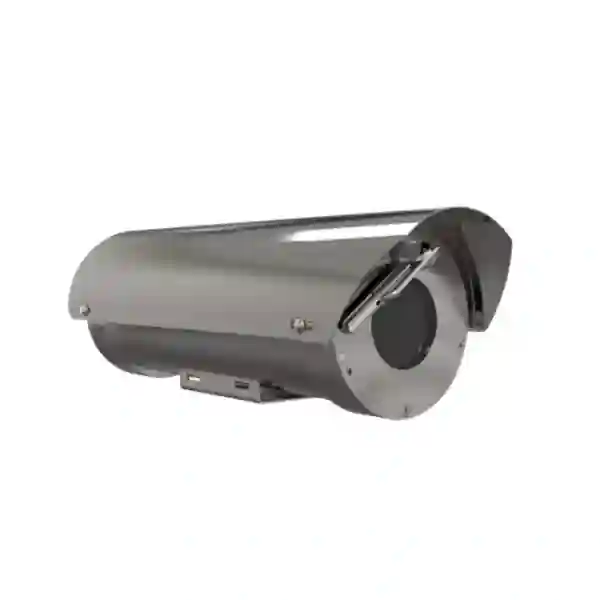
Hanwha TNO-X6320E2F2T1-C: Explosion-Proof 32x Zoom IP Camera
For buyers planning surveillance at hazardous industrial sites, the Hanwha TNO-X6320E2F2T1-C offers full-HD visible-light video, 32x optical zoom, single-mode fibre connectivity and a stainless-steel explosion-proof configuration. Use this guide to assess viewing needs, site classification, electrical compatibility and the practical details required for a sound purchase decision.
Important fit checks: 110 VAC input; fixed camera direction rather than integrated PTZ movement; no wiper on this exact model. Confirm exact certification for your installation before ordering.
At a glance
Buyers evaluating the Hanwha TNO-X6320E2F2T1-C in Tanzania should begin with hazardous-area compatibility, the required camera view, network integration and power engineering. This is an industrial surveillance product for specific conditions, not an interchangeable alternative to an ordinary IP camera. A safe and usable installation depends on the complete approved system.
Technical snapshot
The figures below summarise published information for the exact model. Installation-specific suitability, certification and supply scope need independent project verification.
| Manufacturer / model | Hanwha Vision / TNO-X6320E2F2T1-C |
|---|---|
| Camera type | Explosion-proof visible-light IP zoom camera |
| Resolution | 1920 × 1080 (2 MP) |
| Zoom lens | 4.44–142.6 mm; 32x optical zoom |
| Video | H.265 / H.264 / MJPEG; up to 60 fps on H.265/H.264 |
| Network | RJ-45 and duplex single-mode 9/125 µm fibre module (F2 configuration) |
| Recording | Dual microSD/SDHC/SDXC slots, up to 256 GB each |
| Rated operating ambient | -40°C to +60°C |
| Enclosure | 316L stainless steel; IP66 / IP67 |
| Electrical | 110 VAC input; 37 W maximum |
| Size / mass | 176 × 154 × 720 mm; approximately 21 kg |
| Variant notes | C suffix; no-wiper model; exact certification to be checked on ordered unit |
Where this camera may fit
Consider when the exact certification and ambient limits align with the approved hazardous-area classification and installation design.
Single-mode fibre can support a planned industrial communications design between the camera and central monitoring infrastructure.
The optical zoom helps operators examine distant detail within a fixed camera direction; wide-area PTZ scanning requires another solution.
What the exact model is—and is not
The Hanwha TNO-X6320E2F2T1-C is an industrial network zoom camera supplied in an explosion-proof camera configuration for projects where ordinary CCTV equipment may be inappropriate. Its imaging system is a visible-light CMOS camera with a full-HD picture and a powerful 32x optical zoom. The single-mode fibre interface is a useful feature for industrial designs in which the monitoring point is separated from the control room by substantial cable runs or electrical equipment. This is a specialist specification rather than a general-purpose retail camera.
It is not a thermal imaging or temperature-measurement camera, and a high zoom ratio does not make it a motorised pan-and-tilt camera. Buyers should decide whether the job requires remote zoom within a fixed line of sight, mechanical PTZ movement, thermal detection, or some combination of cameras. Defining that requirement early avoids a technically impressive product being selected for the wrong task.
Why choose an explosion-proof enclosure
Industrial camera selection starts with the environment, not only the image. In areas where flammable gas, vapour or combustible dust may be present, the enclosure, cable entries, mounting and electrical installation must be assessed against the site’s hazardous-area classification. An explosion-proof design is intended to control ignition-related risks associated with the equipment when used within its certified conditions. It does not remove the need for site-specific risk assessment or competent installation.
The final ordered version must be matched to its actual certificate, gas or dust group, temperature class, ambient rating and installation method. A broad product-family claim is not a substitute for the marking on the supplied unit. Ask the project engineer to reconcile the camera configuration with the site’s approved area-classification drawings and local project requirements before an order is released.
Understand the TNO-X6320E2F2T1-C suffix
Exact model codes matter in explosion-proof surveillance procurement. This listing refers specifically to TNO-X6320E2F2T1-C: the 110 VAC, fibre-enabled, T1-temperature-range, C-suffix configuration. Hanwha’s product-family documentation distinguishes C, M and Z certification-related versions and also differentiates configurations with and without a wiper. Those variants are not automatically interchangeable, even when much of the imaging specification is similar.
For this exact code, the supporting model identification describes a no-wiper configuration. A generic family-level feature list mentions a wiper, so it is especially important not to assume one is included here. If a window-cleaning wiper is a functional requirement, ask for the matching W-designated variant and verify its complete code and certification documents. Likewise, do not replace this variant with a different suffix merely because another regional catalogue lists it more prominently.
32x optical zoom for detailed observations
The optical system offers a 4.44–142.6 mm focal range and 32x optical zoom, with autofocus and manual focusing options. At the wide end, a scene can be surveyed for context; at the telephoto end, a selected part of that scene can be examined in greater detail. This is useful where supervisors need a closer look at a valve assembly, operating station, restricted pathway or remote piece of equipment without specifying a fixed narrow-angle lens for every view.
Optical zoom preserves sensor-level detail more effectively than simply enlarging recorded pixels, but it cannot overcome poor lighting, vibration, contamination or atmospheric haze. The useful identification range depends on mounting geometry, camera aim, light, required target size and video compression. Request a sample field-of-view assessment instead of treating the 32x number as a guarantee of recognition or incident evidence at a particular distance.
Full-HD image quality and frame rate
The camera provides up to 1920 × 1080 resolution and up to 60 frames per second on the H.265 or H.264 streams, with frame-rate behaviour dependent on video format and system configuration. Full-HD recording can help a control-room operator view activities, machinery and access movement with useful detail. A higher frame rate may be valuable for fast-moving objects, although it also changes throughput, decoding and storage planning.
Resolution alone cannot define the coverage area. A wide view can capture more context while giving each distant subject fewer image pixels; zooming in changes that relationship. Agree the target task—general observation, process checking, forensic review or a defined operational event—before setting lens position and recording profiles. For a multiview installation, the video-management system and display wall should be able to decode the selected stream settings without skipped frames or unnecessary buffering.
Day-and-night surveillance considerations
Hanwha specifies an automatic infrared-cut filter, with low-light sensitivity figures of 0.05 lux in colour and 0.005 lux in monochrome under its stated test conditions. This offers flexibility when a monitored operation runs beyond daylight hours. The camera can change operating mode as light levels change, but real image quality remains dependent on site illumination, reflective surfaces, camera settings and how quickly a subject moves.
Do not interpret low-light sensitivity as a promise that the camera will show every detail in darkness. A visible-light camera still needs an adequate illumination plan; hazardous-area lighting and any associated fixtures require their own suitability review. Night-time testing should check contrast, vehicle headlights, shadowed machinery, glare and exposure time. If the brief demands detection without visible illumination, discuss whether a separately specified thermal camera is appropriate rather than assuming this model has thermal capability.
WDR, glare and difficult lighting
Industrial scenes regularly contain very bright and very dark regions in a single frame. Doorways, inspection ports, vehicle headlights, floodlights and sun-facing steel structures can expose the limits of a standard security camera. This model includes wide dynamic range together with other exposure and backlight-compensation tools to help balance such scenes. The manufacturer publishes differing WDR numbers between its short key-features text and detailed specification table, so a project should confirm any numerical performance threshold directly.
Practical commissioning matters more than choosing a menu setting on paper. Inspect the actual scene at different times of day, especially where reflective steel, steam, warning lamps and changing process lighting affect contrast. Compare recordings before and after exposure adjustments. If the image must support evidentiary review, retain configuration records showing what was tested and what the resulting scene quality allowed an operator to observe.
Digital stabilisation, defog and image controls
The manufacturer’s technical specification includes gyro-assisted digital image stabilisation, defog processing, noise reduction and adjustable image settings. These features may improve usability when a camera is installed on a structure subject to vibration or when atmospheric conditions reduce contrast. They should be treated as aids to image quality, not substitutes for a rigid mounting structure, clean viewing window or sensible positioning away from turbulent exhaust.
Before commissioning, inspect the video at both the wide and high-zoom ends. A movement that is barely noticeable in a wide-angle view can become distracting at long focal lengths. Evaluate any digital-stabilisation crop, low-light noise reduction and defog setting against the actual monitoring requirement. Process areas may change appearance from day to night or during maintenance, so a configuration that is attractive during an initial demonstration can require adjustment after real operating conditions have been observed.
Video codecs and network efficiency
H.265, H.264 and MJPEG support give system designers options for recording and live viewing. Hanwha also lists WiseStream II, several streaming profiles and selectable bitrate control. In an industrial surveillance architecture, a higher-quality stream can serve recording while a smaller stream supports a constrained monitoring client or a low-bandwidth supervisory link, subject to the compatibility and policy of the chosen recorder or VMS.
Codec selection should be based on more than advertised bandwidth savings. Verify that the recorder, investigation workstation, mobile client and any integration software can decode the selected profile. Where lossless detail is expected for technical inspection, compressed video must be assessed against moving machinery, foliage, vapour and other complex scenes. Plan bandwidth with representative test footage, simultaneous viewers, retention targets and network overhead rather than relying on a single generic bitrate estimate.
Single-mode fibre as an integration option
The F2 configuration includes a duplex single-mode 9/125-micrometre fibre network module alongside the manufacturer’s listed RJ-45 interface. Fibre can be attractive in plants with dispersed equipment, long routes and challenging electrical environments. It can help designers separate communication paths from electrical interference, provided the entire optical path and associated networking equipment are engineered to suit the installation.
The camera’s optical interface does not eliminate design work at the other end. Confirm fibre type, connector requirements, compatible transceiver or switch, optical budget, patch arrangements, termination quality and the network topology. The cable route must also comply with the hazardous-area design and any applicable segregation or mechanical protection requirements. A site acceptance test should record link performance under operating conditions, not just whether a device responds to a short bench test.
Fibre versus copper in an industrial network
Copper Ethernet can be simple when distances are short, infrastructure is already present and the installation environment permits it. Fibre is often considered where the route is longer, electrically noisy or between locations with different earthing conditions. These are engineering trade-offs, not a reason to use fibre indiscriminately. Each additional converter, patch panel and cabinet adds components that will require access, power and maintenance.
For the TNO-X6320E2F2T1-C, start with a route drawing showing the camera, enclosure entries, patch termination, industrial switch and monitoring location. Review the available conduit or tray, bend radius, splice strategy and service loop. Confirm whether the project requires redundancy, independent ring paths or a single link. Where a vendor proposes to replace fibre with copper or a different camera suffix, request a revised design and verify the exact ordered model rather than treating the change as merely a cabling detail.
Analytics that can assist operators
The listed video analytics include motion detection, tamper events, fog detection, face detection, shock detection, virtual areas and virtual lines. Depending on configuration, operators may use these features to draw attention to a boundary crossing, movement within a selected zone or a scene that has become difficult to see. They can support a broader monitoring process when their limitations are understood and alarm handling has been defined.
These are not a substitute for industrial safety instrumentation, certified gas detection, fire systems or human assessment. An analytic event can be affected by rain, shadow, vibration, moving vegetation, reflections and the selected field of view. Pilot the rule with site-specific recordings, measure nuisance alarms and document missed detections. Do not label this model as an AI person-and-vehicle classification camera unless that exact capability is independently verified for the ordered unit and firmware.
Events, notifications and useful response design
The manufacturer lists alarm triggers including analytics and loss of network connectivity, with options to upload images or initiate recording actions. These functions can help a site convert continuous video into reviewable events, especially where operators supervise many cameras. A good event rule identifies an actionable situation, sends it to an appropriate destination and gives the operator a clear response instruction.
For example, a virtual-line alert might support review of movement across a maintenance boundary, while a network-disconnect notification can expose a damaged cable or power fault. Neither rule guarantees that a hazardous condition has been detected. Agree priorities, alarm ownership, schedule, escalation paths and evidence retention with the site’s security and operations teams. Test alarm handling during planned disruptions, not only during normal operation, to identify repeated alerts or important events that disappear when a network segment is unavailable.
Local storage and recording resilience
Hanwha lists two microSD, SDHC or SDXC slots, with up to 256 GB supported per slot and a total of 512 GB. Local edge recording may be useful as one part of a resilient surveillance design, subject to card type, recording settings and device configuration. It should not automatically be treated as the primary long-term archive or a substitute for the site’s approved recording and backup policy.
Storage duration depends on resolution, codec, bitrate, recording schedules, scene motion and card capacity. Check the desired retention period with a calculated or measured recording rate rather than a fixed number of days. For incident investigations, confirm how footage is retrieved, who can access it and how clocks are synchronised. If continuous recording to a central NVR is required, validate recovery after short interruptions and ensure the operating procedure explains what happens if the fibre or central recorder fails.
ONVIF and video management compatibility
The published network specification includes ONVIF Profiles S, G and T, RTSP and the manufacturer’s SUNAPI interface. These provide recognised paths for connecting the camera with network video recorders and software platforms. However, standards support does not guarantee that every analytic event, alarm response, configuration feature or maintenance operation is exposed equally in all third-party products.
Before specifying a VMS, test the exact camera model, firmware and intended integration method. Check live video, playback, clock synchronisation, credentials, analytics metadata, event subscription and account permissions. Determine whether the monitoring team needs features that are accessible only through the camera’s native interface or a vendor-specific driver. Obtain a documented integration acceptance test, particularly when the site combines different generations of cameras and recording platforms.
Cybersecurity and controlled network access
An industrial camera is a network endpoint and should be governed like other connected infrastructure. Hanwha lists HTTPS, digest authentication, IEEE 802.1X network-authentication options, IP-based access control and system or event logs. These features can contribute to a layered security design, but secure deployment depends on configuration, credential management, infrastructure and ongoing maintenance.
A suitable design typically defines a dedicated camera network or tightly controlled segment, role-based accounts, approved time sources, logging and a controlled update procedure. Disable unneeded services and avoid exposing a camera directly to the public internet. Document which administrators can change recording rules, who can export evidence and how access is revoked after contractor work. Cybersecurity requirements should be tested before handover and reviewed again when recording servers, switches or firmware are changed.
Fixed direction with optical zoom—not mechanical PTZ
A recurring selection error is treating ‘zoom camera’ and ‘PTZ camera’ as interchangeable. Optical zoom changes how closely an existing line of sight is viewed; mechanical pan and tilt change the direction in which the camera points. The TNO-X6320E2F2T1-C is described as an explosion-proof zoom camera, not as an integrated motorised PTZ positioning assembly. A manufacturer event function that can hand an alarm to a PTZ preset does not itself provide pan-and-tilt movement.
If a project needs one unit to scan multiple widely separated vessels, roads or loading positions, an appropriately certified PTZ or positioning solution may be better. If the task is sustained observation of a known fixed process line with occasional close inspection, this zoom configuration may be suitable. Map each required view and permitted mounting location before deciding how many cameras or what kind of movement is needed.
316L stainless steel for demanding locations
The manufacturer specifies stainless steel 316L construction for this product. This material is frequently selected for demanding industrial environments where corrosion resistance and mechanical durability are important. It can be relevant in chemical plants, external installations, exposed process areas and facilities close to salt-laden coastal air. Nonetheless, no enclosure material is maintenance-free, and corrosion performance depends on the actual exposure, surface condition and cleaning practices.
A site assessment should include spray, deposits, chemical cleaning agents, industrial vapour and adjacent dissimilar metals. Review fasteners, mounting hardware, brackets and the accessories supplied with the assembly, not only the main housing. A robust camera body will not compensate for an unsuitable fixing or poorly protected termination. Specify a maintenance inspection routine that includes the viewing window, cable glands, seals, supports and visible evidence of water ingress or mechanical damage.
Ingress protection and exposure limits
Hanwha’s current exact-model page lists IP66 and IP67 under IEC 60529. These ingress ratings are relevant where the camera is exposed to dust, rain or water jets, subject to the complete installed assembly and the test conditions behind each rating. The site should avoid extending these claims to pressure washing, immersion, chemicals or other exposure patterns without confirmation that the equipment is designed and installed for the intended conditions.
IP ratings do not independently establish hazardous-area suitability and do not make every accessory equally protected. Cable entries, joints, external connectors, drainage and maintenance practices are important. If the location has direct spray, abrasive dust, high humidity or persistent condensation risk, the installation method and inspection cycle should address those hazards. Verify any additional ingress claims against the exact ordered variant’s current certificate rather than relying on older family material.
Temperature range and environmental checks
The exact T1 model is specified for an operating temperature range of minus 40°C to plus 60°C, with non-condensing relative humidity between zero and 90 percent under the published operating conditions. This offers a broad industrial ambient range but does not mean the camera can be exposed to any nearby process temperature. Radiant heat from equipment, enclosed cabinets, sun-exposed metalwork and local ventilation conditions can change the temperature experienced by the assembly.
Designers should measure or calculate the actual ambient conditions at the selected mounting position. Review temperature alongside hazardous-area certification, cable ratings and any accessories. The T2 variant is a different temperature-range configuration and cannot be assumed to be the same product. If the installation is close to hot process surfaces, specify appropriate stand-off, shielding or a revised location after engineering review rather than assuming that the published upper limit is unaffected by local heat sources.
110 VAC requirement in Tanzania
This model is listed with a 110 VAC input and maximum consumption of 37 W. That is a critical procurement check in Tanzania, where TANESCO describes its low-voltage distribution as 400/230 V and the local supply frequency is generally 50 Hz. A camera specified for 110 VAC must not be connected directly to a 230 V supply. Its supply arrangement must be engineered for the actual site voltage, frequency, protective devices and hazardous-area requirements.
Do not assume that a normal office plug adaptor solves this issue. An appropriately designed power-conversion and distribution arrangement may be required, with equipment placement and approval matched to the site classification. Confirm the exact input tolerance, frequency compatibility and connection requirements from the latest model documentation before procurement. Include the transformer or other approved solution, enclosure, grounding, isolation, protection, cabling and testing in the project scope where necessary. This is one of the most important questions to resolve before requesting a final quotation.
Power continuity and operational availability
A camera monitoring an industrial entrance or process asset may be needed during electrical disturbances, planned maintenance and abnormal events. Determine whether surveillance is essential during a utility interruption, and for how long. If continuity is required, review backup power for the camera, any conversion equipment, network switch, fibre termination, NVR, monitoring workstation and time source. Powering only the camera will not maintain a usable video service if the adjacent infrastructure fails.
Availability is a system property, not an isolated camera feature. Document restart behaviour after power restoration, network recovery, expected alarm messages and the process for confirming that recording has resumed. The selected backup arrangement must also satisfy the location’s electrical and hazardous-area design. Avoid assuming PoE supplies this model; the published exact-model electrical input is 110 VAC, and any alternatives need manufacturer confirmation.
Mounting and structural engineering
The published dimensions are 176 × 154 × 720 mm, with an approximate product weight of 21 kg. This is substantially heavier than a compact office or retail CCTV camera. Mounting therefore requires a proper mechanical assessment for the supporting steelwork, wall, pole, bracket, fasteners and any dynamic loading associated with wind or vibration.
Ensure that installation drawings provide adequate working clearance, safe lifting or handling, access to cable entries and a practical maintenance position. The long housing and high zoom can make even modest mounting vibration visually significant. Structural arrangements should be approved by the project engineer and follow the latest manufacturer instructions. Before ordering, confirm whether the specified bracket, sunshade, glands, fixings, junction equipment and other accessories are included or separate, as an incomplete bill of materials can delay commissioning even when the main camera arrives correctly.
Hazardous-area installation and cable entries
Explosion-proof equipment can lose its intended protection if an incorrect gland, entry seal, adapter, fastener or field modification is used. The camera must be installed in accordance with the applicable instructions and certification documents by competent personnel authorised for the site. The area classification, equipment markings, ambient-temperature conditions and wiring method should be recorded in the design package.
Confirm the entry sizes and approved accessories with the current manufacturer documentation for the ordered unit. Review fibre termination and power cabling as separate interfaces; each may have different routing and protection requirements. Do not drill an alternative cable opening or substitute a generic connector on the assumption that the stainless housing alone provides explosion protection. The finished installation should be inspected, tested, labelled and incorporated into the facility’s hazardous-area equipment register as applicable.
Application: oil and gas facilities
Oil and gas projects may need visual observation of selected pipeline areas, equipment approaches, pumping stations and controlled work zones. For a defined, fixed direction, the optical zoom can offer both contextual and close-in views. The fibre interface may also be useful when video has to reach a control network from a dispersed industrial area. These are possible applications, not a claim that every oil or gas location is automatically covered by this model’s approvals.
Start with the process safety team’s area classification and the exact surveillance requirement. Identify whether personnel movement, valve state, equipment access or general situational awareness is the primary task. Some situations call for multiple fixed views, mechanical PTZ, thermal imaging or dedicated process sensors. Compare the camera’s marking, field of view and low-light performance with the actual operational requirement before selecting the product.
Application: chemical processing and storage
At chemical facilities, visual surveillance might support observation of loading areas, containment access, perimeter transitions or locations where workers carry out inspection activities. A stainless-steel explosion-proof zoom camera can be considered when the site’s hazardous-area assessment and environmental conditions justify such a configuration. Corrosive vapours, washdown procedures, restricted maintenance access and variable lighting may affect the engineering decision.
The central question is what the camera should help the operator see and what action will follow. It should not be presented as a chemical-leak detector or safety shutdown instrument. For an installation near chemicals, review material compatibility across seals, windows, coatings, mounting parts and glands. Confirm the exact certification marking, required viewing angle and incident-review workflow, then test representative imagery under actual process conditions.
Application: ports and coastal industrial sites
Ports, marine industrial yards and coastal energy facilities can expose surveillance equipment to wind, salt, moisture and large differences in illumination. A robust enclosure and 32x optical zoom may be useful for observing a fixed approach, access gate or equipment location from a secure mounting point. Long fibre routes may also form part of the site’s existing communications architecture.
Salt exposure remains a maintenance consideration even when 316L stainless steel is used. Assess mounting hardware, cable accessories and routine cleaning before relying on a corrosion-resistant housing as the entire solution. Wind-driven movement can reduce high-zoom image usefulness, and strong backlighting from water or metal surfaces should be tested at the intended time of day. Any hazardous-area requirement must be evaluated independently of general coastal weather resistance.
Application: mining and heavy industry
Mining, mineral processing and heavy industrial sites may require cameras near conveyors, machinery or restricted equipment areas. The combination of zoom, video analytics and a rugged enclosure may be useful for remotely observing a fixed process point. However, a dusty installation is not necessarily an explosive-dust location, and a camera selected for hazardous conditions must still be matched to the specific dust or gas classification.
Check the anticipated accumulation of dust on the viewing window, the ability to clean safely, lighting at night and vibration from nearby machinery. If one camera must continuously follow mobile vehicles, fixed-direction zoom may not meet the brief. Where video supports investigation after an event, identify required retention, image detail and operator responsibilities. The camera is one element of a broader monitoring system and should not be used in place of required machinery guarding or safety controls.
Site survey before specification
A productive survey answers several connected questions: which asset must be viewed; from what permissible mounting position; under what light, heat, weather and vibration conditions; and with what response time or recording requirement? The result should be a simple camera schedule showing model, purpose, mounting position, target distance, desired field of view, area classification and route to the recording network.
Photograph the proposed view at different times if possible, and record obstacles such as pipes, railings or moving equipment. Check that a maintenance team can safely reach the unit without creating unnecessary operational disruption. Review communications cabinet locations, available fibre pairs and electrical supply. It is easier to adjust the camera layout during design than to compensate for an obstructed fixed view after a heavy certified enclosure has been installed.
Video system design and capacity
Recording design should be based on the camera’s real deployment settings. Confirm the number of streams, selected video codec, resolution, frame rate, compression quality and simultaneous viewers. Determine whether the VMS is expected to store a continuous archive, events only or a combination of both. The answer affects network switch capacity, fibre utilisation, storage sizing, server decoding and operational bandwidth.
For a facility-wide design, calculate peak and ordinary traffic separately, including other cameras sharing the same industrial uplink. Validate how monitoring behaves during fibre failover or a congested link. Design time synchronisation and event consistency across camera, NVR, VMS and site control systems. A well-documented baseline helps operators distinguish a camera fault from a wider network problem and makes future expansion or replacement easier.
Commissioning and acceptance testing
An acceptance test for this model should extend beyond confirming that live video appears. Verify the supplied model and certificate markings, input power, fibre connection, picture at both zoom extremes, focus, night-time operation, recording, account permissions and recovery after a controlled interruption. Where analytics are used, perform positive and negative tests against the agreed scene and document the results.
Record the installed firmware version and export an approved configuration baseline under the site’s security process. Check image quality from the real operator workstation, not solely from a laptop connected at the camera. Confirm that alarms arrive at the intended destination, clocks agree and evidence can be retrieved by authorised staff. Handover documents should include as-built drawings, support contacts, scheduled inspections and safe procedures for access to the enclosure.
Maintenance planning and lifecycle
Specialist camera maintenance should be planned during procurement. The equipment may require controlled access, permits and inspection methods because of the hazardous-area location. Provide a practical schedule to check window cleanliness, visible corrosion, support integrity, seals, cable entries, connectivity, focus and recording status. The interval will depend on the facility’s environment and approved maintenance procedures.
Firmware and software updates require separate coordination with cybersecurity and operations teams. Verify change compatibility with the recorder and analytics before deployment, retain configuration backups and document how a failed change is handled. If replacement parts or a spare unit are important to operational continuity, discuss procurement strategy without assuming stock or lead times. The site should know which information is required to order an exact replacement rather than relying on a broadly similar product-family description.
Comparing the correct alternatives
A standard industrial IP camera may be adequate if the location is not classified as hazardous and a simpler enclosure satisfies environmental requirements. A PTZ or positioning camera may suit wide-area scanning that cannot be covered from a fixed direction. A thermal camera may help with low-visibility detection or specific thermal tasks, but radiometric temperature measurement is a separate specification that must not be assumed from a model name.
Even within Hanwha’s explosion-proof range, changes to power, temperature rating, certification suffix, fibre interface or wiper can affect suitability. Compare exact complete model codes and their current documentation, not just brand and zoom multiplier. The best alternative is the one that matches the approved area classification, actual viewing task, network design, maintenance model and budget once the full installed system is considered.
Preparing an accurate quotation
For a practical Tanzania quotation, provide the complete model code, project location and equipment destination, site hazardous-area classification, desired quantity, power availability, fibre connectivity and the function each camera must perform. Include any requirement for wiper, special brackets, local recording, network equipment, monitoring software or safe-access accessories. If an engineering contractor has already issued specifications, attach the relevant non-sensitive camera schedule and certification requirements.
Ask for the complete scope of supply and exclusions in writing. Confirm version and certificate, 110 VAC supply arrangement, installation accessories, integration responsibilities, site testing, documentation and any applicable commercial terms. Product price, availability, import arrangements, taxes, delivery and warranty require an actual supplier quotation; none are asserted on this page. This approach makes it easier to compare proposals on the same technical basis rather than focusing on a camera-only figure.
Key procurement decisions in one place
The Hanwha TNO-X6320E2F2T1-C is a specialist choice when the project needs a full-HD zoom image, single-mode fibre communication and an appropriately approved explosion-proof configuration in a defined fixed direction. Its practical strengths depend on correct installation, suitable scene geometry and integration with the site’s network and operational procedures. The model code should stay unchanged through enquiry, quotation and purchasing unless a formal engineering substitution is approved.
Before releasing a purchase order, close the largest possible sources of mismatch: site certification versus ordered suffix, 110 VAC input versus available supply, no-wiper configuration versus window-cleaning needs, fixed direction versus PTZ coverage and fibre interface versus installed network architecture. When those points are resolved, the remaining system design can be documented with far less ambiguity.
Frequently asked questions about the TNO-X6320E2F2T1-C
Is the TNO-X6320E2F2T1-C a thermal camera?
No. This is a visible-light CMOS explosion-proof zoom network camera. It records standard video and supports optical zoom. It is not marketed as a radiometric camera and should not be specified for temperature measurement, gas detection or thermal imaging. If those functions are necessary, define the measurement or detection requirement separately and select technology supported by its own verified specification.
What is the maximum resolution and optical zoom?
Hanwha lists 1920 × 1080 full-HD video and a 32x optical zoom lens, covering a 4.44–142.6 mm focal length range. The quality of evidence from a particular distance still depends on the installed field of view, lighting, target size, vibration and compression. A drawing or representative field-of-view test is the appropriate way to validate the required detail.
Does this exact model include a wiper?
The full model identification TNO-X6320E2F2T1-C corresponds to a no-wiper configuration in the model-family product records. Some generic feature descriptions refer to a wiper because other variants include one. Do not assume a cleaning mechanism is supplied. If a wiper is essential, request the full W-designated alternative model and confirm its certificate, operating limits and accessories.
Can I connect it directly to Tanzania’s 230 V supply?
No. Hanwha specifies a 110 VAC input for this model. TANESCO describes typical low-voltage distribution at 400/230 V. The electrical design therefore needs a properly engineered and approved arrangement compatible with the camera’s input specification, site frequency and hazardous-area conditions. Never make a direct 230 V connection simply because an appropriate-looking plug or cable is available.
Does the camera support PoE?
The published exact-model power specification is 110 VAC, with maximum power consumption of 37 W. Do not plan to energise this configuration through a PoE network port without explicit manufacturer documentation confirming an applicable option. Power and data are separate design items here, and any conversion or protective equipment should be included in the project drawings and bill of materials.
Can it pan and tilt to follow moving targets?
The listed device is an explosion-proof zoom camera, not a complete motorised pan-and-tilt assembly. Optical zoom changes magnification within a fixed viewing direction. If operators need to steer the camera between multiple areas, specify an appropriate certified PTZ or positioning solution instead. Any alarm handover to another PTZ camera does not add physical pan-and-tilt movement to this unit.
What fibre connection is listed?
The manufacturer identifies a duplex single-mode 9/125-micrometre fibre module for the F2 configuration, as well as an RJ-45 network interface in its product specification. Confirm the optical transceiver, connector, network switch, fibre budget and termination requirements for the actual site. Do not infer an optical reach or connector type from the words single-mode alone.
Which recording formats and standards are supported?
The published specification lists H.265, H.264 and MJPEG video compression, multiple profiles and ONVIF Profiles S, G and T, alongside RTSP and vendor interfaces. The best combination depends on the NVR or VMS. Verify exact firmware compatibility, event support and playback behaviour rather than assuming that all features work identically with every third-party recording system.
How much local storage is available?
There are two listed microSD, SDHC or SDXC card slots, each supporting up to 256 GB according to the manufacturer, for a total of 512 GB. Actual retention depends on bitrate, codec, recording mode and card specification. Central recording and evidence-handling requirements should be reviewed separately. Storage capacity alone does not establish a guaranteed number of recording days.
What temperature and ingress ratings apply?
The T1 model is listed for ambient operation from minus 40°C to plus 60°C and carries published IP66 and IP67 ratings. These are equipment limits, not permission for every installation. The complete hazardous-area marking, cable-entry system, local thermal exposure, cleaning methods and accessories must also be suitable. Confirm the exact delivered version and current documentation before approval.
Is it automatically certified for hazardous areas in Tanzania?
No claim of automatic Tanzania approval is made here. Hanwha’s published product information includes hazardous-area certification references, while the C suffix identifies a particular variant. The project’s responsible engineer must review the exact supplied certificate and marking against site classification and applicable Tanzanian requirements. A manufacturer product-family certification list alone is not adequate evidence for every installation location.
Is this a good choice for a coastal industrial facility?
It may be considered where a defined fixed surveillance view, corrosion-resistant enclosure and appropriate hazardous-area design are required. The manufacturer specifies 316L stainless steel, but the result depends on the environment and all installation components. Review salt exposure, cleaning access, wind-driven vibration, fasteners, glands and optical-window maintenance before finalising the system.
Can video analytics replace a safety alarm or gas detector?
No. Motion, virtual-line, virtual-area and related camera analytics are useful as supplementary surveillance tools, but they do not replace safety-rated industrial detection, emergency shutdown or mandated protective systems. Scene changes can create false or missed alerts. Define what each alert means, how it is tested and which operator is responsible for responding.
What information is needed for a quote?
Provide the complete TNO-X6320E2F2T1-C model code, quantity, project context, hazardous-area classification, desired viewing task, mounting details, network and fibre design and available electrical supply. Also specify any required accessories, recorder integration, commissioning and documentation. Price, stock, lead time, warranty and delivery conditions must be established through a current project-specific quotation.
How should the camera be accepted on site?
Use a written acceptance schedule covering model identification, certification, power, fibre connectivity, daytime and night-time picture quality, zoom and focus, recording, security controls, events, failover recovery and documentation. Confirm viewing results at the operator workstation. Commissioning acceptance should be based on the final installation and project criteria, not solely on a manufacturer brochure demonstration.
Request a Tanzania project quotation
Ask FourTeck Tanzania to review the Hanwha TNO-X6320E2F2T1-C against your project requirements. Share the exact model, quantity, site classification, available voltage, fibre infrastructure, mounting location and intended surveillance task. A quotation should confirm the actual scope, any accessories, technical documentation and commercial terms rather than assuming them.
No online stock, pricing, Tanzania certification status or delivery commitment is asserted.




Reviews
There are no reviews yet.