
Industrial video surveillance · Hazardous-area equipment
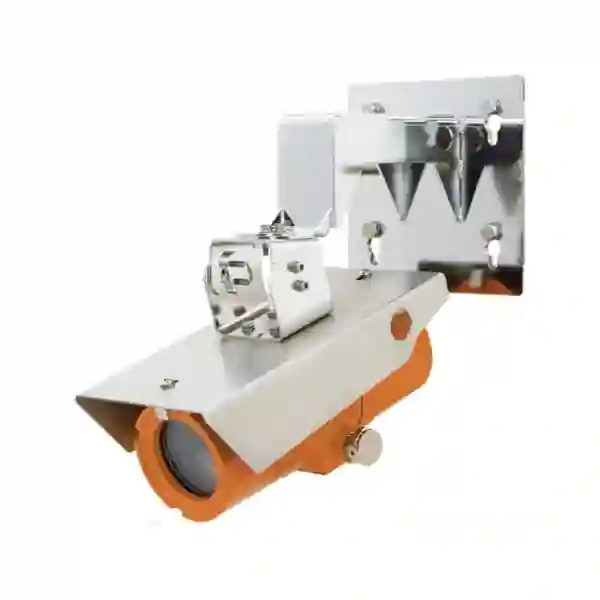
Hanwha Vision TNO-X8072EPT1-Z: 5MP Explosion-Proof Fixed Network Camera
Need a fixed video view in a potentially hazardous industrial area? The Hanwha TNO-X8072EPT1-Z combines 5MP visible-light imaging with a specialised enclosure carrying published hazardous-location markings. Before buying, confirm the site’s classification, camera angle, certified installation method and recording requirements.
5MP image · 4.1–9mm lens · 120dB WDR · H.265 · IP66 / Type 4X · PoE camera power
For industrial security teams and project engineers in Tanzania, selecting an explosion-proof camera requires more than comparing megapixels. The planned installation must satisfy the site’s area classification, deliver a useful view at the working distance and integrate with the recording system. This page separates manufacturer-verified camera capabilities from engineering and commercial matters that require project confirmation.
The Hanwha TNO-X8072EPT1-Z is best evaluated for a defined, continuously monitored scene where a fixed camera is acceptable. It is not a thermal imager and it is not a motorised PTZ. Read the technical overview, application guidance and procurement checklist before requesting a project-specific quotation.
Verified technical overview
| Camera type | Fixed network, explosion-proof enclosure |
|---|---|
| Image resolution | 5MP, 2560 × 1920 |
| Maximum frame rate | Up to 30fps |
| Lens | 4.1–9mm varifocal, P-Iris |
| Horizontal field of view | Approximately 82° wide to 43° tele |
| Compression | H.265 / H.264 / MJPEG |
| Image functions | 120dB WDR, day/night ICR, WiseStream II, DIS |
| Network | RJ-45 10/100BASE-T; ONVIF S/G and SUNAPI listed |
| Camera power | IEEE 802.3af PoE; 7.5W maximum stated |
| Heater power | Separate 12–24V DC; 25W stated |
| Ingress protection | IP66 / Type 4X |
| Enclosure | Powder-coated aluminium; approx. 6.35kg |
| Hazardous-location markings | Manufacturer lists cFMus Class I/II/III Division 1 and ATEX/IECEx markings; project verification required |
Specifications reflect published Hanwha documentation and must be confirmed for the exact supplied unit. Certification and local acceptance are separate project checks; no Tanzania-specific approval or current stock has been verified.
What this camera is designed to do
The Hanwha TNO-X8072EPT1-Z is a fixed-view IP surveillance camera supplied in a specialised explosion-proof enclosure for locations where the surrounding atmosphere may create additional ignition risks. Its role is to provide dependable visual evidence at a selected position, rather than to replace gas detection, fire protection, process instrumentation or a plant safety system. For buyers, the first question is whether the specific hazardous-area classification, viewing task and installation method match the camera and its approved accessories.
Typical evaluation begins with the physical scene: a loading connection, a production boundary, a process access point or a guarded corridor. The 5MP image can help operators review people, vehicles, equipment and process-adjacent activity when visibility and positioning are suitable. However, the camera cannot prove that a valve is safe, identify a chemical release or verify a machine condition merely from the video image. Those functions call for purpose-designed instrumentation and procedures.
Treat this model as an engineered component of a complete video surveillance design. Buyers should agree on the required field of view, scene lighting, network architecture, cable route, mechanical mounting, hazardous-area documents and recording plan before placing an order. A well-selected camera that is correctly installed is more valuable than an impressive specification fitted to the wrong mounting position.
Explosion-proof terminology and area classification
An explosion-proof camera is not a device that makes a hazardous workplace safe by itself. The term concerns the tested construction and protection method of the camera enclosure for defined potentially explosive atmospheres. Hanwha’s documentation lists cFMus hazardous-location approval for Class I, II and III, Division 1, Groups B, C, D, E, F and G, together with specified ATEX and IECEx markings. These markings must be interpreted against the complete certificate and the plant’s own classification drawings.
A site engineer should establish whether the area is classified by a Division system or a Zone system, what gas or dust group applies, what temperature class is required, and which local rules govern installation. The fact that a manufacturer’s datasheet displays a certificate family does not establish automatic acceptance for every site or authority. Any necessary regional or Tanzania-specific recognition should be checked with the relevant competent parties before procurement and installation.
Do not substitute a normal IP66 outdoor CCTV camera simply because it also resists rain and dust. Ingress protection and explosion protection answer different engineering questions. Similarly, do not assume that the enclosure’s marking automatically covers a field-fitted gland, an added accessory, a power supply or an improvised junction box. Every element in the hazardous-area installation requires its own appropriate review.
Where 5MP resolution creates practical value
At its stated maximum resolution of 2560 × 1920 pixels, the camera offers more detail than a conventional 1080p image over a comparable field of view. That can be useful when a supervisor needs to review movements around a loading area, identify which door was used or understand the sequence of activity around a piece of equipment. At supported settings, Hanwha specifies up to 30 frames per second, which can provide a smoother record of moving subjects than very low-frame-rate surveillance.
Pixel count alone does not determine whether a face, label or small object will be identifiable. Target size in the image changes with distance, lens setting, camera angle and the portion of the scene being recorded. Compression, poor light, atmospheric haze, lens contamination and vibration can all remove useful detail. Buyers should define what an operator must actually see and validate it at the intended camera position.
For critical evidence, ask the installer to demonstrate representative still images and recorded playback, not only a bright live preview on a laptop. A successful test should show the real target at the farthest important distance, under the lighting and movement conditions that matter to the site. This creates an objective basis for lens adjustment, recording quality and storage decisions.
Choosing the 4.1–9mm varifocal lens setting
The built-in 4.1–9mm lens provides an adjustable viewing angle rather than one permanently fixed focal length. Hanwha’s technical data gives an approximate horizontal angle from 82 degrees at the wide end to 43 degrees at the telephoto end. The wider setting is generally suited to showing context across a broad area; the narrower setting gives more image pixels to a smaller section of a scene. Neither choice is automatically superior.
For example, a wide view may document who approaches an entrance and what equipment is nearby, while a narrower view may better capture activity around a defined connection point. Before commissioning, mark the essential zones on a site drawing and check that no important approach route sits outside the selected angle. Remember that the camera is a fixed model: once it is mechanically aimed, it does not automatically rotate to follow activity.
Digital PTZ in the image-processing specification means electronic cropping and enlargement of a recorded image, not a motorised pan-and-tilt mechanism. Digital enlargement cannot create detail that was never captured by the sensor. If operators need to look routinely in several physical directions or follow distant targets dynamically, a separately approved motorised PTZ system may be a better design choice.
Image quality in difficult industrial lighting
Industrial environments often contain bright work lights, shaded passages, reflective metal and daylight entering from one side of a structure. The TNO-X8072EPT1-Z includes 120dB wide dynamic range to help manage scenes with strong bright and dark regions. This is relevant when a doorway, platform or vehicle approach is backlit. Wide dynamic range can preserve useful information in a challenging scene, but it cannot eliminate every glare or contrast problem.
Hanwha also lists day-and-night operation with an infrared-cut filter, digital noise reduction, digital image stabilisation with a gyroscope, and a defog function. These are image-processing capabilities, not a substitute for correct lighting, a stable mount and an unobstructed optical path. Stabilisation can help with some movement effects; severe movement of the housing or mount still requires a mechanical correction.
The camera’s published low-light sensitivity is a sensor specification, not a promise of acceptable evidential images in darkness. There is no reason to assume an integrated infrared illuminator or thermal imaging function on this fixed visible-light camera. Where night-time identification is required, check real scene lighting and any separately specified illumination equipment against the area’s hazardous-location restrictions.
Video codecs and the recording decision
The camera supports H.265, H.264 and MJPEG, giving system designers options for recording and distribution. H.265 may help reduce transmitted or stored data for a comparable target visual quality, provided that the selected recorder and viewing clients support it. H.264 may offer broader compatibility with some older infrastructure, while MJPEG can suit particular integration requirements. Codec choice must be tested with the actual video management environment.
Hanwha’s WiseStream II capability and multiple streaming profiles can help an integrator allocate video quality according to the task. A full-resolution recording stream might be retained for evidence while a lighter stream supports a remote overview. The site should still configure minimum useful quality, frame rate, event handling and network traffic policies rather than leaving every parameter on a factory default.
Bandwidth is not a universal number attached to the product. A busy scene with movement, foliage, smoke or changing lighting can behave differently from a quiet indoor passage. Retention calculations should use tested or conservatively estimated bitrates for the chosen profile, multiplied by actual recording hours and the required number of days. Include sensible headroom and verify the playback quality after recording.
Recording, edge storage and integration
Hanwha lists removable SD-family edge storage, network-attached storage options and network video recording interfaces for the model. Edge storage can be useful as part of an event or resilience strategy, but it should not automatically be presented as a replacement for a managed recording system. Memory-card service life, approved capacity, formatting, retrieval and the policy for a full card all matter in industrial operation.
The manufacturer identifies ONVIF Profile S/G and SUNAPI interfaces, along with RTSP-related network protocols. This improves integration possibilities with suitable network video recorders and management systems, but exact interoperability depends on software versions, profiles, licensing, security configurations and the particular functions being used. A successful live picture does not by itself confirm that event metadata, time synchronisation or edge-recording recovery works.
Before purchase, request an end-to-end compatibility check against the site’s recorder or VMS. Test live streaming, scheduled and event recording, playback, date and time consistency, user permissions, alarm handling, restart recovery and the route for software maintenance. If the organisation depends on one specific analytic trigger or storage workflow, insist on a witnessed demonstration of that feature.
Analytics and event awareness
The camera’s listed video and audio analytics include functions such as motion detection, virtual line, enter and exit, loitering, tampering, defocus and directional detection. These tools can support operator awareness by drawing attention to events within a defined scene. The important distinction is that they are configurable video analytics rather than guaranteed conclusions about physical safety or production compliance.
An entry or exit rule, for example, needs the intended detection line, direction, target size and surrounding activity to be considered. Moving shadows, weather effects, equipment motion and crowded scenes may create unwanted alarms or missed detections. Sensitivity should be tuned against a realistic operational test. The procedure for reviewing an alarm is as important as the alarm itself.
Organisations should decide who receives an alert, how it is verified, how long the clip is kept and what response is appropriate. Where an alarm could lead to a high-consequence decision, human review and independent safety systems remain essential. Camera analytics must not be represented as certified emergency-shutdown logic, fire detection or an independent gas-monitoring device.
Power design: PoE camera and separate heater
A particularly important buying detail is the difference between camera power and heater power. Hanwha specifies IEEE 802.3af Power over Ethernet for the camera electronics, with a maximum camera draw of approximately 7.5W. The enclosure heater has a separate 12–24V DC input and a stated 25W power requirement. Buyers should not assume that a single PoE cable automatically powers every function of the complete assembly.
The manufacturer distinguishes operating ranges with the heater from operation on PoE only. Its datasheet lists a PoE-only range of approximately -10°C to +55°C, while the broader heated operating range depends on region and configuration. Even in a warm climate, it is useful to understand this separation for correct wiring, service and future relocation of equipment. The heater and its circuit must be reviewed against the actual site conditions.
Power-system design should cover source location, backup power, protection, permitted wiring methods, cable sizing and the rating of components used in the classified area. Do not wire a standard unapproved power adapter directly into a hazardous enclosure without design review. Agree with the installer how electrical isolation and safe maintenance will be performed.
IP66, Type 4X and housing construction
The powder-coated aluminium enclosure is intended for industrial outdoor service and carries IP66 and Type 4X ingress-protection information in Hanwha’s documentation. These ratings are useful when the camera faces dust, rain and routine environmental exposure. They do not mean every possible chemical, washdown substance, impact or corrosion environment has been evaluated for the installation.
Assess the actual exposure: airborne salt, cleaning chemicals, chemical vapours, physical abrasion, vibration, heat from nearby equipment and the likelihood of accidental strikes. Mounting position and cable entry orientation can influence long-term reliability. An industrial camera can still suffer optical obstruction or structural damage if it is installed where a moving object or hose repeatedly contacts the housing.
Specify a maintenance method that protects the enclosure and does not defeat its certified construction. The sealing arrangements, fasteners, finish and window should be inspected according to the manufacturer’s instructions and local safety procedures. Repainting, drilling, replacing a gland or modifying a cover should never be treated as an ordinary cosmetic change in a certified hazardous-area assembly.
Mounting position and approved hardware
The camera weighs approximately 6.35kg according to the manufacturer and is not a lightweight office CCTV unit. An appropriate wall, pole or corner mounting arrangement must account for static weight, vibration, environmental loading and accessibility for maintenance. Hanwha identifies optional mounting accessories for the model family, but the correct accessory codes and supplied parts must be confirmed with the current product documentation and the exact quotation.
Begin with a structural and optical survey. The mounting position should protect the intended view from pipes, equipment covers and parked vehicles while avoiding unnecessary exposure to impact. Ensure service personnel can safely reach the camera for inspections. A technically excellent image is less useful if an operator has to close a dangerous work area each time the viewing direction needs adjustment.
The field installation should follow the certified assembly requirements, the chosen support system and the plant’s permit procedures. Use appropriately rated fasteners, cable-entry components, glands and protective measures. A bracket that mechanically fits is not automatically suitable for the hazardous-area installation or the site’s environmental conditions.
A site survey before procurement
Before selecting the model for a Tanzania project, the customer should share a marked-up layout, hazardous-area designation and a short description of what the camera must observe. These three inputs help prevent mismatches that cannot be corrected through software settings. A site survey should also note mounting height, distance to targets, backlighting, nighttime conditions, nearby moving equipment and where the cable can safely run.
The integrator should record the intended network endpoint, switch location, power source, recorder and method for remote access. Where long cable runs are required, the design may need approved intermediate infrastructure rather than relying on an assumed unrestricted Ethernet distance. If a network connection is interrupted, the business should know whether video continues to be stored, whether operators receive an alert and how recordings are reconciled later.
Finally, clarify the acceptance criteria before requesting a price. Useful criteria include a target visible at a specified distance, a stable stream at the chosen frame rate, a demonstrated recording and playback workflow, accurate timestamps and a documented safe installation. These are measurable and more useful than a generic request for the best industrial camera.
Hazardous-area installation responsibilities
A classified installation requires people who understand the applicable electrical and mechanical protection methods. The camera’s listed markings are a starting point for engineering review, not permission for any contractor to connect arbitrary equipment inside a hazardous zone. The engineer responsible for classification and the installer should confirm the precise equipment certificate, permitted ambient conditions, any special conditions of use and the correct cable-entry arrangement.
Purchasers should ask who will provide the compliance paperwork, who will sign off the mounting and wiring method, and who will maintain the dossier after installation. This is especially important when an existing plant is being extended, because a familiar cable tray or junction box may not be suitable for a newly classified section. Changes to a hazardous-area camera can affect more than the video system.
The listing of cFMus, ATEX or IECEx information in a manufacturer document must not be confused with an independently verified Tanzania-specific product approval. The correct legal and technical requirements depend on the project and competent authority. Make certification review an explicit pre-order step rather than assuming it has been settled by a marketing description.
Network design and cybersecurity
The TNO-X8072EPT1-Z is a network camera, so cybersecurity is part of physical-security performance. Its published interfaces include encrypted web access and mechanisms for authenticated administration. A practical deployment should use site-approved credentials, least-privilege accounts, secure management access and a documented configuration baseline. Avoid exposing the camera’s administration interface directly to the public internet.
Segment surveillance traffic where appropriate, control which recorders and workstations can reach the device, and keep reliable time synchronisation. Review firmware support for the exact unit and its current lifecycle status with the manufacturer or an authorised technical channel. Do not presume that an older product supports every security method found on a newer Hanwha model or a more recent camera family.
Cybersecurity policy should cover who changes settings, how accounts are removed when staff leave, how configuration backups are protected and how incidents are investigated. A camera that records good video but is difficult to administer safely can create avoidable risk for the wider plant network. Include the IT and operational-technology teams in design approval where their systems intersect.
Industrial video retention and evidence handling
An industrial surveillance project usually needs a written answer to a simple question: what will happen to an important recording after an incident? Retention rules vary by business need and applicable policy, so a fixed number of days should not be assumed from the camera’s specification. Define the normal recording interval, event rules, access rights and the procedure for exporting a clip before selecting storage capacity.
Storage estimates need the tested stream bitrate, number of cameras, hours recorded per day, retention period and allowance for activity peaks. Consider a separate policy for event clips and ordinary continuous footage. High resolution can improve detail, but retaining uncompressed or unnecessarily high-bitrate video across every stream may increase infrastructure cost without meeting a real operational requirement.
After installation, test evidence export and playback on a separate workstation with authorised credentials. Confirm that the timestamp, camera identity and original image quality are preserved as required by the organisation. Access logging and documented handling procedures matter because footage can contain sensitive information about workers, visitors and operations.
Operational scenario: loading and transfer points
At a fuel, chemical or other controlled transfer location, operators may need a fixed view of a connection point and the surrounding approach path. The 5MP sensor and adjustable lens can help define a usable view, while the explosion-proof enclosure may be relevant where the area classification requires such equipment. The camera remains one part of the site design: it does not certify the transfer, confirm a leak-free connection or replace the responsible operator.
A good layout captures enough context to understand who approached the area, what activity occurred and whether the intended procedure was visibly followed. Excessive zoom may hide important movements outside the frame. A very wide view may show the process but lack the pixels needed to inspect a smaller target. A sample image at the actual mounting distance helps choose the right compromise.
Work with site safety staff to keep the camera away from moving transfer arms, hose sweeps and places likely to collect dirt on the window. The agreed recording workflow should support post-event review without requiring unsafe access to the camera enclosure.
Operational scenario: access points and boundary monitoring
In an industrial compound, a controlled entry point can generate questions after an unexpected visit or a procedural deviation. The model’s fixed perspective can document movement through a doorway, stair approach or perimeter crossing when the field of view is properly set. Virtual-line and enter-or-exit analytics may assist monitoring, subject to testing in the actual scene.
The primary design question is whether the video should establish general activity, the direction of movement or an identifiable image of a person. These goals require different pixel density and positioning. Strong backlight through an entrance, bright vehicle lamps and nearby obstructions may make an initially attractive viewpoint less effective. The wide dynamic range feature can help, but demonstration remains necessary.
Where the entry area is hazardous, the camera and all installation materials must be selected for that classification. If the access point is not classified, a conventional network camera may provide the required view at a different cost. The choice should follow the safety drawings and the operational need, not a blanket preference for the most specialised enclosure.
Operational scenario: processing and utility areas
Fixed video can help operators maintain situational awareness near a selected process line, pump group, utility corridor or equipment access route. The camera provides a visual record of what was present within the frame; it does not measure process pressure, temperature or the condition of internal machinery. When a maintenance event occurs, footage may help reconstruct the sequence of visible actions if the view and recording period are appropriate.
In busy mechanical areas, consider periodic vibration, changing shadows, steam, dust and objects that intermittently block the lens. Digital stabilisation and defog functions can assist image presentation, but a properly engineered mounting position and clear optical path remain essential. Avoid aiming directly into routine high-glare sources if another angle can meet the same evidence requirement.
Because plant equipment changes over time, review the view after new piping, barriers or storage racks are installed. A camera that was correctly commissioned can lose much of its operational value when the scene is altered. Assign responsibility for periodic review of the coverage map and any alarm zones.
Operational scenario: maintenance and incident review
A fixed camera may contribute useful context when a plant investigates an unexpected interruption, access event or maintenance activity. High-resolution images can assist a review when the relevant people and equipment are visibly within the scene. The value comes from consistent coverage, correct timestamps, dependable recording and a method to retrieve original footage without editing it.
Plan for ordinary work patterns: temporary scaffolding, parked service vehicles, protective clothing, night shifts and changes in lighting. An acceptance test taken during a quiet daytime visit may not represent an actual incident. Sample playback should include at least one challenging condition that reflects the site’s normal operation.
Access to footage should be restricted to approved users and handled under the organisation’s privacy and retention policies. Camera surveillance supports investigation; it should not become an unverified substitute for a safety permit, a competent witness, a calibrated instrument or documented process records.
Fixed camera versus motorised PTZ
The model name is sometimes misread because manufacturer code explanations contain references to a bullet body style, and the network feature list includes digital PTZ. The actual TNO-X8072EPT1-Z is described by Hanwha as a fixed explosion-proof camera. Its lens can be set to the desired field of view, but it does not provide a motor-driven pan-and-tilt mechanism for moving between different directions during routine operation.
A fixed-view design is useful when evidence must show the same point continuously and where the site values predictable scene coverage. A motorised PTZ is more appropriate when operators need to actively inspect several zones, follow moving objects or vary camera direction. That choice introduces its own requirements for mechanics, controls, permissions and appropriate hazardous-location certification.
Do not assume digital zoom is equivalent to an optical zoom on a high-power PTZ. Cropping a recorded frame reduces the area shown without increasing the underlying scene detail. Select the required viewing task first, and compare certified alternatives only after the area classification and mounting constraints have been established.
What the model does not promise
This camera is not a thermal imager and does not detect heat signatures through complete darkness. It is also not a gas detector, flame detector, intrinsically safe handheld instrument or stand-alone industrial safety controller. Its explosion-proof enclosure does not remove the need for safe installation, appropriate area classification or routine inspection. These distinctions protect buyers from choosing the product for a task it was not designed to perform.
Likewise, a datasheet feature such as video analytics does not establish a guaranteed identification accuracy, false-alarm rate or performance in every weather condition. Camera suitability must be tested for the actual site. Image quality depends on lens angle, light, distance, compression, vibration and cleanliness. An industrial enclosure does not change the optical limits of a visible-light sensor.
Finally, the presence of a model in a published document does not prove local stock, current manufacturer lifecycle status, delivery date, service entitlement or warranty terms. Those commercial details should be confirmed in the quotation and purchase documents for the specific project, especially when procurement depends on an exact part number or replacement compatibility.
Compatibility checks for an existing CCTV system
Retrofitting the camera into a live CCTV estate requires more than a matching Ethernet connector. Identify the recording platform, software version, accepted codecs, licensed channel count, event integration method, authentication requirements and supported recording profiles. ONVIF and RTSP support can provide common integration paths, but functional coverage depends on the selected recorder and configuration.
Test both the operator’s daily workflow and the administrator’s maintenance workflow. Can operators reach live and recorded footage without changing camera settings? Are event clips searchable? Does time remain correct after an outage? Can the site restore a configuration after a replacement unit is fitted? These questions reveal operational problems that will not appear on a one-page specification comparison.
Agree on responsibilities for upgrades and exceptions. An integration that relies on obsolete software or unsecured legacy protocols may need additional design work. For long-term use, request evidence that the manufacturer and recorder supplier can support the required combination rather than promising compatibility based solely on a generic profile logo.
Commissioning checklist: optical and video tests
Commissioning should start with the agreed coverage drawing. Verify that the actual camera position matches the approved plan, the correct model is installed and the accessories match the reviewed configuration. Adjust the varifocal lens to cover the required area, then capture sample images at the nearest and farthest important positions. Confirm the recorded stream, not only the local viewing image.
Test at least one bright-versus-dark scene and one low-light condition relevant to operating hours. Check whether vibration causes blur or whether a frequent obstruction hides a key target. Review frame rate, compression and recording quality while movement is occurring. If analytics are needed, use representative crossing events and nuisance movements to tune the detection zones.
Record the configuration and the test results. A useful handover package includes a camera identifier, mounting position, selected view, network details stored securely, approved user roles, stream settings, retention policy and sample acceptance screenshots. This becomes the baseline for troubleshooting and future changes without relying on one technician’s memory.
Commissioning checklist: electrical and hazardous-area tests
Electrical commissioning should be conducted under the site’s approved procedure by competent personnel. Confirm the equipment marking and certificate reference against the area classification before energising the installation. Inspect the mounting, enclosure condition, cable routes, permitted entries, gland selection, bonding or grounding provisions and any special manufacturer instructions applicable to the supplied assembly.
Verify the PoE feed for the camera electronics and separately document the heater circuit when fitted. A camera working over PoE does not prove that the heater has been wired or is available. Use the approved test methods for the particular hazardous environment and do not open or modify the enclosure outside permitted conditions. The installer should provide documented results rather than only a statement that the picture is visible.
The handover should also identify inspection intervals, the responsible maintenance team and what changes require an engineering review. A future cable replacement, bracket change or enclosure repair can alter the basis on which the installation was accepted. Keep the technical documentation accessible to the people who will maintain the system.
Ongoing inspection and maintenance
A hazardous-area camera needs an inspection plan that addresses both its surveillance function and the integrity of its certified assembly. The optical side involves window cleanliness, unobstructed coverage, stable focus, useful lighting and working recording. The mechanical side involves corrosion, mounting security, visible damage and the condition of approved cable-entry arrangements.
Set inspection frequency according to the site environment, relevant standards and the plant’s own maintenance plan. A dusty loading operation may need different visual checks from a protected equipment corridor. Do not apply unapproved cleaning chemicals, open an enclosure or replace components simply because a maintenance procedure works on ordinary commercial CCTV. Follow manufacturer and local safety instructions.
Periodically confirm that users can retrieve a historical recording and that alerts still reach the responsible team. Check for configuration drift after network changes or maintenance work. A camera that continues to send a live picture can nevertheless have the wrong time, failed recording storage or a blocked view. These operational tests help keep its original purpose intact.
How to compare the full installed cost
The camera is only one part of the cost of a classified-area surveillance installation. A realistic quotation may need to account for certified mounting components, cables and glands, appropriate junction arrangements, PoE switching, heater power where required, network connectivity, recording capacity, engineering review, installation labour, testing, documentation and ongoing inspections.
Comparing the bare camera price with an ordinary outdoor IP camera is therefore misleading. The specialised enclosure and installation controls serve a different safety requirement. At the same time, not every industrial location is classified, and a normal camera may be sufficient in a safe area. Spending more on an explosion-proof model where it is unnecessary will not automatically improve the surveillance outcome.
Ask for a clearly itemised proposal with exclusions, dependencies and optional equipment shown separately. Confirm whether existing storage and VMS licences are sufficient, whether the support structure is already available and which team will provide hazardous-location sign-off. This makes bids easier to compare and reduces surprise work during installation.
Questions to include in a Tanzania quotation request
When requesting the Hanwha TNO-X8072EPT1-Z for a project in Tanzania, provide the model number exactly as written and state whether it is a new installation, additional camera or replacement. Include a short description of the industrial area and the intended view. If possible, attach a site plan, photographs taken from a safe position and the classified-area drawing prepared by the responsible engineer.
List the recorder or VMS currently in use, the preferred network connection, the required recording period and whether the camera must integrate with an existing alarm procedure. State if a heater circuit, wall mount, pole mount or special mounting arrangement is expected. Include any site-specific document acceptance rules so the response can address certification evidence at quotation stage.
Request confirmation of exact manufacturer part number, commercial availability, permitted accessories, lifecycle and support status, warranty terms, installation responsibilities and the scope of commissioning. None of these details should be assumed from a generic online product description. A complete brief enables a more reliable technical and commercial response.
A sensible buying decision
The strongest reason to shortlist this model is the combination of a stated hazardous-area enclosure classification and a 5MP fixed network imaging platform. It becomes a good fit only when those two characteristics solve a real project requirement. Where the area is classified and the scene is well defined, the buyer can evaluate whether the 4.1–9mm lens, fixed direction, recording interfaces and installation requirements suit the job.
If the task instead requires thermal detection, long-range optical tracking, motorised pan and tilt, built-in infrared lighting or process measurement, specify that need openly and assess a different device. Do not expect a single fixed visible-light camera to cover all industrial security and safety functions. Likewise, ask whether a lower-complexity camera would be appropriate in a non-classified location.
For a responsible purchase, confirm three decisions in order: safety classification and equipment suitability; optical coverage and recording performance; then the complete installed system and commercial terms. This sequence reduces the risk of purchasing equipment that looks technically capable on paper but cannot be used as intended at the site.
Lighting and night-time operation planning
Night-time video depends on the amount, distribution and colour of light available to the sensor. Hanwha publishes low-light figures and an automatic day-and-night function, but such values are measured under stated conditions and do not guarantee identifiable images at every distance. Motion blur may become visible when exposure times increase, particularly around moving people or vehicles. The site should test real movement under the intended lighting.
If additional illumination is required, it must be selected and installed with the hazardous-area conditions in mind. Avoid making assumptions that a standard floodlight, infrared unit or wiring accessory can be added within a classified zone. Glare and reflections from polished metal can sometimes make extra lighting less effective unless the angle is chosen carefully.
Ask the installer to demonstrate the farthest important target after dark and inspect saved footage at normal playback speed. Evaluate whether the view supports the required decision, not merely whether a silhouette can be seen. Where there is no adequate visible light, consider an appropriately approved alternative imaging approach rather than promising the performance of a thermal camera.
Privacy, access control and worker expectations
Industrial video systems may capture employees, contractors and visitors, making access governance part of a well-designed project. Decide which roles need live viewing, which may retrieve archived images and who can export clips. Limit privileges according to operational need and apply the organisation’s applicable privacy and information-security policies. The camera’s presence should fit an established, communicated surveillance purpose.
Where analytics are used, avoid presenting an automated event as a definitive conclusion about a person’s conduct. Environmental conditions, obstructions and configuration choices influence detection outcomes. Human assessment, access records and other evidence may be needed to understand an event fairly. Retain recordings according to a documented policy rather than indefinitely by default.
Check that the VMS and camera accounts are maintained as responsibilities change. User accounts, stored exports and incident evidence should be reviewed periodically. These measures help a technically capable surveillance device remain a useful and proportionate part of the site’s security operations.
Environmental realities for Tanzania projects
Projects in Tanzania can involve varied site environments, from sheltered industrial interiors to exposed coastal or inland installations. The relevant issues are the conditions at the particular facility rather than a generic claim that one camera is suitable for every region. Examine ambient temperature, humidity, dust, rainfall, chemical exposure, salt-laden air, power reliability and access for maintenance as part of the project survey.
The published IP66 and Type 4X information is useful context, but it should not replace an assessment of corrosion risk, protective mounting and permitted cleaning methods. The operating-temperature specification also needs to be read alongside the heater-power requirement. For a local installation, check the exact configuration and the site’s environmental range instead of relying on a simplified headline about temperature resistance.
FourTeck Tanzania content should help the buyer ask the right questions without implying confirmed local inventory, field-service coverage or regulatory acceptance. A site-specific quotation and engineering review remain necessary before equipment is ordered or installed.
Documentation that should accompany handover
A professional handover should identify the exact camera model, supplied accessories and serial information recorded by the project team, together with the manufacturer’s applicable documentation. Include the final position, lens view, network design, stream profiles, permitted administrative roles and references to the recorded acceptance tests. Store sensitive access details securely rather than in a public handover file.
For the hazardous-location portion, the responsible installer should provide the relevant approved drawings, equipment documentation, inspection results and a record of any special conditions that affect use or maintenance. This information supports safe work years after the original installation team has left. A camera asset register should identify who authorises changes to the certified assembly.
Finally, document the recording and incident-retrieval procedure in plain language. Operators should know where footage is stored, who can access it, how time synchronisation is verified and what to do if the video becomes unavailable. A handover pack that answers these questions is often more useful than a long specification sheet kept separately.
Common procurement mistakes to avoid
One common mistake is reading the model as a thermal or movable PTZ camera because it belongs to an industrial range. This particular unit is a fixed visible-light network camera. Another is assuming that IP66 weather protection proves hazardous-area suitability; the product’s actual certificates and the site classification must be considered separately. A third is overlooking the dedicated power requirement for the heater.
Other mistakes include treating a declared protocol as a guarantee of full VMS compatibility, relying on seller-listed memory capacity when documents differ, choosing the lens setting without a target-distance test and assuming that a branded mounting accessory fits every site condition. Quotation-stage clarifications are cheaper than correcting the wrong installation after a plant has granted access.
Always identify model-specific facts, design assumptions and yet-to-be-verified commercial details separately. If a reseller marks the product discontinued or limited in stock, confirm the manufacturer’s lifecycle position and exact orderability for the intended market before committing a project schedule. Avoid publishing a local price or availability promise without reliable evidence.
Frequently asked questions
Is the TNO-X8072EPT1-Z a thermal camera?
No. Hanwha describes this model as a 5MP fixed visible-light network camera in an explosion-proof enclosure. Its day-and-night functions assist conventional video imaging, but that is not the same as a sensor that forms images from heat radiation. If the project needs thermal detection in darkness, ask for an appropriately specified and certified thermal solution. The buying brief should state whether the objective is ordinary visual evidence, temperature-related awareness or a separate process-safety measurement.
Does the camera pan or tilt by motor?
No motorised pan-and-tilt movement is specified for this fixed camera. The manufacturer’s network feature list includes digital PTZ, which allows electronic enlargement or navigation within the captured picture. It does not rotate the physical housing or create a new viewing angle. If an operator must follow activity across several directions, compare suitably approved motorised PTZ models after confirming the hazardous-area classification, mechanical loads and required recording workflow.
Can one PoE connection run the whole unit?
PoE powers the camera electronics, with IEEE 802.3af and a stated maximum camera draw of 7.5W. The heater is separately specified at 12–24V DC with a 25W requirement. A proposed installation therefore needs a deliberate decision about whether the heater is used and how its circuit will be safely supplied. The working temperature range differs between PoE-only and heated operation. Confirm wiring and certificate conditions before treating the complete unit as installed.
What image detail should a buyer expect from 5MP?
The stated maximum video resolution is 2560 × 1920 at up to 30 frames per second. Useful detail at a specific location depends on scene width, distance, lens setting, light, movement and recording quality. A wide field of view can show more context but fewer pixels on a small subject; a narrower view does the reverse. Ask for sample live and recorded images from the intended mounting location before claiming that a person, label or object can be identified.
Is IP66 enough for a hazardous area?
No. IP66 describes resistance to dust and water ingress under defined tests. Hazardous-area protection is a separate question involving the equipment’s certified construction, markings, classification and conditions of use. Hanwha lists specific cFMus and ATEX/IECEx information for this model, but the project engineer must verify the complete documentation and its suitability for the installation. Mounting hardware and cable entries also need appropriate review. Neither IP66 nor an explosion-proof label removes the need for competent site approval.
Will it work with an existing NVR?
The published network interfaces include ONVIF Profile S/G, RTSP-related protocols and SUNAPI. These offer recognised ways to integrate video, but interoperability depends on the recorder’s software, licensing, supported streams, configuration and the required events. Confirm the precise NVR or VMS version and test recording, playback, timestamp synchronisation, alarms and recovery after an outage. Avoid assuming all features are compatible merely because live video can be displayed.
Does the camera have onboard storage?
Manufacturer documentation lists SD-family edge-storage capability and support for network-oriented recording options. Published source material differs on certain maximum-capacity descriptions, so the precise supported card type, limit and firmware requirements should be confirmed against current documentation for the supplied unit. For a production system, plan recording retention, card maintenance and retrieval procedures rather than depending on an unspecified memory-card size. The main recorder and any edge-storage functions should be tested together.
Can it provide footage in complete darkness?
Do not assume so. The product is a conventional visible-light camera with published low-light sensitivity and day-and-night imaging functions, not a thermal camera. Very low illumination may produce an image, but the level of detail needed for identification can be different from merely seeing movement. If complete-darkness coverage is required, assess suitable illumination or a different certified imaging technology, and test the selected option at the site during the relevant operating hours.
Is the camera approved for use everywhere in Tanzania?
No universal Tanzania approval has been verified for this specific model. Manufacturer references to cFMus, ATEX and IECEx classifications are useful technical evidence but do not automatically establish regulatory acceptance for every Tanzanian plant or project. The responsible engineer should compare the exact certificates with site classification and applicable requirements. Commercial availability, local warranty, installation coverage and any project-specific approvals also need to be confirmed individually before ordering.
What should I send when requesting a quotation?
Provide the exact model TNO-X8072EPT1-Z, location and nature of the intended industrial site, hazardous-area classification, viewing distance, expected lighting, preferred mounting position and recording platform. State whether a heater, pole or wall mounting, network expansion or additional storage is required. Ask for confirmation of exact part number, accessory compatibility, manufacturer lifecycle status, documented certifications, available commercial terms and commissioning scope. These details are the best starting point for a useful project-specific proposal.
Request a project-specific technical quotation
Share the exact model TNO-X8072EPT1-Z, site classification, intended viewing distance, mounting plans and existing CCTV platform when contacting FourTeck Tanzania. Ask for the full certificate documents, confirmed component compatibility, current commercial availability and the scope of installation and commissioning support. Do not rely on assumed stock, pricing or regulatory acceptance.
Next step: Request a FourTeck Tanzania technical quote and hazardous-area installation review.




Reviews
There are no reviews yet.