
Industrial network video | Hazardous-area positioning camera
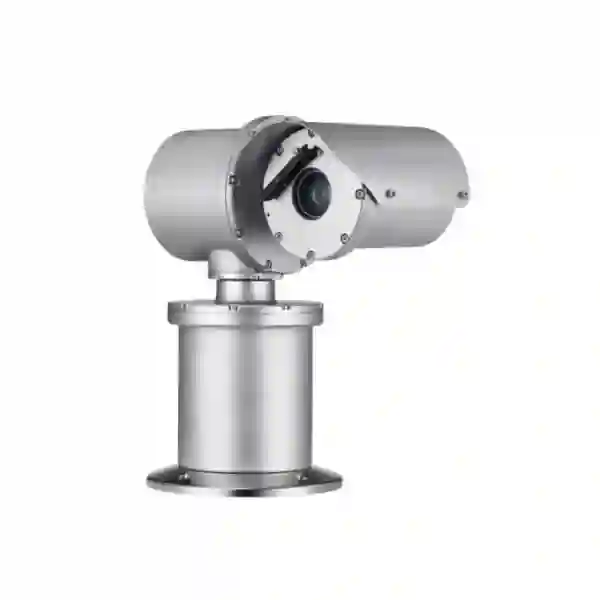
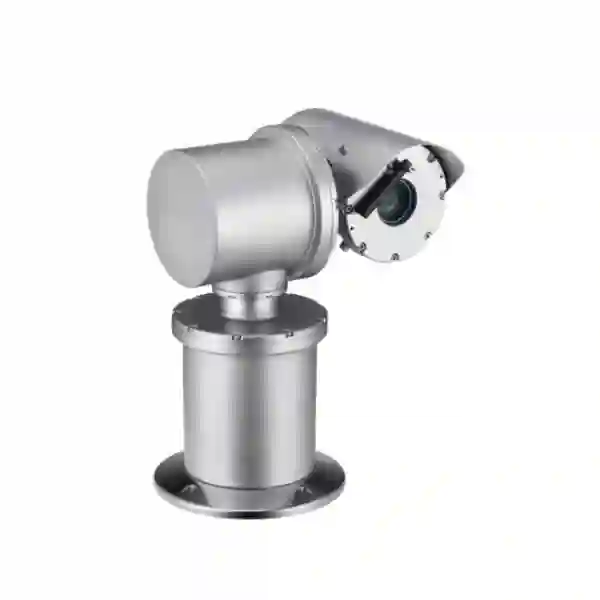
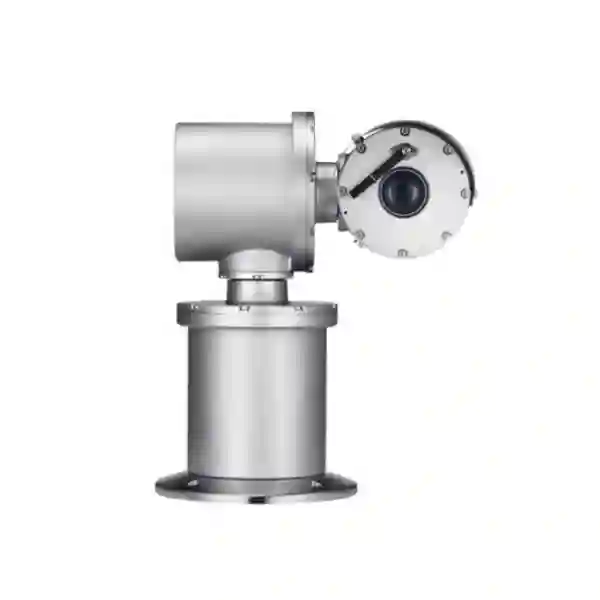
Hanwha TNU-6322E Explosion-Proof Camera
The Hanwha TNU-6322E explosion-proof camera gives industrial security teams flexible 2MP video monitoring, precision optical zoom and remote pan/tilt control in a purpose-built stainless-steel enclosure. It is a specialist choice for correctly classified hazardous areas—not a substitute for a site-specific engineering and certification review.
Planning a hazardous-area CCTV project in Tanzania? Request a quotation with your zone classification, camera positions, lighting conditions, power design and recorder details so the proposed configuration can be assessed accurately.
Specifications at a glance
| Camera type | 2MP network explosion-proof positioning camera |
|---|---|
| Sensor and image | 1/2.8-inch CMOS; maximum 1920 × 1080 |
| Optical system | 4.44–142.6 mm focal length; 32× optical zoom |
| Pan / tilt | 360° endless pan; 180° tilt (-90° to +90°); 300 presets |
| Video processing | H.265, H.264, MJPEG; up to 60 fps at 2MP with H.265/H.264 |
| Low light and image quality | Auto ICR day/night, 120 dB WDR; no integrated IR on this model |
| Enclosure | 316L stainless steel; built-in wiper; IP67; IK10 |
| Connectivity | RJ-45 10/100 Ethernet; ONVIF Profiles S, G and T |
| Power | 24 VAC; maximum 99 W |
| Operating range | -40°C to +60°C; 0–95% RH non-condensing |
| Size / weight | 611 × 438 × 235 mm; approximately 36 kg |
| Hazardous-area marking | Manufacturer lists ATEX and IECEx gas/dust markings; validate exact certificate for installation |
Specifications are based on Hanwha Vision’s published information for the exact TNU-6322E model. Confirm the current product revision, certification documents, accessories and supply details before ordering.
Who should consider this camera?
Industrial surveillance often demands more than a general-purpose weatherproof camera. At a fuel-transfer point, chemical process unit or other location assessed as a potentially explosive atmosphere, the video device and its installation must be appropriate for the specific hazard. This product addresses the need for adjustable visual coverage in that environment. Its pan/tilt mechanism and motorised lens let an operator examine selected areas without relying on a separate camera at every viewing angle. The correct use case is a planned industrial CCTV system supported by a hazardous-area assessment, not an improvised replacement for ordinary building security equipment.
The main buyers are plant security managers, engineering contractors, electrical and instrumentation teams, system integrators and project procurement departments. Each may evaluate the product differently. Security staff care about observing gates, processing equipment and movement corridors. Engineering teams care about equipment markings, mounting loads and approved cable arrangements. Network teams need predictable streams, credentials and recorder integration. Procurement must know which accessories and documents belong to the proposed package. A sound specification should bring these requirements together rather than choose the camera based only on resolution or lens magnification.
For Tanzanian industrial projects, explain the actual installation environment when requesting a quotation: whether the location is outdoors or sheltered, whether gas or dust hazards are classified, whether a pole or wall can support the load, and whether the scene is illuminated after dark. The TNU-6322E is useful when verified hazardous-area suitability and flexible viewing geometry are both required. It may be unnecessarily complex where the site is not hazardous or where a fixed camera already provides the required evidence. Correct selection begins with the task the video must perform.
Explosion-proof design and certification: what buyers must verify
Hanwha Vision identifies ATEX and IECEx ratings for this model, including gas marking Ex db IIC T6 Gb and dust marking Ex tb IIIC T80°C Db in the published specification. Such markings carry more information than a generic statement that a product is explosion-proof. They relate to protection method, atmosphere, equipment group, temperature classification and equipment protection level. The purchasing team should provide the site’s formally determined hazardous-area classification to a competent specialist and ask for a documented comparison against the exact camera certificate and its conditions of use.
Equipment certification is not a general guarantee that every installation near fuel, vapor, solvent or combustible dust is permissible. A selected enclosure may be suitable for one zone or material group but not another, and the installation method may introduce additional requirements. Site drawings, area classification, ambient conditions, cable entries, glands, bonding, isolation, maintenance access and local acceptance obligations remain important. Do not interpret the term explosion-proof as meaning a camera can detect explosive gases, suppress a fire or eliminate ignition risk across an entire process plant. Its intended function is imaging within an appropriately engineered arrangement.
Request the exact IECEx and ATEX certificates, relevant drawings and installation instructions for the unit being supplied. Ask the installer to verify approved entry devices, allowable supply arrangement and inspection practices before energising the equipment. The camera’s enclosure ratings for water and impact are separate from its hazardous-area approvals; all three can matter, but none replaces the others. Local project owners should also establish any applicable Tanzania-specific site and regulatory approval obligations with their responsible safety and electrical professionals rather than assuming that international markings alone settle every compliance question.
TNU-6322E versus TNU-6322ER: the lighting distinction
The model suffix matters. The standard TNU-6322E has automatic infrared-cut filter day/night switching and a sensitive image sensor, but it does not contain the integrated infrared illuminator associated with the TNU-6322ER. On an illuminated plant, or a site where a separately engineered lighting system is available, the E model may be appropriate. On a dark compound requiring active illumination from the camera itself, select a product specifically documented for that requirement. Do not base a purchase order on photographs or descriptions of the visually similar ER variant.
Automatic day/night operation is not equivalent to producing useful images in complete darkness. Hanwha specifies minimum illumination values of 0.05 lux for colour and 0.005 lux for black-and-white under defined exposure conditions. Those figures help characterize sensor sensitivity, but practical identification still depends on lighting distribution, motion, distance, lens position, exposure settings, weather and display or recorder configuration. A distant moving target under weak light may be less useful than the headline lux figure suggests. Have the system designer define acceptable image detail and test conditions at each important view.
Where lighting cannot be changed, compare the IR-equipped TNU-6322ER or another correctly certified camera with the actual site classification. Any separate illuminator placed in a hazardous area needs its own suitability assessment and installation plan. Infrared range figures should never be copied from a different model onto the E variant. This simple distinction prevents a common procurement error: receiving a mechanically suitable camera that cannot deliver the intended night-time images. Confirm the full model number, not just the shared 6322 naming, in the quotation and technical submittal.
32× optical zoom for specific inspection points
The 4.44–142.6 mm motorised zoom lens provides 32× optical magnification. At its widest setting, the published horizontal field of view is approximately 61.8 degrees; at the telephoto end, it narrows to approximately 2.19 degrees. This flexibility is valuable when an operator needs both general awareness of an industrial yard and a closer view of a valve station, pipe rack, access gate or equipment position. Optical zoom changes the camera’s view through its lens rather than merely enlarging existing pixels, making it useful for detailed observation when the target and conditions permit.
A narrower field of view should not be mistaken for guaranteed identification across any distance. Image usefulness depends on the number of pixels covering the target, distance, focus, atmospheric haze, vibration, lens condition and lighting. At high zoom, small movement at the mounting point may become conspicuous in the picture. The unit includes digital image stabilisation and defog functions, but these do not eliminate every mechanical or weather limitation. Define what the operator must recognize, inspect or verify, and calculate the expected scene detail before finalizing the mounting point.
A good design documents a wide establishing view and a few operationally important close-up views. During acceptance testing, capture example imagery from each position in daylight and during representative night operation. If a task requires continuous evidence at more than one location, remember that a single movable camera points in only one direction at any given instant. A dedicated fixed camera may still be necessary for uninterrupted coverage while the positioning camera supplies flexible detail. This mixed-camera approach can be more effective than attempting to make one zoom camera solve every observation task.
360-degree positioning and predictable patrols
The TNU-6322E supports endless 360-degree panning and a 180-degree tilt range from minus 90 to plus 90 degrees. Hanwha lists manual pan speeds from 0.5 to 80 degrees per second and tilt speeds from 0.1 to 60 degrees per second. Up to 300 presets can be stored, with supported patrol functions that include swing, groups, trace, tours, automatic runs and schedules. These capabilities help operators move between meaningful views without repeatedly searching for the same scene. They are most useful when configured around defined surveillance tasks rather than left as a collection of unused settings.
Preset names should reflect the site rather than arbitrary sequence numbers. An operations team might use labels such as loading bay overview, perimeter gate, pump-skid access and elevated pipeline junction, subject to the areas genuinely visible from the chosen mount. Tour order and dwell time should prioritize risks and operator workflows. A slow patrol that checks many directions can create gaps between visits; faster movement may reduce viewing time or introduce blur. The system specification should describe which positions require continuous observation and which can be revisited periodically.
PTZ speed and preset features should also be evaluated alongside safety practices. Operators may be tempted to reposition the camera while working around personnel or moving machinery, but video monitoring never replaces direct line-of-sight controls, process alarms or safe work procedures. Limit PTZ permissions appropriately, agree on a default home position, and define what happens after a power interruption or network event. A commissioning checklist that records the preset names, views and return-to-home behavior makes future maintenance and operator training substantially easier.
Video quality, frame rate and compression choices
The 1/2.8-inch CMOS sensor records a maximum resolution of 1920 by 1080 pixels. Hanwha publishes up to 60 frames per second at 2MP using H.265 or H.264, with MJPEG available for scenarios where that format is required. High frame rate can help show moving vehicles, personnel and mechanical activity more smoothly, but it also raises storage and network requirements when other settings are equal. A buyer should not assume that every stream needs 60 fps. For many overview tasks, a lower tested setting may be sufficient; faster movement may justify more frames.
Wide dynamic range up to 120 dB addresses scenes where bright exterior light and darker industrial structures appear together. Automatic infrared-cut filter switching, noise reduction, image stabilisation and defog functions provide additional tools for image tuning. None should be presented as a guarantee against glare, obscured lenses or heavy atmospheric conditions. The best configuration is established by observing the actual scene during the lighting conditions that matter, then adjusting exposure, compression, WDR and frame rate as a coordinated set rather than maximizing every setting independently.
The camera supports H.265, H.264 and MJPEG plus WiseStream II. Modern codecs can reduce bandwidth for comparable visual quality in suitable conditions, but exact savings depend on motion, detail, noise, frame rate and the encoding setup. Confirm that the chosen NVR or video management platform can decode the selected format and frame rate before standardizing the profile. Keep at least one lower-demand viewing profile where appropriate for remote operators. Record the selected streams in the commissioning document so that future changes to the recorder or network do not silently degrade critical views.
Housing, weather and corrosion considerations
Stainless steel 316L construction makes the enclosure relevant to demanding industrial surroundings where a general consumer camera body may be inappropriate. The manufacturer also lists IP67 ingress protection and IK10 impact resistance. These ratings describe tested characteristics of the enclosure; they do not imply that every corrosion exposure, cleaning chemical, impact scenario or maintenance practice has been proven harmless. A coastal or process-plant installation still needs a material compatibility review covering the atmosphere, nearby chemical operations and the proposed inspection routine.
The built-in wiper is especially practical where airborne deposits, light rain or splashes can affect the viewing window. Wiping helps maintain visibility, but it does not replace inspection and careful cleaning. Particles can abrade optical surfaces when handled incorrectly, and deposits may need approved procedures to remove. Confirm whether the installation allows maintenance crews to reach the window safely and whether other site-specific protection is needed. If the camera looks through persistent steam, fog, dust clouds or liquid spray, the dominant obstacle may be the atmosphere itself rather than the window.
Outdoor design should consider more than the advertised IP number. Check prevailing wind, direct sunlight, vibration from nearby plant, possible high-pressure washdown, salt exposure, cable bend radius and the physical path for drainage. Mount the camera where it has a useful line of sight without creating unnecessary obstructions or unsafe maintenance tasks. Local weather conditions can differ sharply between project locations, so the project specification should describe the actual exposure instead of treating ‘outdoor Tanzania’ as a single environmental category.
Electrical supply and power engineering
The published input requirement is 24 VAC with a maximum power consumption of 99 W. This is an important early design decision because the camera is not simply a standard low-power PoE network endpoint. The electrical designer should provide a suitable isolated supply and verify conductor sizing, route length, protection, earthing and voltage behavior under operating load. Motor movement, startup conditions and ancillary requirements should be covered by the manufacturer’s installation documents. Do not substitute an unverified power adapter or assume that a nearby network switch can supply the camera over Ethernet.
In remote industrial compounds, supply reliability may depend on transformers, protected distribution circuits, backup arrangements and the quality of local electrical infrastructure. A design review should consider normal operating voltage, potential disturbances, service isolation and safe restart after loss of supply. If backup power is required, size it using an agreed load profile and manufacturer guidance, not a guess based only on video-camera power averages. The maximum 99 W figure is useful for conservative planning, but final sizing can require margin for connected equipment and installation conditions.
Electrical installation in a hazardous area has requirements beyond simply connecting two power wires. Appropriate cable glands, entries, terminations, bonding and maintenance procedures must be chosen for the equipment certificate and site classification. Have qualified personnel validate the complete arrangement before energising the unit. Include wiring drawings, supply specifications, protective devices and accessible isolation details in the handover pack. This allows operations teams to troubleshoot power faults without improvising changes to an assembly whose safety characteristics depend on how it has been installed.
Network design and recording-platform integration
The camera provides 10/100BASE-T Ethernet and IP streaming. Hanwha lists RTSP and other common network protocols, multiple streaming profiles, and ONVIF Profiles S, G and T. Those features help system integrators evaluate compatibility with supported recorders and video management software. They do not mean that every camera-specific setting, event or PTZ command will work identically in all third-party applications. Test live view, recording, time synchronization, presets, supported events and recovery behavior against the actual software and firmware versions selected for the project.
Network designers should separate the needs of local security operators from those of remote viewers. A main high-quality recording profile may coexist with an economical live-view stream, subject to device limits and the platform configuration. Estimate bandwidth from representative footage, including changing light, wind-driven vegetation, rain and busy operating periods. A nominal codec ratio is not an adequate capacity calculation. Consider storage retention, redundancy, packet loss, clock synchronization and how the system behaves during an uplink interruption. Decide whether recording should continue locally at the recorder when remote connectivity fails.
Documentation must include IP addressing, network segment, allowed services, authentication approach, firmware version and the chosen stream profiles. Use secure management methods and restrict unnecessary exposure to public networks. Before committing to an NVR purchase, ask the integrator for a practical proof of interoperability rather than relying only on a brand label or a single protocol logo. This reduces the risk of discovering late in the project that essential functions such as preset tours, alarm responses or stored video retrieval require additional configuration.
Analytics and alarm events: useful support, not a safety sensor
Hanwha lists software functions such as motion detection, tampering, defocus and fog detection, audio detection, virtual lines and virtual-area event rules including intrusion and loitering. The unit also has one alarm input and one alarm output. Depending on configuration, events can be used for notifications, recorded material and PTZ preset actions. Such capabilities are useful for a security operations workflow in which an event helps direct attention to the relevant view. Their effectiveness should be established by testing rather than assuming that every motion in an industrial scene can be classified reliably.
Refineries, terminals and factories may contain steam releases, shifting shadows, reflections, rotating machinery and frequent vehicle movement. These conditions can cause nuisance events or missed detections when basic rules are applied indiscriminately. Set zones to match accessible routes or meaningful boundaries and document expected normal activity. Start with a manageable number of event rules; review alerts during representative shifts and adapt thresholds where the supported configuration permits. A high alert count can overwhelm operators and make genuinely important events harder to notice.
Video analytics are not a substitute for certified fire, gas, intrusion or process safety instrumentation. Do not treat a camera’s fog detection feature as chemical leak detection, or its motion rules as a personnel protection interlock. Keep functional-safety systems independent and follow the project’s required separation and approval procedures. Define the escalation path for relevant video alerts and confirm that alarm output wiring, event destinations and retention settings are approved for the project. The goal is actionable security information, not a misleading promise of automated hazard prevention.
Cybersecurity and operational access
The published specification lists HTTPS, digest authentication, 802.1X network authentication, IP-based access control and audit logs. These controls provide a foundation for a managed video network, but their presence alone does not secure an installation. The operator needs a current account policy, network segmentation, documented firmware handling, controlled remote administration and a defined method for removing access when staff or contractors change roles. Default credentials should not be left in service, and shared administrative accounts should be avoided wherever feasible.
Give viewing, recording administration and PTZ control only to the roles that require them. An operator allowed to view a stream does not necessarily need permission to modify networking or move the camera away from a priority position. Keep configuration backups and record the firmware revision installed. Manufacturer support guidance should be consulted before applying an update, particularly when the device is part of a regulated or tightly controlled industrial system. Maintenance changes may require a planned outage, verification of restored presets and review of change records.
Treat remote access as a separate system-design question. Exposing camera services directly to the public internet expands risk and can create unreliable operating practices. Prefer an approved managed access architecture, with encryption and organizational authentication where supported. Maintain correct timestamps, system logs and a retention policy suitable for the project’s legitimate security requirements. Finally, make cybersecurity part of handover and periodic review rather than a one-time configuration exercise performed only during initial installation.
Structural mounting and physical handling
At approximately 36 kg and around 611 × 438 × 235 mm, the camera requires deliberate lifting, mounting and support design. This is not a small dome that can be attached to any available bracket. The structural engineer or qualified installer should assess dead load, wind load, vibration, dynamic movement and fastener selection for the chosen mounting surface. Check clearances through the entire pan and tilt envelope. A bracket that seems adequate while the camera is stationary may still need special attention under environmental or operating loads.
Hanwha identifies dedicated accessory options for this product family, including wall, pole and pedestal mounting arrangements. Ask the supplier to confirm each accessory part number and its suitability for the exact proposed installation before ordering; do not assume the bracket is included with the camera. A complete bill of materials should cover the camera, manufacturer-approved mount, fasteners, cabling infrastructure, entry components, power provisions and any other required protection. Identify which items are available with the quote and which must be designed or sourced separately.
Installation sequencing is particularly important at elevated industrial positions. Plan lifting access and safe work conditions before equipment arrives. Confirm that the camera can be maintained without creating a difficult scaffolding requirement every time the viewing window needs cleaning. Preserve all required enclosure seals and certified assemblies during handling and installation. Photograph the final mount, record fastener and cable details, and provide as-built drawings. Good physical documentation often saves more future disruption than a small reduction in initial camera hardware cost.
Typical industrial observation scenarios
A tank farm or loading terminal might use the camera for visual oversight of vehicle entry, transfer areas and selected operating positions. Remote pan and optical zoom are useful when the operator needs to move from an establishing view to an inspection point. However, the camera cannot view every transfer position simultaneously. For areas that must remain continuously visible, pair it with appropriately selected fixed cameras and define the recording coverage explicitly. The hazardous-area classification of each mounting point must still be checked separately; adjacent locations may not share identical requirements.
At a chemical processing site, operators may want views of approach paths, pipe-rack intersections, external equipment areas or routine maintenance activity. The value comes from placing the camera where zoom and positioning actually improve the observation task. Viewing through structural steel, dense pipework, process vapor or strong backlighting can limit performance regardless of camera specification. A short site survey with example sight lines and clearly defined monitoring questions is more reliable than promising blanket visibility across a complicated plant.
For a fuel depot, power-related industrial facility or other high-risk compound, the design might prioritize access surveillance, incident review and coordination between security personnel. Avoid presenting recorded video as process-control instrumentation or a guarantee against accidents. In all scenarios, the camera is one element of a broader system involving recording, operator procedures, power, communications and certified electrical work. Ask for a project-specific design when the environment includes hazardous materials, high structures, coastal conditions or long-distance monitoring requirements.
Tanzania project considerations before procurement
Industrial buyers in Tanzania may be coordinating international equipment specification with local installation, site acceptance and ongoing maintenance teams. Give every stakeholder the same exact model number and the current technical documentation. The project should establish which entity owns the hazardous-area classification, who approves the electrical drawings, who will configure the recorder and who will service the camera. This prevents responsibility gaps that can emerge when the equipment supplier, network integrator and site contractor are separate organizations.
Do not assume that published international certificates automatically establish local site approval. Ask the project’s responsible engineering and compliance personnel to determine which applicable requirements need formal review or acceptance. Local power conditions, environmental exposure, occupational safety practices and network availability should all be translated into written design criteria. Where a product needs long-lead accessories or specialist mounting hardware, a quotation should identify those line items clearly without assuming stock or delivery dates. Budgeting must include the complete installed system, not only the camera unit.
A practical tender request specifies the surveillance objective, hazard data, camera quantity, proposed elevations and positions, lighting at each scene, recorder or VMS platform, network arrangements, power supply and preferred acceptance tests. It should also ask the supplier to state what is and is not included in pricing. FourTeck Tanzania can be approached for an application-specific quotation and clarification of the offered configuration. Any claims about stock, delivery, installation coverage or warranty terms should be established in the actual commercial offer rather than assumed from general product information.
How to select suitable camera positions
Start with an annotated site plan showing assets, traffic routes, restricted areas and locations where images would have operational value. Assign each proposed camera a primary mission, such as overview, evidence capture, access monitoring or targeted inspection. This helps determine whether 2MP resolution and the available zoom range will meet expectations. A high position may reveal more of the compound but make facial or equipment details smaller at the wide end. A lower position may provide better target detail while increasing the risk of obstruction or restricted movement.
At each candidate point, evaluate the field of view over the entire planned PTZ route, not just a single favorable photograph. Inspect for pipework, gantries, tower legs, overhead cables and the camera’s own supporting structure. Consider sun angle at different times, direct artificial lights, rain path and the direction from which dusty winds may deposit material on the window. For higher zoom views, review vibration and structural stiffness. If the scene includes a safety-critical activity requiring continuous evidence, document the need for a fixed companion viewpoint.
Finally, reconcile the desired sight lines with the installation classification and service access. A position outside a hazardous zone may simplify certain design requirements, but the location must be checked against the actual site boundaries and surveillance geometry. The shortest network route is not always the safest or most maintainable route. Use a preliminary drawing or photographic mock-up to align security, process engineering and electrical contractors before the mount and cable paths are finalized.
Commissioning and acceptance testing
Before installation is accepted, check the delivered model identifier and all certificates against the approved submittal. Verify that the power supply, mounting hardware, cable entries and enclosure arrangements match the project documentation. Qualified personnel should perform the required hazardous-area and electrical inspections. This stage is also the right time to capture serial and firmware details, review any accessories included in the supply and confirm that the build reflects the design that the site formally approved.
Once powered and networked, verify video at the intended resolution and frame rate, time synchronization, streaming profiles, recorder connection and the ability to retrieve stored footage. Exercise pan, tilt and zoom across the practical operating envelope. Save and check the required presets, schedules and tour behavior. Test the wiper and confirm the viewing window remains clear after normal operation. Confirm that user privileges work as intended and that network interruptions or power recovery do not leave the system in an unexpected state.
Acceptance should include representative images in strong daylight, variable contrast and the lowest lighting expected during operation. For each priority viewpoint, record the result against a written task such as recognizing a vehicle type, observing a gate movement or checking a visible equipment condition. A camera is not successfully commissioned merely because a live image appears on a screen. Capture sample footage and document any limitations, especially at long zoom or in very low light. Provide an agreed defect list and retest unresolved issues before operational handover.
Maintenance, inspection and service planning
A hazardous-area camera requires maintenance arrangements that preserve both image quality and certified equipment integrity. Build the service schedule around manufacturer instructions, site inspection requirements and environmental severity. Monitor picture clarity, the operation of the wiper, seal and entry conditions, physical damage, corrosion signs, preset performance and unusual mechanical behavior. Record findings in a traceable maintenance log. When cleaning the window, follow approved methods; unsuitable chemicals or abrasive techniques may cause more damage than the original contamination.
Inspecting or opening hazardous-area equipment can involve specific work permits, isolation requirements and competent personnel. Do not alter the enclosure, cable entries or internal assembly for convenience. Replacement parts, seals and any approved repair arrangements should be verified against the exact product instructions and certification constraints. A damaged mount or cable gland may create an issue that is not visible in recorded video. For this reason, periodic physical inspection complements remote functional checks.
On the digital side, review recording health, clock accuracy, event volumes, account access and software compatibility. After authorized firmware or VMS changes, confirm that critical PTZ presets, tours and event actions still work. Maintain a spare-parts and support plan proportionate to the business impact of camera downtime. Operators should know how to report a degraded image without making unsafe ad hoc changes. The objective is a camera that remains usable, maintainable and correctly installed throughout its service life.
Buying checklist: define the whole solution
Request a proposal that identifies the exact Hanwha TNU-6322E product, current technical data, applicable approval documentation and whether any proposed substitutions are permitted. Confirm that the installed location has been classified and that the equipment markings are suitable. Include a written statement of the monitoring requirement, day and night visibility expectations and priority viewing distances. If integrated IR is needed, explicitly state it so the quotation does not accidentally specify the non-IR E variant. Check whether a different camera type would better fit a fixed-view requirement.
Ask the supplier or integrator to detail mounting accessories, cable entries, protective hardware, 24 VAC supply, network connection, recorder integration, commissioning and training. The camera weight and electrical load are too significant to leave to informal assumptions. The proposal should separate supplied hardware from installation services and identify responsibility for structural design, electrical certification and system testing. Confirm which functions will be demonstrated during acceptance, especially presets, alarm events, recording format, remote viewing and restoration after interruptions.
Finally, request commercial terms covering the precise item being offered, applicable taxes or other project costs where known, support process, warranty terms, delivery commitments and any exclusions. These are quotation-specific matters and should not be invented from a manufacturer specification sheet. A clear quote helps decision makers compare offers on the delivered operational capability rather than headline camera price alone. Provide enough project information for the supplier to identify potential mismatches before equipment is ordered.
Total cost and long-term value
The capital cost of a specialist explosion-proof positioning camera is only one part of its installed cost. Engineering review, mounting structures, electrical supply, cable installation, specialized entry components, recording and network infrastructure, testing and future access for servicing can be material parts of the budget. Where a high-mounted device requires powered access equipment for inspection, ongoing maintenance costs deserve attention during design. Buying a technically suitable camera at an impractical location can still produce a poor ownership outcome.
Value should be measured against the monitoring jobs the camera accomplishes. If the zoom and PTZ functions let operators inspect several non-simultaneous areas effectively, the product may provide operational flexibility. Where every scene must be recorded continuously, separate fixed views may offer better evidence continuity. An accurate comparison should therefore include camera quantity, useful coverage, lighting, bandwidth, retention, available operators and safety-related installation work. More movement or higher magnification does not automatically mean a more effective surveillance design.
A transparent procurement record also protects the project against lifecycle surprises. Document the product revision, approved accessory arrangement, video platform version and future service responsibilities. Ask about replacement equipment and support pathways if downtime would be expensive. Avoid unsupported claims about the camera’s working life, stock or guaranteed response time. The strongest value case is a verified fit between a real industrial monitoring need and an installed, supported system that can be safely maintained.
When a different camera may be the better choice
Choose the TNU-6322E primarily when hazardous-area eligibility, mobile viewing and 32× optical zoom are relevant to the same camera position. A conventional industrial fixed camera may be more practical where the atmosphere is not classified and a single constant field of view covers the task. Conversely, a certified fixed camera can be preferable inside a hazardous area when continuous viewing of one critical point is more important than moving between targets. Asking what must stay in view at all times is often more useful than asking which model has the most functions.
If the location is unlit and integrated IR is needed, evaluate the separately specified TNU-6322ER and confirm its own certification, power, mounting and environmental requirements. If very long-range identification is required, assess target pixel density, atmospheric conditions and lens characteristics rather than choosing by zoom number alone. For projects needing thermal detection or specialist analytics, identify those needs explicitly and seek a product with verified relevant capabilities. A visible-light positioning camera should not be represented as a thermal sensor.
Where continuous multi-angle surveillance is needed, consider combining a positioning camera with dedicated overview units. This can preserve broad recording while allowing close inspection on demand. The right design balances site classification, expected observation tasks, staff workflow, infrastructure and support. A careful requirements comparison can prevent unnecessary complexity as well as under-specification. The next sensible step is a documented technical review and quotation, not a purchase based solely on a familiar model name.
Frequently asked questions
Is this an ordinary outdoor CCTV camera?
No. It is a specialist 2MP network positioning camera with manufacturer-listed hazardous-area certifications and a stainless-steel enclosure. The distinction matters because equipment intended for a classified location must be selected and installed against the exact hazard and certificate conditions. Although it also carries IP67 and IK10 ratings, those are not substitutes for explosion-protection suitability. An ordinary weatherproof camera should not be treated as interchangeable with this model in a hazardous area.
Does the TNU-6322E have infrared night vision?
The TNU-6322E has low-light day/night imaging with automatic infrared-cut filter control, but it does not have the built-in IR illuminator of the TNU-6322ER variant. It therefore needs sufficient scene illumination to obtain useful images. If the intended area will be completely dark, the buyer should evaluate an IR-equipped, properly certified alternative or an approved lighting design. Always check the precise model suffix in a proposal.
What resolution and frame rate does it provide?
Hanwha specifies a maximum 1920 by 1080 resolution and up to 60 frames per second with H.265 or H.264 under the manufacturer’s stated conditions. The best recording setup depends on the desired scene detail, movement, available bandwidth, compression and NVR support. Running every profile at the highest quality is not automatically beneficial. An integrator should establish recording and viewing settings during testing and retain those values in the handover documentation.
Can the camera rotate continuously?
Yes. Its pan mechanism provides endless 360-degree movement, with a tilt range of 180 degrees. The device supports stored positions and several automated movement modes. However, the camera still observes only its current direction at any one moment. If a gate or process position must remain continuously recorded, a separate fixed viewpoint may be needed. Careful preset design helps operators use the movement capabilities without overlooking priority areas.
What does 32× optical zoom mean for distant monitoring?
The motorised lens changes its focal length from 4.44 to 142.6 mm, offering wide views and narrow detail views. The maximum telephoto horizontal field of view is approximately 2.19 degrees. Whether a distant subject can be recognized depends on target dimensions, distance, motion, light, vibration and atmospheric clarity. Ask the designer to calculate or demonstrate the expected image detail for actual monitoring distances instead of assuming that zoom alone guarantees identification.
Is PoE sufficient to power the unit?
No. The manufacturer’s published requirement is 24 VAC, with maximum power consumption of 99 W. Ethernet provides network connectivity but should not be assumed to supply power to this model. Proper power engineering, protection and installation arrangements are needed. In hazardous locations, qualified installers must also verify applicable cable-entry and electrical requirements. Confirm the supplied power equipment as a separate quotation line item.
Can it work with third-party NVR or VMS software?
The camera supports ONVIF Profiles S, G and T, along with network streaming and Hanwha interfaces. These help with integration, but complete functionality depends on the particular NVR, VMS, software versions and configuration. Ask for tested support of recording, playback, PTZ presets, time synchronisation and any alarm functions you need. A protocol listing is a useful starting point, not a promise that every third-party feature will function automatically.
Can it be mounted on a pole or wall?
Hanwha lists purpose-designed accessory options for wall, pole and pedestal arrangements, but suitability must be verified for the selected hardware and location. The camera weighs approximately 36 kg, making structural checks and safe access essential. Accessories may not be included in the base camera price. Confirm bracket part numbers, load calculations, fasteners, cable routing and service clearances with the integrator before ordering.
Will the camera detect fire, gas leaks or dangerous chemicals?
No such safety-detection capability should be assumed. This is a visible-light surveillance camera with video analytics and alarm interfaces, not a certified fire or gas detector. Video may assist an operator’s situational awareness, but it must not replace approved process-safety instrumentation, gas detection or site emergency procedures. If the project has a formal safety function, specify and engineer that function separately using equipment suitable for its required purpose.
What information is needed for a Tanzania quotation?
Provide the required quantity, exact TNU-6322E model, hazardous-area classification, location drawings, preferred mounting positions, approximate viewing distances, day and night lighting, recorder or VMS model, network plan and proposed 24 VAC power supply. Mention corrosion exposure and maintenance access where relevant. Ask for the camera, brackets, electrical and connectivity components, certification documentation and commissioning requirements to be itemized in the commercial offer.
Request a project-specific quotation
To evaluate the Hanwha TNU-6322E explosion-proof camera for an industrial site, share the classified-area information, key surveillance objectives and proposed installation arrangements with FourTeck Tanzania. Ask for the current exact-model specifications, applicable certification documents, accessory compatibility and a commercial proposal that identifies what equipment and services are included. Where the project requires night viewing, confirm the available light and whether the non-IR model is acceptable before proceeding.
A strong next step is an engineering-led review that checks model suitability, power, structural support, network integration, operator use and acceptance criteria together. This avoids treating a certified camera as a universal solution and makes the final procurement easier to justify. Prices, availability, delivery, local approvals and warranty details must be confirmed through the specific quotation; they are not asserted on this page.
Discuss your hazardous-area surveillance project
Request a FourTeck Tanzania quotation for the exact Hanwha Vision model and installation context. Include hazard classification, surveillance distances, lighting, mounting method and recording-platform details so technical and commercial questions can be addressed together.
Next step: Request a project-specific quote from FourTeck Tanzania.




Reviews
There are no reviews yet.