
Industrial thermal monitoring · Hanwha Vision
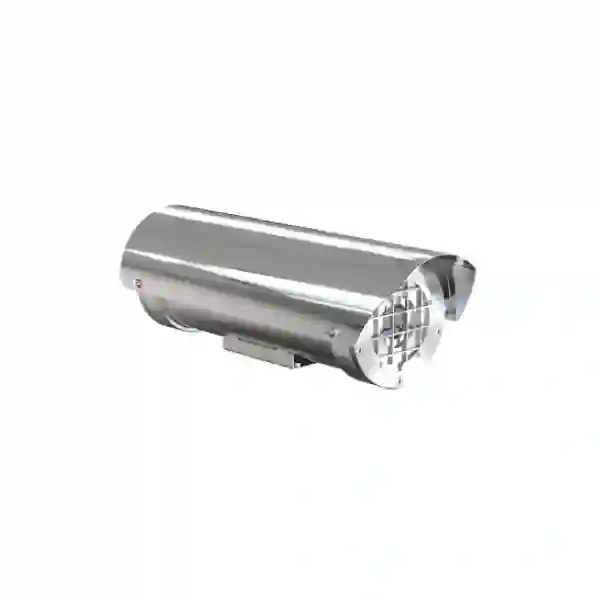
Hanwha Vision TNU-C3032A1WT1-M QVGA AI Explosion-Proof Thermal Camera
The Hanwha TNU-C3032A1WT1-M is a radiometric thermal network camera with AI analytics and an explosion-protected 316L stainless-steel housing. It is designed for projects that need to evaluate temperature events and industrial activity in appropriately classified hazardous locations. For Tanzania procurement, confirm the exact site classification, fixed-lens coverage, power supply, camera integration, and certification before requesting a project-specific quotation.
Exact-model specification snapshot
The following values are drawn from Hanwha Vision’s product specifications. Confirm current versions of the manufacturer datasheet, certifications and installation instructions before approving the design.
| Native thermal sensor | 384 × 288 uncooled microbolometer |
|---|---|
| Video outputs | 384 × 288 and 768 × 576 |
| Frame rate | Up to 8 fps |
| Focal length | 9.7 mm fixed |
| Field of view | Approximately 38° horizontal × 29° vertical |
| Minimum object distance | 2.8 m |
| Temperature range | −40°C to 550°C |
| Temperature accuracy | ±2°C to 150°C; ±15% above 150°C |
| Temperature monitoring | 10 polygonal regions; spot readings |
| Analytics | People, vehicles, lines and defined areas |
| Power | 24VAC |
| Housing | 316L stainless steel; IP66 and IP67 |
| Video / API | H.265, H.264, MJPEG; ONVIF S/G/T/M |
| Storage | One microSD-family slot, up to 1 TB |
| Operating ambient | −40°C to +60°C |
A buyer’s guide to the exact model
The Hanwha TNU-C3032A1WT1-M is an explosion-protected, radiometric thermal network camera developed for industrial observation in suitably classified hazardous environments. Its value is the combination of infrared temperature monitoring, AI-assisted event detection and a robust stainless-steel enclosure. It is especially relevant when ordinary visible-light CCTV does not answer the operator’s principal question: whether a monitored surface is showing a concerning heat pattern or whether a person or vehicle has entered an important industrial area. Buyers should assess the exact model, not assume that every camera sold under an explosion-proof category has equivalent measurement, networking or certification capabilities.
For a Tanzania project, the first step is to establish the need and the safety boundary. Identify the intended zone classification, the assets to observe, ambient exposure, viewing distances, alarm responses and integration systems. Then compare those requirements with the manufacturer’s published technical details and the full certification record. Ask for a site-specific quotation after the engineering requirements are clear. This content does not claim local stock, prices, delivery times, installation coverage, separate Tanzanian approvals or manufacturer authorization on behalf of any seller; these commercial matters require confirmation.
Understanding thermal rather than visible-light imagery
The specified camera measures infrared radiation through an uncooled thermal detector, so it creates imagery based on apparent thermal differences rather than ordinary reflected visible light. This is useful when monitoring equipment temperatures and movement in scenes where bright lighting is unavailable or undesirable. A hot component can appear conspicuous even when its surface looks normal to a visible-light camera. That advantage should not be confused with all-purpose vision: thermal imagery cannot be expected to reveal surface colours, printed labels, fine text, faces or vehicle registration plates at the detail achieved by an appropriately selected optical camera.
The best imaging choice depends on the task. A security team seeking personal identification may need a certified visible-light camera with sufficient detail and lighting. A maintenance team seeking a developing thermal anomaly may place much greater value on radiometric zones and trend alerts. Some industrial projects need both streams so an alert identifies a thermal change and the second view provides visual context. Select coverage around the required evidence, rather than treating thermal monitoring as an automatic replacement for conventional surveillance.
Thermal sensor, output and frame rate
Hanwha specifies an uncooled microbolometer with 384 × 288 physical detector resolution, a spectral range of 8–14 micrometres and a thermal sensitivity of 30 mK or better. Available video resolutions are listed as 384 × 288 and 768 × 576. Importantly, the larger output dimension does not mean that the physical detector contains 768 × 576 sensing elements. For a tiny thermal target, its size in the native sensor image is still the relevant starting point when assessing measurement suitability and useful detail.
Maximum video frame rate is listed as 8 fps for the supported video formats. Eight frames per second can be adequate for many temperature monitoring and defined-area observation tasks, but it will not look as fluid as conventional higher-frame-rate CCTV. A project concerned with fast machinery, high-speed vehicles or rapidly changing transient events should assess that limitation early. Ask the integrator to demonstrate the chosen motion and alarm scenarios, using realistic distances and scene content rather than solely reviewing a static product image.
Lens field of view and minimum target distance
The manufacturer’s fixed focal length is 9.7 mm. Published viewing angles are approximately 38 degrees horizontally, 29 degrees vertically and 47 degrees diagonally, with a minimum object distance of 2.8 metres. These figures tell the designer how much of the site can fit into one fixed view. They should be considered against the dimensions of critical components such as motor housings, pipe joints, tank sections, vehicle routes or security boundaries. A camera mounted too far from a small target may show its general location without delivering enough target pixels for reliable evaluation.
A useful coverage drawing identifies camera height, orientation, near and far limits, the target’s width and the areas to be excluded from temperature alerts. Allow for structures, insulation, equipment movement, reflections and potential obstructions. The specifications also publish pan, tilt and rotate adjustment ranges, but those values should not be taken as proof of motorized PTZ or automatic optical tracking. Confirm the intended adjustment method and mounting accessories against the specific manufacturer’s installation instructions before finalizing the design.
The meaning of radiometric monitoring
Radiometric functionality means the camera can provide temperature-related data rather than only showing relative heat contrast. Hanwha lists a temperature detection range of −40°C to 550°C, spot temperature reading and up to ten user-configurable polygonal temperature regions. Monitoring conditions can be set for above, below, increase and decrease events. These features give the operator a way to watch defined parts of a process scene and investigate changes against an agreed baseline. They can be useful for planned condition monitoring in an industrial facility where access to the monitored equipment is difficult.
Thresholds need engineering context. A heat signature may shift because of a real equipment fault, changed process load, altered insulation, weather conditions or a moved camera. An alarm should therefore have a named target, reference conditions, a defined level of concern and a response procedure. Where a measured value affects a safety-critical decision, validate it with the appropriate reference instrument and the facility’s approved control strategy. A thermal camera supports awareness; the measured number alone must not be assumed to establish fault diagnosis.
Temperature accuracy and measurement uncertainty
The stated accuracy is ±2°C at or below 150°C and ±15% above 150°C. This published distinction is essential when buyers are considering relatively tight warning bands, especially for high-temperature equipment. The displayed detection range and the achievable measurement accuracy are not equivalent concepts. The difference between a warning at a process threshold and a useful operational measurement may depend on the possible uncertainty at that temperature. Record these assumptions in the project acceptance criteria instead of presenting a temperature limit as an absolute guarantee.
Thermal measurement is affected by emissivity, the target surface, reflection, apparent size, distance, atmospheric interference and viewing angle. Polished metal surfaces, small isolated hot spots, steam, smoke, nearby radiant surfaces and changing weather may all require special care. A proposal should document how emissivity and calibration practices will be handled and whether a representative target can be monitored consistently. If operators must make a high-consequence decision, design a suitable verification step and any separate certified sensing or protection equipment required.
Explosion-protection certification and area suitability
The manufacturer identifies ATEX and IECEx credentials and highlights Zone 1 capability for this exact model. Its product specifications list gas and dust protection descriptions including Ex db IIB+H2 and Ex tb IIIC. These are significant details for an industrial camera selection, but the precise installation approval rests on the full certificate, nameplate marking and site classification. A certified hazardous-area engineer should check gas or dust group, equipment category, applicable zones, surface temperature conditions, entry components, special conditions of use and environmental requirements before permitting installation.
Explosion-protected equipment is not necessarily suitable for every explosive atmosphere or every national regulatory framework. In particular, no claim of independent Tanzanian regulatory authorization follows simply from an international certification statement. Site management should assess current local and facility-specific requirements alongside the manufacturer’s technical documents. Procurement teams should request the latest certificate revision, installation manual and any applicable drawings as part of the quotation package. Correct selection and installation are as important as the presence of an explosion-proof label.
Stainless construction, ingress protection and exposure
Hanwha describes a 316L stainless-steel body with electropolished welded assemblies and a standard mirror finish. The manufacturer’s environmental ratings include IP66 and IP67, with an operating ambient range of −40°C to +60°C. Stainless construction can be valuable at demanding industrial sites, including some corrosive or salt-exposed conditions, but the material does not guarantee resistance to every chemical or cleaning agent. Environmental suitability depends on the complete assembly and the nature of the site’s contamination, temperatures, mechanical exposure and maintenance methods.
The listed dimensions are 480 mm by approximately 176 mm diameter. Space around a mounting point must allow correct installation, view adjustment, cabling and authorized maintenance. Ingress protection depends on the specified enclosure, cable entries and correct assembly; an incorrectly selected gland can undermine the overall installed protection. A site survey should review cleaning processes, vibration, structural loading, weather direction and proximity to hot surfaces. Equipment, mounts and cable accessories all need to be appropriate for the working environment.
AI analytics for people and vehicles
The exact-model feature list includes person and vehicle classification, object detection and defined-rule events such as virtual line crossing, direction, loitering, intrusion, entry and exit. The BestShot function supports thumbnail-based event review. These capabilities can help a monitoring team understand movement near controlled boundaries, service routes, machinery access areas or other important industrial locations. They should be configured for a clear operational purpose instead of enabling every available rule and creating an unmanageable volume of alerts.
Performance depends heavily on camera position, thermal contrast, obstructions, crowding and scene conditions. Operators should test representative people and vehicles at the expected near and far distances, including movements at the edge of the view. A correctly classified event is useful evidence, but it is not a substitute for a safety interlock or physical access-control system. Document expected behaviour, define who receives the event and decide how that person verifies it before taking action.
Additional analytics and monitoring use cases
Hanwha lists motion detection, tampering, audio detection, sound classification, shock detection, temperature detection, temperature-change detection, tank-level detection and virtual-area appear or disappear events. The availability of these options makes the device adaptable to several industrial workflows. However, a named analytic is not an assurance that it will work reliably on every type of tank, machine, process surface or acoustic environment. An integrator should confirm the specific scenario with representative operating conditions and a clear acceptance test.
For instance, a thermal tank-level indication requires a useful visible temperature boundary under the actual process conditions. A vibration event needs a definition of what constitutes an abnormal occurrence. A virtual line crossing should be designed around the path that matters rather than a convenient screen position. Focus on a small number of meaningful, testable events and add additional functions only after staff understand how each alert will be received, investigated and documented.
Network, encoding and streaming features
Networking includes a shielded RJ-45 Ethernet port rated for 10/100/1000BASE-T. Hanwha lists H.265, H.264 and MJPEG video compression, up to ten streaming profiles and unicast support for up to twenty users. These features can assist in providing different video settings to a recorder, operator workstation or integration platform. They do not mean that every network can support unlimited viewers, full-resolution recording and all analytics simultaneously without careful bandwidth and system design.
Before deployment, specify video profiles, frame rates, bit rates, network segmentation, recorder connection and the bandwidth reserved for live and stored video. Plan what happens during congestion or a communications outage. Time synchronization is especially important where a thermal alert must be correlated with plant events. Document the necessary firewall policy and secure management path rather than exposing camera interfaces unnecessarily. Test the actual installation network before signing off the monitoring solution.
ONVIF, event transport and platform compatibility
The product’s published interfaces include ONVIF profiles S, G, T and M, SUNAPI, MQTT, RS-485 and two configurable alarm I/O ports. Hanwha also lists email and FTP image transfer, event recording, alarm output, PTZ preset handover and MQTT publication among possible actions. These features provide several potential integration routes. Nevertheless, a particular VMS, NVR, automation system or alarm receiver may support only a subset of a profile or event type.
Request version-specific interoperability testing when the system depends on event metadata, temperature readings, recorded clips or remote configuration. Confirm how the receiving platform names events, handles acknowledgements and records failures. Do not assume that MQTT alone creates a validated integration with an industrial control system. The integrator should identify the network path, receiving interface, security credentials and alarm escalation rules, then record a successful end-to-end test with the actual deployed software.
Recording and microSD considerations
The camera has a manufacturer-listed single microSD, SDHC or SDXC slot with support up to 1 TB. Depending on configuration, event-triggered recording can be directed to local or supported network storage. This gives project teams several retention options, but local removable storage should not be treated as a complete evidence-protection strategy. Capacity depends on codec, bit rate, recording schedule, event frequency and scene activity. Card endurance and the operational consequences of a damaged or inaccessible card must also be considered.
Create a recording schedule based on the site’s real retention policy. Determine what operators need to replay, how files are exported, how timestamps are validated and which events must be retained centrally. If recording is needed during a network interruption, test the actual failover behaviour and subsequent retrieval workflow. A thermal image without the relevant threshold, camera identity and event time can be difficult to interpret later, so preserve context as part of the alarm record.
Electrical supply and correct cable entries
The specified power input is 24VAC. An Ethernet connector does not by itself establish that the camera accepts PoE, so designers should not substitute a network switch power output for the documented supply. An approved electrical plan needs to consider supply rating, distribution protection, voltage drop, earthing, surge exposure, isolation and access for authorized work. The exact hazardous-area installation procedure and approved wiring method must be followed independently of the nominal voltage.
Hanwha lists a compatible conduit entry associated with one-half inch and M20 dimensions. Cable gland selection, sealing arrangements, protective conduit, separation, enclosure terminations and bonding need review against the current drawings and certificate conditions. Other components in the installed system may have different environmental or hazardous-area requirements. A qualified contractor should document cable routes, circuit identification and inspection results rather than assuming that a certified camera makes ordinary accessories suitable for the same zone.
Cybersecurity and access control
Hanwha specifies secure boot, signed and encrypted firmware, credential encryption, secure communications, IEEE 802.1X options, IP-based access controls, auditing and TPM support. These built-in functions are helpful in a connected industrial monitoring system. Their existence does not mean that the installation is secure by default. Weak administrative credentials, an exposed management interface, outdated firmware or an uncontrolled remote connection can still create avoidable risks.
Use a recorded commissioning baseline with named access roles, controlled configuration changes and secure time synchronization. Keep the device in the site’s asset inventory and determine who may update software or export recordings. Review firmware compatibility before change windows and preserve the previous configuration for recovery. Security monitoring should also detect a missing camera, failed recording or blocked event path so that absence of alarms cannot be misinterpreted as healthy conditions.
Practical site survey checklist
Before proposing a camera position, record the hazardous-zone classification, the exact targets, the required thermal threshold range and the physical environment. Measure mounting height, near and far target distances, required field width, obstacles and available line of sight. Ask operators about changes between normal production and shutdown periods, including dust, steam, maintenance movement, heat sources and temporary structures. A camera that sees an asset in a drawing may lose useful coverage during ordinary daily operations.
The survey should also capture 24VAC availability, the Ethernet route, cable entry constraints, mounting support, equipment clearances, recording system, control-room workflow and permitted access for maintenance. Where temperature measurement is a principal objective, discuss emissivity and an independent reference check. The outcome should be a documented viewing plan with a device schedule, not just a preferred wall or pole. A survey helps avoid paying for an advanced camera that cannot achieve the required scene geometry.
Commissioning the radiometric functions
Start by confirming that the delivered model, certification and installed accessories match the approved specification. Set the image orientation, define the monitored areas and establish a representative baseline while the process is operating normally. Compare relevant temperature indications with a suitable reference method where a meaningful measurement tolerance is required. Test selected alarm settings using a controlled and safe method, and capture both the observed camera result and the action at the receiving platform.
An acceptance record should identify the monitored target, temperature region, threshold, operating state and expected operator response. Test threshold crossings, event records and notification delivery while recording the exact configuration. Where a condition cannot be safely recreated, document the alternative verification method and any resulting limitations. After commissioning, avoid unauthorized threshold changes; a small setting adjustment can alter the alarm burden or cause a developing abnormal condition to be missed.
Validating the AI event rules
Test person and vehicle rules with representative targets at the intended distances and directions of travel. Include approaches near the edges of the field, normal shift activity and foreseeable visual obstructions. Verify that line crossings, entry and exit zones, tampering events and other configured functions produce the right result in the VMS. Do not assume that a camera successfully displaying a video stream has demonstrated successful alarm delivery or reliable object classification.
For each rule, define an acceptable outcome, a review process and a documented exception. A nuisance alarm may reflect a poor region choice, changing thermal background or unsuitable placement rather than a defective camera. Changes should be based on recorded evidence and retested with the site team. Operators need to know whether an event is a request to review footage, a reason to call personnel or a predefined escalation that requires additional confirmation.
Responding to industrial temperature alerts
A useful alert starts an operational workflow. The monitoring team should receive the camera identity, the relevant viewing area, the observed condition and a time stamp. It should be able to inspect the thermal image and compare the event with process data or an authorized local check. The response plan can distinguish a maintenance investigation from a security incident, a communications failure and a genuine process emergency. These decisions belong to the site’s procedures and responsible staff.
Where heating can indicate a serious hazard, do not let a single camera alert replace the independent detection and protection required by the facility’s risk assessment. Configure escalation, acknowledgement and record retention appropriately, and review repeated nuisance triggers. A successful implementation reduces ambiguity: it makes clear what was detected, what evidence supports the concern, which uncertainty remains and who should take the next action.
Routine inspection and maintenance planning
Regular inspection should confirm that the camera view is unobstructed, temperature zones remain aligned with their targets and alerts reach the intended recipient. Review network reliability, storage health, recorded clips, time synchronization and any unexpected configuration changes. Dirty windows, new reflective equipment, moved machinery or altered process conditions can undermine temperature interpretation without the camera reporting a device fault. Keep a maintenance log and revisit baselines whenever the scene materially changes.
In classified hazardous areas, inspection and any work involving seals, cable entries or protected enclosures must follow authorized procedures and the certified installation instructions. Do not replace components based only on matching physical dimensions. Confirm compatibility, certificate constraints and replacement documentation. Plan service windows and inform the control room when monitoring is unavailable. If a device is temporarily offline, record how the site will cover that loss of visibility.
Compare it with other solution types
A conventional industrial visible-light camera may be preferable for detailed optical identification, while a different thermal sensor or lens may be needed for a very small distant target. Non-radiometric thermal imaging can be suitable where only heat-pattern visibility is needed, but it cannot automatically substitute for the temperature-reading requirements of a radiometric application. A different certified camera class may be necessary where the site classification differs from the rating shown for this exact model.
For safety-critical control, calibrated process sensors, certified fire or gas systems and independent protective equipment may be required. A multi-sensor or bi-spectral assembly can be useful when operators need thermal analysis together with colour context. Evaluate options using target resolution, temperature accuracy, environmental ratings, certification, integration, installation cost and ongoing maintenance. The least expensive camera body is not necessarily the lowest-risk or most economical complete solution.
Tanzania installation and procurement context
For an industrial site in Tanzania, the project location and operating environment affect the practical requirements. Some sites may face heat, airborne dust, corrosive exposure, vibration or intermittent power and connectivity. These are planning possibilities, not claims about any individual location. The stated enclosure material and environmental limits help engineers evaluate exposure, while the power and network design must be assessed as a complete system. Do not assume that cameras, mounts, glands and switches share identical ratings.
Confirm locally applicable site procedures, import and procurement obligations, insurance conditions and any required authority approvals through the responsible parties. There is no verified local price, stock status, installation coverage, warranty arrangement or separate Tanzanian certification claim in this description. Ask the supplier for current equipment availability and terms, a complete bill of materials, certificate documentation and a clear scope of work covering configuration, integration, acceptance testing and future support.
What to provide when requesting a quote
Provide the exact manufacturer and model, quantity, classified-area details, expected gas or dust conditions, mounting positions and the monitored target dimensions. Explain whether the objective is asset temperature monitoring, personnel and vehicle events, security observation or a combination. Include the desired alarm threshold approach and any existing VMS or NVR platform. Mention available 24VAC power, network topology and the recording retention requirement. Drawings and photographs from permitted locations can help engineers determine whether the fixed field of view is appropriate.
Ask the quotation provider to identify which parts are included, what documentation is supplied, whether the current certificate and installation accessories suit the classified area, and which installation responsibilities are excluded. Request confirmation of local availability and delivery terms rather than assuming either. A serious proposal should define test criteria for temperature events, video integration, cybersecurity and alarm delivery so procurement can compare an actual operating solution instead of a model number alone.
A plan for resilient operation
Consider what will happen when there is a power cut, network interruption, loss of storage, changed threshold, damaged cable or missed operator alert. An outage or silence is not evidence that an industrial process is normal. Assign responsibility for device-health monitoring, scheduled alarm tests and backup procedures appropriate to the site’s risk. If the camera is one of several information sources in an operations centre, identify which source takes priority when they disagree and how the difference should be investigated.
Handover should include current settings, a topology diagram, alarm rules, a list of monitoring zones, expected normal readings, support responsibilities and an accessible inspection plan. Train staff on both capabilities and limitations: a thermal colour palette is a visualization, an apparent hot spot may need verification, and video loss can conceal a real event. These operating arrangements often determine how useful an advanced camera becomes after the initial installation.
Frequently asked questions
Does this model provide temperature readings?
Yes. The manufacturer specifies a −40°C to 550°C radiometric detection range, spot reading and as many as ten configurable polygonal temperature zones. The accuracy specification changes above 150°C, so the measurement conditions and intended threshold must be evaluated before treating a value as an operational limit.
Is the detector resolution 768 × 576?
No. The native microbolometer is 384 × 288. Hanwha also lists 768 × 576 as an available output resolution. The larger video setting should not be interpreted as an increased physical thermal sensor resolution or a guarantee that small distant targets are measurable.
Is it suitable for all hazardous areas?
No. Hanwha identifies ATEX and IECEx protection credentials, but a competent engineer must compare the full current certificate, equipment marking and installation instructions with the site’s exact classification. Separate national, site or authority approval requirements may apply.
What does QVGA mean for video quality?
QVGA indicates a relatively low native thermal imaging resolution compared with visible-light CCTV. The camera is intended for heat analysis and event awareness, not identification-quality optical detail. Performance depends on distance, the lens field of view and how many detector pixels cover the target.
Can it distinguish people from vehicles?
Person and vehicle classification is listed among the onboard AI features. Virtual line and virtual-area events are also available. A site test is needed to assess how well those functions work in the intended industrial scene and how events appear in the receiving software.
Does it support ONVIF?
The manufacturer lists ONVIF profiles S, G, T and M along with SUNAPI. This is a starting point for integration, not a guarantee that every third-party recorder supports all telemetry, alarms and metadata. Verify the exact software, firmware and event requirements.
Is the lens motorized?
The product is specified with a fixed-focus 9.7 mm lens. Published pan, tilt and rotate ranges should not be assumed to mean remotely motorized PTZ movement. Check the current installation documentation for the precise mounting and adjustment arrangement.
Can I use PoE to power the camera?
The published input voltage is 24VAC. Do not infer PoE compatibility from the presence of an Ethernet connector. Have the electrical designer provide the specified input and review all cabling and entries against the hazardous-location requirements.
What recording capability is available?
Hanwha lists one microSD-family card slot up to 1 TB, and event-recording capabilities. Actual retention depends on the stream bit rate, recording schedule and card endurance. Check any VMS or network-storage requirements separately.
What is the enclosure made from?
The product is listed as 316L stainless steel with electropolished welded assemblies. IP66 and IP67 environmental ratings are published. Suitability for a specific chemical or marine atmosphere must be established using the site’s exposure conditions and the manufacturer’s instructions.
Can the camera replace a certified shutdown system?
It should not be assumed to be a stand-alone safety-rated fire, gas or emergency shutdown instrument. Thermal alarms can aid industrial awareness, but critical protective functions should be engineered with the independent and certified measures required by the facility’s risk assessment.
How do I obtain a quotation in Tanzania?
Send the exact model, quantity, site classification, monitoring objectives, target distances, electrical and network requirements, and integration needs. Request confirmation of current supply terms, certificates and accessories. Local price, stock, installation service and any project approvals need explicit confirmation.
Request a technical quotation in Tanzania
To evaluate the Hanwha TNU-C3032A1WT1-M for your industrial site, contact FourTeck Tanzania with the quantity, site area classification, target distances, temperature conditions, power and network information, and intended video or alarm system. Request confirmation of current certificates, compatible accessories, engineering responsibilities, supply terms and price for the actual project. This product should be specified against a documented application rather than a generic hazardous-area description.
Next step: Request model confirmation and a project-specific quote from FourTeck Tanzania.




Reviews
There are no reviews yet.