
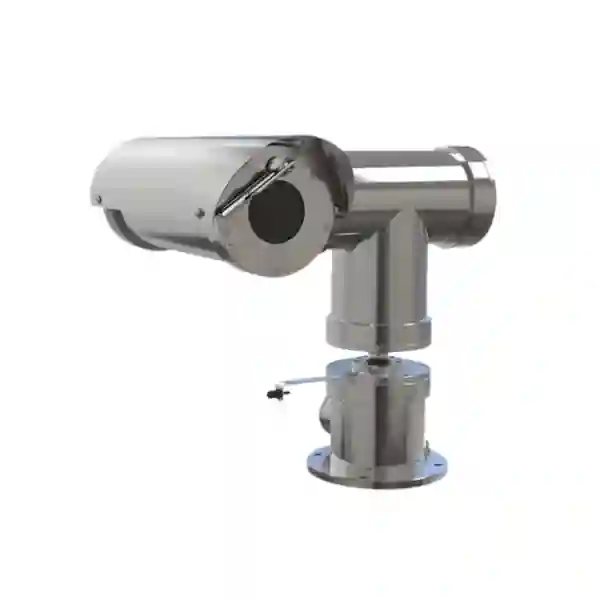
Hanwha TNU-X6320E1F2WT1-C Explosion-Proof PTZ Camera
A 2MP, 32× optical-zoom positioning camera with single-mode fibre, integrated wiper and 24 V AC power for carefully engineered industrial monitoring. Review the exact hazardous-area requirements and the model’s lifecycle before selecting equipment for a Tanzania project.
Important: this exact model is discontinued
Hanwha Vision identifies TNU-X6320A1F2WT2-C as the replacement. This product information describes the legacy TNU-X6320E1F2WT1-C and does not imply current stock, authorised local supply or a guaranteed installation approval. Request a technical review for the original part or the current alternative.
Verified technical specifications
These are manufacturer-listed details for the precise legacy model, not an approval of an installation or a statement about available stock. Review the current manufacturer documentation if procurement or engineering depends on a particular parameter.
| Product type | Explosion-proof network PTZ positioning camera |
|---|---|
| Exact model | TNU-X6320E1F2WT1-C |
| Image sensor | 1/2.8-inch CMOS |
| Maximum resolution | 1920 × 1080 (2MP) |
| Frame rate | Up to 60 fps (H.265/H.264, 60 Hz mode) |
| Lens | 4.44–142.6 mm; 32× optical zoom; autofocus |
| WDR | 150 dB, manufacturer specified |
| Camera movement | 360° pan; −90° to +90° tilt |
| Video codecs | H.265, H.264, MJPEG; WiseStream II |
| Optical network | Duplex single-mode 9/125 µm, F2 version |
| Local storage | Two microSD/SDHC/SDXC slots; total up to 512 GB |
| Input / maximum draw | 24 V AC / 80 W |
| Ingress protection | IP66 and IP67 |
| Housing material | STS316L stainless steel |
| Operating range | −40°C to +60°C |
| Approximate mass | 53 kg |
| Integrated feature | Window wiper |
| Variant marking | cLC CSA; verify exact certificate |
| Lifecycle | Discontinued; replacement TNU-X6320A1F2WT2-C |
An industrial positioning camera, not an ordinary PTZ
The Hanwha TNU-X6320E1F2WT1-C explosion-proof PTZ camera was designed for sites where a conventional outdoor camera may be unsuitable because of the assessed installation environment. Its combination of protected construction, motorised positioning and network video makes it relevant to engineered surveillance systems in industrial facilities. It is not simply a standard CCTV camera placed inside a weatherproof shell. The enclosure, interfaces, installation method and applicable approval documents must all be considered as part of a hazardous-area design. A site engineer must decide whether the precise version and installation arrangement are suitable for the classified location.
A practical starting point is the surveillance task: what equipment or access route must operators observe, from which mounting point, at what distance, and under which lighting conditions? This model offers full-HD imaging, optical magnification and controllable movement. Those features can help a control-room operator inspect different parts of a process area without asking a person to approach it. They do not, by themselves, establish that the camera is permitted for every industrial zone. Confirm the complete project specification before selecting an enclosure or approving installation.
Lifecycle status should lead the purchasing decision
Hanwha Vision currently marks TNU-X6320E1F2WT1-C as discontinued and identifies TNU-X6320A1F2WT2-C as its replacement. That is essential purchasing information rather than a minor note. A discontinued model may still appear in old bills of materials, maintenance manuals and procurement records. However, its previous listing does not prove that new stock, spare parts, firmware, replacement assemblies or new-project support remain available in Tanzania. The safest approach is to distinguish a like-for-like legacy replacement request from a new system design.
For an existing site, record why the exact older part number is needed: existing wiring, approved hazardous-area drawings, viewing angles, mounting hardware, network arrangements or maintenance procedures may be involved. For a new installation, compare the current replacement using its own latest datasheet and hazardous-area certificates. Do not assume that similar-looking part numbers have identical environmental limits, field-of-view figures, dimensions, brackets or approval scope. Request written confirmation for the proposed model and the project conditions before committing the design or issuing a purchase order.
Full-HD video and frame-rate planning
The manufacturer’s specification lists a 1/2.8-inch CMOS image sensor and a maximum 1920 × 1080 image size. Under the specified H.265/H.264 modes, the camera can deliver up to 60 frames per second on a 60 Hz setting or 50 frames per second on a 50 Hz setting. MJPEG has a lower stated maximum. These figures establish the camera’s imaging capability, not a guarantee that every recording profile will run at the same resolution, frame rate and compression setting simultaneously.
For many industrial monitoring tasks, the right frame rate depends on the motion being observed. A process with fast mechanical activity or moving vehicles may justify a higher rate than a quiet perimeter. Higher frame rates can also increase network and storage demands, depending on compression and scene complexity. Specify the required evidential detail, not just the largest number in a brochure. Test image quality at the installed position, including the final NVR recording settings, and verify whether the needed frame rate is supported across the actual software integration.
Understanding 32× optical zoom
The lens covers a manufacturer-listed focal length of 4.44 to 142.6 mm, with 32× optical zoom and autofocus. Optical zoom is useful when an operator needs a closer view of a distant tank fitting, gate, vehicle route or processing structure while retaining real image detail. The camera also lists digital zoom, but digital enlargement should not be treated as a substitute for adequate optical resolution. At maximum zoom, the scene becomes much narrower, which is valuable for inspection but less useful for broad awareness.
Designers should define at least two views for each proposed camera position: a wide context view for locating incidents and a tighter view for the operational question. A successful test should show whether personnel, labels, equipment states or vehicle activity are actually recognisable at the distances involved. Heat shimmer, rain, dust, haze, vibration and foreground obstructions can all restrict usable detail. The nominal zoom ratio alone does not establish a dependable detection or identification distance for a particular facility.
Field of view and scene composition
Hanwha Vision lists an approximate horizontal field-of-view range of 61.8 degrees at the wide end to 2.19 degrees at the telephoto end for this exact model. That difference is significant. At the wide end, the camera can cover a substantial section of an installation from one mounting position. At the narrow end, a small aiming error or vibration can move an important object outside the picture. The best placement therefore considers both the overview and the detailed inspection view.
Draw a simple view plan showing the camera location, target directions, fixed structures and any moving equipment. Check for blind spots caused by pipes, platforms, barriers, vehicles and seasonal vegetation. Keep in mind that PTZ cameras watch where they are pointed at that moment; they do not provide simultaneous, persistent full-area coverage from every direction. If simultaneous observation is essential, additional fixed cameras may be needed. A well-designed network camera system often combines PTZ investigation views with fixed evidential views.
Low-light performance without exaggerated claims
The manufacturer lists minimum illumination figures of 0.05 lux in colour and 0.005 lux in monochrome under specified test conditions. Automatic infrared-cut-filter switching supports day-and-night operation. These are useful indicators when considering a site with changing light, but they do not mean the camera can produce an identifiable picture in complete darkness. No integrated infrared illuminator is established here, and an explosion-proof housing should never be assumed to include night-lighting equipment.
For a Tanzanian industrial site with overnight operations, survey actual lighting at the area being monitored rather than relying only on the published lux figure. Examine work lights, security floodlights, emergency illumination, reflections from metal surfaces and periods when lighting may be switched off. If additional lighting is required, its electrical arrangement and suitability for the assessed area need separate engineering review. Ask for sample footage under representative conditions. A usable night-time image depends on target movement, exposure time, contrast and atmospheric conditions as well as sensor sensitivity.
Wide dynamic range around bright process lighting
The legacy TNU-X6320E1F2WT1-C is specified with 150 dB wide dynamic range. This feature is relevant when an installation includes a bright entrance, sunlit yard, reflective steelwork or strong lighting beside darker machinery. Without effective exposure handling, bright highlights may become white areas while shaded regions lose useful detail. Wide dynamic range helps the image-management system represent both brighter and darker areas, subject to scene conditions and configuration.
During commissioning, compare different exposure and WDR settings at the time of day when the lighting difference is greatest. Check whether the picture preserves the actual operational detail you need, not just whether it looks pleasing on a display. Also consider the manufacturer’s high-light compensation, backlight compensation and digital noise-reduction features. Aggressive adjustments can have side effects such as noise, motion artefacts or a less natural image. Because the manufacturer lists different WDR specifications on the successor model, do not describe the replacement as numerically identical without reviewing its separate documentation.
Automatic focusing, stabilisation and defog
Autofocus helps an operator move between wide-angle observation and a magnified view without manually adjusting the lens for every change. Manual and one-shot focus controls are also listed, making them relevant where the camera repeatedly views a difficult target. The product additionally supports digital image stabilisation with a built-in gyro sensor, along with digital defog. These features can help operators cope with changing camera positions and reduced-contrast scenes, but they do not physically remove every source of blur or atmospheric obstruction.
Mount vibration should be handled structurally before it is treated as a video-processing issue. A camera observing from a steel tower, elevated platform or pipe rack can experience motion that becomes more visible at telephoto settings. Inspect the proposed fixing, wind exposure and maintenance access. Digital defog may improve some hazy images, yet dense smoke, condensation, contaminated glass and severe weather still require a practical visibility plan. Document the best settings for each site instead of assuming that default automatic controls will suit all operating conditions.
Pan-and-tilt positioning in working environments
The specified mechanism covers 360 degrees of pan and a tilt range from −90 degrees to +90 degrees. The manufacturer’s published preset speeds are up to 45 degrees per second for pan and up to 24 degrees per second for tilt. These figures support a useful operator-controlled positioning camera rather than a permanently fixed scene. They can be applied to inspection presets for entrances, process vessels, loading bays or equipment routes, subject to the site’s operational procedures and safety boundaries.
A realistic design should identify the number of meaningful positions, the sequence in which they are used and how operators return to the most important view. Establish whether a camera will mainly support manual investigation or spend more time observing a defined priority scene. The availability of pan-and-tilt movement does not eliminate the risk of an incident occurring outside the current view. Define operational responsibility for PTZ control, and test whether the selected NVR or VMS provides the required controls and permissions.
Window wiper and outdoor visibility
The integrated window wiper is a distinctive advantage in environments where rain, spray or deposited moisture can affect the camera window. A wiper can help restore visibility without an operator immediately travelling to the mounting point. It should be thought of as a practical maintenance aid rather than a promise of uninterrupted clear pictures. The wiper does not remove every kind of dirt, chemical deposit, paint residue or abrasion, and frequent use on a contaminated window may not solve the underlying problem.
Determine whether the selected location will encounter salt deposits, process dust, splashing water or airborne material. A maintenance plan may still require approved cleaning methods, inspection of the window and checking of the wiper mechanism. Some installations may consider a separate washer system, but any accessory must be confirmed for the exact camera model and hazardous-area requirements. Never assume that all similarly named Hanwha washers, tanks or mounting parts are interchangeable with this legacy camera.
316L stainless steel and ingress protection
Hanwha Vision specifies stainless steel grade STS316L construction and IEC 60529 IP66/IP67 ingress protection. These characteristics matter where outdoor equipment can face water, dust and corrosive exposure. IP ratings address defined ingress-testing conditions. They do not, on their own, establish explosion protection, chemical compatibility, resistance to every cleaning agent or suitability for all hazardous locations. Material selection, seals, cable entry and correctly installed accessories remain important to the overall assembly.
For installations in Tanzania, consider the local exposure at the exact mounting position: rain-driven moisture, high humidity, coastal salt, cleaning operations, heat from nearby machinery and potential process contamination. Inspect whether other components such as glands, brackets and exposed fasteners are specified for the same environmental requirements. The camera is only one element of the outdoor assembly. Do not extrapolate stainless-steel construction into a blanket claim that the complete installation will be maintenance-free or immune to corrosion over its service life.
Temperature range and real installed conditions
The manufacturer lists an operating temperature of −40°C to +60°C and a non-condensing operating-humidity condition of up to 90 percent relative humidity. These limits are device specifications, not site-weather forecasts. Even a country with generally warm weather can have equipment exposed to direct sun, heat from industrial plant, high humidity or unusual local microclimates. The camera’s own dissipated power and the installation position should be considered together with the ambient-air temperature.
Confirm the conditions at the intended mounting point during actual plant operation. Avoid using a sheltered weather-station temperature as a substitute for the air surrounding a camera above a roof or close to hot equipment. The mounting arrangement should permit the manufacturer’s specified installation clearances and service procedures. If an engineering specification calls for a different range, do not alter this model’s rating in the quotation. A similarly named temperature variant or successor may have different limits and needs independent model-specific verification.
Explosion-proof suitability requires a site classification
The product is described as an explosion-proof positioning camera and its manufacturer documentation lists cLC CSA-related certification information for the C variant. The exact certificate, hazardous-location classification, installation restrictions and acceptable wiring method must be reviewed by the responsible competent engineer. Different certification systems and area classifications are not automatically interchangeable. The term explosion-proof in a catalogue must not be treated as permission to install any camera in every area containing flammable material or combustible dust.
Begin with the facility’s formally documented hazardous-area classification and applicable project standards. Obtain the exact model’s certificate and current installation instructions, then compare the certified protection concept, permitted environment and installation details against the drawings. Examine cable entries, glands, conduits, grounding, segregation and any special conditions of use. Where local approval or inspection is required, confirm it with the appropriate project authority. This page does not establish Tanzanian regulatory acceptance or certification for a particular classified zone.
What cLC CSA does and does not tell you
The C suffix in this model is associated with the manufacturer’s cLC CSA variant. That is a useful distinction when matching equipment against a historical equipment schedule, but the model suffix should never replace the certificate document. A responsible purchaser should obtain the actual paperwork for the exact ordered configuration and have the relevant professional verify which standards, classification and installation conditions are covered. General product-family statements can mix approvals associated with different regional versions.
There may be several otherwise similar equipment codes with different certification letters, power choices, fibre options or operating-temperature variants. For that reason, quote the entire TNU-X6320E1F2WT1-C part number, not a shortened family description. Ask the supplier to repeat the complete identifier on the offer and supporting documentation. If a contractor proposes an alternative suffix, request a side-by-side compliance review before approving a substitution. Matching video resolution and zoom is not sufficient where certified equipment is required.
Single-mode fibre network interface
An important part of this exact model code is the F2 single-mode fibre configuration. Hanwha Vision identifies a duplex single-mode 9/125 micrometre module for F2 versions and also describes the network interface family using 10/100BASE-T Ethernet. The fibre option can be useful when an industrial surveillance backbone is designed around optical connections. However, stating that the camera is fibre-capable does not confirm the complete interface compatibility with an arbitrary switch, transceiver, patch lead or field termination.
Have the system integrator verify fibre type, optical-interface details, connector arrangements, available ports, patching topology and the receiving network equipment against the installation manual. Check the route length and losses using the actual optics and design information rather than inferring a guaranteed distance from the words single-mode. Also specify how the fibre connection will be protected and terminated within the applicable area-classification rules. Fibre networking does not provide electrical power to this camera; the separate 24 V AC supply still needs engineering.
24 V AC power and electrical design
The camera is specified for 24 V AC input and a maximum power consumption of 80 W. This point deserves prominence because purchasers sometimes assume all modern network cameras can run from PoE. Do not write a PoE requirement into the installation plan for this model without a manufacturer-approved power arrangement. Power transformation, protective devices, isolation, cabling, voltage drop, fault conditions and grounding must be designed for the exact equipment and installation environment.
The system designer should check the available utility supply, the location of suitable power equipment and the consequence of an outage. Where power continuity is needed, evaluate a properly specified backup supply that can support the camera and its necessary network components. Any electrical enclosure or accessory installed in a classified area needs its own appropriate review. Before commissioning, verify the actual input at the camera under load and document the protection arrangement. Never substitute a different voltage simply because another product in the same broad series uses it.
Structural mounting for a heavy positioning camera
The manufacturer lists a product weight of approximately 53 kg and overall dimensions of about 480 × 512 × 475 mm. This is a substantial piece of equipment, so a typical light-duty CCTV bracket should not be selected by appearance alone. The supporting structure must accommodate the static load, dynamic movement, wind action, maintenance activities and any additional approved mounting components. Access for lifting and safe installation can also affect the total project cost.
Ask a qualified structural or installation engineer to validate the complete assembly, including anchors, welded supports, corrosion exposure and maintenance access. Check the manufacturer’s approved bracket and fixing instructions for the exact variant. An existing support that holds a smaller camera should not be presumed sufficient for a 53 kg assembly. Reserve the necessary space for pan and tilt without collisions, and avoid routing cables where movement can create damage. If upgrading to the identified replacement, reconfirm the dimensions and weight rather than reusing the old mount automatically.
Video compression and practical network capacity
The camera supports H.265, H.264 and MJPEG, with the manufacturer’s WiseStream II function identified for efficient encoding. Video compression can make continuous monitoring more manageable, but actual bandwidth depends on the chosen resolution, frame rate, scene movement, image noise and codec settings. A camera looking at a static fence may behave differently from one observing rain, moving machinery and rapidly changing light. The best system design allocates capacity for demanding scenes rather than relying on a single ideal laboratory bitrate.
For every planned camera, calculate expected and peak traffic for the required video streams, then include sufficient headroom for network overhead and other devices. Validate the compression mode with the selected recording and viewing systems. Different clients may request different stream profiles, and simultaneous viewing affects the design. The camera’s network features should be checked against the switch configuration, transport path, access-control policy and any available monitoring tools. A fibre connection improves media choice but does not remove bandwidth or recorder limitations.
Multiple streams and control-room workflows
Hanwha Vision specifies up to ten streaming profiles and up to twenty unicast users for this model, with multicast support also listed. These capabilities help explain how one camera may supply different streams to a recorder, operations display and engineering workstation. The number of possible streams does not mean that every combination of resolution and frame rate will be available at once, or that a wider system can support unlimited viewers without planning.
Define which system receives the recording-quality stream and which clients can use a lower-bandwidth monitoring profile. Decide who has permission to control the PTZ mechanism and how a manual investigation takes precedence over an automated tour or preset. In a plant, different users may have different needs: security staff may require rapid response, while engineers may need a carefully framed inspection view. Test these workflows against the actual VMS configuration. Smooth camera movement and efficient streaming should be evaluated together, not as separate purchasing checkboxes.
Local recording and evidence continuity
The manufacturer’s specifications include two microSD/SDHC/SDXC slots supporting up to 256 GB per slot, for a total stated capacity of up to 512 GB. Edge storage can be useful as part of a system-level recording strategy, especially when the network path is temporarily unavailable. It should not be represented as an unlimited archival solution. The achievable retention period depends on the active streams, motion levels, compression, recording schedule, card capacity and any operational requirements for evidence preservation.
Designers should specify the primary recording system first, then decide whether on-camera storage is needed as an additional layer. Confirm compatible media types, any manufacturer-recommended endurance characteristics and how recorded material is retrieved. A security plan may also require tamper-resistant handling, accurate timestamps, controlled export permissions and documented retention rules. Test network-failure behaviour rather than assuming every VMS will seamlessly restore missing footage. Avoid specifying an unsupported retention duration or describing removable media as a substitute for managed backups.
Video analytics as an operator aid
Listed analytic functions include motion detection, tampering, fog detection, shock detection, face detection and defined virtual-area or virtual-line events. These can support notifications and guide operators towards important activity. They are not a guarantee that every hazard, intrusion or unusual process condition will be detected correctly. Analytics outcomes depend on camera angle, image detail, light, weather, obstructions, scene configuration and thresholds.
Choose each rule according to an actual operational question. For example, a virtual line might identify activity along a restricted access route, while a tamper alert may help staff notice a changed camera view. Test false alerts generated by rain, shadows, reflections and normal equipment motion. Decide who receives notifications and what response is expected. Document zones, schedules and sensitivity settings during commissioning. Never treat general CCTV analytics as a substitute for an engineered process-safety system, gas detector, fire alarm or other equipment specifically intended to protect life and plant.
Integrating recorders, software and existing networks
Manufacturer specifications identify ONVIF Profiles S and G and the Hanwha Vision SUNAPI interface. These may be relevant to interoperable recording and control applications, but the words ONVIF-compatible do not prove that every feature will work with every VMS or NVR version. Full integration may depend on firmware, software drivers, permissions, PTZ commands, event mapping and supported recording modes. A connection that supplies live video is not necessarily evidence that the complete operational workflow has been validated.
Before procurement, test the exact camera or a manufacturer-approved compatibility reference against the proposed system. Verify live view, recording, playback, time synchronisation, PTZ presets, user access and alarm handling. If the site already runs a network video platform, record its software version and update constraints. Check any licensing obligations with the platform provider rather than guessing. The discontinued status makes it particularly important to confirm whether the legacy hardware and firmware remain supported in the project’s current software environment.
Cybersecurity and controlled remote access
The camera’s published network-security functions include HTTPS communication, IEEE 802.1X authentication options, digest user authentication, IP-based access control and logging. These features can help support a more controlled deployment but are not a substitute for an overall cybersecurity plan. Equipment placed on an industrial network should be reviewed for firmware support, account management, network segmentation and secure access from authorised workstations. Legacy-product lifecycle status can affect the long-term security approach.
Use strong unique credentials, least-privilege permissions and restricted management access. Place the camera on an appropriately managed network segment, keep unnecessary services disabled where feasible, and monitor login or system events according to site policy. For remote troubleshooting, use an authorised protected access path rather than exposing the camera directly to the public internet. Obtain the manufacturer’s current support information before planning updates. Industrial change-control procedures may require testing firmware or configuration changes in a controlled manner prior to applying them on an operational site.
A realistic deployment assessment for Tanzania
For a facility in Tanzania, a successful selection begins with the site’s conditions, not an assumed nationwide installation pattern. A mining operation, industrial processing plant, marine-adjacent site and fuel-handling facility may present very different hazards and environmental loads. The specific location, classification documents, network infrastructure and operational objective determine suitability. This page does not claim a local certification, general service coverage, stock position or installation authorisation for this camera.
Prepare a site survey that captures day and night lighting, target distances, mounting height, mechanical vibration, rain exposure, process temperature, networking routes, nearby sources of interference and maintenance access. Confirm the voltage available for the approved supply and the preferred recorder or VMS. Work with the site’s qualified electrical and safety personnel to review hazardous-area requirements. A well-prepared survey reduces the risk of acquiring technically capable hardware that later requires major redesign, special accessories or replacement because the installed conditions were not understood at quotation stage.
Industrial use case: process-area observation
One potential surveillance task is to observe selected process-area structures from a protected point without asking operators to enter the area for every visual check. The 32× optical zoom and PTZ movement can help staff review gauges, equipment surrounds and access paths when they are visible within the camera’s actual field of view. The purpose must be defined carefully: a CCTV image can inform situational awareness, but it is not a calibrated process instrument or an approved replacement for safety interlocks and direct measurements.
Choose target locations based on the real inspection procedure. Ask whether the operator must read a label, see a valve position, detect a leak-related change or simply confirm that personnel are present. Each task needs different detail and lighting. Confirm that zoomed video remains usable under vibration and weather conditions. For an area with combustible atmospheres, the hazardous-area assessment still governs all installed components. Camera selection should be part of the complete engineered monitoring scheme, not a shortcut around inspection safety.
Industrial use case: access routes and loading areas
A positioning camera may be considered for monitoring gate approaches, selected loading operations or restricted access routes within an industrial facility. Wider views can help establish what is happening around vehicles and personnel, while a tighter optical view can support investigation when a relevant event is observed. PTZ functionality is particularly useful for active operators who need to reposition the view in response to a reported incident or unusual activity.
The camera should not be the only source of continuous evidence where multiple routes must be watched simultaneously. During a detailed zoomed inspection of one vehicle, other routes may be outside its field of view. Consider fixed cameras for continuous recording of key crossing points, and define an escalation process for PTZ operators. Confirm the actual detection requirements and the visibility of moving people or vehicles under available lighting. If equipment will be installed in a classified industrial zone, obtain specific engineering approval for the model and complete wiring arrangement before work begins.
Industrial use case: remote yard and perimeter investigation
For a large industrial compound, the optical zoom and motorised positioning can assist with checking a reported issue from a control room. The model’s fibre connectivity may suit a network design in which surveillance points are connected to an optical backbone. This can be beneficial where copper networking is not the preferred media, but the actual suitability of the optics and cable route must be established by the network designer. No fixed transmission distance is guaranteed by the general term single-mode.
Assess each position for obstacles, seasonal changes in vegetation, illumination and the priority areas that must be continuously recorded. An operator may gain useful situational awareness from PTZ control while fixed cameras maintain evidence at entrances or vulnerable boundaries. The outdoor housing rating and integrated wiper can support deployment in exposed conditions, but the exact maintenance environment still matters. Do not infer that an explosion-proof rating is needed for every ordinary perimeter; this specialist product may be unnecessary where a standard outdoor camera is technically appropriate.
Industrial use case: coastal or corrosive exposure
The 316L stainless-steel construction may be relevant where material selection is affected by moisture and some corrosive environmental conditions. This can make the model worthy of technical consideration at industrial sites exposed to saline air or demanding cleaning practices. However, 316L is not universally resistant to every chemical, and the resistance of a complete installed camera depends on far more than the body material. Seals, mounting parts, cable entries and cleaning procedures must be examined individually.
Before approving equipment for a coastal or chemical environment, identify the likely contaminants and cleaning agents, their concentration and frequency of exposure. Ask for a material-compatibility assessment where necessary. Provide access to inspect external surfaces and the wiper window. Consider whether the site imposes additional requirements for fasteners, protective arrangements or washdown procedures. Do not promise a corrosion-free lifespan or a maintenance interval that has not been validated. The supplier’s exact bill of materials and the site’s engineering assessment should govern the final arrangement.
Installation planning: from survey to commissioning
A sound project moves through several distinct checks: confirm the surveillance objective, obtain the hazardous-area classification, select the exact approved hardware, design the structure, plan electrical and fibre routes, verify the recorder integration and define acceptance criteria. Carrying these decisions forward as a documented package is more reliable than ordering the camera first and leaving the difficult parts for installers on site. Especially with a discontinued model, procurement should not begin before replacement options are evaluated.
During installation, follow the manufacturer instructions and the approved project drawings. Verify mounting and lifting arrangements, approved cable entry, supply voltage, protective earthing, fibre termination and access for service personnel. Record the camera identifier and firmware version in the asset register. Commission both wide and zoomed views, day and night image quality, PTZ motion, wiper operation and all required alarm outputs. Finish with clear operator instructions so staff know how the device is intended to support monitoring and what functions it cannot perform.
Operational testing before site acceptance
An acceptance test should demonstrate the buyer’s required outcome rather than simply showing that an image appears on a monitor. Start with the specified target objects and representative conditions. Check live picture detail, the recording version of the stream, usable zoom, focus recovery, preset repeatability, visibility in strong backlight and response to normal rainfall or deposits on the viewing window. Confirm whether PTZ controls and analytic events appear in the selected VMS as intended.
Include network and power-failure scenarios where they are relevant to the site’s operating plan. Verify the behaviour of local recording, alert delivery, time stamps and restored communications. Test the practical maintenance workflow: safe access, visual inspections and wiper operation. Log any limits so operators do not rely on an untested feature during an incident. For hazardous installations, device operation is only one acceptance component; the authorised safety and electrical inspections remain separate requirements, and the project should not be declared complete without the appropriate records.
Maintenance and long-term support considerations
A specialist camera is an ongoing asset, not a one-time equipment purchase. Operators should establish procedures for safe external inspection, window cleaning, checking the wiper mechanism, reviewing logs and verifying that prescribed preset views still show the intended targets. At industrial sites, cleaning and service work may require permits, isolation or other site-specific controls. Do not recommend opening or altering a certified enclosure outside the manufacturer’s authorised instructions and the facility’s safety process.
For this discontinued model, establish how faults will be handled before there is an operational outage. Ask which spare assemblies remain supportable and whether replacement parts can be obtained through an appropriate channel. Document firmware and recorder compatibility, and retain approved configuration backups according to the site’s IT rules. When considering an equipment refresh, preserve the original hazardous-area drawings, cable documentation and field-of-view requirements. Those records can make an otherwise complex change much more manageable and help prevent an unreviewed substitution.
Legacy replacement versus a new camera project
A replacement for a failed TNU-X6320E1F2WT1-C is a different procurement problem from the design of a new site. The replacement project may have fixed mounting points, existing wiring, a limited outage window and a known VMS. Its engineering work should focus on whether the proposed substitute physically fits, meets the required approval, provides the necessary coverage and can be commissioned within the operating constraints. A visual resemblance between cameras is not a sufficient substitution criterion.
For a new project, the starting questions are wider. Do you require certified explosion-proof equipment at this mounting position? Is 2MP enough for the specified evidence task? Does PTZ control help the operator, or would several fixed viewpoints work better? Is single-mode fibre necessary, and can 24 V AC be supplied in the approved way? Compare the manufacturer’s listed successor TNU-X6320A1F2WT2-C using its current specifications. Obtain separate confirmation of availability and commercial terms rather than carrying forward information from the old model.
Procurement documentation that reduces specification errors
A request for quotation should identify the full model name, the desired quantity and whether the request is for an exact legacy replacement or an acceptable current alternative. Include the required certificate basis, hazardous-area documents, fibre architecture, supply voltage, mounting arrangement, intended VMS and operating environment. The supplier should be asked to identify any proposed deviation explicitly so the engineering team can assess it before approving the order.
Avoid using a general heading such as explosion-proof PTZ camera as the only purchase description. It leaves too much room for substitutions with different connectivity, certificates or environmental limits. Require the supplier to confirm the exact part number on the quotation, along with approved options and the documentation that will be supplied. Prices, taxes, delivery arrangements, installation services, local warranty terms and stock should be confirmed in the actual offer. None of these commercial conditions is established by the product’s historical technical specifications.
Questions for the safety, IT and maintenance teams
Hazardous-area cameras sit at the intersection of several professional disciplines. The safety team needs to know which classification applies and which certificates can be accepted. Electrical engineering needs the supply requirements, cable routing and grounding information. Structural engineering needs the real mass, loading and mounting drawings. IT and security teams need to confirm recording, network controls and account management. Maintenance teams need practical access and support arrangements after commissioning.
Bring these disciplines together before the camera is ordered. Ask each team to sign off only on the elements within its competence. A project may fail even when the camera’s optics are good if a mounting detail, spare-parts issue, fibre interface or certification requirement is unresolved. Conversely, a well-coordinated review can determine early that a more appropriate current model or a simpler fixed-camera arrangement would better meet the requirement. Record the agreed assumptions in the technical schedule and use them for both vendor comparisons and final acceptance.
How to compare quotations fairly
When comparing offers, first establish that every proposed unit meets the non-negotiable safety requirements. Only then compare the imaging and network specification. Check whether the quote includes the correct fibre option, power components, approved mounts, cable-entry accessories and documentation. A lower equipment price may conceal additional engineering or infrastructure work if the interface or installation arrangement is different from the design.
Evaluate the project cost as an installed system, not just the camera body. Relevant cost elements may include structural work, lifting equipment, electrical distribution, optical terminations, licensed recording software, commissioning and the maintenance approach. Confirm which responsibilities sit with the supplier and which remain with the customer’s contractors. Because the exact model is discontinued, require a clear statement of supply feasibility and the technical basis of any successor recommendation. A quotation that states uncertainties openly is more useful than one that assumes all items can be substituted without review.
Selecting optical zoom against real evidence needs
Before specifying 32× optical zoom, translate the surveillance purpose into an image task. A security officer who needs to see whether a vehicle entered a gate has different needs from an engineer trying to inspect a small component at a distance. The wide-angle view may establish context, while the telephoto setting concentrates image detail on a specific target. Both must be tested, since high magnification can amplify vibration, make tracking harder and show a small part of the overall area.
Use a site plan or representative test to establish mounting distance, target dimensions and required viewing direction. Where practical, consider how rain, bright light, fog, dust and night lighting affect the actual scene. Do not promise facial recognition, licence-plate reading or a fixed identification range merely from focal length. For evidential requirements, involve the person who will later use the recording and obtain agreement on acceptable detail. That makes the final camera choice measurable rather than subjective.
Designing alerts that people can act on
An analytics event is useful only when someone can interpret it and respond. Identify which alerts matter, the working hours during which they apply and the operational response associated with each event. A virtual-line crossing at a controlled entry point may require a different action from a tamper alert or a network-disconnection warning. Excessive notifications can reduce confidence in the system and distract staff from important incidents.
During commissioning, walk through plausible normal and abnormal scenarios. Test how rain, moving shadows, machinery and allowed staff movements influence the detection rules. Configure zones and exclusions thoughtfully, and document the trigger, notification destination and expected action. Decide which events should produce a recording bookmark or an immediate operator notification. Remember that camera analytics are supportive observation tools; they do not validate dangerous process conditions, protect personnel from ignition hazards or replace instruments designed for functional safety. Keep those responsibilities separate in the site’s procedures.
Recording retention, privacy and auditability
Retention is a project policy decision rather than a number that can be inferred from the camera’s two card slots. Establish how long the site needs video, who may view it and what must happen when a recording is requested for an investigation. A system used primarily for operational awareness may have different documentation needs from one used for access-control incidents or security investigations. The recording server, storage capacity and network design should follow those requirements.
Also define time synchronisation, export format, account permissions and audit records. The camera’s published access and logging features may contribute to a controlled system, but they must be configured and tested. If a camera is pointed towards public or staff areas, assess privacy and applicable legal obligations with appropriate advisers. Avoid placing the camera on an unrestricted network or granting broad administrative access for convenience. A reliable industrial surveillance programme depends as much on governance and training as on resolution and zoom.
Why model suffixes must be checked character by character
Hanwha’s explosion-proof camera family includes variations with different power inputs, fibre arrangements, temperature ranges and certification suffixes. Those distinctions can be critical in an engineering specification. The exact code TNU-X6320E1F2WT1-C should therefore appear consistently on the request, technical submittal, certificate package, purchase order and delivery paperwork. Any discrepancy is a reason to stop and verify, not a minor clerical issue to overlook.
A legacy installation may also include a previous part number on drawings that was later superseded. If a proposed replacement has a different suffix or updated model series, do not assume all features transfer unchanged. Compare the specific manufacturer’s product pages and installation documents for both models, especially the operating limits and certification details. Review the physical assembly as well as the video module. This discipline prevents a procurement team from inadvertently approving a different voltage or unverified hazardous-location arrangement simply because the camera’s general name is similar.
A clear path to a technical quotation
For a useful technical response, prepare the quantity, project location in Tanzania, basic site conditions, hazardous-area classification documents and the desired surveillance purpose. Include target distances, required video retention, current recorder model, network media, existing 24 V AC arrangements and mounting details where available. Indicate whether this is a replacement for an installed unit or a new installation. Drawings and photographs of the proposed mounting area can help the project team understand constraints, provided they are shared through an appropriate controlled channel.
The next step is a model-specific feasibility review. The supplier or project integrator should confirm whether the discontinued legacy code can be supplied, whether the manufacturer’s listed successor should be considered, and which documents are needed for approval. The resulting quotation should make explicit what is included, what remains subject to engineering verification and what requires separate site work. This approach gives buyers a meaningful basis for comparison without guessing at local price, availability or delivery.
Buyer questions and practical answers
Is TNU-X6320E1F2WT1-C still manufactured?
Hanwha Vision currently labels this exact model discontinued. Its listed replacement is TNU-X6320A1F2WT2-C. This does not itself confirm whether legacy units or spare parts remain obtainable in Tanzania. Request an explicit supply and support confirmation for either option before ordering.
What makes this camera different from a normal outdoor PTZ?
It is a specialist explosion-proof positioning model with a listed certification variant, stainless-steel housing and industrial interfaces. Whether it can be installed at a particular location still depends on the site’s formal hazardous-area classification, exact certificate and approved installation method.
Does the camera use PoE?
The manufacturer’s specified input for this exact legacy model is 24 V AC and the maximum listed power consumption is 80 W. Do not assume that its network connection supplies power. Have the electrical design checked against the official installation instructions.
Does it support fibre-optic networking?
Yes. The F2 configuration is associated with a duplex single-mode 9/125 micrometre optical interface. The system integrator should verify the actual interface, terminations, receiving switch equipment and approved routing before specifying the complete link.
Can the camera record when the network is unavailable?
The camera includes two microSD card slots with a stated total maximum of 512 GB. Whether they provide the desired interruption coverage and recovery behaviour depends on configuration, media and recorder integration. Test network-failure recording before relying on it operationally.
Is the camera suitable for total darkness?
The listed low-light and day-and-night features do not establish an integrated illuminator or guarantee identifiable footage without light. Test the actual overnight environment and separately evaluate any necessary illumination and its suitability for the classified area.
What is its zoom range?
The lens is specified from 4.44 to 142.6 mm with 32× optical zoom and autofocus. Optical zoom enables tighter inspection views, but usable detail is still affected by distance, vibration, lighting and atmospheric conditions. Do not infer a guaranteed recognition distance from the zoom number.
Can it replace a gas or fire safety detector?
No. Camera video and analytics are for surveillance and operator awareness. They are not a substitute for safety-rated sensing, certified alarm systems, required inspections or plant safety procedures. A safety engineer should determine the appropriate protective instruments independently.
Does the cLC CSA suffix automatically approve use in Tanzania?
No. The certification information identifies the manufacturer’s variant; it is not evidence of acceptance for every Tanzanian project or every hazardous-area classification. Review the exact certificate and any applicable local or project requirements with the responsible qualified professionals.
Is this camera suitable for coastal industrial locations?
The stainless-steel housing and IP66/IP67 ingress ratings can be relevant to exposed installations. They do not guarantee chemical resistance, zero corrosion or maintenance-free operation. Review the complete assembly, mounting hardware, contamination and cleaning requirements for the actual location.
How heavy is the legacy model?
Hanwha Vision lists a weight of about 53 kg. The mount, fixings, lifting method, wind loading and service-access arrangement all require proper engineering. Do not automatically reuse a bracket intended for a smaller CCTV camera or for a different successor model.
What should I provide when requesting a quotation?
Share the exact model code, intended quantity, legacy-replacement or new-project purpose, site conditions, hazardous-area classification, available power and fibre network design. Include recorder and mounting information if known. Ask for a written confirmation of lifecycle, compatibility and the current replacement option.
Request a model-specific technical quotation
For a Tanzania industrial surveillance requirement, provide the complete model number, quantity, site classification, required coverage, fibre interface, 24 V AC arrangements and existing recorder details. Ask for confirmation of legacy supply feasibility and the manufacturer’s listed replacement before proceeding.
A quotation should clearly identify any proposed substitute, applicable documentation and items requiring separate engineering verification. Price, stock, delivery, warranty and services require confirmation in the actual offer.




Reviews
There are no reviews yet.