
Industrial hazardous-area surveillance | Tanzania technical enquiry
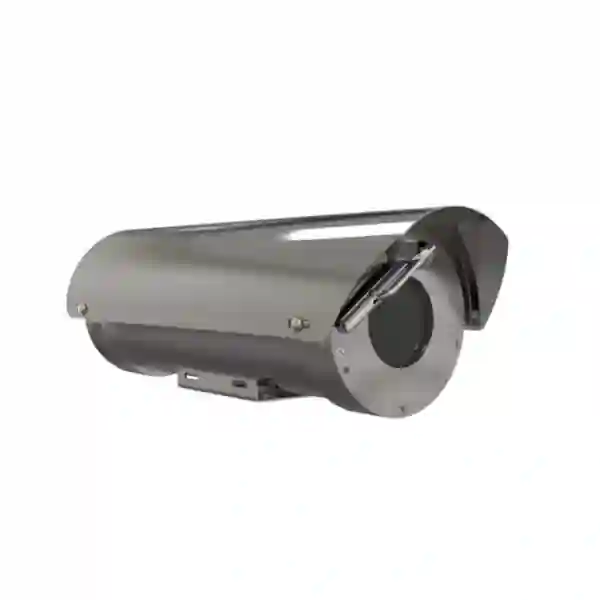
Hanwha TNU-X6320E2F2WT2-C Explosion-Proof PTZ Camera
Evaluate a specialist 1080p, 32x optical-zoom, fibre-connected positioning camera for classified industrial environments. Hanwha Vision identifies this exact model as discontinued, so project enquiries should also review its named replacement, TNU-X6320A2F2WT2-C, against site conditions.
Key decisions: certified hazardous-area fit · 110VAC supply · WT2 temperature limits · fibre network design · recorder integration · lifecycle planning
Important: discontinued model
The TNU-X6320E2F2WT2-C is a legacy product, not a confirmed in-stock offer. The manufacturer identifies the TNU-X6320A2F2WT2-C as its replacement. Ask for a current technical and certification comparison before specifying a unit for new installation.
Verified model overview and engineering checks
| Lifecycle | Discontinued; manufacturer-named successor: TNU-X6320A2F2WT2-C |
|---|---|
| Camera type | Explosion-proof pan/tilt/zoom network positioning camera |
| Video | Full HD 1920 × 1080; up to 60 fps |
| Optics | 32x optical zoom with autofocus |
| Dynamic range | 150 dB WDR in original model feature summary |
| Connectivity | Single-mode fibre option in F2 configuration |
| Weather feature | Integrated wiper |
| Storage | Dual microSD card slots |
| Power | 110VAC input; site electrical design required |
| Ingress protection | IP66/IP67 referenced in manufacturer model listings |
| Temperature variant | Historical WT2 listing: -60°C to +40°C; confirm on unit documentation |
| Hazardous location | cLCus Class I Division 1 and cLC CSA references; site-specific approval required |
Specifications summarise Hanwha Vision’s original model page and historical exact-variant listings. Where older family tables differ by suffix, use current model-specific documentation and the supplied unit’s markings as the authority.
A precise starting point for hazardous-area surveillance
Industrial camera selection is not simply a question of resolution or zoom. On a processing site, tank farm, fuel-handling area or other potentially hazardous facility, the enclosure and its permitted installation conditions can be as important as the image produced. The Hanwha TNU-X6320E2F2WT2-C was designed for that more demanding decision. It combines remotely directed viewing with an explosion-proof positioning-camera construction intended for specified classified-location applications.
The first buying decision is whether the exact model and its documented certification markings fit the installation location. The words explosion-proof do not give unlimited permission to install equipment in every hazardous zone. A competent site engineer should confirm the site classification, gas or dust group where applicable, temperature classification, installation method and the certificate details for the specific supplied unit. These checks belong before a purchase order or installation design is approved.
An equally important issue is lifecycle. Hanwha Vision currently marks the TNU-X6320E2F2WT2-C as discontinued and identifies TNU-X6320A2F2WT2-C as a replacement model. The information on this page helps a buyer assess an existing installation, compare a proposed legacy unit with its successor, and assemble a useful request for technical review. It does not imply that the discontinued version is available from local inventory.
What this model offers at a glance
The manufacturer’s published key features identify 1080p video at up to 60 frames per second, motorised pan and tilt operation, 32x optical zoom with autofocus, multiple video streams, video analytics, an integrated wiper and fibre connectivity. Those features address a recognisable challenge: a control room sometimes needs an overview of a large industrial area and, at another moment, a closer view of a valve, route, vehicle or work location.
The distinction between moving the camera and merely enlarging an image is practical. True optical zoom changes the captured field of view through the lens and can retain more useful scene detail than digital enlargement alone. Pan and tilt let an operator redirect observation without physically accessing an exposed installation point. Actual usable detail still depends on distance, lighting, vibration, atmospheric conditions and the operational task.
Video analytics can help organise alarms, but should be configured as a supporting tool rather than a promise to detect every incident. The wiper is useful when the viewing window is affected by wet conditions, yet it does not replace cleaning inspections or a suitable maintenance regime. The fibre option can help when site networking is designed for long or electrically challenging routes, provided the selected fibre equipment matches the camera interface.
Understand the discontinued status before requesting a quotation
A product identification match is not the same as a current supply confirmation. The manufacturer’s product page describes this exact E-series camera as discontinued. For a new project, procurement should begin with a check of the specified replacement, not with an assumption that an older catalogue part number can still be ordered. Existing operators may still need legacy model information to identify their installed equipment, compare spares or plan migrations.
The named replacement is TNU-X6320A2F2WT2-C. It shares the hazardous-area PTZ concept but should not be presumed mechanically, electrically, digitally or certification-identical without document comparison. A replacement assessment must include footprint and mounting, input power, fibre topology, environmental limits, enclosure certificates, network behaviour, recorder integration and any site-specific commissioning documents. Even a seemingly small revision can affect a controlled engineering design.
For tenders, use the discontinued part number only where it is necessary to describe an installed asset or a historically specified requirement. For new procurement, request an explicitly identified current offering and have the design team approve the model substitution. Avoid describing any current model as a direct drop-in replacement until the mechanical drawings, certificate schedule and interfaces have been checked against the installation.
Full HD image quality and the real meaning of 60 fps
The published maximum video format is Full HD 1920 by 1080 at up to 60 frames per second. Frame rate matters when a moving subject, crane activity, gate operation or vehicle route must be reviewed with less temporal spacing between images. It is not a guarantee that motion will always be clear: shutter exposure, lighting, motion blur, lens position, compression settings and network recording decisions can change the result.
An engineering team should begin by defining what viewers must recognise or verify, and at what distance. Wide-view observation of an approach road has a different requirement from confirming activity around a small mechanical component. Frame-rate and image-quality expectations should be set for the most important use cases, then tested under daylight, night-time and challenging backlit conditions instead of relying entirely on catalogue figures.
Higher settings also affect network load and storage. Multiple operators may prefer a lower-bandwidth overview stream while a recorder retains a more detailed stream for later investigation. Recording duration, event capture policies and the number of simultaneous camera feeds should be included in system sizing. A good design protects the quality of evidence without consuming capacity unnecessarily.
Use the 32x optical zoom purposefully
The lens is a central reason to consider a specialist positioning camera rather than an ordinary fixed-view device. Hanwha lists 32x optical zoom with autofocus for this model family, allowing an operator to move between contextual views and a much narrower observation angle. This can be valuable when equipment, routes and access locations occupy different parts of a large facility.
Zoom should be planned around a defined viewing objective. At long focal lengths, minor movement of the mounting structure, visibility changes or heat shimmer can have a greater effect on the image. Before choosing a location, calculate the expected target size in the field of view and assess sightlines, obstructions and lighting. Do not assume that a large zoom ratio automatically allows an identification task over any chosen distance.
Preset views can reduce the effort of returning to important observation points, but operators still need an overview plan. A camera looking closely at one target is not simultaneously watching the rest of the scene. Where continuous monitoring of multiple areas is mandatory, use complementary fixed cameras or additional viewpoints rather than treating a single PTZ as a complete substitute for site-wide coverage.
Pan-and-tilt positioning in a busy control environment
A remotely steerable camera can support response teams that need to review activity at several positions without sending someone into a difficult area solely to look. Operators may use a wide view during routine monitoring, select a stored viewpoint when an alarm appears, and then zoom closer for contextual assessment. This workflow should be written into operating procedures rather than left to individual preference.
PTZ coverage creates a trade-off: the view is flexible, but one camera can be aimed in only one direction at a time. Control-room managers should decide which areas require uninterrupted observation and which can be checked on demand. Camera ownership, joystick or software control permissions, preset priority and alarm-driven movement all matter when several teams access the same device.
Commissioning should include repeatable view tests, safe mechanical travel, clearance around the housing and verification that the camera returns to appropriate positions after power interruptions. In hazardous industrial spaces, moving parts and mountings need an inspection plan. A formally approved design should record not only where the unit is installed, but why that location provides the necessary operational picture.
Explosion-proof design is a certification decision
Explosion-proof describes a safety design approach under specified standards and classifications; it is not a general synonym for rugged or waterproof. Manufacturer documentation for this model identifies cLCus Class I Division 1 and cLC CSA references. Those references must be interpreted by the responsible engineer against the installation jurisdiction and the actual markings and accompanying certification documents. They do not by themselves establish Tanzanian regulatory acceptance.
A facility may divide locations into hazardous and non-hazardous areas, with different requirements even a short distance apart. The correct assessment considers material properties, the zone or division, equipment protection method, permitted surface temperature, ambient conditions, cable entries and installation rules. The exact approval scope must be read from the unit’s current documents rather than inferred from a product family or suffix.
Procurement should ask for the certificate set associated with the supplied variant, its installation instructions and the allowed accessories or cable-entry arrangements. A compatible camera body can become an unsuitable assembly if fittings, glands, sealing or repairs depart from the approved configuration. The final decision belongs to qualified hazardous-area and electrical personnel working from site requirements.
IP66 and IP67: what enclosure ratings can and cannot answer
Published model descriptions associate this variant with IP66 and IP67 ingress protection. These ratings concern defined dust and water exposure tests; they are different from explosion-protection certification and should never be used as a substitute for hazardous-location suitability. An ingress rating also does not tell the complete story about chemical attack, coastal corrosion, cleaning chemicals, vibration or long-term installation condition.
Outdoor facilities in Tanzania may face rain, dust, sunlight, airborne industrial residue and other site-specific stresses. Engineering teams should evaluate the environmental evidence for the exact equipment and plan how seals, glands and the viewing window will remain serviceable. Details such as the direction of spray, cleaning methods and local exposure can change the maintenance approach even when the published ingress ratings appear appropriate.
Inspection after installation should cover gaskets, cable entries, drainage arrangements where permitted, mounting interfaces and signs of corrosion or damage. Any repair or modification needs to follow the manufacturer instructions and the facility’s hazardous-area procedures. A high IP rating helps define the enclosure, but it is not permission to ignore serviceability or the rest of the site’s safety controls.
The WT2 temperature variant requires special attention
Historical Hanwha model listings associate the TNU-X6320E2F2WT2-C variant with an ambient operating range of approximately minus 60 to plus 40 degrees Celsius. This differs from figures published for some related WT1 variants. The exact temperature rating on the supplied device and its applicable certification documents must take precedence, especially when older product-family specification tables are inconsistent or combine several variants.
The upper limit is important for sun-exposed industrial sites. Ambient air readings, radiant heat from equipment, nearby hot surfaces and enclosure positioning can affect the environment experienced by a camera. A cold-weather-capable model is not automatically the best choice for a hot process area. Where conditions approach the published limit, ask the engineering team to confirm the appropriate temperature variant or a different suitable camera.
Do not make a temperature decision using only the minus value in WT2. The installation specification should capture expected minimum and maximum conditions, solar exposure, any thermal influence from surrounding plant, and the complete certified ambient range. This is a particularly useful comparison point when discussing the newer A-series replacement with the manufacturer or a qualified project supplier.
110VAC input needs engineered power planning
Hanwha identifies 110VAC power for the TNU-X6320E2F2WT2-C. This is an installation requirement, not a universal site-power assumption. Before ordering or reusing an old unit, confirm the available supply, frequency, protection arrangement, isolation, cable route and interface with the facility’s approved electrical design. Do not connect equipment to a supply simply because a similar-looking camera is already installed nearby.
The power plan should cover more than nominal voltage. A surveillance camera serving an operational function may require backup energy, surge protection, appropriate earthing and well-defined behaviour after power is restored. Hazardous-area rules may impose additional requirements on terminations and equipment location. These details need to be reviewed as part of the installation package, not resolved ad hoc during field commissioning.
Ask for the exact wiring and electrical data for the offered unit before selecting transformers, protective devices or cable sizes. The product page does not establish whether power conversion equipment is included in any Tanzania proposal. A technically sound quotation should state what is supplied, what the site provides, what must be installed by a qualified contractor and what tests establish acceptance.
Single-mode fibre architecture and distance planning
Single-mode fibre connectivity is a distinctive feature of the F2 configuration in this product family. It can be attractive in industrial networks where control buildings and remote camera points are separated, or where designers seek galvanic separation in the data path. However, the existence of fibre support does not establish a complete optical network design or a maximum usable link distance for the proposed installation.
Before a final bill of materials is issued, identify the fibre type, connector and termination arrangements, transceiver characteristics, optical budget and any active conversion equipment required at the other end. Check route length, splice losses, patching practices, surge exposure of other connected conductors, redundancy requirements and maintenance access. These checks avoid a common failure in which a camera is specified correctly but the end-to-end link is not.
Recording and viewing systems also need reachable IP networking, management access and a clear cybersecurity boundary. Fibre is a physical transport medium, not a substitute for network design. The project should document address allocation, switch-port configuration, routing or segmentation where appropriate, and the path through which authorised staff will maintain the camera without exposing the system unnecessarily.
Wiper operation and the limits of weather recovery
The integrated wiper is a useful operational feature for a camera expected to remain outside in rain or exposed industrial environments. It may help remove water from the viewing window so that the scene remains more usable during changing conditions. The control method, permitted operating cycle and any associated accessories should be verified for the installed version before operators include wiper operation in routine control-room procedures.
A wiper cannot correct every visibility problem. Salt deposits, oil film, dust accumulation, fog outside the housing, heavy spray and damage to the window may still obstruct the scene. Cleaning practices must be compatible with the approved enclosure materials and site hazards. Routine checks should look for streaking, unusual motion, mechanical wear and whether the camera image actually improves after operation.
When specifying a replacement, confirm that wiper control and service parts remain available and that the new unit can be managed through the intended recorder or control application. A feature label on a datasheet is not proof of the same user interface or integration behaviour. Maintenance access should be designed from the outset so the window can be inspected safely.
Wide dynamic range in mixed-light industrial scenes
Hanwha’s original product information lists 150 dB wide dynamic range for this discontinued E-series model. Wide dynamic range is relevant when a scene includes bright outdoor openings, shaded processing equipment, reflective metalwork or strong lighting differences. It aims to retain more usable information across the brightness range, but it does not eliminate every limitation caused by glare or difficult exposure.
Site acceptance testing should include the lighting situations that matter most: sunrise and sunset near access points, work areas with artificial light, reflective tanks, or a doorway opening from a darker interior to a bright yard. The correct settings for one preset may not be ideal for another. A practical test should compare the resulting image against the buyer’s operational objective rather than a single benchmark number.
Image quality is also influenced by lens cleanliness, exposure choices, moving subjects and digital processing. Do not assume that a 150 dB label means every person or item can be recognised in all conditions. If an application needs evidential identification, validate the target coverage and recording output under realistic worst-case lighting.
Video analytics support operators, not automatic certainty
The discontinued model is described as supporting intelligent video analytics. Related manufacturer specification material identifies event types such as motion, tampering, line crossing and defined-area activities. The usefulness of each analytic depends on the actual firmware, configuration, view, lighting and movement in the scene. Requirements should be expressed as testable alert scenarios rather than broad promises of automatic threat detection.
In industrial surroundings, vegetation movement, steam, equipment vibration, vehicles and changing illumination can produce unwanted events. Setting regions of interest and sensible sensitivity thresholds helps, but the configuration should be trialled against the site’s real activity. Alarm notifications must reach an appropriate person or system, and staff should know what verification step follows an alert.
Where analytics trigger PTZ movement or recording, consider what is lost when the camera points away from a scheduled view. A workflow should specify priority between manual control, presets and automatic alarms. Operators need training, documented escalation rules and periodic performance reviews so automation remains an aid rather than an unexamined assumption.
Recording architecture and dual microSD slots
Hanwha identifies two microSD recording slots on this model. Edge recording can be a helpful component of a resilience plan, but should not be mistaken for an unlimited archive or a guaranteed replacement for central recording. Capacity, card suitability, retention and supported recording modes need verification against the specific firmware and configuration. Site policy should state which information must be retained and for how long.
Consider what should happen during a network interruption. A control centre may lose live access even though the camera can continue certain local functions. The ability to recover and reconcile recordings depends on the selected architecture and management software. Recording at the edge also creates requirements for secure access, card health monitoring and controlled handling of any removable media.
For long-term surveillance, a central recorder or approved video-management platform may still be necessary. Estimate data volume using actual frame rate, codec, scene complexity, image settings and the planned camera count. Test retrieval and playback, not just recording activation. A dependable surveillance design is measured by whether authorised staff can obtain the required footage when an incident needs review.
Video compression and bandwidth choices
The underlying camera family provides multiple stream profiles and common IP video-compression formats. This allows a design to separate routine viewing needs from higher-quality recording requirements where supported by the chosen firmware. Bandwidth should be sized from a real system plan rather than a generic assumption that every camera constantly uses the same rate regardless of scene activity.
A busy yard, changing lights and extensive movement can place different demands on compression from a mostly static scene. Network congestion or insufficient recording throughput may reduce image availability at the time it matters. Designers should budget for simultaneous users, recorder ingestion, remote viewing, maintenance traffic and normal overhead while retaining space for future cameras where the project requires expansion.
When comparing the legacy unit with its replacement, verify not only the codec names but also which stream profiles, resolutions and security options the recorder accepts. A software or firmware mismatch can affect commissioning even if a camera is otherwise healthy. A short bench integration test before field deployment is often more informative than a long compatibility claim with no project-specific evidence.
Compatibility with recording and management software
An IP camera becomes valuable as part of a managed surveillance system. The engineering specification should identify the actual video-management software or network video recorder, its supported device list, recording mode, camera-control interface and licensing requirements. Although manufacturer documentation for closely related E-series units lists standards-based integration interfaces, the exact combination must be verified using the intended model and firmware.
PTZ commands, presets, video streams, alarms and wiper control may not all behave identically across applications. A recorder that displays a live image is not necessarily providing complete operational integration. Test the functions that site users need, including manual positioning, preset recall, time synchronisation, event recording and authorised access. Keep the test results with the commissioning dossier.
When upgrading to TNU-X6320A2F2WT2-C, use the successor’s current integration information rather than carrying over every historic assumption. Confirm whether the management application needs a device profile, updated firmware, an additional licence or other configuration changes. The goal is a predictable operational transition, not simply a camera image appearing on a monitor.
Cybersecurity and administrator access
Industrial video networks should be managed as operational technology or a similarly controlled security environment according to the site’s governance. A camera with network access needs defined ownership, credential management, software maintenance and an incident-response route. Security planning is especially important where remote contractors or multiple control centres may need access to live feeds.
Before commissioning, verify supported secure communication settings, administrator-role separation, network isolation, logging and firmware lifecycle for the actual device. Restrict services that are not required, protect management paths and use the organisation’s approved account and password processes. Older discontinued devices deserve particular attention because future software support may differ from that of currently offered products.
Do not expose a camera’s administration interface directly to the public internet merely for convenient viewing. The engineering plan should identify the approved remote-access solution, how accounts are revoked and who reviews system logs. Replacement planning can be an opportunity to improve security architecture rather than transferring all older configuration choices unchanged.
Mounting loads, mechanical clearance and safe access
An explosion-proof positioning camera is not an ordinary lightweight office camera. The bracket, support, anchors and surrounding structure must be selected for the confirmed assembly weight, geometry, loading and exposure. Related Hanwha documentation lists purpose-built wall-mount and washer accessories, but every proposed bracket and accessory must be checked for exact-model compatibility and the installation’s certification conditions.
An installer should review whether the unit can pan and tilt freely, whether cables will be protected, and whether surrounding equipment or walkways interfere with its movement. Wind loads, structural vibration, maintenance access and the possibility of accidental impact may be relevant. The design should also consider access for cleaning the window and inspecting cable entries without putting technicians into avoidable hazards.
A proper installation package contains drawings, fixing details, cable routes, approved glands or seals, earthing arrangements, test instructions and inspection responsibilities. For any classified area, qualified personnel must follow the applicable site procedures and certificate conditions. Do not substitute a generic CCTV bracket or improvise enclosure modifications simply because the hole pattern appears to fit.
Corrosion, surface care and industrial durability
Hanwha’s product-family material refers to stainless-steel construction for these specialist cameras. Material selection is only one component of a durable installation. The real exposure may include industrial pollutants, chemical washdown, salt-laden air, moisture and mechanical abrasion. The site team should check the exact supplied enclosure materials and any limits stated by the manufacturer before choosing cleaning agents or mounting hardware.
Mixed metals, damaged finishes and unsuitable fasteners can create problems that are not obvious at commissioning. Engineers should consider compatibility among the camera, brackets, bolts, supports and cable hardware. A well-selected camera can still have a shortened service life if adjoining components are not appropriate for the same environment.
Maintenance procedures should identify inspection frequency based on local conditions, not a universal timetable taken from a sales page. Document corrosion findings, window condition, wiper performance, fastener integrity and evidence of water ingress. Where damage affects an explosion-protected assembly, follow the manufacturer’s approved inspection and repair route rather than ordinary workshop repair practices.
Night-time observation and site lighting
Low-light capability is useful, but night performance is a system question. A site’s lighting layout, reflective surfaces, moving machinery and distance to the target can matter more than a single minimum-illumination figure. The original model supports day-and-night imaging, yet its practical results should be checked under the exact conditions that operations staff expect it to cover.
Define whether the camera must show general movement, identify equipment status, observe people at a controlled access point or support another task. Each objective may need different framing, exposure and external illumination. Lighting equipment proposed for classified areas must itself be selected according to the site’s hazardous-area requirements; the camera’s enclosure approval does not automatically cover external lamps.
Carry out night-time acceptance tests at representative locations and settings. Evaluate motion blur, operator visibility and recorded playback, not merely the live screen. A daytime demonstration can hide weaknesses that appear only after artificial lights switch on, when vehicle headlights pass or when the camera is zoomed tightly onto a distant object.
A practical field-of-view study before deployment
Good camera placement begins with the scene, not the pole or wall that happens to be easiest to use. Prepare a marked plan showing each important asset, access route or operational area, the desired overview and the locations where close inspection is expected. Identify obstructions such as pipes, storage vessels and equipment that could block a PTZ sightline.
With the target list in hand, estimate distances and the needed on-screen detail for each use case. Consider the difference between detecting activity, observing a process and recognising a specific feature. Use representative images or an engineering field test where possible. This prevents the common mistake of treating a high optical zoom figure as evidence that every observation objective will be met.
Record the planned home position, alarm positions and any blind spots. If the PTZ is deliberately moved to follow one event, decide whether another camera must preserve continuous evidence elsewhere. Design acceptance criteria should reflect how the camera is actually used by the control room, rather than relying on a single attractive demonstration shot.
Selecting between the E-series unit and the named successor
The E-series TNU-X6320E2F2WT2-C can remain relevant when documenting an installed base, identifying compatible maintenance procedures or evaluating a historic project specification. For new work, the manufacturer’s named successor TNU-X6320A2F2WT2-C is the natural comparison candidate. However, a model designation alone does not establish complete equivalence, and a formal design change may be necessary in a controlled industrial environment.
Start the comparison with hazardous-location certificates, permitted ambient temperature, input power, communication interface, mounting geometry and dimensions. Continue with image settings, recorder support, analytics, wiper operation and service requirements. Where a legacy project relied on a specific drawing or cable assembly, trace that requirement through to the proposed replacement rather than assuming it has disappeared.
Ask the supplier to state which model is being quoted and to attach the applicable current technical documentation. Record any changed specification and the authority that accepts it. For an operating plant, plan the switchover to minimise surveillance gaps, and arrange configuration backup, acceptance testing and a sensible rollback approach if the project demands continuity.
Checklist for project quotations in Tanzania
A meaningful quotation needs more than an exact part number. Tell the supplier whether the request concerns a replacement for an installed camera, a new hazardous-area design or a preliminary budget study. Include the operating location and a concise description of the intended viewing task. This helps distinguish genuine engineering questions from details that can be resolved during later configuration.
Provide the site’s approved hazardous-area classification and relevant environmental assumptions, but avoid sharing sensitive plant documents through an unapproved channel. State the required power source, fibre infrastructure, installation height, control-room platform and any existing camera or recorder information. If a project standard requires a specific certification or installation method, identify that requirement explicitly for validation.
Ask for a response that separates verified equipment specifications from optional accessories, installation services and assumptions. A responsible offer should make any uncertainty about model lifecycle, available stock, lead time, local approvals and warranty terms visible before commitment. No price, stock position, delivery promise or certification acceptance for Tanzania is asserted on this page.
Commissioning tests that matter operationally
Commissioning should prove that the device and the broader system meet the agreed use cases. Begin with safe electrical and mechanical checks, manufacturer-required inspections and documentation of the installed enclosure and cable entries. In classified areas, these activities must be planned and supervised under the facility’s applicable procedures and by suitably qualified personnel.
Then test viewing and control: image quality at important presets, PTZ motion, optical zoom, autofocus, wiper behaviour, local and central recording, time synchronisation and alarms. Check network recovery after an authorised controlled interruption and confirm that the expected recordings can be retrieved. Validate day and night performance where both are part of the operational requirement.
Finally, hand over the configuration, maintenance and inspection records. Operators should understand permissions, basic controls, how to report a degraded image and the procedure for escalating an equipment fault. A camera should not be considered accepted merely because it powers on and produces a picture; the system needs to support real operations reliably.
Maintenance planning for a specialist installation
Long-term performance depends on an inspection plan that respects both camera function and hazardous-area integrity. Routine checks may include the viewing window, wiper, mounting, cable entries, image quality, recording health and signs of corrosion. The frequency should be determined from the operating conditions, manufacturer guidance and the facility’s inspection regime rather than a single schedule applied to every site.
Maintenance access can be harder than installation, especially where work at height, restricted access or operational shutdowns are involved. The original design should therefore anticipate safe access, isolation procedures and spare-parts strategy. If the older model is no longer supported for a necessary repair, the team may need a controlled replacement path rather than a makeshift component substitution.
Keep an asset record with the exact model suffix, serial information, installed firmware, certificates, drawings and service history. These records simplify future decisions when a technician must compare the discontinued E-series unit with a new offering. They also reduce the risk of confusing superficially similar variants that have different electrical, temperature or certification requirements.
Common mistakes to avoid in procurement
A frequent error is to compare cameras by resolution alone. In a hazardous location, the certificate scope, environment, power, installation accessories and maintenance process determine whether the camera can be installed safely. Another error is to read the IP rating as proof of explosion protection. These describe different properties and both must be understood correctly.
It is also risky to treat a discontinued unit as a normal current catalogue item, or to assume its named replacement is a plug-in match. A supplier should identify the actual quoted unit and provide current documents. An engineering team should approve differences that affect the installation. A request based only on a product photograph can miss critical suffix-specific details.
Other avoidable problems include omitting fibre termination requirements, forgetting the 110VAC supply constraint, overlooking blind spots created by PTZ movement and failing to test recorded footage. A clear scope of work, explicit acceptance criteria and realistic maintenance plan are more valuable than a list of impressive but disconnected feature labels.
How to evaluate the complete cost of ownership
The purchase price of a camera is only one part of a specialist installation. A project may need structural supports, suitable electrical work, fibre termination, approved cable entries, network equipment, recording capacity, integration services and documented inspections. Costs can also arise from access equipment, commissioning, operator training and safe maintenance activities. None of these should be assumed included in a product-only quotation.
An engineering-led comparison considers the expected service environment and how the equipment will be maintained over time. A model with attractive initial specifications may be less suitable if its end-of-life status complicates spares or cybersecurity upkeep. Conversely, replacing an existing device may involve drawings, permits, downtime and integration work that need to be budgeted openly.
Request an itemised proposal with exclusions, dependencies and any certification-related conditions. If alternative equipment is offered, assess the total installed solution, not just the quoted camera cost. For a Tanzania project, local price, tax treatment, shipping, support arrangements and warranty require written verification; they are not inferred from generic international product data.
Information to include in a replacement assessment
For an existing TNU-X6320E2F2WT2-C installation, start with the reason for replacement. The problem may be loss of video, unavailable spare parts, environmental damage, changing site classification, new recording requirements or a planned technology refresh. Each reason calls for a slightly different technical review and determines what historical documents need to be collected.
Record the camera’s actual field of view, mounting position, wiring, fibre interface, power feed, recorder settings and any alarm or PTZ presets in use. Check current certificates and site drawings before disturbing equipment. A successor camera may improve some functions while changing dimensions, settings or integration behaviour; none of those differences should be discovered only after a shutdown begins.
The replacement plan should identify an approved new model, installation method, configuration migration, safe work sequence and acceptance tests. Assign responsibility for technical approval and handover. This turns a simple part-number enquiry into a defensible asset decision that preserves useful surveillance and respects the requirements of the industrial site.
What FourTeck Tanzania can discuss with your project team
The most useful next step is a structured technical enquiry. State the exact discontinued model, the installation type, the site environment and whether you need a matching replacement, an engineering comparison or advice on the required surveillance functions. A specialist discussion should clarify uncertainties before an offer is described as suitable for the site.
Share the relevant project constraints through your organisation’s approved enquiry process: classification, operating-temperature limits, available supply, fibre route, recording software and the operational scenes to be viewed. Where certificate acceptance or local compliance is involved, ask the responsible project authority to review the actual supporting documents. No claim is made here that FourTeck holds stock, offers installation coverage or has an exclusive manufacturer authorisation.
The objective is to arrive at an accurate specification and an appropriately documented quotation. Because the original Hanwha TNU-X6320E2F2WT2-C is discontinued, clearly ask whether the named successor or another current, approved model meets the project. The request should remain open to qualified technical review until the actual site conditions and proposed equipment are confirmed.
Frequently asked questions
Is the TNU-X6320E2F2WT2-C a current Hanwha Vision product?
No. Hanwha Vision marks the exact E-series camera as discontinued and identifies TNU-X6320A2F2WT2-C as its replacement. This page is therefore a technical reference and enquiry resource, not evidence of current product stock. Confirm the proposed model and its current documentation before purchase.
What kind of camera is it?
It is an explosion-proof network positioning camera with remotely controlled pan, tilt and 32x optical zoom. It is designed for specialist surveillance planning where equipment certification and installation conditions matter. Suitability for a specific hazardous area must be decided using the actual certificate and site classification.
Does the camera record 1080p video?
Hanwha’s published feature summary states Full HD 1080p at up to 60 frames per second. Final capture and recording settings depend on configuration and the connected recording system. Test playback under the conditions that matter to the intended operational task.
Does the WT2 suffix matter?
Yes. Historical manufacturer model listings associate the WT2 version with a cold-temperature configuration around minus 60 to plus 40 degrees Celsius. Verify the exact permitted ambient range in the supplied documents and do not confuse this variant with WT1 or the successor.
Can I connect it to a normal site power supply?
The manufacturer identifies a 110VAC input for this variant. A qualified electrical designer must confirm how the site will provide the specified supply safely and in accordance with the applicable hazardous-area installation rules. Never assume an adapter or conversion assembly is included.
Does it use fibre or copper networking?
The F2 variant is identified with single-mode fibre connectivity. Network design should verify the exact interface, optical equipment and end-to-end link budget. Do not assume that an existing copper camera cable or a different fibre module will work without checking.
What does the integrated wiper do?
The wiper is intended to help clear the viewing window under wet or contaminated conditions. It cannot replace correct cleaning, inspection or routine maintenance. Check its control integration and service requirements when evaluating a legacy unit or replacement.
Are IP66 and IP67 the same as explosion-proof approval?
No. IP66 and IP67 concern defined dust and water ingress protection. Hazardous-area suitability is determined by the exact explosion-protection certification, equipment marking, installation method and site classification. Both sets of requirements may matter in one project.
Is it certified for installation in Tanzania?
This page does not assert Tanzanian regulatory approval. International manufacturer documents list certain hazardous-location certification references, but acceptance for an actual site must be confirmed by the responsible engineering and regulatory authorities using the exact equipment documents.
Can one PTZ replace several fixed cameras?
Not automatically. PTZ provides flexible coverage, but the camera watches only its current direction. Locations requiring continuous simultaneous observation may need fixed cameras or additional PTZ units. A coverage study should identify blind spots and competing operational priorities.
Will it work with my video-management software?
Compatibility requires checking the exact camera firmware, recorder or software version, supported interfaces and necessary features. Displaying live video alone does not prove that presets, alarms, wiper controls and recording operate as required. A practical integration test is recommended.
What should be supplied for a quote or model comparison?
Provide the exact part number, project type, hazardous-area classification, temperature conditions, power availability, fibre infrastructure, mounting constraints, recorder platform and required viewing tasks. Ask the supplier to distinguish the discontinued camera from any proposed current replacement and to document assumptions.
How do I compare the successor?
Start with the current Hanwha Vision TNU-X6320A2F2WT2-C documentation. Check hazardous-area certificates, operating temperature, power, dimensions, mounting, optics, wiper controls, network interface, recording integration and maintenance. A named replacement should not be assumed to be an approved direct substitution.
Is any Tanzania price, stock or delivery time confirmed here?
No. No local price, stock quantity, shipping timetable, warranty scope or installation service is asserted. These are commercial terms to obtain in a written project-specific response after the model and application have been clarified.
Request a model and installation suitability review
For a FourTeck Tanzania enquiry, specify whether this discontinued model is already installed or is appearing in a new project requirement. Provide the planned hazardous-area classification, ambient conditions, 110VAC power arrangement, fibre network information and recording platform. Request a documented comparison with the manufacturer’s named successor where appropriate.
Next step: contact FourTeck Tanzania through its verified business enquiry channel for a project-specific technical quotation and model review.
Technical content is intended for initial product evaluation. Final equipment selection, certificate acceptance, electrical design and installation are the responsibility of suitably qualified professionals using the exact current manufacturer documentation and applicable site requirements.




Reviews
There are no reviews yet.