
Industrial video surveillance | Tanzania product guide
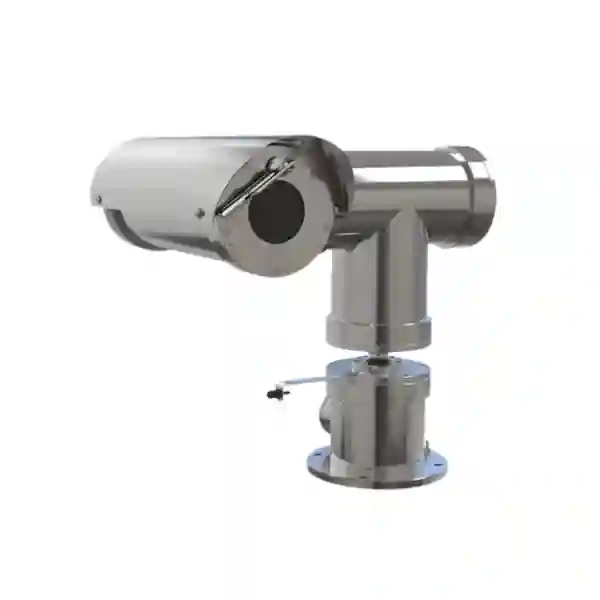
Hanwha TNU-X6320E3WT1-M Explosion-Protected PTZ Camera
The Hanwha TNU-X6320E3WT1-M is a 2 MP explosion-protected positioning camera station designed for industrial video surveillance where the installation must satisfy a hazardous-area engineering assessment. It combines 32× optical zoom, remotely controlled pan and tilt, a 150 dB wide dynamic range feature, and an integrated wiper within a 316L stainless-steel assembly. The E3 designation identifies the 220 VAC model-code variant; exact electrical and certification details should still be checked against the supplied nameplate and documentation. Buyers in Tanzania can use this guide to evaluate image coverage, power, networking, mounting, hazardous-area suitability, and procurement requirements before requesting a project-specific quote.
Suitability and certificates must be checked for the exact supplied unit and installation site.
Who this camera is for, and what to decide first
The Hanwha TNU-X6320E3WT1-M is a networked, explosion-protected positioning camera station intended for industrial surveillance projects where a conventional outdoor CCTV enclosure may be inappropriate. It combines a Full HD visible-light camera with remotely controlled pan and tilt, long-range optical zoom, a corrosion-resistant metal housing, and a built-in wiper. For an engineering team comparing hazardous-area PTZ cameras in Tanzania, the essential question is not simply whether the image looks sharp. It is whether this exact configuration fits the area classification, electrical supply, surveillance objective, communications design, and mounting location.
A successful selection begins with the zone or division assessment and its supporting engineering documents. It continues with the distance and field of view required to see the target, the route by which video reaches a recorder or control room, and the capacity of the structure supporting the camera. The manufacturer describes a 2 MP, 1920 × 1080 video output, 32× optical zoom, and intelligent video features. Those capabilities make the unit worth evaluating for remote visual verification, but they do not by themselves establish that it is suitable for any particular hazardous location.
Before requesting a firm quotation, ask the project designer or responsible safety specialist to confirm the hazardous-area classification and the certificates accepted by the project authority. Confirm the 220 VAC configuration associated with this model-code family, the needed mounting hardware, and whether a conventional Ethernet or separate fiber-enabled model is intended. A quote should identify the complete model string, rather than relying on a generic description such as explosion-proof camera. That small procurement discipline helps avoid expensive substitutions during engineering review.
Understanding the exact Hanwha model number
Hanwha Vision lists TNU-X6320E3WT1-M as an explosion-protected camera station. The manufacturer’s TNU-X6320E series model-code guide distinguishes positioning units from fixed-view models and identifies the E3 power designation as the 220 VAC option. The W character denotes an integrated wiper, the T1 designation identifies the standard-temperature variant within this family, and the M certification suffix identifies the INMETRO-related variant. These identifiers are engineering clues; the actual serial-number label, current data sheet, and supplied certificate package remain decisive for approval.
A common ordering mistake is to treat similarly named variants as interchangeable. An E1 configuration uses a different input-power designation, while an E2 configuration relates to another supply option. A model containing the F2 designation adds the specified single-mode fiber option; this requested model does not contain F2. A change to the final suffix may alter the certification scheme associated with the camera. Even where the optics and general appearance match, differences in power connection, interfaces, hazardous-area documentation, and permissible deployment can materially affect a project.
Use the complete identification TNU-X6320E3WT1-M on purchase requests, technical submittals, equipment schedules, and commissioning records. Ask the supplier to confirm the actual delivered model and its nameplate details before installation. If the order proposes a newer series, alternative housing, or replacement product, treat it as a separate engineering evaluation and request the new data sheet rather than assuming equivalent performance or identical approvals. This is especially important for safety-critical industrial surveillance, where procurement descriptions must align with formally approved equipment schedules.
Hazardous-area assessment and certification
An explosion-protected enclosure is designed for specific hazardous environments, but the words explosion-proof do not mean that every device can be installed in any potentially explosive atmosphere. Suitable equipment must be evaluated against the site’s gas or dust hazards, required equipment protection level, temperature class, ambient conditions, wiring method, and accepted certification system. The Hanwha series literature describes various certification families, including INMETRO and North American classification schemes. It does not establish universal acceptance, and a certificate used in one jurisdiction does not automatically demonstrate compliance with a Tanzanian project’s requirements.
The M suffix in this camera’s model name corresponds to the manufacturer’s INMETRO-related option. Obtain the applicable current certificate and schedule for the exact supplied variant and have the responsible engineer confirm its permitted hazardous-area use. The review should cover any conditions of use, the certified ambient range, required cable glands, sealing methods, entries, earthing, and whether replacement accessories are approved. A camera can have a rugged housing and still be unsuitable if the cable termination or mounting assembly breaks the certified installation arrangement.
Do not confuse the enclosure’s ingress-protection rating with its explosion-protection approval. IP66/IP67 addresses dust and water ingress under specified tests; it is not a substitute for a hazardous-area certificate. Likewise, corrosion-resistant stainless steel is a material choice, not a safety authorization. The installer should follow the latest manufacturer installation instructions and the site’s permit-to-work procedures. Final acceptance should be based on the identified device, the actual site classification, and the requirements imposed by the competent project authority.
Video quality, low light, and realistic image expectations
The visible-light camera records up to 1920 × 1080 resolution at up to 60 frames per second with H.264 or H.265 according to the series technical literature. Its 1/2.8-inch-class CMOS imager, automatic day-and-night switching, and 150 dB wide dynamic range are useful where lighting varies across process areas. High frame rate can help preserve motion detail on a moving subject, although recording at the highest setting increases bandwidth and storage needs. The correct quality target depends on what an operator must be able to confirm, not simply the maximum numbers on a specification sheet.
Wide dynamic range is particularly relevant when a camera looks from a shaded structure toward bright outdoor equipment, a reflective tank, or backlit machinery. Digital noise reduction and defog processing can improve the view under some conditions, but image processing cannot replace adequate light, clean optics, appropriate placement, or a clear line of sight. The camera supports day-and-night operation, yet it is not described as a thermal imager. Do not propose it for temperature measurement, thermal anomaly detection, or completely dark scenes without verifying an appropriate lighting strategy.
For a meaningful test, define a representative observation task: recognize a valve position, verify the state of a loading bay, inspect an operating platform, or follow a moving vehicle within the permitted view. Check image quality at both the wide and telephoto ends of the lens and during expected lighting transitions. Include rain, glare, haze, and vibration where these are credible site conditions. Video demonstrations taken in a clean indoor room are rarely sufficient evidence of outdoor industrial performance.
Optical zoom and pan-tilt coverage
A 4.44–142.6 mm lens provides the stated 32× optical zoom ratio. At its widest setting, the camera can provide situational context, while the long focal length lets an operator concentrate on a smaller distant subject. Optical zoom preserves native image detail better than simply enlarging recorded pixels digitally, but it cannot overcome atmospheric shimmer, lens contamination, or inadequate lighting. The objective is to match actual object size and distance to the required observation or identification task. A 32× label alone does not prove that a particular person or item will be identifiable at an unspecified range.
The positioning assembly is described with continuous 360-degree pan coverage and a 180-degree tilt range in the original series literature. This allows a single station to check several directions sequentially, which can be useful across large industrial assets. It does not provide simultaneous independent viewing of every direction. During active zooming or manual patrol, areas outside the current field of view are temporarily unobserved. Where uninterrupted evidence is required, pair a positioning camera with fixed-view coverage designed for the critical location.
Plan useful presets around real operating questions rather than using a random tour. Operators may need a wide overview, a loading-arm detail view, a platform approach, and a final check of a distant gate. Verify the line of sight, obstructions, and the elevation of each preset during a site survey. Consider whether moving equipment, scaffolding, pipe racks, exhaust plumes, or seasonal vegetation could block important views. A clear camera schedule should say what each preset must show and how frequently it will be used.
Industrial scenarios where it may fit
In oil and gas or petrochemical facilities, operators sometimes need remote visual confirmation of a plant perimeter, a loading operation, or the status of equipment in a classified area. The positioning mechanism and zoom can make it possible to inspect different points from a planned vantage position. The camera should be selected only when the project’s area classification and certification review support it. Remote video is an aid to monitoring, not a replacement for process safety instrumentation, a gas detection system, or procedures requiring personnel at the equipment.
At industrial terminals, depots, or selected marine installations, the weather-resistant enclosure and integrated wiper can be relevant to outdoor viewing exposed to moisture and contamination. A designer may use the camera to observe vehicle movement, transfer interfaces, entry routes, or remote mechanical assets. Its true usefulness depends on site layout, the nature of the hazardous atmosphere, lighting, structural supports, and image transmission. Mount height needs careful balancing: a high position improves overview but may make small details harder to interpret without a suitable zoom and viewing angle.
For heavy industrial sites, the camera may be considered where an operator needs several repeatable viewing directions from one supported mounting point. Examples include external conveyor routes, exposed handling equipment, and the perimeter of a process module. The term industrial does not guarantee that an area is hazardous, and the reverse is also true: a visually ordinary space may have a formal hazardous classification. Choose the camera to solve an explicit observation problem while meeting the engineering envelope, rather than because an explosion-protected unit sounds more robust.
Site survey and surveillance objectives
Start with a marked-up site drawing showing the intended camera position, view targets, hazardous-area boundaries, network routes, power source, and available mounting structure. Identify the principal task for every target: general detection, incident verification, recognition of a person or vehicle, or reading a specific gauge or indicator. Those tasks require very different pixel coverage and lighting. A long focal length may be useful for a particular remote asset yet be too narrow to provide a useful overall view if the location or operator workflow is poorly chosen.
The survey should capture measured distances, expected target movements, working heights, and line-of-sight restrictions. Document whether nearby structures could introduce vibration or thermal distortion and whether access is possible for cleaning or servicing. Site teams should also record sunrise and sunset lighting effects where relevant, including strong reflections from polished tanks, pipework, or metal cladding. A controlled field trial is particularly valuable if the buyer expects precise visual interpretation over a long outdoor distance.
Consider how the selected viewpoint behaves during an alarm. If a preset points toward a process item while the operator needs to see an approaching vehicle, decide which task takes priority and whether an additional fixed camera is necessary. Agree on privacy masking where a view could include sensitive spaces outside the observation task. Ensure the coverage design includes areas hidden by the camera’s own mount or nearby infrastructure. Documenting those constraints in advance reduces disputes about whether a camera is performing as intended.
Network design and video streaming
The manufacturer’s series specifications identify IP video networking, multiple streams, H.265/H.264/MJPEG compression, and common streaming and management protocols. These features can support live viewing, recording, and management by a suitable video platform. A successful deployment still depends on the selected recorder, firmware, security settings, and network design. Do not infer complete compatibility with every VMS or NVR merely from a familiar protocol name. Ask the integrator to test the needed camera functions, especially PTZ controls, presets, events, playback, and administrative access.
Plan separate stream profiles for the intended workloads. A high-quality stream may be used for evidential recording while another lighter profile supports a control-room tile or limited-bandwidth connection. H.265 and the manufacturer’s WiseStream II feature may help manage bitrate under suitable conditions, but the savings depend on scene activity, image settings, and the receiving system. A busy loading area, rain streaks, or rapidly moving equipment can create different traffic patterns from a static demonstration scene. Capacity planning should use measured or conservatively estimated sustained and peak loads.
For remote industrial assets, confirm the complete route from camera to monitoring station, including switches, uplinks, fiber media conversion if applicable, surge protection where specified, and resilience to power interruptions. The requested model name does not include the F2 designation used for an optional built-in single-mode fiber configuration. If direct fiber termination inside the certified housing is a project requirement, request confirmation of the correct model rather than assuming that any unit can be modified later. All interface changes must preserve the certified installation arrangement.
Recording, events, and evidence handling
Hanwha’s technical material for the camera family identifies dual microSD/SDHC/SDXC storage slots and support for network recording arrangements. Edge storage can be useful as part of a resilience strategy, but it should not be the sole evidence plan for a critical facility unless the risk assessment specifically accepts that design. Memory-card endurance, retention period, event rate, and failure monitoring matter as much as nominal capacity. Confirm the capacity supported by the exact firmware and the recording software before buying storage media.
Video analytics can help operators notice movement, tampering, directional activity, and other defined events supported by the firmware. That does not guarantee reliable detection under every industrial condition. Dust clouds, changing shadows, rain, moving vegetation, steam, and machinery can produce nuisance alarms or missed events depending on placement and settings. Use analytics as a configurable aid, with acceptance tests based on the site’s actual threats and working conditions. Critical safety shutdowns should not depend on general-purpose video analytics without an independently validated safety design.
Define what happens after an event: who receives it, what video is recorded, how long the recording is retained, and how operators preserve evidence. Time synchronization and consistent camera naming help teams reconstruct incidents accurately. If events must integrate with a plant control interface, document the approved interface boundary and cybersecurity controls; do not assume a CCTV camera should connect directly to safety or process-control networks. Commission both the normal recording path and the behavior during a temporary network outage.
Power, electrical interfaces, and cable routes
The model-code key in the manufacturer’s original TNU-X6320E3 family literature maps the E3 configuration to a 220 VAC supply. The broader series includes other voltage options, so a distributor’s generic description is not an adequate electrical specification for this exact request. Verify voltage and frequency on the offered nameplate, along with the applicable input tolerance, starting requirements, maximum consumption, and approved protection method. The series literature quotes power demand up to 80 W depending on model, but final circuit design should rely on the current exact-model documentation.
Because the installation may be in a hazardous area, power and signal cables are part of the approval problem, not merely an accessory purchase. Have a competent hazardous-area electrical designer specify the suitable cable entries, gland types, termination, sealing, bonding, protective devices, and isolation procedures. The supplied documentation describes cable entries at the base of the station, but the accepted construction must be verified for the delivered unit and the specific site. Never replace certified fittings with visually similar commodity parts to make an installation easier.
Check the actual supply route and local power-quality conditions during design. If the facility requires uninterrupted video, determine which distribution board, UPS arrangement, monitoring equipment, and recovery process form part of the approved electrical system. A power interruption during a critical observation period can defeat an otherwise well-designed surveillance view. The camera’s input type is also distinct from network power: buyers should not assume standard PoE can substitute for the specified AC supply. Label every cable and circuit clearly for maintenance.
Housing, weather protection, and the wiper
The manufacturer describes electro-polished 316L stainless steel for welded housing assemblies and a toughened-glass viewing window. That choice is relevant to facilities exposed to industrial contaminants or aggressive outdoor conditions. It should not be converted into an unconditional promise that the camera will withstand every chemical, marine atmosphere, or maintenance regime. Corrosion performance depends on the exact exposure, installation details, cleaning products, dissimilar metals, deposits, and inspection practice. Ask the site materials specialist to confirm suitability where chemical exposure is severe or unusual.
IP66/IP67 ingress protection and the integrated silicone wiper are useful attributes for an outdoor positioning station. The wiper can help clear moisture or contamination from the viewing window in circumstances contemplated by the design, but it is not a guarantee of a clear image during intense rain or persistent fouling. It also requires inspection as part of the maintenance plan. If the site expects salt spray, airborne dust, oil films, or sticky residues, determine whether an approved cleaning system or extra maintenance access is required.
The specification identifies the T1 temperature configuration as covering an ambient range starting at minus 40 degrees Celsius and extending to plus 60 degrees Celsius in the series literature. The permissible ambient for a hazardous-area installation must be checked against the exact certified nameplate and conditions of use, not interpreted from a general family table alone. Direct solar load, mounting location, local heat sources, and poor airflow can affect the installation environment. Temperature, weather rating, and hazardous-area approval are separate constraints that all need to be satisfied.
Mechanical installation and access for maintenance
Positioning camera stations can be substantially heavier than familiar commercial dome cameras. The original series information shows a station weight of up to 53 kilograms depending on configuration, so structure, lifting equipment, anchor selection, and service access deserve explicit engineering attention. Do not assume that an existing lightweight CCTV bracket or pole is adequate. Obtain the approved dimensional drawing and the actual offered assembly weight, including the mount and any accessories, before finalizing structural design. Wind loading and vibration should be assessed for the chosen elevation and exposure.
The camera must be placed where its field of view remains useful while inspection can be performed safely. An inaccessible mount may make cleaning, wiper replacement, testing, or fault diagnosis unnecessarily difficult. Plan the service approach around operational constraints, lifting permits, hazardous-area work controls, and nearby energized equipment. The maintenance team should be able to identify the exact mounting accessory and approved spare-part arrangement without dismantling equipment to discover what was installed.
Check for physical conflicts before installation: the pan and tilt mechanism must not strike pipes, structural steel, lighting fixtures, cable supports, or protective guards through its planned movement. Verify clearances at the full usable rotation, not just the home position. Route cables so that movement, vibration, and future maintenance do not damage terminations. The manufacturer’s instructions, approved drawings, and site permit requirements should govern final assembly and torque settings. Any modification to the certified enclosure should require formal engineering review.
Using analytics and operator presets effectively
The TNU-X6320E3 family documentation identifies video analytics such as motion and tamper-related detection, with further functions depending on software and settings. For an operator, the value lies in a small number of well-designed rules that correspond to genuine site concerns. A zone near an access route might be useful, while a broad detection polygon across a constantly moving industrial process may generate excessive alarms. Start with a few high-value scenarios and verify the results during real operation.
Create a named preset plan that matches the control-room workflow. For example, one preset can provide a general scene, another can inspect a loading interface, and a third can check a remote equipment position. Decide who can move the camera when multiple operators are watching the same stream. Set sensible priorities so a routine patrol does not unintentionally interrupt an alarm investigation. Where monitoring is shared, operator training should explain the limits of single-view PTZ coverage and how to return promptly to a standard overview.
Alarm configuration requires ongoing review after the first week of live use. Changes in lighting, traffic routes, and operational activity may affect sensitivity. Record the settings that passed acceptance testing and use formal change control if they are subsequently adjusted. Operators should know which alarms are advisory and which require site procedures. No general-purpose camera feature should be described as a guaranteed safety detector. A clear, modestly configured system often serves industrial users better than a long list of untested analytics rules.
Cybersecurity and access control
Industrial IP surveillance should have a planned security architecture from the start. Assign the camera to an appropriately controlled network segment, restrict management access, and use authenticated, encrypted management where supported. The family technical documentation includes HTTPS and access-control-related features, but security effectiveness depends on configuration, software lifecycle, and network controls. Avoid exposing device management interfaces directly to the public internet. Remote troubleshooting should follow the organization’s approved secure access method rather than an ad hoc port-forwarding arrangement.
Require unique administrative credentials, defined operator roles, accurate device inventory, and a procedure for handing over configuration backups. If the camera is integrated with an NVR or VMS, consider how credentials and permissions are managed across the complete chain. Review event logs and time synchronization, and define who may approve firmware changes. A camera on a sensitive facility is part of a wider information system; its security cannot be assessed by looking only at the enclosure and lens.
Before commissioning, verify the exact firmware offered, security advisories, and the support status of the product family with Hanwha Vision or an authorized technical channel. Do not assume the availability of a feature mentioned in older documentation on every current firmware build. For long-life projects, establish an update and replacement strategy that respects maintenance windows and hazardous-area access procedures. Cybersecurity and physical safety changes should both be documented, especially when network equipment or enclosures need modification.
Commissioning and acceptance testing
A commissioning plan should begin with identity checks. Confirm the complete model string, nameplate power, relevant certification documentation, software version, mounting hardware, and physical condition of the supplied device. Inspect cable entries, terminations, earth bonding, environmental seals, and the approved installation record before energization. The specialist responsible for hazardous-area compliance must sign off the relevant checks; successful video streaming does not mean an installation is safe or compliant. Keep photographs and identification records in the asset register.
After the safety and electrical checks, test the agreed camera views in daylight, low light, and representative operating conditions. Measure whether the requested observation tasks can actually be performed. Confirm optical zoom, focus behavior, full required pan and tilt travel, repeatable presets, wiper operation, and visibility through the window. Verify privacy masks and analytics only where they are part of the approved scope. If a project expects face recognition or instrument reading from a stated distance, use an on-site acceptance criterion rather than a promise inferred from zoom ratio.
Finally, test the connected system: recording retention, live-stream selection, date and time alignment, PTZ permissions, event delivery, power recovery, and the response to a lost network link. Train the operators to distinguish normal scene limitations from faults. Hand over approved drawings, certificates, configuration records, and maintenance instructions. An agreed punch list should identify any remaining image obstructions, alarm-tuning needs, or network issues. Well-documented acceptance is especially important when a camera becomes part of a wider industrial security contract.
Lifecycle, inspection, and service planning
A camera intended for continuous industrial duty needs a maintenance arrangement proportionate to its environment. Plan visual inspections for window contamination, wiper wear, corrosion deposits, loosening of external attachments, cable-entry condition, and signs of physical damage. The interval should reflect the site’s exposure and safety management system rather than a universal schedule invented for all locations. Keep spare-part and access requirements in the maintenance plan so routine issues do not turn into prolonged outages.
Inspection of a hazardous-area assembly must be carried out by personnel trained and authorized for that work. Never open, modify, or replace components in a manner that conflicts with the applicable certificate or manufacturer instructions. If a wiper component, gland, bracket, or window is damaged, obtain the approved replacement specification before ordering. A visually compatible aftermarket component may not preserve the conditions under which the equipment was assessed. Record each intervention alongside the camera’s serial number and location.
Plan what happens when a unit cannot be repaired quickly. Where observation is operationally important, agree on temporary coverage and the threshold for escalating a fault. Ask about serviceability and lifecycle status when requesting a quotation, especially for projects that may take months from design to commissioning. Do not assume a particular warranty duration, local repair capability, or replacement lead time without a written offer. A practical support plan should identify the responsible supplier, documentation package, diagnostic path, and approval process for substitutions.
Comparing this unit with alternatives
Choose this camera when the project genuinely needs a certified hazardous-area positioning station and remote optical zoom, and when the offered variant passes the engineering review. If a fixed overview is enough, an appropriately certified fixed camera could be simpler to operate and may provide more continuous coverage of the important scene. If several areas must be watched simultaneously, two or more strategically placed fixed cameras can sometimes be more useful than one roaming PTZ station. The comparison should follow observation objectives and site risk, not the number of features advertised.
A thermal camera solves a different problem from this visible-light model. Thermal imaging can be considered where the required task depends on heat contrast or special low-visibility observation, but it brings its own resolution, lens, calibration, and certification considerations. Do not select a visible-light PTZ camera as a substitute for temperature monitoring. Similarly, if fiber connectivity inside the camera housing is compulsory, evaluate the correctly designated fiber-enabled variant rather than assuming a field upgrade is approved. Each variant deserves its own electrical and hazardous-area documentation.
Compare total installed cost instead of unit price alone. Include mounting, lifting, certified cable accessories, power distribution, network conversion, storage, control-room software, integration testing, operator training, and planned servicing. A camera that appears economical on a product list can become an expensive choice if an incompatible mount or unapproved enclosure change is discovered late. Build the alternative comparison from complete, exact-model proposals with explicit included and excluded items. Only then will engineering, procurement, and operations teams be comparing like with like.
Tanzania procurement and project handover
For a Tanzania-based industrial project, procurement normally needs more than a model number on a purchase order. The buyer should provide the site’s electrical design basis, hazardous-area requirements, required viewing distances, drawing references, preferred recording system, and expected installation arrangements. Ask the prospective supplier to confirm whether the exact TNU-X6320E3WT1-M is orderable for the project and whether a newer approved alternative is being proposed. A published model page is not proof of current stock, market availability, local support, or a specific delivery commitment.
Request a technical offer that clearly separates the camera station from optional mounting and cleaning accessories, network infrastructure, installation services, and commissioning. Check import and conformity documentation relevant to the actual project through qualified local advisers and the responsible authorities; do not infer Tanzanian approval merely from an international or foreign certification label. Currency, taxes, duties, and delivery terms should come from a current written quotation, not a price estimate on an unrelated foreign retailer’s website.
An effective handover package includes exact equipment identifiers, as-built network and electrical diagrams, the certificate and installation records accepted for the site, a validated preset list, recording settings, cybersecurity configuration ownership, and a maintenance plan. It should also define the point of contact for faults and the escalation route for performance concerns. FourTeck Tanzania can be approached for a project-specific product enquiry, but supply terms and service scope must be confirmed in the resulting proposal. Do not make installation commitments before the location and technical scope are assessed.
Information to include in a quote request
Provide the complete requested model, quantity, and a concise description of the observation objective. Specify whether the camera will observe a fixed item, track moving activity, or alternate between multiple distant positions. Include approximate distances, intended installation height, day-and-night viewing needs, and whether sample images or a demonstration are required. The more precise the observation task, the easier it is to verify suitability and avoid a system that technically works but does not deliver useful pictures.
Include the formal hazardous-area classification and project specification, ambient and corrosion-exposure conditions, existing electrical supply, and network interface requirements. State whether the 220 VAC variant is mandatory and whether an integrated fiber option is needed, because those choices affect the model. Provide preferred video software and recorder details for compatibility assessment. Share structural drawings, cable-route constraints, and approved mounting standards when available. If these details are not yet known, request an engineering review rather than an unconditional equipment recommendation.
Ask suppliers to identify all included components and any critical exclusions: bracket, cable entry fittings, power protection, recording licenses, memory media, transport, commissioning, site acceptance, and future servicing. Request the current exact-model data sheet, certificate schedule, dimensional drawing, and installation manual. Confirm quotation validity and any permitted substitutions in writing. For hazardous installations, an alternative model should not be accepted merely because it has similar resolution or zoom. The final selection should remain traceable to the approved design documents.
Frequently asked questions
Is the Hanwha TNU-X6320E3WT1-M a thermal camera?
No. Hanwha describes it as a visible-light 2 MP explosion-protected positioning camera with a 32× optical zoom lens. It is intended to provide video images, not to measure temperatures. If the task requires thermal anomaly detection or operation based on heat signatures, evaluate a specifically suitable thermal model and its hazardous-area certification separately.
What supply voltage does this model use?
The manufacturer’s TNU-X6320E3 series model-number guide identifies the E3 power code as 220 VAC. Other members of the family have different electrical configurations. Always verify the actual delivered nameplate, applicable electrical characteristics, and current installation guide before designing the final circuit or energizing the unit.
Does it have built-in fiber connectivity?
The series literature assigns optional built-in single-mode fiber to versions marked F2. The requested model string does not include F2. Confirm the exact physical network interface in the supplied technical documentation, and specify the appropriate certified fiber variant if direct fiber termination is necessary at the camera station.
Can it be installed in any hazardous area?
No. Suitability depends on the exact certificate and nameplate, site gas or dust hazard, temperature class, ambient range, installation method, and the project authority’s accepted standards. The M suffix identifies an INMETRO-related variant. A responsible hazardous-area specialist must check whether that particular approval package meets the specific project requirements.
Does 32× optical zoom guarantee identification at long range?
No. Zoom helps frame a distant subject, but usable detail also depends on target size, range, angle, light, atmospheric conditions, mounting stability, and recording quality. State the observation task and distance, then confirm the result through a design calculation or representative field test.
Will IP66/IP67 rating protect against all weather and chemicals?
IP66/IP67 describes tested resistance to water and dust ingress, not universal chemical resistance, corrosion immunity, or explosion protection. The 316L stainless-steel construction and wiper may be useful outdoors, but the local exposure and maintenance plan must still be assessed by the engineer.
Can the camera work with an existing VMS or NVR?
The manufacturer’s series specifications include standard network video technologies and ONVIF-related capabilities. Specific integration should be tested with the chosen VMS or NVR and firmware. Verify live view, PTZ commands, presets, recording, alarms, cybersecurity controls, and remote access rather than assuming full feature compatibility.
Can it watch all directions at the same time?
No. A positioning camera can move through a broad pan and tilt range, but it records the direction in which it is currently aimed. If uninterrupted observation of more than one critical point is required, consider additional fixed cameras or a different camera architecture.
What should a Tanzania buyer confirm before placing an order?
Confirm exact-model availability, the 220 VAC electrical configuration, hazardous-area documents accepted for the site, mounting and cable accessories, network integration, warranty or support terms, and the complete written quotation. Do not infer local stock, delivery speed, or regulator approval from a product description alone.
Request a model-specific Tanzania project quotation
For help evaluating the Hanwha TNU-X6320E3WT1-M, contact FourTeck Tanzania with the required quantity, observation objectives, hazardous-area classification, site conditions, electrical and network requirements, and preferred installation timing. Ask for the exact model, applicable technical and certification documentation, included accessories, and commercial terms in the proposal. A project-specific review is the appropriate next step; no stock, local approval, delivery time, or installation commitment is implied by this guide.
Contact FourTeck Tanzania to request an engineering-led quote.




Reviews
There are no reviews yet.