
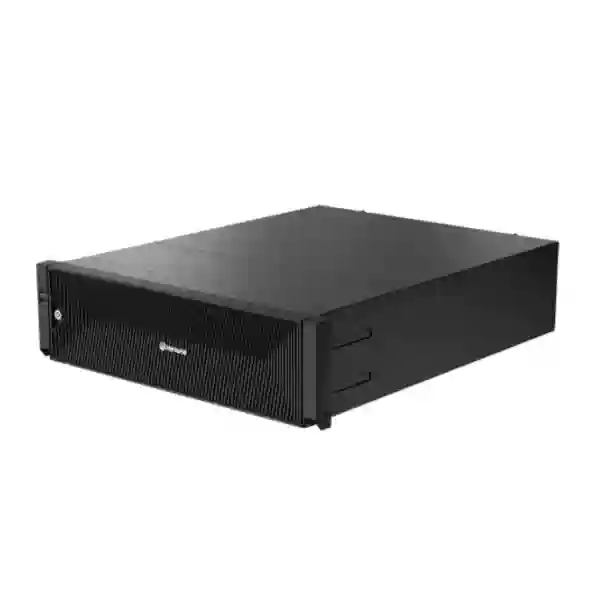
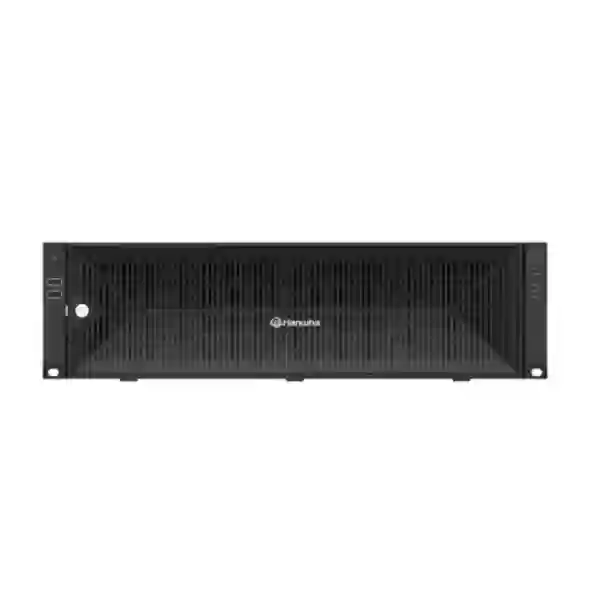
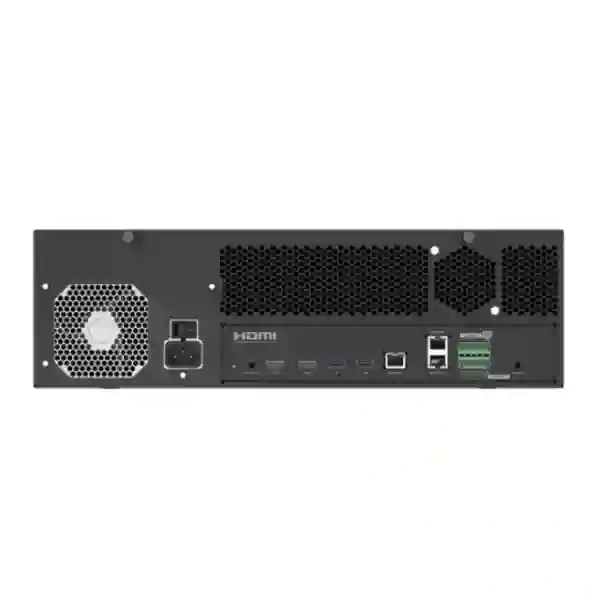
Hanwha XRN-6420B4 64-Channel Network Video Recorder
The Hanwha XRN-6420B4 brings together 64 IP camera inputs, sixteen hot-swappable SATA bays, RAID 5/6 support, dual HDMI monitoring and security-focused device management. For a professional surveillance project, the right question is how the recorder fits the planned camera bitrate, footage retention, network and power infrastructure.
Buyers in Tanzania can use the guidance below to request a configuration-led quotation. Installed drives, usable capacity, local stock, pricing, warranties and delivery terms require confirmation for the exact offer.
Five decisions before buying
Key limits: 520 Mbps is mode dependent; 160 TB is the maximum non-RAID raw disk configuration, not guaranteed usable space or included storage.
Technical overview
| Channels | Up to 64 IP camera channels |
|---|---|
| Resolution | CIF through 32 MP camera support |
| Video formats | H.265, H.264, MJPEG |
| Record load | Up to 300 Mbps normal mode; up to 520 Mbps distributed / RAID modes |
| Drive bays | 16 hot-swappable SATA; maximum 160 TB raw non-RAID with supported 10 TB disks |
| RAID options | RAID 5/6; up to two arrays of eight disks |
| Local display | HDMI 1 3840 × 2160 / 30 Hz; HDMI 2 1920 × 1080 / 60 Hz |
| Connections | 3 × gigabit Ethernet; 8 alarm inputs; 4 alarm outputs |
| Power | One AC inlet; 100–240 VAC, 50/60 Hz; up to 265 W with 16 HDDs |
| Environment | 0 to 40°C operating temperature; 20–85% relative humidity |
Specifications are based on manufacturer-published model information. Verify current compatible drive lists, firmware and project-specific support before purchase.
Who should consider this Hanwha recorder?
The Hanwha XRN-6420B4 is a professional 64-channel network video recorder intended for organisations that want a central place to collect, store, display and investigate video from multiple IP cameras. Its 12th-generation Intel processing platform, embedded Linux operating system, extensive internal disk arrangement and security-related features are directed at substantial surveillance installations. Buyers should see it as part of a designed camera and network system, not as a stand-alone answer to every security requirement.
Potential uses include a larger commercial property, multi-building campus, distribution facility, hospitality site or industrial operation with many camera viewpoints. These are examples of suitability, not claims about existing installations. A site may need to keep watch over entrances, storage areas, vehicle movements, circulation spaces and restricted zones, with authorised people able to search past events. The important benefit is organised evidence and operator visibility across a planned camera estate.
A small organisation with few cameras may find a less complex recorder more appropriate. At the other extreme, a large or mission-critical installation may need several recorders and independent failure domains. Begin the buying decision with a camera schedule, recording-retention target, expected users, network layout and the consequences of downtime. Those requirements determine whether this 64-channel unit is the right component and what supporting equipment is necessary.
Core specifications explained in practical terms
The recorder supports a maximum of 64 IP camera channels, with published camera resolution support extending to 32 megapixels. Hanwha lists H.265, H.264 and MJPEG compression and the SUNAPI and ONVIF camera protocols. The specifications identify sixteen hot-swappable SATA drive bays with a maximum of 160 TB of raw non-RAID storage when populated with supported 10 TB drives. Neither the maximum channel count nor the storage headline confirms that disks come with a particular commercial offer.
RAID 5 and RAID 6 are supported, and the manufacturer describes two arrays of up to eight disks each. Local display uses two HDMI outputs, including 3840 by 2160 at 30 Hz on the first and 1920 by 1080 at 60 Hz on the second. The unit lists three gigabit Ethernet interfaces, eight alarm inputs, four alarm outputs and connections for local management and exporting footage. Camera compatibility, layout and decoding limits still need to be checked for the proposed deployment.
An integrated Trusted Platform Module, access logging, signed-firmware support and network security controls contribute to the product’s management capabilities. The exact model suffix matters: XRN-6420B4 has one AC power inlet, while the related XRN-6420DB4 is the model Hanwha describes with two inlets. The stated operating temperature range is 0 to 40 degrees Celsius. Correct identification of the model and environment is essential before approving the rack and power design.
Recording bandwidth: 300 Mbps and 520 Mbps are different figures
Hanwha specifies up to 300 Mbps recording bandwidth in normal recording mode and up to 520 Mbps when distributed recording is configured. The RAID-mode specifications also list up to 520 Mbps, including the degraded or rebuild conditions stated by the manufacturer. This distinction matters because a buyer could select a 64-camera profile based on the larger number while leaving the recorder in a mode whose stated limit is considerably lower. Confirm the intended operational mode during design and commissioning.
A simple example shows why bitrate budgeting matters. Sixty-four cameras with a recorded average of 4 Mbps each generate around 256 Mbps of camera video. That number is below the normal-mode headline, but it is only an approximation before traffic variations and a sensible operating margin. If the same 64 cameras each average 8 Mbps, the combined load becomes approximately 512 Mbps. That exceeds the normal-mode figure and leaves almost no margin even near the larger published limit.
Actual bitrates vary with movement, lighting, image complexity, recording frame rate, selected compression and the settings of each camera. Busy scenes and poor low-light images can be more demanding than a quiet demonstration scene. Obtain measured values for the intended profiles and estimate bursts rather than relying on a camera’s nominal bitrate. Also consider the separate playback-bandwidth figure, operator live viewing and the capacity of the network links carrying video to the recorder.
Storage capacity and realistic retention calculations
The listed 160 TB is maximum raw storage capacity in a non-RAID arrangement, not guaranteed usable capacity after an array is created and not an assurance of a particular retention period. Some space is consumed by formatting and management, and RAID parity reduces usable capacity further. The duration of stored footage depends on camera count, real average bitrate, hours recorded, audio, recording schedule and retention policy. A technical quotation should translate those assumptions into an estimated number of days.
As a planning illustration, a continuous 1 Mbps video stream represents about 10.8 GB of data in twenty-four hours using decimal units. Sixty-four cameras averaging 4 Mbps continuously would therefore create roughly 2.76 TB each day, or about 83 TB over thirty days, before RAID, filesystem and reserve allowances. This is calculation guidance, not a measured promise. A higher actual bitrate, additional streams or longer retention target changes the disk requirement, sometimes substantially.
Not every channel necessarily needs the same recording profile. Critical entrances may justify more detail or longer continuous retention, while some low-activity areas may use an agreed schedule or supported event rules. Those decisions should follow the site’s operational and legal requirements rather than an attempt to make an undersized disk array appear sufficient. Identify who is authorised to change schedules, when footage is overwritten and how important recordings are retained beyond automatic expiry.
How RAID 5, RAID 6 and hot-swap affect the project
RAID 5 and RAID 6 can make a storage system more tolerant of certain disk failures, but they use capacity for parity and do not replace an independent evidence backup. In a conventional equal-drive eight-disk array, RAID 5 uses the equivalent of one disk for parity and RAID 6 the equivalent of two. Actual available space must be confirmed under the manufacturer’s supported configuration. Ask the installer for the proposed array map, total raw terabytes, projected usable terabytes and expected retention.
RAID 5 can offer greater usable capacity, whereas RAID 6 provides an additional layer of disk-failure tolerance within a supported array. Choosing between them should depend on business risk, size of drives, expected rebuild processes and the importance of keeping recordings available. The XRN-6420B4 offers hot-swappable bays, but replacement still requires the correct compatible drives and a controlled procedure. A hot-swap design does not make incorrect disk removal or unmanaged maintenance harmless.
Build storage-health notifications into the operations plan. Establish who sees a drive warning, who orders an approved replacement and who verifies that an array has returned to its normal state. If important footage must survive theft, fire, accidental deletion or a wider site incident, arrange separate controlled exports or backups. Include restoration and verification tests in the handover document. An intact RAID array is one element of availability, not a complete disaster-recovery strategy.
Camera resolution, video codecs and image usefulness
The recorder accepts high-resolution network camera inputs, but its ability to record a stream is not identical to its capacity to decode numerous live streams at once. The manufacturer’s local display decoding table varies with resolution, frame rate and encoding. For a control room that expects many simultaneous high-resolution views, choose sensible main and substream profiles and demonstrate the requested layout. Do not assume the 64-channel input specification guarantees 64 simultaneous full-resolution 32 MP views.
H.265 may reduce network and storage demand for certain scenes, while H.264 may be required by older clients or particular integrations. MJPEG has different bandwidth characteristics and should not be treated as an interchangeable low-storage option. Verify the encoding that the proposed cameras actually support and the playback tools investigators will use. Profile decisions should include measured low-light and high-motion footage, because the quality and bitrate can change dramatically with the scene.
The most valuable recording is one that preserves usable detail for a legitimate security task. Lens choice, viewpoint, illumination, shutter settings, weather exposure and camera mounting often matter more than an impressive megapixel figure. Define whether the camera must detect activity, identify a person, read an object or provide contextual coverage. Then choose resolution and bitrate based on those outcomes. A recorder cannot recreate details that were blurred or never captured by the camera.
Network connectivity and PoE infrastructure
The XRN-6420B4 includes three gigabit Ethernet interfaces, but its published connections do not make it a substitute for the external PoE switching and cabling that may be needed to operate IP cameras. Build a network drawing showing every camera, switch, uplink and recording interface. Check the PoE power requirements of the camera models, the capacity of switch power supplies and the real link speeds across different buildings or cabinets. The recording system is limited by its weakest necessary connection.
Camera networks benefit from planned addressing, time synchronisation and appropriate separation from ordinary office traffic. Where suitable, use dedicated VLANs, carefully scoped firewall rules and monitored network switches. Uplink congestion, packet loss or an unstable wireless bridge can cause gaps even when the recorder itself has spare recording bandwidth. Test the busiest camera traffic alongside live viewing and evidence playback. A headline recorder capacity does not compensate for a poorly planned network.
Remote access introduces a different set of questions. Decide whether viewers use a secure corporate path, supported browser access or compatible Wisenet client software, and confirm the applicable software versions. Limit who can see live feeds, retrieve recordings or change settings. Keep the administration interface away from unnecessary public exposure. Test the remote workflow using the site’s actual internet connection, because remote bandwidth and authentication can be more restrictive than local recording performance.
Live monitoring and effective operator workflows
Hanwha lists dual HDMI monitoring, dynamic display layouts and virtual channels. These functions help security staff organise camera views around the work being done. A front-desk team may need the main entrance and reception, while a supervisor may prioritise a loading bay and perimeter. Screen layouts should be agreed with operators rather than determined only by the maximum number of boxes a monitor can display. A cluttered wall of tiny images can reduce rather than improve awareness.
Name cameras by recognisable location and purpose, including building, floor or direction where appropriate. Keep the layout consistent with site maps and train staff to find adjacent viewpoints during an incident. Document which feeds belong in standard presets and who may change them. For larger estates, well-labelled streams, usable event logs and straightforward playback can save more time than an elaborate but unfamiliar interface. Test the workflow with the people who will actually use it.
Live response and retrospective search are separate acceptance tasks. An operator responding now needs prompt access to relevant views and the current alarm context. An investigator working days later needs accurate timestamps, a manageable search path and verifiable exports. Have the installation team demonstrate both tasks with representative recordings. Review whether the operator can find, play and export the needed sequence without being given hidden technical assistance.
Events, intelligent search and camera compatibility
Supported event sources include alarm inputs and camera-side conditions such as motion or supported analytics, with configurable actions including notifications, alarm outputs and other event responses. The availability of particular events depends on the connected camera, its capabilities, protocol and configuration. Draw up an event matrix listing each important trigger, the expected operator action, the recorded information and the escalation contact. Without those decisions, a long alarm feature list may produce unmanageable noise.
Hanwha’s published specifications describe object-attribute AI search as compatible with Hanwha AI cameras. That wording is important: the recorder should not be presented as adding full AI analysis to every third-party stream by itself. If searches based on supported object characteristics are required, verify the exact proposed camera hardware and current firmware. Ask for a demonstration using realistic footage. Basic ONVIF video compatibility does not establish the availability of every advanced analytic or metadata feature.
Test false-alarm behaviour in busy and quiet periods, particularly at night, when lighting, shadows or moving vegetation may alter scene conditions. Decide which events require immediate attention and which should be captured for later investigation. Include camera loss, recording interruption and disk-health events as operational alerts. The aim is to improve response to meaningful exceptions while retaining an understandable record of what happened and who acted.
Cybersecurity, accounts and firmware management
The integrated TPM is one part of a broader device-security approach. Hanwha also lists signed firmware, user access logs, 802.1X, IP filtering and supported encrypted communication features. These are useful controls, but they only improve deployment security when configured correctly. During installation, record the approved management network, replace default credentials where applicable and avoid shared administrator accounts. Give routine monitoring users the minimum privileges required for their work.
Create a clear access policy for live viewing, historical search, evidence export and configuration changes. Establish who approves new accounts, who reviews access periodically and who disables access when a staff member changes duties. Reliable system time is important both for incident reconstruction and for comparing video with door-control or alarm records. Log administrative changes and preserve configuration backups in a location governed by appropriate access controls.
Decide in advance how firmware upgrades, client-software updates and security advisories will be handled. Record the installed version, relevant release notes and camera compatibility before changing a live system. Test upgrades under an approved maintenance procedure with a recovery plan. Security must remain an operational responsibility after commissioning; a product’s cybersecurity features cannot compensate for abandoned accounts, uncontrolled remote connections or unsupported software left unmaintained.
Resilience, power interruption and evidence continuity
The manufacturer’s specification lists N+1 failover and ARB support, but that does not prove they operate in any arbitrary arrangement. Such capabilities require compatible devices, a supported configuration and testing of the planned failure scenario. If a site must keep recording through equipment loss, define how much interruption is acceptable and what components need redundancy. A design review should address disks, recorder hardware, switches, network links and power rather than relying on a single failover label.
The XRN-6420B4 has one AC inlet, a critical distinction from the dual-inlet XRN-6420DB4. If the buyer requires separate power feeds or higher equipment availability, consider the alternative model or a different system architecture. An uninterruptible power supply can help protect against brief outages or allow controlled shutdown, but backup runtime depends on batteries and every connected load. Remember to include switches, cameras, cooling and any essential monitors when calculating power-protection requirements.
Footage that matters to an investigation may need preservation outside ordinary rolling storage. Agree who can export recordings, how original dates and times are recorded and where the evidence is held. Verify that exported files open on the intended receiving systems and that any necessary viewing software is available. RAID alone cannot protect an export from accidental deletion or a site-wide incident. Keep an auditable process for evidence handling and review it periodically.
Rack space, environment and maintenance access
Hanwha lists the chassis dimensions as approximately 440 by 132 by 571.1 millimetres and the weight as approximately 14 kilograms without drives. Depth, rear cable room and access to front drive bays should be checked against the actual rack before ordering. Leave room for ventilation, safe handling and maintenance without disturbing other equipment. The populated unit may also introduce significant heat and drive noise, so choose a suitable technical area rather than placing it in an unventilated cupboard.
The specified input range is 100 to 240 volts AC at 50/60 Hz, with a manufacturer-listed maximum consumption of 265 watts when sixteen hard drives are installed. Use this figure in a broader cabinet power and heat assessment. The published operating temperature is 0 to 40 degrees Celsius, with relative humidity of 20 to 85 percent. Do not assume that an ordinary room remains within limits when switches, UPS equipment and multiple drives are active.
Cleanliness, airflow and physical access deserve attention in warm or dusty environments. Design the cabinet so that cables do not block vents and maintenance personnel can identify and replace the correct drive safely. Monitor environmental conditions where equipment reliability is important. If a particular location is exposed to excessive heat, moisture, vibration or contamination, improve the installation environment rather than implying that the recorder is certified for such exposure.
Planning a deployment in Tanzania
For a Tanzanian business, project readiness begins with a realistic assessment of local operating conditions at the chosen premises. Check supply power quality, network infrastructure, temperature inside the equipment space and who will administer the system after installation. These are sensible design questions, not claims of verified product stock, local installation coverage or guaranteed response times. The exact commercial offer and service responsibilities must be confirmed separately before the buyer commits.
Where cameras are distributed between buildings, document the medium connecting them, available bandwidth and the consequence of a link failure. A centralised recorder needs reliable access to each camera stream. If a connection is limited or unpredictable, the layout and recording strategy may need to change. For internet-based monitoring, account for the upstream connection and the security of remote access. Do not treat a strong local recording specification as a promise of smooth remote viewing on every network.
A useful local quotation should include the precise XRN-6420B4 model, the actual included accessories and drives, RAID configuration, usable storage estimate, retention assumption, compatible cameras and required commissioning services. Ask for current price and taxes, availability, delivery terms, warranty route and after-sales arrangements in writing. No Tanzania-specific approvals, import status, sale price or inventory level can be established from a generic product feature summary.
Comparing the B4 model with other recording choices
The XRN-6420B4 may be appealing when the project requires a substantial single-recorder channel count and sizeable internal storage. A smaller 16- or 32-channel recorder may be more appropriate for modest sites, while multiple recorders may improve fault isolation at a large or business-critical property. The choice should follow the number of cameras, bitrate, protection requirements, location of buildings, desired retention and practical administration costs. Maximum specifications are a poor substitute for system design.
Check the suffix on the final order. Hanwha identifies XRN-6420B4 as the 64-channel single-power-inlet product, while XRN-6420DB4 is a related 64-channel dual-power-inlet variant. It would be misleading to describe both as having identical power arrangements. If power resilience is a central procurement requirement, evaluate the intended UPS, feed arrangement and alternative recorders as a whole. The right answer depends on the installation and the outage scenarios that matter.
Compare proposals using common assumptions rather than competing marketing tables. Ask each supplier to show predicted usable storage, recording headroom, supported camera functionality, recovery procedures, security configuration, cooling needs and how acceptance will be demonstrated. Consider whether the current design can accommodate sensible growth, but do not pay for channels or storage that the network and maintenance budget cannot support. Document the reasons for choosing a particular architecture.
Commissioning checks before handover
Before live operation, verify the exact recorder model, supported hard-drive models and all installed firmware versions. Configure disk arrays and recording profiles, then confirm actual camera ingestion rates against the design. Check every camera’s viewpoint, clock, resolution and ability to record the required event detail. Confirm continuous and scheduled recording policies, the overwrite plan and the expected retention range. Camera naming should match the approved site plan so investigations do not depend on someone’s memory.
Test local display presets and any authorised remote viewer from the devices staff will use. Confirm that normal users cannot alter administrator settings and that all required events, alarms and notifications reach the right people. Search for a specific recorded incident, play it back and export a sample clip. Open that clip on the expected receiving computer to verify the format and playback process. These end-to-end tasks are more meaningful than confirming that a camera tile is green.
Under a safe, agreed test procedure, check responses to camera disconnection, network interruption, disk alerts and short power disruptions. If the installation includes RAID protection, failover or other resilience measures, commission those capabilities explicitly. Record approved settings, software versions, configuration backups, network maps, user-role assignments, environmental checks and escalation contacts. Acceptance should be based on witnessed results and written responsibilities, not an assumption that powering up the hardware proves the system is complete.
Build a quotation around your actual surveillance plan
A useful request for quotation lists every planned camera and, where possible, its manufacturer, model, resolution, codec, frame rate and likely average bitrate. State whether recording is continuous or event-driven, the number of days footage must be retained and whether certain cameras need a different policy. Explain how many simultaneous local and remote viewers will work with the system and whether the site depends on dual-monitor operations, event integration or particular search capabilities.
Ask for the recorder and hard drives to be itemised separately. The proposal should name compatible drive models, raw and estimated usable capacity, RAID level, configuration assumptions and the expected retention calculation. Include switching, PoE, uplinks, rack space, protected power, cooling, cybersecurity setup, commissioning and staff training. Where intelligent search is expected, obtain confirmation for exact camera models and integration conditions rather than a generic claim about AI support.
Request a current configuration-led quote for Hanwha XRN-6420B4 through a verified FourTeck Tanzania enquiry route. Confirm local pricing, availability, delivery, taxes, warranty and support terms for the specific offer. Do not infer that hard drives are supplied, an installation package is included or a service promise applies unless it appears in the quotation. This approach gives purchasing, facilities and security teams a common technical basis for comparing proposals.
Common questions about the XRN-6420B4
How many cameras does the XRN-6420B4 accept?
The manufacturer specifies a maximum of 64 IP camera channels. Channel count is not a promise of unrestricted aggregate bitrate, full-resolution simultaneous local decoding or advanced analytics on every camera. Plan the actual camera profiles and confirm the total recording load and display requirements. A properly sized 64-camera design also needs sufficient disk capacity, network switching, power and a realistic operator workflow.
Why do some descriptions say 300 Mbps and others 520 Mbps?
These figures apply to different recording conditions. The published normal-mode recording specification is up to 300 Mbps; distributed recording and RAID modes are listed at up to 520 Mbps. Do not design to the larger number while assuming the smaller-mode configuration. Verify which mode is proposed, and allow operational headroom for fluctuating scene complexity and camera bitrate rather than treating either limit as a comfortable continuous target.
Does the advertised 160 TB mean storage is included?
No. The manufacturer’s capacity specification describes what the recorder can support using the appropriate number of compatible drives. It does not establish what any individual sales package includes. An itemised quotation should confirm whether disks are supplied, their exact models, their number, how they are arranged and the estimated net space. RAID parity and system overhead mean usable storage can be less than the raw installed capacity.
Can I use third-party ONVIF IP cameras?
Hanwha lists ONVIF and SUNAPI among the supported protocols. That provides a useful starting point for camera interoperability, but actual functions vary with model, firmware, integration method and specific feature. Test live video, recording, events, PTZ where required, timestamps and export behaviour using the intended cameras. Do not assume that every advanced function available on a Hanwha camera will automatically be present through a third-party connection.
Can the recorder provide AI object searches on all feeds?
The manufacturer qualifies object-attribute AI search as compatible with Hanwha AI cameras. That is not the same as promising advanced AI analysis for any attached camera. Specify exact compatible camera models and versions, identify which attributes matter to the project and request a demonstration using representative recordings. If the cameras do not produce supported metadata, an AI-related feature in the NVR specification may not deliver the desired search workflow.
Does it provide power to the IP cameras?
The documented interface list identifies gigabit network connections but not an integrated bank of camera PoE ports that would replace external switching. Design the camera network and power separately, using compatible PoE switches or approved power arrangements. Check port counts, uplink capacity, the power budget of each switch and protection against outages. A recorder’s video bandwidth specification is not a specification for the rest of the camera network.
Is RAID a complete backup solution?
No. RAID is principally a storage availability measure for certain disk faults. It does not automatically protect footage from mistaken deletion, theft, fire, malicious changes or broader equipment failure. Decide whether important clips need independent copies or a controlled long-term archive. Test alerts and drive-replacement procedures. If compliance or evidence obligations apply, design the associated retention and access controls as a separate responsibility.
How much disk space is needed for thirty days?
Use the actual number of continuously recorded cameras and measured average video bitrates. As a rough illustration, 64 cameras at 4 Mbps each generate about 83 TB of video in thirty days before RAID and other allowances. The final requirement changes with codec, frame rate, movement, recording schedule, audio and drive-protection arrangement. Have the installer provide a calculation and reserve sufficient margin before deciding the number of disks.
Can two local monitors be connected?
The manufacturer’s specification lists two HDMI outputs with different maximum output resolutions and refresh rates. The product also provides dynamic display arrangements and virtual channels. However, local decoding capacity varies with stream settings and display mode. Test the exact live views and number of simultaneous streams expected by the control room. Dual HDMI outputs alone do not guarantee that every high-resolution camera can be displayed at full resolution at once.
What is the difference between B4 and DB4?
The published model descriptions distinguish their power inlets. XRN-6420B4 has one AC power inlet, while XRN-6420DB4 is the related 64-channel version with two. Confirm the suffix on the order, not merely the camera count. If separate power feeds or enhanced availability are required, review the whole electrical and recorder design. Two power connections only help if the supporting power arrangement is engineered correctly.
Can the recorder be managed over the internet?
Hanwha lists browser, desktop and mobile viewer options subject to supported versions and access limits. A secure access plan is still required. Avoid unnecessary direct exposure of the administrative interface and use appropriate account permissions, encryption and managed network access. Test remote live viewing, recorded playback and export across the actual connection. Internet quality and security choices can affect the experience even when local recording is functioning correctly.
What should a Tanzania buyer verify before ordering?
Confirm the exact model, the supported camera schedule, mode-specific recording load, included hard drives, usable retention capacity, rack and cooling needs, switching and UPS requirements. Request current written confirmation of local price, inventory, delivery terms, applicable charges, warranty arrangements and service scope. The general specification does not establish those commercial facts. A documented configuration and acceptance plan helps avoid expensive assumptions after installation.
Request a configuration-led quote in Tanzania
Prepare the camera schedule, average bitrates, required retention days, proposed recording mode and physical site requirements. Request an itemised solution specifying compatible disks, RAID layout, expected usable capacity, network and UPS equipment, commissioning responsibilities and current commercial terms.
Next step: Contact FourTeck Tanzania through a verified sales or enquiry channel for a scoped Hanwha XRN-6420B4 proposal. No unsupported local pricing, availability or service guarantees are implied.




Reviews
There are no reviews yet.