
Network audio / indoor ceiling installation
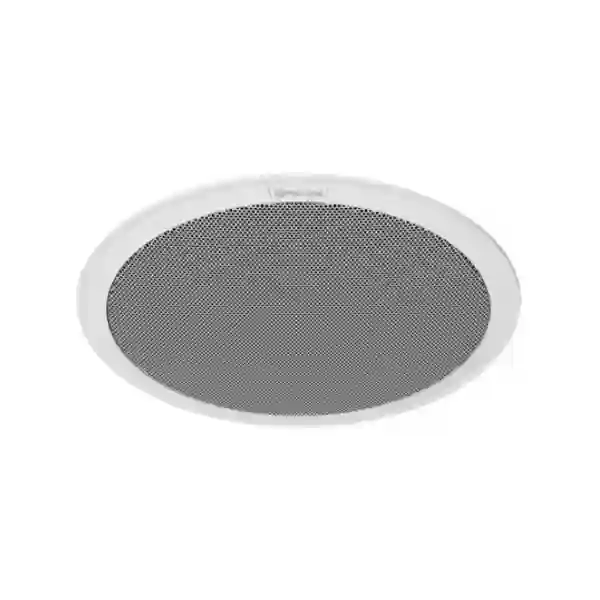
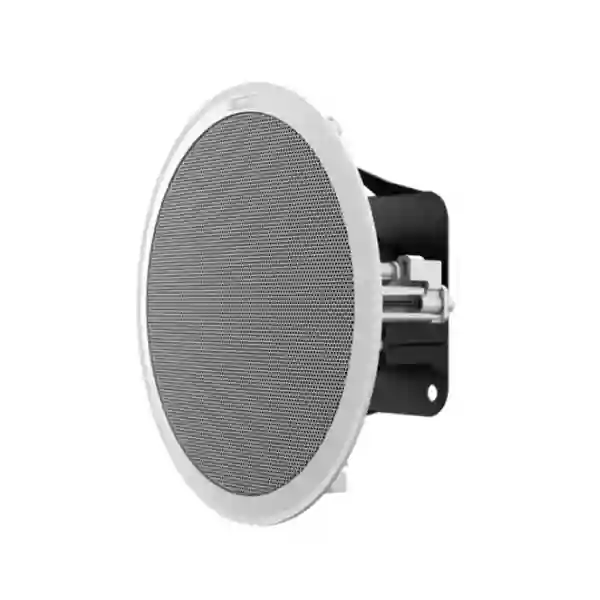
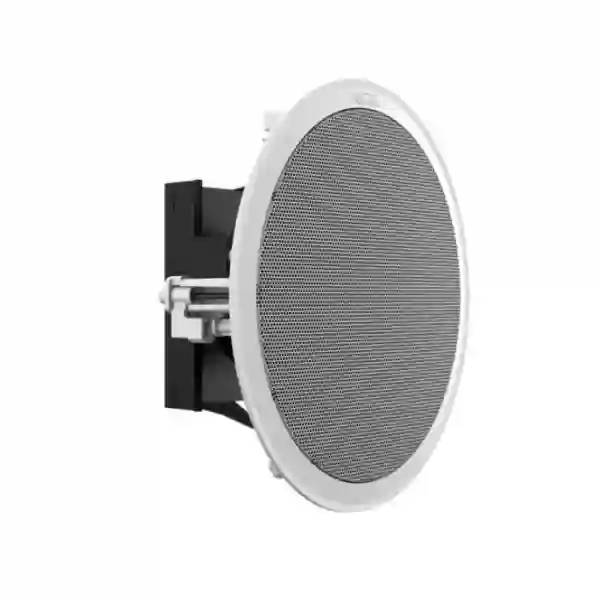
Hanwha SPA-C100W IP Ceiling Speaker
Plan clear indoor paging and announcements with a white network ceiling speaker featuring a built-in 10W amplifier, PoE or PoE+ power and SIP-capable audio integration.
For Tanzania projects: confirm network design, ceiling fit, audio coverage and source compatibility before specifying the complete system.
Is this the right speaker for your site?
Good reasons to evaluate it
- Indoor ceiling-mounted IP announcements
- Network paging and configured audio zones
- PoE-powered endpoints with managed switching
- Planned SIP and recorded-message workflows
Check alternatives or design first
- Outdoor, wet or washdown locations
- Extremely noisy or acoustically difficult rooms
- Regulated evacuation or fire-alarm use
- Unverified PBX or native Swahili TTS requirements
At-a-glance specifications
| Product type | Indoor-oriented IP ceiling speaker; white |
|---|---|
| Amplifier | Built-in 10W Class D |
| Power | IEEE 802.3af PoE / IEEE 802.3at PoE+ |
| Max SPL | 96dB on PoE; 100dB on PoE+ |
| Network | 10/100 Base-T Ethernet |
| Speaker frequency range | 120Hz–20kHz (−10dB) |
| Memory | 1GB internal; manufacturer lists SDHC microSD options up to 32GB |
| Dimensions / weight | Approx. 269mm diameter × 142.5mm height; 1.8kg |
| Environment | −20°C to +50°C; 10–85% RH non-condensing |
| Protocols / integration | SIP, SUNAPI HTTP API, ONVIF Profile S and documented network functions |
Figures are manufacturer specifications and do not establish local stock, warranty, price or achieved sound levels in a particular installation.
A practical IP audio choice for the right ceiling space
The Hanwha SPA-C100W IP ceiling speaker is intended for facilities that need clear network-delivered announcements, coordinated background audio, or spoken messages in selected indoor areas. It brings an amplifier, network connection, and playback functions into a white ceiling-mounted unit. Rather than pulling a conventional speaker circuit from a central analogue amplifier to every location, the designer can plan network-connected endpoints and a suitable audio control arrangement. This can be especially helpful where the building already has structured Ethernet cabling, managed switches, and IT staff who support connected devices. It is not automatically the right product for every room; acoustic layout and network design remain essential.
A buyer should start with the intended message, the audience, and the noise conditions. A receptionist making occasional announcements needs a different workflow from a school bell schedule, a hotel background-music system, or a facility with many zones. Identify who may start a broadcast, which areas must hear it, whether simultaneous announcements are expected, and what must happen if the network or electricity fails. These requirements determine the complete solution. A ceiling speaker alone does not define a compliant emergency voice evacuation system, guarantee intelligibility, or provide an entire public-address installation.
The SPA-C100W is the white version of this Hanwha Vision model family. Check the exact model on purchasing paperwork, particularly where ceiling speakers, pendant speakers, wall speakers and horn speakers could be confused. Choose a ceiling location where the speaker is physically suitable and where installers can reach an approved mounting point, provide network cabling, and perform sound testing after installation. Ask for a project-specific system design before ordering a large quantity.
What the verified specifications mean to the buyer
Hanwha specifies a built-in 10W Class D amplifier, 10/100 Base-T Ethernet connectivity, IEEE 802.3af PoE and IEEE 802.3at PoE+ power support, and 1GB of internal memory. The speaker section is described as a two-way design with an 8-inch low-frequency driver and a 2-inch high-frequency driver. These figures describe the equipment, not a promise that any particular room will receive a uniform sound level. Ceiling height, room area, surrounding surfaces and the sound source all influence what occupants actually hear. A good design converts specifications into a practical listening test.
The stated maximum sound pressure level differs by supply type: 96dB on PoE and 100dB on PoE+. That distinction matters if a design depends on loudness. The published frequency range for the speaker itself is 120Hz to 20kHz at the stated minus-10dB reference, while the separate line-output frequency response is listed as 20Hz to 20kHz. These are different measurements and should not be merged into one speaker response claim. Similarly, output level in dBV refers to an audio interface measurement rather than an acoustic volume setting.
The manufacturer lists a 90dB sensitivity at one watt, a nominal coverage pattern of 90 degrees at 1kHz and 60 degrees at 4kHz, and a white enclosure approximately 269mm in diameter and 142.5mm high, weighing about 1.8kg. Coverage figures vary with frequency and are not a guarantee of speech clarity at every seat. Request installation drawings and confirm the mounting cut-out and support method with the current manufacturer instructions before any ceiling is cut.
Build the system around actual broadcasts, not just speaker count
An IP public-address deployment begins with sources, controllers, destinations and operations. Sources may include an authorised person speaking through a supported microphone, a compatible SIP telephone path, scheduled audio, or a configured event input. Destinations are speakers or zones that receive a particular message. The control layer determines which source is allowed, how the destination is selected, and how different announcements compete for attention. This distinction is important because a building with twenty speakers could still require several independent announcement zones and carefully prioritised messages.
Hanwha describes speaker mode and controller-based arrangements within its IP audio documentation. The choice depends on the deployment design and supported system components. Do not assume a single SPA-C100W will operate every networked speaker without configuration or without meeting the documented controller requirements. For multi-building or multi-floor sites, document the required device roles, network topology, clock synchronisation, administrative access, schedules and operational responsibility before installation. A system diagram is often more useful than a simple shopping list.
For a proposed Tanzania project, prepare a room-by-room audio schedule. Include each space, ceiling height, normal ambient noise, whether announcements must be intelligible over music, the preferred language of recorded messages, and whether the speaker should work during an IT outage. Mark the source of each broadcast and its intended area. These details help separate a straightforward paging job from a more complex managed audio project and reduce the chance of buying additional speakers to correct a design issue.
PoE and PoE+: plan power from the switch outward
Power over Ethernet is a useful feature of the SPA-C100W because its network cable can also provide operating power from suitable equipment. Hanwha lists support for IEEE 802.3af Type 1 Class 3 and IEEE 802.3at Type 2 Class 4. An installer should confirm that the selected switch or injector can negotiate the correct standard, that each port has sufficient capacity, and that the switch has enough total available PoE budget for every connected device. A switch advertised as PoE capable may not deliver full power to all ports at once.
PoE+ is especially relevant when the project expects the manufacturer’s higher 100dB maximum sound pressure specification, compared with 96dB listed for standard PoE. This is a manufacturer rating under defined conditions, not a guaranteed listening level at the far end of a corridor. Acoustic design still matters. Where available, choose a managed switch with clear power usage and fault reporting so a failed port is easier to locate. Confirm cable category, cable routes, terminations and allowable cable length against network installation standards and the product guide.
Critical facilities should also assess electrical resilience. A PoE speaker depends on its switch, upstream equipment, controller and audio source. If the switch loses mains supply, the speaker may lose both network service and power. A suitable UPS, documented network failover strategy, and tested operational procedure can reduce disruption, but these elements are not included simply because a speaker supports PoE. Request an end-to-end power diagram rather than assuming the ceiling device is independently backed up.
Network connectivity and bandwidth considerations
The SPA-C100W uses 10/100 Base-T Ethernet and supports IP-based audio functions. A network team should determine addressing, DHCP or reserved addresses, management access, clock settings, and route visibility before mounting devices. Consistent device names, locations and IP assignments make future service faster. For larger installations, use an inventory that connects the physical ceiling position with the switch port, device identifier, zone name and management credentials. Avoid putting passwords or network secrets into public documentation.
Hanwha lists multicast and unicast capabilities for its dynamic public-address controls. Multicast can be efficient when one audio stream is delivered to many receiving devices, but the network must be configured to handle the traffic correctly. The designer should review VLAN boundaries, multicast forwarding behaviour, routing, quality of service and the upstream connections that carry audio. If managed switching is already in place, coordinate with the customer’s IT team rather than changing network settings independently during installation.
Network reliability affects audible reliability. A message that sounds correct during a short demonstration could fail during heavy traffic, a switch reboot, or an incorrectly configured routing change. Test scheduled playback, live announcements, simultaneous sources and recovery after a planned power interruption. Record packet-loss symptoms, audible delays, the intended control priority and who can troubleshoot the system. The goal is not just to establish that the speaker responds to ping, but to verify that an authorised user can reliably deliver an understandable message to the intended listeners.
Zones and groups: important capacity figures need context
The manufacturer’s specification describes up to 256 multicast zones, up to 20 unicast zones and up to 255 groups, with a multi-source multicast arrangement covering up to 48 sources, described as 24 audio and 24 microphone channels. It also states that up to 15 audio channels can broadcast simultaneously under the relevant arrangement. These are stated system-control capabilities, not an assurance that one small switch or one speaker can support a complete building at those limits without suitable architecture. Actual use depends on device roles, configuration and network conditions.
A zone is a practical place or announcement area. A group is a way of addressing several zones together. Consider a multi-level office: each floor may have its own zone while a whole-building group is used for a common notice. In a school, classrooms and shared areas might need distinct routing, with broadcasts timed to avoid interrupting teaching. The right zone plan begins with operational behaviour rather than an arbitrary maximum number. Keep zone names intuitive for staff who may not understand the underlying network.
Ask who can speak to all zones and who can address only one area. Work through overlapping messages, priority rules and after-hours use. A hotel may want low-level music in one area while the administration team makes a clear staff announcement elsewhere. A warehouse office may need a separate zone from a noisy industrial bay, which may be better served by a different speaker type. Document these differences and verify them through commissioning tests, rather than treating maximum zone counts as the main purchase criterion.
SIP and business telephony integration
Hanwha lists SIP as a supported protocol for the SPA-C100W and describes testing with clients including Grandstream, Yealink, Cisco and MicroSIP, along with an Asterisk PBX environment. The manufacturer also specifies DTMF under RFC2833 and the PCMU, PCMA and Speex audio codecs it supports. This makes SIP paging a relevant design option when organisations want an authorised telephone user to initiate speech over their IP audio system. However, a tested client list is not a guarantee that every PBX platform, hosted calling service, firmware revision or dial plan will work without validation.
A business considering telephone-to-speaker announcements should first describe the desired call flow. Will the caller dial a paging extension, authenticate, select a zone, hear a confirmation tone and then speak? Will incoming calls be prevented from creating unapproved broadcasts? Does the organisation need audit trails or defined speaking privileges? The PBX, network and audio configuration should be checked as one workflow. Audio codec negotiation, DTMF transport, registration, firewall treatment and timing need practical testing.
Do not promise automatic interoperability with an existing Tanzanian telecom operator, SIP trunk or hosted PBX based solely on SIP support. A local service provider’s trunk may be suitable for external calls without being relevant to internal multicast paging. The customer’s system administrator should verify the exact PBX model, software version, network access and desired features. If telephone paging is business-critical, test the complete call path before the final installation is accepted.
Announcements, audio files and supported text-to-speech languages
The SPA-C100W supports WAV and MP3 audio, with manufacturer-listed bit rates and sampling rates, and provides 1GB internal memory. Hanwha also describes SDHC microSD media support up to 32GB with its specified media compatibility information. These features are useful for planned messages, chimes, notification sounds and background audio where the configuration supports the intended playback workflow. Storage should be organised carefully: retain approved master recordings, record file versions and make sure a replaced message is distributed to the correct destinations.
Text-to-speech can simplify the generation of standard announcements, but its native language list matters. Hanwha lists English in US and UK variants, German, French, Spanish and Russian for the product. Swahili is not in that published TTS list, so do not represent native Swahili text-to-speech as a verified capability. For a facility that needs spoken Swahili, one possible workflow is to prepare a properly recorded Swahili audio file in a supported format and validate playback, subject to the system’s configuration and operational requirements.
Announcements also need human-centred design. Speak at a measured pace, make instructions short, avoid needless jargon and test recordings against normal background noise. Where a message carries important operational meaning, identify who approves the wording and who can replace it. A technically correct recording may still be confusing to guests, customers or temporary workers. Multilingual sites should plan the languages, speaker routing, volume and repetition policy deliberately, rather than assuming one audio message serves every listener.
Event inputs and integration with other systems
Hanwha lists one dry-contact input channel and one dry-contact normally-open output channel for the SPA-C100W, together with virtual contacts and event or preset functions. These options may allow a properly designed system to connect certain configured equipment events with audio actions. The exact trigger sequence, electrical limits, security approvals and source priority must follow the current device documentation and any external controller requirements. A dry contact is a specific electrical interface, not a general guarantee that every alarm or building-management platform can connect safely.
If the objective is to announce a door event, operational alert or camera-initiated message, first establish the authoritative source of the event, how it is authenticated and what happens when that source misbehaves. Decide whether repeated triggers should be suppressed and whether staff need to acknowledge an event. For video-system scenarios, verify any intended integration with the actual surveillance software and supported API or event features. The manufacturer lists SUNAPI and ONVIF Profile S, but those names alone do not define the complete integration or make all third-party functions available.
Life-safety use deserves a separate, formal engineering review. The speaker’s ability to play announcements does not demonstrate approval as a fire detection, emergency evacuation or mandated alarm device under applicable rules. Do not replace a regulated alarm system with ordinary IP paging on the strength of a product brochure. Consult the appropriate qualified professionals for design, integration, testing and any required local approvals. For routine operational announcements, a well-defined trigger and message approval process is still essential.
Ceiling fit, mounting and the right physical environment
The SPA-C100W is a white ceiling speaker with manufacturer-stated overall dimensions of approximately 269mm in diameter and 142.5mm in height, and a weight of roughly 1.8kg. Before installation, the site team should obtain the current mounting guide and verify the correct ceiling opening, safe support method, cable entry, service clearance and access above the ceiling. Overall product dimensions are not the same as cut-out dimensions. Never use the nominal diameter as an instruction to cut a hole. Use the exact approved installation drawing for the device and ceiling system.
A suspended-ceiling tile may need supplementary support so that the speaker’s weight is not carried by an unsuitable panel alone. The installer should also consider ceiling fire compartments, structural supports, other services, electrical separation and the ability to service the device later. Ceiling location should be chosen alongside lighting, sprinklers, ventilation outlets, partitions and seating patterns. A visually tidy position in the centre of a tile is not automatically the best acoustic position for intelligible announcements.
The published operating range is minus 20 to plus 50 degrees Celsius, with 10 to 85 percent relative humidity under non-condensing conditions. The manufacturer page gives no ingress-protection rating for this model. Do not describe it as waterproof, weatherproof or suitable for uncovered outdoor use. In locations exposed to wind-driven rain, washdown, condensation, corrosion or heavy dust, assess an appropriately rated alternative. A ceiling speaker selected for an indoor reception should not automatically be copied into an open loading bay or a damp plant area.
Acoustic coverage: what a specification sheet cannot decide
The two-way driver arrangement and rated output make the SPA-C100W an option for voice and suitable background audio, but perceived quality depends on more than wattage. Hard floors, glass partitions, tall atriums, crowds, air-conditioning and other sound sources can reduce intelligibility. Adding volume may not solve excessive echoes. A layout with several carefully positioned speakers operating at moderate levels can be preferable to forcing one device to cover too much space. The required arrangement should be established by an acoustic survey or informed site assessment.
Hanwha provides a coverage pattern of 90 degrees at 1kHz and 60 degrees at 4kHz. Those numbers illustrate that coverage changes with frequency. A person walking away from the central axis may hear some parts of speech less clearly, even if a nominal sound-level target is met. Consider where people stand, sit, queue or move, and whether a message needs to reach a doorway, counter or corridor corner. Do not infer an exact square-metre coverage area from the published angles alone.
A sensible commissioning process uses representative audio and realistic operating conditions. Test a female and male voice where appropriate, check the selected languages, listen at likely audience positions, and check the loudest expected ambient period. Confirm that important words can be understood without discomfort in nearby quiet rooms. Record adjustments for each zone. Avoid presenting manufacturer maximum SPL as the normal working volume or as an independently verified result in the customer’s building.
Access control, security and IT ownership
Because the SPA-C100W is a network device, its security must be managed like other connected building equipment. Hanwha lists password-protected roles and access features, with supported network protocols that vary in security properties. The product’s regional pages and firmware revisions can differ in how they describe supported functions, so administrators should follow the current release documentation when enabling HTTPS, authentication, management interfaces and any other security features. Avoid enabling unnecessary services simply because a protocol name appears in a specification table.
Choose strong unique credentials, assign responsibility for account changes, and restrict administrative access to appropriate networks or management workstations. Place the audio system in a network design that limits exposure to unrelated guest devices and the public internet. If a PBX or video platform needs access, allow only the necessary traffic. Record approved changes, device versions, backup procedures and recovery credentials in a secure location. Configuration documentation should be available to the site owner without placing secrets on equipment labels.
Operational abuse matters as much as technical compromise. An unauthorised paging user could cause disruption even if the loudspeaker itself is functioning correctly. Define who can broadcast, what each role can address, and how messages are stopped. Review firmware and support notices during the equipment lifecycle, stage upgrades carefully and test audio after changes. For a large site, the person who maintains the switches, the person who operates announcements, and the person who administers the PBX should have an agreed support procedure.
Monitoring, acceptance tests and ongoing maintenance
Hanwha describes audio monitoring, speaker tests, connection verification and system logging among the SPA-C100W functions. These are useful tools for service teams, but no monitoring feature eliminates the need to verify audible output in the actual room. A level indicator can show a signal while poor routing, muted volume, environmental noise or an installation fault prevents listeners from understanding the message. Build both network checks and listening checks into the maintenance plan.
At commissioning, document the installed model and firmware, mounting location, network details, source assignments, zone membership, test file and observed result. Confirm that standard PoE and PoE+ behaviour matches the design. Exercise a local recording, a live announcement where applicable, the expected group destinations and any approved event preset. If SIP paging is part of the system, dial and test it through the customer’s actual PBX. Confirm that unintended zones remain quiet and that users understand how to end a broadcast.
Maintenance should include periodic inspection of exposed parts, fixing systems and accessible cabling by qualified staff. Review switch health, unexpected device disconnections, credential ownership, recorded messages and operational changes. If the facility layout changes, update the zone map. Keep a clear route for incident reporting: who responds to silence, distorted audio, repeated announcements or an unauthorised message? A reliable public-address installation is a maintained workflow, not merely a set of speakers installed once.
Where this speaker fits: offices, schools, hospitality and retail
In an office, the SPA-C100W may be considered for reception areas, shared working zones, circulation spaces and internal staff announcements, provided ceiling mounting and sound coverage are appropriate. Buyers should separate occasional live paging from permanent background music, since the controls and listener expectations differ. For a multi-floor building, use zone names that match actual floor plans and ensure staff can direct a message to the right people without broadcasting unnecessarily throughout the building. Consider quiet meeting rooms and privacy-sensitive spaces when choosing volume settings.
In education, scheduled chimes and announcements can be useful, but the project team should consider lesson disruption, staff permissions, remote buildings and uneven ambient noise. In hospitality, background audio and guest information may be considered for selected indoor areas; however, aesthetic fit, music licensing responsibility, customer comfort and clear separation of staff-only messages all matter. In retail, a site might want routine announcements that do not overwhelm shoppers or cashiers. None of these examples proves the model is right for every building in the sector.
For clinics, warehouses or industrial sites, requirements may be more demanding. Staff may need very clear instructions, corridors may have hard reflective surfaces, and some areas may involve dust, washdown or significant noise. A ceiling speaker with no published ingress-protection rating may not be the appropriate endpoint in those spaces. Consider whether a properly rated horn or wall speaker is required instead. For every project, identify the audience, acoustic conditions, network ownership and criticality of the announcements before choosing the endpoint family.
How it compares with conventional analogue speaker layouts
A conventional analogue public-address system usually relies on centrally located amplification and speaker cabling designed for its electrical distribution method. An IP audio system places network-capable endpoints at selected locations and can make room or zone management more flexible when correctly integrated. Neither approach is universally better. Existing building wiring, control requirements, future changes, power resilience and maintainers’ skills can make a large difference to the total installed cost and operating experience.
The SPA-C100W’s built-in amplifier and PoE support may reduce the need for a separate local amplifier at each speaker. They do not remove the need for suitable switching, cable pathways, controller design, microphones or audio sources where required. A buyer should compare a complete bill of materials rather than comparing only the price of an IP speaker with the price of a passive ceiling speaker. Include switch power budget, structured cabling, configuration, rack space, training, documentation, commissioning, maintenance and any approved audio server or software components.
An upgrade project deserves special attention. Existing ceiling openings may not fit this enclosure. The old system may use analogue speaker loops that cannot be reused as Ethernet lines. Existing microphones and alarm interfaces may require different hardware, and staff may need a new control method. Ask whether the objective is to replace a failed device, add a single IP audio zone or redesign the public-address network entirely. Each case leads to a different technical proposal and a different risk profile.
Procurement checklist for a Tanzania-based project
A useful quotation request includes the exact requested model, the number of areas, approximate site layout, installation environment and intended audio sources. Identify whether the customer already operates managed PoE switches and whether those switches have spare port and power capacity. Include the ceiling construction, access above the ceiling, expected operating hours and whether backup power is required. If the project is an extension to an existing Hanwha audio arrangement, record current models and software versions so that compatibility can be checked before equipment is committed.
For operational planning, specify the required languages and whether recorded audio, text-to-speech, live microphone or telephone paging is preferred. Explain the need for zone selection, schedules and simultaneous sources. Where the system will interface with CCTV, a building management platform or a PBX, provide the actual platform and firmware details. A short working demonstration is more valuable than a generic compatibility promise. For larger sites, include the people who will administer the system and the minimum handover training they need.
Local pricing, stock, delivery, warranty terms and installation support for this exact listing have not been verified here and should be requested directly before purchase. The manufacturer states that regional availability can vary, so an online model listing elsewhere should not be treated as proof of local supply. Obtain a written quotation that distinguishes equipment, accessories, network work, configuration, testing, training and any ongoing support. A clear scope helps buyers compare proposals without assuming that a unit price includes a complete commissioned system.
Common design mistakes to avoid
The first mistake is treating 100dB as the volume every listener will experience. It is a maximum product sound-pressure specification under the relevant PoE+ condition, not a site measurement. The second is treating PoE and PoE+ as interchangeable for output planning. A switch with a limited power budget can change expected performance. The third is choosing speaker quantity from a floor area alone. Ceiling height, reverberation, background noise and room use must also be considered before a count is finalised.
Another frequent problem is buying the endpoint before defining message routes. The number of zones, permissions and sources affects every part of the system. Similarly, a model’s SIP support should not be mistaken for approval with every telephone platform. Test the actual PBX, dial plan and calling rights. Avoid assuming automatic Swahili text-to-speech or outdoor protection; neither is established by the manufacturer’s published SPA-C100W specification. Recorded language content and protected speaker alternatives may be more suitable for those needs.
Finally, do not neglect operational handover. A capable installation can become unreliable if nobody knows the password, source files, zone names, power circuit or maintenance process. Ensure the customer receives a sensible diagram, device inventory, tested configuration and instructions for common tasks. Before sign-off, simulate a source failure and a switch restart where safe to do so. An installation that has only passed an initial music playback test is not necessarily ready for daily announcements.
A step-by-step route from inquiry to working system
Start with a brief site assessment: map the spaces and identify where people must hear announcements. Agree the reason for using IP audio rather than assuming it is required. Define each source, the person allowed to use it, the zones it may address and the priority of its messages. Make a list of abnormal situations, including power interruption, a missing audio file and a network fault. The goal is a small, testable requirement set that purchasing and technical teams can both understand.
Next, check the physical and network infrastructure. Review ceiling type, mounting method, Ethernet routes, switch ports, total PoE capacity and UPS arrangements where needed. Confirm manufacturer dimensions against the actual construction. Decide whether an audio controller, microphone, PBX path or third-party platform is within scope, and verify compatibility for the exact versions proposed. If prerecorded messages are required, create representative files in supported formats and confirm that the wording and language meet the site’s needs.
Then commission in stages. Configure one representative unit, test its audio and network behaviour, and confirm the intended user experience before repeating the settings across a site. Validate zone routing, priority, speech clarity and reporting in the normal operating environment. Record the working configuration, train responsible staff and arrange a maintenance plan. This staged approach reduces rework and produces evidence of suitability rather than depending on marketing specifications alone.
Frequently asked questions
Is the Hanwha SPA-C100W an ordinary passive ceiling speaker?
No. It is an IP ceiling speaker with a built-in 10W Class D amplifier, Ethernet connectivity and PoE or PoE+ power support. It should be evaluated as a network endpoint within a suitable audio system rather than wired directly like an ordinary passive speaker. Confirm the whole system arrangement before purchasing.
What is the difference between PoE and PoE+ for this model?
Hanwha specifies a maximum sound pressure level of 96dB under PoE and 100dB under PoE+. PoE+ may be important to the target output design, but it does not guarantee loudness or intelligibility in a particular room. Check the actual power delivery capability of the chosen switch and commissioning measurements.
Can it be used for SIP paging from an office phone?
The manufacturer’s specification lists SIP functionality and tests with various SIP clients and an Asterisk PBX environment. A proposed telephone paging workflow still needs validation against the exact PBX version, dial plan, authentication, codecs, routing and security policy. Do not assume all third-party PBX functions are supported automatically.
Does the product offer Swahili text-to-speech?
Swahili is not included in the manufacturer-published native text-to-speech language list for this model. The listed languages include English variants, German, French, Spanish and Russian. If Swahili announcements are required, prepare and test suitable recorded audio files as part of the configured solution instead of promising native Swahili synthesis.
Can one speaker cover a whole office or classroom?
That cannot be confirmed from a model number or maximum output figure alone. Room dimensions, ceiling height, acoustics, furniture and background noise determine the useful coverage. The stated directional pattern also varies with frequency. A site assessment and representative listening test should determine speaker quantity and placement.
Is the SPA-C100W suitable for outdoor use?
The manufacturer does not provide an ingress-protection rating for this model in the checked specification. It should not be described as waterproof or weatherproof. For outdoor, damp, washdown or heavy-dust settings, assess a speaker with an appropriate published environmental rating and mounting method.
Can it play scheduled announcements or stored recordings?
Hanwha documents local audio functions and lists support for WAV and MP3 files, along with internal memory. The complete scheduled-playback workflow depends on device mode and the chosen controller configuration. Confirm scheduling, file handling, priorities and operational access with the current documentation and a practical test.
How many zones or groups are supported?
Hanwha lists up to 256 multicast zones, 20 unicast zones and 255 groups in the relevant dynamic public-address architecture. These are system capability figures subject to configuration and operating conditions, not a promise that one standalone device can deliver an entire installation at these limits without other suitable components.
Does it have a microphone or external event connections?
The manufacturer identifies embedded audio monitoring functions, one dry-contact input and one normally-open dry-contact output. Whether a particular monitoring, talkback or alarm-trigger scenario works depends on configuration, integration and electrical requirements. Do not treat the device as a substitute for a certified alarm panel or a complete intercom system.
Will it work with existing network switches?
It requires suitable 10/100 Ethernet and a correctly powered PoE or PoE+ connection. The installer should confirm the switch’s per-port standard, total power budget, network traffic policy and multicast behaviour where used. A functioning Ethernet link alone does not confirm that all announcements and controller operations will work.
Is any central equipment still needed?
That depends on the intended control method and scale. A single endpoint can support certain local functions, while a multi-zone installation may involve an approved controller, microphone, PBX, network switching or other audio-system components. Define the complete workflow before deciding what hardware and configuration the quotation must include.
What product details should appear on a quotation?
Use the exact Hanwha Vision SPA-C100W model and specify quantities, audio sources, zone requirements, mounting environment, power arrangement, installation scope and acceptance tests. Ask the supplier to confirm local pricing, stock position, delivery, warranty and support terms in writing. No local price or availability is assumed on this page.
Can it integrate with Hanwha security systems?
The specification lists interfaces including SUNAPI and ONVIF Profile S. These are starting points for integration assessment, not universal guarantees that any camera event or video management platform will trigger the requested announcement. Verify the exact platform, firmware, application logic and event priority through manufacturer documentation and a controlled demonstration.
What happens during a power or network outage?
A speaker powered by PoE depends on its connected power-delivering network equipment. Loss of a switch, route or controller may disrupt some or all required functions. Design an appropriate UPS and recovery plan if continuity matters, then test behaviour during representative interruptions. Do not assume the product alone supplies backup power or a complete fault-tolerant architecture.
How can staff verify that the system is working?
Use documented connection and audio monitoring capabilities alongside audible tests from representative listening positions. Confirm that intended destinations play and other zones do not, check programmed audio files and SIP paths where applicable, and record results. Network health indicators are useful but cannot replace a real intelligibility check.
Request a Hanwha SPA-C100W project quotation
Tell FourTeck Tanzania about your site type, number of rooms, ceiling conditions, preferred announcement method, existing network and required zones. A useful proposal should distinguish the speaker hardware from PoE switching, controller or PBX configuration, installation and commissioning. Ask for confirmation of current local availability, price, warranty and the complete scope before placing an order.
Next step: request a quote and a system-fit review for the exact SPA-C100W model.




Reviews
There are no reviews yet.