
FortiGate Firewall for Data Centers
FortiGate data center firewalls are designed for environments where security inspection must keep pace with large application flows, east-west server traffic, encrypted sessions, data-center interconnects and hybrid-cloud connectivity. Fortinet positions its high-end FortiGate platforms around dynamic segmentation, unified policy enforcement, FortiGuard threat protection, high-speed interfaces and centralized operations. For buyers in Tanzania, the practical procurement question is not simply which chassis has the largest firewall number; it is which platform has the right inspected throughput, port mix, session capacity, resilience design, licensing and management architecture for the actual workload.
FourTeck can support a structured evaluation covering existing traffic, planned growth, server and tenant zones, north-south and east-west inspection, high availability, IPsec connectivity, FortiGuard subscriptions, FortiCare support, centralized management and migration planning. Availability, commercial terms and final model selection should be confirmed through a current quotation and the latest Fortinet documentation.
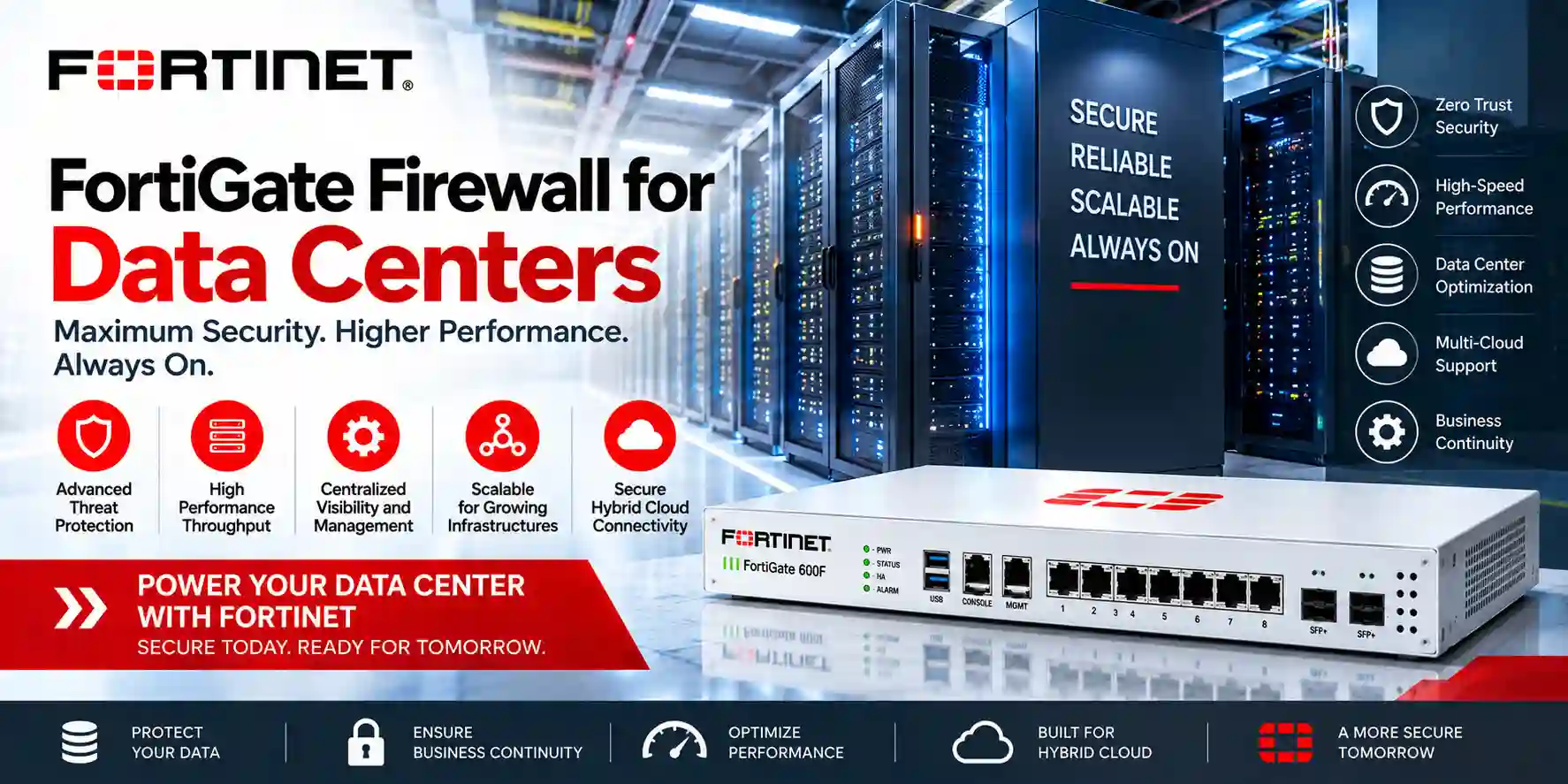
What a FortiGate data center firewall is designed to solve
A data center firewall sits in a different operating environment from a small branch gateway. Traffic volumes are larger, sessions can be more numerous, application dependencies are tighter, and the cost of disruption is usually higher. Security policy may be required at the internet edge, between application tiers, around shared services, across virtualized networks, between production and disaster-recovery sites, or between private infrastructure and public cloud. A suitable FortiGate design therefore has to balance inspection depth with application performance while giving administrators consistent visibility and control.
Fortinet describes its data center approach as part of a hybrid mesh firewall architecture. The objective is to apply coordinated controls across physical, virtual and cloud environments while keeping policies and operations aligned. In a data center context, this can include segmentation of east-west traffic, high-speed north-south inspection, IPsec connections between sites, secure access controls, application visibility, intrusion prevention and malware protection. FortiGate can also participate in broader Fortinet Security Fabric designs with centralized management and analytics components selected according to the project.
The correct platform should be chosen from measured and forecast traffic rather than from a single headline figure. Fortinet’s current data-center guidance specifically highlights security requirements, throughput, interface connectivity, redundancy for disaster recovery and interconnect features such as IPsec VPN. Those factors are useful for Tanzanian organizations building a new data center, refreshing a perimeter firewall, introducing segmentation, consolidating older appliances or creating a more resilient multi-site design.
Inspected throughput
Size against the security services that will actually run, including IPS, application control, malware protection and encrypted traffic inspection where required.
Resilience
Plan high availability, redundant links, power, routing behavior, maintenance windows and disaster-recovery connectivity before the hardware is ordered.
Segmentation
Protect critical application zones and east-west flows with policy boundaries that reflect workload sensitivity, trust level and operational responsibility.
Operations
Include logging, change control, policy review, backup, firmware planning, administrator access and centralized management in the lifecycle design.
Current FortiGate high-end model context
Fortinet’s current NGFW portfolio groups a range of high-end appliances under its data-center category. Representative platforms include FortiGate 1000F, 1200G, 1800F, 2600F, 3000G, 3200F, 3500G, 3700F, 3800G, 4200F, 4400F, 4800F, 7081F and 7121F families. The right model is workload-dependent; a list of models should not be treated as an automatic sizing ladder because interface requirements, security-service performance, session behavior, redundancy, licensing and deployment architecture can change the appropriate choice.
Performance figures are vendor test results and can change by software release, traffic profile, packet size, enabled features and test methodology. Confirm the latest Fortinet datasheet and ordering guide for the exact model and required services before purchase.
Key capabilities to evaluate
East-west security and segmentation
Data-center threats do not only enter from the internet. Compromised workloads can move laterally, which is why internal segmentation is a core design topic. Fortinet promotes scalable segmentation, including VXLAN-related use cases on supported platforms, for protecting traffic between application and server zones.
High-speed interconnect
Where multiple racks, fabrics or data centers exchange large volumes of traffic, interface speed becomes a design constraint. High-end FortiGate platforms can provide 100GE and, on selected models, 400GE connectivity. The required port count, optics and redundancy must be validated for the exact model.
IPsec VPN and hybrid connectivity
Data-center interconnect, branch aggregation, cloud access and disaster-recovery paths may rely on encrypted tunnels. VPN throughput, tunnel count, routing design and failover behavior should therefore be included in sizing rather than treated as a secondary feature.
FortiGuard security services
FortiGuard subscriptions can add services such as intrusion prevention, malware protection, application control, web and DNS security depending on the bundle selected. Service scope should be mapped to policy objectives and renewed consistently across an HA cluster.
Centralized management and analytics
Larger environments benefit from controlled configuration workflows, consistent policy, centralized logging and repeatable changes. FortiManager and FortiAnalyzer can be considered where the project needs broader operational control, reporting or multi-device visibility.
High availability and lifecycle
Fortinet’s data-center ordering guidance states that each appliance in an HA cluster requires its own valid support and FortiGuard licensing at the same service level. Procurement should therefore budget for the cluster as a complete serviceable system rather than a single primary appliance.
How to size a FortiGate firewall for a data center
Start with traffic that the firewall will actually inspect. Separate internet edge traffic from server-to-server traffic, backup and replication flows, storage traffic, VPN traffic and management traffic. Identify peak rather than average utilization, then estimate realistic growth over the intended hardware lifecycle. Next, decide which flows need IPS, malware prevention, application control, SSL inspection or other security profiles. Raw firewall throughput can be substantially higher than full security inspection throughput, so a design based only on line rate can leave insufficient headroom.
Session behavior matters as well. Some applications create large numbers of short-lived connections, while others maintain fewer but longer sessions. Internet services, API-heavy platforms, virtual desktop environments, DNS, large SaaS integrations and service-provider workloads can place different demands on a firewall. Interface design should then be mapped to the network: 10GE, 25GE, 40GE, 100GE or 400GE requirements, link aggregation, redundant fabrics, transceiver types and physical cabling all affect model selection.
Finally, plan for maintenance and failure. A pair of firewalls may be required for high availability, but the surrounding network must also support redundant links and predictable routing. Confirm failover expectations, state synchronization, change procedures, firmware strategy and maintenance windows. If the data center participates in disaster recovery, include the secondary site, replication paths and inter-site VPN requirements in the sizing exercise. The result should be a documented design target that can be compared against the latest Fortinet performance tables and ordering options.
Licensing, FortiCare and high availability
Hardware and security subscriptions should be planned together. Fortinet offers service bundles that can include combinations of FortiGuard protections and FortiCare support. The appropriate bundle depends on the controls the organization intends to enforce and the support model it needs. A procurement document should therefore specify the appliance, service bundle, term, support level and any separate management or analytics components rather than requesting an undefined “FortiGate license.”
For HA clusters, Fortinet’s current ordering guide is explicit that all appliances need valid support contracts and required FortiGuard licenses. Licensing only the primary unit is not sufficient because any cluster member can become primary and because each unit interacts with Fortinet services. This is an important budget point for Tanzania organizations comparing a single-appliance quote with a resilient production architecture.
Renewal planning should begin before expiration. Security signatures, support entitlement and operational continuity are easier to manage when contract dates are documented and aligned. Where a customer is migrating from another vendor or an older FortiGate, Fortinet also offers FortiConverter services for configuration conversion. A migration project should still include manual policy review so unused rules, obsolete objects and unnecessary exceptions are not copied blindly into the new environment.
Related FourTeck security and regional resources
For Tanzania project context, review FourTeck Tanzania, which covers integrated IT, networking, firewall, server and infrastructure requirements. This is relevant when the FortiGate must be coordinated with switching, server, rack, power, cabling and support dependencies rather than purchased as an isolated appliance.
For cross-border procurement and model research, FourTeck Africa provides regional Fortinet and network-firewall resources, including high-end FortiGate product coverage. Organizations with East African branch or disaster-recovery requirements can also use FourTeck Uganda and FourTeck Kenya as regional discussion points for adjacent-country projects.
For Gulf-linked sourcing, Fortinet-focused project research and UAE security requirements, FourTeck Fortinet UAE can be useful where purchasing, corporate IT or regional architecture teams are based in the UAE while infrastructure is deployed elsewhere.
FortiGate Firewall for Data Centers Tanzania
Tanzania organizations evaluating FortiGate for data-center security commonly need to protect server applications, databases, virtualization clusters, internet-facing services, private cloud platforms and connectivity to branch offices or external cloud services. A useful Tanzania requirement starts with the data flows that matter most to the business. Financial systems, ERP, healthcare applications, government services, education platforms, logistics systems, customer portals and hosted workloads may all have different availability and inspection priorities. The firewall design should identify critical zones and define which traffic must cross security boundaries rather than placing every server in one broadly trusted network.
Connectivity conditions can vary by site, and data centers may combine multiple upstream providers, private links and VPN paths. For that reason, Tanzania buyers should document internet capacity, expected growth, WAN diversity, data-center interconnect requirements and any branch aggregation traffic before selecting hardware. If high availability is required, both appliances, support contracts, FortiGuard services, links and upstream/downstream network redundancy should be included in the bill of materials. Power, rack space, cooling and optics should be reviewed alongside firewall specifications because high-end appliances are infrastructure components, not desktop security devices.
A Tanzania quotation should also state whether the project requires only supply, or whether it includes design review, migration, policy cleanup, installation, testing, documentation and administrator handover. Existing rulebases often contain years of accumulated objects and exceptions. Moving to a new FortiGate is an opportunity to confirm which policies are still required, which systems can be segmented more tightly and which temporary rules should be retired. For organizations connecting Tanzania infrastructure with cloud or regional offices, IPsec capacity, routing design and centralized management can be as important as internet-edge protection.
The strongest procurement request is therefore specific: current firewall model, measured peak traffic, internet and private-link speeds, server VLANs, expected concurrent sessions where known, VPN requirements, required FortiGuard services, HA expectations, interface speeds, transceiver needs and target lifecycle. With those details, the FortiGate discussion can focus on fit instead of guessing from organization size alone.
FortiGate Firewall for Data Centers Dar es Salaam
Dar es Salaam is a major concentration point for corporate headquarters, telecom, financial services, logistics, hospitality, government-related operations and technology infrastructure. A FortiGate data-center project in the city may need to secure a private server room, colocation footprint, enterprise data center or a hybrid environment that connects local systems to public cloud. The first design task is to understand whether the firewall is acting mainly as an internet edge, an internal segmentation gateway, a VPN aggregation platform, a data-center interconnect control point, or several of these at once.
For busy environments, inspection requirements should be mapped to business applications. A public customer portal may need strict inbound controls and visibility, while database replication between trusted clusters may have different latency and throughput requirements. East-west segmentation can help reduce the ability of a compromised workload to reach unrelated systems. Administrators should group application tiers and management networks according to trust and operational need, then build policies around those boundaries rather than relying on an oversized flat VLAN design.
Dar es Salaam projects should also consider carrier diversity and physical path resilience. Two internet links connected to the same upstream risk may not provide the resilience expected from true redundancy. Where the FortiGate pair sits between redundant core switches and multiple providers, routing and failover tests should be part of commissioning. If the firewall terminates IPsec links for branches across Tanzania, tunnel scale and encrypted throughput should be included in the sizing model. If remote administrators manage the environment, privileged access should be restricted, logged and separated from ordinary user traffic.
Before requesting a quote, record rack location, available power, uplink speeds, optics, switch interfaces, existing security subscriptions, migration constraints and the acceptable maintenance window. This information helps turn a generic FortiGate request into a design that can be validated against current Fortinet datasheets and the operational realities of the Dar es Salaam site.
FortiGate Firewall for Data Centers Mwanza
Mwanza-based organizations may operate a central server environment that supports offices, healthcare facilities, educational institutions, regional distribution, manufacturing, retail or public-sector services across the Lake Zone. In these designs, the data-center firewall often has to protect more than a single internet connection. It may aggregate branch VPNs, control access to ERP and database services, isolate operational technology or CCTV networks, and provide a policy boundary between local services and cloud applications.
A practical Mwanza sizing exercise should separate user internet browsing from business-critical server traffic. If backups, replication or large file transfers cross the firewall, they can create sustained bandwidth that looks very different from interactive user traffic. If inspection is applied to these flows, the model should be selected on the relevant security-performance figures rather than raw firewall throughput. Organizations should also check whether future uplink upgrades could exceed the capacity of the selected interfaces long before the appliance reaches end of life.
Resilience should reflect the importance of the services hosted. A highly available FortiGate cluster makes more sense when the connected network, power and upstream links are also designed to avoid single points of failure. Document which applications must stay reachable during a firewall failure, which routes should change automatically, and how administrators will verify synchronization and health. For sites that depend on remote support, configuration backups and clear change documentation become especially important because troubleshooting must be possible without relying on one engineer’s memory.
A Mwanza procurement request should include current and planned bandwidth, number of branch tunnels, application zones, public services, preferred support term, security-service requirements and any centralized logging needs. That creates a clear basis for comparing FortiGate models and avoids selecting an appliance only from user count, which is usually an incomplete data-center sizing method.
FortiGate Firewall for Data Centers Arusha
Arusha organizations often combine local business systems with cloud applications, branch connectivity, hospitality platforms, NGO or institutional services, tourism operations and regional collaboration. A FortiGate data-center deployment can provide a controlled security boundary around server and application environments, but the architecture should reflect how those services are actually used. A customer-facing reservation or web application, for example, has different exposure from an internal finance system or a management network used only by administrators.
Segmentation is therefore an important planning theme. Rather than treating all servers as equally trusted, the network can separate public services, application servers, databases, management systems, backup infrastructure and user networks. Firewall policies can then allow only the traffic each tier requires. This approach improves visibility and can contain lateral movement if one workload is compromised. Where virtualization overlays or larger east-west traffic patterns are involved, supported FortiGate segmentation capabilities and interface design should be reviewed against the exact model.
For Arusha environments with remote offices or field operations, IPsec connectivity may be a major part of the firewall workload. The design should estimate encrypted traffic, tunnel count and failover behavior. Where public cloud is part of the architecture, administrators should also decide whether security policy remains on the physical data-center firewall, extends to FortiGate virtual appliances, or is coordinated through broader hybrid controls. The goal is consistent policy without forcing every traffic path through an inefficient route.
When preparing a quotation, include the existing network diagram if available, server subnet list, critical applications, internet links, branch count, inspection requirements, HA expectations and logging/reporting needs. A clear Arusha deployment scope helps ensure that the selected FortiGate is sized for the actual security functions and future growth rather than purchased as an isolated replacement for an older firewall.
FortiGate Firewall for Data Centers Dodoma
Dodoma data-center requirements can involve public administration, institutions, education, healthcare, enterprise offices and organizations that need secure access to central applications from multiple sites. In these environments, the firewall may become a critical control point for application access, branch VPNs, internet services and administrative connections. Availability and governance can therefore be as important as maximum throughput.
A sensible design begins with policy ownership. Define who approves firewall rules, how emergency changes are handled, how expired rules are removed and where configuration backups are stored. Centralized management can be considered when several FortiGate devices or sites must follow common standards. Logging should be planned according to operational and audit needs, with retention based on the organization’s requirements rather than whatever storage happens to be available on the appliance.
Technical sizing should account for encrypted traffic and security profiles. Modern applications rely heavily on TLS, so an organization that expects deep inspection must consider the relevant SSL-inspection performance and certificate-management implications. Not all traffic should necessarily be treated identically; policy can be based on risk and application requirements. IPsec links to other offices or recovery sites should be included in the capacity calculation, and interfaces should provide enough headroom for planned switch or carrier upgrades.
For Dodoma procurement, a complete request can list the required FortiGate role, primary and secondary links, server zones, remote-site count, VPN bandwidth, HA requirement, support period, FortiGuard bundle expectations and migration scope. Where a resilient pair is planned, both appliances require appropriate support and security-service licensing. Documenting these details early helps technical and procurement teams compare equivalent proposals instead of receiving quotes with different service coverage.
FortiGate Firewall for Data Centers UAE
UAE-based enterprises frequently operate regional headquarters, cloud-connected infrastructure, colocation environments and multi-country networks that create demanding firewall requirements. A FortiGate data-center design for the UAE may need to inspect high-speed internet traffic, connect private data centers with public cloud, segment application tiers and support secure links to offices across the Middle East, Africa and Asia. The procurement team should separate these roles and quantify each traffic class before choosing a model.
High-speed interfaces can be especially relevant where the firewall sits between modern spine-leaf networks, dense virtualization clusters or data-center interconnects. Fortinet’s high-end portfolio includes models with 100GE and selected 400GE connectivity. The network team should confirm the number and type of required ports, optics, breakout needs, redundancy and compatibility with adjacent switches. Interface availability should be checked in the current datasheet because chassis and appliance configurations differ.
UAE projects also tend to involve formal change control and clear responsibility between internal IT, service providers, colocation teams and regional administrators. Migration planning should define who owns routing, NAT, VPN, security policies, certificates and validation testing. If FortiManager or FortiAnalyzer is included, the architecture should specify where those systems run and how they are protected. For HA, licenses and support should be aligned across cluster members to avoid gaps during failover.
A useful UAE quotation request includes throughput under the required inspection profile, session expectations, public-service exposure, data-center interconnect bandwidth, cloud connectivity, HA mode, support term and management tools. Organizations sourcing for African subsidiaries should also include destination, import responsibility and implementation scope separately so commercial logistics do not get confused with the technical bill of materials.
FortiGate Firewall for Data Centers Uganda
Uganda organizations planning data-center security may need to protect core applications in Kampala while serving branches, regional offices or operational sites across the country. FortiGate can be evaluated as a platform for internet-edge security, application segmentation, branch VPN concentration and secure connections to cloud or disaster-recovery environments. The architecture should begin with application dependency mapping so security policies do not accidentally block essential service-to-service communication during migration.
For multi-site businesses, VPN and routing behavior deserve particular attention. Branches may use different access circuits and bandwidth levels, and the central firewall can become a concentration point for all encrypted traffic. IPsec throughput should therefore be sized alongside threat-protection performance. Where SD-WAN is part of the wider Fortinet design, routing and path-selection policy should be tested with failure scenarios rather than assumed from a configuration template.
Uganda data-center buyers should also consider how security events will be monitored. A high-performance firewall provides limited value if logs are never reviewed or if rule changes are undocumented. Centralized analysis and management tools can be evaluated for larger environments, especially where multiple FortiGates need consistent policy. Access to administration interfaces should be limited to dedicated management networks or approved secure paths, with strong authentication and role separation.
A procurement package should define the appliance role, peak traffic, required interfaces, branch and cloud tunnels, HA expectation, security subscriptions, support duration and migration responsibilities. If the project spans Tanzania and Uganda, use consistent naming, addressing and change procedures where practical so operational teams are not maintaining two unrelated firewall standards.
FortiGate Firewall for Data Centers Kampala
Kampala is the main enterprise and connectivity hub for many Uganda organizations, so a FortiGate data-center deployment there may combine multiple demanding roles. A single environment can host banking, ERP, education, healthcare, government, telecom or managed-service applications while also terminating remote-site VPNs and internet services. Sizing should therefore be based on the busiest expected inspection period, not a quiet average measured during normal office hours.
Organizations should identify which traffic needs full security profiles. Public-facing application flows may require different controls from replication between tightly controlled systems. Encrypted traffic can materially affect performance when deep inspection is enabled. If SSL inspection is part of the security strategy, the team should plan certificate deployment, exclusions, application compatibility and user-impact testing as well as hardware capacity. This makes the decision more realistic than simply comparing raw throughput numbers.
Kampala environments may also connect to regional branches with varying link quality. The firewall design should account for tunnel failover, routing convergence and the risk of a central outage affecting many sites at once. High availability can reduce appliance failure risk, but the network should include redundant switch paths and upstream links if the objective is true service resilience. Backup configurations, software version control and documented recovery procedures should be part of operations from the first day.
Before requesting a FortiGate quote for Kampala, provide current interface speeds, internet and private circuits, security profiles, VPN load, number of protected server zones, HA requirements and the expected growth period. These inputs allow an enterprise model to be evaluated against the actual architecture rather than selected because another organization of similar size uses it.
FortiGate Firewall for Data Centers Arua
Arua-based organizations may not operate hyperscale infrastructure, but they can still have data-center-style requirements when a regional server room supports many users, remote sites, healthcare systems, education platforms, logistics applications or public services. The appropriate FortiGate may therefore sit below the largest chassis class while still needing careful sizing for inspection, VPN connectivity and resilience. The objective is to match the actual workload, not to overbuy purely because the project is described as a data center.
For a regional environment, WAN reliability and remote administration often shape the design. If the firewall supports links to Kampala, cloud services or neighboring sites, the team should map which applications remain usable when one connection fails. Dual links can improve continuity, but routing and DNS behavior should be tested so services actually switch as intended. Where branches use IPsec, encrypted throughput and concurrent tunnel requirements should be documented.
Segmentation can provide significant security value even in a modest data center. Separating servers, administrators, backup systems, CCTV, guest networks and ordinary users makes policy clearer and can reduce lateral movement. Firewall rules should be specific enough to protect critical systems while remaining maintainable. Logging, naming standards and comments in policy objects are practical operational controls that make future troubleshooting easier, especially when support is provided from another city.
An Arua quotation request should describe the number and type of protected services, internet and inter-site link speeds, inspection features, VPN requirements, interface count, HA needs and expected expansion. This gives suppliers enough context to recommend a FortiGate model without assuming that every data-center project needs the same hardware tier.
FortiGate Firewall for Data Centers Mbarara
Mbarara organizations can use a central FortiGate to protect business applications, healthcare systems, educational services, financial platforms, retail infrastructure or regional operations that serve multiple sites in western Uganda. A data-center firewall design should separate the need for internet security from the need for internal segmentation. If all critical servers sit behind the same trusted interface, the organization may still have substantial lateral risk even when the internet edge is well protected.
Start by identifying zones according to function and sensitivity: public services, application servers, databases, management, backup, user networks and third-party access are common examples. Define permitted communication between these zones, then estimate how much of that traffic the firewall must inspect. If high-volume backup or replication flows cross security boundaries, their sustained bandwidth can affect sizing significantly. Where inspection would provide limited value, policy and architecture should be designed deliberately rather than applying every feature to every flow without testing.
Operational simplicity is also important. A smaller IT team benefits from consistent objects, clear rule names, scheduled backups and documented change history. If multiple FortiGate devices are deployed at branches, centralized management may reduce configuration drift. Support terms and FortiGuard subscriptions should be tracked as part of asset management so security services do not expire unnoticed.
For a Mbarara project, the request for quotation should include application criticality, peak traffic, branch connectivity, internet speed, desired segmentation, VPNs, management requirements and resilience targets. With this information, model selection can be based on security workload and growth rather than on a generic assumption about city size or employee count.
FortiGate Firewall for Data Centers Gulu
Gulu enterprises and institutions may need centralized security for applications supporting education, healthcare, NGOs, logistics, public services or branch operations across northern Uganda. A FortiGate can provide a consolidated control point for internet access, server segmentation and secure connections to other offices, but centralization increases the importance of resilience. The design should state what must continue working if an appliance, switch, circuit or power source fails.
If high availability is required, the project should include two appropriately licensed FortiGate appliances, redundant links and a clear failover design. Fortinet requires valid support and required FortiGuard services on all members of an HA cluster. This means budget comparisons should evaluate the complete cluster rather than presenting one fully licensed device and one under-specified standby unit. Maintenance and firmware procedures should also explain how upgrades will be performed without creating unnecessary downtime.
For organizations with sites connected over IPsec, Gulu can be part of a wider regional topology where the central firewall exchanges traffic with Kampala, other Ugandan cities or cross-border infrastructure. The network team should size encrypted throughput and confirm that the route design avoids inefficient backhauling where direct cloud access would be more appropriate. Logging and remote administration should use secure management paths and documented credentials with role-based access.
A complete Gulu quotation request should state the current gateway, expected bandwidth, server networks, required security profiles, inter-site tunnels, HA objective, support period and implementation scope. This allows the proposed FortiGate to be reviewed technically before commercial approval and gives the organization a clearer basis for future expansion.
FortiGate Firewall for Data Centers Kenya
Kenya has a large concentration of enterprise, cloud, telecom, financial and colocation infrastructure, making high-capacity firewall design a common requirement for organizations with Nairobi-based data centers or regional operations. A FortiGate project may involve internet edge inspection, application segmentation, cloud connectivity, service-provider links, disaster-recovery traffic and branch VPN aggregation. These workloads should be quantified separately because each can stress different firewall resources.
High-speed data-center networks increasingly use 25GE, 40GE, 100GE and, for selected architectures, 400GE links. Fortinet’s high-end portfolio includes platforms designed for these connectivity levels. The model choice should account for how many ports are required, whether they need hardware acceleration, what optics are supported and how links will be distributed across redundant switching fabrics. A firewall with sufficient inspection throughput but insufficient interface architecture is still the wrong choice.
Kenya organizations operating regionally should also plan policy consistency. If branches in Tanzania or Uganda use FortiGate, common naming, object standards and centralized management can simplify operations. However, policies should still reflect each site’s services and legal or operational requirements. A change made for one country should not automatically be pushed everywhere without validation. Disaster recovery between countries should include IPsec performance, routing, failover testing and application dependency checks.
For procurement, describe the physical and logical topology, internet and private links, inspection profile, public services, expected peak throughput, HA design, FortiGuard requirements and support term. High-end FortiGate purchases are best treated as engineered infrastructure projects, with current availability and commercial terms confirmed at quotation time.
FortiGate Firewall for Data Centers Kuwait
Kuwait data-center environments can support government, finance, oil and gas, healthcare, retail, telecom and enterprise applications where availability and controlled access are critical. A FortiGate deployment should be designed around the sensitivity of those workloads and the traffic that crosses trust boundaries. High throughput alone is not enough; the platform must also provide the required interfaces, inspection services, session capacity, routing functions and operational visibility.
For organizations using multiple data centers, a key design question is how security policy applies to inter-site traffic. Replication and backup can consume large sustained bandwidth, while user and API traffic can create many sessions. The team should decide which interconnect flows require inspection and how failover affects routes. Fortinet’s data-center guidance specifically includes disaster-recovery redundancy and IPsec interconnect requirements among selection considerations, making these appropriate inputs for a Kuwait sizing exercise.
Operational governance should include administrative separation, change approval, centralized logs and regular policy review. If a high-availability pair is deployed, both units need aligned support and FortiGuard coverage. Hardware lifecycle planning should also include spare optics, maintenance procedures and vendor documentation so critical changes are not improvised during an incident. Where existing third-party firewalls are being replaced, policy conversion tools can assist but should not replace a deliberate rule cleanup.
A Kuwait quotation should identify required line speeds, inspected throughput target, HA architecture, VPN and cloud connectivity, management tools, service subscriptions and support period. If the purchasing organization is linked to projects in Tanzania or other African markets, separate the central architecture standard from local site requirements so each deployment is appropriately sized.
FortiGate Firewall for Data Centers Ghana
Ghana organizations may deploy FortiGate data-center firewalls for financial platforms, enterprise applications, telecom infrastructure, education, healthcare, government systems and regional business services. Accra-based data centers can also act as hubs for branch networks, which means the central firewall has to handle both server protection and encrypted WAN traffic. The architecture should document those roles so the appliance is not sized from internet speed alone.
Segmentation is particularly useful where multiple departments, tenants or application tiers share infrastructure. A firewall can enforce boundaries between public services, internal applications, databases, management and backup networks. For larger virtualized environments, east-west visibility can help reduce blind spots between workloads. The policy model should remain understandable; excessive rule complexity can become an operational risk if administrators cannot easily determine why traffic is allowed.
Ghana buyers should also plan lifecycle costs. A high-end firewall purchase may include FortiCare and FortiGuard services, and resilient clusters require coverage for each unit. Centralized management and analytics can be included when the organization needs consistent policy, reporting or multi-device visibility. Support terms, renewal dates and ownership should be documented before handover so ongoing security operations do not depend on procurement records that are difficult to find later.
For quotation accuracy, share peak traffic, encrypted traffic expectations, interface speeds, number of protected zones, branch or cloud tunnels, HA requirement, support term and migration scope. This lets the FortiGate proposal reflect the organization’s real security workload and gives procurement teams a clearer way to compare technically equivalent options.
FortiGate Firewall for Data Centers Nigeria
Nigeria’s large enterprise and service-provider market can generate demanding data-center firewall workloads, particularly for organizations operating in Lagos, Abuja and other major commercial centers. FortiGate can be considered for high-speed internet security, segmentation, multi-tenant environments, hybrid cloud, large VPN estates and data-center interconnect. The first step is to quantify these use cases rather than selecting a high-end model simply because the organization is large.
Traffic patterns can vary widely. Financial transaction systems may prioritize predictable latency and availability; digital platforms can create bursts of connections; service providers may require very large session tables; backup and replication can create sustained elephant flows. Fortinet’s high-end models address different combinations of throughput, interfaces and scale, so the technical team should compare the latest datasheets against measured requirements. Where 100GE or 400GE-class links are needed, the exact port layout and supported optics must be confirmed.
Security operations should be part of the design. A complex data center benefits from centralized logging, documented changes, administrator role separation and tested backup/restore procedures. For HA, service contracts and FortiGuard coverage should be aligned across the cluster. If multiple countries share one policy framework, management can be centralized while still allowing local exceptions to be reviewed and documented.
A Nigeria quotation request should state peak inspected throughput, concurrent connection characteristics where known, public services, interface requirements, data-center interconnect bandwidth, VPN load, HA design, management tools and subscription term. This information helps avoid both under-sizing and unnecessary over-sizing, especially when comparing appliance and chassis options across the FortiGate high-end portfolio.
FortiGate Firewall for Data Centers Seychelles
Seychelles organizations can have critical data-center requirements even when the overall user population is smaller than in large continental markets. Hospitality groups, financial services, government, telecom, aviation, education and multi-site businesses may depend on centralized applications that need strong network security and high availability. The FortiGate selection should therefore focus on business criticality, link capacity and inspection requirements rather than assuming that a smaller market automatically needs a small firewall.
International connectivity and off-island cloud or disaster-recovery services can make WAN design particularly important. The firewall may terminate site-to-site IPsec, protect internet access and control connections to hosted platforms. If redundant providers are available, failover should be tested from an application perspective: DNS, routing, VPN and remote access all need to behave correctly. A high-availability firewall pair reduces appliance risk, but resilience still depends on power, switching and upstream diversity.
Operational support should also influence architecture. Clear documentation, remote management controls, configuration backups and standardized policy naming make it easier to maintain a system when specialist support is not physically present at all times. FortiManager and FortiAnalyzer can be considered if multiple devices or sites require centralized control and visibility. FortiGuard subscriptions should be chosen according to the intended protections and tracked through renewal.
A Seychelles quotation should include application criticality, internet and inter-site bandwidth, inspection profile, server zones, VPN needs, HA expectations, interface requirements and support term. With those inputs, the design can prioritize reliability and maintainability while still choosing an appropriately sized FortiGate rather than defaulting to an unnecessarily large platform.
Deployment and migration checklist
Capture current peak traffic, interfaces, session behavior, VPN load, security profiles, public services and growth projections.
Document north-south and east-west flows, HA topology, routing, data-center interconnects, management paths and disaster recovery.
Specify FortiGuard services, FortiCare level and term for every appliance in the production cluster.
Review old rules, objects and NAT policies; do not move obsolete configuration into the new firewall without validation.
Test application access, internet services, VPNs, HA failover, logging, routing and rollback procedures before declaring completion.
Record software versions, backup locations, renewal dates, administrator roles, diagrams and change procedures for ongoing operations.
Frequently asked questions
Which FortiGate model is suitable for a data center?
There is no single model for every data center. Fortinet’s high-end portfolio spans multiple appliance and chassis families. Selection should be based on required security throughput, sessions, interface speeds, port count, segmentation, VPN, high availability and growth. Current datasheets should be checked for the shortlisted model.
Should I size by firewall throughput or threat-protection throughput?
Use the performance figure that best reflects the enabled security services. Raw firewall throughput is useful for basic forwarding, but production designs that enable IPS, malware protection, application control or SSL inspection should consider the relevant inspected-performance metrics and allow headroom.
Does a FortiGate HA pair need two licenses?
Yes. Fortinet’s current data-center ordering guidance states that each appliance in an HA cluster needs valid support and required FortiGuard service licensing. Cluster members should have the same service level because any member can become primary.
Can FortiGate secure east-west traffic?
Yes. Fortinet positions data-center FortiGate NGFWs for internal segmentation as well as perimeter security. The architecture can inspect traffic between application and server zones, helping contain lateral movement. The exact design depends on the network topology and performance requirements.
Can FortiGate connect two data centers securely?
FortiGate supports IPsec VPN and can be part of a data-center interconnect design. Required encrypted throughput, routing, redundancy, latency and application behavior should be evaluated before choosing a model. Very high-capacity interconnects may also require specific high-speed interfaces.
What information should I send for a FortiGate data-center quotation?
Provide current firewall details, peak traffic, interface speeds, security services, public applications, server zones, VPN load, branch count, HA expectations, support term, FortiGuard requirements, management tools and planned growth. A network diagram is helpful for complex environments.
Can an old firewall configuration be migrated to FortiGate?
Fortinet offers FortiConverter services to assist migration from other firewall platforms and older FortiGate devices. Conversion should be combined with a policy review so obsolete rules and unnecessary objects are not transferred into the new environment.
Quotation checklist for FortiGate Firewall for Data Centers
For a useful quotation, send enough information for the proposed firewall to be validated rather than guessed. Include the following where available:
- Current firewall model, software version and reason for replacement or expansion.
- Peak internet, internal, replication and VPN traffic rather than only contracted bandwidth.
- Required interface speeds and quantities, including 10GE, 25GE, 40GE, 100GE or 400GE where relevant.
- Security services that will be enabled, including IPS, malware protection, application control, web/DNS filtering or SSL inspection.
- Public-facing applications, server zones, VLANs, virtualized environments and segmentation goals.
- Branch VPNs, cloud connections, remote-access requirements and data-center interconnect links.
- High-availability design, upstream/downstream redundancy and acceptable maintenance windows.
- FortiGuard bundle preference, FortiCare term, management/analytics requirements and renewal expectations.
- Rack, power, cooling, optics, cabling and implementation responsibilities.
- Migration scope, testing plan, documentation and administrator handover requirements.
Decision recap
FortiGate Firewall for Data Centers is most relevant when an organization needs high-performance security around critical applications, internal segmentation, hybrid infrastructure, data-center interconnects or large VPN workloads. Fortinet’s portfolio spans multiple high-end appliances and chassis, so model selection should be engineered from required inspected throughput, interface connectivity, session behavior, resilience and security services.
For Tanzania buyers, the key procurement discipline is to compare complete architectures. A quote for one appliance without HA licensing, optics, FortiGuard services, support, migration or management may appear cheaper but is not equivalent to a resilient production solution. Conversely, selecting the largest platform without measured requirements can create unnecessary cost and operational complexity.
Prepare the traffic and topology information first, shortlist models against the latest Fortinet documents, and then request a quotation that clearly separates hardware, subscriptions, support, implementation and optional services. This produces a decision that technical, procurement and finance teams can review on the same basis.
Consultation panel: prepare your data-center firewall requirement
When contacting FourTeck, include your country, data-center location, current firewall, peak bandwidth, number of protected zones, required interface speeds, branch and cloud VPNs, desired high availability, FortiGuard services and expected project timeline. If you already have a Fortinet model in mind, include it so the discussion can confirm whether it fits the workload instead of starting again from a generic product list.
For complex projects, a network diagram, traffic graph and current rulebase summary can materially improve the sizing discussion. Do not send credentials or confidential keys. The objective is to provide enough architecture context to identify an appropriate FortiGate family, service bundle and deployment scope for quotation.