
What is Fortinet Security Fabric?
Fortinet describes the Security Fabric as an integrated cybersecurity architecture designed to coordinate protection, visibility and response across a broad digital environment. FortiOS is a central foundation for Fortinet secure networking, while the wider portfolio extends into endpoint, identity, access, switching, wireless, application security, cloud and security operations. A Security Fabric project therefore is not one fixed bill of materials. The correct architecture depends on what an organization is protecting, how many sites and users it has, where its applications run, how remote access is delivered, what existing systems must remain, and how much centralized visibility the operations team requires.
Fortinet’s current platform positioning groups major capabilities around Secure Networking, Unified SASE and Security Operations. Secure Networking covers areas such as next-generation firewalls, secure SD-WAN, LAN, WLAN and related network controls. Unified SASE addresses secure access for users and applications in distributed work environments. Security Operations brings together detection, telemetry, analytics, automation and response capabilities. These areas can overlap operationally, which is why design should begin with business flows rather than with a catalogue. A branch office that needs reliable internet failover, secure Wi-Fi, encrypted connectivity to headquarters and consistent logging has a different Fabric profile from a data center, a hybrid workforce or an organization building a dedicated SOC.
The buying goal: coordinated security, not product accumulation
A strong procurement plan identifies which controls need to exchange information, which systems require central management, what level of logging should be retained, who will operate each component, and which subscriptions are necessary for the selected capabilities. This avoids buying overlapping tools without a clear operational model. It also helps teams distinguish what can be enabled immediately from what should be introduced later after processes, skills and infrastructure are ready.
FourTeck Tanzania can use the requirement discussion to map a practical scope. Buyers can begin with their current firewall, internet bandwidth, branches, users, remote access method, switches and access points, endpoint controls, cloud platforms, security monitoring needs and any compliance or reporting obligations. That information gives the design team a clearer foundation for product selection and quotation.
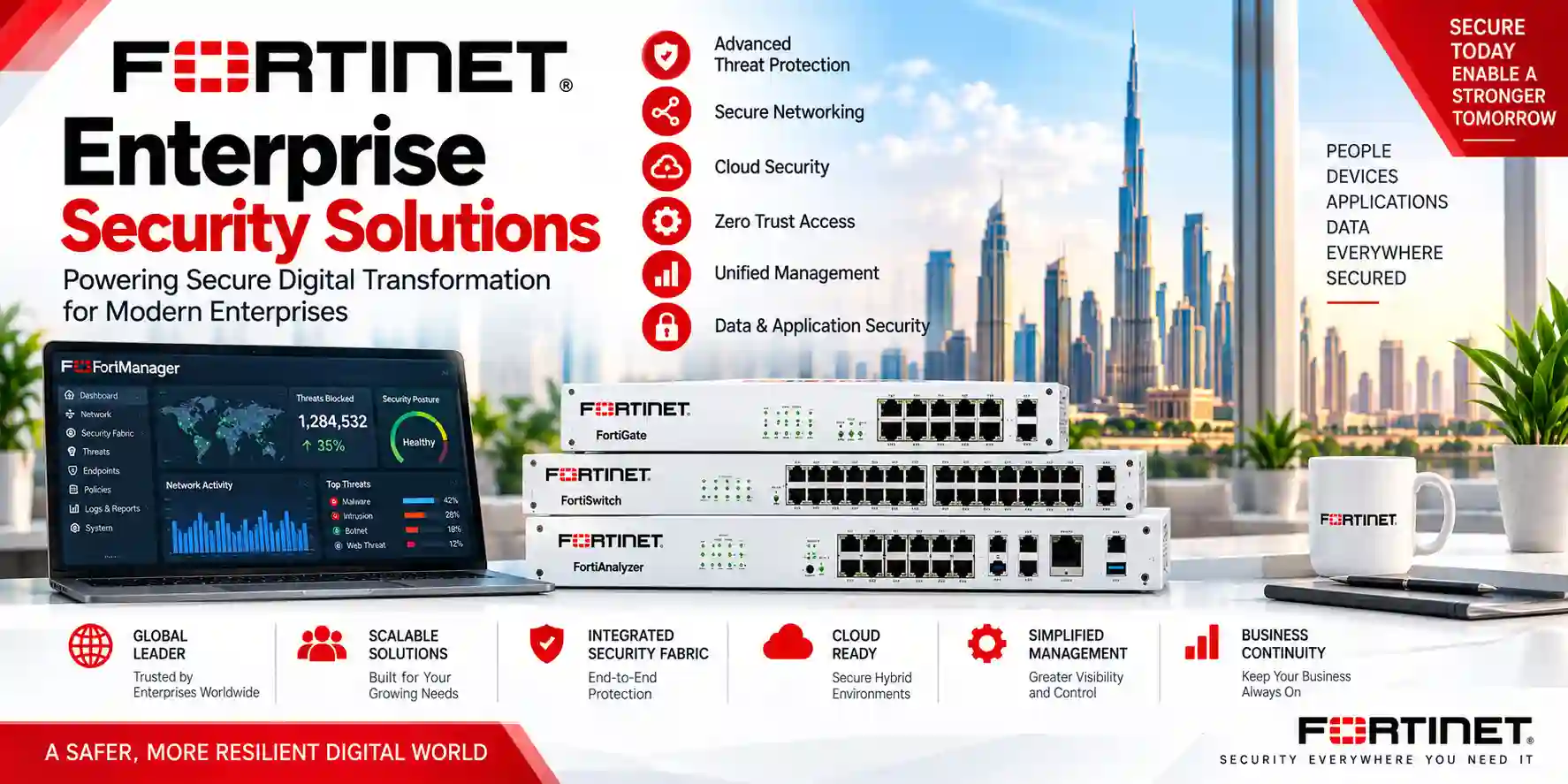
Core Fortinet Security Fabric solution areas
FortiGate and Secure Networking
FortiGate next-generation firewalls can form a central enforcement point for network security, segmentation, VPN and Secure SD-WAN. Selection should consider inspected traffic, application use, encrypted traffic, branch scale, interface requirements, resilience and future growth rather than raw firewall throughput alone.
FortiManager
FortiManager is used for centralized management and policy administration in multi-device and multi-site Fortinet environments. It becomes especially relevant when organizations want consistent configuration workflows, controlled changes and scalable administration across a larger FortiGate estate.
FortiAnalyzer
FortiAnalyzer centralizes security and network telemetry and supports analysis, reporting and automation. Its role should be scoped from expected log volume, retention, reporting requirements, incident workflows and the number of connected systems rather than added as an afterthought.
FortiClient and secure access
FortiClient can provide endpoint telemetry, secure access and endpoint-security capabilities depending on edition and licensing. Organizations should define whether the goal is VPN, ZTNA, endpoint posture, protection, cloud-delivered access or a combination before selecting the licensing path.
FortiSwitch and FortiAP
Secure wired and wireless networking can be brought into a Fortinet-led architecture using FortiSwitch and FortiAP. The design still needs standard network planning: port counts, PoE budgets, uplinks, VLANs, radio coverage, user density, guest access and resilience all influence the final result.
Security Operations
Fortinet Security Operations includes tools for logging, SIEM, SOAR, endpoint detection and response, network detection and related workflows. Not every organization needs every component. Scope should follow staffing, alert volume, response maturity, reporting and integration needs.
How to design a Fortinet Security Fabric project
| Planning area | Questions to answer | Possible Fortinet relevance |
|---|---|---|
| Internet and branch edge | Bandwidth, failover, VPN, segmentation, inspected traffic, availability | FortiGate, Secure SD-WAN, FortiGuard services |
| Central administration | Device count, policy standards, change control, branch rollout | FortiManager |
| Visibility and reporting | Log sources, retention, reports, investigations, alert handling | FortiAnalyzer and broader SecOps options |
| Users and endpoints | Remote access, ZTNA, posture, endpoint protection, user location | FortiClient, EMS, FortiSASE and identity controls |
| LAN and WLAN | Ports, PoE, VLANs, Wi-Fi coverage, guest access, device visibility | FortiSwitch, FortiAP, FortiNAC where required |
| Applications and cloud | Public apps, APIs, hybrid cloud, SaaS, workload protection | FortiWeb, FortiSASE, cloud and application-security components as appropriate |
The table is a planning framework, not a fixed bundle. Model numbers, subscriptions, capacity and compatibility should be validated against current Fortinet documentation and the exact design. A quote should clearly separate hardware, subscriptions, support terms, implementation scope and optional services so procurement teams can compare proposals on equivalent assumptions.
Fortinet Security Fabric Solutions Tanzania
Organizations evaluating Fortinet Security Fabric Solutions in Tanzania often have a mixed environment rather than a clean-sheet network. A head office may already have an internet firewall, several managed switches, business Wi-Fi, servers and cloud applications. Branches may use different connectivity providers and different generations of security devices. Remote users may depend on VPN while new applications move to SaaS. For this environment, the useful starting point is to map data flows and operational responsibility. Identify where internet traffic enters, which sites need encrypted connectivity, what applications must remain reachable during a link failure, which networks should be segmented, and which events need centralized visibility. This produces a security architecture that supports the business instead of forcing the business to fit an arbitrary product list.
Tanzania deployments can also benefit from deliberate resilience planning. Internet service diversity, power quality, rack conditions and support access can vary between sites, so a design should document what happens when a link, appliance or power source becomes unavailable. Secure SD-WAN may be relevant for organizations with multiple WAN links or branches, but its value depends on application policy, path quality, failover expectations and the security controls applied to traffic. Central management and logging can become more important as the number of FortiGate devices grows. FortiManager can support structured policy administration, while FortiAnalyzer can provide consolidated telemetry, reporting and investigation support. Their sizing and licenses should be based on the actual estate and expected log rates.
For procurement teams, a Tanzanian Security Fabric quotation should ideally state the current and target network shape, number of users and branches, internet capacity, selected FortiGate role, required subscriptions, VPN or ZTNA scope, switching and wireless dependencies, management and logging requirements, implementation tasks, documentation and handover expectations. If endpoint, SASE, web application, NAC or SOC capabilities are required, those should be called out separately rather than implied. This makes renewals easier to understand later and reduces the risk of paying for overlapping functions without a defined operational use.
FourTeck Tanzania’s technology services overview explains how firewall, networking, Wi-Fi and lifecycle requirements can be planned together, while the Tanzania technology shop provides a buying-oriented route for product enquiries. Buyers considering a compact branch firewall can also review the verified FortiGate 30G Tanzania product page as one example in the wider FortiGate family. Model suitability still depends on the required security services, bandwidth and deployment scope.
Fortinet Security Fabric Solutions Dar es Salaam
Dar es Salaam buyers commonly need to connect headquarters, commercial offices, warehouses, retail operations, hospitality properties, clinics, professional services and branch locations that rely heavily on internet-delivered applications. In these environments, Fortinet Security Fabric planning should begin with the edge but continue into the internal network. A FortiGate can provide policy enforcement and secure connectivity, yet the business outcome also depends on sensible VLAN design, managed switching, Wi-Fi segmentation, identity, endpoint controls and a logging process that someone actually reviews. A flat LAN with one firewall policy for every device is difficult to govern as the number of users, cameras, phones, access points and servers increases. Segmenting by function and trust can make policy clearer and reduce unnecessary paths between systems.
For a Dar es Salaam head office with several branches, centralized administration can be more valuable than managing each device independently. FortiManager may support consistent policy deployment and controlled change across the FortiGate estate, while FortiAnalyzer can consolidate logs and provide security and network visibility. The organization should decide whether it needs daily operational dashboards, formal audit reporting, retained logs for investigations, alert workflows or a more mature security-operations process. That decision affects the architecture and licensing. If remote and hybrid work is significant, FortiClient, ZTNA or FortiSASE may be evaluated based on the applications users need, device posture expectations and whether access must be protected both on and off the corporate network.
Procurement should also include physical and service dependencies. Confirm rack space, interfaces, transceivers, UPS capacity, patching, internet handoff type, secondary links, maintenance windows and who will coordinate with service providers. For branch connectivity, document the preferred topology and what applications require prioritized paths. Where FortiSwitch and FortiAP are included, calculate PoE and uplink capacity and plan staff, guest and operational SSIDs instead of treating wireless as an accessory. The result should be an operating design that can be documented and repeated when a new branch is opened.
FourTeck Tanzania’s verified contact page lists Dar es Salaam among its Tanzania office locations and can be used to start a requirement discussion. Share the current firewall model, internet speeds, user count, branches, remote users, important applications and any planned network refresh so the quotation can distinguish immediate needs from future Fabric expansion.
Fortinet Security Fabric Solutions Mwanza
For organizations in Mwanza, a Fortinet Security Fabric project may need to protect a regional office, distribution point, hospitality site, healthcare facility, education environment or a branch that communicates continuously with systems hosted elsewhere. The architecture should account for how dependent the site is on WAN connectivity. If finance, ERP, inventory, cloud collaboration or centralized databases stop working when the primary link fails, internet resilience becomes a business-continuity requirement rather than a networking convenience. In that case, multiple WAN links, route policy and secure SD-WAN may be part of the FortiGate design. The team should define acceptable failover behavior, identify applications that need preference, and decide whether traffic can break out locally or must traverse a central security point.
Security Fabric value at a Mwanza branch can also come from visibility into what is connected locally. Wireless access points, switches, workstations, IP phones, cameras and operational devices can create different trust requirements. Where FortiSwitch and FortiAP are appropriate, a coordinated design can align network segmentation and security policy. If third-party switches or access points remain in service, the design should confirm what level of integration is available rather than assuming full Fabric control. Existing infrastructure can often remain useful if its interfaces, VLAN capabilities and lifecycle status still support the target architecture.
Operational simplicity should influence model selection. A branch with a small local IT team may benefit from centralized policy, configuration backup, firmware planning and logging administered from another location. That is a different requirement from a site expected to operate independently. It also changes the value of FortiManager and FortiAnalyzer. Before purchasing, define who will receive alerts, who can approve policy changes, how configuration backups are handled, and what documentation is required after deployment. A tool that collects data but has no owner does not improve security by itself.
When requesting a Mwanza quotation, include the site’s primary and backup connectivity, number of users and devices, critical applications, existing switches and access points, VPN dependencies, required security services and expected growth. If the branch will eventually be one of many regional sites, say so early. A repeatable template for firewall policies, VLANs, Wi-Fi, logging and naming conventions can reduce complexity as the wider organization expands.
Fortinet Security Fabric Solutions Arusha
Arusha organizations may operate offices, tourism and hospitality environments, education facilities, professional services, NGOs, healthcare operations or regional businesses that host guests, staff and third-party users on the same premises. That mix creates a strong need for access separation. A Fortinet Security Fabric design can use policy and segmentation to distinguish corporate users, guest Wi-Fi, business systems, cameras, voice devices and infrastructure management. The exact products depend on the site, but the principle is consistent: devices with different business roles should not automatically receive the same network access. FortiGate can enforce security policy between networks, while FortiSwitch and FortiAP can be considered when the organization wants a more integrated wired and wireless design.
Guest and contractor access deserve specific treatment. Hospitality and service environments may have a high turnover of users, while NGOs or project teams may work with temporary personnel and external specialists. The security plan should decide how users authenticate, what internal systems are excluded from guest access, and whether remote application access should use VPN or a zero-trust approach. Where FortiClient and ZTNA capabilities are being considered, buyers should define device ownership, endpoint posture requirements and which applications need access. This prevents a licensing decision from being made before the access model is clear.
Monitoring requirements also vary. A single branch may only need routine firewall logs and reports, while a larger organization may need consolidated data across Arusha, Dar es Salaam and other locations. FortiAnalyzer can be scoped from the number of devices, expected events, retention and reporting. Centralized change management through FortiManager becomes more useful as policy consistency and branch count grow. Neither platform should be sized simply from a generic bundle; operational requirements and current Fortinet guidance should drive the decision.
FourTeck Tanzania’s verified contact information includes an Arusha office listing on the Tanzania contact page. A useful Arusha request should include the site type, user count, guest Wi-Fi expectations, remote workers, internet links, existing firewall, switching and wireless hardware, applications that must be protected and whether centralized management is required across more than one location.
Fortinet Security Fabric Solutions Dodoma
Dodoma buyers planning Fortinet Security Fabric Solutions may include public-facing organizations, education environments, professional offices, NGOs, institutions and multi-department businesses where policy consistency and controlled access matter as much as perimeter defense. A useful design begins by documenting which departments and services need to communicate. Finance systems, HR resources, general staff, guest networks, servers, CCTV and administrative interfaces often have different trust requirements. Segmentation can then be expressed as clear policy rather than a collection of exceptions added over time. FortiGate may act as an enforcement point, but the design should also consider switching, wireless, identity and endpoint controls that influence whether the policy can be applied consistently.
For institutions with multiple buildings or remote offices, branch connectivity needs to be planned together with security inspection and application performance. Secure SD-WAN can be relevant when organizations have more than one WAN path, need application-aware routing or want consistent branch policy, but it should be configured around measured connectivity and business priorities. A proposal should state the assumptions: available circuits, link speeds, public addresses, VPN peers, high-availability expectations and which applications receive priority. Without those details, a quotation can look complete while leaving critical implementation questions unanswered.
Governance is another key requirement for Dodoma environments. If several administrators or outsourced teams manage the network, central policy workflows and logs can help create clearer accountability. FortiManager may support standardized configuration and approval processes across devices. FortiAnalyzer can support centralized logs, dashboards and reports. Organizations with higher security-operations needs may evaluate broader Fortinet SecOps tools, but that step should follow defined incident-response and monitoring processes rather than tool-first procurement.
The verified FourTeck Tanzania contact page lists a Dodoma office. For an accurate requirement discussion, provide branch count, user population, internet links, policy or reporting needs, remote-access use, existing network equipment and any services that cannot tolerate interruption during migration. This allows implementation sequencing and rollback planning to be considered before changes are made.
Fortinet Security Fabric Solutions UAE
Organizations with operations in the UAE often combine fast internet, cloud applications, hybrid users, branch networks and demanding security or reporting requirements. A Fortinet Security Fabric architecture can be useful when the business wants to consolidate network security, branch connectivity, remote access and security telemetry without operating every control as a separate island. The design should still begin with traffic and identity. Map the offices and cloud environments, identify business-critical SaaS and private applications, document remote and third-party access, and decide where inspection and policy enforcement should occur. If the organization has multiple Emirates or data-center connections, high availability and path diversity should be included from the outset.
UAE deployments may place stronger emphasis on central management, audit visibility and integration with existing enterprise systems. FortiManager can help structure multi-device policy administration, while FortiAnalyzer can centralize logs and support analysis and reporting. Unified SASE may be relevant when users need consistent secure access away from the office. FortiClient, ZTNA and cloud-delivered security can be evaluated according to whether users access public internet, SaaS and private applications from managed or unmanaged devices. The chosen subscriptions should match those use cases rather than being selected only because they are included in a broad bundle.
Procurement teams operating between Tanzania and the UAE can benefit from keeping architecture standards aligned across markets. The exact hardware can differ by bandwidth and site size, but naming, policy structure, logging categories, administrative roles and documentation can follow a common template. That makes future support and security review more predictable. Migration planning is especially important if existing firewalls, switches or endpoint tools are already integrated with business systems. Compatibility should be verified before change windows are scheduled.
For UAE-specific Fortinet buying information, the verified FourTeck Fortinet UAE site covers FortiGate, renewal, SD-WAN, FortiManager, FortiAnalyzer and related security requirements. Tanzania-based organizations with UAE branches can use that regional resource while keeping the overall Fabric architecture coordinated with their East African sites.
Fortinet Security Fabric Solutions Uganda
Ugandan organizations evaluating Fortinet Security Fabric Solutions may be trying to standardize several branches, improve firewall security, connect users to cloud services or gain better visibility over networks that have grown in stages. The architecture should first separate core business needs from optional capabilities. A company with five branches and centralized applications may prioritize reliable VPN or SD-WAN, consistent firewall policy and centralized logging. Another organization with a mobile workforce may place more emphasis on endpoint posture, ZTNA and secure access. A third may need stronger internal segmentation for servers, users, guest Wi-Fi, cameras and operational systems. These scenarios can use the same Fortinet platform but should not produce the same bill of materials.
Connectivity quality and branch support should be part of the Uganda design. If sites use different service providers or link types, the team should define how routing reacts to degraded paths and whether business applications receive priority. Secure SD-WAN is most useful when it is tied to measurable performance and application policy. At each branch, firewall capacity should be selected with the intended security services enabled. VPN, intrusion prevention, application control, web filtering and encrypted traffic inspection can affect practical throughput, so raw interface speed is not a sufficient sizing method.
Central operations can reduce configuration drift. FortiManager may support consistent policy across a growing FortiGate estate, while FortiAnalyzer can collect and analyze logs. If the organization already uses third-party endpoint, identity, SIEM or cloud platforms, the project should confirm supported connectors and decide which system remains authoritative for each workflow. Integration should simplify operations, not create duplicate alerts and conflicting policy ownership.
The verified FourTeck Uganda site provides a regional route for business technology enquiries and network-security planning. For a Fabric quotation, include branch count, internet links, applications, user numbers, current firewall estate, Wi-Fi and switching environment, remote users, logging needs and whether the final design must be centrally managed from Uganda, Tanzania or another regional location.
Fortinet Security Fabric Solutions Kampala
Kampala businesses often operate dense office environments where employees, guest devices, IP phones, Wi-Fi, CCTV, servers and cloud applications share the same physical network. A Fortinet Security Fabric design can help create clearer boundaries between these services, but only when the underlying network is structured. Before selecting products, inventory the existing VLANs, switches, access points, internet connections and critical applications. Identify unmanaged switches or legacy devices that could limit segmentation. Then define which user and device groups need communication and which should be isolated. FortiGate can enforce policies at selected network boundaries, while FortiSwitch and FortiAP can be considered when integrated LAN and wireless management is part of the target architecture.
Kampala organizations with branch networks should also consider how security changes are managed. Manual configuration of many firewalls creates the risk of inconsistent rules, old objects and undocumented exceptions. FortiManager can become relevant for policy standards and centralized administration. FortiAnalyzer can provide a unified view of logs and support reporting, but retention and capacity need to be planned from actual event volume and compliance expectations. If the organization wants a SOC-style workflow, decide who triages alerts, what constitutes an incident and how response actions are approved before expanding the toolset.
Remote work is another design dimension. If employees connect to internal applications from home or while traveling, determine whether traditional VPN, ZTNA or a SASE approach better fits the application and identity model. FortiClient may be part of that design, but licensing and endpoint features vary. Device ownership, operating systems, authentication, certificate use and posture checks should all be documented so the secure-access method is practical for users as well as administrators.
For Kampala procurement, request a proposal that separates hardware, subscriptions, centralized-management components, implementation, migration, training or handover and optional recurring support. That separation makes the lifecycle cost easier to understand and gives the business a clearer renewal calendar. The broader FourTeck Uganda resource can be used for regional coordination while the Tanzania page remains focused on multi-market architecture and buying guidance.
Fortinet Security Fabric Solutions Arua
Arua deployments may involve regional branches, NGOs, healthcare, education, distribution or service locations where connectivity and on-site technical resources differ from a large capital-city office. That makes simplicity and resilience important. A Security Fabric design should avoid unnecessary components at the branch while still giving central teams enough visibility and control. Start by defining the applications the site must reach, whether users depend on local servers or cloud services, how the branch connects to headquarters, and what happens if the primary internet service fails. FortiGate can provide firewalling and secure connectivity, while centralized management may allow the branch to operate with less day-to-day local administration.
For a smaller branch, the architecture should pay attention to practical infrastructure. Confirm the internet handoff, number of wired devices, wireless coverage, PoE requirements, UPS runtime and environmental conditions around the network rack. If FortiSwitch or FortiAP are included, their power and uplink requirements should be sized with future devices in mind. If third-party switches and access points remain, determine whether they support the VLAN and monitoring functions needed for the target security policy. A branch design fails when the firewall is capable of segmentation but the access layer cannot carry it correctly.
Arua organizations connected to a wider Uganda or East Africa estate can use a standard branch template. Define a repeatable addressing model, VLAN structure, naming convention, firewall policy baseline, VPN design and log destination. Exceptions should be documented rather than silently added. FortiManager can support this type of standardized administration when the FortiGate estate justifies it. FortiAnalyzer can give central teams visibility into security events from branches without requiring staff at every site to inspect local logs.
For procurement, send site-specific details instead of requesting a generic “Fortinet Security Fabric price.” Include user count, devices, ISP links, business applications, existing firewall, switching, Wi-Fi, VPN requirements and desired central-management model. This produces a more defensible design and makes it easier to distinguish the minimum branch requirement from optional capabilities that can be added later.
Fortinet Security Fabric Solutions Mbarara
For Mbarara businesses, the strongest reason to consider a Security Fabric is often the need to connect security controls around real operations: offices, warehouses, retail sites, education facilities, medical environments or regional branches that depend on cloud systems and centralized services. A practical design starts with the risk and workflow. If the main concern is reliable branch connectivity, focus on FortiGate sizing, WAN diversity, VPN or SD-WAN and central administration. If the concern is internal access, spend more time on VLANs, identity and endpoint posture. If monitoring is weak, define logging and alert ownership. A broad platform is valuable only when each component solves a specific operational problem.
Branch networks in Mbarara may also need to support CCTV, Wi-Fi, IP telephony and business endpoints on common cabling and switching. These services have different traffic and trust characteristics. Cameras may produce sustained video streams, phones are latency sensitive, guest Wi-Fi should usually be isolated, and administrative interfaces should not be open to every user network. The firewall and switching design should therefore be coordinated. Where FortiSwitch and FortiAP fit the project, the security policy can be aligned with the access infrastructure. Where other brands remain, compatibility and VLAN behavior should be verified before migration.
Subscription planning matters because Security Fabric deployments can include multiple services with different renewal cycles. Procurement should receive a clear list of what is licensed, the term, the covered appliance or user count, and what operational capability depends on that subscription. The objective is to avoid discovering at renewal time that a critical filtering, support or endpoint feature was assumed but never documented. Centralized platforms should also be licensed and sized according to the managed estate and data volume.
For a Mbarara quote, include existing network diagrams if available, user and device quantities, internet bandwidth, number of sites, remote-access expectations, current security products and a description of the problems the new design must solve. This enables a phased proposal: stabilize the edge first, then add centralized management, access integration or broader security operations as the business case requires.
Fortinet Security Fabric Solutions Gulu
Gulu organizations considering Fortinet Security Fabric Solutions may be looking for stronger protection without creating an environment that is too difficult to maintain. That balance should shape the architecture. A smaller office may need a correctly sized FortiGate, sensible network segmentation, secure remote access and dependable backups of the configuration before it needs a complex set of security-operations tools. A larger institution or multi-site business may justify FortiManager, FortiAnalyzer and additional controls because centralized policy and visibility reduce the effort of managing each site separately. The design should therefore be scalable but not overloaded on day one.
Connectivity should be treated as part of security availability. If the site relies on cloud applications or centralized systems, document what happens when the primary ISP degrades. A second link can improve resilience, but effective failover requires routing policy, health checks and application priorities. Secure SD-WAN can bring those functions together with FortiGate security, provided the deployment is configured around the actual links. VPN topology should also be deliberate: full mesh, hub-and-spoke and cloud-based access patterns have different operational implications.
Gulu deployments may also need straightforward support procedures. Identify who has administrative access, where credentials and configuration backups are stored, how firmware updates are tested, and who receives security notifications. Central tools can help, but responsibility still needs to be assigned. If the business uses external support, define the boundary between monitoring, change requests, incident response and vendor escalation. Documentation should include device inventory, license dates, WAN details, VLANs, VPNs and any exceptions to the standard policy.
An effective quotation for Gulu should therefore contain more than an appliance price. It should show assumptions, subscription term, required accessories, implementation tasks, migration sequence, testing, handover and optional ongoing support. Buyers can use the FourTeck Uganda site for regional coordination while building a consistent Fabric design across Uganda and neighboring operations.
Fortinet Security Fabric Solutions Kenya
Kenyan enterprises and growing businesses can use Fortinet Security Fabric as a framework for combining branch security, data-center controls, cloud access, LAN/WLAN security and operational visibility. A common use case is a Nairobi headquarters connected to branches, warehouses or customer-facing sites that use multiple internet providers and depend on SaaS applications. In that scenario, the design should identify which traffic is business critical, what can use local internet breakout, which services require secure tunnels, and how policy remains consistent across locations. FortiGate with Secure SD-WAN may address edge security and path selection, while FortiManager can support centralized administration when device count and change-control requirements justify it.
Kenya deployments can also be influenced by cloud adoption and remote work. If users need access to SaaS, public internet and private applications from outside the office, Unified SASE or ZTNA may become part of the discussion. The access design should state whether devices are corporate managed, whether endpoint posture is checked, which identity systems are used and how contractors or third parties are handled. FortiClient and related Fortinet services can be evaluated against those requirements. A secure-access solution that is difficult for users to operate may lead to workarounds, so user experience and support should be included in the evaluation.
For organizations with mature security teams, telemetry and response can be expanded through FortiAnalyzer and broader Security Operations products. The sequence matters. First decide what data is useful, where it comes from, how long it should be retained and who acts on alerts. Then select the tooling and capacity. If third-party SIEM, EDR or cloud-security products are already established, verify supported integrations and avoid duplicating responsibility without a clear reason.
The verified FourTeck Kenya site provides a regional route for Kenyan business technology enquiries. Organizations operating across Kenya and Tanzania can standardize architecture principles while sizing each branch for its own bandwidth, user density, application mix and resilience needs. This is usually more maintainable than forcing identical hardware into sites with very different workloads.
Fortinet Security Fabric Solutions Kuwait
Kuwait organizations exploring Fortinet Security Fabric may have strong requirements for secure internet access, branch connectivity, remote users, application protection and centralized reporting. The project should separate edge-security requirements from wider Fabric ambitions. At the edge, FortiGate sizing should account for the actual security services and encrypted traffic the organization plans to inspect, not only the ISP link speed. If sites use multiple internet circuits or cloud applications, Secure SD-WAN may help combine path control with integrated security. The configuration should be based on application priorities, expected latency and failover behavior rather than simply enabling a feature by default.
Large Kuwait deployments may gain operational value from centralized management. FortiManager can structure device groups, policy packages and controlled changes across multiple FortiGate systems. FortiAnalyzer can centralize logs and reporting, supporting investigations and operational visibility. For organizations with audit or security-operations obligations, define what reports are required, who reviews them and how incidents are escalated. The platform should serve a documented process. If more advanced SIEM, SOAR, EDR or NDR capabilities are needed, those can be evaluated as part of a broader Fortinet Security Operations architecture.
Remote work and cloud access can introduce another layer. FortiClient, ZTNA and FortiSASE may be relevant depending on whether users need access to private applications, SaaS and general web services from managed devices. Identity integration, MFA, device posture and support workflow should be designed together. Licensing should clearly identify user quantities and included functions so renewal planning remains transparent.
The verified FourTeck Kuwait site gives regional buyers a dedicated route for IT and cybersecurity discussions. Companies operating in Kuwait and East Africa can use a shared security standard—common policy naming, logging, documentation and administrative roles—while adapting appliance capacity and connectivity to each location. That approach supports consistency without pretending that every branch has identical requirements.
Fortinet Security Fabric Solutions Ghana
Ghanaian businesses considering Fortinet Security Fabric may be focused on consolidating security across headquarters, branches, cloud applications and remote employees. A practical architecture starts by identifying where trust boundaries should sit. Internet-facing services, internal applications, guest access, business users, operational devices and management interfaces rarely need the same level of access. FortiGate can be used to enforce policy at key network boundaries, while FortiSwitch, FortiAP, endpoint and identity controls may extend visibility and segmentation when they are appropriate to the environment. The design should also make clear which existing infrastructure will remain and what interoperability is expected.
For businesses with branches outside Accra or across West Africa, WAN reliability and policy consistency can become major concerns. Secure SD-WAN may be useful where multiple links are available or application-aware routing is required. Before implementation, document the ISP circuits, link performance, VPN topology, cloud destinations and applications that need priority. FortiManager can then become relevant when central teams need to apply consistent policy across several FortiGate systems. This can reduce manual configuration differences, but change workflows and access roles should still be defined.
Security visibility also needs a purpose. FortiAnalyzer can support centralized logs, analytics and reports, while wider Fortinet Security Operations tools can extend detection and response. Buyers should decide what data is important, how long it must be retained, who reviews alerts and what response actions are permitted. If an external SOC or managed service is involved, the handoff between internal teams and the service provider should be documented so alerts do not sit without an owner.
The verified FourTeck Ghana site can support regional enquiry routing. For organizations that also operate in Tanzania, the design conversation can focus on common architecture standards and lifecycle planning while maintaining local connectivity and site requirements. A strong quotation should list hardware, subscriptions, implementation, integration, management, logging and renewal assumptions separately so procurement can compare the total solution rather than only the firewall appliance cost.
Fortinet Security Fabric Solutions Nigeria
Nigeria’s large and distributed business environments can make Security Fabric architecture especially relevant where organizations need to connect headquarters, branches, cloud workloads and remote users under consistent policy. A multi-site company should first classify its locations. A large Lagos head office, a regional branch, a warehouse and a small sales office do not need identical appliance capacity, but they can follow the same policy model. Define standard VLAN categories, administrative roles, VPN conventions, logging destinations and minimum security services. Then size each FortiGate and access layer according to local user count, bandwidth, devices and availability requirements.
WAN design is often a central part of the solution. If sites use several service providers, Secure SD-WAN can help apply path selection and security from the same platform, but the configuration should reflect actual application behavior and link quality. Some applications may tolerate a short interruption; others may require more deliberate resilience. High availability at large sites, redundant circuits and failover testing should be treated as design decisions, not optional details added after deployment.
Operational scale also influences the value of FortiManager and FortiAnalyzer. Central management can make standardized rollouts, policy changes and configuration control easier across many devices. Central logs and reporting can improve investigations and visibility, particularly when events from multiple branches must be correlated. Mature teams may consider additional Fortinet SecOps components, but should first define detection use cases, incident ownership, integration with existing SIEM or endpoint tools and required response automation. Buying every component is not the same as building a working SOC process.
The verified FourTeck Nigeria site provides a regional path for Nigeria technology enquiries. Organizations operating across Nigeria, Ghana, Kenya, Uganda and Tanzania can use the broader FourTeck Africa Fortinet Security Fabric resource to coordinate a cross-country buying discussion while keeping each site’s bill of materials grounded in its real workload.
Fortinet Security Fabric Solutions Seychelles
Seychelles organizations can have distinctive network conditions because hospitality, tourism, finance, professional services and distributed island operations often depend heavily on internet connectivity and secure access to centralized or cloud-hosted applications. A Fortinet Security Fabric design should therefore place resilience and remote manageability near the top of the requirement list. Start by identifying which business processes require continuous internet, whether there are multiple available circuits, and how branches or properties communicate with central services. FortiGate and Secure SD-WAN may be relevant for secure edge connectivity and path control, but the design should be based on measured links and application priorities.
Hospitality and guest environments create another security consideration. Guest Wi-Fi, staff devices, payment or back-office systems, cameras, building systems and administrative interfaces should not be treated as one network simply because they share the same property. Segmentation and access policy can reduce unnecessary exposure. FortiSwitch and FortiAP may support an integrated Fortinet access architecture where suitable, while existing third-party infrastructure can remain if it supports the required VLAN and management functions. Compatibility should be verified rather than assumed.
Remote management can reduce the dependence on frequent on-site changes. FortiManager may support centralized configuration and standardized policy when several properties or branches use FortiGate. FortiAnalyzer can provide centralized telemetry so security and network teams can inspect events without logging into each appliance separately. The organization should define log retention, alert ownership, reporting and support escalation. If remote users need secure access, FortiClient, ZTNA or SASE can be evaluated according to application location and device-management requirements.
For Seychelles procurement, include the number and type of sites, primary and backup connectivity, expected users and guests, key business applications, current firewalls, switching and wireless platforms, remote access, centralized-management expectations and any reporting obligations. This gives the solution designer enough context to separate essential components from optional expansion. Cross-market organizations can also use FourTeck’s verified Tanzania, UAE and Africa resources to keep architecture standards aligned without making unsupported assumptions about local stock, offices or service coverage in Seychelles.
Compatibility, licensing and deployment guidance
Security Fabric features depend on product, model, FortiOS or software release and licensed services. Before ordering or upgrading, confirm the current Fortinet compatibility and release documentation for every component that must integrate. This is especially important when mixing existing FortiGate devices with FortiAnalyzer, FortiManager, FortiClient EMS, FortiNAC, FortiSwitch, FortiAP or other Fabric products. A feature available in one release can have prerequisites or limitations in another. Hardware lifecycle and supported software versions should be checked as part of the project plan rather than after equipment has arrived.
Licensing should be documented as an operational dependency. FortiGate security services, support, centralized management, analytics, endpoint, SASE and other platform components may use different subscriptions or entitlement models. Procurement should know the term, quantity, covered device or user population, renewal date and function enabled by each entitlement. When comparing quotations, ask vendors to state whether prices include the required subscriptions and support periods, and whether optional services have been separated clearly. This reduces confusion when an apparently lower hardware price excludes capabilities expected by the technical team.
Deployment should include a change plan. Record current configurations, backup devices, document WAN and VPN details, identify dependencies, define maintenance windows and establish a rollback path. For multi-branch estates, pilot the standard at a representative location before repeating the pattern. After implementation, capture diagrams, administrator roles, license records, policy standards and monitoring ownership. A Security Fabric provides more value when the operating model is as well organized as the technology.
Related FourTeck Tanzania resources
Technology servicesReview solution planning, integration, network security, switching, wireless and lifecycle considerations relevant to a Fortinet deployment.
Tanzania shopUse the buying guidance to frame product quantities, compatibility, infrastructure and lifecycle requirements before requesting a quotation.
FortiGate 30G TanzaniaReview one verified FortiGate product page as an entry point to Fortinet firewall buying; final sizing must still be based on the target environment.
About FourTeck TanzaniaUnderstand the wider FourTeck Tanzania business-technology context when a Security Fabric project also involves servers, networks, Wi-Fi or other systems.
Contact and quotationSend user, site, bandwidth, branch, licensing and integration requirements to begin a more accurate Fortinet solution discussion.
Quotation checklist for Fortinet Security Fabric Solutions
- Current firewall brand, model and software version
- Internet bandwidth and expected upgrades
- Number of users, devices and branches
- Primary and backup WAN circuits
- Site-to-site VPN and remote-user requirements
- Critical SaaS, cloud and private applications
- Existing switching, Wi-Fi and VLAN design
- Need for FortiManager centralized administration
- Log retention and FortiAnalyzer reporting needs
- Endpoint, ZTNA or SASE requirements
- Identity, MFA and third-party integration requirements
- Required FortiGuard, support and other subscription terms
- High-availability, uptime and change-window expectations
- Implementation, migration, documentation and handover scope
Fortinet Security Fabric FAQs
Is Fortinet Security Fabric a single product?
No. It is an architecture and platform approach that can combine selected Fortinet secure networking, SASE, endpoint, management, analytics, security-operations and other products. The exact components depend on the environment and use case.
What role does FortiGate play in the Security Fabric?
FortiGate provides next-generation firewall and secure-networking capabilities and can be a major enforcement and integration point in a Fabric design. Model selection should reflect inspected throughput, interfaces, VPN, SD-WAN, users, branch requirements and enabled security services.
What is the difference between FortiManager and FortiAnalyzer?
FortiManager focuses on centralized management and policy administration, while FortiAnalyzer focuses on centralized telemetry, analytics, reporting and related security-operations functions. Many multi-site environments use both for different operational roles.
Can Fortinet Security Fabric integrate with third-party products?
Fortinet supports integrations through its Fabric ecosystem, connectors and APIs, but support varies by product and version. Every required third-party integration should be verified against current Fortinet documentation before the architecture is finalized.
Does every Security Fabric deployment need FortiSwitch and FortiAP?
No. Existing network infrastructure may remain where it meets the technical and operational requirements. FortiSwitch and FortiAP can be considered when integrated wired and wireless management, segmentation and Fabric visibility are useful to the project.
How should I request a Fortinet Security Fabric price in Tanzania?
Provide site count, users, internet speeds, existing firewall and network hardware, VPN and remote-user requirements, desired security services, management and logging needs, and expected subscription term. Price depends on the selected hardware, licenses and implementation scope.
Can a Security Fabric be deployed in phases?
Yes. Many organizations begin with a secure network edge and branch connectivity, then add centralized management, logging, endpoint, access, application-security or security-operations capabilities as requirements and operational maturity grow.
What should be checked before upgrading a Fabric?
Review current Fortinet release notes and compatibility guidance for every integrated component, back up configurations, check support status, identify dependencies, test the change path where possible and prepare a rollback plan before production upgrades.
Decision recap: build the Fabric around operations
Fortinet Security Fabric is most useful when an organization treats it as an architecture rather than a shopping list. Start with users, sites, applications, connectivity, trust boundaries and operational responsibilities. Use FortiGate and secure networking where network enforcement and branch connectivity are required. Add FortiManager when centralized policy administration reduces complexity. Add FortiAnalyzer when consolidated visibility, reporting and investigation become important. Evaluate FortiClient, ZTNA, SASE, FortiSwitch, FortiAP, FortiNAC, application-security and broader Security Operations products only where they solve defined requirements.
FourTeck Tanzania can help structure the discussion around product selection, integration, licensing, network dependencies and deployment scope. The goal is a solution that can be explained to both technical and procurement teams: what each component does, why it is required, how it is licensed, what it integrates with, who operates it and how the design can expand later without unnecessary rework.
Plan your Fortinet Security Fabric with clearer inputs
A useful consultation starts with your current environment and target outcome. Share the firewall and network equipment you have today, branches, internet links, users, remote access, business applications, logging expectations, subscriptions approaching renewal and any problems you want the new architecture to solve. FourTeck can then help organize the requirement into product, licensing, integration and implementation workstreams.