
FortiGate Data Center Firewall Solutions
FortiGate Data Center Firewall Solutions are designed for organizations that need to inspect and control very large volumes of traffic without treating security as an afterthought. Fortinet positions its high-end FortiGate platforms for data center, hyperscale and hybrid environments where north-south perimeter traffic, east-west application traffic, inter-data-center connectivity and cloud-connected workloads can all require consistent policy enforcement.
For Tanzania projects, the buying process should begin with architecture rather than a model number. Internet edge bandwidth, internal application flows, encrypted traffic, segmentation boundaries, routing design, interface speeds, high-availability requirements, FortiGuard services, FortiManager administration, FortiAnalyzer logging and future capacity all affect the correct platform. FourTeck can help organize those inputs into a clearer bill of materials and quotation request without assuming stock, delivery time or a particular license package.
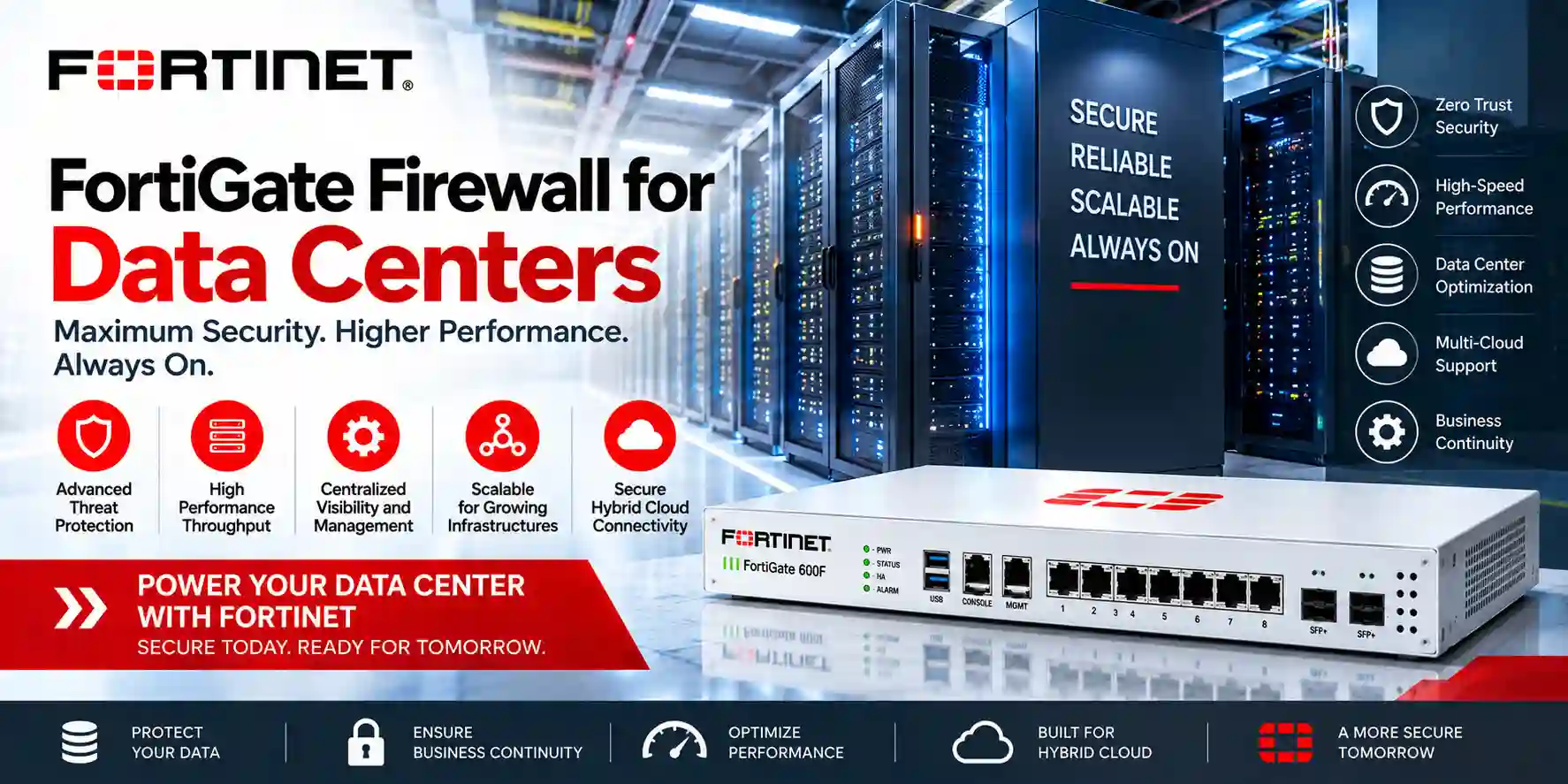
What FortiGate Data Center Firewall Solutions are built to address
Modern data centers no longer have a single clean boundary. Applications may be split across physical servers, virtualized clusters, private cloud, public cloud and disaster-recovery sites. Users and partner systems may enter through different network paths, while application tiers exchange large volumes of east-west traffic inside the environment. Fortinet’s current data-center firewall positioning emphasizes hybrid mesh firewall architecture, dynamic segmentation, unified policy control, AI/ML-driven FortiGuard threat protection and hardware-accelerated performance across these environments.
East-west segmentation
Inspect lateral traffic between application, database, management and infrastructure zones so access is based on explicit business need rather than broad internal trust.
High-capacity edge security
Protect internet and partner-facing services while planning around inspected throughput, encrypted traffic, sessions, routing scale and the actual interface speeds used by the data center.
Hybrid consistency
Use a common FortiOS-based policy model across physical FortiGate, virtual appliances and supported cloud deployments where the organization needs coordinated control.
Operational visibility
Centralize configuration and policy workflows with FortiManager and consolidate logs, analytics and security telemetry with FortiAnalyzer when those tools are part of the selected design.
Current Fortinet high-end data center firewall references
Fortinet’s current data-center solution page lists multiple high-end platforms and publishes threat-protection throughput figures for comparison. These values are useful starting points, but they are not sufficient for procurement on their own. Final sizing should include interface requirements, traffic mix, TLS inspection, routing, session behavior, VPN, segmentation, logging, redundancy and headroom for growth.
| FortiGate model | Fortinet-listed threat protection | Planning note |
|---|---|---|
| FortiGate 7121F | 520 Gbps | Chassis-class platform for very large environments; validate modules, power, rack space and redundancy. |
| FortiGate 7081F | 312 Gbps | Designed for high-scale data-center and service-provider requirements; architecture determines fit. |
| FortiGate 3800G | 200 Gbps | High-end current-generation option; confirm interfaces and enabled feature mix against the latest data sheet. |
| FortiGate 3700F | 75 Gbps | Suitable for evaluation in high-throughput enterprise designs where the published capacity matches inspected workload. |
| FortiGate 4800F | 70 Gbps | Fortinet positions this family for hyperscale use cases and high-speed interfaces; confirm exact variant and licensing. |
| FortiGate 3500F | 63 Gbps | Evaluate when the project needs high throughput without moving immediately to a modular chassis. |
| FortiGate 3200F | 45 Gbps | Check security-service mix, interface density, HA design and projected traffic before selection. |
| FortiGate 3000F | 33 Gbps | Can be assessed for enterprise core or data-center edge requirements that fit its verified specifications. |
| FortiGate 1000F | 13 Gbps | A lower point in the high-end list; useful where data-center requirements are substantial but below hyperscale levels. |
Published performance can change as product lines and test methods evolve. A purchase request should therefore identify the exact model and current Fortinet data sheet being used for approval. Do not compare a raw firewall-throughput number with a threat-protection or NGFW figure as though they measure the same workload.
Architecture, licensing and operations guidance
A data-center firewall purchase usually includes more decisions than the appliance itself. High availability may require paired devices, matching interface plans, resilient switching and a tested failover design. Optics and cabling must align with the transceiver and port speeds used in the core. Routing design should account for BGP, OSPF, static routes, ECMP or other protocols actually used by the network. Segmentation should be mapped to applications, management zones and trust boundaries instead of being added after the firewall is installed.
FortiGuard services should be specified by the security functions the organization intends to use and by the desired subscription term. FortiCare support should be reviewed separately so procurement teams know what support entitlement is being purchased. Some hyperscale functions may require additional licensing on supported platforms, so buyers should not assume that every advanced feature is activated by the hardware alone. Current Fortinet documentation should be checked for the exact model and FortiOS release.
For centralized operations, FortiManager can provide policy-based provisioning, configuration management, automation and visibility across FortiGate environments. FortiAnalyzer can consolidate telemetry, logs and security analytics for monitoring, investigation and reporting. The practical design question is whether management and analytics will be local, virtualized, cloud-based or distributed across locations, and how log retention, administrator roles and change control will be handled.
A resilient deployment also needs operational documentation: interface maps, routing design, security zones, NAT rules, VIPs, VPNs, HA behavior, management addresses, logging destinations, firmware branch, backup process and rollback plan. The best firewall hardware cannot compensate for unclear ownership or an undocumented cutover. FourTeck’s Tanzania services page explains the broader integration approach for projects that combine firewalling with network, server, cabling and support requirements.
FortiGate Data Center Firewall Solutions Tanzania
FortiGate Data Center Firewall Solutions Tanzania are relevant to banks, telecom and service-provider networks, government and institutional environments, large enterprises, hosting environments, universities, healthcare groups and organizations running business-critical applications that cannot rely on simple branch-class perimeter security. A Tanzania data-center design may include public-facing services, internal application tiers, storage networks, virtualization clusters, management networks, backup systems and links to branch offices or cloud environments. Each path has a different risk and performance profile, so the firewall architecture should be built around traffic flows rather than around a single internet-speed figure.
The first sizing task is to separate north-south and east-west demand. Internet-edge traffic can be substantial, but server-to-server communication may be much larger inside a virtualized or private-cloud environment. If the security policy requires inspection between application zones, the firewall must process that internal traffic without becoming a bottleneck. The design should also document TLS inspection expectations, concurrent sessions, new connection rates, VPN traffic, routing scale and any data-center interconnect requirement. Fortinet’s current high-end portfolio spans multiple performance classes, which allows the architecture to be matched more closely to workload instead of selecting a model solely by brand or price.
Procurement in Tanzania should define the commercial scope with the same care as the technical scope. Ask for the exact appliance or chassis, required interface modules, transceivers, power configuration, FortiGuard services, FortiCare support, subscription period, management and analytics components, implementation work and documentation. If high availability is required, make the pair explicit in the bill of materials. If the organization already uses FortiGate, include the existing models and FortiOS versions so migration, policy conversion and management compatibility can be reviewed before purchase.
FourTeck Tanzania provides broader planning information across integrated IT and security infrastructure in Tanzania, while the Tanzania technology shop helps buyers consider adjacent categories such as servers, switching, wireless and racks. These links are useful because a data-center firewall does not operate alone: uplink design, core switching, server networks, rack power, cooling, cabling and logging infrastructure can all influence deployment success. Current availability, lead time and exact commercial terms should be confirmed at quotation stage rather than assumed from the page.
FortiGate Data Center Firewall Solutions Dar es Salaam
FortiGate Data Center Firewall Solutions Dar es Salaam are particularly relevant where headquarters, carrier connections, hosted applications, colocation environments and enterprise server rooms concentrate large amounts of business traffic. A Dar es Salaam deployment may sit between multiple internet providers and a core network, protect a private-cloud cluster, segment internal systems or secure connections to disaster-recovery and branch locations. Those roles should be mapped individually because a firewall used mainly for internet edge security has different capacity requirements from one that also inspects east-west traffic between application tiers.
Interface planning deserves early attention. High-end FortiGate platforms can support very fast connectivity, but the project must still match firewall ports to the actual switch fabric, optics and cabling used in the data center. A network using 10, 25, 40, 100 or 400 Gigabit links should document how traffic reaches the firewall, whether links are aggregated, how failure is handled and where routing takes place. The objective is to avoid buying security capacity that cannot be used because the surrounding switching or transceiver plan is incomplete. Rack space, power feeds and cooling are also part of the design, especially for larger chassis-class platforms.
High availability should be tested as an application experience, not only as a firewall status indicator. The design should state what happens to routing adjacencies, NAT, VPN sessions and upstream paths when one node or link fails. Maintenance procedures should cover firmware upgrades, configuration backups and rollback. If the organization hosts customer-facing services, maintenance windows and change-control procedures become especially important because a small policy error can affect many users at once. Central management through FortiManager and centralized analytics through FortiAnalyzer can help standardize operations when the environment contains several firewalls or sites.
For procurement, Dar es Salaam buyers should provide peak and average traffic, current and planned link speeds, server and application zones, public services, VPN needs, routing protocols, HA requirements, logging retention and desired security-service term. The FourTeck Tanzania contact page is the verified route for a quotation discussion. A complete request helps technical and procurement teams compare offers on equal scope instead of comparing a hardware-only price with another proposal that includes subscriptions, optics, implementation and support.
FortiGate Data Center Firewall Solutions Mwanza
FortiGate Data Center Firewall Solutions Mwanza can support organizations that operate regional application hubs, healthcare and education systems, logistics networks, manufacturing operations, financial services, hospitality groups and distributed businesses with important workloads outside Dar es Salaam. A regional data-center or server-room role does not have to be hyperscale to require serious security. The key issue is concentration of risk: if many branches, users or operational systems depend on one Mwanza site, the firewall becomes part of the availability design as well as the security architecture.
Connectivity should be assessed according to real path diversity. Two circuits do not automatically provide resilience if they share the same physical route or upstream dependency. The firewall design can support multiple WAN or private links, but business continuity still depends on provider diversity, correct routing and realistic failover policies. Where a Mwanza site connects to a primary data center elsewhere, IPsec or private network connectivity may carry replication, ERP, file services or application traffic. These flows should be classified so backups or large transfers do not unintentionally compete with latency-sensitive business services during constrained conditions.
Segmentation is also important in regional environments that combine different operations. Administrative users, servers, CCTV, building systems, guest networks, backup infrastructure and third-party maintenance access should not be treated as one trusted zone. FortiGate can enforce policy between segments when traffic is routed through the firewall, but the core switching and VLAN design must preserve those boundaries. For critical server environments, administrator access should be restricted, logged and separated from ordinary user traffic. If the site has limited on-site security staff, centralized configuration and logging become more valuable because they allow a central team to review policy and events consistently.
A Mwanza quotation request should describe the site’s operational role, not only its internet bandwidth. Include which services are hosted, how many branch or partner links terminate there, expected security inspection, log volume, high-availability requirements and the growth expected over the firewall lifecycle. Also document physical dependencies such as rack space, power redundancy, UPS capacity, switch interfaces and transceivers. The goal is a platform that supports the full environment with headroom rather than an appliance that is technically fast enough in a basic throughput test but undersized once inspection, VPN and internal segmentation are active.
FortiGate Data Center Firewall Solutions Arusha
FortiGate Data Center Firewall Solutions Arusha can be relevant to hospitality groups, tourism operations, international organizations, education and research institutions, healthcare providers, regional enterprises and businesses that maintain central applications for multiple sites. Arusha environments can combine office users, guest services, public web applications, cloud platforms, remote branches and operational systems. A data-center firewall design should therefore distinguish between customer-facing access, staff applications, server administration and third-party connectivity so that the security policy reflects how each service is actually used.
Guest and partner connectivity is a good example. Hotels, conference venues, NGOs or multi-tenant environments may support users and systems that should reach the internet or selected applications without gaining broad access to internal infrastructure. Segmentation can reduce unnecessary trust, but it must be backed by correct switching, routing and identity processes. If a server cluster is also hosted on the site, east-west application traffic should be mapped before inspection is enabled at scale. The security team needs to know which flows are latency-sensitive, which use encryption and which can tolerate additional inspection overhead.
Regional and cross-border operations may also place Arusha in a hub role for connectivity to Kenya, other Tanzanian cities or cloud services. Standardized FortiGate policy can simplify a multi-site design, but address plans, routing and VPN parameters must remain unique and well documented. Centralized management can help keep configuration consistent while still allowing site-specific rules. Logging should capture meaningful security and administrative events without creating retention costs that were never planned. FortiAnalyzer can be considered where centralized analytics and reporting are required, while FortiManager can be considered for controlled policy and device management.
When requesting a quotation, Arusha buyers should include the number of protected server zones, public services, WAN and private links, expected throughput after security inspection, HA requirement, logging retention and license term. For related site infrastructure, the FourTeck Tanzania approach page explains how network, security, compute and supporting systems are considered together. That integrated view is useful because data-center firewall performance depends on the surrounding switching, server, cabling, power and operational design as much as it depends on the appliance specification.
FortiGate Data Center Firewall Solutions Dodoma
FortiGate Data Center Firewall Solutions Dodoma can fit institutional, administrative, public-sector, education, enterprise and project environments where important applications or shared services are concentrated in a central server facility. In these settings, security requirements often extend beyond internet filtering. The firewall may need to enforce separation between departments, protect application and database tiers, control partner access, secure branch connectivity, support remote administration and generate records that help with operational oversight. Those functions should be defined before model selection because each can add traffic, session and logging demand.
Change control is especially important for systems that support many users or formal business processes. A FortiGate deployment should have an approved network diagram, security-zone definition, routing plan, administrator model and backup procedure before production cutover. New policies should be documented with an owner and purpose, and temporary rules should have a removal date. Centralized management can help maintain consistency across multiple firewalls, but the organization still needs governance around who can change policy, how changes are reviewed and how emergency access is handled.
Availability planning should include device failure, link failure, switch failure and planned maintenance. A high-availability pair can address appliance resilience, but it does not remove every single point of failure around the firewall. Power feeds, upstream switches, routing adjacencies, optics and ISP paths may also need redundancy. For critical workloads, the acceptance test should include a documented failover exercise that confirms application reachability and management access, not simply that the secondary unit becomes active.
Dodoma procurement teams should prepare a structured bill of materials that separates hardware, modules, optics, FortiGuard security services, FortiCare support, management, analytics and implementation. If tender documentation requires exact compliance against a specification, use the current vendor data sheet for the precise model instead of reusing performance values from another FortiGate family. FourTeck’s FortiGate 30G Tanzania page is useful as a branch-firewall reference when designing a hub-and-spoke estate, but data-center platforms must be sized independently for the much larger traffic and availability requirements at the central site.
FortiGate Data Center Firewall Solutions UAE
FortiGate Data Center Firewall Solutions UAE are often evaluated by organizations with high-capacity internet circuits, regional headquarters, cloud-connected applications, colocation footprints and multi-country operations. In these environments, interface speed and inspected throughput can become equally important because the firewall may sit between 100 Gigabit or faster network layers while also applying security services. Fortinet’s high-end portfolio includes models designed for data-center and hyperscale use cases, including platforms with very high threat-protection figures and, on supported models, high-speed 400 Gigabit connectivity.
A UAE data-center architecture may also serve as a regional hub for Africa, GCC or Asia operations. That creates policy questions beyond the local facility: which branches route internet traffic centrally, which use local breakout, where inspection occurs, where logs are retained and how application access is controlled across countries. A hybrid design can combine physical FortiGate platforms with supported virtual or cloud firewall instances, but administrators should define a common policy and management model so that security does not fragment across environments.
Power, rack space and cooling deserve attention at the high end of the portfolio. Chassis-class firewalls and very fast interfaces can have infrastructure requirements that differ significantly from standard branch appliances. Procurement should therefore coordinate with the data-center team before ordering modules, rails, power options and optics. High availability and software maintenance should be designed with the switching and routing environment, ensuring that planned failover or upgrades do not create unexpected asymmetric paths or application interruption.
For UAE-led projects, buyers can use the verified FourTeck Fortinet UAE specialist site as a regional reference and the FourTeck UAE site for broader infrastructure context. Organizations coordinating the same architecture with Tanzania should standardize documentation and policy naming while still sizing each firewall to local traffic, interface and compliance requirements. Availability and commercial terms should be confirmed for the specific model, bundle, destination and implementation scope.
FortiGate Data Center Firewall Solutions Uganda
FortiGate Data Center Firewall Solutions Uganda can support organizations that centralize business applications, internet security or branch connectivity in a primary enterprise facility. National businesses may operate a core site in Kampala while serving branches in cities such as Mbarara, Gulu or Arua. The data-center firewall at that hub may therefore process internet traffic, inter-branch VPN, internal application flows and third-party connections at the same time. Sizing should account for those combined duties rather than using only the speed of the primary ISP circuit.
Consistency across branches is easier when the core architecture is clearly defined. The central FortiGate can enforce access to shared services, while smaller branch FortiGates or other secure edge devices apply local internet and segmentation policy. Addressing, routing and security zones should be standardized enough to support central operations without creating overlapping subnets or one-off configurations. If the network uses secure SD-WAN, the data center should be designed as part of the overlay rather than as an isolated firewall, with routing behavior and failure handling tested from branch to application.
Uganda projects should also consider the management path during a connectivity failure. If all administration depends on the same production link that is being protected, troubleshooting can become difficult when that path fails. Out-of-band management, console access procedures or alternate secure management channels may be appropriate for important environments. Central logging should be sized for actual event volume and retention needs, especially when many branches send traffic and security logs to one location.
For regional procurement and planning, the verified FourTeck Uganda site provides a country-specific starting point, while Tanzania teams can maintain a consistent architecture through common documentation and Fortinet management practices. A request for quotation should identify the number of branch tunnels, expected inspected throughput, internal segmentation, routing protocols, HA requirements, FortiGuard term, FortiCare support, management and analytics scope. Current pricing and delivery should be confirmed rather than inferred from another country or model.
FortiGate Data Center Firewall Solutions Kampala
FortiGate Data Center Firewall Solutions Kampala are suitable for evaluation where a city-based headquarters or data-center site hosts critical applications for many users, branches or external customers. Kampala organizations in finance, telecom, education, healthcare, logistics, government and large enterprise environments can have traffic patterns that change quickly during business peaks. The firewall must therefore be sized for the security services in use and for the connection behavior of the applications, not just for average bandwidth. Large numbers of short-lived sessions can create different pressure from fewer sustained high-bandwidth flows.
A central Kampala firewall may also serve multiple trust boundaries: internet edge, DMZ, server networks, management zones, backup systems, partner connections and branch VPN termination. Placing all of these on one flat inside network would limit the value of a high-end security platform. Instead, the architecture should define which networks require inspection between them and which traffic can be handled by the switching layer. This keeps policy purposeful and avoids forcing unnecessary flows through the firewall simply because it is available.
Operations teams should design logging and policy workflow at the same time as the hardware. FortiManager can help centralize device and policy management across a larger Fortinet estate, while FortiAnalyzer can centralize security telemetry and analytics. Those tools still require planning around administrator roles, retention, storage, backup and integration with existing SOC or IT service processes. A clear naming convention for interfaces, objects and policies makes troubleshooting far faster than a collection of rules created over many years without ownership.
For a Kampala quotation, document the exact port-speed requirement, expected security throughput, current core switch interfaces, internet providers, branch connectivity, VPN requirements, public services and HA topology. Include any FortiGuard bundle and FortiCare term needed by policy. If the device will replace an existing firewall, export or document key rules, NAT, routes and VPNs early so migration complexity is visible before procurement. This preparation helps compare proposals fairly and reduces the chance that implementation work, optics or required subscriptions appear later as unplanned additions.
FortiGate Data Center Firewall Solutions Arua
FortiGate Data Center Firewall Solutions Arua are relevant when a regional site supports critical applications, aggregation or secure connectivity but has fewer local infrastructure resources than a major capital-city data center. The most important design question may not be maximum throughput; it may be operational resilience. If the site supports logistics, healthcare, education, public services, NGOs or branch aggregation, the firewall should be manageable and recoverable even when on-site specialist support is limited.
Arua connectivity can be planned around primary and secondary paths, but failover rules should reflect the actual capacity of each path. During a degraded period, essential transactions, voice, administrative access or branch-to-core traffic may need priority over backups, software downloads or guest usage. FortiGate routing and SD-WAN capabilities can participate in that design when correctly configured, yet the business still needs realistic policies about what must continue and what can wait. Testing should include full path loss and recovery rather than assuming that a secondary link will behave as expected.
Remote management should be protected carefully. Administrative interfaces should not be exposed broadly, credentials and roles should follow least privilege, and configuration backups should be available outside the device. Centralized logging can help a remote team understand incidents without travelling immediately to the site. If the Arua environment acts as a small regional hub, site-to-site connectivity should use documented routes and non-overlapping address space so that future branches can be added without redesigning the network.
When preparing a quotation, specify whether Arua is a standalone data-center room, a disaster-recovery location or a regional aggregation site. Include hosted applications, expected users, WAN and private links, branch tunnels, security services, interface needs, rack and power conditions, desired HA design and remote-support assumptions. A larger FortiGate is not automatically better if the surrounding environment cannot use its capacity; the objective is a balanced design with sufficient headroom, supported interfaces and operational controls appropriate to the site’s role.
FortiGate Data Center Firewall Solutions Mbarara
FortiGate Data Center Firewall Solutions Mbarara can support growing organizations that use the city as a regional service, education, healthcare, finance, distribution or enterprise hub. A central site may host applications for several branches and may also require secure internet access for local users. That combined role can produce very different traffic at different times: business applications during office hours, backups overnight, branch VPN traffic continuously and public services around the clock. Capacity planning should look at peaks and concurrency rather than simple monthly averages.
Segmentation can reduce the impact of a compromised endpoint or misconfigured system. Server, user, guest, management, CCTV, building systems and backup networks can be separated according to business need. If the FortiGate performs inter-zone inspection, the internal switching architecture should ensure those flows actually traverse the firewall. Security rules should be explicit enough to protect systems but not so broad that troubleshooting becomes impossible. Application owners should be involved in defining required ports, destinations and dependencies before restrictive rules are activated.
If the Mbarara site has a secondary role in business continuity, firewall configuration should be included in disaster-recovery testing. A backup data center is useful only if routing, DNS, VPN, public access and security policies shift correctly when production workloads move. Keeping policy objects and naming consistent between primary and recovery sites can reduce errors during an incident. FortiManager may help with coordinated policy administration, while FortiAnalyzer can provide centralized visibility across the sites when those tools are selected.
A purchasing request should state expected throughput with inspection, number and speed of links, approximate sessions, branch tunnels, public services, required security subscriptions, management tools, HA and DR requirements. Also identify who is responsible for rack installation, cabling, optics, configuration, migration and acceptance testing. Separating these items makes it easier to compare quotations and avoids treating the firewall appliance as the complete project. For multi-city Uganda requirements, country-level coordination can begin through FourTeck Uganda while Tanzanian teams maintain common standards across the broader regional estate.
FortiGate Data Center Firewall Solutions Gulu
FortiGate Data Center Firewall Solutions Gulu can be considered for organizations that operate a regional IT hub, institutional server facility or branch aggregation site with limited local security staffing. The operational model should influence the design. A device with strong throughput is useful only if administrators can monitor it, back it up, update it safely and recover from configuration mistakes. For a regional environment, remote manageability and clear documentation can therefore be as important as headline performance.
The firewall should be integrated with the site’s continuity plan. Where more than one connection exists, routing and health checks should detect not only a completely failed link but also severe packet loss or latency that makes an application unusable. Backup capacity may be smaller than the primary path, so security policy and traffic shaping should identify essential services. Cloud applications, ERP, medical systems, education platforms, voice and administrative access may need different treatment from guest traffic or bulk replication during a constrained period.
A Gulu environment that hosts local servers should also maintain clear boundaries between production workloads and user networks. Management access can be placed in a dedicated zone, backups can be isolated from ordinary users and partner access can be restricted to the exact applications required. The firewall can enforce these policies when the network routes through it, but the switch configuration, VLAN design and addressing plan must support the same boundaries. Policy descriptions and object naming should be understandable to an engineer who did not originally build the system.
Procurement should include the whole operational package: firewall hardware, security-service subscriptions, support term, optics, rack accessories, management, analytics, implementation and knowledge transfer where required. The quote should also clarify responsibilities if the device is staged centrally and installed in Gulu. Define who supplies WAN details, who connects the core switch, how console access will be provided, how rollback will work and what tests mark successful handover. This reduces project risk and makes remote regional deployment more predictable.
FortiGate Data Center Firewall Solutions Kenya
FortiGate Data Center Firewall Solutions Kenya can support regional headquarters, financial services, technology companies, cloud-connected enterprises, hosting environments, universities, telecom and multi-site organizations that need high-capacity security at the network core. A Nairobi-centered design may also connect offices in Tanzania, Uganda and other East African markets, which makes address planning, VPN standards and policy consistency important from the beginning. Cross-border architecture should avoid creating a central bottleneck simply because the main data center is in one country.
Where Kenya acts as a regional hub, the firewall may inspect branch-to-data-center traffic, internet breakout, partner connections and cloud access simultaneously. Each flow should be measured or estimated independently. A high-speed internet connection is not a substitute for understanding internal traffic, and a very large raw firewall figure does not guarantee adequate performance when advanced inspection is enabled. Current Fortinet data sheets should be used for the precise model, with headroom added for growth and security-policy changes over the expected lifecycle.
Management can be standardized across countries while still allowing local differences. FortiManager can support centralized configuration workflows, while FortiAnalyzer can provide a shared logging and analytics layer. The organization should define who owns global policy, who approves country-specific rules and how emergency changes are recorded. This governance matters when the same platform protects multiple businesses or jurisdictions because an apparently local firewall change can affect regional connectivity.
For Kenya-related procurement, the verified FourTeck Kenya site provides a regional starting point. Tanzanian organizations coordinating a shared East Africa design can use common Fortinet standards for policy, management and logging while sizing the appliances separately for each location. A complete RFQ should include topology, throughput, port speeds, HA, branch tunnels, cloud links, security services, support term, deployment scope and expected growth. Availability and delivery should be confirmed for the exact model and destination rather than assumed from another regional project.
FortiGate Data Center Firewall Solutions Kuwait
FortiGate Data Center Firewall Solutions Kuwait can be relevant to enterprises, government-related organizations, finance, oil and gas, service providers and regional businesses with high-capacity networks or critical hosted systems. Data-center security in Kuwait may involve fast internet links, private circuits, cloud interconnects and disaster-recovery designs, so the firewall must be evaluated as part of the core architecture rather than as a standalone security appliance. Port speed, rack footprint, power and cooling can be significant considerations at the high end.
A common design challenge is balancing security inspection with application performance. Not every flow necessarily requires the same inspection profile. Public web services, user internet access, server replication, backup traffic and management traffic have different risks and latency sensitivity. The security team should define policy by zone and application, then size the FortiGate for the inspected flows that will actually traverse it. This produces a more defensible design than buying the largest model available or routing all internal traffic through one enforcement point without a clear reason.
High availability should cover both production and maintenance events. The design can include paired FortiGates, redundant links and coordinated switching, but acceptance testing should verify routing convergence, application reachability and management after failover. For organizations operating both Kuwait and East Africa, the same policy standards can be reused while local topology and capacity remain different. Centralized management can simplify a regional estate, provided administrator roles and change approval are clearly defined.
The verified FourTeck Kuwait site can be used for Kuwait-focused technology discussions. A FortiGate data-center RFQ should list exact model or performance target, interface speeds, transceivers, HA, FortiGuard security services, FortiCare term, FortiManager or FortiAnalyzer requirements, implementation and migration scope. If the purchase is part of a regional standard that includes Tanzania, keep documentation and operational processes aligned while confirming licensing, availability and logistics separately for each market.
FortiGate Data Center Firewall Solutions Ghana
FortiGate Data Center Firewall Solutions Ghana can support banks, technology providers, universities, government and institutional environments, logistics companies, telecom-related infrastructure and enterprises that host centralized services. An Accra data-center or headquarters site may combine public applications, branch aggregation, partner connectivity and cloud access, producing a traffic profile that is more complex than a typical office edge. The firewall should be selected according to the workload after security services are enabled and with enough capacity for planned growth.
Internal segmentation is particularly useful where many business units share the same compute environment. Finance, identity systems, databases, application servers, backups and management networks can have different access requirements. By defining explicit zones and routing selected traffic through FortiGate, security teams can reduce broad lateral access. That policy should be coordinated with the virtual switching and physical core so that the intended traffic path is predictable. Poorly planned asymmetry can cause troubleshooting problems even when the firewall rules themselves are correct.
For Ghana organizations with regional operations, standardizing management and logs can improve visibility. FortiManager can help teams manage policy across multiple FortiGate deployments, while FortiAnalyzer can centralize telemetry and analytics. Retention should be planned against actual log volume and any internal or regulatory requirements rather than an arbitrary duration. Disaster-recovery planning should also include firewall policy, routing and DNS changes so that security remains consistent when applications move between primary and secondary sites.
The verified FourTeck Ghana site offers a country-focused FourTeck route for broader procurement conversations. A quotation for a Ghana data-center firewall should include expected throughput, traffic types, public services, branch connections, port speeds, HA, FortiGuard package, support term and implementation scope. Buyers should confirm the current Fortinet data sheet for every proposed model and avoid reusing specifications from another series. Cross-country projects can share design standards with Tanzania while still treating pricing, logistics and service scope as market-specific items that need confirmation.
FortiGate Data Center Firewall Solutions Nigeria
FortiGate Data Center Firewall Solutions Nigeria can be evaluated for large enterprise, financial, telecom, hosting, public-sector, energy and technology environments that require high session scale, fast interfaces and continuous security inspection. Networks in Lagos, Abuja and other major centers can support very large user populations and multiple upstream providers, so the firewall architecture should account for both throughput and connection behavior. New connection rates, concurrent sessions, encrypted traffic and internal segmentation can all influence the required platform class.
Resilience should be designed across several layers. A high-availability pair protects against appliance failure, but data-center continuity may also depend on dual power, redundant switching, diverse provider paths and stable routing. If several carriers terminate at the site, BGP or other routing policies should be coordinated with firewall failover so traffic does not become asymmetric after an outage. Where public services use NAT or load balancing elsewhere in the network, those dependencies should be documented before migration to a new firewall platform.
Large Nigerian environments can also generate substantial logging volume. Security teams should decide which logs are operationally useful, how long they must be retained and where analytics will run. FortiAnalyzer can consolidate security telemetry when selected, while FortiManager can help control changes across a distributed FortiGate estate. Role-based administration and configuration revision processes become valuable at this scale because many teams may interact with the security platform over its lifecycle.
The verified FourTeck Nigeria site provides a regional FourTeck entry point for Nigeria technology requirements. A data-center firewall RFQ should clearly state traffic targets, port speeds, routing, HA, segmentation, branch or partner tunnels, logging, FortiGuard security services, FortiCare term and implementation scope. For organizations coordinating Nigeria with Tanzania or other African countries, the FourTeck Africa site can provide broader regional context, while exact availability, commercial terms and deployment responsibilities remain subject to confirmation.
FortiGate Data Center Firewall Solutions Seychelles
FortiGate Data Center Firewall Solutions Seychelles can be relevant to hospitality groups, financial services, government and institutional systems, telecom-related environments and organizations that operate centralized applications for island locations. A Seychelles project may have lower absolute traffic than a hyperscale metropolitan facility while still carrying high business risk because users, reservations, finance, public services or remote sites depend on a small number of central systems. Sizing should therefore balance performance with resilience and operational support.
Connectivity diversity can be especially important for island operations. Multiple internet or private links should be reviewed for actual route independence, capacity and failover behavior. If backup bandwidth is limited, traffic policy should protect the services required to keep the business operating. Remote replication, cloud backups or software updates may need to yield to customer-facing applications, voice, management or payment systems during a degraded link condition. FortiGate routing and SD-WAN features can support policy-driven path selection when the surrounding design is correct.
Remote administration and lifecycle planning should be included in the purchase. If specialist engineers are not always on site, the device should have clear out-of-band or recovery procedures, documented console access, configuration backups and a tested escalation path. Centralized management and analytics can help a remote operations team maintain visibility across multiple locations. Hardware replacement planning and support entitlement should also be understood before deployment rather than discovered during an outage.
A Seychelles quotation should state whether the firewall protects a primary data center, hotel group core, disaster-recovery site, multi-branch hub or hosted service environment. Include expected traffic, number of WAN and internal high-speed links, server zones, public services, VPN requirements, HA, FortiGuard and FortiCare terms, management and logging. Avoid oversizing purely for prestige: a balanced design with sufficient security throughput, appropriate interfaces, power resilience and strong documentation often delivers better operational value than a much larger platform that is not integrated properly with the rest of the infrastructure.
Related FourTeck Tanzania resources
Tanzania technology shop
Use the shop for adjacent product categories such as servers, switches, wireless, firewalls and rack infrastructure that may form part of a data-center project.
Integrated services
Review network, security, server, cabling and lifecycle-service context when the firewall is part of a broader infrastructure modernization.
FortiGate 30G branch reference
Useful when a data-center design also includes smaller FortiGate branch locations and the project needs a hub-and-spoke security architecture.
FourTeck Tanzania overview
See how firewalls connect with switching, servers, structured cabling, UPS, Wi-Fi and other technology categories in an integrated project.
Company approach
Use the About page to understand the FourTeck Tanzania approach to business technology planning and multi-system integration.
Current product archive
The current Tanzania product archive provides a verified list of catalog items already exposed on the site; high-end data-center models should still be quoted to the exact design.
Quotation contact
Use the verified Tanzania contact page when the architecture, capacity and commercial scope are ready to be discussed as a formal requirement.
FortiGate data center firewall quotation checklist
A strong quotation begins with enough technical detail to avoid guessing. Provide the following information so hardware, subscriptions and implementation can be compared on the same scope.
FortiGate Data Center Firewall Solutions FAQ
Which FortiGate model is suitable for a data center?
There is no single correct model for every data center. Fortinet lists high-end platforms from the FortiGate 1000F upward through large chassis systems such as the 7081F and 7121F, with newer G-series options also present in the portfolio. Selection should be based on inspected throughput, sessions, interface speed, segmentation, routing, VPN, HA, logging and growth.
Should I size by raw firewall throughput?
No. Raw firewall throughput measures a different workload from NGFW or threat-protection testing. A production design should use the performance metric closest to the security services that will be enabled and should add realistic headroom for traffic growth, encrypted inspection and future policy changes.
Can FortiGate inspect east-west data-center traffic?
Yes, Fortinet positions its data-center firewalls for internal segmentation as well as perimeter protection. The network must route the intended flows through the enforcement point, and the firewall should be sized for that internal traffic in addition to north-south internet or partner traffic.
What do FortiManager and FortiAnalyzer add?
FortiManager provides centralized Fortinet device and policy management, automation and configuration workflows. FortiAnalyzer consolidates security telemetry, logs and analytics. They are separate components to be selected and licensed according to the management and reporting architecture.
Do data-center FortiGate models require FortiGuard subscriptions?
The hardware can provide core firewall functions, while subscribed FortiGuard services provide additional threat-intelligence and security capabilities according to the purchased package. Hyperscale features on supported platforms may also have separate licensing requirements. The exact bundle should be confirmed against the current model and Fortinet documentation.
Is high availability enough for business continuity?
HA improves firewall resilience, but a complete continuity design also considers power, switching, carrier paths, routing, DNS, cloud dependencies and application behavior. A failover test should verify real application reachability and management, not only that the secondary firewall becomes active.
Can the same FortiGate policy model be used across Tanzania and other countries?
A shared architecture can standardize object naming, security profiles, logging, management and change control, but each site should retain its own correct addressing, routing, capacity and local requirements. Standardization should improve support without forcing identical hardware or topology where the workload is different.
What should I send FourTeck for a data-center firewall quote?
Send the current network diagram if available, internet and private-link speeds, switch interface speeds, traffic estimates, security services, server zones, public applications, routing protocols, VPN requirements, HA preference, logging needs, subscription term and implementation scope. Include the existing firewall model when planning a migration.
Decision recap
The correct FortiGate data-center firewall is the model that fits the inspected traffic, interfaces, session behavior, routing, HA, segmentation and operational model of the specific environment. Current Fortinet performance figures provide a useful baseline, but the network design determines which metric matters and how much headroom should be reserved. Buyers should also treat FortiGuard services, FortiCare support, management, analytics, optics, power and implementation as part of the same procurement decision.
For Tanzania projects, a useful next step is to prepare a short architecture brief and bill of materials instead of asking only for “FortiGate price.” This makes quotations easier to compare and gives the implementation team a clear starting point. Current product availability, support terms and logistics should be confirmed during quotation because they can vary by model, bundle, destination and project timing.
Plan your FortiGate data center firewall project
Share the data-center topology, throughput targets, port speeds, security zones, HA requirements, FortiGuard term and current environment. FourTeck can use those inputs to structure a product and deployment discussion around the real workload rather than a generic appliance list. For additional catalog context, the verified Tanzania product archive shows currently listed products, while high-end data-center requirements should be specified separately against current Fortinet documentation.