
FortiGate Firewall Licensing Options
FortiGate licensing is easier to understand when the appliance, support contract and security subscriptions are treated as separate buying decisions. A FortiGate provides the firewall platform, FortiCare provides technical support and service entitlement, and FortiGuard services provide continuously updated security capabilities. Fortinet currently offers building-block security bundles—Advanced Threat Protection (ATP), Unified Threat Protection (UTP) and Enterprise Protection (ENT)—as well as individual services and flexible licensing approaches such as FortiFlex for suitable deployments.
This page is written for procurement teams, IT managers, system integrators and business owners comparing new FortiGate purchases, annual or multi-year renewals, branch standardisation and multi-country Fortinet projects. It explains what each license category is intended to cover, what information should be included in a quotation, how to avoid comparing unlike offers and how to plan renewals without assuming that every FortiGate requires the same security package.
FortiCare covers support and service. ATP adds core network and malware protection. UTP adds web, DNS and broader network protection. Enterprise Protection adds broader data, SaaS, IoT and risk-focused capabilities. Exact commercial SKUs, terms and availability should be confirmed for the specific FortiGate model and region.
FortiGate licensing explained in practical terms
A common purchasing mistake is to treat “the FortiGate license” as one item. In practice, several layers can appear on a Fortinet quotation. The hardware or virtual appliance provides the FortiOS platform and the capacity associated with that model. FortiCare is the support layer. FortiGuard subscriptions activate and maintain security services that depend on Fortinet threat intelligence, signatures, cloud lookups and other continuously updated databases. Additional cloud, management, analytics, SASE, SD-WAN, OT, managed security or conversion services can be added when the design requires them.
The key procurement question is therefore not “does this FortiGate have a license?” but “which support and security entitlements are included, for how long, and which of those services will our policies actually use?” Two quotations for the same FortiGate model can look very different because one may be hardware only, another may include FortiCare with ATP, and another may include UTP or Enterprise Protection for a longer term. A lower initial figure is not necessarily a lower total cost if important security services have been excluded or if the renewal dates create an avoidable gap.
For general internet-edge deployments, buyers should map licensing to the required controls: intrusion prevention, malware protection, application control, web filtering, DNS filtering, sandboxing, data loss prevention, SaaS visibility, IoT risk, attack-surface monitoring, OT security and technical support. Features that are not required should not be purchased merely because they are available; conversely, a policy cannot rely on a service that has not been licensed. The goal is to align the subscription with the security architecture, operating model and budget.
FortiGate licensing options at a glance
FortiCare
Support and service entitlement. Fortinet offers per-device support levels including Essential, Premium and Elite. Current FortiGate security bundles include FortiCare Premium, with Elite available as an upgrade in supported commercial configurations.
ATP
Advanced Threat Protection is the core security bundle. Current Fortinet material lists services such as IPS, antivirus, FortiSandbox SaaS, application control and inline CASB as foundational ATP capabilities.
UTP
Unified Threat Protection builds on ATP and adds web and network protection such as URL and DNS filtering, video filtering and anti-botnet/C2 communication services. It is commonly evaluated for business internet-edge use.
Enterprise Protection
Enterprise Protection includes ATP and UTP capabilities and adds broader controls such as DLP, attack-surface monitoring and risk scoring, AI-based inline malware prevention, and IoT detection with vulnerability correlation.
A-la-carte services
Fortinet also allows selected services to be licensed individually. This can suit specialised deployments where the organisation already obtains some controls from another platform and only needs specific FortiGuard capabilities.
FortiFlex
FortiFlex is a flexible, usage-based licensing program intended for eligible hybrid, cloud and hardware scenarios. Entitlement usage is calculated over time and can be adjusted as capacity or service needs change.
ATP vs UTP vs Enterprise Protection
Bundle composition can evolve. Always validate the current Fortinet ordering guide and the exact SKU for the FortiGate model, term and region before purchase or renewal.
FortiCare Essential, Premium and Elite
FortiCare determines the support experience around the FortiGate. Essential is positioned as a base-level, web-support-oriented service with next-business-day response expectations. Premium provides 24×7 support and a faster response for critical issues. Elite adds enhanced service levels, including a shorter critical-response target, extended engineering support for qualifying long-term-support firmware and access to FortiCare Elite device insights for supported FortiGate environments.
The support tier should reflect business impact. A lab firewall, small non-critical branch and headquarters internet edge may justify different support expectations. Procurement should document which devices require faster response or advanced replacement rather than applying one tier blindly across the estate.
Important distinction
FortiCare is not the same as FortiGuard. FortiCare deals with support, firmware entitlement and service handling. FortiGuard services provide security intelligence and subscription-dependent controls. A quote can include one without the full set of the other, so both must be checked.
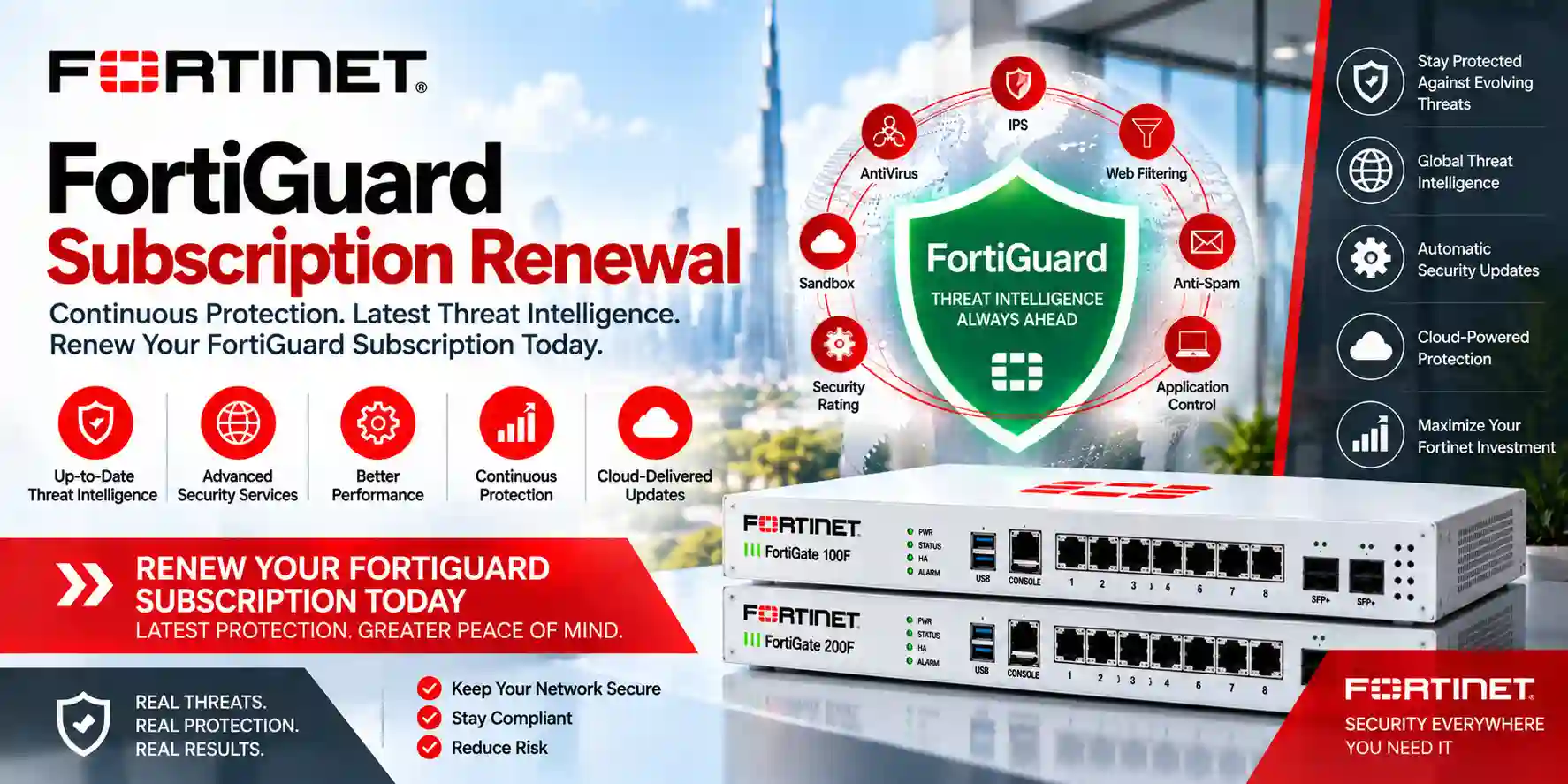
Renewal planning: what changes when subscriptions expire?
A FortiGate does not simply become a useless piece of hardware at the moment every subscription ends, but an expired entitlement can materially change the security posture. Fortinet documentation explains that services such as web filtering and DNS filtering depend on valid licensing, while antivirus, IPS and application-control databases may stop receiving current updates when their associated contracts are no longer active. Support and firmware rights are also tied to service entitlement. The operational risk is therefore not only whether packets continue to pass; it is whether the firewall continues receiving the intelligence, support and updates assumed by the organisation’s security policy.
For renewal projects, start with the serial number, FortiGate model, current service package, expiry date and required future security features. Then confirm whether the existing bundle should be renewed unchanged, upgraded, reduced or restructured. A business that has adopted a separate secure web gateway may no longer need exactly the same combination it purchased three years earlier. Another business may have added SaaS applications, IoT devices, compliance requirements or branch locations that justify moving to broader protection. Renewal is therefore a useful point for policy review rather than an automatic purchase-order repeat.
Where several FortiGates renew at different times, procurement teams may also want to align terms where commercially possible so budgeting and administration become easier. Do not assume that co-termination, backdating, grace periods or reinstatement treatment will be identical in every case. These are commercial-entitlement details that should be confirmed against the specific assets before the order is placed.
How to choose the right FortiGate license
Choose by required control, not by company size alone. A 20-user professional office that handles sensitive data and relies heavily on SaaS may need broader controls than a 100-user internal-only site behind another security layer. Start with the threats and policies you actually need the FortiGate to enforce.
Check where web and DNS security are performed. If the FortiGate is the primary internet edge and administrators need category-based web controls and DNS protection, UTP is a natural bundle to evaluate because it extends ATP with those web-focused services. If those controls are already delivered by another platform, ATP or a-la-carte licensing may deserve consideration.
Buy Enterprise Protection for mapped requirements. DLP, attack-surface security, IoT detection and advanced malware services are valuable when they correspond to defined use cases and an operating process. Paying for a capability that nobody configures, monitors or governs does not automatically improve security.
Separate hardware sizing from subscription choice. The same FortiGate model can be quoted with different bundles, but enabling more inspection can change real-world throughput and resource use. Hardware selection should therefore be validated against the services that will run, not only against the raw firewall-throughput figure.
Plan the support level around business impact. A headquarters edge, data centre, payment environment or high-availability pair may justify a different FortiCare tier than a test unit. Include replacement expectations, support response, maintenance windows and internal escalation requirements in the decision.
Related FortiGate and network planning
Licensing should be planned with the actual firewall deployment. For a compact branch example, review the FortiGate 30G Tanzania product page, which connects appliance sizing, FortiGuard services, IPsec connectivity and branch deployment decisions. The FourTeck Tanzania technology shop also provides buying guidance across firewalls, switching, Wi-Fi and supporting infrastructure.
For customers coordinating UAE requirements, the FourTeck Fortinet UAE resource can help frame Fortinet purchasing and licensing discussions for UAE projects. East African organisations with connected operations can also reference FourTeck Uganda when standardising related technology across multiple sites.
Quotation information to prepare
Provide the FortiGate model, serial number for renewals, required country, current expiry date, desired term, current bundle, security features in use, FortiCare level, high-availability design, number of appliances, FortiGate Cloud or FortiAnalyzer requirements, OT or SASE requirements and any planned model replacement. Clear input reduces the risk of receiving a technically valid but commercially incomplete quote.
FortiGate Firewall Licensing Options Tanzania
FortiGate Firewall Licensing Options Tanzania buyers should approach the subscription as part of a complete security architecture rather than as an afterthought to the appliance. Tanzanian organisations commonly operate a mixture of office users, cloud applications, guest Wi-Fi, IP phones, CCTV, branch links, servers and remote-access requirements. The FortiGate may therefore act as the control point for several different traffic types. The correct licensing package depends on which of those flows must be inspected and which security controls the organisation expects the firewall to provide.
For a business internet edge, UTP is frequently worth evaluating because it adds web and DNS protection to the core ATP capabilities. An organisation that already performs web security through another platform may instead compare ATP or selected individual services. Enterprise Protection becomes relevant when security policy extends into DLP, SaaS risk, IoT visibility, attack-surface monitoring or more advanced malware-prevention requirements. These are not simply “small, medium and large” tiers; they represent different security-service sets. The purchasing decision should therefore be tied to policy, compliance and operational ownership.
Tanzania procurement teams should also check the FortiCare support level, the subscription term and the exact device registration. For an existing FortiGate renewal, provide the serial number and current entitlement information so the correct renewal SKU can be matched. For a new deployment, confirm whether the offer includes hardware plus security services or only the appliance. If high availability is planned, the commercial design should account for the licensing requirements of every cluster member rather than assuming that one subscription automatically covers two units.
Operationally, the license decision should be documented alongside the firewall design. Record which policies depend on IPS, antivirus, web filtering, DNS filtering, sandboxing or other FortiGuard services; assign responsibility for renewal dates; and define what support response is expected if the device fails. FourTeck Tanzania can use those details to help structure a more complete licensing discussion. Organisations that need broader network integration can also review the Tanzania services overview to connect firewall licensing with switching, Wi-Fi, segmentation and lifecycle support.
FortiGate Firewall Licensing Options Dar es Salaam
FortiGate Firewall Licensing Options Dar es Salaam projects often involve busy offices where internet access supports cloud productivity, ERP, CRM, video meetings, voice, remote users and multiple business departments. In this environment, the license should be selected only after the organisation understands which traffic the FortiGate will inspect. A branch or headquarters with broad internet usage may benefit from UTP because web and DNS filtering can become practical policy tools in addition to the IPS and malware-oriented services available through ATP. Organisations handling more sensitive information or diverse device populations may need to evaluate Enterprise Protection capabilities.
Dar es Salaam businesses also commonly plan redundant connectivity. The licensing discussion should be separated from the networking discussion: SD-WAN capabilities in FortiOS and FortiGuard security services solve different problems. A second ISP link may improve resilience, but it does not replace the need to keep threat intelligence and security subscriptions current. Likewise, a high security bundle cannot compensate for an undersized appliance if deep inspection, VPN and web controls are enabled across large volumes of traffic. Model sizing and subscription selection should therefore be completed together.
For renewal, IT teams should inventory the FortiGate serial number, current support level, present bundle, expiration date, firmware branch and security profiles in use. If web filtering or DNS filtering is enabled in production policy, a renewal proposal should preserve the entitlement needed for those functions unless the design is deliberately changing. If the firewall has only been used for site-to-site VPN, routing and segmentation, the team may wish to reassess whether the existing security package is still the most appropriate commercial choice. Any change should be made because of architecture, not because one quote happens to be cheaper.
A well-prepared Dar es Salaam licensing request includes appliance count, required duration, FortiCare expectation, security services, high-availability status, management and logging requirements, branch count, and whether the organisation needs configuration or migration assistance. This makes it easier to compare offers on equal scope. It also supports budgeting by separating device cost, subscription cost and implementation work instead of hiding all three behind a generic “firewall price.”
FortiGate Firewall Licensing Options Mwanza
FortiGate Firewall Licensing Options Mwanza buyers may be securing a regional office, clinic, school, trading company, warehouse, hospitality property or branch that connects back to systems elsewhere in Tanzania. For these locations, licensing should support the services that the branch can realistically operate and maintain. ATP can provide a core layer of intrusion prevention, malware protection and application control. UTP extends that coverage with web and DNS security, which can be useful when the FortiGate is the main internet gateway for staff and guest users. Enterprise Protection adds broader controls when there is a defined need for data, SaaS, IoT or attack-surface functions.
Regional sites should be especially careful about renewals because a missed subscription can affect the freshness of security databases and cloud-dependent services even when basic connectivity continues. If the branch has limited local IT support, central teams should keep an asset register showing FortiGate model, serial number, current service bundle, expiry date and responsible owner. Renewal reminders should be part of normal infrastructure management rather than something discovered from a warning banner after expiration.
Where Mwanza connects to a Dar es Salaam headquarters or another branch by IPsec VPN, the license decision should be consistent with the role of each firewall. A small branch may require the same policy controls as the head office even though the hardware model is smaller. Conversely, a dedicated VPN or segmentation device may not require every internet-edge subscription. Standardising bundle names across all branches can simplify procurement, but standardisation should not override technical reality. The correct approach is to standardise the decision criteria: internet-facing role, inspected traffic, user browsing, data sensitivity, IoT exposure, support criticality and management model.
A Mwanza quotation request should state whether the requirement is new hardware, renewal or upgrade; list the exact FortiGate model; describe the current FortiGuard functions in use; and identify the desired support term. If the branch is expanding, mention planned bandwidth increases, user growth, new guest Wi-Fi or additional cloud applications. These changes may influence both appliance headroom and the most useful security bundle, allowing procurement to avoid a short-term license decision that no longer fits the site after expansion.
FortiGate Firewall Licensing Options Arusha
FortiGate Firewall Licensing Options Arusha discussions often need to account for mixed business environments. Hospitality operations, tourism companies, NGOs, education sites, professional offices and branch businesses can combine employee internet use, guest Wi-Fi, payment or booking systems, cameras, cloud applications and remote access on the same physical network. The firewall license should support the controls used to separate and protect those traffic classes. UTP is often evaluated when web and DNS security are important, while Enterprise Protection may be relevant for organisations with stronger data-governance, IoT or security-risk requirements.
Guest networks create a useful example. A hotel or customer-facing office may isolate guest traffic with VLANs and firewall policy, but administrators may also want web-category controls, malicious-domain protection and application visibility. Those needs affect subscription selection. The Wi-Fi system, switch configuration and FortiGate policy must all preserve segmentation, while the FortiGuard bundle determines which cloud-backed and continuously updated security services are available to the firewall. Buying the appliance first and deciding the license later can therefore create gaps between the intended policy and the activated services.
Arusha organisations should also decide how much vendor support they need. FortiCare Premium is included with current FortiGate security bundles, while Elite can provide faster critical response and additional support benefits for environments where downtime carries higher operational cost. The support decision should reflect how quickly the business needs escalation when the firewall has a serious issue. A small remote office that can tolerate delayed repair may have different requirements from a hospitality site where internet access and booking systems must remain continuously available.
For an Arusha renewal or new purchase, document the desired security outcomes in plain language before asking for a SKU: prevent malicious downloads, control risky sites, protect DNS, inspect applications, reduce data leakage, identify unmanaged IoT or maintain rapid vendor support. Then map those outcomes to ATP, UTP, Enterprise Protection or selected add-ons. This outcome-first process makes the quotation easier for both IT and finance teams to review and reduces the chance that a bundle is chosen only because it carries a familiar name.
FortiGate Firewall Licensing Options Dodoma
FortiGate Firewall Licensing Options Dodoma buyers may include project offices, institutions, contractors, NGOs, education environments and growing businesses that need formal security controls and predictable support. In these settings, procurement documentation is as important as the technical configuration. The purchase request should clearly state whether the requirement is FortiCare support, FortiGuard ATP, UTP, Enterprise Protection, an individual service, or a combined hardware-and-subscription bundle. Generic descriptions such as “Fortinet license” make it difficult to compare proposals and can lead to missing capabilities.
Where policy requires URL filtering, DNS protection or anti-botnet controls, UTP is a stronger match than an ATP-only request because current Fortinet bundle structure places those web-oriented services above the core ATP layer. Where DLP, IoT detection and vulnerability correlation, advanced malware prevention or attack-surface monitoring are formal requirements, Enterprise Protection deserves evaluation. If the organisation only needs a narrow set of security services, a-la-carte licensing may be commercially and technically appropriate. The final choice should be validated against the current ordering guide for the exact model.
Dodoma sites may also operate under change-control processes. In that case, renewal planning should begin early enough to allow technical review, budget approval, quotation validation, purchase order processing and license registration before the existing services end. The team should record the FortiGate serial number, FortiCloud or support account ownership, current entitlements and responsible administrator. This is particularly important when staff changes occur, because a valid subscription is much easier to manage when asset registration and administrative access are already documented.
If several offices are being standardised, create a licensing matrix showing each firewall’s role, model, support criticality and required security services. A headquarters internet edge, internal segmentation firewall, lab device and small branch should not automatically receive identical packages. The matrix gives management a defensible reason for each subscription level and creates a clearer renewal budget. It also makes future tender or quotation exercises easier because suppliers can quote against a defined scope instead of interpreting vague requirements differently.
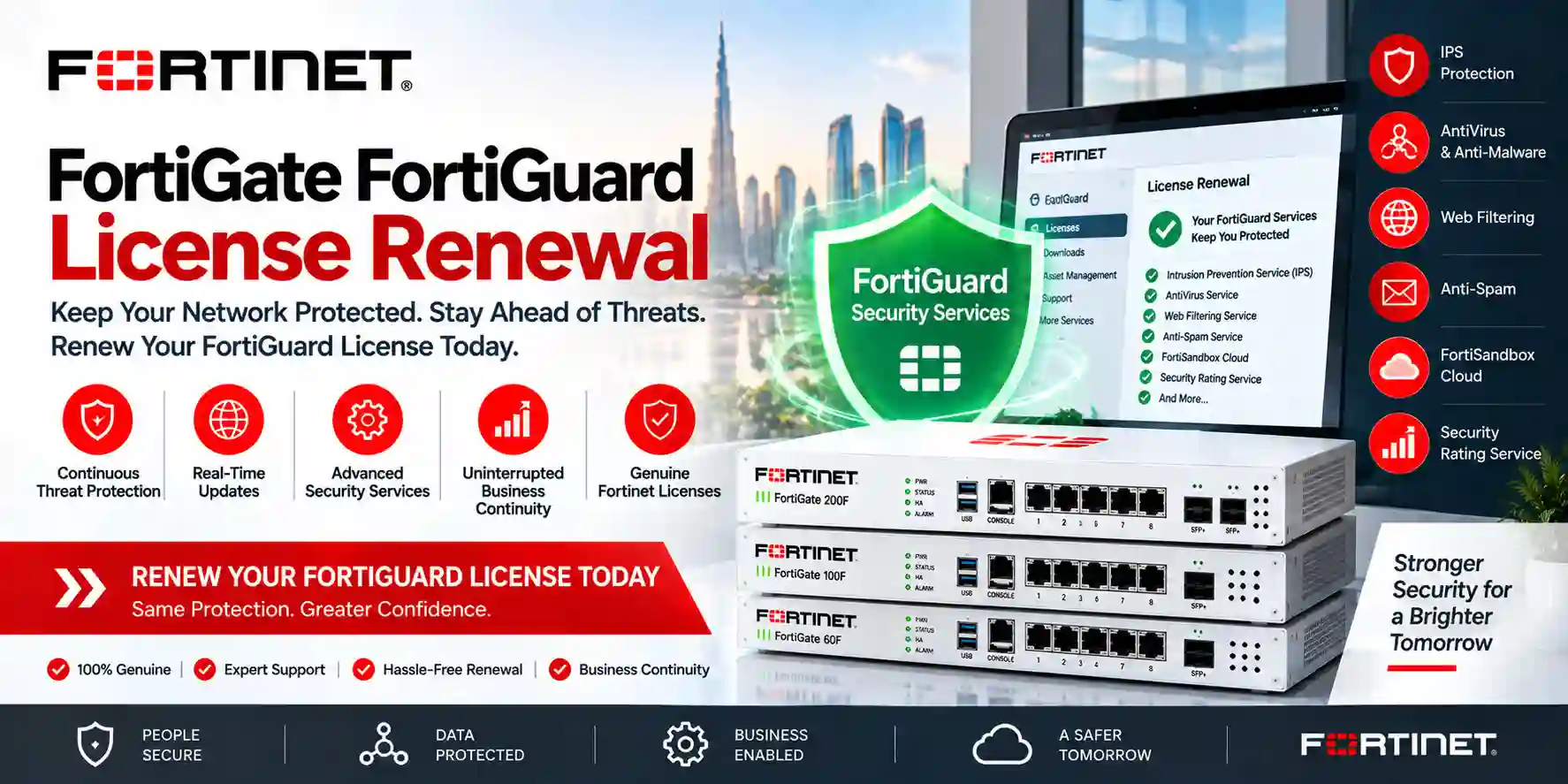
FortiGate Firewall Licensing Options UAE
FortiGate Firewall Licensing Options UAE buyers often compare appliance-only offers, one-year security bundles, multi-year renewals and enterprise support options across multiple suppliers. Because the same FortiGate model can appear in very different commercial configurations, procurement teams should compare the exact support level, FortiGuard bundle and subscription duration before comparing total prices. A FortiGate with UTP for three years is not commercially equivalent to the same hardware with no security services or a shorter ATP term, even though the appliance model number is identical.
UAE organisations with office internet, cloud applications and broad employee browsing often evaluate UTP because it adds web and DNS protection to the core threat-prevention services. Companies with more advanced requirements around data governance, IoT visibility, SaaS risk or attack-surface monitoring may review Enterprise Protection. ATP can suit environments that need core IPS and malware capabilities but obtain web security elsewhere. FortiCare support should be evaluated separately, with Elite considered where accelerated vendor response and additional support benefits align with operational requirements.
Multi-country companies should also standardise licensing logic across UAE and African branches. A consistent security architecture makes central management easier, but the commercial bundle can still vary by role. For example, a UAE headquarters handling higher traffic and sensitive applications may require Enterprise Protection and higher support expectations, while a small branch may use UTP. What should remain consistent is the documentation: model, serial, entitlement, expiry date, firmware policy, logging destination, renewal owner and security profiles. This allows regional IT teams to see quickly which features depend on active subscriptions.
When requesting a UAE quote, include the exact FortiGate series, whether it is a new unit or renewal, preferred term, current subscription if applicable, high-availability design, required FortiCare level and any add-on services. If the firewall will be staged in the UAE and deployed elsewhere, also confirm registration, support geography and handover responsibilities. Regional buyers can use the specialist FourTeck Fortinet UAE resource linked earlier for related planning without assuming that pricing, stock or licensing conditions are identical across every market.
FortiGate Firewall Licensing Options Uganda
FortiGate Firewall Licensing Options Uganda projects frequently involve organisations operating several branches with different internet links and local support conditions. A strong licensing plan should therefore balance central standardisation with site-specific risk. ATP, UTP and Enterprise Protection can all be valid choices depending on the role of the FortiGate. A branch that sends most web traffic directly to the internet may need web and DNS controls through UTP, while a specialised internal firewall may only require core services or a narrower entitlement. Enterprise Protection should be considered when broader data, device and risk-focused controls are actively required.
Uganda-based IT teams should maintain a central license register for FortiGate assets across Kampala, Arua, Mbarara, Gulu and other locations. The register should record model, serial number, site, device role, support tier, FortiGuard bundle, expiry date and renewal owner. This simple discipline prevents regional appliances from being forgotten until a subscription has already expired. It also makes budgeting more predictable because finance teams can see which sites renew in the same quarter and which devices may be approaching a replacement decision.
If an organisation operates both Tanzania and Uganda, licensing can be aligned with a common branch security standard. The standard might define that all internet-facing branches require UTP, all sensitive enterprise edges require Enterprise Protection, and dedicated VPN appliances are assessed separately. The exact rules should reflect the organisation’s risk model rather than these examples, but documenting them helps procurement avoid ad-hoc decisions. It also improves technical consistency because security profiles can be built around known entitlements.
For Uganda quotations, provide the current FortiGate details and the security services actually enabled. If the requirement is renewal, do not rely only on an old invoice; confirm the current device registration and entitlement status. If it is a new project, include planned bandwidth, branch connectivity, users, guest networks, public services, logging and high availability. This information helps separate the license discussion from the appliance-sizing discussion while ensuring the two still support the same operational design.
FortiGate Firewall Licensing Options Kampala
FortiGate Firewall Licensing Options Kampala buyers often need to protect offices that depend heavily on cloud applications, financial systems, customer platforms and branch connectivity. The firewall may inspect web traffic, terminate IPsec tunnels, enforce application policy and separate internal networks. Licensing should reflect those functions. ATP provides the core threat-protection layer, UTP adds the web and DNS controls commonly needed at an internet edge, and Enterprise Protection adds capabilities for organisations with more advanced data, SaaS, IoT and security-risk objectives.
Kampala environments should be cautious about using employee count as the only licensing or sizing input. Security subscriptions are not simply sold as “20-user” or “100-user” protection for standard physical FortiGate operation; the hardware model determines platform capacity, while subscription bundles determine which security services are available. A small team with high bandwidth, extensive cloud usage and deep inspection can place significant load on the firewall. A larger team with a simpler traffic profile may behave differently. License and model selection should therefore be reviewed together.
Renewal planning should include a policy dependency review. Identify every active security profile that relies on FortiGuard: IPS sensors, antivirus, web filtering, DNS filtering and other licensed services. Confirm that the new bundle preserves those dependencies or that the security design will be changed intentionally. This is especially important when a buyer considers moving from UTP to ATP to reduce cost. If web filtering remains configured as a required control, downgrading without redesign can create an operational and policy mismatch.
A Kampala procurement request should also state support expectations. If the FortiGate protects a business-critical site, FortiCare Premium or an Elite upgrade may be relevant depending on the desired response and service level. Include whether advanced replacement expectations, 24×7 vendor assistance, longer-term firmware support or proactive device insights matter to the organisation. These support requirements are easier to approve when expressed as business-continuity needs rather than unexplained SKU differences.
FortiGate Firewall Licensing Options Arua
FortiGate Firewall Licensing Options Arua projects can involve regional branches where central IT teams need security to remain consistent even when local technical resources are limited. Licensing should support a configuration that can be managed remotely and predictably. If the FortiGate is the primary internet gateway, UTP can be useful because central administrators can apply web and DNS controls alongside core IPS and malware protection. If the branch has a specialised role and web security is delivered elsewhere, ATP or selected services may be sufficient. The choice should follow the architecture rather than the branch’s distance from headquarters.
For remote sites, renewal continuity is particularly important because resolving an entitlement problem after expiration may require coordination among local staff, procurement, the reseller and the central Fortinet account owner. A central asset register should therefore contain the serial number, license package, expiration date and support account details well before renewal. Technical teams should also keep configuration backups and note which policies rely on FortiGuard services so they understand the impact of any lapse.
Arua branches may have variable connectivity, making internet failover and IPsec connectivity important operational topics. These networking functions should not be confused with FortiGuard subscription services. A dual-WAN design can improve reachability, but the security posture still depends on active threat intelligence and current security databases when those features are enabled. Similarly, strong FortiGuard licensing does not create bandwidth or correct poor ISP performance. Procurement should therefore budget separately for connectivity, firewall capacity, security subscriptions and support.
When requesting an Arua quote, provide the device role, current or proposed FortiGate model, ISP bandwidth, number of WAN links, branch VPN requirements, approximate user and device count, security services in use, preferred term and implementation responsibility. If the branch will be configured centrally and shipped pre-staged, define who will register the license, connect the WAN handoff, perform final testing and maintain the device after handover. Clear ownership is one of the most effective ways to ensure that the purchased license translates into an operational security service.
FortiGate Firewall Licensing Options Mbarara
FortiGate Firewall Licensing Options Mbarara buyers may be planning for a growing office rather than a static network. A branch that starts with a small team can quickly add cloud applications, guest Wi-Fi, cameras, additional VPN traffic and faster internet. Licensing should therefore be selected with a reasonable view of the next subscription period. If web and DNS controls are expected to remain part of the branch policy, UTP gives a clearer fit than a core ATP-only package. If more advanced data or IoT requirements are expected, Enterprise Protection may become relevant.
Growth affects the hardware decision as well. A broader subscription can enable more inspection, which may increase processing demand compared with simple firewall forwarding. A FortiGate that is comfortable at today’s bandwidth may offer little headroom after a major ISP upgrade if deep inspection is also expanded. The license and hardware should therefore be reviewed during the same planning exercise even though they are separate commercial items. This is particularly useful when renewing an older model that may be approaching a practical replacement point.
Mbarara organisations with multiple sites should standardise how renewals are approved. A branch owner can confirm operational needs, central IT can confirm technical services, security teams can validate policy requirements, and procurement can confirm term and commercial scope. This shared process prevents licenses from being chosen only by finance or only by engineering. It also makes the decision traceable when management later asks why one site has UTP and another has Enterprise Protection.
A complete Mbarara request should distinguish new license, renewal and upgrade. For renewal, include serial number and current entitlement. For upgrade, state which new feature drives the change—for example DLP, IoT visibility or broader threat prevention. For a new firewall, describe the site role and inspection expectations. Also state whether the quotation should include only Fortinet entitlement or configuration, migration, testing and documentation. This separation helps buyers compare offers without confusing service labour with the subscription itself.
FortiGate Firewall Licensing Options Gulu
FortiGate Firewall Licensing Options Gulu requirements often benefit from simplicity and central visibility. A regional office may not have a full-time firewall specialist, so the selected bundle should correspond to security controls that central administrators can configure, monitor and maintain. UTP can provide a practical combination for an internet-facing branch by combining core threat protection with web and DNS services. ATP can suit a narrower architecture, while Enterprise Protection should be adopted when its additional data, IoT and attack-surface capabilities have clear owners and operating procedures.
Support level is also important in a regional context. If an outage would require remote troubleshooting before an engineer could reach the site, the organisation may value stronger vendor support. FortiCare Premium offers 24×7 assistance, while Elite provides enhanced response targets and additional support features. The appropriate tier depends on the business impact of failure, not simply on geography. A low-criticality branch might tolerate a different service level from a location that processes continuous transactions or provides essential connectivity to several dependent systems.
Gulu teams should maintain a renewal checklist that includes entitlement validation, configuration backup, firmware review, security-profile inventory and confirmation of the FortiCloud/support account used to register the appliance. This makes renewal a controlled maintenance event rather than a purely commercial one. It is also a good opportunity to remove unused policies, verify logging and decide whether the current bundle still matches the role of the firewall.
When asking for a Gulu quotation, specify whether the branch internet is local breakout or routed through another office, whether users browse directly through the FortiGate, whether guest Wi-Fi is present, whether IPsec connects to central systems and whether the firewall is part of a standard branch template. These details help determine if web security, broader enterprise services or only core protection are appropriate. The aim is not to purchase the highest bundle automatically; it is to purchase the bundle that supports the controls the branch will actually operate throughout the subscription term.
FortiGate Firewall Licensing Options Kenya
FortiGate Firewall Licensing Options Kenya buyers may be coordinating cybersecurity across Nairobi headquarters, regional branches, retail locations, schools, clinics, warehouses or multi-country East African operations. The licensing challenge is often consistency. A central IT team wants predictable security policy, but sites can differ significantly in bandwidth, users, applications and risk. The most useful strategy is to standardise the decision framework rather than force every FortiGate into the same subscription. Define when ATP is acceptable, when UTP is required and which risks justify Enterprise Protection.
For branches with local internet breakout and general staff browsing, UTP is commonly a strong candidate because it adds URL and DNS security to the core ATP protections. A data centre edge or highly regulated environment may require the broader controls available in Enterprise Protection. A dedicated VPN or segmentation firewall may have a narrower service requirement. These are architecture decisions, not marketing tiers. The business should be able to explain which security outcome is mapped to each purchased entitlement.
Kenya-based organisations also need a clear renewal process across multiple assets. A shared spreadsheet or configuration-management system should record FortiGate serials, site names, appliance roles, bundle, support tier, term, renewal date and account ownership. When a branch is replaced, the record should be updated so procurement does not accidentally renew a retired appliance. When a new branch is opened, the licensing requirement should be included in the project bill of materials from the beginning rather than discovered during commissioning.
Cross-border projects between Kenya, Tanzania and Uganda should additionally coordinate addressing, VPN, central logging and administrative access. Licensing can support the same security profiles across regions, but commercial conditions and device registrations should be confirmed for the actual deployment countries. Avoid assuming that a SKU quoted for one region can simply be transferred elsewhere without validation. A complete request should state where each firewall will be deployed, the desired term and which central Fortinet services or management platforms are part of the design.
FortiGate Firewall Licensing Options Kuwait
FortiGate Firewall Licensing Options Kuwait procurement often involves businesses comparing hardware, one-year coverage and multi-year security bundles for offices, retail, logistics, hospitality and enterprise environments. The first commercial check should be whether every supplier is quoting the same entitlement. A three-year UTP package, a one-year Enterprise Protection bundle and a hardware-only appliance should never be compared as though they were identical products. The quote should spell out the FortiGate model, FortiCare level, FortiGuard bundle, term and any add-ons.
For internet-facing sites, UTP deserves evaluation where the FortiGate will enforce URL and DNS policies. ATP can fit environments that need core intrusion and malware protection but use a separate platform for web controls. Enterprise Protection should be considered when DLP, SaaS visibility, IoT risk or broader attack-surface capabilities are part of the security requirement. The highest bundle is not automatically the correct bundle; the correct bundle is the one that supports documented policy and can be operated effectively by the IT or security team.
Kuwait organisations with critical operations may also focus on support response. FortiCare Premium and Elite should be compared in terms of the business consequence of an outage and the desired vendor escalation path. If a firewall protects a revenue-generating site or high-availability perimeter, enhanced support can have different value from a small non-critical branch. These decisions should be made alongside the resilience design, including HA, spare strategy, maintenance windows and configuration backups.
For renewal, provide the serial number and current entitlement instead of requesting a generic “FortiGate license price.” Renewal SKUs are model-specific, and the correct commercial treatment can depend on the existing service state. If an organisation is considering replacing an older FortiGate, compare the cost of renewing the current appliance against the lifecycle and capacity of a newer model. A license renewal is sometimes the correct decision, but it should not postpone a required hardware upgrade when bandwidth, support status or inspection demand has outgrown the platform.
FortiGate Firewall Licensing Options Ghana
FortiGate Firewall Licensing Options Ghana buyers can benefit from treating licensing as part of cybersecurity lifecycle management. New firewall projects receive attention during installation, but the subscription becomes just as important one or three years later when the renewal date approaches. Security teams should know which FortiGuard features are active, procurement should know which contract term applies, and management should understand the operational impact if services are allowed to lapse. This shared ownership avoids the common situation where an expired entitlement is discovered only after a warning appears.
Ghanaian offices and branches that rely on the FortiGate for normal employee internet access should evaluate whether UTP provides the right mix of core threat prevention and web/DNS control. Organisations with more advanced regulatory, data-protection, SaaS and IoT requirements may consider Enterprise Protection. ATP can be appropriate when the primary requirement is network and malware protection and web security is delivered elsewhere. Selected FortiGuard services can also be purchased individually when a bundle would include several functions the organisation does not need.
The support decision should be documented separately. FortiCare Essential, Premium and Elite offer different service experiences, and current FortiGate security bundles include Premium as their support baseline. An organisation should decide whether Premium meets its expected outage response or whether Elite is justified for critical appliances. The support level can also vary across the estate, provided the difference is deliberate and recorded.
A Ghana licensing quotation should include location, model, serial number for renewals, desired duration, current bundle, required future bundle, support expectations, high-availability status and any management or analytics services. If several branches are involved, use one schedule listing each device rather than sending separate informal requests. That gives procurement a single view of the estate, reduces duplicate or missed renewals and makes it easier to align future contract dates where commercially possible. It also helps technical teams verify that every production firewall has the security entitlement assumed by its configuration.
FortiGate Firewall Licensing Options Nigeria
FortiGate Firewall Licensing Options Nigeria requirements can range from a single office firewall to large distributed networks with several branches, data centres and cloud workloads. In multi-site environments, licensing becomes an asset-management problem as much as a security problem. Each FortiGate should have a defined role, subscription, support tier and renewal owner. Without that structure, organisations can end up with inconsistent bundles, missed expirations or security policies that depend on services no longer entitled on a particular appliance.
For typical office internet edges, UTP can provide a balanced mix because web and DNS security are added to ATP’s core intrusion and malware controls. Enterprise Protection can be evaluated for higher-risk environments where DLP, IoT detection, attack-surface monitoring and more advanced malware-prevention functions fit a documented requirement. ATP remains useful where the organisation already has another layer handling web access and only needs the core FortiGuard protection stack on the firewall. The selection should be based on control ownership, not merely company size.
Nigeria projects should also distinguish traditional fixed-term subscriptions from FortiFlex. FortiFlex can be relevant to organisations that need adjustable, usage-based entitlements across eligible hybrid deployments, including FortiGate VM and supported hardware scenarios. It is not simply a cheaper replacement for every standard subscription. The finance and technical teams should understand how consumption is measured, which assets qualify and whether the flexibility matches the deployment pattern before choosing it.
For procurement, request a bill of materials that names every FortiGate model and entitlement rather than accepting descriptions such as “full security license.” If high availability is used, confirm licensing for all units in the cluster. If the estate uses FortiManager, FortiAnalyzer, FortiGate Cloud, SOC services or other platforms, identify those separately so renewal responsibility is clear. A structured Nigeria licensing schedule can then be reviewed quarterly, allowing the organisation to plan renewals, replacements and security upgrades before they become urgent purchasing events.
FortiGate Firewall Licensing Options Seychelles
FortiGate Firewall Licensing Options Seychelles buyers may place a high value on continuity because replacement logistics and specialist support can be more complex for island environments. The security subscription and FortiCare support level should therefore be reviewed together with the hardware-resilience plan. A business should know what happens if the appliance fails, how quickly support is expected to respond, whether there is an HA or spare-device strategy and which FortiGuard services are essential to ongoing policy enforcement.
Hospitality, financial, professional and service organisations in Seychelles may have mixed traffic involving staff, guests, payment or booking systems, cloud applications, cameras and remote management. UTP can be relevant when web and DNS security are needed at the local internet edge. Enterprise Protection may fit organisations with stronger data, IoT or attack-surface requirements. ATP may be sufficient for a narrower deployment where web security is handled by another service. The site should not purchase a higher bundle purely for reassurance; every licensed feature should correspond to a use case, policy or planned control.
Because connectivity and support logistics influence operations, the renewal process should begin with enough lead time for commercial validation and internal approval. Keep the serial number, entitlement and account registration documented. Confirm the exact term and support level before the current service ends. If the appliance is approaching the end of its practical lifecycle, compare renewal against replacement so the organisation does not commit to a long subscription term on hardware that may soon need upgrading.
A Seychelles quotation should also include the deployment country, site role, desired security bundle, FortiCare requirement, high-availability design and any need for remote configuration or staging. If the firewall serves a hotel or resort with guest Wi-Fi, explain whether guest traffic receives web security or is isolated with a different policy. If the device protects business systems and remote access, state the critical applications and support expectations. This operational context allows licensing to be matched to the actual environment rather than selected from a generic price list.
FortiGate licensing for hardware, virtual machines and hybrid environments
Physical FortiGate appliances and FortiGate VMs can participate in different licensing models. Traditional FortiGate-VM licensing includes perpetual and subscription-oriented approaches depending on the series, while FortiFlex provides a more adjustable program for eligible environments. FortiFlex can create entitlements for service packages such as FortiCare, ATP, UTP and Enterprise and can also support add-ons including FortiGate Cloud management, FortiAnalyzer Cloud, SOCaaS, managed FortiGate, SD-WAN services, OT security and other options depending on the product and program.
Hybrid organisations should avoid mixing licensing models without documentation. A cloud firewall that scales up and down may benefit from consumption flexibility, while a fixed branch appliance may be simpler under a traditional multi-year subscription. Central security teams should track both as part of one entitlement inventory so cloud and physical firewalls receive consistent policy and renewal governance even when their commercial licensing mechanisms differ.
Quotation checklist for FortiGate licenses and renewals
FortiGate Firewall Licensing FAQ
Does a FortiGate firewall need a subscription to pass traffic?
A physical FortiGate can continue performing base firewall and networking functions without every FortiGuard subscription active, but subscription-dependent security services, updates and support entitlements can be reduced or unavailable. Production designs should therefore treat licensing as part of the security policy rather than assuming that continued packet forwarding means protection is unchanged.
What is the difference between FortiCare and FortiGuard?
FortiCare is the support and service layer. FortiGuard is the family of security services and threat intelligence used by functions such as IPS, malware protection, URL filtering and DNS filtering. A complete buying decision often needs both.
What does ATP include?
Fortinet currently positions ATP as the foundational FortiGate security bundle. Current material lists IPS, antivirus, FortiSandbox SaaS, application control and inline CASB among the included core services. Exact ordering details should be validated for the specific SKU and term.
What does UTP add over ATP?
UTP builds on ATP and adds broader web and network security, including URL and DNS filtering, video filtering and anti-botnet/C2 communication services in current Fortinet bundle descriptions.
When should Enterprise Protection be considered?
Enterprise Protection is designed for broader security coverage. Current Fortinet material adds capabilities such as DLP, attack-surface monitoring and risk scoring, AI-based inline malware prevention, and IoT detection with vulnerability correlation on top of ATP and UTP services.
Can FortiGuard services be purchased individually?
Yes. Fortinet offers selected services on an a-la-carte basis. This can be useful for specialised designs where only specific FortiGuard services are required or where another platform already delivers part of the security stack.
What is FortiFlex?
FortiFlex is Fortinet’s flexible, usage-based licensing program for eligible deployments. It can support adjustable entitlements across hybrid environments and can include FortiGate VM, supported hardware and security or support packages depending on the program configuration.
What information is needed for a FortiGate renewal quote?
Provide the exact FortiGate model, serial number, deployment country, current bundle, current expiry date, desired term, required security services, FortiCare level and any planned changes. For multiple devices, use one asset list to reduce omissions.
Should I buy one year or multiple years?
The best term depends on budget, hardware lifecycle, procurement policy and expected architecture changes. A longer term can simplify renewal administration, but it should be aligned with the useful life of the appliance and the organisation’s security roadmap.
Can the license bundle be changed at renewal?
In many cases a customer can choose a different appropriate service package at renewal, subject to the current commercial offerings and model eligibility. Any change should be reviewed against the security profiles and services the firewall is configured to use.
Decision recap
FortiGate licensing works best when support, security services and hardware are evaluated separately but purchased as one coherent design. ATP provides foundational threat protection. UTP adds web and DNS-focused controls. Enterprise Protection adds broader data, SaaS, IoT and risk-oriented capabilities. FortiCare determines support service, while FortiFlex can provide flexible usage-based licensing for suitable deployments.
Before asking for price, identify the FortiGate model, device role, required security outcomes, support criticality and preferred term. For renewals, add serial numbers and current entitlement details. This creates a quotation that procurement can compare accurately and security teams can defend technically.
Plan your FortiGate licensing with FourTeck
FourTeck can help structure FortiGate licensing enquiries around the exact appliance, current entitlement, intended security services, support requirement and deployment region. The objective is to avoid incomplete quotes, mismatched bundles and last-minute renewal problems. Share the model and serial number for an existing firewall, or the expected users, bandwidth, traffic role and security requirements for a new deployment.
For a new FortiGate purchase, ask for hardware, FortiCare, FortiGuard bundle, term and implementation scope as clearly separated items. For renewal, include the expiry date and any planned change in security strategy. This gives both technical and commercial teams a cleaner basis for approval and lifecycle planning.