
FortiGate SD-WAN Solutions
FortiGate SD-WAN Solutions bring software-defined WAN intelligence and next-generation firewall security together on the FortiGate platform. For organizations that rely on cloud applications, branch connectivity, VPN links, multiple internet circuits or hybrid working, the practical goal is simple: use available WAN paths more intelligently while maintaining a consistent security policy. Fortinet positions Secure SD-WAN as a converged networking and security capability running on FortiOS, with centralized deployment, visibility and management options for distributed environments.
Fourteck helps customers translate that platform capability into a deployable design. A useful SD-WAN project begins with the current WAN topology, business-critical applications, ISP links, latency and loss sensitivity, VPN requirements, security controls, branch count, failover expectations and operational model. That information helps determine whether the requirement is a simple dual-WAN branch, a multi-site overlay, a hub-and-spoke environment, a cloud-connected architecture or a larger centrally managed deployment.
What FortiGate Secure SD-WAN Does
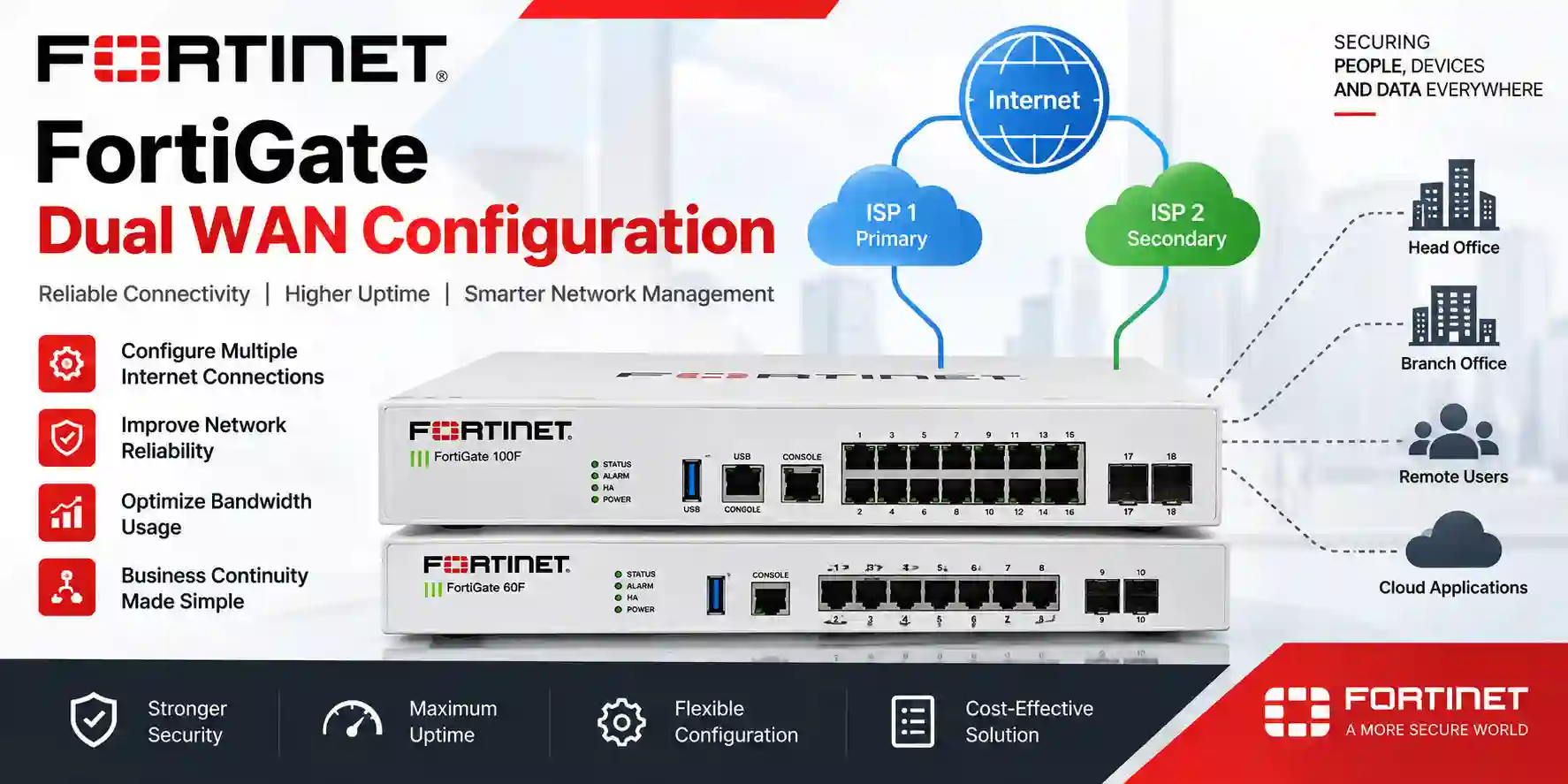
Fortinet describes Secure SD-WAN as a solution that converges networking and security through FortiOS. In practical terms, a FortiGate can participate in WAN path selection while also enforcing firewall policies and the security services appropriate to the chosen deployment. SD-WAN rules can be designed around application needs, link health and business priorities rather than treating every packet as if all WAN links were equivalent. This is useful where an organization has two or more connectivity options such as business broadband, dedicated internet, MPLS, LTE/5G backup or other routed services.
A sound design can monitor WAN quality indicators and use policy to decide which link should carry particular traffic. The objective may be straightforward failover, active use of multiple circuits, preference of one path for voice or collaboration, selection of a better-performing route for cloud applications, or secure branch-to-branch and branch-to-head-office connectivity. Fortinet documentation also supports architectures that combine SD-WAN with IPsec overlays, high availability, cloud connectivity and centralized management. The correct configuration depends on the actual topology and should be tested against failure scenarios rather than assumed to work from a generic template.
SD-WAN should therefore be viewed as a network design discipline, not simply a checkbox on a firewall. Link monitoring targets, routing, NAT behavior, application identification, firewall policies, VPN design, DNS dependencies, session persistence and failback behavior can all affect the final user experience. Fourteck can help structure these requirements before implementation so that the intended business outcome—resilience, application quality, simplified branch operations or WAN consolidation—is measurable and testable.
Core FortiGate SD-WAN Capabilities to Plan Around
Application-aware steering
Create routing intent around business applications and traffic classes, then select eligible WAN members according to policy and measured conditions.
Performance SLAs
Monitor latency, jitter, packet loss or reachability targets so traffic can avoid a path that is technically online but not meeting the desired service level.
WAN resilience
Use multiple links to improve continuity and design explicit primary, secondary or balanced behaviors according to the applications and circuits involved.
Integrated security
Apply FortiGate firewall functions and subscribed FortiGuard security services according to the organization’s policy while using the same platform for WAN control.
Centralized operations
FortiManager can support centralized FortiGate and SD-WAN configuration workflows, templates and orchestration for organizations operating multiple sites.
Visibility and analytics
Operational visibility can be extended with Fortinet management and analytics tools so network teams can investigate WAN health, traffic behavior and security events.
Dual WAN, Multi-WAN and Intelligent Failover
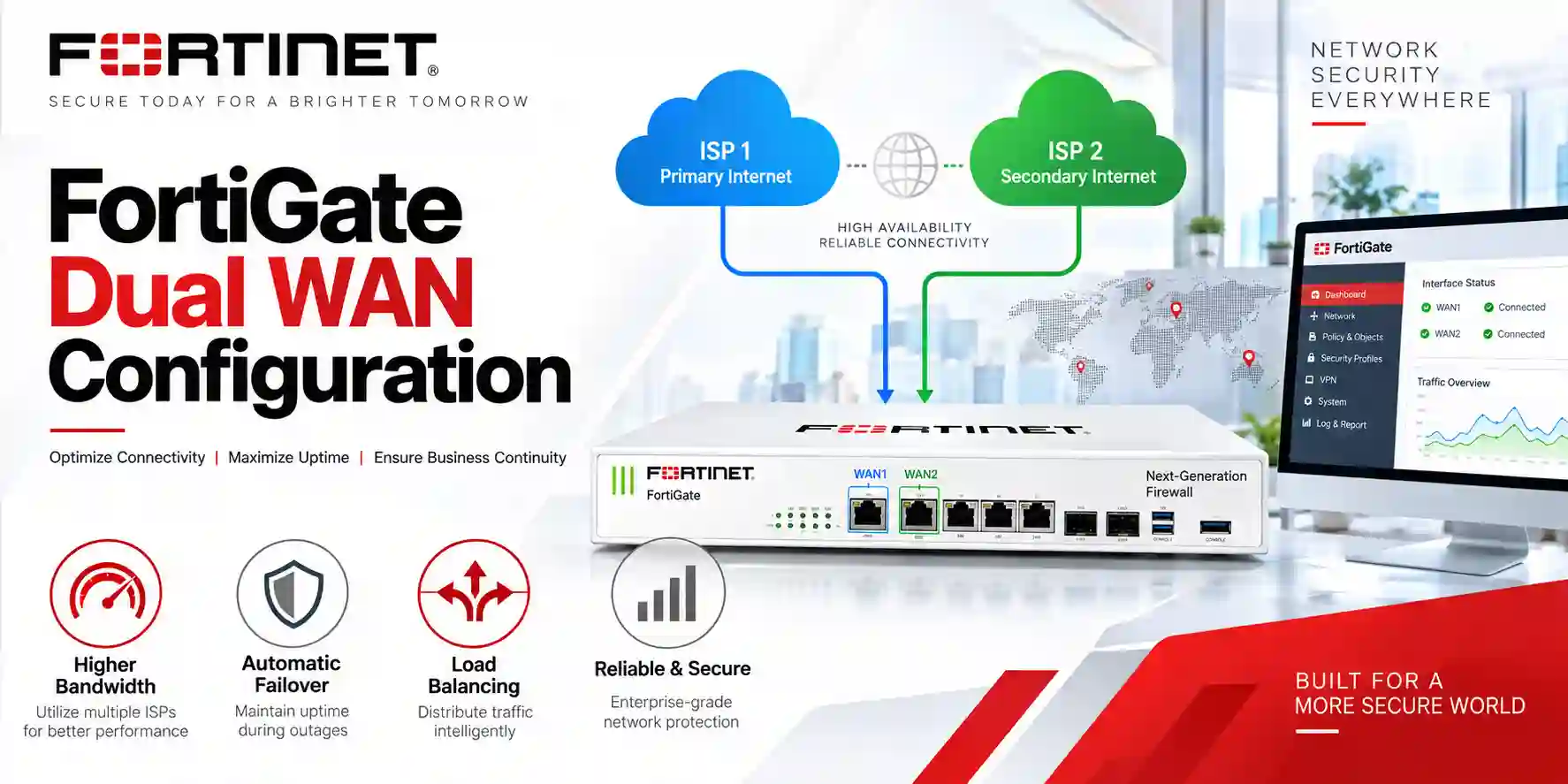
Many FortiGate SD-WAN projects begin with two internet links, but the design decision is more specific than “make WAN2 a backup.” Administrators need to decide which traffic should normally use each path, which health checks indicate that a path is genuinely usable, how quickly traffic should move when conditions deteriorate, what happens when the preferred link returns and how NAT or VPN sessions behave during a path change. Fortinet’s technical guidance shows that SD-WAN can monitor multiple WAN members and apply policy to fail over or balance traffic, but configuration should match the intended session behavior and application tolerance.
For environments with several circuits, the benefit is the ability to create differentiated path policy instead of one global default. A collaboration platform may be sensitive to jitter, a cloud ERP connection may need predictable latency, bulk backup traffic may tolerate a lower-priority circuit, and guest internet can often use spare capacity without competing with business-critical sessions. This policy-driven approach makes the WAN more intentional and can improve use of connectivity already being paid for.
Deployment and Buying Guidance
1. Start with WAN reality
Document providers, handoff types, public addressing, bandwidth, expected latency, backup links, data caps and any routing restrictions. SD-WAN policy can only be as effective as the underlay links it is controlling.
2. Define applications
Identify voice, video, SaaS, ERP, cloud, VPN, backup and general web traffic. Decide which applications are critical, which can move freely and which need stable path selection.
3. Size security and VPN load
Choose the FortiGate model using the traffic profile and enabled security services, not raw firewall throughput alone. VPN scale, encrypted inspection and future bandwidth growth can materially affect sizing.
4. Plan management
A small standalone site may be managed locally, while multi-branch environments can benefit from centralized templates, policy workflows, orchestration and analytics using Fortinet management platforms.
5. Test failure, not only success
A deployment plan should include tests for link loss, high latency, packet loss, VPN recovery, DNS behavior, SaaS sessions, voice calls and link restoration so failover expectations are verified.
6. Confirm licensing scope
FortiGate platform functions, FortiGuard security services and optional management or cloud services have different commercial scopes. The quotation should state the exact hardware, subscriptions and service terms required.
FortiGate SD-WAN Solutions Tanzania
Organizations planning FortiGate SD-WAN Solutions in Tanzania commonly need to balance three objectives: dependable internet access, secure connectivity between sites and controlled access to cloud or data-center applications. The most useful design begins by mapping the actual business locations and the connectivity available at each one. A headquarters may have two fixed internet circuits, a branch may use one fixed service plus mobile backup, and a smaller site may operate with more limited bandwidth. SD-WAN can bring these different link types into a common policy framework, but the path rules should reflect what each site can realistically support.
For a Tanzania deployment, procurement teams should provide branch count, estimated users per site, internet bandwidth, critical applications, VPN requirements and any existing FortiGate equipment. It is also useful to identify whether sites communicate mainly with a central office, with each other, with public cloud services or directly with SaaS platforms. That traffic pattern determines whether hub-and-spoke, partial mesh, direct internet breakout or another topology is appropriate. Where voice and video are important, performance targets should consider jitter and packet loss rather than uptime alone. Where ERP or line-of-business applications are centralized, path stability and tunnel design may matter more than simply sharing traffic evenly across links.
Security should be planned alongside WAN behavior. FortiGate can combine firewall policy with SD-WAN decisions, allowing the same branch edge to control access and choose paths. However, subscribed security services, encrypted inspection requirements and VPN usage influence appliance sizing. A quotation should therefore separate the network objective from the hardware decision: first define what the system must do, then select a FortiGate model that has suitable interfaces, capacity and headroom for the enabled services. Customers reviewing a smaller branch platform can also see the FortiGate 30G Tanzania product page as an example of model-specific buying guidance, while larger or more security-intensive sites may require a different FortiGate family.
The operational plan matters after deployment. Configuration backups, change control, firmware planning, link-health baselines and documented failover tests make troubleshooting easier. Multi-site environments should also consider whether centralized management is needed so policy and SD-WAN changes are not repeated manually at every branch. Fourteck’s Tanzania technology services overview explains how firewall, switching, Wi-Fi and supporting infrastructure can be planned together, which is particularly relevant because an SD-WAN edge still depends on reliable LAN switching, addressing, cabling and power.
FortiGate SD-WAN Solutions Dar es Salaam
FortiGate SD-WAN Solutions in Dar es Salaam can be especially relevant for organizations that depend on cloud services, customer-facing systems, branch connectivity and continuous internet access from a primary business site. A typical design question is whether a second internet circuit should operate only as backup or be used actively. SD-WAN gives network teams more choices: the preferred circuit can carry latency-sensitive business traffic, another can carry selected internet or guest traffic, and policy can change automatically when measured quality falls below defined targets. This is more useful than basic link redundancy when both circuits are valuable assets and the business wants predictable application behavior.
A Dar es Salaam head-office design should begin with application mapping. Microsoft 365 or other SaaS platforms, voice and video conferencing, cloud-hosted ERP, remote-access services, site-to-site VPNs, backups and public web services all behave differently during path changes. For example, a real-time call is sensitive to jitter and packet loss, while a backup job may simply need available bandwidth. SD-WAN rules can reflect these differences, but they should be backed by meaningful health checks and a test plan. The team should also confirm whether public IP changes during failover affect external allowlists, banking portals, partner VPNs, hosted applications or any service tied to a specific source address.
Where Dar es Salaam acts as a hub for branches elsewhere in Tanzania, tunnel design becomes another priority. IPsec overlays may be used to connect branches securely, and the business should define whether branch traffic must pass through headquarters or can go directly to cloud services. Centralized breakout may simplify some controls but can add latency and bandwidth demand at the hub. Direct internet access can improve SaaS paths but requires consistent branch security. FortiGate’s converged model allows these network and security decisions to be designed together rather than treating the WAN and firewall as separate projects.
Procurement should therefore request more than an appliance price. A meaningful scope can include model sizing assumptions, WAN interface needs, security subscriptions, VPN topology, configuration, migration, testing, documentation and support expectations. If switching or wireless design also needs review, the Fourteck Tanzania technology shop provides broader product-category context. The final SD-WAN solution should be judged by how well it supports the applications and failure scenarios of the business, not by the number of WAN ports alone.
FortiGate SD-WAN Solutions Mwanza
FortiGate SD-WAN Solutions in Mwanza can suit organizations that need dependable connectivity between a regional operation and other offices, cloud applications or centralized systems. The design may involve a main fixed internet service with a secondary path, or more than two links where different providers and connection types are available. The value of SD-WAN is not simply having extra links; it is being able to monitor them and apply business rules so traffic uses an appropriate path. That can help a branch continue operating when a circuit fails and can also reduce dependence on one provider when several links are available.
For Mwanza sites supporting logistics, distribution, professional services, retail, education or other multi-location operations, the network plan should identify which applications must remain reachable during an outage. Point-of-sale systems, cloud productivity suites, voice, remote desktops, ERP, inventory platforms and VPN connections may have different priorities. A useful requirements workshop ranks these applications and defines acceptable degraded modes. For example, the business may decide that a backup mobile path should preserve ERP and essential collaboration while noncritical updates and large downloads are restricted until the primary circuit returns. SD-WAN policy can then be aligned with that operational intent.
The branch edge also needs suitable security and LAN integration. If staff, guest Wi-Fi, cameras, servers or voice devices share the same site, VLAN segmentation and firewall policy should be clear so a WAN change does not weaken internal controls. FortiGate can enforce network security while participating in the SD-WAN design, but the supporting switch infrastructure, power protection and cabling remain important. Where the site depends heavily on connectivity, the quotation should identify UPS requirements for the firewall, ISP equipment and switches because SD-WAN cannot provide resilience if the local network loses power.
A good Mwanza deployment should also include operational handover. Administrators need to know how to check member status, read performance-SLA results, confirm which path a rule is using and distinguish an ISP quality problem from a firewall or LAN issue. Baseline documentation should include WAN addressing, provider details, interface names, health-check targets, routing intent, VPN dependencies and escalation contacts. This turns SD-WAN from an opaque feature into an operational tool that staff can understand and maintain.
FortiGate SD-WAN Solutions Arusha
FortiGate SD-WAN Solutions in Arusha can be designed for organizations that rely on a mix of office productivity, reservations or customer systems, cloud applications, collaboration tools and secure access to remote resources. Hospitality, travel, professional, non-profit and institutional environments may have very different traffic profiles, so a useful design should not start from a generic “dual WAN” template. It should start from business services: which applications must remain available, where those applications are hosted, how users connect and what the acceptable fallback behavior is when link quality changes.
Where internet-facing applications are central to daily operations, SD-WAN can monitor more than simple link status. A circuit may be technically connected while experiencing high latency, jitter or packet loss that affects calls and cloud applications. Performance-SLA monitoring can support path decisions based on quality targets, allowing selected traffic to use a healthier route. The monitoring target must be chosen carefully so it represents the service being protected. Testing should include partial degradation as well as a complete cable disconnect, because real-world problems are often quality failures rather than total outages.
Arusha organizations with remote sites, camps, satellite offices or partner connections should also define how VPN connectivity is expected to behave. Some environments need a straightforward tunnel to headquarters, while others benefit from multiple overlays or direct paths between branches. The complexity should match the business need. Too many tunnels and exceptions can make troubleshooting difficult, while an overly centralized design can create unnecessary backhaul. Fortinet’s SD-WAN and routing capabilities provide flexibility, but the architecture should remain understandable to the team that will operate it.
Before requesting a quotation, customers can document current firewall model, FortiOS version, WAN providers, link speeds, public addressing, VPN peers, important SaaS domains, voice/video usage, branch count and planned growth. If a new FortiGate is needed, sizing should account for security inspection and VPN load as well as internet bandwidth. The objective is a solution that maintains a stable user experience under normal conditions, changes paths predictably during impairment and can be supported without guesswork after handover.
FortiGate SD-WAN Solutions Dodoma
FortiGate SD-WAN Solutions in Dodoma can support offices that need resilient connectivity to cloud platforms, centralized data, remote branches and secure partner networks. Public-sector, professional, education, enterprise and project environments can place strong importance on predictable access to central systems. In these cases, WAN design should focus not only on internet uptime but also on path control, security policy, administrative visibility and documented failover behavior. SD-WAN is useful when several network paths need to be treated according to their quality and business purpose rather than as simple primary and backup interfaces.
A Dodoma requirements assessment should record which services are local and which are remote. If applications are hosted at another data center, site-to-site VPN availability may be the main concern. If most workloads are SaaS, direct internet quality may have a larger effect on users. If collaboration traffic is important, voice and video should be identified separately from general browsing. These distinctions make it possible to write SD-WAN rules that have a clear business reason. Rules should remain as simple as the requirement allows, because unnecessary exceptions increase operational complexity and can make troubleshooting harder.
Security controls should be included in the same scope. FortiGate integrates network security and SD-WAN functions through FortiOS, which makes it possible to apply branch security without adding a separate WAN appliance purely for steering. The required FortiGuard services, logging, remote access and segmentation policies should be confirmed in the quotation. For multi-site deployments, centralized management can reduce manual repetition and make configuration standards easier to maintain, particularly when new sites are added or policies need coordinated changes.
Implementation should include a rollback plan and documented acceptance tests. The team can test loss of each WAN circuit, degraded latency, VPN recovery, critical web applications, DNS resolution, voice calls and return to the preferred path. Successful testing should confirm the desired business behavior, not just show that packets can still reach the internet. Fourteck can help turn those acceptance criteria into a practical deployment scope that covers equipment, configuration, migration, validation and handover.
FortiGate SD-WAN Solutions UAE
FortiGate SD-WAN Solutions in the UAE are commonly evaluated by organizations with multiple offices, cloud-first application usage, high-bandwidth internet services and strict expectations for branch continuity. The technical principles remain the same as in any geography: understand the underlay circuits, map the applications, define security requirements and decide how traffic should move when link quality changes. A UAE deployment may range from a compact dual-internet office to a regional hub serving many branches, so appliance sizing and management design should be based on the actual topology rather than country-level assumptions.
For organizations with branches across Dubai, Abu Dhabi or other Emirates, application steering can help avoid sending all traffic through one central site when direct cloud access is more appropriate. Microsoft 365, UCaaS, CRM and other SaaS applications may benefit from local internet access, while private applications can continue through encrypted overlays. FortiGate allows WAN and security policy to be combined at the branch edge, but the organization should still decide where inspection occurs, how identity is handled, which traffic is permitted to use direct breakout and how logs are collected for operational review.
High-availability requirements should be distinguished from WAN redundancy. Two internet links protect against some provider failures, but they do not protect against a firewall hardware failure. Sites that require device-level resilience may need a FortiGate HA design as well as multiple WAN circuits. Fortinet documentation includes designs that combine SD-WAN with FortiGate clustering, and the quotation should identify whether duplicate appliances, switch topology and matching subscriptions are required. The test plan should then cover both circuit and device failures so the organization understands the remaining single points of failure.
For customers requiring a specialist firewall context in the region, Fourteck’s Firewall Dubai solution portal covers FortiGate and broader firewall deployment topics. A UAE SD-WAN proposal should clearly state what is included: FortiGate hardware or virtual form factor, support and security subscriptions, branch configuration, VPN design, centralized management if needed, migration services, testing and documentation. This makes it easier to compare quotations on architecture and scope rather than headline appliance price alone.
FortiGate SD-WAN Solutions Uganda
FortiGate SD-WAN Solutions in Uganda can help multi-site organizations make better use of fixed and mobile connectivity while maintaining a consistent security approach at the branch edge. A national or regional deployment may contain sites with very different link characteristics, so the architecture should avoid assuming that every branch has identical bandwidth or provider quality. SD-WAN policies can be standardized where appropriate while still allowing site-specific WAN members, thresholds and priorities. That balance is important for operational consistency without ignoring local connectivity realities.
The first design question is where applications live. A business with a central data center in Kampala may need resilient encrypted tunnels from branches. Another organization may rely mainly on public cloud and SaaS services, making direct internet access more important. Some companies need both. FortiGate can support routing, VPN and security at the same edge, which makes it possible to build different traffic paths according to application destination and policy. Centralized management can become valuable as the number of sites grows because templates, coordinated changes and visibility are harder to maintain through isolated device administration.
Organizations should also define what a backup circuit is expected to carry. If the secondary link has less bandwidth or higher cost, it may be inappropriate to let every user and application continue unchanged during failover. A controlled degraded-mode policy can prioritize critical business systems and restrict low-priority transfers until the preferred circuit returns. Conversely, where two links have similar capacity, active use of both can improve utilization. The right choice is a business decision supported by technical policy, not a universal SD-WAN rule.
A procurement checklist for Uganda should include the FortiGate model or sizing inputs, branch count, WAN providers, link speeds, VPN topology, critical applications, security subscriptions, management approach and support requirements. Cross-border organizations should also document connectivity to Tanzania, Kenya or other regions so routing and tunnel architecture can be designed coherently. The goal is a WAN that behaves predictably during congestion and outage, keeps security controls consistent and remains manageable as sites are added.
FortiGate SD-WAN Solutions Kampala
FortiGate SD-WAN Solutions in Kampala can be planned for headquarters, data-center-connected offices, retail networks, professional firms and other organizations where users depend on a mixture of local, private and cloud applications. A city head office may have more than one high-capacity circuit and act as the control point for remote branches. In that environment, SD-WAN policy should be designed together with routing and VPN architecture so the head office does not become an avoidable bottleneck or single path for traffic that could safely reach cloud services directly.
Application classification is central to a useful design. Voice and video benefit from stable latency and low jitter. ERP sessions may need a consistent path to a private application. Large updates, backups and general downloads are more tolerant and can use available capacity without displacing critical traffic. Performance-SLA targets and SD-WAN rules can express these priorities, while firewall policy controls what each user or network segment is allowed to access. Testing should verify both routing decisions and security enforcement after a path change.
Kampala sites with many branches should consider operational scale early. Manually configuring every FortiGate independently can create policy drift and inconsistent naming. FortiManager is designed to support centralized Fortinet management and SD-WAN orchestration workflows, allowing teams to use templates and coordinated policy processes. FortiAnalyzer can add analytics and reporting capabilities where required. These products are not automatically necessary for every small deployment, so the management architecture should match the site count, staffing model and reporting needs.
The quote request should describe whether the project is greenfield, a migration from traditional routers, an upgrade from an existing FortiGate deployment or a redesign of an existing SD-WAN configuration. Migration scope can involve routing changes, VPN recreation, firewall-rule cleanup, DNS or NAT adjustments and staged cutovers. A well-planned change window should include configuration backup, rollback steps and application owners who can validate critical services. That operational discipline is as important as the SD-WAN feature set itself.
FortiGate SD-WAN Solutions Arua
FortiGate SD-WAN Solutions in Arua can be valuable where a branch needs to remain connected even when the preferred WAN link becomes unavailable or performs poorly. In locations where organizations consider a mix of fixed and cellular connectivity, the backup path may have different bandwidth, latency or commercial limits. SD-WAN makes it possible to treat links differently instead of assuming equal capability. A branch can prefer the primary circuit under normal conditions, move essential traffic to a secondary path during impairment and keep noncritical traffic constrained if the fallback connection is more limited.
This type of design should define “essential” before configuration starts. Email, selected SaaS services, ERP, voice, payment systems, remote management and VPN traffic may have different business importance. The organization should identify which applications must survive a primary-link outage and which can wait. Once priorities are agreed, the SD-WAN rules and traffic policies can reflect that operational hierarchy. This makes the fallback behavior deliberate and reduces the risk of a constrained backup circuit becoming saturated by software updates, streaming or bulk transfers.
Health-check design is also important. Monitoring only physical interface state is not enough if the provider circuit remains electrically up but has poor upstream reachability. Performance-SLA probes can help identify reachability or quality problems, but the targets must be stable and relevant. Administrators should avoid creating a design that switches paths unnecessarily because of an unreliable monitoring endpoint. Baselines should be observed and thresholds tuned according to real application needs rather than copied from another network without validation.
For Arua branches connected to a larger Uganda or East Africa network, VPN routing and management access need to remain available during failover. Documentation should show how administrators can reach the device if a WAN circuit is down, how tunnels re-establish, which public addresses change and whether any third parties must update allowlists. A practical handover can include a simple troubleshooting matrix: check local power and LAN first, then WAN member status, SLA state, route selection, tunnel state and application reachability. This reduces dependence on trial-and-error during an incident.
FortiGate SD-WAN Solutions Mbarara
FortiGate SD-WAN Solutions in Mbarara can support growing businesses that are adding cloud services, new branches, IP telephony, video collaboration or remote access and no longer want all connectivity decisions tied to a single static default route. SD-WAN provides a framework for using more than one path with policy and health awareness. A deployment can begin with two internet links at one office and later become part of a broader multi-site design, provided the original addressing, routing and management approach leaves room for expansion.
Scalability should therefore be considered at the buying stage. The FortiGate model needs sufficient interfaces and performance for the current site, but sizing should also consider planned internet upgrades, VPN growth and security inspection. Buying an appliance solely because its raw firewall throughput exceeds today’s circuit speed can be misleading if the business intends to enable additional security services or many encrypted tunnels. Model selection should use the relevant Fortinet data sheet for the exact appliance and should leave realistic headroom without inflating the design unnecessarily.
A Mbarara office that uses cloud collaboration and VoIP should pay particular attention to quality metrics. A link can have ample bandwidth while still producing poor real-time experience because of loss or jitter. SD-WAN can use performance criteria in path selection, but QoS, LAN congestion and Wi-Fi quality also matter. If a voice call is poor, the cause may be the WAN, the switching layer, wireless interference or the service itself. End-to-end troubleshooting therefore remains essential even after SD-WAN is installed.
The operational objective should be clarity. Administrators should be able to explain why traffic selected a particular WAN link, how the system decides a path is unhealthy, what happens when the preferred link recovers and how to verify the status. Configuration naming, comments, diagrams and a record of the intended failover behavior make future changes safer. Fourteck can help scope the solution from requirement discovery through model selection, configuration, testing and documentation so the branch is prepared for both present connectivity and future growth.
FortiGate SD-WAN Solutions Gulu
FortiGate SD-WAN Solutions in Gulu can be designed for distributed organizations that need secure branch connectivity, reliable cloud access and a practical backup path when the primary WAN is unavailable. Educational, non-profit, healthcare, professional and commercial environments can each have different application priorities, so design discussions should focus on the services that actually keep the site operating. The branch may require access to centrally hosted systems, public cloud applications, video meetings and remote administration, and those flows should not all be assumed to have the same tolerance for delay or interruption.
A resilient branch design can combine multiple WAN members and use SD-WAN rules to prefer links based on policy and measured performance. If the secondary circuit has reduced capacity, the fallback plan can protect essential traffic first. If both links are similar, the organization may choose to use both during normal operation. Either approach should be accompanied by firewall policies that maintain the intended security posture regardless of the path selected. The branch should not become less secure simply because traffic moves from one ISP to another.
Where Gulu is one site in a larger network, standardization brings operational value. Interface names, address objects, VPN templates, SD-WAN rule naming and monitoring targets can be kept consistent across branches while still accommodating different circuits. Centralized management can help when site count justifies it, but a smaller network can also be kept manageable through disciplined local configuration and documentation. The key is to prevent each branch from becoming a unique snowflake that requires separate troubleshooting knowledge.
Procurement teams should ask suppliers to state their assumptions. If a quotation includes configuration, it should clarify the number of WAN links, VPN tunnels, branches, policy scope, security subscriptions, testing and documentation included. If support is required after deployment, the boundary between hardware support, Fortinet subscriptions and integrator support should be clear. This creates a more useful commercial comparison and reduces surprises after installation. The best SD-WAN outcome is not merely a successful cutover; it is a branch network whose normal and failure behavior is understood by the people responsible for keeping it running.
FortiGate SD-WAN Solutions Kenya
FortiGate SD-WAN Solutions in Kenya can support organizations with branch networks, cloud-heavy workloads and regional connectivity requirements across East Africa. A Nairobi head office, for example, may connect to branches, data centers, SaaS platforms and regional locations using several underlay services. SD-WAN provides the policy layer that can choose paths according to application and link conditions, while FortiGate provides integrated security at the same edge. The architecture should still be designed from business flows rather than from a generic diagram because direct cloud access, centralized applications and partner networks have different routing and inspection requirements.
For regional operations connecting Kenya with Tanzania or Uganda, the design should identify whether inter-country traffic passes over public internet IPsec, private carrier services, cloud hubs or another arrangement. If multiple paths exist, SD-WAN policy can improve resilience, but end-to-end application behavior must be tested. Some sessions tolerate a source-address change better than others, and third-party systems may use IP allowlists. Migration planning should therefore inventory external dependencies before changing the path logic.
Kenya deployments with many branches can benefit from a repeatable blueprint. Standard FortiGate classes can be mapped to branch size, but each class should be validated against actual users, bandwidth, VPN and security services. A small outlet and a large regional office should not automatically receive the same appliance or inspection profile. Centralized management can support template-based rollout and reduce configuration drift. Where analytics and reporting are important, the logging architecture should also be designed for the required retention and operational visibility.
A quotation should separate the appliance, subscriptions, management components and professional services so procurement can understand the lifecycle cost. Customers should also confirm support duration, renewal responsibilities and the process for adding branches later. For organizations comparing related regional services, Fourteck’s Tanzania presence and wider network can help coordinate requirements, but the technical design should remain grounded in the exact sites and circuits involved. SD-WAN creates flexibility only when the policies, monitoring and operating procedures are clear enough to use that flexibility safely.
FortiGate SD-WAN Solutions Kuwait
FortiGate SD-WAN Solutions in Kuwait can be planned for enterprises, branch networks and growing businesses that require secure multi-link connectivity and predictable cloud application performance. Where organizations use high-speed business internet together with private connectivity or backup services, the WAN policy should reflect the role of each circuit. One link might be preferred for business-critical SaaS, another might provide internet breakout or additional capacity, and both can participate in failover according to defined health conditions. SD-WAN makes these decisions policy-driven instead of relying only on static route priority.
Cloud adoption changes the WAN conversation because sending all branch traffic back to a data center may no longer be efficient. Direct access can shorten the path to SaaS services, but it also means branch security must be capable of enforcing the organization’s controls locally. FortiGate combines network security and SD-WAN functions through FortiOS, allowing organizations to design these policies on a common platform. Exact security services should be selected according to risk and subscription scope, and the chosen FortiGate should be sized for the inspection functions that will actually be enabled.
Kuwait organizations with critical availability requirements should distinguish circuit redundancy, device redundancy and power redundancy. SD-WAN addresses path selection across WAN links, but it does not by itself remove all single points of failure. A highly available design may also need two FortiGate appliances, redundant switches, resilient ISP handoffs and suitable power protection. These layers should be documented so management understands what failures the design is intended to withstand and which risks remain.
Operationally, the team should receive clear visibility into link health and policy decisions. A handover can include a network diagram, SD-WAN member list, performance-SLA targets, rule descriptions, VPN topology, logging destinations and test results. Renewal dates for support and security subscriptions should also be tracked. When this lifecycle information is included from the start, the solution is easier to maintain and expand. The resulting project is not simply an internet failover configuration; it is a managed WAN edge with defined security and application behavior.
FortiGate SD-WAN Solutions Ghana
FortiGate SD-WAN Solutions in Ghana can help organizations with branches, distributed users and cloud applications move from basic link failover toward policy-based WAN control. A typical requirement may include two ISPs at a head office, branch VPNs and direct access to SaaS. The design should define how these services interact: whether branch internet traffic is inspected locally, whether private applications remain centralized, which path carries real-time traffic and what should happen when performance falls below acceptable levels. FortiGate can consolidate many of these routing and security functions, but the design still needs explicit business rules.
For Accra-based headquarters and regional sites, path diversity can improve resilience only when the underlying services are sufficiently independent. If two circuits share the same physical route or upstream dependency, the organization may not receive the level of redundancy expected. Provider diversity, handoff location and power should therefore be part of WAN planning, not just the firewall configuration. SD-WAN can select among available links, but it cannot compensate for two services failing from the same external dependency.
Application priorities should be agreed with business owners. Finance systems, contact-center traffic, collaboration, customer portals, backups and general browsing may require different path treatment. Performance-SLA thresholds should be aligned with what users actually experience. It is usually better to start with a small number of meaningful rules and expand after observing traffic than to create an overly complex policy set on day one. Clear naming and documentation reduce operational risk as rules evolve.
Commercially, customers should request the exact FortiGate model, support term, FortiGuard services, management components and professional services as separate line items where practical. The project scope should identify how many locations and circuits will be configured, whether existing VPNs will be migrated and which applications will be tested after cutover. This makes procurement more transparent and gives technical teams a clear acceptance baseline. As branch count grows, centralized management and consistent templates can be considered to keep the Ghana environment aligned with the organization’s wider network standards.
FortiGate SD-WAN Solutions Nigeria
FortiGate SD-WAN Solutions in Nigeria can be designed for organizations that operate at significant branch scale or depend on multiple internet providers to keep business applications available. In a large distributed environment, the main challenge is often consistency rather than simply adding more WAN links. Each branch needs a predictable policy for application steering, security, VPN connectivity and failover, while still accommodating local differences in bandwidth and provider characteristics. FortiGate and centralized Fortinet management can support a standardized branch architecture when the design is structured around repeatable templates.
For multi-ISP sites, active use of more than one circuit can improve resource utilization, but load distribution should not be confused with application quality. Equal traffic sharing may send a latency-sensitive application over a poorer path even when a better one is available. SD-WAN rules can use business intent and measured link conditions to make a more suitable decision. Teams should decide whether each application needs lowest latency, best quality, preferred cost, fixed priority or another strategy and should keep the rule set understandable enough to troubleshoot.
Nigeria deployments can also involve complex VPN and cloud connectivity. A branch may need access to a local data center, cloud workloads and internet SaaS simultaneously. Building one universal tunnel path for everything can create bottlenecks. Conversely, allowing unrestricted direct internet at every site without consistent inspection can weaken policy. A Secure SD-WAN architecture should strike a deliberate balance, with clear segmentation, firewall policy and path selection for each traffic category. Where a hub architecture is used, hub capacity and redundancy should be sized for the aggregate branch load.
Operational scale makes monitoring and change control essential. Network teams should be able to see which links are failing quality targets, deploy coordinated policy changes and keep firmware levels controlled. Central management can reduce repetitive configuration and configuration drift, but governance is still needed for testing and approvals. A procurement scope should include the expected branch rollout method, staging, zero-touch or preconfiguration requirements where applicable, acceptance testing, documentation and support. This turns SD-WAN from a collection of branch appliances into a controlled network platform capable of growing with the organization.
FortiGate SD-WAN Solutions Seychelles
FortiGate SD-WAN Solutions in Seychelles can be considered by hospitality, professional, government, financial and other organizations that rely heavily on dependable internet access and secure connectivity between sites. In island environments, organizations may pay particular attention to resilience because a branch can depend on a small number of available network paths. SD-WAN can help make better use of those paths, but the design should start with the actual providers, capacity, latency and backup options available to each site rather than assuming a standard connectivity profile.
A hotel or multi-site business, for example, may have guest internet, staff systems, cloud applications, IP telephony, video conferencing, payment services and management traffic sharing the WAN. These categories should not necessarily receive the same priority during congestion or failover. SD-WAN policy can protect critical business services while allowing lower-priority traffic to use remaining capacity. Segmentation is equally important so guest or unmanaged device traffic cannot reach protected internal resources merely because it uses the same physical connection.
Where several islands or remote facilities are connected, encrypted overlays may be required for private applications. The design should confirm whether traffic should pass through a central hub or whether direct site-to-site connectivity is beneficial. It should also account for the capacity of the hub and the consequences of a hub outage. If cloud services are the primary destination, direct internet access with consistent security may be more efficient than backhauling everything. FortiGate provides flexibility, but the final topology should remain simple enough for local and remote support teams to understand.
Because replacement logistics can be important in remote locations, lifecycle planning deserves attention. Customers should document the FortiGate model, support coverage, configuration backups, spare strategy where justified, subscription renewal dates and remote-management method. The implementation should include failover tests and clear recovery procedures. This ensures the business is not relying only on the fact that a second circuit exists; it has verified how critical services behave when the preferred path, an ISP device or another dependency fails.
Compatibility, Integration and Management
FortiGate Secure SD-WAN can be part of a wider Fortinet environment that includes FortiManager for centralized management, FortiAnalyzer for analytics and reporting, FortiSwitch for wired access, FortiAP for wireless and FortiExtender for cellular connectivity. The value of integration depends on the customer’s architecture; not every deployment needs every component. The requirements should identify which functions already exist and whether management consolidation would reduce operational work.
Third-party networks can also coexist with FortiGate. An SD-WAN deployment may connect to existing switches, wireless systems, carrier routers, cloud platforms or partner VPN devices. Compatibility should be validated at the protocol and topology level rather than assumed from brand names. Routing protocols, VLANs, IP addressing, NAT, IPsec parameters, authentication methods and monitoring integrations are more important than whether every component comes from one vendor.
For customers who are still building the broader environment, the Fourteck Tanzania IT solutions overview explains how firewalls, switching, Wi-Fi, servers, voice and other infrastructure can be considered together. This is relevant to SD-WAN because user experience can be limited by LAN congestion, poor wireless design or power instability even when WAN policy is correctly configured.
FortiGate SD-WAN Quotation Checklist
Decision Recap
Choose FortiGate SD-WAN based on the WAN problem you need to solve, not simply because multiple internet links are present. A small office may need deterministic primary/backup behavior. A cloud-heavy branch may need application-aware path selection. A large distributed enterprise may need overlay orchestration, centralized policy and analytics. The right FortiGate hardware then follows from bandwidth, security services, VPN load, interfaces and future growth.
Before purchasing, define application priorities, desired failover behavior and operational ownership. After deployment, verify the design with real failure tests and document the expected results. These steps make the difference between an SD-WAN feature that is merely enabled and an SD-WAN solution that is aligned with business continuity and user experience.
FortiGate SD-WAN FAQs
Is SD-WAN included in FortiGate?
Fortinet integrates Secure SD-WAN capabilities into the FortiGate/FortiOS platform. The complete commercial scope still depends on the appliance, support, subscribed FortiGuard services and any optional centralized management or cloud services selected for the project.
Can FortiGate SD-WAN use two internet connections?
Yes. FortiGate SD-WAN can use multiple WAN members and apply rules for failover, preference or load distribution. The exact behavior depends on the configuration, performance-SLA conditions, routing and application requirements.
What information is needed to size a FortiGate for SD-WAN?
Provide internet bandwidth, user count, number of branches, VPN requirements, security services, expected encrypted inspection, interface needs and planned growth. Model-specific performance should be checked against the current official Fortinet data sheet.
Does SD-WAN replace a firewall?
On FortiGate, SD-WAN and next-generation firewall functions run on the same platform, so a separate SD-WAN edge appliance may not be required for many designs. Security policy and WAN policy are still distinct design concerns and should both be configured deliberately.
Can FortiGate SD-WAN work with MPLS and broadband together?
Fortinet Secure SD-WAN is designed to steer traffic across different WAN transports. A mixed MPLS, broadband, dedicated internet or cellular design should be validated against the carrier handoffs, routing, address plan and application requirements of the specific network.
What is the difference between failover and SD-WAN?
Basic failover normally chooses a secondary route when the primary becomes unavailable. SD-WAN can make more granular decisions using policy and link-health information, allowing different applications to prefer different paths and enabling more flexible use of multiple links.
Do I need FortiManager for FortiGate SD-WAN?
Not every small deployment requires FortiManager. It becomes more valuable when an organization wants centralized policy workflows, templates, orchestration and coordinated management across many FortiGate sites.
Can Fourteck help with migration from existing WAN routing?
A migration scope can be planned around the existing router or firewall environment, WAN circuits, VPNs, addressing, NAT, routing and application dependencies. The safest process includes configuration backup, staged changes, application validation and a rollback plan.
Plan Your FortiGate SD-WAN Requirement
Send Fourteck the number of sites, current FortiGate or router models, ISP links, internet speeds, critical applications, VPN topology and the outcome you want from SD-WAN. We can use that information to structure the model-selection and deployment discussion without assuming that every branch needs the same design.
For related firewall, networking and infrastructure planning, review the Fourteck Tanzania pages linked above. The most useful quotation will explain the assumptions behind the hardware, subscriptions, configuration and support scope so your technical and procurement teams can evaluate the complete solution rather than comparing appliance names alone.