
FortiClient VPN and ZTNA
FortiClient is Fortinet’s unified endpoint agent for secure access, combining VPN connectivity with Universal Zero Trust Network Access capabilities so organizations can move from broad network access toward more granular, identity- and device-aware application access. For businesses in Tanzania, it can support remote staff, branch users, administrators, contractors and hybrid teams while giving IT teams a structured path to central management through FortiClient Endpoint Management Server (EMS).
Fortinet’s current FortiClient portfolio includes a VPN/ZTNA edition with zero-trust application access, real-time endpoint posture checks, enhanced VPN with continuous assessment, vulnerability features, web filtering, CASB capabilities and centralized management through EMS. The correct licensing, endpoint count, operating systems, authentication method, FortiGate/FortiOS compatibility and deployment architecture should be confirmed before quotation.
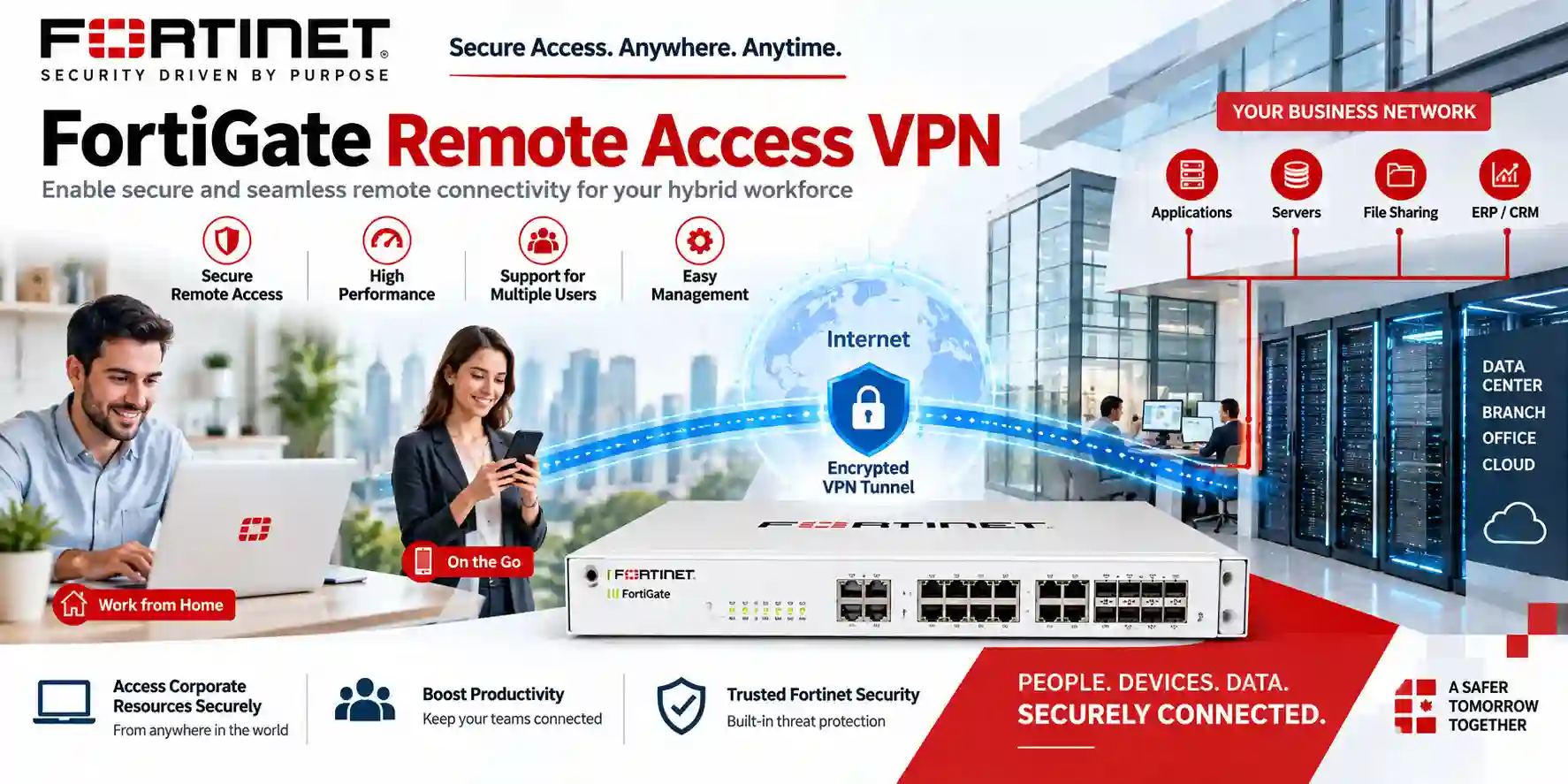
FortiClient supports encrypted remote-access VPN workflows. Fortinet documents SSL and IPsec VPN capabilities across FortiClient editions, subject to the gateway platform, software release and selected deployment design.
ZTNA can grant access to specific applications after checking user identity, device identity and endpoint posture, reducing the need to treat a user as trusted simply because a network tunnel is established.
EMS provides centralized FortiClient deployment, policy, endpoint visibility and ZTNA orchestration. For ZTNA designs, EMS is a core component that supplies endpoint posture context and tagging information.
Organizations do not have to replace every VPN workflow at once. Fortinet positions the unified agent as a way to keep VPN where appropriate while onboarding applications to ZTNA progressively.
What FortiClient VPN and ZTNA is designed to solve
Traditional remote access often starts with a simple requirement: allow an employee outside the office to reach internal resources securely. A VPN can solve that requirement by creating an encrypted tunnel. The challenge appears when the organization grows, introduces cloud applications, adds contractors, supports personal and corporate devices, or needs different access rights for different applications. A network-level tunnel can become broader than the business task actually requires. Zero Trust Network Access changes the decision from “is this user connected to the network?” to “should this verified user, on this device in its current posture, be allowed to reach this specific application?”
FortiClient supports both models in the same broader Fortinet architecture. The endpoint agent can participate in VPN access and, with the appropriate licensed and configured environment, in Universal ZTNA. Fortinet describes ZTNA as using automatic encrypted tunnels to a ZTNA application gateway, with access decisions based on user identity, device identity and ongoing posture information. This can help businesses reduce unnecessary exposure while preserving a familiar endpoint agent for users.
The practical deployment question is therefore not “VPN or ZTNA?” in isolation. Many businesses need a transition plan. Legacy applications may continue to depend on network-level remote access while web, RDP, SSH or other application services are gradually moved behind ZTNA access policies. A useful design documents which applications exist, who needs them, what device standards are required, how identity will be verified, how endpoints will be managed and what happens when a device no longer meets security requirements.
Verified FortiClient capabilities and buying considerations
| Area | Verified capability | What to confirm before purchase |
|---|---|---|
| Remote access | VPN connectivity is available in FortiClient, including SSL/IPsec support depending on edition and gateway environment. | FortiGate model, FortiOS release, VPN type, authentication, MFA and migration dependencies. |
| ZTNA | Universal ZTNA can use user identity, device identity and posture for granular application access. | Protected applications, application gateways, certificates, DNS, identity sources and access policy. |
| Management | FortiClient EMS or FortiClient Cloud centralizes deployment, configuration and endpoint visibility. | Cloud or on-premises management, endpoint count, administrator model and upgrade process. |
| Posture | ZTNA tagging and posture checks can influence access decisions. | Required OS state, vulnerability status, endpoint controls and remediation workflow. |
| Licensing | Fortinet offers commercial FortiClient tiers and supports endpoint- or user-oriented licensing models in current EMS documentation. | Exact bundle, quantity, term, support entitlement and whether additional endpoint protection is required. |
VPN-only download versus managed FortiClient ZTNA
Fortinet provides a VPN-only FortiClient download for organizations that need basic client VPN functionality. Fortinet also makes clear that enterprise tiers add capabilities such as support, centralized management, zero-trust posture assessment and broader secure-access controls. The free or VPN-only client should therefore not be treated as equivalent to a centrally managed FortiClient ZTNA deployment.
For procurement, identify whether the requirement is simply “users need a VPN client” or whether the business expects centralized endpoint policy, posture-aware access, application-specific ZTNA, reporting, controlled upgrades and lifecycle support. That distinction determines whether a no-cost client is sufficient or whether a licensed FortiClient/EMS architecture is needed.
FortiClient deployment and integration planning
1. Inventory access requirements
List remote users, endpoint types, operating systems, business applications, internal servers, SaaS services and branch dependencies. Separate resources that genuinely need network-level access from applications that can be presented individually through ZTNA.
2. Define identity and posture
Decide how users authenticate, whether MFA is required, what identity directory is authoritative and what endpoint conditions should affect access. ZTNA value depends on meaningful policy, not on enabling a feature without defining trust criteria.
3. Plan EMS management
Choose the appropriate EMS deployment model, define endpoint groups, test client packages, confirm upgrade rings and establish a rollback process. Pilot users should represent real application and connectivity patterns before broad deployment.
4. Integrate the gateway
Confirm FortiGate/FortiOS compatibility, ZTNA application gateway design, required certificates, DNS behavior, public reachability, routing and policy. Existing VPN configurations should be documented before migration.
Related FourTeck Tanzania resources
For firewall sizing and a concrete Fortinet edge-security example, review the FortiGate 30G Tanzania product page. It explains how FortiGate security, IPsec connectivity, licensing and branch planning fit together; this is useful when FortiClient users will terminate or integrate with a FortiGate environment.
The FourTeck Tanzania technology shop provides broader buying guidance across firewalls, networking, endpoints and supporting infrastructure, while the Tanzania IT services page explains design, installation, configuration and support activities that may surround a secure-access project.
Organizations planning an integrated project can use the FourTeck Tanzania solution overview to connect cybersecurity with switching, Wi-Fi, servers and user devices. The FourTeck Tanzania approach page gives additional context on solution planning and lifecycle support.
FortiClient frequently runs on employee laptops and connects users to business applications, so the Grandstream GXP1625 Tanzania page is not a direct Fortinet dependency but is a verified example of how FourTeck structures business endpoint procurement within the same site. For a FortiClient-specific request, use the verified FourTeck Tanzania contact page and include endpoint count, required access type and existing Fortinet environment.
FortiClient VPN and ZTNA Tanzania
FortiClient VPN and ZTNA Tanzania is relevant to organizations that need to connect staff securely to business applications from offices, homes, project sites and travel locations without treating every remote user as if they were physically connected to the same trusted LAN. The starting point should be the access requirement rather than the client software alone. A business may have finance users who need ERP, engineers who need RDP or SSH to a defined server, administrators who need broader infrastructure access, and managers who primarily need cloud services. These groups should not automatically receive identical network privileges. FortiClient makes it possible to retain encrypted VPN workflows where they remain appropriate while introducing Fortinet Universal ZTNA for applications that can be protected with identity- and posture-aware access.
For Tanzanian procurement teams, the key commercial distinction is between the VPN-only client and a licensed, centrally managed FortiClient deployment. If the requirement includes EMS, endpoint posture checks, ZTNA tags, centralized configuration, web filtering or other enterprise functions, the quotation must identify the correct FortiClient edition and licensing basis. Endpoint quantities, user counts, operating systems and subscription term should be specified before purchase. The existing FortiGate estate also matters. Record firewall models, FortiOS versions, current SSL or IPsec VPN dependencies, authentication servers and any FortiAuthenticator or FortiToken use. This information reduces surprises during migration.
Connectivity across Tanzania can differ significantly by site, so remote-access design should tolerate real network conditions rather than assume uniform links. A user on a stable office connection and a staff member on a variable mobile or regional connection may experience the same security policy differently. Split tunneling, full tunneling, DNS behavior, session persistence and application sensitivity should be tested in a pilot. For ZTNA, application reachability and gateway placement should be validated from multiple networks. The objective is not simply to make the connection technically successful; it is to provide predictable access without exposing unnecessary resources.
A useful Tanzania quotation request should include the number of users or endpoints, locations, supported operating systems, VPN protocols currently used, applications to be protected, identity platform, MFA requirement, FortiGate models, EMS preference, subscription term and whether implementation services are required. FourTeck can use that information to scope licensing and deployment rather than treating FortiClient as a generic download. Businesses also planning new gateways can review FortiGate 30G Tanzania for branch-firewall considerations and the Tanzania services overview for broader integration planning.
FortiClient VPN and ZTNA Dar es Salaam
FortiClient VPN and ZTNA Dar es Salaam deployments often begin with organizations that have a concentration of head-office users plus employees who work from home, visit customers, move between branches or require after-hours access to internal systems. In this environment, secure access should be designed around application roles. Finance staff may require controlled access to accounting platforms, operations teams may need line-of-business systems, IT administrators may require infrastructure management, and external support providers may need temporary access to a narrow service. Giving every remote user the same network tunnel is operationally simple but can create unnecessary reach. A phased ZTNA design can place selected applications behind granular access policy while VPN remains available for use cases that genuinely require broader connectivity.
Dar es Salaam businesses frequently depend on cloud productivity, video meetings and SaaS at the same time as private applications. This mix should influence tunnel strategy. Backhauling all internet traffic through one corporate VPN gateway may create avoidable load, while sending everything directly to the internet can bypass controls the organization expects. The correct design depends on policy, risk, bandwidth and the secure-web architecture already in place. FortiClient’s integration with Fortinet’s wider secure-access portfolio gives architects several options, but those options need to be planned rather than enabled by default.
A Dar es Salaam pilot should include users from different departments and connection types. Test authentication, MFA, DNS resolution, access to internal web applications, remote desktop, file services if required, SaaS behavior, endpoint posture changes and recovery after a connectivity interruption. Where ZTNA is used, verify that a user can reach only the intended application and that an endpoint falling outside required posture is handled according to policy. Central EMS management should also be tested for configuration updates and controlled FortiClient upgrades. A successful pilot produces documented policy and deployment steps, not only a list of users who managed to connect.
When requesting FortiClient pricing in Dar es Salaam, provide endpoint or user quantity, desired subscription term, EMS preference, current FortiGate model and software release, identity source, MFA approach and the applications targeted for VPN or ZTNA. If the business is replacing a legacy remote-access setup, describe current tunnel types and user groups so the migration can avoid accidental loss of access. Organizations coordinating firewalls, switches and user devices can also use the Tanzania technology shop as a procurement reference and the Tanzania quotation contact to submit the final requirement.
FortiClient VPN and ZTNA Mwanza
FortiClient VPN and ZTNA Mwanza can support organizations that operate a regional office, branch, warehouse, education facility, clinic, hospitality site or distributed workforce while central applications remain elsewhere. In these cases, access design should account for both user mobility and branch connectivity. A branch may already use site-to-site IPsec for office systems, yet individual employees still need secure access when working away from the premises. FortiClient can provide that endpoint layer without forcing the organization to redesign every site-to-site connection. Where application-specific ZTNA is appropriate, the same client can participate in a more granular access model that verifies user and endpoint context before allowing the session.
Mwanza deployments should pay close attention to endpoint lifecycle. Remote users cannot be assumed to remain patched, compliant and identically configured indefinitely. EMS is valuable because it provides a central place to manage FortiClient configurations, observe endpoint state and support posture-based policy. The business should define what “acceptable posture” means in practical terms. Examples might include a supported operating-system state, expected security software, vulnerability conditions or other indicators available to the platform. The aim is to create requirements users can meet and IT can support, rather than a policy so strict that routine changes constantly block productive work.
Network variability should also be part of testing. If staff connect over different providers or mobile links, VPN and ZTNA sessions should be validated under realistic latency and interruption. Applications behave differently: a browser-based system can recover differently from an RDP session, file transfer or persistent database connection. Pilot testing should therefore use actual business workflows. For ZTNA, verify application discovery, certificates, DNS and gateway reachability. For VPN, review address pools, split-tunnel routes and access policies so only required networks are exposed.
A procurement request for Mwanza should state whether the organization needs the VPN-only client, a licensed VPN/ZTNA edition, EMS management or a broader endpoint-security tier. Include quantities, operating systems, required applications, existing Fortinet products and implementation scope. If the site also needs a compact FortiGate, the verified FortiGate 30G Tanzania page provides useful gateway-planning context. If the access project is one element of a wider infrastructure refresh, the FourTeck Tanzania solution overview helps connect remote access with network, Wi-Fi, endpoint and server requirements.
FortiClient VPN and ZTNA Arusha
FortiClient VPN and ZTNA Arusha is relevant to tourism, hospitality, NGOs, education, professional services, healthcare, project offices and other organizations whose users may alternate between offices, customer sites, home networks and travel. These working patterns make location a weak basis for trust. A person may be legitimate while the device is unmanaged, outdated or outside policy; conversely, a managed device may be in the office but the user may not be authorized for a particular application. Fortinet’s ZTNA model addresses this by combining user identity, device identity and posture context, while FortiClient retains VPN capabilities for applications or administrative tasks that still need network-level connectivity.
Hospitality and NGO environments may also have seasonal staff, consultants or temporary project users. Access should therefore be easy to revoke and should not depend on permanent broad network credentials. A useful design creates role-based groups, maps users to the smallest reasonable application set, applies MFA where required and documents how access expires. For contractors, ZTNA can be particularly useful when the requirement is one defined internal application rather than an entire subnet. The implementation should still consider whether contractor devices are permitted, what posture can be measured and how support is provided when a user fails a posture check.
Arusha businesses should also test the client on the actual endpoint mix. Fortinet supports FortiClient across major desktop and mobile platforms, but capability can vary by operating system and release. Do not assume a policy defined for Windows behaves identically on every mobile or desktop platform. Build a compatibility matrix that lists business-critical features, OS versions and expected user workflows. EMS deployment packages should be staged to a small group before broad rollout, and existing VPN settings should be backed up and documented.
For a quotation, include permanent staff, temporary users, contractors, endpoint platforms, applications, existing VPN type, FortiGate/FortiOS versions and desired licensing term. State whether EMS is expected to be cloud-hosted or on-premises and whether FourTeck is being asked only to supply licensing or also to assist with policy design, pilot deployment and migration. The FourTeck Tanzania services page describes the broader project-support context, and the Tanzania approach page explains how multi-component technology projects are planned rather than treated as isolated product purchases.
FortiClient VPN and ZTNA Dodoma
FortiClient VPN and ZTNA Dodoma can suit organizations that require structured, auditable access for employees, administrators, consultants and branch personnel. Institutional, professional and project environments may place particular value on clear access policy, change control and documented user roles. FortiClient’s role in such an architecture is more than installing a VPN icon on a laptop. In a managed deployment, FortiClient communicates endpoint context through EMS and can participate in access decisions that consider identity and device posture. This allows security teams to move toward policies where users receive access to defined applications rather than automatically receiving broad internal reach.
A Dodoma project should begin with an application register. List the systems that remote or mobile users must access, where each application is hosted, how it authenticates, which ports or protocols it uses, who owns it and whether it can be presented through a ZTNA application gateway. Some systems may be suitable for immediate ZTNA onboarding, while older applications or administrative workflows may need VPN. Keeping both access methods available during transition can reduce migration risk, provided policy overlap is understood and tested.
Logging and operational ownership are equally important. Decide who monitors endpoint registration, who approves new access groups, how lost or retired devices are removed, how certificates are renewed, how client upgrades are tested and what support procedure applies when a user is blocked. Centralization through EMS can simplify these tasks, but the organization still needs an operational process. A technically correct ZTNA policy that no one owns will eventually drift just as a firewall rulebase can.
Procurement teams in Dodoma should request a quotation that separates licensing, implementation and optional support. Specify endpoint or user quantities, subscription duration, OS mix, current Fortinet infrastructure, identity and MFA systems, application list and whether there is an existing SSL/IPsec VPN to migrate. Avoid comparing offers that use different FortiClient tiers as if they were identical. For wider network planning, the FourTeck Tanzania shop guidance covers firewalls and business infrastructure, while the verified Tanzania contact page can be used to submit the project scope.
FortiClient VPN and ZTNA UAE
FortiClient VPN and ZTNA UAE requirements commonly arise in organizations with hybrid employees, distributed branches, cloud applications, data-center workloads and regional teams. The same company may have users in Dubai or Abu Dhabi accessing applications hosted in the UAE, Tanzania or another country, making access architecture a regional design rather than a local laptop configuration. FortiClient can provide encrypted VPN access and, in a licensed ZTNA deployment, application-specific access using identity and endpoint posture. Fortinet’s broader Security Fabric can connect those endpoint decisions to FortiGate gateways and other identity or security components.
For UAE headquarters managing African branches, a useful strategy is to standardize policy concepts while allowing site-specific differences. The organization can define common endpoint groups, naming conventions, certificate practices, MFA rules and client-upgrade procedures, then adapt gateways and applications according to the country. This is preferable to building a completely different remote-access method for every office. However, standardization should not become an assumption that all bandwidth, application hosting and legal requirements are identical. Data location, identity services and local internet architecture should be reviewed for each environment.
Migration from traditional VPN should be phased. Start with applications that have clear owners and stable user groups. Validate ZTNA access from both on-network and off-network locations, confirm DNS and certificates, then measure help-desk impact before expanding. Administrative or legacy protocols can remain on VPN until an appropriate replacement pattern is proven. The goal is a controlled reduction in unnecessary network-level access, not an abrupt technology change that interrupts business workflows.
FourTeck maintains a verified UAE technology site at FourTeck UAE and a security-specialist resource at Firewall Dubai. These pages are useful for organizations coordinating FortiClient with firewall, VPN and network-security requirements across the UAE. A cross-border quotation should specify where users are located, where applications are hosted, the current FortiGate estate, endpoint count, operating systems, licensing term, EMS model and implementation responsibilities. This allows the secure-access design to be treated as a regional architecture rather than a collection of unrelated client installs.
FortiClient VPN and ZTNA Uganda
FortiClient VPN and ZTNA Uganda can help organizations secure access for employees who work across head offices, branches, home networks and customer locations. For businesses operating in both Uganda and Tanzania, the same Fortinet endpoint agent can support a consistent remote-access strategy while site-specific gateways, internet connections and application locations remain different. The design should begin by separating branch-to-branch connectivity from user-to-application access. Site-to-site IPsec may continue to carry office traffic, while FortiClient handles individual user access away from the branch. ZTNA can then be introduced for applications where granular access provides a better fit than exposing a larger internal network.
Ugandan deployments should define how endpoint state affects access. A user account may be valid, but a device can still present additional risk if it is unmanaged or outside expected security posture. FortiClient EMS can distribute configuration and provide endpoint context used for ZTNA tagging. Policies should be understandable to administrators and support staff: if access is denied because of posture, the user needs a clear remediation path. Testing should include not only successful access but also what happens when a device falls out of compliance, a certificate expires or the user changes roles.
Regional organizations should also standardize client lifecycle. Define which FortiClient release is approved, how new versions are tested, which endpoint groups receive updates first and how failures are rolled back. Mixed unmanaged versions can create unnecessary troubleshooting. For VPN, document split-tunnel routes, DNS and address pools. For ZTNA, document application destinations, gateways, certificates and policy tags. This documentation makes remote support more reliable for offices outside the main IT location.
The verified FourTeck Uganda site covers local business IT, networking and communication context, while FourTeck Tanzania can coordinate the Tanzania side of a shared requirement. For a FortiClient quote, provide user or endpoint quantity, Uganda locations, applications, identity and MFA method, current firewall estate, OS mix, EMS preference and subscription term. If both countries will use the same policy, identify which elements must be standardized and which must remain site-specific.
FortiClient VPN and ZTNA Kampala
FortiClient VPN and ZTNA Kampala is particularly relevant to urban businesses with mobile sales staff, managers, consultants, technical teams and hybrid employees who need access to internal applications without being permanently inside the office network. A conventional VPN can remain effective for many workflows, but it often connects the device to a wider network segment than the user needs. For applications with clear boundaries, ZTNA can narrow access by evaluating identity and endpoint context before establishing the application session. The unified FortiClient agent makes it possible to use both approaches as the organization modernizes access.
A Kampala deployment should map user personas before configuring policies. For example, a finance role may need ERP and document systems, a support engineer may need RDP to approved servers, and an executive may only need specific internal web applications. Contractors should have separate identities and expiry rules. Administrators should avoid building one catch-all remote group because it is convenient during rollout. Granular groups make later auditing easier and reduce the impact of a compromised account or endpoint.
Connectivity and user experience also matter. Employees may move between office Wi-Fi, home broadband and mobile connections during the same day. Test session establishment, roaming behavior, DNS and application resilience across those conditions. When an application is moved to ZTNA, users should understand whether access becomes transparent or whether authentication behavior changes. Help-desk documentation should distinguish between identity failure, device-posture failure, gateway reachability and application-side problems so troubleshooting does not default to reinstalling the client.
For quotation planning in Kampala, specify endpoint count, operating systems, access groups, applications, current VPN design, FortiGate model and FortiOS release, identity provider, MFA and the desired FortiClient term. State whether EMS is already present or must be included. Organizations operating multiple Ugandan branches can use FourTeck Uganda for regional IT context and coordinate cross-border requirements with FourTeck Tanzania. The important procurement outcome is an exact bundle matched to the access architecture, not merely a line item labelled “FortiClient.”
FortiClient VPN and ZTNA Arua
FortiClient VPN and ZTNA Arua can help regional offices and mobile personnel maintain controlled access when local IT resources are limited and support is often delivered remotely. In this type of environment, standardization and manageability may be more important than feature quantity. A FortiClient deployment should use predictable profiles, clearly named endpoint groups, documented authentication and a support process that can be followed by staff who are not security specialists. EMS central management can reduce configuration drift by allowing administrators to deploy and update FortiClient policy from a central platform rather than relying on users to configure tunnels manually.
For remote branches, it is also important to distinguish a user access issue from a site connectivity issue. A branch may have its own site-to-site tunnel to headquarters, while an individual travelling employee uses FortiClient. If an application is unavailable, administrators should know whether the problem sits in the local ISP, the site tunnel, the user’s VPN, the ZTNA gateway, DNS, identity or the application itself. Documentation should therefore include simple architecture diagrams and test points. This reduces the time required to support a site where direct technical access may not be immediately available.
ZTNA can be useful where Arua users need only a small set of central applications. Instead of exposing a broader network, the business can create application-specific access subject to user and endpoint checks. That policy should still be tested for low-bandwidth or intermittent connections. Application owners should confirm how their systems respond when sessions reconnect, whether persistent connections are required and whether the user experience remains practical.
When requesting FortiClient licensing for Arua, provide the number of managed endpoints, OS versions, user roles, central applications, current VPN method, FortiGate/FortiOS details and EMS status. Include implementation expectations such as remote onboarding, migration assistance, documentation or administrator handover. If the requirement covers several Ugandan cities, standardize the common policy and list site exceptions explicitly. The FourTeck Uganda site is a verified regional reference, and the FourTeck Tanzania services page provides additional context for integrated network and security implementation.
FortiClient VPN and ZTNA Mbarara
FortiClient VPN and ZTNA Mbarara can support growing branches whose employees depend on central ERP, file services, management systems, internal portals or administrative tools. As a branch grows, the number of remote-access exceptions often grows with it. A manager needs after-hours access, an external accountant needs one finance system, an IT contractor needs temporary server access and mobile employees need applications while travelling. If every request is solved by adding another broad VPN account, the remote-access environment can become difficult to review. FortiClient ZTNA offers a way to move suitable applications toward narrower access decisions while preserving VPN for workflows that still require it.
The organization should define access owners. Application managers should approve who needs each service, while IT maintains the FortiClient and EMS configuration. When someone changes roles or leaves, access should be removed from the relevant group rather than relying on memory. Device certificates and endpoint records should also have a lifecycle so retired devices do not remain trusted indefinitely. These are governance tasks rather than software features, but the technology is most useful when it supports a clear process.
Mbarara deployments should include performance and failover testing. If a branch has a backup internet path or users often rely on mobile connectivity, test both VPN and ZTNA behavior during path changes. Avoid assuming that an application working on the primary link will behave identically after failover. DNS caching, public source addresses, long-lived sessions and authentication windows can influence recovery. Document expected behavior so support teams know whether a user must reconnect or whether the session should continue automatically.
For procurement, separate software entitlement from implementation effort. Confirm whether the quote includes only FortiClient licensing, EMS, deployment packaging, ZTNA application onboarding, VPN migration, identity integration, testing or ongoing support. Provide endpoint count, operating systems, current gateway platform and desired term. Multi-site organizations can coordinate the Ugandan requirement through FourTeck Uganda and broader East African design through the FourTeck Tanzania platform. A clearly scoped quotation makes renewals and future expansion easier to manage.
FortiClient VPN and ZTNA Gulu
FortiClient VPN and ZTNA Gulu can provide a consistent secure-access method for regional offices where central IT teams need to manage users and endpoints without frequent on-site intervention. The first design goal should be simplicity. Users should receive preconfigured access rather than manually entering gateways and advanced options whenever possible. Administrators should have a standard endpoint profile, naming convention and documented process for onboarding, changing and retiring devices. FortiClient EMS is central to that model because it can distribute configuration and provide the endpoint context required by Fortinet ZTNA.
Gulu organizations should select applications for ZTNA based on clear business value. An internal web portal, RDP service or defined application can be a practical starting point because access can be limited to the users who need it. A legacy system that expects broad local-network behavior may remain on VPN until it can be redesigned. This mixed approach avoids making the migration itself a business risk. The organization can measure which applications have moved, which still require network access and what dependencies remain.
Support readiness matters when users are far from the central office. Create a small diagnostic checklist: confirm internet access, FortiClient registration, user authentication, MFA, endpoint posture, DNS resolution and application reachability. For VPN, verify tunnel status and assigned routes. For ZTNA, verify the destination rule, certificate and gateway policy. This structured approach prevents every issue from becoming a full reinstall and helps remote staff provide useful information to the help desk.
A Gulu quotation should list the site role, endpoint quantity, Windows/macOS/Linux/mobile mix as applicable, users, business applications, current VPN configuration and whether the branch already uses FortiGate. If the project spans Kampala, Arua, Mbarara and Gulu, ask for a common design with documented site-specific variables rather than four independent builds. The verified FourTeck Uganda resource can support regional coordination, and the FourTeck Tanzania contact route can be used for cross-border requirements and quotation planning.
FortiClient VPN and ZTNA Kenya
FortiClient VPN and ZTNA Kenya is relevant to businesses that need a consistent access model for headquarters, branches, remote users and cloud-connected teams. Kenyan organizations operating alongside Tanzania or Uganda can benefit from standardizing FortiClient policy across countries while maintaining separate gateways and application policies where necessary. The value of standardization is operational: the same endpoint groups, client-upgrade process, authentication logic and troubleshooting method can be understood by a regional IT team. The limitation is that connectivity, application hosting and compliance requirements can vary, so each country still needs technical validation.
A common migration path is to preserve established VPN for administrative tasks and legacy resources while moving selected applications to ZTNA. Application owners should identify user groups, device requirements and expected session behavior. Security teams can then define posture conditions and identity requirements. Pilot users should test from office and remote networks. If users regularly travel between Kenya and Tanzania, include those roaming scenarios so the access design is not optimized only for one location.
Procurement teams should also separate access licensing from endpoint protection requirements. The VPN/ZTNA edition focuses on secure access and associated controls, while Fortinet offers broader tiers that add more endpoint security capabilities. The correct choice depends on whether the organization already has endpoint protection from another platform or wants to consolidate more functions into FortiClient. Avoid paying for overlapping controls without a deliberate architecture decision, but also avoid assuming the VPN-only download provides centralized ZTNA management.
The verified FourTeck Kenya site covers business networking and firewall context for Kenyan deployments. Regional projects can also use FourTeck Tanzania to coordinate requirements involving Tanzanian users or gateways. A FortiClient quotation should include country and city, endpoint or user quantity, OS mix, current FortiGate models, FortiOS versions, identity platform, MFA, EMS preference, subscription term and implementation scope. These details help distinguish a straightforward license request from a design-and-migration project.
FortiClient VPN and ZTNA Kuwait
FortiClient VPN and ZTNA Kuwait can support organizations with corporate offices, remote executives, external administrators and regional operations that need controlled access to applications without relying exclusively on network location. A business may keep sensitive systems in a data center or private cloud while employees connect from offices, homes and travel locations. FortiClient can provide VPN access where network connectivity is necessary and ZTNA where the requirement can be reduced to specific applications. This combination allows the organization to modernize gradually rather than forcing all remote-access use cases into a single model.
For companies that also operate in East Africa, Kuwait can be treated as another policy domain within a regional secure-access architecture. Identity should be centralized where practical, but application gateways and routing should be placed according to where applications live. If a Tanzania user accesses an application hosted in Kuwait, or a Kuwait user accesses a system in Tanzania, latency and internet path must be included in testing. ZTNA does not eliminate physical network distance; it changes how access is authorized and exposed.
Security teams should document which endpoint conditions matter. Overly broad posture rules can create support burden, while rules that never affect access provide little value. Start with measurable requirements tied to real risk, then add conditions after observing pilot behavior. EMS groups can help apply different policies to corporate endpoints, contractors or specialized systems. Client updates should also be controlled so a new FortiClient release is validated before deployment to all users.
The verified FourTeck Kuwait site provides a regional IT and network-security reference. Cross-border organizations can coordinate this with FourTeck Tanzania for East African users or infrastructure. A quote should identify where the EMS management platform will sit, endpoint quantities, operating systems, identity/MFA, applications, current VPN dependencies, FortiGate estate and licensing term. Implementation scope should state whether policy design, application onboarding, client packaging, pilot support and migration documentation are included.
FortiClient VPN and ZTNA Ghana
FortiClient VPN and ZTNA Ghana can address secure remote access for financial services, professional firms, education, healthcare, logistics, NGOs, retail operations and other organizations with distributed staff. The strongest design begins by understanding which users need which applications. A remote employee who needs a single internal portal should not necessarily receive the same network reach as an infrastructure administrator. FortiClient supports a transition from VPN-based access toward application-specific ZTNA, using endpoint posture and identity context to help make access decisions.
Ghanaian organizations with multiple offices should keep branch connectivity and endpoint access as separate architectural layers. FortiGate site-to-site tunnels may connect offices, while FortiClient serves users outside those offices. ZTNA can provide consistent application access whether a user is on or off the corporate network, which is useful when the same employee moves between locations. The policy should be based on the application and user role rather than a long list of network exceptions that becomes difficult to audit.
A practical pilot should include technical and nontechnical users. Measure login steps, application launch time, failures caused by posture policy and help-desk effort. Security controls are sustainable only when users can follow them and administrators can support them. Where MFA and SSO are used, verify that session behavior meets business expectations. Where endpoint posture is required, publish remediation guidance before enforcing the policy broadly.
The verified FourTeck Ghana site provides a regional route for broader technology requirements. A Ghana FortiClient quote should include user/endpoints, operating systems, city or site list, applications, current VPN configuration, FortiGate/FortiOS environment, identity source, MFA, EMS deployment preference and subscription term. If the organization is also operating in Tanzania, use the FourTeck Tanzania contact page to coordinate the Tanzanian portion of the requirement. The objective should be a consistent policy model with local technical validation, not a one-size-fits-all deployment copied unchanged across countries.
FortiClient VPN and ZTNA Nigeria
FortiClient VPN and ZTNA Nigeria can support large and small organizations whose staff access business systems from headquarters, branches, homes and customer sites. In a distributed environment, the number of remote users can grow faster than the original VPN design. New departments, contractors and cloud applications often lead to additional tunnel groups and firewall rules until it becomes difficult to explain exactly who can reach what. ZTNA provides an alternative for suitable applications by making access more application-specific and by considering user and device context rather than treating the tunnel itself as proof of trust.
For multi-site Nigerian organizations, central FortiClient EMS can help keep client configuration consistent, but policy should still account for different business units. A branch sales team, call center, finance group and IT operations team may all require different applications and device standards. Use groups that reflect business roles and document the owner of each access policy. When employees move roles, update group membership rather than creating personal exceptions that remain indefinitely.
Connectivity diversity means testing should include several networks and realistic congestion. VPN tunnel performance and ZTNA application behavior depend on the underlying internet path. Long-lived sessions may react differently from ordinary web traffic when a connection changes. Mobile employees should test the applications they actually use, not only a generic ping or browser page. Support teams should have clear steps to identify whether failures originate in the endpoint, identity, posture rule, gateway, DNS or application.
The verified FourTeck Nigeria website is a regional reference for organizations coordinating broader IT requirements. Cross-country projects can pair it with FourTeck Tanzania when users or applications span both markets. A FortiClient quotation should identify endpoint count, operating systems, locations, user roles, applications, existing VPN design, FortiGate/FortiOS versions, EMS status, identity/MFA, desired term and migration services. This information allows the supplier to confirm the correct FortiClient tier and implementation scope instead of quoting a generic client license.
FortiClient VPN and ZTNA Seychelles
FortiClient VPN and ZTNA Seychelles can be useful for hospitality, professional services, government-related projects, financial organizations and distributed businesses that need remote employees or administrators to reach private applications securely. Island operations can have a strong need for remote support because specialist IT staff may not always be physically present at every site. A well-managed FortiClient deployment can give administrators a consistent endpoint agent while reducing dependence on users manually maintaining VPN settings. EMS central management can distribute policy and support ZTNA posture context from a central location.
Seychelles deployments should design for resilience and supportability. If a user is locked out by an endpoint posture condition, the remediation process should work remotely. If a client update causes a compatibility issue, administrators should have a staged rollout and rollback approach. If an application is available only through ZTNA, the team should understand the gateway, certificate and DNS dependencies required to restore service. These operational details become especially important where travel time or local technical resources are limited.
Businesses with headquarters in another country should decide where identity and EMS management are centralized. Cross-border architecture can simplify policy but can also add latency or dependencies if every management function is placed far from users. FortiClient policies can be standardized while application gateways remain near the protected applications. Test real traffic between locations before assuming that one centralized path will provide the required user experience.
For a Seychelles quote, provide the number of endpoints and users, islands or sites involved, OS mix, applications, current VPN type, FortiGate/FortiOS environment, authentication platform, MFA, EMS preference and requested subscription term. State whether remote implementation, application onboarding, migration and documentation are required. For regional coordination, the FourTeck UAE platform and FourTeck Tanzania provide verified FourTeck network references. The design should remain grounded in actual application and connectivity requirements rather than assuming that a standard VPN profile is sufficient for every user.
FortiClient quotation checklist
✓ Windows, macOS, Linux and mobile platform mix
✓ Countries, cities and branch locations
✓ Current FortiClient version if already deployed
✓ Current SSL/IPsec VPN design
✓ Applications targeted for ZTNA
✓ Identity source, SSO and MFA requirements
✓ Subscription term and support expectations
✓ Pilot, migration and documentation scope
✓ Any endpoint-security functions required beyond VPN/ZTNA
FortiClient VPN and ZTNA FAQs
What is the difference between FortiClient VPN and FortiClient ZTNA?
VPN creates an encrypted connection that can provide network-level access according to routing and firewall policy. FortiClient ZTNA is designed for more granular application access based on user identity, device identity and endpoint posture. FortiClient can support both, allowing organizations to retain VPN where required while moving suitable applications toward ZTNA.
Is FortiClient VPN-only the same as the licensed VPN/ZTNA edition?
No. Fortinet provides a VPN-only download, while enterprise FortiClient tiers add centralized management, support, zero-trust posture and other capabilities. Confirm the exact edition against the access, management and security functions required.
Is FortiClient EMS required for ZTNA?
Fortinet documentation identifies FortiClient EMS as a required component for FortiClient ZTNA because it manages endpoint registration, certificates and ZTNA posture/tag context used by FortiGate and related enforcement points.
Can a business migrate from VPN to ZTNA gradually?
Yes. Fortinet specifically positions the unified FortiClient agent as a way to move from VPN toward Universal ZTNA over time. A phased approach is usually easier to control because applications can be tested and migrated individually.
What information is needed for a FortiClient quote?
Provide user or endpoint quantity, operating systems, locations, current FortiGate/FortiOS environment, VPN method, identity and MFA requirements, applications targeted for ZTNA, EMS preference, subscription term and implementation scope. This allows the correct commercial tier and services to be identified.
Decision recap
Choose the VPN-only client when the requirement is limited to basic supported remote-access VPN and the organization does not need centralized EMS management or zero-trust posture. Evaluate the licensed VPN/ZTNA edition when the business needs managed endpoints, granular application access, posture-aware policy and a controlled path from VPN to ZTNA. Consider broader FortiClient endpoint-security tiers when secure access is being consolidated with additional endpoint protection requirements.
The correct decision depends on current gateways, application architecture, identity, endpoint count and operational ownership. Confirm the exact FortiClient edition, licensing term and FortiGate/FortiOS compatibility before purchase.
Consultation panel: prepare a precise FortiClient requirement
Send FourTeck a short environment summary rather than only the words “FortiClient license.” Include endpoint or user quantity, countries and cities, OS mix, current firewall models, FortiOS versions, VPN type, identity/MFA, applications and desired subscription duration. State whether you need supply only, EMS setup, VPN migration, ZTNA application onboarding, pilot deployment, documentation or support.
For broader regional coordination, verified FourTeck network resources include FourTeck Kenya, FourTeck Uganda, FourTeck Ghana, FourTeck Nigeria, FourTeck Kuwait, FourTeck UAE and Firewall Dubai.
Research basis: official Fortinet FortiClient product information, Fortinet product-download information, Fortinet ZTNA solution material, Fortinet documentation for EMS/ZTNA, current publicly indexed non-vendor FortiClient reseller and service-provider pages, FourTeck Tanzania site research and verified FourTeck regional network pages. Search intent reviewed included FortiClient VPN, FortiClient ZTNA, FortiClient EMS, FortiClient VPN/ZTNA licensing, FortiClient remote access, FortiClient zero trust, VPN-to-ZTNA migration and regional supplier/quotation variants. Conversational-search patterns considered included “How do I migrate FortiClient users from VPN to ZTNA?”, “Do I need EMS for FortiClient ZTNA?”, “Which FortiClient license do I need for remote workers?” and “Can FortiClient use VPN and ZTNA together?”. The supplied FortiGate remote-access VPN image was used because it directly illustrates encrypted remote connectivity within the Fortinet ecosystem; other supplied images were not used because they were less specific to the FortiClient access topic. FourTeck Tanzania currently exposes fewer than four relevant product/category pages in its indexed shop; all suitable verified same-domain resources were used without inventing URLs.