
Fortinet Firewall Integration
Fortinet Firewall Integration is the process of connecting a FortiGate firewall to the network, security, identity, management, cloud and branch systems that depend on it. A useful integration is more than installing a firewall at the internet edge. It defines how trusted and untrusted zones communicate, how users authenticate, how branches exchange traffic, how logs reach the right monitoring platform, how wired and wireless networks are segmented, and how security policy is maintained when the environment changes.
Fourteck approaches Fortinet integration as an architecture and implementation task. The objective is to make FortiGate work predictably with the existing environment while preserving business access, reducing unnecessary exposure and creating a configuration that can be documented, tested and supported after deployment.
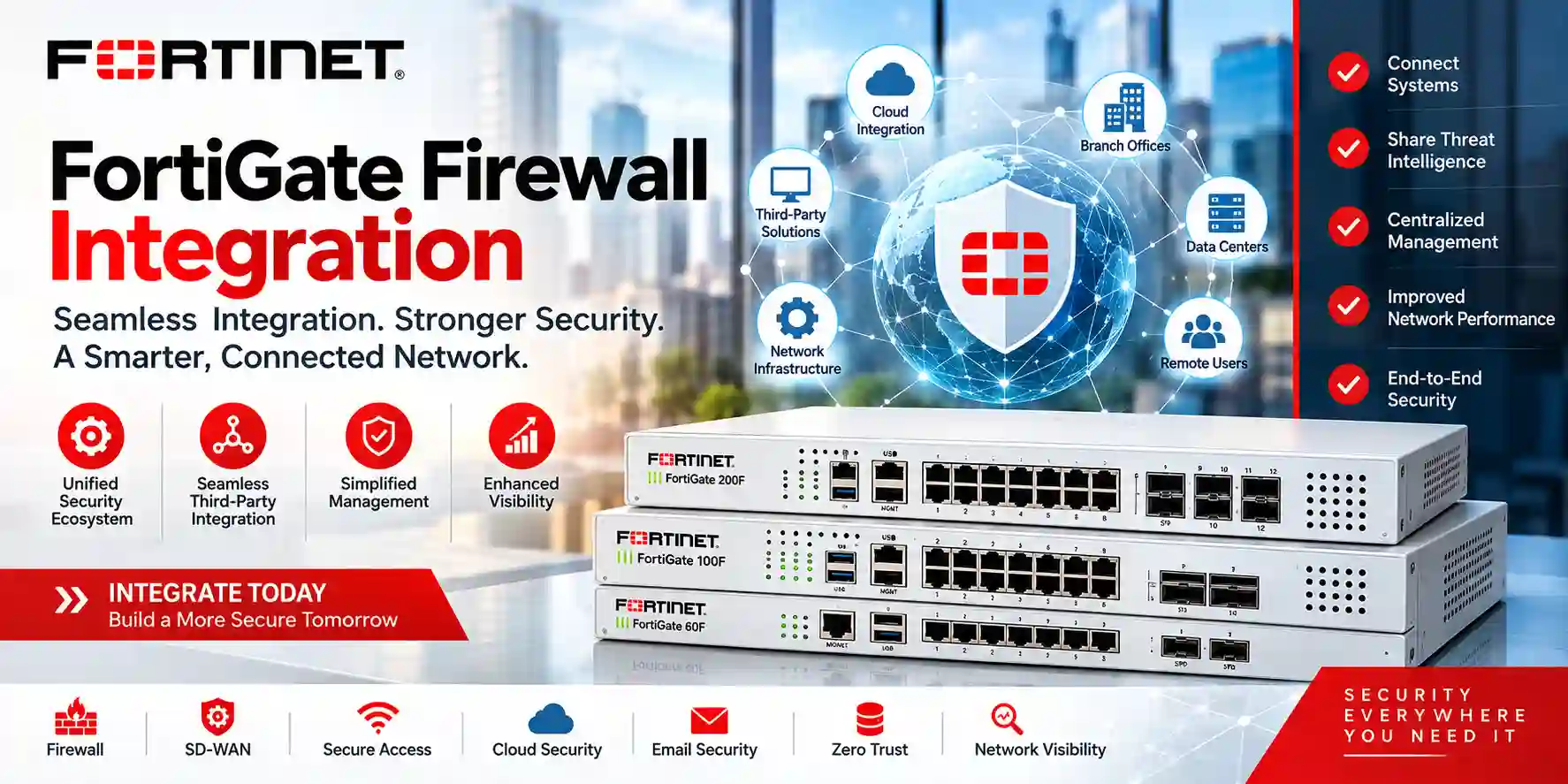
Fortinet Firewall Integration connects FortiGate with LAN, WAN, VPN, SD-WAN, identity, logging, Fortinet Security Fabric components, cloud services and supported third-party platforms.
The goal is controlled access, clearer segmentation, consistent policy, dependable branch connectivity, useful logging and an administration model that remains manageable as the network grows.
Model choice, FortiOS version, licenses, interfaces and connected products must be confirmed against the actual design. Integration should never be based on assumed compatibility.
What Fortinet Firewall Integration Covers
A FortiGate deployment can sit at the edge of a small office, protect a campus, connect branches, enforce policy between internal zones, secure data-center traffic, or operate in virtual and cloud environments. Fortinet positions FortiGate as part of a broader Security Fabric rather than an isolated firewall. In practical terms, integration begins by mapping the traffic that must cross the firewall and the systems that will provide identity, network access, management, logging, endpoint context or application connectivity.
Common projects include connecting FortiGate to managed switches and access points, creating VLAN and zone policy, configuring site-to-site IPsec VPN, introducing SD-WAN across multiple internet links, integrating FortiManager for centralized administration, sending logs to FortiAnalyzer, using FortiClient and identity services for controlled remote access, coordinating FortiNAC for access visibility and segmentation, or connecting cloud and third-party platforms through supported Fabric Connectors and APIs. The exact functions available depend on product, software version, subscription and design, so implementation should follow current vendor documentation rather than a generic configuration template.
The most important design question is not “which features can be turned on?” but “which traffic and users need which access, under which conditions, and how will the organization operate that policy later?” This keeps the integration tied to business requirements. It also makes testing more meaningful because every firewall rule, tunnel, route and connector can be linked to an expected workflow.
Core Integration Areas
LAN and VLAN Segmentation
Map users, servers, voice, guest Wi-Fi, cameras, management and other device groups into logical segments with explicit policy between them. Integration should preserve required application paths while limiting unnecessary lateral communication.
VPN and Branch Connectivity
Plan encrypted site-to-site links and approved remote-access methods around routing, authentication, address design, failover and application requirements. VPN design should include monitoring and documented recovery steps.
Secure SD-WAN
Where multiple WAN links exist, FortiGate can combine security and SD-WAN functions. The integration plan should define link health, path selection, business-critical traffic, VPN overlays and the behavior expected during degradation or circuit failure.
Management and Analytics
FortiManager can support centralized device and policy administration, while FortiAnalyzer can receive and analyze logs. The design should consider management reachability, administrator roles, configuration workflow, storage and reporting requirements.
Identity and Endpoint Context
Firewall policy can be more useful when it aligns with approved identity and endpoint information. The chosen method may involve supported directory, authentication, FortiClient, FortiAuthenticator or FortiNAC capabilities according to the environment.
Cloud and Third-Party Systems
Fortinet provides an ecosystem of integrations and Fabric Connectors. Compatibility should be verified for the exact cloud, SIEM, identity, ticketing, monitoring or security platform before committing to an automated workflow.
Fortinet Security Fabric Integration
Fortinet describes the Security Fabric as an architecture in which security and networking products can share context and operate as coordinated components. For a firewall project, this matters because a FortiGate may become the policy and connectivity point for technologies beyond internet access. FortiSwitch and FortiAP can form part of the secure LAN edge, FortiManager can coordinate management, FortiAnalyzer can provide centralized log analytics, FortiNAC can contribute device and access context, and FortiClient can participate in endpoint and secure-access workflows. Other Fortinet products and compatible third-party platforms may connect through documented integrations.
A Security Fabric design still needs disciplined boundaries. Integration should not be treated as a reason to connect every system automatically. Each connector needs a purpose, owner, required permissions, failure behavior and test procedure. For example, a logging integration should confirm that the correct events arrive with usable timestamps and device identity. A centralized-management integration should define who can make changes, how configuration revisions are reviewed and how an emergency change is handled. A network-access integration should be tested with compliant and non-compliant endpoints so that policy behavior is understood before broad rollout.
This structured approach is especially important during migration. Existing firewall rules can contain years of exceptions, temporary changes and undocumented dependencies. Instead of copying every rule directly, the integration project should identify required services, owners, sources, destinations and security intent. Redundant or obsolete rules can then be reviewed rather than automatically carried into a new architecture.
Integration Planning Before Configuration
A reliable firewall integration starts with discovery. Record the current internet links, public IP usage, VLANs, subnets, DHCP and DNS dependencies, routing, exposed services, VPN peers, authentication sources, network-management paths, critical applications and any devices that must communicate across segments. Identify planned changes as well as current conditions, because a firewall sized or designed only for today can become a constraint when internet bandwidth, branch count or security inspection grows.
The next step is a traffic matrix. This does not need to be complicated: list who needs to connect to what, on which service, and why. Finance users may need ERP access but not camera-management access. Guest Wi-Fi may require internet only. IP phones may need call-control and time services. Cameras may need the recorder and management station while being blocked from unrelated user networks. Servers may need backup, monitoring and specific application flows. Converting these relationships into explicit policy is more secure and easier to audit than using broad “allow any” rules.
Finally, define rollback and testing. A firewall cutover affects internet access, cloud applications, voice, remote users, branches and potentially published services. The project should define pre-change backups, maintenance timing, validation tests, responsible contacts and a practical rollback path. A successful integration is one that the organization can explain and recover, not merely one that passes traffic immediately after installation.
Related Fourteck Resources
Customers planning firewall integration often need related guidance on networking, model selection and wider regional deployment. These verified Fourteck pages provide useful next steps without assuming that one architecture fits every organization.
FortiGate 30G TanzaniaSee a current Tanzania FortiGate product page when evaluating an entry-level appliance for an appropriate small-site requirement.
Fourteck Tanzania ShopUse the shop overview to connect firewall requirements with switches, Wi-Fi, servers and supporting infrastructure.
Fortinet UAE by FourteckRegional Fortinet information for organizations coordinating FortiGate, licensing and cybersecurity requirements in the UAE.
Fourteck IT Solutions AfricaBroader Africa technology context for businesses coordinating firewall, connectivity and infrastructure across several markets.
Fortinet Firewall Integration Tanzania
Fortinet Firewall Integration Tanzania is relevant to organizations that need a FortiGate to become part of a complete business network rather than operate as a stand-alone internet gateway. The project may involve a new office, a replacement of an existing firewall, branch consolidation, improved segmentation, VPN connectivity, secure access for remote users, dual-internet resilience, or centralized management across several sites. The starting point should be the actual environment: internet bandwidth, number of users and devices, VLAN design, server and cloud applications, public services, branch links, existing switch and wireless infrastructure, authentication systems and the security functions the organization intends to use.
For Tanzania deployments, procurement and technical planning should be separated but coordinated. Procurement needs the correct FortiGate model, subscription or support requirements, compatible accessories and an implementation scope. Technical teams need an agreed logical design that defines interfaces, zones, routes, NAT, firewall policies, VPNs, administrative access, logging and backup. If the site uses multiple internet connections, the design may also consider FortiGate SD-WAN, health checks and failover behavior. If the business has offices in different cities or countries, policy naming, address objects, VPN standards and documentation should be consistent enough that another engineer can understand the topology without reverse-engineering it from the live device.
A strong Tanzania integration plan also considers the network behind the firewall. Guest Wi-Fi, employee devices, IP phones, cameras, servers and management equipment should not automatically share one flat trusted network. Appropriate segmentation can create clearer policy boundaries, while centralized logging can help teams understand which traffic is being allowed or blocked. The final acceptance test should cover internet access, DNS, critical cloud applications, internal services, branch tunnels, remote access, published services where applicable, failover if included, administrator access and log visibility. Fourteck can use these inputs to build a quotation and integration scope that reflects the customer’s actual environment rather than a generic firewall checklist.
Fortinet Firewall Integration Dar es Salaam
Fortinet Firewall Integration Dar es Salaam often centers on busy office networks, headquarters, professional services environments, retail operations, hospitality properties, warehouses and organizations connecting users to cloud applications and remote branches. The useful design question is how traffic should move through the business, not simply how quickly the internet circuit operates. A FortiGate at the edge may need to coordinate user internet access, server publishing, guest Wi-Fi isolation, remote access, branch VPNs and security inspection while also preserving performance for voice, video meetings and cloud systems. These competing demands need to be documented before configuration.
A Dar es Salaam project can benefit from a migration plan that clearly distinguishes current-state dependencies from desired improvements. Existing networks sometimes contain direct public exposure, shared subnets, old port-forwarding rules or VPNs that no longer have clear owners. During integration, each dependency should be checked and tied to a business owner. Where multiple WAN services are available to a site, FortiGate SD-WAN can be evaluated for path control and resilience, but the actual design should account for circuit characteristics, routing and applications rather than assuming that two links automatically provide seamless continuity. Failover should be tested with real business workflows such as cloud login, voice, VPN and web applications.
For procurement teams requesting a Fortinet firewall integration quotation in Dar es Salaam, useful inputs include the current firewall model, internet link speeds, number of users, number of locations, estimated VPN users, public IP requirements, critical applications, expected segmentation, whether centralized management or FortiAnalyzer logging is required, and any target cutover window. Site diagrams and an export of the current configuration can improve planning when they are available and approved for review. The implementation should finish with configuration backup, logical network documentation, administrator handover and an agreed list of any items left for future phases. This creates a more supportable security environment than treating the firewall as a one-time appliance installation.
Fortinet Firewall Integration Mwanza
Fortinet Firewall Integration Mwanza can be planned for organizations that need secure connectivity between local users, business applications and other company locations. A branch or regional office may have fewer users than a headquarters but still depend on the same ERP, cloud collaboration, voice, CCTV monitoring or management platforms. That makes policy consistency important. The firewall should provide the branch only the access it requires while keeping local guest, operational and administrative traffic separated according to the organization’s rules.
For a multi-site design, Mwanza can be treated as one node within a documented WAN and security standard. Addressing, VLAN naming, VPN design, administrator access, logging and backup procedures can be standardized so troubleshooting does not depend on site-specific memory. Fortinet Secure SD-WAN may be considered if a site uses more than one WAN path, while IPsec VPN can connect the branch to another office or data center. The design should define what happens when a preferred path is unavailable, which applications can use an alternate route, and how IT teams will identify whether a problem is caused by the ISP, tunnel, routing, DNS, firewall policy or the application itself.
A Mwanza integration scope should also account for local network devices. Wireless access points, switches, IP phones, cameras and servers can create different security zones and bandwidth patterns. If the FortiGate will integrate with FortiSwitch or FortiAP, the exact models and software compatibility should be validated first. If existing third-party switches and access points remain in place, the design can still use VLANs and explicit firewall policies provided the underlying network supports the required tagging and routing. Procurement teams can help by providing site count, device count, internet details, current topology and expected growth. The final result should be a branch firewall configuration that is simple enough to operate, specific enough to enforce policy and documented well enough to support future expansion.
Fortinet Firewall Integration Arusha
Fortinet Firewall Integration Arusha may support offices, tourism and hospitality operations, education, professional services, logistics or organizations that combine staff networks with guest and operational systems. These environments benefit from clear separation because the same physical network infrastructure can carry very different traffic. Employee devices may need access to internal applications, guest users may need internet only, CCTV systems may need recorder connectivity, and management interfaces should be limited to authorized administrators. FortiGate policies can enforce these boundaries when the VLAN and routing design is planned correctly.
For hospitality or visitor-heavy environments, firewall integration should pay particular attention to guest wireless isolation, internal business applications, payment or reservation systems where applicable, administrative management and any third-party services that need controlled inbound or outbound access. The project should avoid broad rules created merely to make a system work quickly. Instead, required services can be documented and tested so that the firewall policy remains understandable. Logging should also be designed for operational value: enough information to troubleshoot access and investigate events without assuming that collecting every possible log automatically produces useful security insight.
Organizations in Arusha requesting integration should also consider lifecycle needs. FortiOS upgrades, FortiGuard subscriptions, configuration backups, VPN certificates or credentials, administrator accounts and change documentation all require ownership after the initial project. If FortiManager or FortiAnalyzer is introduced, management and logging paths should remain available even during network changes. For a site with branches, standard configuration templates can reduce drift while still allowing location-specific addressing and services. A good quotation therefore describes both the firewall work and the dependencies: switching, wireless, internet, authentication, cloud services, remote users and any downtime required for cutover. The aim is a secure and maintainable environment that supports daily operations rather than a configuration that is difficult to explain once the installer leaves.
Fortinet Firewall Integration Dodoma
Fortinet Firewall Integration Dodoma should begin with governance as well as connectivity. Organizations with structured departments, formal procurement or regulated workflows may need clear records of who can administer the firewall, how policy changes are requested, which networks are considered trusted, and how security events are retained or reviewed. FortiGate can support detailed network controls, but the operational process around those controls is what keeps the configuration consistent over time. A design should therefore define administrator roles, backup frequency, change approval, monitoring responsibility and the information included in handover documentation.
Segmentation is particularly useful when a site includes user networks, servers, guest access, voice, cameras, access control or specialized devices. Instead of allowing these systems to communicate freely, the integration can define required application paths and block unnecessary traffic. If centralized identity is available, selected policies may be aligned with authenticated users or groups through supported methods. If a FortiAnalyzer platform is part of the environment, the logging design can provide a central view of firewall and security events. If several FortiGates are deployed, FortiManager may help standardize administration, but version support, licensing and topology should be checked before implementation.
For a Dodoma quotation, procurement teams can provide the desired security outcome and the existing technical baseline. Useful information includes internet circuits, public services, users, branches, remote-access requirements, VPN peers, existing network segments, current firewall rules, support expectations and any maintenance window restrictions. The design should also identify dependencies that sit outside the FortiGate, such as DNS, directory services, cloud applications, ISP routing and switch VLAN configuration. Acceptance testing can then be tied to these dependencies rather than a simple “internet works” check. This creates a deployment that is easier to audit, troubleshoot and expand when new applications or sites are introduced.
Fortinet Firewall Integration UAE
Fortinet Firewall Integration UAE can support organizations coordinating headquarters, branches, cloud applications, remote users and regional operations. The design may combine next-generation firewall policy, IPsec VPN, Secure SD-WAN, centralized management, logging and integration with identity or endpoint systems. Businesses with sites in both the UAE and East Africa can gain operational value from consistent naming, policy standards and documentation even when the individual locations use different internet providers, address ranges or appliance sizes.
A regional architecture should avoid copying configurations blindly between countries. Each location may have different WAN services, public IP arrangements, cloud access paths and local applications. The reusable part should be the security model: zone definitions, least-required access, administrator controls, logging standards, VPN conventions and change procedures. FortiManager can be evaluated where multiple FortiGates need central administration, while FortiAnalyzer can be considered for centralized logs and analysis. Fortinet also provides Security Fabric and ecosystem integrations, but the exact connector, API or third-party compatibility should be validated against the deployed software versions and commercial licenses.
For procurement and migration in the UAE, the firewall integration scope should include existing configuration review, target architecture, migration mapping, test plan, rollback plan and handover. Organizations replacing a legacy firewall should identify NAT rules, site-to-site tunnels, remote-access groups, static routes, dynamic routing if used, published services and any special application dependencies before cutover. This reduces the risk of discovering undocumented traffic after the new firewall is live. Fourteck’s regional Fortinet resource can support product and licensing discussions, while the Tanzania project can retain its own validated design. The result is a repeatable multi-country approach without assuming that one site’s settings are suitable everywhere.
Fortinet Firewall Integration Uganda
Fortinet Firewall Integration Uganda is useful for companies that want secure links between offices, controlled internet access and consistent security policy across a distributed environment. The project can be structured around branch connectivity, user and server segmentation, remote access, cloud application performance and centralized visibility. FortiGate should be selected and configured according to real traffic and inspection needs rather than user count alone, because VPN, security services, encrypted traffic inspection, logging and future bandwidth can all affect the appropriate design.
For organizations connecting Uganda and Tanzania, IP addressing and VPN design deserve early attention. Overlapping private address ranges can make site-to-site connectivity difficult, especially when networks have grown independently. A discovery phase should therefore record every relevant subnet, gateway, NAT dependency and route before tunnels are built. Where multiple WAN circuits exist, SD-WAN can be evaluated for path selection and link health, but operational testing should confirm how applications behave during failover. Some sessions may need to reconnect after a path change, so expectations should be based on the application and topology rather than a generic promise of uninterrupted service.
The Uganda integration plan should also define security administration. Who can change rules? Where are backups stored? Which logs are required? How are firmware upgrades assessed and scheduled? Which VPN or remote-access accounts must be removed when staff or contractors change? These process questions are as important as the initial firewall policy. For quotations, organizations can provide branch count, WAN details, user numbers, critical services, current firewall platforms, cloud dependencies and expected growth. A clear scope can then separate hardware and subscriptions from engineering work such as design, migration, VPN creation, segmentation, logging, testing and documentation.
Fortinet Firewall Integration Kampala
Fortinet Firewall Integration Kampala can address the needs of headquarters, branch-heavy businesses, service companies, education, retail and other organizations where internet access is only one part of the security requirement. A Kampala site may need secure connectivity to regional offices, controlled access to internal servers, guest network separation, remote-user VPN, cloud application access and protection for public-facing services. These functions should be designed as a coordinated policy set rather than added one by one over time without documentation.
A useful integration exercise is to classify networks by role. Corporate users, administrators, servers, guests, voice, CCTV, building systems and test devices can each be assigned an appropriate trust level. Firewall policies can then permit the minimum practical communication between those groups. This improves troubleshooting because traffic paths are intentional. When a device cannot reach an application, engineers can check the specific route and rule rather than search through a large flat network. If supported Fortinet switching, wireless or NAC components are part of the solution, their integration can add operational visibility, but compatibility must be verified for the exact hardware and FortiOS release.
For Kampala procurement, the bill of materials should not be finalized before the security design is understood. Interface count, WAN links, high-availability requirements, VPN scale, logging, management, subscriptions and expected security inspection all influence the solution. If a customer already has FortiGate, the work may focus on integration rather than replacement: connecting FortiAnalyzer, introducing FortiManager, redesigning VLAN policy, adding site-to-site VPN, implementing SD-WAN or cleaning up legacy rules. The quotation should say which existing components remain, which are changed and what testing will prove success. This makes project approval easier for both technical and commercial stakeholders.
Fortinet Firewall Integration Arua
Fortinet Firewall Integration Arua may be especially relevant for branch or operational sites that need dependable connectivity to a central office while keeping local access simple and secure. A smaller site should not automatically receive a simplified security policy if it handles important business applications. Instead, the architecture can standardize the essentials: trusted user networks, guest separation, protected management, branch VPN, DNS and DHCP dependencies, logging and a documented recovery process. The appliance and subscription level can then be matched to the site’s actual bandwidth, inspection and growth needs.
Remote troubleshooting should be considered during design. If a branch firewall loses its primary WAN or a VPN tunnel fails, technical teams need an agreed method to determine whether the problem is local connectivity, routing, authentication, tunnel negotiation, DNS or the remote application. Monitoring and logs should therefore be useful to the support workflow. If a second WAN link is available, SD-WAN may provide a structured way to test path health and steer traffic, but failover policy should prioritize the applications that matter most instead of treating every flow identically.
Arua branch integration can also benefit from configuration consistency with Kampala, Tanzania or other corporate locations. Consistency does not mean identical IP addresses or hardware; it means repeatable conventions for interface names, VLAN roles, object naming, VPN settings, administrator accounts, backups and documentation. Procurement teams should provide current ISP details, expected users, branch applications, remote-support requirements and any planned growth. With those inputs, the integration scope can include only the components required for the branch while still fitting the wider company security model. This approach is easier to maintain than creating an independent firewall design at every location.
Fortinet Firewall Integration Mbarara
Fortinet Firewall Integration Mbarara can be designed for growing branch offices, retail and service networks, education environments, healthcare operations or multi-site businesses that need secure access to central applications. Growth is an important factor because a firewall installed for today’s headcount may later need to support more cloud traffic, additional Wi-Fi users, new branches, higher-speed internet or stronger inspection. The integration plan should therefore record realistic expansion expectations and avoid consuming all available interfaces, address space or policy structure at the beginning.
The local LAN should be part of the firewall discussion. If staff, guests, cameras and voice devices all share the same subnet, security rules at the internet edge cannot provide meaningful internal separation. Managed switching and VLANs can create clearer boundaries, with FortiGate enforcing only the flows required between them. For environments using existing third-party switching, integration can still be practical as long as VLAN tagging, routing and management responsibilities are clearly defined. Where FortiSwitch or FortiAP is proposed, supported integration and software compatibility should be checked before deployment.
A Mbarara quotation should identify whether the requirement is a new FortiGate, a replacement, or an integration improvement to an existing device. The work may include policy redesign, VPN, SD-WAN, remote-access changes, FortiAnalyzer logging, FortiManager onboarding or migration from legacy rules. Each change should have a test case. For example, a branch VPN test should verify both connectivity and application access; a guest VLAN test should verify internet access and isolation; a management test should confirm that administration is limited to approved sources. This turns the firewall project into an auditable implementation rather than a collection of configuration commands.
Fortinet Firewall Integration Gulu
Fortinet Firewall Integration Gulu should focus on business continuity, clear remote support and security boundaries appropriate to the site. Branch locations often depend heavily on central systems and cloud services, so a firewall outage or routing change can have an immediate operational impact. The integration should document internet circuits, branch tunnels, essential DNS and authentication services, local applications and the support contacts responsible for each dependency. This information reduces troubleshooting time when an issue crosses the firewall, ISP and application layers.
Where the Gulu site connects to a head office, IPsec VPN can provide encrypted site-to-site connectivity. The design should specify which subnets are carried, how routes are selected, which security policies permit traffic and what logging is available for troubleshooting. If the business has a second WAN service, SD-WAN may be assessed for failover and traffic steering. A realistic test should include intentional path failure during an approved window so support teams understand the behavior before an unplanned outage occurs. Critical applications should be tested individually because different protocols and sessions recover differently after a path change.
Security operations after deployment are equally important. Local staff should know which symptoms to report, while central IT should have protected management access, current backups and documented topology. Administrator access should not be exposed more broadly than necessary. If FortiManager is used centrally, the Gulu FortiGate can be incorporated into an organization-wide management process after confirming reachability, version compatibility and policy ownership. If FortiAnalyzer is used, logs can support investigation and reporting. Procurement can speed planning by providing the current network diagram, ISP details, users, applications, VPN requirements and growth expectations before a quotation is finalized.
Fortinet Firewall Integration Kenya
Fortinet Firewall Integration Kenya can form part of a regional security standard for organizations operating across East Africa. A company with offices in Kenya, Tanzania and Uganda may want common firewall policy principles, secure inter-site connectivity and centralized administration while still allowing each site to use the internet services, addresses and applications appropriate to its environment. The integration architecture should separate global standards from local exceptions so configuration remains predictable and supportable.
Regional VPN planning is often the first technical challenge. Subnets should be checked for overlap, and the design should identify whether traffic moves directly between branches, through a central hub or according to another approved topology. If Secure SD-WAN is used, path selection and performance monitoring can be incorporated with the firewall, but applications, latency sensitivity and link characteristics should guide the rules. Centralized logging and management may help organizations reduce configuration drift across multiple FortiGates, provided connectivity, versions and administrator responsibilities are clearly defined.
Kenya projects can also include cloud and third-party integrations. Fortinet supports a broad ecosystem, but every connector should be validated for the exact product and version. Identity services, SIEM platforms, ticketing systems, cloud networks or other security tools may require API permissions, certificates, service accounts or network reachability that need to be planned securely. A quotation should therefore distinguish core firewall integration from optional systems integration. Procurement teams can provide site count, FortiGate models if already installed, internet bandwidth, expected VPN topology, cloud platforms, management tools and desired support model. This produces a clearer regional scope and reduces the risk of discovering incompatible assumptions during implementation.
Fortinet Firewall Integration Kuwait
Fortinet Firewall Integration Kuwait may involve secure office networks, branch connectivity, data-center access, remote users and cloud applications that need consistent policy and visibility. For organizations also operating in Tanzania or the wider region, the firewall program can use a shared architecture document that defines zone roles, VPN standards, logging expectations, administrator access and change control. Each Kuwait site can then adapt those standards to local addressing, circuits and business applications without creating a completely separate security model.
Integration planning should consider both north-south and east-west traffic. Internet security is important, but internal segmentation can be just as valuable when user devices, servers, guests, IoT or operational systems share infrastructure. FortiGate can route and enforce policy between approved segments, while compatible switching and wireless platforms can extend the design to the access layer. Where centralized FortiManager and FortiAnalyzer services are used, the management network, logging transport, storage and administrator roles should be treated as part of the architecture rather than an afterthought.
A Kuwait migration should include a rule review before cutover. Existing firewalls may contain objects and policies created for old applications or temporary projects. Copying them without validation can preserve unnecessary exposure and complexity. The integration team can map required services, confirm owners and build a target policy that is easier to explain. Procurement can support this process by collecting the current model, license status, user and bandwidth figures, branch and VPN details, planned security functions and any compliance or reporting requirements. The final scope can then include configuration, migration, testing, documentation and knowledge transfer alongside the required Fortinet products or subscriptions.
Fortinet Firewall Integration Ghana
Fortinet Firewall Integration Ghana can help organizations connect business users, branches and cloud services under a clearer security policy. The value comes from architecture rather than simply placing a FortiGate at the edge. A Ghana deployment should identify which systems are public, which are internal, which users need remote access, how guest and operational networks are separated, where logs are stored and how configuration changes are managed. These decisions shape the practical security outcome more than a generic feature list.
For multi-site organizations, the integration can create repeatable branch standards. Common VLAN roles, address-object naming, VPN conventions, log settings and backup procedures make support easier, while site-specific addressing and applications can remain local. If a Ghana branch connects to Tanzania, Kenya, Nigeria or another office, the VPN topology should be designed deliberately to avoid route ambiguity and address overlap. SD-WAN can be assessed where more than one WAN path exists, with policies based on application priority and link health rather than simple round-robin traffic distribution.
Organizations should also plan licensing and lifecycle. Some Fortinet security functions and services depend on subscriptions, while software compatibility can change between releases. Before adding a FortiAnalyzer, FortiManager, FortiClient, FortiNAC or third-party integration, confirm the supported versions and required licenses. A quotation should therefore list not only appliances but the intended functions and connected systems. Useful inputs include current topology, user count, internet capacity, remote access, VPN peers, server networks, cloud services and expected reporting. That information lets the integration scope focus on the customer’s actual risk and operational needs instead of assuming every available feature should be enabled.
Fortinet Firewall Integration Nigeria
Fortinet Firewall Integration Nigeria can support large user populations, multi-branch organizations, cloud adoption and environments where network availability is closely tied to day-to-day business operations. The FortiGate design should be based on traffic volume, security inspection, WAN topology, VPN requirements, interfaces, logging and future growth. Raw firewall throughput alone is not an adequate sizing method because the enabled security services and encrypted traffic profile can materially affect performance.
For distributed businesses, Secure SD-WAN can be evaluated as part of the FortiGate architecture to combine path selection with security policy. The design should define what constitutes a healthy link, which applications are sensitive to latency or loss, whether tunnels use hub-and-spoke or another topology, and how operations teams will identify a carrier issue versus a firewall issue. Centralized FortiManager and FortiAnalyzer platforms may help with policy consistency and visibility across many sites, but management ownership and software compatibility should be validated before rollout.
Nigeria integration projects can also involve third-party security and cloud platforms. Fortinet documents an open ecosystem and Fabric Connectors, but a connector should be deployed only when its data flow, permissions and operational value are understood. Integration with a SIEM, identity service, cloud network or ticketing platform should define credentials, API access, event ownership and what happens if the connector becomes unavailable. Procurement teams can improve scope accuracy by providing site count, existing FortiGate models, internet links, VPN design, cloud platforms, management tools, critical applications and expected security services. This allows engineering work, licenses and hardware to be separated clearly in the quotation and creates a more transparent migration plan.
Fortinet Firewall Integration Seychelles
Fortinet Firewall Integration Seychelles may be useful for hospitality, professional services, distributed offices and organizations that depend strongly on internet and cloud connectivity. A well-designed firewall project should balance security controls with operational reliability. Guest access, staff systems, management networks, cameras, voice and business applications may share physical infrastructure but should have different policy requirements. FortiGate can become the routing and security point between these networks when VLANs and access rules are planned carefully.
Remote support and configuration recovery can be particularly important for island or geographically separated sites. The integration plan should define secure administrator access, backup procedures, software upgrade planning and a tested method for restoring service if a change causes unexpected impact. Where more than one WAN service is available, SD-WAN can be assessed for resilience and path control. The design should still document application behavior during failover and confirm that monitoring can distinguish a local circuit problem from a VPN, DNS, firewall or cloud-service issue.
For a Seychelles quotation, businesses can provide the number of sites, users, guest networks, internet circuits, cloud applications, public services, remote users, branch VPN requirements and any Fortinet products already in place. If FortiSwitch, FortiAP, FortiManager, FortiAnalyzer or another component is proposed, version and license compatibility should be verified before the final bill of materials is approved. The project should conclude with a clear configuration record, test results and responsibilities for ongoing policy changes. This is especially valuable for hospitality and service environments where network availability directly affects staff productivity and the user experience.
Fortinet Integration Use Cases
| Requirement | Integration focus | Validation questions |
|---|---|---|
| New office firewall | WAN, LAN, VLANs, policies, NAT, DNS/DHCP, management, logging | Which users, devices and services need access, and what growth is expected? |
| Legacy firewall migration | Rule and object review, NAT, VPN, routes, published services, cutover | Which existing rules are still required, and who owns each dependency? |
| Multi-branch connectivity | IPsec VPN, SD-WAN, routing, standardized policy and monitoring | Are subnets unique, what topology is required, and how should failover behave? |
| Central management | FortiManager onboarding, policy workflow, administrator roles | Which teams can change configuration and how are revisions approved? |
| Central logging | FortiAnalyzer reachability, log selection, retention and review | Which events are operationally useful and who reviews them? |
| Secure LAN edge | FortiSwitch, FortiAP, VLANs, guest/staff separation | Which hardware and software versions are supported together? |
| Third-party integration | Fabric Connector or API, credentials, data flow, automation | What permissions are required and what happens if the connector fails? |
Fortinet Firewall Integration Quotation Checklist
A useful quotation starts with enough context to distinguish appliance supply from engineering work. Sharing the details below helps identify whether the project is a straightforward integration, a migration, a multi-site rollout or a wider Security Fabric design.
Fortinet Firewall Integration FAQ
What does Fortinet firewall integration mean?
It means connecting and configuring FortiGate as part of the wider network and security environment. Depending on the project, that can include WAN, LAN, VLANs, VPN, SD-WAN, identity, logging, FortiManager, FortiAnalyzer, FortiSwitch, FortiAP, FortiNAC, FortiClient, cloud services and supported third-party platforms.
Can FortiGate integrate with non-Fortinet products?
Yes, Fortinet documents an open ecosystem with Fabric Connectors, APIs and technology integrations. The exact compatibility, required permissions and supported software versions should be confirmed for the third-party platform involved.
Can an existing firewall configuration be migrated to FortiGate?
A migration can map existing networks, routes, NAT, policies and VPN requirements to FortiGate, but old rules should be reviewed before being carried forward. Unsupported, obsolete or undocumented settings may need redesign rather than direct conversion.
What is the role of FortiManager?
FortiManager is Fortinet’s centralized management platform for FortiGate and other supported Fortinet infrastructure. It can help organizations manage configurations, policy workflows and multiple devices from a central system. Supported versions and deployment design should be checked before onboarding devices.
What is the role of FortiAnalyzer?
FortiAnalyzer provides centralized logging, analytics and reporting capabilities for supported Fortinet environments. Integration planning should define which devices send logs, how they reach the platform, what retention is required and who will review the resulting information.
Can FortiGate integrate with FortiSwitch and FortiAP?
Fortinet supports integrated secure networking with FortiGate, FortiSwitch and FortiAP. The exact management method and supported capabilities depend on hardware and software versions, so compatibility should be verified as part of the design.
Is SD-WAN included in a firewall integration project?
It can be. FortiGate includes Secure SD-WAN capabilities that can be configured when a site has suitable WAN links and a business case for path selection, health monitoring, branch connectivity or failover. The design should be based on actual applications and circuit behavior.
What information is needed before FortiGate integration?
Useful inputs include current topology, internet links, users, subnets, VLANs, servers, public services, VPN peers, remote users, authentication sources, cloud applications, management platforms, existing firewall configuration and future growth. Better discovery reduces cutover surprises.
How should firewall integration be tested?
Testing should follow business workflows: internet access, DNS, critical applications, internal services, VPN, remote access, published services, segmentation, failover where included, administrator access and log visibility. Every important policy should have an expected result.
Does every Fortinet integration require new hardware?
No. Some projects improve an existing FortiGate by integrating centralized management, logging, VPN, SD-WAN, network segmentation or other supported systems. Hardware replacement should be based on capacity, support status, interfaces and required features rather than assumed automatically.
Decision Recap
Fortinet Firewall Integration should be treated as a connected security architecture. Start with traffic flows, users, applications, branches, VLANs, internet links and operational ownership. Then select the FortiGate model, licenses and connected Fortinet or third-party systems that fit those requirements. Confirm compatibility before implementation, use explicit policy instead of broad access, and include backup, rollback, testing and handover in the project scope.
For procurement, the fastest route to a meaningful quotation is to provide the current firewall, internet bandwidth, user and site counts, VPN requirements, existing network diagram, target integrations and desired timeline. This lets the solution be sized and scoped around the environment instead of assumptions.
Plan Your Fortinet Integration Scope
Share your current topology, FortiGate or existing firewall model, internet links, branch count, VLANs, VPN users, critical applications and the systems you want to integrate. Fourteck can use that information to structure the product, licensing and engineering requirements for a Fortinet firewall integration project.