
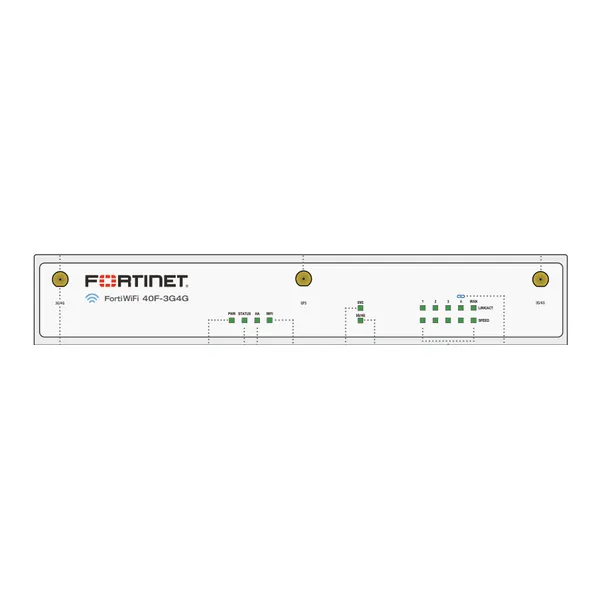
FORTINET SECURE BRANCH EDGE • CELLULAR WAN
FortiGate 40F 3G4G (FG-40F-3G4G) Tanzania
FortiGate 40F 3G4G is a compact Fortinet next-generation firewall designed for small offices, distributed branches and remote sites that need business firewall controls together with an embedded 3G/4G/LTE WAN module. It is particularly useful when a site needs cellular connectivity as a primary or secondary path without adding a separate external LTE router. Fortinet specifies five Gigabit Ethernet RJ45 ports, an embedded cellular modem, two Nano-SIM slots and three SMA antenna ports on the FG-40F-3G4G. The platform combines FortiOS networking and security functions with Secure SD-WAN, VPN and optional FortiGuard security services.
*Fortinet-published up-to performance values; actual results vary with configuration, traffic mix, enabled inspection and software version.
FG-40F-3G4G verified product overview
The FortiGate 40F-3G4G belongs to Fortinet’s FortiGate/FortiWiFi 40F family. Unlike the standard FG-40F, this model integrates a 3G/4G/LTE cellular modem. Fortinet’s ordering information identifies the SKU as FG-40F-3G4G and describes five GE RJ45 ports with one WAN port and four switch ports, an embedded wireless WAN module and external SMA WWAN antennas. The detailed interface table further identifies one hardware-accelerated GE RJ45 WAN/DMZ port, three internal GE RJ45 ports, one FortiLink port, one USB port, one RJ45 console port, two Nano-SIM slots and three SMA antenna ports.
Use an available mobile network path for primary connectivity, backup design or branch continuity according to carrier coverage, SIM service and configuration.
A desktop form factor brings firewall, routing, VPN and security policy controls to smaller locations without a large rack appliance.
FortiLink, FortiAP support and FortiOS management help the appliance participate in a broader Fortinet branch design when required.

FortiGate 40F 3G4G technical specifications
| Model / SKU | FortiGate 40F-3G4G / FG-40F-3G4G |
| Cellular | Embedded 3G/4G/LTE modem; 2 Nano-SIM slots; 3 SMA antenna ports |
| Ethernet | 1 GE RJ45 WAN/DMZ, 3 GE RJ45 internal, 1 GE RJ45 FortiLink |
| Firewall throughput | Up to 5 / 5 / 5 Gbps (1518 / 512 / 64 byte UDP) |
| IPS / NGFW / Threat Protection | Up to 1 Gbps / 800 Mbps / 600 Mbps |
| IPsec VPN | Up to 4.4 Gbps |
| Concurrent TCP sessions | Up to 700,000 |
| High availability | Active-Active, Active-Passive, clustering |
Performance numbers are laboratory reference values published by Fortinet, not a promise of application throughput at every site. SSL inspection, IPS profiles, application control, malware protection, logging, VPN encryption, packet sizes and traffic mix can materially change effective performance. Fortinet also notes that SSL VPN is not supported on FortiOS 7.6.0 and above, so buyers planning remote access should confirm the intended FortiOS release and current Fortinet-recommended access architecture before deployment.
Buying, licensing and deployment guidance
A useful FG-40F-3G4G quotation starts with more than the hardware SKU. Procurement teams should identify internet bandwidth, expected inspected traffic, user count, branch applications, VPN requirements, cellular carrier options, SIM plan, antenna placement, VLANs, logging requirements and the security services expected from FortiGuard. The correct FortiCare and FortiGuard term should be confirmed at quotation time rather than assumed. A cellular-capable firewall can improve design flexibility, but continuity still depends on carrier signal, subscription status, radio conditions, antenna placement and correct failover or SD-WAN policy.
For related Fortinet planning, review FourTeck Tanzania for Tanzania procurement enquiries, FortiGate 40F UAE guidance for a regional 40F comparison, FortiGate firewall Kenya for East African model-selection context, FortiGate 30G Uganda when comparing compact branch appliances, and FourTeck Fortinet UAE for specialist Fortinet enquiries. These links provide related regional and product context; final model selection should still be based on the actual network design.
FortiGate 40F 3G4G Tanzania
For Tanzania organizations, the FortiGate 40F 3G4G is most relevant where a compact site needs both conventional Ethernet WAN connectivity and the option to use a cellular network. That can include branch offices, retail locations, clinics, schools, professional offices, warehouses and remote operational sites. The integrated modem changes the design conversation: instead of treating mobile connectivity as a separate consumer router, the network team can plan cellular WAN within the same FortiGate policy and routing environment. This does not guarantee uninterrupted service, because carrier coverage and SIM service remain external dependencies, but it can simplify a resilient edge design when configured correctly.
Tanzania buyers should begin by checking the fixed-line connection, the mobile carriers available at the exact site, indoor signal quality, antenna placement and whether the cellular link is intended as primary, secondary or emergency connectivity. The two Nano-SIM slots provide physical flexibility, but SIM behavior and failover must be planned around supported FortiOS functions and carrier services. Security sizing is equally important. The headline 5 Gbps firewall figure is not the same as full threat-protection capacity; Fortinet publishes 600 Mbps threat-protection throughput for the series under its defined test conditions. If the business expects heavy SSL inspection, many VPN users or sustained high-bandwidth security scanning, sizing should use inspected-traffic requirements rather than ISP speed alone.
For procurement, request the exact FG-40F-3G4G hardware reference, the required FortiCare and FortiGuard subscription term, power and antenna inclusions, deployment scope and configuration requirements. Businesses planning branch VPN should document remote sites, subnets, routing and authentication needs. Organizations using cloud applications should identify critical services that need priority during failover to a lower-bandwidth cellular connection. FourTeck Tanzania can use this information to prepare a more useful quotation and deployment discussion without assuming stock, delivery dates or a particular license bundle before confirmation.
FortiGate 40F 3G4G Dar es Salaam
Dar es Salaam businesses often operate in connectivity-intensive environments where internet access supports cloud productivity, payment systems, VoIP, remote administration, supplier portals and branch communication. The FG-40F-3G4G can suit a smaller office or branch that wants a Fortinet security edge plus an integrated mobile WAN option. A common design is to keep a business broadband or fiber service as the primary path and configure cellular as an alternate path. Another possibility is a temporary or remote site where cellular is the practical WAN. The appropriate approach depends on signal quality, data-plan economics, application requirements and the level of resilience the business needs.
Before purchase, a Dar es Salaam IT team should map users, VLANs, guest access, servers, cameras, IP phones, cloud applications and VPN destinations. This helps determine whether the 40F platform has enough inspected-throughput headroom. The Fortinet datasheet lists up to 1 Gbps IPS, 800 Mbps NGFW and 600 Mbps threat protection, which are more relevant to security sizing than raw firewall throughput when multiple inspection features are enabled. For branch-to-head-office connectivity, the published IPsec figure is up to 4.4 Gbps under Fortinet’s test method, although real VPN throughput depends on packet mix, encryption and concurrent security processing.
Cellular resilience should also be tested rather than assumed. Building construction, equipment-room placement and network congestion can affect radio performance. External SMA antennas should be positioned according to the deployment environment and vendor guidance. Procurement teams should ask for a quote that clearly identifies the FG-40F-3G4G, subscription term and any configuration work such as SD-WAN rules, IPsec tunnels, security profiles, VLANs and logging. That produces a more comparable business proposal than asking only for a unit price.
FortiGate 40F 3G4G Mwanza
In Mwanza, the FortiGate 40F 3G4G can be considered for small business sites that need secure internet access and a practical fallback path where a second fixed circuit is inconvenient. A branch may use Ethernet WAN for normal operations while reserving LTE for continuity, or it may use mobile connectivity at a site where fixed service is still being provisioned. Because the cellular modem is integrated, routing, firewall policy and SD-WAN decisions can remain within the FortiGate environment rather than relying on an unmanaged external hotspot. The benefit is architectural simplicity, not a guarantee of mobile-network availability.
Mwanza buyers should evaluate which applications must remain usable during failover. Email and transactional systems may need priority while software updates, guest traffic, video streaming or large backups are restricted on a metered cellular link. FortiOS policy and SD-WAN features can support this kind of traffic design when configured appropriately. Security teams should also consider whether users need site-to-site IPsec, remote administration, web filtering, application control or intrusion prevention, because these requirements influence subscription selection and effective throughput.
The physical deployment deserves attention. The appliance is a compact desktop platform, but antenna position, ventilation, power quality and cable organization still matter. A UPS may be part of the broader continuity plan even though it is not part of the firewall itself. For quotation preparation, provide user count, ISP handoff type, desired mobile carrier, SIM availability, network subnets, VPN peers and expected security services. FourTeck can then discuss the appliance and licensing scope without making unsupported assumptions about local stock or delivery. Where the network is expected to grow substantially, compare the 40F class with newer or larger FortiGate models before standardizing multiple branches.
FortiGate 40F 3G4G Arusha
Arusha organizations in hospitality, professional services, education, logistics and branch operations may need internet security that continues to support core applications when the preferred WAN is unavailable. The FG-40F-3G4G addresses that design problem by combining a FortiGate firewall with an embedded 3G/4G/LTE module. For a small site, this can reduce the number of separate devices at the edge and provide a cleaner basis for WAN policy. The cellular service itself remains dependent on the chosen operator, coverage and subscription, so a pre-deployment signal and carrier assessment is important.
A useful Arusha design starts by separating essential and nonessential traffic. Reservation systems, payment workflows, corporate VPN and operational cloud services may deserve higher priority during cellular failover than guest browsing or bulk synchronization. Network segmentation can also keep staff, guest, voice, camera and management traffic under distinct policies. The FG-40F-3G4G provides three internal GE ports plus a FortiLink interface and WAN/DMZ port, giving a compact base for a structured branch network. Larger switching and wireless requirements can be designed with appropriate Fortinet or compatible network infrastructure rather than expecting the firewall alone to replace every LAN component.
When requesting a FortiGate 40F 3G4G Arusha quote, include the desired FortiGuard services and support term, not just the hardware model. Explain whether LTE is primary or backup, whether two SIMs are planned, how many branch VPNs are required and what traffic should survive a failover event. If SSL inspection or advanced threat profiles will be heavily used, size against Fortinet’s inspected performance values and leave operational headroom. This creates a purchase specification that reflects the real network rather than choosing solely from a headline throughput number.
FortiGate 40F 3G4G Dodoma
For a compact office or branch in Dodoma, the FG-40F-3G4G offers a way to combine business firewall functions with a built-in cellular WAN capability. This can be valuable for organizations that rely on cloud applications, remote access, inter-office VPN or online services and want an alternate connectivity method available at the security gateway. The appliance is not a substitute for connectivity planning: mobile signal, carrier congestion, data allowance and antenna placement still determine whether LTE can meet the business objective. The advantage is that the mobile interface can participate in the FortiGate routing and security design.
Dodoma deployments should document what happens when the main WAN fails. Does all traffic move to cellular, or only essential business applications? Should guest internet stop? Are IPsec tunnels expected to re-establish across the alternate path? Does the mobile provider use addressing that affects inbound services? These questions should be answered during design and testing. Secure SD-WAN can help select paths based on configured rules and health checks, but policies must reflect the organization’s applications and carrier conditions.
From a security perspective, Fortinet publishes up-to 600 Mbps threat protection and 800 Mbps NGFW throughput for the 40F family. Those figures provide a more realistic reference for an inspected edge than the raw 5 Gbps firewall maximum. Procurement teams should identify FortiCare, FortiGuard, VPN, logging and management requirements before approving the bill of materials. For a multi-site rollout, use a repeatable configuration standard while allowing each branch to have its own ISP and cellular parameters. FourTeck can use the resulting site information to discuss quotation and deployment scope for Dodoma without presuming a specific stock position or service entitlement.
FortiGate 40F 3G4G UAE
UAE buyers may consider the FG-40F-3G4G for compact branches, temporary project offices, retail locations and remote operational sites that need Fortinet security with a cellular WAN option. In dense commercial environments, a fixed broadband or leased service may remain the primary connection while LTE provides an alternate route. For temporary facilities, cellular may help bring a site online while permanent connectivity is arranged. In either case, the integrated modem allows the WAN decision to be managed alongside FortiGate firewall and SD-WAN policies rather than placing an unrelated consumer router in front of the security appliance.
The UAE design should account for carrier plan, coverage at the actual premises, data limits, public or private addressing requirements and the applications that must remain available. Voice, payment, cloud ERP and branch VPN traffic may have different continuity priorities. Security subscriptions should be selected around the threat-prevention functions the organization intends to operate, and the appliance should be sized using inspected throughput. Fortinet’s published 40F-series figures include up to 1 Gbps IPS, 800 Mbps NGFW and 600 Mbps threat protection, with actual performance varying by configuration.
Procurement teams comparing the standard FortiGate 40F and the 40F-3G4G should focus on whether integrated cellular materially improves the site design. If a branch already has diverse fixed WAN circuits and no cellular requirement, the standard model may be simpler. If LTE backup or primary mobile WAN is part of the resilience plan, the 3G4G variant can reduce external equipment. For UAE product context, FourTeck’s FortiGate 40F regional page can help frame the base 40F platform, while the final quote should specify the exact FG-40F-3G4G SKU and desired support/security term.
FortiGate 40F 3G4G Uganda
Uganda branch networks can benefit from a security gateway that is designed with multiple connectivity options in mind. The FG-40F-3G4G combines the FortiGate 40F security platform with an embedded 3G/4G/LTE modem, making it relevant for offices where mobile service is an important backup or primary WAN choice. A branch can maintain normal traffic on a wired ISP and use LTE under defined failover conditions, or a remote site can use cellular while still applying FortiGate firewall and VPN policy. The final reliability depends on the operator and site conditions, so deployment should include coverage and failover testing.
For Uganda procurement, start with the network requirement rather than a bundle name. Record user count, internet speed, inspected traffic, IPsec tunnels, remote-access method, VLANs, critical cloud applications and any FortiGuard functions needed. If cellular is backup, define which traffic is allowed over the alternate link and whether bandwidth-heavy applications should be restricted. The dual Nano-SIM hardware gives deployment flexibility, but carrier behavior, SIM provisioning and FortiOS configuration should be confirmed during implementation.
FourTeck’s Uganda content for compact FortiGate and FortiWiFi models provides useful comparison context for buyers deciding among small branch appliances. The FG-40F-3G4G differs specifically by including the cellular modem and associated antenna/SIM hardware. Buyers should request the exact SKU in the quotation and confirm FortiCare and FortiGuard terms. For sites with higher inspection demand, more ports or substantial growth, a larger or newer FortiGate may be a better architectural fit, so the 40F-3G4G should be selected after capacity review rather than only because cellular connectivity is required.
FortiGate 40F 3G4G Kampala
Kampala offices, clinics, shops and professional branches may use the FG-40F-3G4G where internet continuity is important but deploying two fixed circuits is not always desirable. The appliance provides a conventional GE WAN interface and an embedded mobile WAN module, allowing a network designer to create a primary/backup or policy-based multi-WAN arrangement. This can keep firewall policy, VPN and routing under FortiOS control. Cellular service should still be validated at the premises because indoor coverage and congestion can vary considerably even within the same city.
The most useful design question is not simply whether LTE works, but what the business expects LTE to carry. A small accounting office may prioritize cloud accounting, email and a corporate VPN. A retail branch may prioritize transaction systems and management traffic. A clinic may prioritize approved operational systems while limiting guest use. SD-WAN rules and firewall policy can reflect these priorities when the network is configured carefully. Security services should also be selected deliberately; FortiGuard subscriptions can add capabilities such as threat prevention and web security according to the purchased service package.
For a Kampala quote, specify FG-40F-3G4G, the subscription/support duration, the preferred carrier or SIM strategy, the number of VPN peers and whether configuration is required. The published Fortinet performance numbers are up-to lab values, so allow headroom for real traffic. If the branch expects heavy encrypted inspection, many users or larger future bandwidth, compare other FortiGate models before standardization. A well-defined bill of materials and deployment scope helps procurement compare offers on equivalent terms rather than mixing hardware-only pricing with bundles that include different service entitlements.
FortiGate 40F 3G4G Arua
Arua sites that depend on mobile connectivity or need a practical backup path can evaluate the FortiGate 40F 3G4G as a compact secure edge. The integrated cellular modem means a branch does not necessarily need a separate LTE router to introduce a mobile WAN into its FortiGate design. This is useful for smaller distributed operations where reducing device count can simplify support. The mobile link remains subject to carrier availability, signal strength and plan limitations, so resilience should be proven through testing rather than assumed from the presence of a modem.
For remote or distributed operations, VPN design is often central. The FG-40F-3G4G supports IPsec VPN and Fortinet publishes up to 4.4 Gbps IPsec throughput under its defined test conditions. Actual tunnel performance over cellular will normally be constrained by the mobile connection and network conditions long before that appliance maximum. Teams should test tunnel recovery after WAN changes, DNS behavior, application sessions and any address translation introduced by the carrier. Where inbound connectivity is required, carrier addressing policies deserve special attention.
Arua procurement teams should request an itemized proposal that separates hardware, FortiCare, FortiGuard services and deployment work. The network brief should include primary ISP details, desired cellular role, critical applications, user count, VLANs and branch-to-branch connectivity. If the firewall will protect a site with cameras, guest networks or bandwidth-intensive services, define traffic classes and failover restrictions so the cellular link is not overwhelmed. This approach turns the 3G4G feature into a planned continuity tool rather than an unused specification on the product sheet.
FortiGate 40F 3G4G Mbarara
Mbarara businesses looking for a small Fortinet firewall with integrated mobile WAN can consider the FG-40F-3G4G for branch protection, VPN and continuity planning. The model has one GE WAN/DMZ interface, three internal GE ports, one FortiLink port and an embedded 3G/4G/LTE modem with dual Nano-SIM slots. That hardware layout is suitable for a compact edge, but the overall LAN may still need managed switching and wireless infrastructure depending on users, VLANs, phones, cameras and access points.
A practical Mbarara deployment may use a fixed ISP for normal business traffic and reserve cellular for selected services during an outage. Another site may use mobile service as the main path where fixed connectivity is unsuitable. In both cases, define health checks, routing behavior and traffic priorities before go-live. The firewall can make policy decisions, but it cannot improve weak radio coverage or remove carrier data limits. Antenna positioning and signal validation are therefore part of the network design, not an afterthought.
Security sizing should reflect enabled controls. Fortinet publishes up to 800 Mbps NGFW and 600 Mbps threat-protection throughput for the 40F family. Organizations with internet circuits near those figures should leave headroom and consider growth, encrypted inspection and concurrent services. Ask for the exact FG-40F-3G4G SKU and confirm the desired FortiGuard/FortiCare term. If the business plans multiple branches, a consistent policy template, VPN naming standard, logging approach and renewal calendar can reduce operational complexity. FourTeck can use those requirements to discuss a suitable quotation and related Fortinet options.
FortiGate 40F 3G4G Gulu
For Gulu branch and small-office networks, the FortiGate 40F 3G4G offers a compact combination of next-generation firewall functions and integrated cellular WAN hardware. This can support organizations that want a mobile backup path without placing an additional LTE gateway in front of the firewall. It can also fit locations where cellular is the practical initial WAN. The design should always begin with local carrier assessment, because cellular performance can change by building, antenna position, network load and subscription.
Operational continuity works best when the business defines a reduced-service mode for outages. During LTE failover, essential SaaS, branch VPN and administrative traffic can be prioritized while guest access, large downloads and noncritical synchronization are limited. The exact implementation depends on FortiOS configuration and application requirements. If two SIMs are used, document which carrier and plan belongs to each slot and how the organization expects them to be used. This is especially important for support teams troubleshooting a remote branch.
The security subscription should be aligned with the intended controls. Hardware alone provides the platform, while FortiGuard and FortiCare choices affect security-service and support entitlements. A Gulu quotation should therefore state the hardware, term and services clearly. Capacity planning should use inspected traffic, not only raw firewall throughput. Fortinet’s up-to 600 Mbps threat-protection figure gives a useful reference for the 40F family under its test profile. If a site is expected to exceed the appliance’s practical security capacity or needs more interfaces, compare a higher FortiGate model while retaining the same resilience principles.
FortiGate 40F 3G4G Kenya
Kenya organizations can use the FG-40F-3G4G as a compact Fortinet branch firewall where integrated mobile WAN is part of the connectivity plan. This differentiates it from a standard FG-40F deployment in which cellular connectivity would need an external device. For retail branches, professional offices, clinics, education sites and distributed operations, the design can combine fixed internet with a cellular alternate path or use LTE at locations where it is the preferred access method. Carrier service and site signal remain external dependencies that must be validated.
The Kenya buying decision should compare the 40F-3G4G against other FortiGate classes using actual inspected throughput, user count, port needs and growth. FourTeck’s Kenya FortiGate firewall guidance places the standard 40F in the compact growing-SMB/branch category, while larger models provide more headroom for heavier sites. The 3G4G model adds cellular capability but does not change the need for capacity planning. Fortinet’s published up-to values include 1 Gbps IPS, 800 Mbps NGFW and 600 Mbps threat protection.
For deployment, define the cellular role, SD-WAN health checks, critical applications, VPN behavior and any bandwidth controls during failover. Confirm FortiGuard and FortiCare terms at quotation time. Procurement should avoid comparing a bare appliance quote with a multi-year security bundle as if they were equivalent. The proposal should also identify configuration responsibilities, SIM provisioning and any required switching or wireless components. A structured requirement helps determine whether the FG-40F-3G4G is a suitable long-term branch standard or a specialized option for sites that specifically benefit from integrated LTE.
FortiGate 40F 3G4G Kuwait
Kuwait businesses considering the FortiGate 40F 3G4G are typically solving two requirements at once: protecting a compact site and giving it a cellular WAN option. The appliance can fit a small branch, retail operation, project office or remote facility where fixed connectivity needs an alternate path. Because the LTE modem is integrated into the FortiGate hardware, WAN selection can be designed with firewall and SD-WAN policy in one platform. This reduces reliance on a separate consumer mobile router, although carrier service and radio conditions still determine cellular performance.
Environmental and physical planning matter in any cellular deployment. The firewall should have suitable ventilation and power protection, while the SMA antennas need placement that supports acceptable signal. Network teams should test the chosen SIM and carrier at the actual installation point and validate failover before relying on it for business continuity. During an outage, policies can be designed to favor operational applications and restrict nonessential traffic, especially where the mobile plan is metered or provides less bandwidth than the primary circuit.
For procurement, request the FG-40F-3G4G explicitly and confirm support and FortiGuard subscription requirements. The standard FortiGate 40F and 40F-3G4G share the same core performance class, but the integrated cellular hardware is the reason to select this variant. If the site has higher inspection demand, more segmentation or significant growth, compare larger FortiGate options before purchase. A complete Kuwait quote should state hardware, security services, term and configuration scope so decision-makers understand what is included rather than judging proposals only by the initial appliance price.
FortiGate 40F 3G4G Ghana
Ghana branch environments can consider the FG-40F-3G4G when a small site needs Fortinet firewall controls plus mobile WAN capability in the same appliance. This can be useful where a fixed connection is primary but cellular backup is desirable, or where a remote branch relies on mobile service. The device’s two Nano-SIM slots and three SMA antenna ports provide hardware options for cellular deployment, but organizations should verify operator compatibility, coverage, SIM service and FortiOS behavior for their intended design before rollout.
Business continuity planning should identify which services need to survive a primary-WAN failure. A branch may need ERP, email, payment or corporate VPN traffic while guest internet and bulk transfers can wait. The FortiGate can enforce policy and participate in SD-WAN path selection, but configuration should be tested under real failover conditions. If site-to-site IPsec is required, confirm tunnel recovery and routing when the public-facing path changes. Carrier NAT or addressing can affect some use cases and should be assessed during deployment.
For security sizing, the 40F family is a compact branch platform with Fortinet-published up-to 1 Gbps IPS, 800 Mbps NGFW and 600 Mbps threat protection. Those values should be treated as design references, not guaranteed production rates. Ghana procurement teams should request the exact model, security subscription, support term and deployment services needed. If the site is expected to grow beyond the 40F class, evaluate a larger or newer FortiGate rather than oversubscribing the appliance. The right quote should also clarify whether antennas and power accessories are included according to the official SKU package and regional ordering details.
FortiGate 40F 3G4G Nigeria
Nigeria organizations with distributed branches can use the FortiGate 40F 3G4G as a compact edge option where mobile WAN is an important part of resilience. The embedded modem can simplify sites that would otherwise need a separate LTE router, while FortiOS provides a common environment for firewall policy, VPN, routing and SD-WAN decisions. This is useful for smaller retail, service, clinic, education and administrative locations, provided the site’s inspected traffic and interface requirements fit the 40F performance class.
A Nigeria deployment should assess multiple dimensions of cellular service: signal at the exact equipment location, network congestion, data plan, SIM management and whether the carrier’s addressing supports the intended VPN or inbound requirements. The presence of dual Nano-SIM slots does not by itself create a complete redundancy strategy; the organization must decide how the SIMs and WAN paths are intended to operate and configure the firewall accordingly. Antenna placement and failover testing are essential parts of commissioning.
Security and procurement planning should remain equally disciplined. Fortinet lists up-to 5 Gbps raw firewall, 1 Gbps IPS, 800 Mbps NGFW and 600 Mbps threat-protection throughput. For real business sizing, focus on the security features that will be enabled and leave capacity headroom. Request FortiCare and FortiGuard terms explicitly, and document whether configuration, VPN migration or policy recreation is part of the project. If many branches are being standardized, define templates for addressing, VLANs, logging, VPN and renewals so the cellular feature becomes part of a manageable network architecture rather than a one-off branch exception.
FortiGate 40F 3G4G Seychelles
Seychelles businesses and remote operating sites may find the FG-40F-3G4G relevant where a compact security appliance needs a cellular WAN alternative. Island and distributed-site connectivity can make resilience planning especially important, but the correct solution depends on the available fixed and mobile services at each location. The integrated LTE modem allows mobile connectivity to be considered inside the FortiGate edge design rather than as a completely separate device, which can simplify policy and support for a small branch.
Before deployment, verify carrier coverage, SIM plan, antenna placement and the applications expected to use the mobile path. If the primary connection fails, business-critical cloud services, remote management and VPN may need priority while guest traffic or large downloads are reduced. The firewall can support policy-based traffic handling and secure SD-WAN design, but these capabilities must be configured around the actual network. Where a carrier uses addressing that affects inbound access, VPN architecture should be reviewed carefully.
Procurement should specify FG-40F-3G4G and confirm the desired FortiCare and FortiGuard services. Fortinet’s up-to performance values are useful for comparing models, but effective throughput depends on inspection, logging, encryption and traffic. A small branch may fit comfortably within the platform, while a busier hospitality or multi-service site may need more headroom. Buyers should therefore provide internet bandwidth, users, VLANs, VPN peers and expected security profiles when requesting a quotation. This makes it easier to determine whether the cellular-equipped 40F is the right fit or whether another FortiGate should be considered.
Related solutions and selection paths
The FG-40F-3G4G is a specialized member of the 40F family because cellular WAN is built in. Buyers who do not need integrated LTE can compare the standard FortiGate 40F. Sites needing integrated Wi-Fi should distinguish FortiWiFi models from FortiGate models rather than assuming the FG-40F-3G4G includes local wireless LAN; Fortinet’s interface table shows no Wi-Fi interface on the FortiGate variant. Sites with higher throughput, more users or larger interface requirements should compare higher FortiGate models. The best selection uses measured bandwidth, expected inspection, VPN load, port requirements and future growth.
For Tanzania projects, related design work may include Fortinet and network-security enquiries through FourTeck Tanzania. For nearby regional comparison, use FortiGate products Kenya to review compact and larger FortiGate classes, and FortiWiFi 40F Uganda when the requirement includes built-in Wi-Fi rather than cellular-only WAN capability.
FortiGate 40F 3G4G FAQ
Does FG-40F-3G4G have built-in 4G/LTE?
Yes. Fortinet specifies an embedded 3G/4G/LTE cellular modem on the FG-40F-3G4G, with two Nano-SIM slots and three SMA antenna ports.
Is FortiGate 40F-3G4G the same as FortiWiFi 40F-3G4G?
No. Both can include the cellular modem, but the FortiWiFi variant also includes a Wi-Fi interface. The FortiGate FG-40F-3G4G does not list an integrated Wi-Fi interface.
Can LTE be used for backup internet?
The integrated cellular WAN can be incorporated into a backup or multi-WAN design. Actual continuity depends on carrier service, signal, SIM provisioning and correct routing or SD-WAN configuration.
What is the firewall throughput?
Fortinet publishes up to 5 Gbps IPv4 firewall throughput for the 40F series. It separately lists up to 1 Gbps IPS, 800 Mbps NGFW and 600 Mbps threat protection, which are important when sizing inspected traffic.
What should I include in a quote request?
Include the exact FG-40F-3G4G model, desired FortiCare/FortiGuard term, user count, internet bandwidth, LTE role, SIM/carrier plan, VPN needs, VLANs, security profiles and any configuration or migration work.
Quotation checklist
Decision recap
Choose the FortiGate 40F 3G4G when the site fits the compact 40F security class and integrated cellular WAN adds real value to the connectivity design. Confirm the cellular environment, size the appliance against inspected traffic, select the appropriate support and security services, and test failover behavior before treating LTE as a continuity mechanism. If cellular is unnecessary, compare the standard FortiGate 40F; if Wi-Fi must be integrated, compare the FortiWiFi variant; if traffic, users or segmentation exceed the compact branch profile, evaluate a larger FortiGate.
Plan your FG-40F-3G4G deployment
Share your location, ISP speed, user count, cellular-backup requirement, VPN needs and preferred security-service term. FourTeck Tanzania can use those details to prepare a product and deployment discussion around the exact FortiGate 40F 3G4G requirement.


Reviews
There are no reviews yet.