
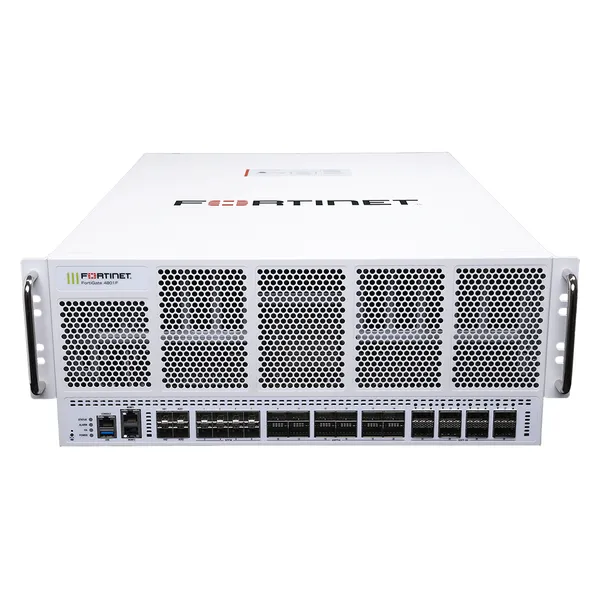
FORTINET HYPERSCALE NETWORK SECURITY
FortiGate 4801F (FG-4801F) Tanzania
FortiGate 4801F is designed for organizations that need extremely high firewall capacity, dense high-speed interfaces, large session scale and security inspection at data-center or carrier-class traffic levels. Fortinet specifies up to 3.1 Tbps IPv4 firewall throughput, 87 Gbps IPS throughput, 77 Gbps NGFW throughput, 75 Gbps threat-protection throughput and 800 Gbps IPsec VPN throughput for the 4800F series. The FG-4801F adds two 1.92 TB SSDs for local storage and combines NP7 and CP9 security processing with FortiOS.
FortiGate 4801F verified performance and hardware overview
The FG-4801F belongs to Fortinet’s FortiGate 4800F Series. Its role is substantially different from a branch firewall: it is built for data-center edge, large enterprise core security, hyperscale firewalling, high-volume IPsec aggregation, segmentation and service-provider environments where traffic rates and connection counts can be exceptionally high. Fortinet’s current datasheet lists IPv4 and IPv6 firewall throughput of up to 3.1/3.1/0.93 Tbps depending on packet size, 1,396 Mpps firewall packet processing, 280 million standard concurrent TCP sessions and an optional hyperscale figure of up to 1.8 billion sessions. New TCP sessions are listed at 915,000 per second in standard operation and up to 25 million with the hyperscale firewall license. These are laboratory maximums and actual results depend on configuration, traffic mix and enabled services.
Maximum IPv4 firewall throughput at larger packet sizes.
IPS throughput using Fortinet’s enterprise traffic mix.
NGFW throughput with firewall, IPS and application control enabled.
Threat-protection throughput with multiple security functions active.
Interface density is a defining characteristic. Fortinet lists eight hardware-accelerated 400GE/200GE/100GE/40GE QSFP-DD/QSFP56/QSFP28/QSFP+ slots, twelve 200GE/100GE/40GE QSFP56/QSFP28/QSFP+ slots, eight 50GE/25GE/10GE/GE SFP56/SFP28/SFP+/SFP slots, four additional 50GE/25GE/10GE/GE high-availability and auxiliary slots, and two 10GE/GE RJ45 management ports. The appliance is a 4RU rack-mount platform measuring 175 × 435 × 663 mm. The AC FG-4801F uses four power supplies with hot-swappable 2+2 redundancy. Procurement teams should therefore treat optics, fiber type, rack depth, power feeds, cooling, high-availability topology and FortiGuard/FortiCare subscriptions as part of the design rather than as afterthoughts.
Security, VPN, segmentation and management
FortiGate 4801F runs FortiOS and can consolidate firewall policy, intrusion prevention, application control, malware protection, encrypted-traffic inspection, VPN, secure networking and segmentation in a common platform. Fortinet specifies 63 Gbps SSL inspection throughput under its published test conditions, 180 Gbps application-control throughput and 18 Gbps SSL-VPN throughput. IPsec VPN throughput is listed at 800 Gbps, with support figures of up to 40,000 gateway-to-gateway IPsec tunnels and 200,000 client-to-gateway IPsec tunnels. The platform supports virtual domains, active-active or active-passive high availability and clustering. For very large estates, Fortinet also lists support for extensive FortiSwitch and FortiAP management counts, but architects should validate the exact FortiOS release, feature dependencies and operational model before using a core firewall as a management anchor.
A sensible FG-4801F project starts with traffic characterization. Internet bandwidth alone is not enough. Teams should document east-west data-center traffic, north-south application flows, encrypted traffic percentage, packet-size profile, number of concurrent sessions, session creation rate, VPN aggregation, segmentation zones, public services, routing protocols, expected inspection profiles and growth. High availability should be designed around failure domains, not merely a second appliance. Power feeds, upstream and downstream switch diversity, optics, routing convergence, state synchronization, maintenance windows and configuration backup all affect the real resilience of the deployment.
Buying and sizing the FG-4801F
The FG-4801F is most relevant when a smaller enterprise firewall would create a throughput, port-density or session-scale constraint. Typical evaluation scenarios include major data centers, large internet edges, high-capacity campus or enterprise aggregation, cloud connectivity hubs, service-provider security gateways, large-scale IPsec termination and environments where 100GE, 200GE or 400GE interfaces are required. A quotation should identify the exact hardware model, AC or DC power requirement, FortiGuard bundle, FortiCare support level, subscription term, optics and cables, high-availability quantity, rack and power requirements, implementation scope and any centralized management or analytics components.
FourTeck Tanzania’s broader IT, networking and security portfolio can be used when the firewall is part of a wider infrastructure project. Regional teams can also review FourTeck Fortinet UAE, FourTeck Kenya, FourTeck Uganda and FourTeck Africa when coordinating multi-country requirements. These links are useful for organizations standardizing security architectures across East Africa, the GCC and wider African operations.
FortiGate 4801F Tanzania
For Tanzania organizations evaluating the FortiGate 4801F, the first question should be whether the project genuinely requires hyperscale capacity. The FG-4801F is appropriate for environments where firewalling is part of a large data-center, carrier, cloud, government, financial-services, national enterprise or very high-volume digital-service architecture. Its 400GE-capable interface mix can support designs that would otherwise need multiple lower-capacity appliances or additional aggregation layers. That does not mean every large business needs this model. A careful design compares real traffic, security inspection demand, encrypted sessions, VPN concentration, routing scale, segmentation requirements and expected growth against the platform’s published limits.
Tanzania deployments should include practical infrastructure planning. A 4RU appliance of this class needs suitable rack depth, stable power, cooling, front-to-back airflow and organized fiber management. The FG-4801F AC specification uses 200–240V AC and Fortinet publishes average and maximum power figures for the model, so electrical capacity and UPS design should be confirmed rather than estimated from smaller firewall experience. High availability normally means considering two appliances plus diverse power feeds and resilient network paths. Transceiver selection is equally important because 25GE, 50GE, 100GE, 200GE and 400GE links may use different optical modules, fiber types and distance specifications.
Procurement teams in Tanzania should request a bill of materials that separates appliance hardware, support, security subscriptions, optics, accessories and implementation. Security subscriptions should match the intended policy set; buying a high-capacity firewall without planning the services that will actually be enabled can produce an incomplete commercial comparison. FourTeck can help structure the requirement around internet edge protection, data-center segmentation, VPN aggregation, high availability and integration with existing switching, routing, logging and management systems. The outcome should be a deployable architecture rather than a box-only quotation.
FortiGate 4801F Dar es Salaam
Dar es Salaam buyers are likely to encounter the FG-4801F in projects where business-critical connectivity converges: large headquarters, data centers, telecom environments, financial platforms, cloud gateways and organizations aggregating traffic from many branches. In these designs, raw internet speed is only one input. Architects should measure peak and sustained traffic, encrypted application flows, east-west segmentation, public-service traffic, routing adjacency, VPN tunnels and the rate at which new connections are created. The 4801F’s high session capacity is particularly relevant for environments serving very large user populations or internet-facing services, but capacity should still be mapped to the exact workload.
A Dar es Salaam data-center deployment also needs physical and operational preparation. The 4RU chassis, redundant power supplies and high-speed optical interfaces require a rack plan that accounts for cable bend radius, patching, airflow and service access. Teams should decide which links use 400GE, 200GE, 100GE, 50GE, 25GE or 10GE before ordering optics. Upstream routers and core switches must support the selected speeds and transceiver standards. If the firewall is deployed as a high-availability pair, the network design should avoid creating shared points of failure in power, switching or carrier connectivity.
For procurement, include the exact FG-4801F model, required subscription bundle, FortiCare level, optics, implementation scope, migration plan and testing criteria. A replacement project should document the existing firewall’s objects, NAT policies, VPNs, routes, security profiles and logging integrations before cutover. A new deployment should define segmentation and policy ownership before traffic arrives. FourTeck Tanzania can use this information to prepare a more meaningful commercial and technical discussion for Dar es Salaam organizations that need a high-capacity Fortinet security platform rather than a generic firewall quote.
FortiGate 4801F Mwanza
In Mwanza, the FortiGate 4801F is most likely to fit organizations operating a major regional data hub, large enterprise network, service platform or aggregation point rather than a conventional branch office. Enterprises with distributed sites around the Lake Zone may use a central security architecture to terminate VPNs, enforce common policies and protect applications accessed by many remote locations. The FG-4801F’s published IPsec capacity and tunnel scale make it a candidate for very large aggregation designs, but the architecture should distinguish between VPN encryption throughput, inspected application traffic and ordinary routed traffic so that sizing reflects the actual security path.
Connectivity resilience deserves particular attention. A high-capacity firewall cannot compensate for a single upstream dependency. Network teams should map carrier circuits, core switching, routing, DNS, authentication, logging and power dependencies. Where multiple WAN or backbone paths exist, routing and failover behavior should be tested under realistic conditions. If applications are hosted centrally, recovery objectives should also consider what happens when the primary data center, a carrier path or a security cluster member is unavailable. High availability is strongest when both device and surrounding infrastructure failure modes are understood.
Mwanza procurement teams should also plan lifecycle operations. Large firewalls need controlled firmware upgrades, configuration backups, monitoring, alerting, policy review and clear administrative roles. FortiOS capabilities can integrate security and networking functions, but operational discipline remains essential. Before requesting a quote, prepare expected interface speeds, fiber distances, routing protocols, VPN counts, segmentation zones, inspection requirements, rack environment and desired subscription term. This makes it easier to determine whether the FG-4801F is proportionate to the project and which optics, licenses and services belong in the final bill of materials.
FortiGate 4801F Arusha
Arusha organizations considering FG-4801F should evaluate it as strategic infrastructure for very high-capacity security, not simply as an upgraded office firewall. Potential use cases include large hosting environments, major institutional networks, high-volume digital platforms and regional aggregation where many networks or services converge. If the requirement is a normal enterprise branch or headquarters internet edge, a smaller FortiGate may be more economical and operationally simpler. The 4801F becomes compelling when port density, 100GE-to-400GE connectivity, session scale, IPsec aggregation or high inspection throughput are genuine design requirements.
For Arusha sites, environmental preparation is part of product suitability. The published operating range does not remove the need for clean data-center cooling, controlled airflow and stable power. The appliance’s 4RU format and front-to-back forced airflow should align with rack orientation and hot/cold aisle practice where used. Power planning should account for the actual AC configuration and redundant feeds. Fiber design should identify connector type, transceiver reach, patch-panel path and spare capacity. These details reduce commissioning delays that can occur when a high-end firewall arrives before the rack, power or optics plan is complete.
Security policy planning should happen before deployment. Define trusted and untrusted zones, server segments, management networks, partner connectivity, VPN termination, public services and logging destinations. Decide which traffic requires SSL inspection and which applications have compliance or technical exceptions. Confirm whether centralized FortiManager or FortiAnalyzer components are part of the operational model. FourTeck can help Arusha buyers organize these inputs into a quotation request that covers hardware, subscriptions, optics and deployment needs while keeping the final architecture aligned with the actual network rather than simply selecting the largest available model.
FortiGate 4801F Dodoma
Dodoma deployments may involve government, institutional, education, national-service or large enterprise environments where security policy, segmentation and resilient connectivity are central design concerns. The FortiGate 4801F can provide a high-capacity enforcement point for large networks, but procurement should begin with requirements rather than headline throughput. Document the number of security zones, critical applications, user and device populations, public services, VPN relationships, internet and backbone links, encrypted traffic, compliance logging and expected growth. These inputs determine whether the 4801F’s scale is necessary and how its interfaces should be allocated.
For environments with strict change control, migration planning can be as important as hardware. Existing firewall rules often accumulate over years, and moving them without review can reproduce obsolete access. A transition project should classify rules, owners, objects, NAT, routes, VPNs and security profiles; identify dependencies; and define rollback. High availability should be tested with planned failover exercises. Management access should be isolated and protected, and administrative roles should follow least-privilege principles. Logging capacity and retention should be coordinated with the FG-4801F’s local storage and any external analytics platform.
Dodoma buyers should ask suppliers to make commercial assumptions explicit. The quotation should state hardware variant, subscription package and term, support service, optics, power accessories, professional services and any management products. If tender documentation references performance, specify which metric matters—firewall, IPS, NGFW, threat protection, SSL inspection or IPsec—because these are not interchangeable. A structured specification reduces the risk of comparing offers that look similar in model name but contain different subscription coverage or implementation scope.
FortiGate 4801F UAE
For UAE enterprises and service providers, the FG-4801F can sit at the edge of high-bandwidth data centers, large digital-service environments, regional hubs and carrier-scale security architectures. The dense mix of 400GE, 200GE, 100GE, 50GE, 25GE and 10GE interfaces is useful when a security layer must connect directly into modern high-speed fabrics without forcing all traffic through lower-speed aggregation. Selection should still be based on measured workloads. Architects should compare peak throughput, encrypted traffic, inspection profiles, session creation, routing scale, east-west segmentation and VPN requirements with Fortinet’s published test methodology.
UAE projects often involve multi-site and multi-cloud connectivity. In such environments, a firewall may enforce policy between internet, private WAN, cloud on-ramps, hosted applications and data-center zones. FortiOS can consolidate many networking and security functions, while FortiGuard services provide subscription-based security capabilities. The exact bundle should be selected according to required services rather than assumed from the appliance model. High availability, centralized management, analytics, configuration backup and operational monitoring should be designed as part of the same project.
Commercial preparation should include the exact AC or DC variant, support term, FortiGuard services, optics and cabling, rack and power design, migration scope and testing. Organizations coordinating UAE and African sites may also need consistent naming, policy standards and change procedures across regions. A common Fortinet architecture can help standardize operations, but local connectivity and application dependencies still need individual validation. FourTeck’s regional Fortinet resources can support quotation and architecture discussions where the FG-4801F is being considered as part of a broader high-capacity security platform.
FortiGate 4801F Uganda
Uganda organizations considering the FortiGate 4801F are typically looking at a central data-center, large enterprise, carrier, financial or nationwide aggregation requirement. The model’s scale is far beyond ordinary branch needs. A central platform can be valuable where many remote sites connect through IPsec, where large applications are hosted behind segmented security zones, or where high-speed internet and backbone connections require inspection without reducing the network to low-speed interfaces. The design should separate branch tunnel counts from application inspection demand and from raw routed traffic.
A national or multi-site deployment benefits from a clear hierarchy. Smaller FortiGate appliances may secure branches while the FG-4801F acts as a high-capacity hub. In that architecture, tunnel design, routing, address planning, failover and policy consistency matter as much as appliance performance. Network teams should define how branch traffic behaves if a hub fails, whether dual hubs are required, how routes converge and where shared services such as DNS, identity and logging reside. Centralization can simplify policy but can also concentrate dependencies, so resilience must be designed deliberately.
Uganda procurement should request the complete system rather than only the firewall. Include optics, redundant power design, FortiGuard and FortiCare, high-availability quantity, management and analytics, installation and migration. For organizations operating across Kampala, Mbarara, Gulu, Arua and other cities, document branch bandwidth and critical applications so the hub architecture can be validated. FourTeck Uganda and FourTeck Tanzania can support regional discussions where a common Fortinet approach is being evaluated across East African operations.
FortiGate 4801F Kampala
Kampala is a natural location for centralized enterprise and service-provider infrastructure, and the FG-4801F may be evaluated where many business systems, branches or customer services converge. Its value is not simply the 3.1 Tbps maximum firewall figure; the more useful question is how much inspected traffic the design expects. IPS, NGFW, threat protection and SSL inspection have different published performance values, and encrypted application traffic can become the dominant workload in modern networks. Sizing should therefore use the security services that will actually be enabled.
If Kampala acts as a hub for distributed sites, teams should map every dependency around the firewall. Branch VPNs may depend on multiple carriers, identity systems, DNS, route propagation and central applications. A resilient firewall pair is only one layer of availability. Diverse switching, power and upstream connectivity may be needed to prevent a common failure from isolating the hub. Change control should also account for the number of connected sites: a policy or route error at a central point can affect many locations simultaneously, making staged changes and rollback procedures important.
Before requesting a Kampala FG-4801F quote, prepare interface speeds, optical distances, high-availability requirements, VPN counts, routing protocols, security zones, subscription services, logging and retention requirements, rack details and migration timing. If the project replaces an existing platform, provide sanitized configuration summaries and traffic statistics where possible. This enables a technical conversation about fit and implementation rather than a simple price comparison. The result should specify what is included, what is optional and which assumptions still need site validation.
FortiGate 4801F Arua
For Arua, the FG-4801F would usually be relevant only where the city forms part of a much larger regional network or where an organization operates a substantial aggregation or data-service facility. Most local office requirements can be served by smaller FortiGate models. The 4801F should be considered when there is a documented need for very high session scale, high-capacity IPsec aggregation, data-center segmentation or 100GE-to-400GE interfaces. This distinction helps procurement avoid paying for capacity that the site cannot use.
If an Arua operation connects to a central hub elsewhere, the better architecture may place the FG-4801F at the central data center and use a right-sized branch appliance locally. In that case, the Arua requirement still matters because WAN bandwidth, application criticality, failover connectivity and tunnel design influence the hub. Teams should identify which services must remain available during WAN interruption, whether local internet breakout is allowed, and how security policy is coordinated between branch and hub. These questions can change the correct model and licensing mix at both ends.
For a genuine local high-capacity deployment, rack, power, cooling and fiber infrastructure should be confirmed early. The FG-4801F’s interface capabilities only deliver value when connected infrastructure supports compatible speeds and optics. Procurement should include transceivers and fiber reach, not assume generic modules will work. A structured bill of materials, implementation plan and support model will make the project easier to commission and maintain. FourTeck can help translate the Arua site role into a regional Fortinet architecture and identify whether the 4801F belongs locally or at the aggregation layer.
FortiGate 4801F Mbarara
Mbarara enterprises may encounter the FortiGate 4801F when planning a regional data hub, large institutional platform or multi-site aggregation design. The central question is workload concentration. If many branches, cloud links, public services and data-center zones meet at one security layer, a high-end firewall can reduce architectural bottlenecks. However, the published maximum firewall throughput should not be used alone. Security architects should estimate IPS, NGFW and threat-protection traffic separately and account for SSL inspection, IPsec and connection rates.
A useful Mbarara design exercise is to map traffic by source, destination and business importance. Separate user internet access, server-to-internet traffic, branch-to-data-center flows, partner links, management traffic and backups. Decide which flows require deep inspection, which need segmentation and which are latency sensitive. This allows security policy to be intentional and helps estimate realistic throughput. It also exposes opportunities to avoid unnecessary hairpinning of traffic through a central firewall when another secure architecture would be more efficient.
Physical deployment needs the same discipline. Confirm 4RU rack space, power feeds, UPS and generator strategy, cooling, fiber trays, optics and upstream/downstream port availability. A high-availability pair doubles some physical requirements and should be reflected in rack and power planning. Commercially, specify the support term and FortiGuard services, not only the appliance. Mbarara buyers can then compare complete solutions on a like-for-like basis and plan implementation around migration, testing, documentation and operational handover rather than treating the firewall as an isolated purchase.
FortiGate 4801F Gulu
Gulu organizations should view FG-4801F as a specialized high-capacity platform. It is most suitable where the local or regional role justifies data-center-class interfaces and session scale. If the requirement is secure internet, VPN and segmentation for a conventional office, selecting a smaller FortiGate generally creates a simpler and more proportional design. Where Gulu is part of a large distributed enterprise, the 4801F may instead sit at a central hub that aggregates traffic from Gulu and many other sites.
For hub-and-spoke environments, branch continuity is an important design topic. Determine whether Gulu users require direct internet access if the central hub is unavailable, whether applications are local or centralized, and whether dual VPN paths are needed. SD-WAN and routing policy can influence how links are selected, while security controls must remain consistent. The firewall architecture should also consider maintenance: a firmware upgrade or configuration change at the hub should not create unnecessary outage risk for every connected branch.
If the FG-4801F is physically deployed in Gulu, the site should be assessed for data-center readiness. Stable power, environmental control, rack depth, redundant network paths and compatible optics are prerequisites. Published operating limits are not a substitute for good facility design. Procurement should capture appliance variant, subscriptions, support, transceivers, cables, high-availability quantity and professional services. FourTeck can help organize those details and compare them with the actual traffic and resilience objectives so the final solution is sized around business needs rather than model prestige.
FortiGate 4801F Kenya
Kenya enterprises, data-center operators and service providers can evaluate the FG-4801F for very high-capacity security at internet edges, cloud interconnects, large hosting platforms and national or regional network hubs. Nairobi-based infrastructure in particular may aggregate traffic from many branches and neighboring markets, making session scale, IPsec capacity and high-speed optics important. The platform’s 400GE-capable ports can align with modern data-center fabrics, but the surrounding routers and switches must support the chosen speeds and optical standards.
A Kenya deployment should be designed around measured traffic and security policy. If most traffic is encrypted, SSL inspection strategy can materially affect capacity planning and user experience. Teams should define certificate deployment, exceptions, privacy and compliance rules, and application compatibility before enabling broad inspection. For internet-facing services, session creation rate and DDoS architecture may be relevant alongside firewall throughput. For branch aggregation, tunnel counts, route scale and failover behavior are important. No single benchmark describes all these workloads.
Commercial evaluation should compare complete configurations. The FG-4801F includes local SSD storage, but centralized analytics may still be desirable for long-term retention, reporting and multi-device visibility. FortiGuard subscriptions and FortiCare support should be aligned to the required service level and term. Optics can represent a meaningful part of a high-speed project, so list each link speed, fiber type and distance. FourTeck Kenya can support regional procurement discussions, while organizations operating in Tanzania and Kenya can use a common design standard with site-specific bandwidth and infrastructure validation.
FortiGate 4801F Kuwait
Kuwait organizations considering FortiGate 4801F are typically addressing large data-center, government, financial, telecom or high-volume enterprise security requirements. The appliance’s dense high-speed interface mix makes it suitable where 100GE, 200GE or 400GE connectivity is part of the network fabric. Architects should validate whether those interfaces are needed for internet edge, internal segmentation, cloud connectivity or service-provider peering, then map each physical link to compatible optics and fiber.
Cooling and power deserve explicit design attention in Gulf data-center environments. The FG-4801F is a 4RU chassis with redundant hot-swappable power architecture and front-to-back airflow. Rack placement should preserve the intended airflow and maintenance access. Power circuits, UPS capacity and redundancy should be checked against the exact AC or DC model rather than inferred. When deploying a pair, both units should not depend on a single power distribution or network path if high availability is a project objective.
Security design should address segmentation, VPN, application control, intrusion prevention, malware protection and encrypted traffic according to risk and business need. Subscription choices affect which FortiGuard services are available, so the commercial bill should clearly state the selected bundle and term. Organizations connecting Kuwait with UAE or African operations may also want consistent policy objects, logging and management practices across regions. FourTeck can help prepare a cross-region bill of materials and migration plan while keeping local connectivity, compliance and facility requirements distinct.
FortiGate 4801F Ghana
Ghana buyers should evaluate the FortiGate 4801F when a project reaches hyperscale or major data-center dimensions. Large financial platforms, digital-service providers, telecom environments, hosting facilities and national enterprise hubs can generate the session volumes and high-speed traffic that justify this class of firewall. For a conventional office or branch, the 4801F is likely to be unnecessarily large. Correct sizing starts by documenting application traffic, internet capacity, internal data-center flows, VPN aggregation, security inspection and expected growth.
Where Accra or another Ghana location acts as a regional hub, the firewall may protect both local applications and traffic from distributed branches. Routing design should avoid accidental concentration of nonessential traffic while ensuring critical flows receive appropriate inspection. If IPsec is used at scale, tunnel establishment, routing and redundancy should be tested. Identity and authentication dependencies should also be mapped because a highly available firewall cannot restore access if the identity service or DNS platform behind it is unavailable.
Procurement should include the complete connectivity plan. The FG-4801F supports multiple high-speed interface families, but transceivers are not interchangeable simply because they share a physical cage. Select optics according to speed, standard, fiber and distance, and verify compatibility with the device at the other end. Add FortiGuard, FortiCare, management and analytics requirements, installation, migration and testing to the quotation scope. This produces a more accurate total project cost and gives operations teams a clearer handover path after deployment.
FortiGate 4801F Nigeria
Nigeria’s large enterprise, financial, telecom, cloud and digital-service environments can create traffic volumes that make a platform such as FortiGate 4801F relevant. Lagos or other major data-center hubs may aggregate internet, private WAN, cloud and branch traffic through a common security architecture. The FG-4801F provides substantial interface density and published session capacity, but the design should be driven by traffic engineering. Peak packet rates, connection creation, encrypted flows and inspection profiles can matter as much as aggregate gigabits per second.
Resilience planning is especially important for a central hub serving many sites. Deploying two firewalls does not automatically remove every outage path. Architects should examine upstream carrier diversity, core-switch redundancy, power, routing convergence, DNS, identity, management and logging. Maintenance procedures should allow one cluster member to be serviced without unexpected application interruption. Configuration backups and change review are important because a logical error can affect both members of a high-availability pair.
For Nigerian procurement teams, the order should define the exact FG-4801F hardware, FortiCare and FortiGuard term, transceivers, cabling, high-availability quantity, centralized management or analytics, professional services and migration. If the firewall protects regulated or high-value systems, include requirements for administrative access, logging, retention and policy review in the project scope. FourTeck can support multi-country discussions where Nigerian infrastructure must align with security standards used in Tanzania, Ghana, Kenya, Uganda or UAE operations while still reflecting local network conditions.
FortiGate 4801F Seychelles
In Seychelles, the FG-4801F would be a specialized choice for a major carrier, data-center, government, financial or high-capacity service environment rather than a typical business firewall. Island connectivity patterns can make resilience architecture particularly important. A security platform should be evaluated together with available upstream links, routing, application hosting locations and disaster-recovery strategy. If the actual bandwidth and session requirements are modest, a smaller FortiGate may provide the required security with lower power, rack and operational complexity.
Where the 4801F is justified, physical planning should be completed before procurement. Confirm 4RU rack space, sufficient depth, redundant power, cooling and front-to-back airflow. High-speed optical links should be specified by exact standard and reach. If traffic crosses submarine or international links, latency and path diversity are separate from firewall performance and should be considered in application design. A high-capacity appliance can inspect traffic quickly, but it cannot remove latency or outages elsewhere in the communications path.
Seychelles buyers should prepare a quotation checklist that includes appliance model, AC/DC requirement, subscriptions, support, optics, high availability, management, logging, implementation and training or handover needs. If the firewall will serve multiple islands, sites or business units, document segmentation and VPN relationships in advance. This allows the policy architecture to be designed cleanly and makes future changes easier. FourTeck can use those details to determine whether FG-4801F is appropriate and to structure a regional solution without making assumptions about stock, delivery time or local service coverage.
Compatibility, integration and deployment checklist
Network interfaces
Confirm every required link speed, optical standard, fiber type, distance and peer-device capability. Reserve interfaces for HA, management, internet, core, cloud and segmentation according to the design.
Security services
List IPS, application control, malware protection, web controls, SSL inspection, VPN and other services that will actually be enabled. Use the relevant inspected-throughput figures for sizing.
Operations
Define FortiOS release management, configuration backup, administrator roles, monitoring, alerting, logging, policy review, change control and recovery procedures before production handover.
The FG-4801F should be integrated with the surrounding architecture rather than treated as an isolated security device. Core switching and routing must be able to forward traffic at the intended rates. Identity services should be resilient if policies depend on user or group information. Logging platforms need capacity for the event volume generated by a large firewall. Public applications may require load balancing, DNS, certificate and DDoS controls outside the firewall itself. Backup, monitoring and management networks should be protected without becoming dependent on the same path they are intended to monitor.
FortiGate 4801F quotation checklist
For a useful quotation, provide: required quantity; AC or DC preference; high-availability design; current and future internet or backbone bandwidth; required 10GE, 25GE, 50GE, 100GE, 200GE and 400GE links; optical distances and fiber type; number of security zones; expected concurrent sessions; VPN tunnel and user counts; security services to be enabled; FortiGuard bundle preference; FortiCare term; routing protocols; VDOM requirements; logging and analytics requirements; existing firewall model; migration expectations; rack and power environment; target implementation window; and any mandatory compliance or documentation requirements. If some values are unknown, identify them as design questions rather than guessing.
A complete bill of materials may include two FG-4801F appliances for HA, transceivers, fiber patching, support and security subscriptions, centralized management or analytics, rack/power accessories and professional services. The exact list depends on architecture. Pricing, stock, lead time and warranty terms should be confirmed at quotation time and are not assumed on this page.
FortiGate 4801F FAQ
What is FortiGate 4801F used for?
It is a high-capacity Fortinet next-generation and hyperscale firewall intended for demanding data-center, enterprise, carrier and service-provider environments. Common architectural roles include high-speed internet edge security, large-scale segmentation, IPsec aggregation and protection of high-volume digital services.
What is the FG-4801F firewall throughput?
Fortinet’s current 4800F Series datasheet lists IPv4 firewall throughput up to 3.1/3.1/0.93 Tbps for 1518/512/64-byte UDP packets. All published values are up to figures and vary with configuration and traffic.
Does FortiGate 4801F include storage?
Yes. Fortinet lists 2 × 1.92 TB SSD onboard storage for FG-4801F and related 4801F variants.
Which high-speed ports does FG-4801F provide?
The platform provides hardware-accelerated interface groups supporting speeds up to 400GE, plus 200GE, 100GE, 50GE, 40GE, 25GE, 10GE and GE depending on slot type and compatible transceiver. Exact optics must be selected for the required speed and reach.
Should I buy one or two FG-4801F appliances?
That depends on availability requirements. Fortinet supports active-active, active-passive and clustering configurations. Critical environments often evaluate redundant appliances, but a complete HA design also considers power, switches, carriers, routing and other shared dependencies.
How should FG-4801F be sized for SSL inspection?
Use the workload and security profile rather than raw firewall throughput. Fortinet publishes 63 Gbps SSL inspection throughput under its stated test conditions. Application mix, cipher suites, policy and configuration affect real performance.
Decision recap and consultation
FortiGate 4801F is a specialized security platform for networks that genuinely need hyperscale sessions, very high firewall and VPN capacity, high-speed optical interfaces and data-center-class deployment. Its strongest fit is not determined by company size alone. A large organization with modest internet traffic may need a smaller model, while a service platform with massive connection rates may benefit from the 4801F even with a comparatively focused application set. The right decision comes from traffic measurements, security services, interface requirements, resilience objectives and operational capability.
For consultation, prepare a simple network diagram and the quotation checklist above. FourTeck Tanzania can discuss the FG-4801F alongside switching, fiber, rack, power, VPN, management and security-service requirements. This helps expose dependencies before procurement and makes it easier to build a bill of materials that can actually be installed. Final pricing, availability, subscription terms and implementation scope should be confirmed through a current quotation.




Reviews
There are no reviews yet.