
FortiSwitch FSR-112F-POE Tanzania
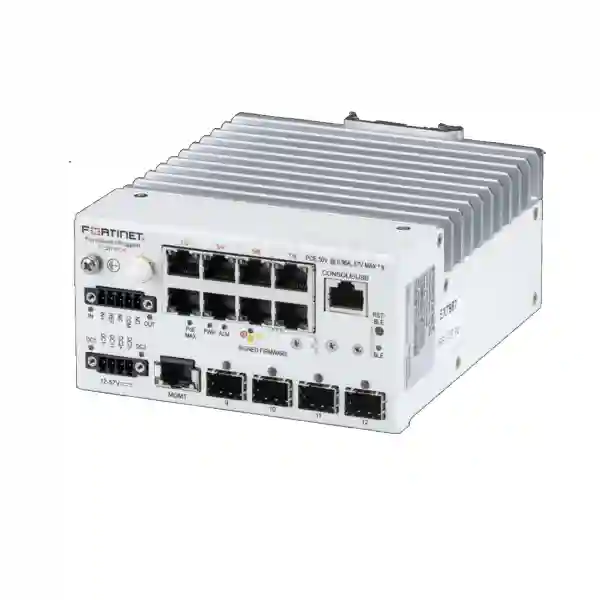
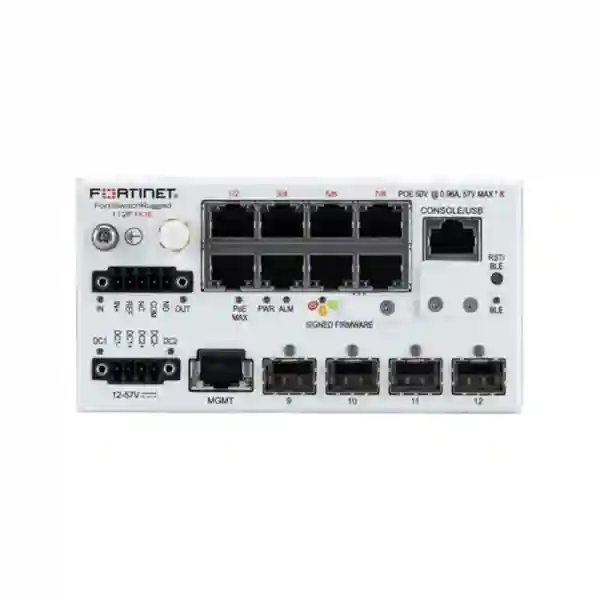
FortiSwitch Rugged 112F-POE (FSR-112F-POE) brings secure, compact Ethernet switching and high-power PoE to industrial, utility, surveillance and operational-technology networks. For Tanzanian organizations planning connectivity in cabinets, plants, compounds, production environments or distributed infrastructure, this model combines eight copper PoE access ports with four fiber-capable SFP interfaces in an IP40-rated rugged platform. Buyers can use this page to understand verified capabilities, deployment considerations, PoE sizing and quotation requirements before selecting the switch for a project.
10M/100M/1G copper access interfaces with IEEE 802.3af/at/bt support.
100M/1G SFP interfaces for suitable fiber or supported transceiver-based uplinks.
Plan endpoint demand carefully against the switch-wide PoE power budget.
Designed for demanding industrial and operational-technology deployment scenarios.
Verified FSR-112F-POE capabilities
Fortinet identifies the FSR-112F-POE as a ruggedized Layer 2 FortiGate switch-controller-compatible PoE switch. Its network interfaces comprise eight 1G/100M/10M RJ45 ports and four 1G/100M SFP interfaces. The PoE ports support IEEE 802.3af, 802.3at and 802.3bt, including up to 90W Type 4 capability, subject to the overall 240W PoE budget. Fortinet’s rugged product matrix lists 24 Gbps duplex switching capacity, 35.7 Mpps packet forwarding, 16,000 MAC-address storage, sub-microsecond network latency and support for 4,000 VLANs. These figures help engineers determine whether the platform fits the intended edge topology rather than choosing solely by port count.
The switch is especially relevant when powered edge devices and fiber uplinks need to coexist in a compact rugged design. Typical endpoint categories can include compatible IP cameras, wireless access points, phones, sensors or other powered devices, but the exact power class and consumption of every endpoint must be checked. A device being PoE-capable does not by itself guarantee that a complete deployment fits within the available budget. Good design therefore starts with a port-by-port inventory, maximum power requirements, uplink media, redundancy expectations and environmental conditions.
Management, FortiLink and operational planning
FortiSwitch can be managed in Fortinet environments using FortiGate integration through FortiLink, while Fortinet also documents cloud-oriented management options for standalone switching scenarios. The appropriate method depends on the wider architecture, software compatibility, security policy and operational model. When integrating an FSR-112F-POE into an existing Fortinet estate, confirm the FortiGate and FortiSwitchOS compatibility matrix for the software releases you intend to run before implementation.
PoE allocation also deserves deliberate configuration. Fortinet documents priority-based and first-come-first-served approaches to PoE allocation. This can matter when connected demand approaches the available power budget: an organization may want critical cameras, radios or control endpoints to retain power before lower-priority devices. Engineers should document those priorities during commissioning rather than treating PoE as an unmanaged convenience.
Technical specification snapshot
| Model | FortiSwitch Rugged 112F-POE / FSR-112F-POE |
| Copper interfaces | 8 × 10M/100M/1G RJ45 |
| SFP interfaces | 4 × 100M/1G SFP |
| PoE | 8 ports; IEEE 802.3af/at/bt, up to 90W capability; 240W total budget |
| Switching capacity | 24 Gbps duplex |
| Forwarding | 35.7 Mpps |
| MAC addresses | 16,000 |
| VLANs | 4,000 |
| Enclosure rating | IP40 |
Deployment and buying guidance
Before requesting a quotation, define the number of copper endpoints, how many require PoE, each endpoint’s maximum wattage, the required fiber distances and transceiver types, the upstream switch or firewall, and the desired management method. Also document cabinet space, power-source design, grounding, surge protection and environmental conditions. Ruggedized equipment can simplify challenging deployments, but correct enclosure, cabling and electrical engineering remain important parts of a reliable installation.
For projects already standardized on Fortinet, buyers may also evaluate the broader FourTeck Tanzania technology portfolio alongside regional Fortinet resources from FourTeck Fortinet UAE, FourTeck Uganda, FourTeck Kenya, FourTeck Ghana and FourTeck Nigeria. These regional resources can help procurement teams frame multi-country requirements while keeping the exact FSR-112F-POE specification consistent.
FortiSwitch FSR-112F-POE Tanzania
Tanzanian industrial and enterprise buyers can consider the FSR-112F-POE where a compact rugged access switch is required between powered field devices and the wider network. The combination of eight PoE copper ports and four SFP interfaces is useful when a site needs local endpoint connectivity plus fiber paths toward a control room, aggregation layer or another building. A sensible procurement process begins with the topology rather than the switch alone: count endpoints, classify their PoE demand, identify fiber runs, confirm transceiver requirements and decide whether management will be integrated with a FortiGate.
For surveillance projects, the 240W shared PoE budget should be compared against camera maximum consumption, especially where PTZ, heaters, illuminators or other high-demand functions are involved. For wireless projects, check the access point’s Ethernet speed and PoE class so that the access layer does not become an avoidable constraint. In industrial settings, review electrical design, grounding and enclosure requirements together with the switch’s published environmental specifications. Tanzania deployments may span offices, compounds, utilities, transport facilities, production areas and remote infrastructure; each context creates different cabling and resilience priorities.
A quotation request is more useful when it states required quantities, endpoint types, SFP media and distances, management architecture, support expectations and implementation scope. This reduces ambiguity around accessories and avoids treating an industrial switch as a standalone bill-of-material item. Buyers should also specify whether they need supply only, configuration assistance, migration planning or a broader Fortinet network design. FourTeck can then align the commercial discussion to the documented project requirement without making assumptions about stock, delivery time or compatibility.
FortiSwitch FSR-112F-POE Dar es Salaam
In Dar es Salaam, the FSR-112F-POE can fit projects that connect powered edge devices across commercial compounds, logistics environments, industrial premises and distributed facilities. Fiber uplinks can be particularly useful where network segments must cross distances or electrically noisy areas, while the eight copper PoE ports can consolidate local powered devices. The design should still be engineered around actual traffic, endpoint power and physical topology rather than assuming every eight-device installation has identical requirements.
Organizations planning CCTV, wireless or converged edge connectivity should prepare a PoE schedule that records the expected and maximum wattage of each powered device. The switch-wide 240W budget is the controlling design figure even though individual ports support high-power PoE classes. For uplinks, identify whether 100M or 1G SFP connectivity is suitable and choose supported optics for the fiber type and distance. If the project requires faster uplinks or a larger PoE pool, another FortiSwitch model may be more appropriate.
Dar es Salaam procurement teams can improve quotation accuracy by documenting site count, switch quantity, endpoint list, existing FortiGate model and software, required SFPs, power arrangement and commissioning expectations. Where equipment is being installed in cabinets exposed to heat, dust or industrial conditions, validate the complete cabinet and power design, not only the IP40 rating of the switch. A properly scoped request makes it easier to determine whether FSR-112F-POE is the right access-layer choice or whether a higher-capacity rugged model should be considered.
FortiSwitch FSR-112F-POE Mwanza
For Mwanza projects, a rugged PoE switch can be relevant when network endpoints are distributed through operational sites rather than conventional office floors. The FSR-112F-POE gives engineers eight powered Gigabit copper connections and four SFP interfaces in a compact platform. This creates a practical building block for sites where cameras, access points, phones or compatible industrial Ethernet devices need local connectivity while fiber carries traffic back toward aggregation infrastructure.
Selection should account for growth. If all eight copper ports are allocated on day one, there is no copper expansion margin on the switch. Likewise, the PoE budget needs headroom for endpoint startup and maximum draw. Engineers should avoid sizing solely from average consumption. Fiber design should specify multimode or single-mode requirements, distance, connector ecosystem and supported transceivers. These details matter to procurement because the base switch and optical accessories are separate design decisions.
Mwanza buyers planning integration with FortiGate should confirm supported FortiOS and FortiSwitchOS combinations before rollout and define the intended FortiLink topology. Standalone or cloud-oriented management requirements should likewise be stated explicitly. For a useful quotation, include the number of sites, device quantities, endpoint power classes, fiber requirements, configuration scope and any support requirement. This approach supports a technically defensible bill of materials instead of purchasing by model name alone.
FortiSwitch FSR-112F-POE Arusha
Arusha organizations evaluating the FSR-112F-POE may include hospitality compounds, institutions, commercial facilities, security systems and operational sites where powered endpoints must connect reliably at the edge. Eight PoE-enabled Gigabit copper ports support a compact endpoint cluster, while four SFP slots allow designers to plan fiber connections to upstream network infrastructure. The rugged format is valuable where conventional office switching is not the ideal physical fit.
A network designer should determine whether the switch is being used primarily for surveillance, wireless access, voice, industrial Ethernet or a mixed endpoint set. Each scenario changes PoE allocation and traffic assumptions. High-power devices deserve special attention because a port’s maximum capability and the switch’s 240W aggregate budget are different constraints. Where continuity matters, define which devices have the highest PoE priority and document the expected behavior if demand approaches the available budget.
For Arusha procurement, include installation context in the request: indoor cabinet or protected industrial enclosure, available DC power, fiber routes, uplink count, endpoint types and management architecture. If the switch will be controlled through FortiGate, provide the firewall model and software version so compatibility can be reviewed. Clear scope also helps distinguish hardware supply from configuration, commissioning and ongoing support. This is especially important for multi-site projects where a repeatable standard configuration may be more valuable than a one-off device purchase.
FortiSwitch FSR-112F-POE Dodoma
Dodoma deployments can use the FSR-112F-POE as a rugged access-layer option where powered devices and fiber uplinks need to meet in a compact industrial switch. Potential environments include institutional compounds, utility infrastructure, surveillance networks and distributed facilities. The model’s eight copper ports are straightforward to understand, but a good design also considers the four SFP interfaces, PoE power budget, VLAN requirements and integration with the upstream security architecture.
For networks separating cameras, administration, wireless users and operational devices, VLAN planning can help maintain logical segmentation. Fortinet’s product matrix lists support for up to 4,000 VLANs, but practical architecture should be driven by the organization’s policy and management requirements rather than the maximum number. Where FortiGate manages FortiSwitch through FortiLink, centralized visibility can simplify operations, subject to correct software compatibility and configuration.
Dodoma buyers should send a quotation brief containing the switch quantity, connected-device schedule, PoE wattage, SFP needs, fiber distances, existing network equipment and desired services. If deployment conditions are unusual, include temperature, enclosure and power information for engineering review. This avoids unsupported assumptions and makes it possible to assess whether FSR-112F-POE, a larger FortiSwitch Rugged model or another architecture best matches the actual requirement.
FortiSwitch FSR-112F-POE UAE
UAE projects often combine enterprise security platforms with surveillance, wireless and operational-technology networks across warehouses, industrial facilities, campuses and infrastructure sites. The FSR-112F-POE is relevant where eight ruggedized PoE access ports are sufficient and 100M/1G SFP connectivity matches the uplink design. Its high-power PoE capability can support demanding compatible endpoints, while the 240W aggregate budget remains the key sizing constraint.
For a multi-site UAE deployment, standardization can simplify configuration and spares planning. Engineers should define a standard port map, VLAN template, PoE priorities, FortiLink design and optical transceiver list, then validate exceptions per site. Environmental design remains important: a rugged switch should still be installed with appropriate enclosure, DC supply, grounding and cable management. The project team should review Fortinet documentation for the exact operating limits and approved accessories used in the final bill of materials.
Procurement teams can reference Fortinet-focused FourTeck UAE resources when preparing regional requirements. A complete RFQ should distinguish hardware, optics, support subscriptions where required, configuration, installation and post-deployment assistance. For cross-border projects involving Tanzania and the UAE, maintaining a common technical specification while documenting country-specific logistics separately can reduce configuration drift.
FortiSwitch FSR-112F-POE Uganda
Ugandan organizations can evaluate FSR-112F-POE for rugged edge connectivity where a small number of powered Ethernet endpoints must connect to fiber or an upstream Fortinet network. The switch’s eight Gigabit copper PoE ports can serve concentrated device groups, and the four SFP interfaces provide flexibility for fiber-connected sites. This can be useful in security, utility, industrial and distributed-enterprise designs where conventional office access switches are not the preferred form factor.
The most important pre-purchase exercise is endpoint and power mapping. Record every device, required data rate and maximum PoE draw. Compare the sum against the 240W budget and retain sensible headroom. Next, document the fiber topology and supported transceiver requirements. Finally, decide how the switch will be managed and how VLANs and security policy fit the broader network. These steps turn a product request into a deployment specification.
For Uganda-related procurement, FourTeck Uganda can be referenced for regional technology requirements. Multi-country customers should keep the FSR-112F-POE technical baseline consistent while separately confirming commercial terms, availability and service scope for each destination. No deployment should assume stock or lead time without a current quotation.
FortiSwitch FSR-112F-POE Kampala
Kampala enterprises planning secure access networks may use the FSR-112F-POE at rugged edge locations where cameras, wireless access points or other powered endpoints need local Ethernet connectivity. Four SFP slots allow fiber-based upstream connections where the physical network design requires them. For office-only environments, buyers should compare the rugged model against standard FortiSwitch families; ruggedization is most valuable when the deployment conditions justify it.
Network teams should review whether eight copper ports provide sufficient present and future capacity. A design using seven or eight ports immediately may benefit from a larger model to preserve expansion headroom. PoE should be sized from maximum device consumption, and high-priority endpoints should be identified. If the switch is integrated into a FortiGate-managed environment, validate firmware compatibility and FortiLink design before commissioning.
A Kampala RFQ should list quantities, endpoint models, SFP requirements, fiber distance, existing Fortinet equipment, installation location and support scope. This information lets the supplier evaluate accessories and integration needs rather than quoting an isolated switch. For projects that extend beyond Kampala, create a per-site schedule because power, fiber and endpoint requirements can differ substantially even when the same switch model is standardized.
FortiSwitch FSR-112F-POE Arua
Arua deployments may involve distributed facilities where network infrastructure needs to connect powered edge equipment with fiber backhaul. FSR-112F-POE provides a compact combination of eight PoE copper interfaces and four SFP interfaces. For remote or operational sites, however, hardware selection should be accompanied by careful power, enclosure, grounding and remote-management planning so that the network can be maintained efficiently.
The 240W PoE budget should be treated as a shared resource. A mix of low-power and high-power devices can fit differently from eight identical endpoints. Create a power worksheet and reserve headroom where appropriate. Fiber design should also account for the actual route and optical specification rather than purchasing SFPs generically. Supported optics and the intended distance need to be matched deliberately.
For an Arua quotation, provide site conditions and operational expectations as well as the hardware quantity. State whether configuration will be performed centrally, whether FortiGate/FortiLink management is planned, and whether installation or remote assistance is needed. This information is particularly valuable for distributed deployments because a standardized configuration and documented recovery process can reduce future support complexity.
FortiSwitch FSR-112F-POE Mbarara
Mbarara businesses and operational sites can consider the FSR-112F-POE when a rugged switch must power a modest group of Ethernet devices while providing fiber uplink options. It is suited to designs that value compact port density and industrial positioning more than large campus-scale access capacity. The switch should be evaluated as part of the complete network, including firewall, aggregation, optical links, endpoint power and management.
For surveillance deployments, calculate camera power at maximum operating conditions and identify whether any device uses higher-power PoE modes. For wireless, confirm the access point’s PoE and Ethernet requirements. For mixed environments, use VLANs and policy design to separate device groups according to security needs. Fortinet’s management ecosystem can help centralize operations when the switch is correctly integrated with compatible FortiGate infrastructure.
Mbarara procurement teams should avoid ordering optics or power components by assumption. Provide fiber type, distance, connector requirements and endpoint details in the RFQ. Also specify whether the requirement is supply-only or includes configuration and deployment services. A clear scope enables a more accurate bill of materials and helps determine whether the 112F-POE has enough port and power capacity for future expansion.
FortiSwitch FSR-112F-POE Gulu
For Gulu network projects, FSR-112F-POE can provide ruggedized PoE access at locations where endpoint count is relatively compact and fiber connectivity is useful. Its eight powered Gigabit RJ45 ports can connect compatible edge devices, while four SFP interfaces support suitable 100M/1G optical designs. The correct choice depends on whether this capacity aligns with both current devices and planned growth.
Remote-site resilience starts with more than the switch. Review DC power, surge protection, grounding, enclosure design, cable routes and upstream redundancy. Determine how administrators will reach and monitor the switch, and document firmware and configuration standards. Where FortiLink is used, ensure the FortiGate environment supports the selected FortiSwitchOS release and planned topology.
A Gulu project request should include a per-site port schedule and PoE worksheet. If multiple locations use the same design, note any site exceptions such as longer fiber runs or different endpoint classes. This gives procurement and engineering teams a common reference and reduces the risk of missing optics, accessories or capacity requirements during deployment.
FortiSwitch FSR-112F-POE Kenya
Kenyan industrial, logistics, security and distributed-enterprise networks can evaluate the FSR-112F-POE as a compact rugged access switch. The model is most compelling where powered endpoints and fiber uplinks are both required and the eight-port copper capacity is appropriate. Designers should compare it with larger FortiSwitch Rugged options when port growth, higher uplink speed or a larger PoE pool is required.
A strong design process separates data capacity from power capacity. Eight Gigabit access ports may satisfy bandwidth needs while the connected devices could still exceed the shared 240W PoE budget. Conversely, power may be sufficient while port count leaves no expansion margin. Review both dimensions independently. Fiber optics should be selected for the actual media and distance, using supported transceivers.
For Kenya requirements, customers can consult FourTeck Kenya while maintaining a common specification for regional deployments. An RFQ should include hardware quantities, optics, endpoint list, FortiGate integration details, implementation scope and support expectations. Commercial availability and delivery should always be confirmed in the current quotation rather than assumed from a product page.
FortiSwitch FSR-112F-POE Kuwait
Kuwait deployments can use rugged switching in industrial compounds, infrastructure sites and security networks where powered endpoints operate outside conventional office access environments. FSR-112F-POE combines eight Gigabit PoE copper ports with four SFP interfaces and Fortinet management integration. Its suitability should be evaluated against environmental design, endpoint power and uplink requirements.
Thermal and enclosure planning is important in demanding climates. The switch’s rugged positioning does not remove the need to follow Fortinet’s published operating specifications or to engineer the cabinet and power system appropriately. Network teams should calculate PoE load, confirm optical reach and define management before procurement. If a site requires more than eight copper endpoints or faster uplinks, compare other models rather than forcing the design around the 112F-POE.
Kuwait procurement teams can use FourTeck Kuwait for regional context. For multinational rollouts, use a consistent configuration template and accessory list but validate local installation conditions separately. Include support and implementation requirements in the quotation so that hardware, configuration and lifecycle expectations are commercially clear.
FortiSwitch FSR-112F-POE Ghana
Ghanaian organizations deploying surveillance, wireless, industrial Ethernet or distributed infrastructure can consider FSR-112F-POE when ruggedized PoE switching is required at the network edge. The four SFP interfaces are useful where fiber forms part of the site topology, and the eight copper ports can serve a compact endpoint group. Capacity planning should include both present requirements and realistic expansion.
PoE planning is central to the design. Add each endpoint’s maximum power requirement and compare the result with the 240W switch budget. Where devices have different operational importance, consider PoE priority policies. For data segmentation, define VLANs according to security architecture, and where FortiGate management is used, validate FortiLink and software compatibility before deployment.
Customers with Ghana requirements can reference FourTeck Ghana. A complete quotation request should identify site count, switch quantities, optics, fiber type and distance, endpoint models, management method and service scope. This makes the commercial response more useful and reduces the chance of missing accessories or selecting a switch that lacks growth headroom.
FortiSwitch FSR-112F-POE Nigeria
Nigeria projects across industrial, energy, commercial and security environments may require rugged edge switching that can power connected devices and use fiber for upstream connectivity. FSR-112F-POE offers eight Gigabit PoE ports and four SFP interfaces in Fortinet’s rugged family. It can be a strong architectural fit where this port density and the 240W PoE budget match the site requirement.
Engineers should document power quality and protection, cabinet conditions, grounding and cable routes as part of the network design. For PoE, use maximum endpoint consumption rather than typical values when checking capacity. For fiber, specify supported optics according to distance and media. If the switch will join a FortiGate-managed fabric, confirm release compatibility and FortiLink design before deployment.
For Nigeria-focused procurement, FourTeck Nigeria provides a regional route for requirements. Buyers should state whether they need equipment only or a broader scope including configuration, rollout and support. For multi-site projects, a standardized bill of materials can simplify operations, but each location still needs validation for endpoint count, power demand and fiber distance.
FortiSwitch FSR-112F-POE Seychelles
Seychelles organizations may consider rugged PoE switching for hospitality compounds, surveillance, utilities and distributed facilities where fiber links connect buildings or operational areas. The FSR-112F-POE’s eight copper PoE ports and four SFP interfaces allow a compact edge node to serve powered endpoints while connecting back to upstream infrastructure. The network design should account for environmental exposure and enclosure requirements appropriate to each site.
Where fiber is used between buildings, define optical distance, fiber type and supported transceivers before ordering. Where cameras or wireless devices use PoE, calculate maximum power and maintain appropriate budget headroom. Salt, moisture and local environmental factors should be addressed through the overall installation design and manufacturer-compliant enclosure strategy; an IP40 switch should not be assumed to be weatherproof or suitable for direct outdoor exposure.
A Seychelles RFQ should therefore include the physical installation context, endpoint schedule, fiber topology, PoE worksheet and desired management approach. For projects managed from another country, document remote-access and configuration standards so support teams have a repeatable operational model. Confirm current availability, commercial terms and service scope during quotation rather than relying on generic regional assumptions.
Quotation checklist
For a precise FSR-112F-POE quotation, provide: required quantity; country and project location; number and model of powered endpoints; maximum PoE consumption per endpoint; fiber type and distance; required SFP quantities; upstream FortiGate or switch model; intended FortiLink or standalone management; VLAN and segmentation requirements; installation environment; power design; configuration or installation scope; and support expectations. If the project spans multiple sites, provide this information per site because a single generic quantity can hide important design differences.
Frequently asked questions
How many PoE ports does FSR-112F-POE have?
It has eight 10M/100M/1G RJ45 PoE ports. Fortinet lists IEEE 802.3af/at/bt support, including up to 90W capability, with a 240W total PoE budget.
Does it have fiber interfaces?
Yes. The model has four 100M/1G SFP interfaces. Select supported transceivers according to the fiber type, distance and network design.
Can FortiGate manage the switch?
Fortinet describes FSR-112F-POE as FortiGate switch-controller compatible. Confirm FortiOS/FortiSwitchOS compatibility for the exact releases planned for deployment.
Is the FSR-112F-POE an outdoor switch?
Fortinet lists an IP40 rating. Do not interpret that as a weatherproof outdoor enclosure. Follow the manufacturer’s environmental specifications and use an appropriate installation enclosure for the site.
What should be checked before buying?
Check port count, maximum PoE load, fiber requirements, supported optics, management architecture, firmware compatibility, environmental conditions, power design and future expansion.
Decision recap and consultation
Choose FSR-112F-POE when the verified eight-port rugged PoE format, four 100M/1G SFP interfaces and 240W PoE budget fit the intended edge design. Before ordering, validate endpoint power, optics, FortiGate integration and environmental installation details. FourTeck Tanzania can review a project brief and prepare a quotation based on the stated requirement rather than assumptions.



Reviews
There are no reviews yet.