
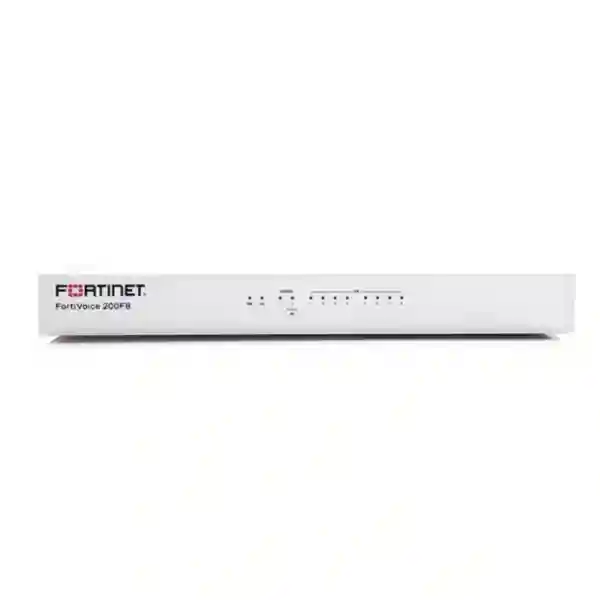
FortiVoice FVE-200F8 Tanzania
FortiVoice FVE-200F8 is a purpose-built Fortinet business phone system for organizations that need a manageable path from conventional telephone lines to IP-based unified communications. Fortinet specifies capacity for up to 200 extensions, eight integrated FXO ports and 24 VoIP trunks. This combination makes the platform relevant to established offices, hotels, professional services, education environments, healthcare administration, distributed businesses and other organizations that want centralized call handling without assembling an IP PBX from unrelated components.
Plan user growth, departments, reception points and shared phones against the verified system capacity.
Integrated analog trunk connectivity can support migration scenarios where conventional lines remain part of the voice design.
VoIP trunk capacity supports SIP-oriented business calling designs, subject to provider compatibility and deployment planning.
What FortiVoice FVE-200F8 solves
A business telephony project is more than choosing extension capacity. Organizations need routing, reception workflows, call queues, voicemail, user mobility, trunk planning, endpoint management and a design that fits the existing LAN and WAN. FVE-200F8 brings these requirements into the FortiVoice ecosystem. Fortinet documents advanced call features including call queue, call recording, operator-console functions and other enterprise calling tools for this model. Optional services can extend the deployment with FortiFone softclient, unified communications, call-center and hotel-management capabilities. Exact licenses and subscriptions should be selected against the required workflow rather than assumed from the appliance alone.
Deployment and integration planning
Before procurement, document the number of current users, expected growth, desk-phone requirements, reception positions, departments, hunt groups, call queues, PSTN or SIP trunks, remote users, recording requirements and branch locations. Network readiness should include VLAN design, PoE capacity for IP phones, DHCP and DNS behavior, QoS policy, WAN stability and security controls. For multi-site designs, Fortinet documentation identifies FVE-200F8 as a supported FortiVoice local-survivability model and states that it can manage up to five FortiVoice gateways in current administration guidance. Gateway choice still depends on whether the design requires FXS, FXO or other supported interfaces.
FortiVoice FVE-200F8 Tanzania
Tanzanian organizations evaluating FortiVoice FVE-200F8 should begin with a voice-system inventory rather than a simple appliance quotation. Record every extension type, incoming line, outgoing route, reception workflow and branch dependency. A company moving from an older PBX may still depend on analog lines while gradually adopting SIP services, making the FVE-200F8 combination of eight FXO interfaces and VoIP trunk support useful for phased migration planning. Businesses should also identify whether employees need only desk phones or a combination of FortiFone endpoints and softclient access. Where call queues, call recording or operator functions are important, these requirements should be mapped before licensing and configuration are finalized. Network preparation is equally important: switching capacity, PoE budgets, voice VLANs, QoS, WAN reliability and security policies can directly affect call quality. For organizations with branches, resilience and gateway requirements should be discussed as part of the topology rather than added after installation. FourTeck can assist with solution scoping, compatible endpoint selection and quotation preparation without assuming that every organization needs the same license bundle. Buyers comparing broader security and networking options can also review FourTeck Tanzania technology solutions and the regional FourTeck Africa portfolio when planning integrated network and communications projects.
FortiVoice FVE-200F8 Dar es Salaam
Dar es Salaam businesses often need a phone platform that can organize communications across reception, sales, operations, finance and customer-service teams. For a FVE-200F8 project, the useful starting point is concurrent business activity rather than employee count alone. A 150-person organization may have very different call-routing needs from a similarly sized hotel, clinic or contact-heavy service business. Map direct inward dialing requirements, receptionist consoles, queue behavior, business hours, overflow routes and emergency calling processes. If existing analog carrier lines must remain active during migration, the eight FXO ports are an important verified hardware characteristic; if SIP trunks are planned, provider interoperability and network edge configuration should be validated. Organizations should also plan handset classes by role instead of buying one phone type for everyone. Executives, receptionists, shared spaces and standard users can have different feature needs. The LAN should be assessed for PoE, voice VLAN segmentation and QoS before rollout. Remote and mobile work requirements may make FortiFone softclient and unified-communications options relevant, but licensing should be quoted for the intended user population. A structured bill of materials should therefore include the FVE-200F8, endpoint quantities, any required gateways, subscriptions or add-ons, network dependencies and implementation scope. This approach makes quotations easier to compare and reduces configuration changes during deployment.
FortiVoice FVE-200F8 Mwanza
For Mwanza organizations, FVE-200F8 can be evaluated as the central communications layer for offices that want predictable extension management and a mix of traditional and IP calling. Procurement teams should identify whether the system is replacing an analog PBX, consolidating multiple smaller systems or supporting a new facility. Replacement projects require careful number and trunk migration planning, while new sites provide an opportunity to design voice VLANs, PoE switching and structured cabling correctly from the start. The verified 200-extension ceiling should be compared with expected growth over the useful planning horizon, leaving sensible capacity for new departments, meeting rooms and shared endpoints. Where businesses operate satellite offices or operational sites, document how calls should continue during WAN disruption and whether FortiVoice gateway or survivability functions are appropriate. Call recording and queue requirements should be defined with retention, access and organizational policy in mind rather than enabled casually. Buyers should also specify whether they need softclient mobility, unified communications or specialized call-center functions, because these can affect licensing. A good Mwanza quotation request should list users, trunks, current phone numbers, endpoint types, site count, internet links, switches and desired calling workflows. That gives the solution designer enough information to distinguish appliance capability from the additional infrastructure needed for a reliable production deployment.
FortiVoice FVE-200F8 Arusha
Arusha has organizations whose communications requirements range from corporate offices and professional services to tourism, hospitality, education and operational facilities. FVE-200F8 is particularly worth assessing where a business needs up to 200 extensions and values both analog-line connectivity and VoIP trunking. Hotels and hospitality operations should map front-desk calling, guest-service workflows, room or staff extensions and any hotel-management integration requirements before choosing optional capabilities. Office environments may focus instead on receptionist handling, queues, voicemail, extension mobility and softclient access. The network design should separate voice traffic appropriately and ensure sufficient PoE and switching resources for the intended FortiFone endpoints. If an existing PBX is being replaced, document analog devices that might still require gateway connectivity, including legacy phones or other approved interfaces. Businesses should avoid assuming that a new PBX automatically fixes poor WAN quality; SIP services and remote extensions depend on stable network conditions and appropriate QoS. For procurement, request a solution-level quote that identifies appliance, endpoints, licenses, gateways, implementation and support scope separately. This makes it easier to understand which elements are mandatory and which are optional. Regional organizations can also consult FourTeck Kenya when coordinating East African technology requirements across borders.
FortiVoice FVE-200F8 Dodoma
Organizations in Dodoma considering FortiVoice FVE-200F8 should translate administrative and operational requirements into a clear dial plan before purchase. Start with departments, extension ranges, reception coverage, working hours, call-forward rules, queues and external-number presentation. The FVE-200F8 supports up to 200 extensions, so planners should include foreseeable organizational growth rather than sizing only for today’s headcount. For sites that still rely on conventional telephone lines, eight integrated FXO ports can simplify certain migration designs, while 24 VoIP trunks provide capacity for IP-based carrier connectivity. Exact trunk configuration remains dependent on the selected service provider and network design. Security teams should include the voice platform in change management, access control, backup and update procedures. Network teams should verify PoE, VLAN and QoS readiness before phones are deployed. If multiple sites need to participate in one communications environment, WAN topology and survivability requirements should be included early. Fortinet’s current documentation supports gateway management on FVE-200F8, but the number and type of gateways should be matched to the actual interface requirement. A detailed quotation checklist reduces ambiguity and helps procurement compare complete solutions rather than appliance prices alone.
FortiVoice FVE-200F8 UAE
UAE buyers evaluating FVE-200F8 commonly need to align PBX design with office density, branch connectivity, SIP services and user mobility. The system’s 200-extension capacity places it in a practical range for established small-to-mid-sized enterprises and departmental deployments, while eight FXO ports can support designs retaining analog trunks. Twenty-four VoIP trunks provide an IP calling foundation, subject to carrier and configuration compatibility. Multi-location organizations should document central versus branch call processing, failover expectations and gateway needs. Softclient, unified-communications, call-center and hotel-management options should be selected according to business workflow and licensed accordingly. Buyers coordinating UAE projects can review FourTeck UAE solutions for regional technology planning. A complete request for quotation should identify user count, sites, trunk type, endpoints, recording requirements, queues, integrations and implementation expectations so the proposal reflects a working system rather than only the PBX appliance.
FortiVoice FVE-200F8 Uganda
Ugandan organizations can assess FVE-200F8 for centralized business telephony where extension growth, analog migration and SIP calling need to coexist. Planning should distinguish desk users, shared phones, reception positions and mobile users, then map the required call flows. Organizations retaining PSTN lines can evaluate the eight FXO interfaces, while VoIP-oriented deployments should validate SIP-provider requirements and WAN quality. Branch environments should consider survivability, gateway interfaces and management responsibilities. Fortinet documentation shows that the FVE-200F8 can manage FortiVoice gateways, providing a path for designs that require additional supported analog interfaces. Buyers should also define call recording, queue and operator-console needs before configuration. For country-specific procurement coordination, FourTeck Uganda provides a relevant regional FourTeck resource. Quotations are most useful when they separate core appliance, phones, add-ons, licenses, gateways and deployment services.
FortiVoice FVE-200F8 Kampala
Kampala businesses with busy reception, sales or customer-service teams should size FVE-200F8 around call patterns as well as extension count. Queue design, simultaneous inbound activity, transfer workflows, operator functions and recording policies can influence the final architecture. The appliance supports up to 200 extensions and combines analog FXO connectivity with VoIP trunks, which can be useful during staged modernization. Network readiness should include managed switching, PoE budgets, VLAN segmentation and QoS. If staff need mobility, softclient and unified-communications options can be evaluated separately. Procurement teams should ask for a bill of materials that identifies endpoint models by user role and states which licenses or subscriptions are included. For branch connectivity, document WAN links and the expected behavior during outages so resilience can be designed deliberately.
FortiVoice FVE-200F8 Arua
For an Arua deployment, practical planning begins with connectivity and operational continuity. A centralized IP PBX can simplify extension administration, but remote or branch users depend on reliable LAN and WAN design. FVE-200F8 offers capacity for up to 200 extensions, eight FXO ports and 24 VoIP trunks, allowing organizations to consider mixed analog and IP trunk strategies. Before purchase, document carrier services, internet resilience, power protection, switching, PoE and cabling. Where a branch needs local analog interfaces or survivability, supported FortiVoice gateway options should be assessed against the exact topology. User training is also important: receptionists and administrators need call-handling and management procedures, while ordinary users benefit from consistent extension and voicemail conventions. A quotation should therefore include not just the appliance but also endpoint quantities, licenses, network dependencies and configuration scope.
FortiVoice FVE-200F8 Mbarara
Mbarara organizations planning a phone-system refresh should first decide which legacy functions must be preserved and which workflows can improve through IP communications. FVE-200F8 supports 200 extensions, making it suitable for environments where a single system can cover multiple departments with room for planned growth. Eight FXO ports can accommodate selected analog trunk requirements, while 24 VoIP trunks support IP-based calling designs. The project should include a dial-plan workshop covering extension ranges, inbound routing, after-hours behavior, queues, voicemail and escalation. Network teams should confirm that switches can power the intended phones and prioritize voice traffic. If call recording is required, access, retention and organizational policy should be defined. Optional unified communications, softclient, call-center or hotel-management capabilities should be quoted only where they match the use case.
FortiVoice FVE-200F8 Gulu
In Gulu, FVE-200F8 can support organizations moving from fragmented telephone arrangements toward centrally managed extensions and IP calling. The strongest deployments begin with a site survey and requirements list: current lines, user numbers, reception points, shared phones, departments, remote staff and future expansion. The verified 200-extension capacity provides a clear sizing boundary, while integrated FXO and VoIP trunk support allows different carrier approaches to be considered. Organizations with remote sites should examine WAN resilience and whether local survivability or gateways are needed. Power protection, PoE switching and structured cabling should be included in project planning because voice availability depends on the supporting infrastructure. Buyers should request configuration, endpoint and license details in writing so the final system scope is clear.
FortiVoice FVE-200F8 Kenya
Kenyan organizations considering FVE-200F8 can use the same disciplined sizing process: count extensions, identify call-intensive roles, document trunk services and map branch requirements. The appliance provides up to 200 extensions, eight FXO ports and 24 VoIP trunks. This can suit businesses transitioning from analog services to SIP while retaining selected legacy connectivity. The endpoint plan should differentiate reception, executives, standard users and shared areas, while network design should address PoE, VLANs and QoS. Softclient and unified-communications requirements should be tied to actual mobile-working needs. Multi-site organizations should include resilience and gateway design in the initial architecture. FourTeck’s Kenya technology site can support regional planning alongside Tanzania projects.
FortiVoice FVE-200F8 Kuwait
Kuwait procurement teams evaluating FortiVoice FVE-200F8 should distinguish appliance capacity from complete solution requirements. A production deployment can include phones, PoE switching, SIP or analog carrier services, licenses, gateways, configuration and support. The FVE-200F8 capacity of 200 extensions should be checked against growth, while its eight FXO ports and 24 VoIP trunks should be matched to the trunk strategy. Businesses requiring call-center, hotel-management or unified-communications functions should identify these at quotation stage so optional capabilities are correctly scoped. Network readiness, security controls and backup procedures belong in the implementation plan. Regional buyers can review FourTeck Kuwait for related procurement context.
FortiVoice FVE-200F8 Ghana
Ghanaian businesses can assess FVE-200F8 when they need a structured business phone system with up to 200 extensions and flexibility between analog and VoIP trunks. Planning should capture carrier options, phone-number migration, receptionist workflows, queues, voicemail and any recording requirements. Eight FXO ports provide integrated analog connectivity, while 24 VoIP trunks support SIP-oriented designs. For distributed organizations, branch connectivity and survivability should be considered before finalizing the topology. Network teams should validate switching, PoE, QoS and WAN stability. Procurement should request a complete bill of materials and clearly identify optional licenses. This avoids comparing an appliance-only quote with a fully configured communications solution.
FortiVoice FVE-200F8 Nigeria
Nigerian enterprises evaluating FVE-200F8 should design around business continuity, trunk availability and departmental call flows. With up to 200 extensions, the platform can consolidate many users under one administrative system, but capacity planning should include shared endpoints and growth. The combination of eight FXO ports and 24 VoIP trunks supports mixed migration strategies where suitable carrier services are available. Multi-site deployments should document WAN links, failover expectations and gateway needs. Call-center or high-volume reception environments should specify queue, recording and operator requirements early. Network infrastructure, power protection and endpoint selection are part of the voice solution, not afterthoughts. A well-defined quotation separates hardware, phones, add-ons, implementation and ongoing support requirements.
FortiVoice FVE-200F8 Seychelles
Seychelles organizations assessing FVE-200F8 may prioritize hospitality, professional-service and multi-site communications. The platform’s 200-extension capacity can cover a substantial office or property deployment, while eight FXO ports provide analog trunk options and 24 VoIP trunks support IP calling. Hospitality buyers should document front-desk, staff, guest-service and hotel-management requirements before choosing optional functions. Other businesses may prioritize reception, softclient mobility, queues and voicemail. Because island and distributed-site connectivity can influence voice performance, WAN design and resilience deserve early attention. Endpoint power, switching, VLANs and QoS should be verified before rollout. A complete procurement request should list users, sites, trunks, endpoint roles, optional features and implementation expectations.
Selection and quotation checklist
Prepare the following before requesting a FortiVoice FVE-200F8 quotation: total extensions now and in three years; number and type of carrier trunks; existing analog lines; required FortiFone endpoints; reception and operator positions; call queues; recording requirements; softclient users; branch sites; gateway interfaces; hotel or call-center functions; PoE switch availability; VLAN and QoS readiness; WAN links; migration timing; training requirements; and post-deployment support expectations. This information helps convert a product request into an implementable communications design.
Frequently asked questions
How many extensions does FVE-200F8 support?
Fortinet lists FVE-200F8 for up to 200 extensions.
Does FVE-200F8 include analog trunk ports?
Yes. Fortinet specifies eight FXO ports for this model.
How many VoIP trunks are supported?
Fortinet lists 24 VoIP trunks for FVE-200F8. Actual service configuration should be validated with the selected carrier and deployment design.
Can it manage FortiVoice gateways?
Current Fortinet administration documentation lists FVE-200F8 with support for managing up to five FortiVoice gateways.
What should be included in a quote?
Include the appliance, endpoint quantities and models, trunks, optional licenses, gateway requirements, network dependencies, configuration, migration, training and support scope.
Decision recap
Choose FVE-200F8 when its verified capacity and interfaces fit the planned communications architecture: up to 200 extensions, eight FXO ports and 24 VoIP trunks. Evaluate optional collaboration, call-center and hospitality capabilities separately, and design the LAN, WAN, phones and gateways as part of the same project. The best procurement outcome comes from a requirements-led bill of materials rather than an appliance-only comparison.
Plan your FortiVoice FVE-200F8 deployment
Share your user count, locations, current telephone lines, SIP requirements, endpoint quantities and desired call workflows with FourTeck Tanzania. A structured requirement set makes it easier to prepare a relevant quotation and identify any licensing, gateway or network dependencies before implementation.

Reviews
There are no reviews yet.