
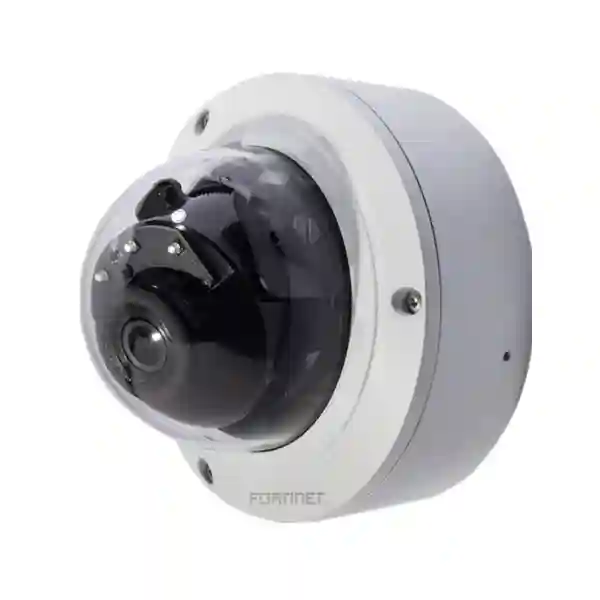
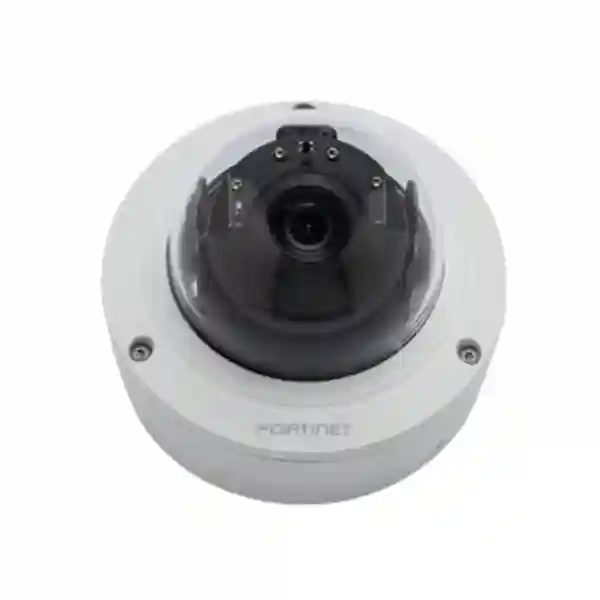
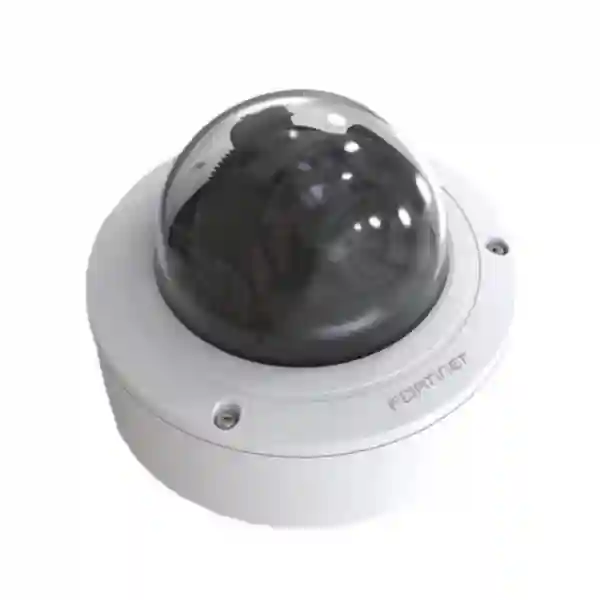
FortiCamera FCM-CD51 Tanzania
FortiCamera FCM-CD51 is a 5MP fixed-dome IP surveillance camera built for organizations that want high-resolution video, straightforward network deployment and integration with Fortinet video-security infrastructure. Its fixed 2.8mm lens provides a broad 95-degree horizontal viewing angle, while 20m+ dimmable infrared illumination supports monitoring after dark. The camera combines wired Ethernet, Wi-Fi and Bluetooth Low Energy connectivity with PoE power, HDR imaging and a built-in microphone, giving security teams a practical platform for offices, entrances, corridors, retail areas, warehouses and other monitored spaces.
Verified highlights
Camera: 5MP fixed dome, indoor/outdoor
Lens: 2.8mm fixed, 95° horizontal view
Night monitoring: 20m+ dimmable IR
Network: 10/100 Ethernet, Wi-Fi, BLE
Power: IEEE 802.3af PoE Class 3
Protection: IP67-rated enclosure
FortiCamera FCM-CD51 overview
The FCM-CD51 sits in Fortinet’s FortiCamera family of network video-security cameras and is positioned as a fixed-dome model. Fortinet documentation lists the camera at 5MP resolution with a 1/2.8-inch low-light CMOS sensor, fixed F2.0 aperture and 2.8mm focal length. Its stated field of view is 95° horizontal, 72° vertical and 118° diagonal. This combination suits installations where planners want a consistent, relatively wide scene rather than an adjustable optical zoom. For camera placement, that distinction matters: the installer should determine the required identification and observation zones before fixing mounting points because the CD51 uses a fixed focal length.
Video can be encoded using H.264 or H.265, enabling deployment teams to balance image quality, storage planning and network utilization according to the wider surveillance architecture. Fortinet specifies HDR above 80dB, 3D noise reduction and low-light operation, while infrared illumination extends beyond 20 metres and can be dimmed. A built-in microphone adds audio capture where organizational policy and applicable law permit it. The camera also supports RTSP, providing an additional consideration for compatible video workflows.
For centralized surveillance, Fortinet positions FortiCamera alongside FortiRecorder network video recorders and FortiCentral video management software. Buyers planning a new installation should therefore scope the camera count, retention objective, recording architecture, network capacity, PoE budget and viewing requirements together rather than treating each camera as an isolated purchase.
5MP imaging
High-resolution capture provides useful scene detail for general business surveillance, with deployment quality still depending on distance, lighting, angle and the monitoring objective.
Day and night coverage
Low-light imaging and dimmable 20m+ infrared illumination help the camera continue monitoring when visible light falls, making placement and reflective surfaces important design considerations.
Flexible connectivity
10/100 Ethernet, Wi-Fi and BLE provide deployment options. Wired PoE is especially useful where a single Ethernet run can carry network connectivity and electrical power.
Outdoor-ready construction
The IP67-rated dome is intended for indoor and outdoor use. Correct mounting, cable termination and environmental planning remain essential to preserve installation reliability.
Technical specifications
| Specification | FortiCamera FCM-CD51 |
|---|---|
| Format | Fixed dome, indoor/outdoor |
| Sensor resolution | 5 MP |
| Image sensor | 1/2.8-inch low-light CMOS |
| Lens / aperture | 2.8mm fixed / F2.0 |
| Viewing angle | 95° horizontal / 72° vertical / 118° diagonal |
| Minimum illumination | 0.05 Lux @ F2 color / 0.01 Lux @ F2 B/W |
| Dynamic range | HDR >80dB |
| Compression | H.264 / H.265 |
| IR illumination | 20m+ dimmable |
| Audio | Built-in microphone |
| Ethernet | 1 × 10/100 |
| Power | 802.3af PoE Class 3 |
| Dimensions | 97 × 120 × 120 mm |
| Weight | 498 g |
Integration and deployment planning
A surveillance project should begin with the operational question each camera must answer. Entrances may require a different mounting height and scene width from corridors, reception areas, perimeter approaches or warehouse aisles. The CD51’s 2.8mm fixed lens and 95° horizontal view make early scene planning particularly important. Installers should validate the field of view at the intended mounting point and consider backlighting, night-time reflections, moving subjects and the distance at which useful detail is required.
Network design is equally important. A PoE switch should have sufficient port capacity and power budget for the planned cameras, while uplinks must be sized for aggregate video traffic. Recording retention should be calculated using the selected resolution, frame rate, compression, scene complexity and recording schedule. Where organizations already use Fortinet infrastructure, teams can evaluate the wider Fortinet video-surveillance architecture together with network and security requirements. Explore FourTeck Tanzania technology solutions when planning the supporting network, security and infrastructure around a camera deployment.
Fortinet states that FortiCamera integrates with FortiRecorder and FortiCentral. FortiCentral provides video management for connected FortiRecorder and FortiCamera environments, helping operators work with live and recorded video through a centralized interface. Organizations considering cloud-based management should distinguish the FCM-CD51 from the separate FCM-CD51-C cloud-native model and confirm the required architecture before ordering.
FortiCamera FCM-CD51 Tanzania
For Tanzanian organizations, the FortiCamera FCM-CD51 is relevant where surveillance must cover business premises with a compact fixed-dome camera and where the project team values integration with a structured IP network. Typical planning scenarios include offices, education facilities, healthcare administration areas, hospitality properties, retail premises, logistics facilities and controlled building entrances. The product should be selected against the actual scene rather than only its megapixel rating: buyers should document the width of the area, expected subject distance, lighting conditions, mounting surface and whether audio capture is appropriate.
A quotation request is more useful when it includes the number of cameras, floor plans or approximate coverage zones, recording-retention target, available PoE switching, network topology and preferred monitoring location. This allows the camera requirement to be assessed alongside recorder capacity, storage, mounting accessories and network infrastructure. Tanzania deployments can vary significantly between a single-site office and a distributed organization, so scalability and central viewing requirements should be established early.
Outdoor deployments also need practical site assessment. IP67 protection is valuable, but installers still need to consider cable routing, mounting stability, water ingress around terminations, lightning and surge strategy, network cabinet conditions and power resilience. For business continuity, surveillance switching and recording equipment may also need suitable UPS protection. Buyers seeking a complete Fortinet-oriented infrastructure can also review the wider FourTeck Africa technology portfolio for regional solution context.
FortiCamera FCM-CD51 Dar es Salaam
In Dar es Salaam, commercial surveillance projects often need to account for busy entrances, mixed indoor/outdoor coverage and network infrastructure shared with other business applications. The FCM-CD51’s fixed dome form factor can suit reception zones, office access points, shop areas, covered building approaches and similar scenes where a broad fixed view is appropriate. The 5MP sensor, HDR and low-light capabilities provide a strong technical base, but final image usefulness depends on correct positioning and lighting assessment.
For multi-floor offices and commercial sites, planners should map cameras to PoE access switches and calculate both power and bandwidth headroom. Recording should be designed around the organization’s retention policy rather than guessed from camera count alone. H.265 compression can help reduce bandwidth and storage demand compared with less efficient encoding, while actual consumption still changes with frame rate, image complexity and recording configuration. If a site already operates segmented business networks, surveillance VLAN design, access controls and management pathways should be incorporated into the deployment plan.
Procurement teams can reduce revisions by requesting a bill of materials that clearly separates cameras, mounts, recorder or management components, switching, storage and installation services. This also makes it easier to compare technically equivalent proposals. For a Tanzania-focused consultation, use the FourTeck Tanzania contact page to provide the site count and project requirements.
FortiCamera FCM-CD51 Mwanza
Mwanza buyers evaluating the FCM-CD51 can focus first on coverage geometry and infrastructure readiness. A fixed 2.8mm lens is useful when the desired scene is known in advance, but it does not provide the installation flexibility of a motorized zoom model. For branches, shops, offices, stores and institutional buildings, a site survey should identify where the camera can see the intended area without excessive obstruction, glare or backlighting. HDR can assist with challenging contrast, yet mounting direction remains an important design choice.
The camera’s 802.3af PoE capability can simplify cabling by carrying power and network connectivity over Ethernet. In a larger project, however, every switch must be checked for both port availability and total PoE budget. Uplink utilization should also be considered where many cameras send streams toward a central recorder. Network resilience, UPS sizing and secure equipment cabinets can become as important as camera specifications when surveillance is expected to operate continuously.
Organizations with multiple Mwanza facilities should define whether monitoring occurs locally, centrally or through a hybrid operational model. FortiRecorder and FortiCentral can form part of that architecture. A procurement specification should document camera quantity, retention period, user roles, remote viewing needs and expected future expansion. This creates a more reliable basis for a quotation and reduces the risk of under-sizing recording or network resources.
FortiCamera FCM-CD51 Arusha
Arusha deployments can range from professional offices and hospitality environments to educational, retail and operational facilities. The FortiCamera FCM-CD51 provides a discreet fixed-dome format with indoor/outdoor capability, which can be useful where a consistent viewing area is preferred. For hospitality and customer-facing spaces, camera placement should balance security objectives with privacy policies and the visual character of the site. Audio recording through the built-in microphone should only be enabled where it aligns with organizational policy and applicable requirements.
For entrances that experience strong daylight outside and lower illumination inside, HDR is a useful camera capability, but a practical test of the intended angle is still advisable. Night coverage should similarly be checked for reflective walls, glass, signage or nearby surfaces that could affect IR performance. The stated 20m+ IR distance is a technical capability rather than a guarantee that every target at that distance will meet a specific identification objective.
A complete Arusha surveillance bill of materials may extend beyond cameras to include PoE switches, recording, storage, mounts, UPS systems and secure network configuration. Procurement teams should ask for clearly identified model numbers and avoid mixing the FCM-CD51 with the FCM-CD51-C, which is a separate cloud-native variant. Planning for future camera additions at the initial network and recorder-sizing stage can reduce later infrastructure changes.
FortiCamera FCM-CD51 Dodoma
For organizations in Dodoma, the FCM-CD51 can be evaluated for administrative buildings, offices, institutional premises, stores and controlled access areas requiring IP-based video surveillance. Its 5MP resolution and fixed wide-angle lens support broad scene coverage, while the dome construction offers a compact installation profile. Camera quantity should be derived from actual coverage requirements; one wide-view camera is not automatically a substitute for multiple cameras when separate identification zones or blind-spot control are required.
A structured deployment plan should define camera naming, IP addressing, network segmentation, time synchronization, user access, retention and incident-export procedures. These operational details make the surveillance system easier to manage after installation. Where FortiRecorder and FortiCentral are selected, the recording and management environment should be sized against both current and planned cameras.
For quotation preparation, Dodoma buyers can specify whether the project is a new build, an expansion or a replacement of an existing CCTV system. Existing cable type, switch capacity, rack space and power protection can materially affect the final design. Asking for an itemized proposal makes it easier to understand which elements are Fortinet camera hardware and which are supporting infrastructure or implementation services.
FortiCamera FCM-CD51 UAE
UAE organizations considering the FCM-CD51 can use the same design discipline: define surveillance outcomes, verify the field of view, size recording and network resources, and confirm the required management architecture. The IP67-rated indoor/outdoor design and PoE connectivity can suit commercial and operational facilities where a fixed dome camera is appropriate. Environmental exposure, mounting surfaces and cable pathways should still be assessed at each site.
Multi-site UAE projects may benefit from standardized camera naming, VLAN policy, recorder design and operator procedures. A repeatable template makes future expansion easier while preserving consistent security controls. Fortinet’s broader surveillance portfolio includes fixed and motorized dome, bullet, fisheye and mini-cube models, so the CD51 should be chosen where its fixed 2.8mm field of view matches the scene. For broader UAE infrastructure sourcing and solution context, visit FourTeck UAE.
Before procurement, confirm the precise hardware SKU, required mounting accessories, support coverage and any recorder or software components. Avoid assuming that features of the CD51-C cloud model apply to the standard FCM-CD51. A model-specific bill of materials is the safest basis for technical approval and purchasing.
FortiCamera FCM-CD51 Uganda
Ugandan businesses can evaluate the FortiCamera FCM-CD51 for IP surveillance where a fixed-dome camera, PoE network connection and Fortinet-oriented video architecture are appropriate. Projects should begin by separating camera coverage requirements from recording requirements. Camera resolution and lens determine what the camera can capture, while retention and evidence handling depend on the recorder, storage and operating policy.
For branch networks, network bandwidth between locations can influence whether recording is kept locally or video is viewed centrally. Teams should avoid designing continuous video transport across constrained WAN links without calculating expected traffic. Local recording with centralized management may be one architectural option depending on the selected Fortinet components and business requirements. Power stability, UPS capacity and switch redundancy also deserve attention in sites where surveillance availability is operationally important.
For Uganda-specific technology sourcing context, FourTeck Uganda provides a regional point of reference. When requesting a FortiCamera quotation, include the number of sites and cameras, approximate coverage zones, desired retention and whether existing PoE switching can be reused.
FortiCamera FCM-CD51 Kampala
Kampala commercial sites may require surveillance across entrances, customer areas, office floors, storage rooms and external approaches. The FCM-CD51 can fit scenes where its fixed 95° horizontal view provides the required coverage. Rather than placing cameras only according to architectural symmetry, installers should prioritize the security objective: who or what must be visible, at what distance, under which lighting conditions and at which times of day.
PoE simplifies installation but shifts power planning into the network layer. A switch with enough physical ports may still lack sufficient PoE budget for a full camera load, so both figures should be checked. Camera traffic should also be included in uplink calculations and QoS or segmentation policies where appropriate. H.265 support can improve encoding efficiency, while final storage consumption remains configuration-dependent.
Organizations planning several Kampala branches can standardize on approved camera positions, naming conventions, user permissions and maintenance procedures. The result is easier troubleshooting and more predictable expansion. Procurement documentation should clearly state FCM-CD51 rather than the similarly named CD51-C cloud model to avoid an architecture mismatch.
FortiCamera FCM-CD51 Arua
For Arua facilities, the FCM-CD51 offers an IP-based fixed-dome option that can be planned around Ethernet infrastructure rather than traditional analog CCTV cabling. This is useful for organizations standardizing surveillance on managed networks, provided network design and cybersecurity are treated as part of the project. Camera management access should be restricted to authorized administrators and surveillance traffic should be incorporated into the organization’s network-security design.
Site conditions should guide placement. Outdoor-rated equipment still requires sound mounting and protected cable entry, while indoor cameras need suitable viewing angles and consideration of changing daylight. IR illumination can assist at night, but installers should test for glare and reflection after final mounting. The built-in microphone adds another information channel, though its use should be governed by policy.
Arua buyers comparing quotations should look beyond the camera unit price and compare the complete solution: mounts, PoE switching, recording capacity, storage, UPS, configuration, commissioning and support. A well-scoped bill of materials makes technical differences visible and supports a more accurate procurement decision.
FortiCamera FCM-CD51 Mbarara
Mbarara organizations can use the FortiCamera FCM-CD51 in projects where a fixed wide-angle dome is suitable for the target scene. Retail, education, office, healthcare administration and logistics environments can all have different evidence requirements, so the same camera placement pattern should not be copied blindly between sites. The 5MP sensor offers useful resolution, but the number of pixels on a person or object decreases as the subject occupies a smaller part of the frame.
This makes survey measurements important. Teams should note corridor widths, entrance distances, mounting heights and expected night lighting. Where a scene requires optical adjustment after installation, another FortiCamera model with a motorized lens may be more appropriate. The FCM-CD51 is strongest where the desired fixed view is already understood.
For multi-camera systems, recording retention and PoE capacity should be calculated before purchase. A procurement request that includes these parameters can produce a more complete response than a request for camera pricing alone. Future expansion should also be considered so that switches and recording platforms are not immediately exhausted by the first deployment phase.
FortiCamera FCM-CD51 Gulu
In Gulu, the FCM-CD51 can form part of a modern network-surveillance deployment for offices, institutions, retail facilities and operational sites. Its PoE capability helps reduce separate power cabling at camera points, while Wi-Fi and BLE add connectivity and setup options. For dependable business surveillance, wired network design is commonly evaluated alongside wireless possibilities because cable infrastructure can provide predictable bandwidth and centralized PoE power management.
Night performance should be assessed after installation rather than assumed from the IR range alone. Camera angle, nearby reflective objects and environmental conditions influence the recorded image. HDR is helpful where bright and dark regions appear in the same scene, such as doorways, but careful positioning can further improve results.
Gulu procurement teams should document who will operate the system and how footage will be accessed during an incident. User roles, password policy, time synchronization, retention and export procedures are part of an effective surveillance deployment. If the project will grow to additional sites, a centralized operational model using compatible Fortinet recording and management components can be evaluated from the beginning.
FortiCamera FCM-CD51 Kenya
Kenyan organizations evaluating the FCM-CD51 can position it within a wider IP surveillance and network-security design. The camera’s fixed 2.8mm lens is suited to defined wide-view scenes, and its 5MP imaging, HDR and infrared illumination address common day/night monitoring requirements. The selection process should nevertheless compare the scene with other FortiCamera formats where narrower, adjustable or specialized views are required.
For office campuses, retail chains and distributed branches, standardizing camera models can simplify spares and operating procedures, but only when the standardized model genuinely fits each scene. Recording architecture should be sized using camera quantity, expected bit rate and retention objectives. Network teams should reserve PoE and uplink capacity and document segmentation and administrative access.
For Kenya-oriented procurement and infrastructure context, visit FourTeck Kenya. A useful quote request identifies the exact FCM-CD51 SKU, number of units, mounting requirements, recorder needs and whether switching and UPS infrastructure are part of the scope.
FortiCamera FCM-CD51 Kuwait
Kuwait projects can evaluate the FortiCamera FCM-CD51 for fixed-dome surveillance across indoor and suitable outdoor locations. Environmental planning remains important even with an IP67-rated enclosure, particularly where equipment is exposed to heat, dust and direct sunlight. Camera placement, cable routes and supporting network equipment should be reviewed as a system rather than as independent components.
The camera’s fixed lens provides predictable coverage once positioned, while 20m+ IR and low-light capability support monitoring outside normal daylight conditions. For demanding scenes, buyers should define whether the purpose is general observation, recognition or another operational objective, because those requirements influence camera distance and placement. A wider field of view captures more of a scene but spreads available pixels across that wider area.
For Kuwait-specific technology sourcing, FourTeck Kuwait provides regional context. Procurement teams should request the exact hardware model and distinguish it from cloud-native variants when approving the bill of materials.
FortiCamera FCM-CD51 Ghana
Ghanaian businesses can consider the FCM-CD51 when moving toward centrally managed IP surveillance or extending an existing Fortinet video environment. Its dome format, 5MP imaging and indoor/outdoor rating make it relevant to a broad set of commercial scenes. The strongest deployments start with coverage maps and operational requirements rather than simply replacing older cameras one-for-one.
Network and recording resources should be verified before rollout. Each camera consumes PoE power, switch capacity, bandwidth and recording storage. If multiple buildings or branches are involved, WAN links and central monitoring workflows also become design factors. Organizations should define whether video is continuously recorded, event-driven or configured using another approved policy and size infrastructure accordingly.
For Ghana regional technology information, see FourTeck Ghana. When requesting a quote, provide camera quantities, site count, retention target and the existing network environment so the surrounding infrastructure can be scoped accurately.
FortiCamera FCM-CD51 Nigeria
Nigeria deployments can range from a small office installation to multi-site commercial surveillance. The FortiCamera FCM-CD51 is a fixed-dome model that can be standardized for scenes where its 2.8mm lens and 95° horizontal viewing angle are appropriate. Large sites should divide coverage into security zones and select camera positions based on the information required from each zone.
Power and network resilience deserve particular attention in business-critical surveillance. PoE centralizes camera power at the switch, which can simplify backup when the switch and recorder are connected to correctly sized UPS infrastructure. Recording capacity, switch power budget and network uplinks should all include growth headroom where additional cameras are expected.
For Nigeria-focused sourcing context, visit FourTeck Nigeria. A complete procurement brief should specify the camera model, quantity, installation environment, recorder or VMS needs, mounts and supporting network equipment instead of relying on a camera-only price comparison.
FortiCamera FCM-CD51 Seychelles
For Seychelles organizations, surveillance planning can involve hospitality, office, retail and operational properties where indoor and outdoor camera locations coexist. The FCM-CD51’s IP67-rated fixed dome construction can be considered for appropriate environments, but coastal exposure makes installation quality, mounting hardware and cable protection important practical considerations. Equipment selection should account for the exact site conditions rather than relying solely on the enclosure rating.
The fixed 2.8mm lens is useful for predictable wide-area views, while IR and low-light capability support after-hours monitoring. Sites with large variations between bright exterior light and shaded areas can benefit from HDR, though installers should still choose angles that minimize unnecessary glare. The camera’s built-in microphone should be incorporated only where audio is required and permitted by policy.
For island or distributed-site operations, remote management requirements and bandwidth availability should be considered early. Recording locally while enabling authorized central viewing may reduce dependence on continuous WAN transport, depending on the final Fortinet architecture. Buyers should specify retention, camera count and operator locations when requesting a solution design.
Related infrastructure and FourTeck resources
A FortiCamera project normally depends on more than the camera. Network switching supplies connectivity and PoE, recorders and storage preserve footage, security controls protect management access, and UPS systems can support continuity. For cross-market requirements, the FourTeck technology network provides broader infrastructure context. Tanzania customers can start from FourTeck Tanzania and use the Tanzania sales contact page for a model-specific quotation.
For Fortinet-oriented deployments, it is useful to assess the surveillance network alongside firewalling, secure remote access and switching requirements. The approved FourTeck network also includes Fortinet solution resources for customers researching the wider Fortinet ecosystem. Links are provided for contextual research; final product availability, pricing and project scope should be confirmed at quotation stage.
Buying and quotation checklist
List each area that requires coverage and the proposed number of FCM-CD51 units.
Provide approximate distances, mounting heights, lighting conditions and indoor/outdoor status.
State how long recorded video should be retained so recording and storage can be sized.
Identify available PoE ports, switch models, uplinks, VLAN requirements and UPS protection.
Clarify local versus centralized viewing, user roles and whether FortiRecorder/FortiCentral are required.
Specify FCM-CD51 and do not interchange it with the distinct FCM-CD51-C cloud-native model.
FortiCamera FCM-CD51 FAQs
What resolution does the FortiCamera FCM-CD51 provide?
Fortinet specifies a 5MP sensor for the FCM-CD51. Image usefulness in a real deployment also depends on lens coverage, distance, lighting, mounting angle, encoding and configured stream settings.
Is the FCM-CD51 suitable for outdoor use?
Yes. Fortinet lists the model for indoor/outdoor use with an IP67 rating. Installation should still use suitable mounting, cable protection and environmental practices.
Does the FortiCamera FCM-CD51 support PoE?
Yes. It supports IEEE 802.3af PoE Class 3, allowing compatible Ethernet infrastructure to provide network connectivity and power over the camera cable.
What is the lens and viewing angle?
The FCM-CD51 uses a 2.8mm fixed lens. Fortinet specifies a 95° horizontal, 72° vertical and 118° diagonal field of view.
How far does the infrared illumination reach?
Fortinet lists 20m+ dimmable IR illumination. Actual usable scene detail at night depends on the environment, camera angle, reflectivity, target size and other conditions.
Can FCM-CD51 work with FortiRecorder?
Yes. Fortinet positions the standard FCM-CD51 within its FortiCamera/FortiRecorder video-surveillance architecture, with FortiCentral available for video management.
Is FCM-CD51 the same as FCM-CD51-C?
No. They are separate orderable models. The CD51-C is identified by Fortinet as a cloud-native camera with onboard storage and FortiCamera Cloud support, while the standard FCM-CD51 is the network model covered on this page.
Decision recap
Choose the FortiCamera FCM-CD51 when the project calls for a Fortinet 5MP fixed-dome IP camera with a 2.8mm wide-angle lens, 20m+ IR, HDR, built-in microphone, PoE, Wi-Fi/BLE connectivity and indoor/outdoor IP67 construction. Before ordering, confirm that the fixed field of view matches each scene and size the recorder, storage, PoE switching and network capacity for the complete camera estate.
Consultation panel
For a more useful quotation, send the camera quantity, site locations, target coverage areas, retention period and details of existing switches or recording equipment. FourTeck can then review the request against the exact FCM-CD51 requirement and associated infrastructure scope without assuming stock, delivery time or project conditions.


Reviews
There are no reviews yet.