
Grandstream GRP2612 Tanzania
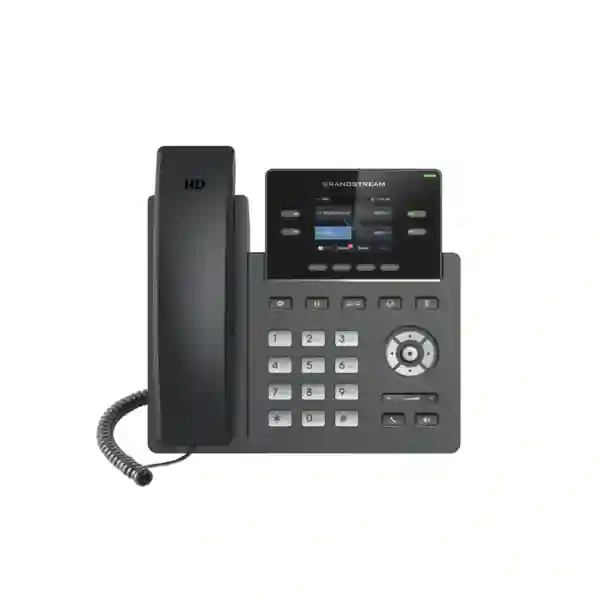
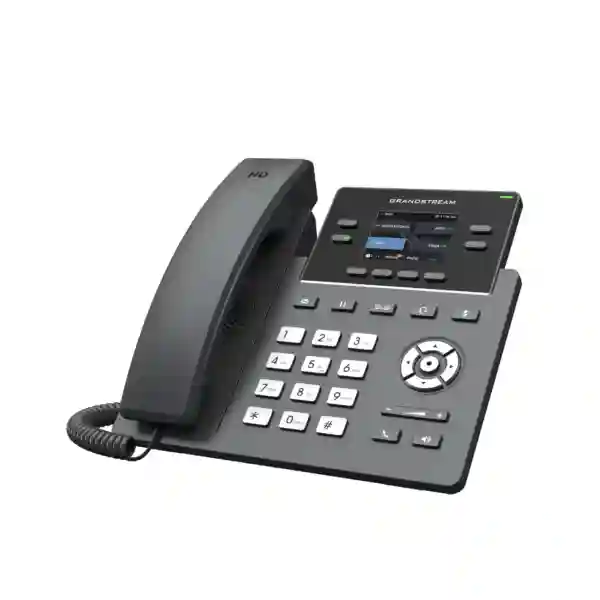
The Grandstream GRP2612 is a professional desk IP phone for organizations that want a manageable SIP endpoint for office users, branch teams, reception support roles and larger standardized deployments. Grandstream positions the GRP2612 family for mass deployment and easy management, with centralized administration through Grandstream Device Management System (GDMS). Current manufacturer information lists 4 SIP accounts, 4 multi-purpose line keys, a 2.4-inch 320 × 240 color LCD, HD audio with wideband codecs including G.722 and Opus, up to 16 digital BLF keys, a swappable faceplate and enterprise-oriented protection such as secure boot, dual firmware images and encrypted data storage. The family includes different network and power choices, so buyers should confirm the exact suffix before ordering rather than assuming every GRP2612 variant has the same interfaces.
What the Grandstream GRP2612 is designed to solve
A business desk phone has to do more than place and receive calls. It must fit the selected PBX, register reliably with SIP accounts, work with the network design, support the call-handling features expected by users and remain manageable as the number of extensions grows. The GRP2612 family is particularly useful where an organization wants a consistent endpoint platform that can be configured centrally rather than maintained one handset at a time. This makes it relevant for businesses standardizing telephony across departments, branches, service desks and distributed offices.
For Tanzania deployments, the practical decision is not simply whether the phone supports SIP. Buyers should verify the required power method, switch capabilities, network port speed, headset needs, PBX compatibility, provisioning approach and whether Wi-Fi is genuinely required. The standard GRP2612 uses dual 10/100 Mbps Ethernet ports without integrated PoE, while the GRP2612P adds PoE and the GRP2612W adds PoE plus integrated dual-band Wi-Fi. The GRP2612G provides Gigabit Ethernet with PoE. Selecting the exact variant at quotation stage prevents common installation problems such as missing power adapters, inappropriate switch expectations or buying Wi-Fi capability for desks that already have suitable wired connectivity.
Voice quality
HD audio support includes wideband codecs such as G.722 and Opus. Actual call quality still depends on the PBX, SIP trunk, WAN performance, LAN congestion, codec policy and Quality of Service design.
Central management
GDMS supports centralized configuration, provisioning, monitoring and management of compatible Grandstream endpoints, helping IT teams maintain repeatable settings across larger phone estates.
Business call handling
The platform supports common telephony functions such as hold, transfer, forward, call pickup, call park, shared or bridged line appearances, conferencing and downloadable phonebook options when configured with a compatible system.
GRP2612, GRP2612P, GRP2612W and GRP2612G differences
| Variant | Ethernet | PoE | Wi-Fi | Typical selection reason |
|---|---|---|---|---|
| GRP2612 | Dual 10/100 Mbps | No integrated PoE | No | Wired desk where local power is acceptable |
| GRP2612P | Dual 10/100 Mbps | Yes | No | PoE-powered wired deployment |
| GRP2612W | Dual 10/100 Mbps | Yes | Dual-band; newer hardware supports Wi-Fi 6 per Grandstream | Flexible desks where Wi-Fi is required |
| GRP2612G | Dual Gigabit | Yes | No | Gigabit pass-through requirement |
Hardware revisions have changed over the product lifecycle. Grandstream identifies older hardware as legacy and documents different account limits for some discontinued revisions. Buyers replacing an existing unit should therefore verify the hardware revision and exact model suffix rather than assuming an old GRP2612 has the same capabilities as current documentation.
Technical and deployment highlights
2.4-inch 320 × 240 color LCD with a swappable faceplate for organizations that want visual branding consistency.
Current manufacturer product information lists 4 SIP accounts, 4 multi-purpose line keys and up to 16 digital BLF keys.
Secure boot, dual firmware images, encrypted data storage, TLS and SRTP support provide a foundation for more securely managed voice deployments.
RJ9 headset connectivity, HD handset audio and full-duplex speakerphone operation support different desk-working styles.
Compatibility, PBX and network planning
A GRP2612 can register to SIP-based systems, but procurement should still confirm the exact PBX platform, firmware level, SIP feature requirements and any provisioning templates used by the organization. Features such as BLF, shared line appearance, voicemail indicators, directory access and server-side call handling depend on the phone and PBX being configured together. Grandstream UCM deployments are a common pairing, but the phone’s SIP standards support broader use where interoperability has been validated.
Network readiness is equally important. Voice should be protected from avoidable congestion with appropriate VLAN, QoS and switch configuration. PoE-capable variants require a switch with sufficient port and power budget. A computer connected through the phone’s PC port shares the physical desk connection, so the GRP2612G can be preferable when Gigabit throughput to the attached workstation is required. For larger projects, centralized provisioning through GDMS and consistent naming, extension ranges, firmware policy and backup processes can reduce support effort.
Grandstream GRP2612 Tanzania
Organizations searching for the Grandstream GRP2612 in Tanzania are usually trying to solve one of three practical problems: standardizing desk phones for a new IP PBX, replacing older SIP handsets with centrally manageable models, or extending an existing Grandstream environment without creating a mixed collection of endpoint types. The GRP2612 family fits these scenarios when the user profile calls for a color-screen business phone, multiple SIP accounts, programmable line handling and support for centralized provisioning. For a Tanzania-wide procurement, the most valuable preparation is a clear extension count, user-role map and network-power plan. Standard users may need only core calling functions, while reception, support or supervisors may use BLF and call pickup more intensively.
The Tanzania network environment should be considered before selecting the suffix. A site with managed PoE switching will usually benefit from a PoE-capable GRP2612P, GRP2612W or GRP2612G because power is delivered over the Ethernet cable and can be protected centrally through a UPS-backed switch. A desk without PoE can use the standard GRP2612 with suitable local power. Where Wi-Fi is required because cabling is impractical, the GRP2612W can provide greater placement flexibility, but wired Ethernet remains preferable for predictable voice performance when cabling is available. If the user’s PC will pass through the phone and requires Gigabit connectivity, the GRP2612G is the more appropriate family member.
Tanzania buyers should also confirm whether the phones are for a single office or a standardized multi-site deployment. Multi-site designs benefit from agreed extension numbering, firmware policy, VLAN standards, provisioning templates and documented fallback procedures. Central management through GDMS can help administrators apply consistent configuration and monitor compatible endpoints without visiting every desk. The PBX, SIP trunk and firewall configuration still need to be designed coherently, because centralized phone management does not replace correct voice routing, NAT policy or WAN resilience.
Fourteck Tanzania can support the commercial and technical evaluation by connecting the endpoint decision to the wider telephony environment. Buyers can review the Fourteck Tanzania technology shop for broader business IT categories, and use the Tanzania contact page to provide quantity, PBX information, preferred variant and deployment details. A useful quotation request should state the number of handsets, whether PoE is available, whether Wi-Fi or Gigabit pass-through is needed, and whether configuration or integration assistance is part of the required scope.
Grandstream GRP2612 Dar es Salaam
For businesses in Dar es Salaam, the GRP2612 is relevant to corporate offices, professional services firms, logistics operations, hospitality administration, retail management offices and growing organizations moving from basic analog telephony to SIP-based communications. Dar es Salaam environments often include a mixture of new and existing cabling, managed switches, internet connections and legacy PBX arrangements. Before choosing the phone, the voice design should identify whether the deployment will use an on-premises IP PBX, hosted SIP service or hybrid approach. The phone itself is only the user endpoint; call routing, external numbers, queues, recording, voicemail and branch connectivity are determined by the surrounding system.
A common procurement question in Dar es Salaam is whether to buy the base GRP2612 or a powered/network-enhanced variant. If desks connect to PoE switches, GRP2612P provides a cleaner installation because individual power adapters are not required at each position. Where office layouts change frequently or cable access is restricted, the GRP2612W can be considered for Wi-Fi, provided wireless coverage and capacity are designed for voice traffic. For desks where the same wall outlet serves both phone and computer and the workstation requires high wired throughput, the GRP2612G avoids the 100 Mbps limitation of the base/P/W Ethernet interfaces.
Dar es Salaam offices should also plan for power continuity and network segmentation. A PoE switch connected to a correctly sized UPS can keep several phones powered during short interruptions, but the full voice chain must remain available, including the switch, PBX or cloud path, firewall and internet link. Voice VLANs can separate phone traffic from general data, while QoS can prioritize latency-sensitive packets during periods of congestion. These design steps are especially important in offices where large file transfers, cloud backups, video meetings and IP telephony share the same internet connection.
For a quotation, Dar es Salaam buyers should provide the number of extensions, expected user roles, existing switch model, PoE availability, PBX brand, SIP provider and any need for headsets, wall mounting or custom faceplates. Fourteck’s Tanzania IT and telecom services overview explains the wider integration approach around networking, IP telephony and infrastructure. This helps distinguish a simple handset purchase from a full project that may include provisioning, VLAN configuration, PBX setup, testing and user handover.
Grandstream GRP2612 Mwanza
In Mwanza, the GRP2612 can suit branch offices, distributors, service businesses, educational administration, healthcare offices, hotels and other organizations that need consistent SIP calling without moving to a high-end executive handset at every desk. The key purchasing question is how many users need advanced call visibility versus straightforward extension calling. The GRP2612 provides up to 16 digital BLF keys, which can be useful for teams that watch colleague availability or shared extensions, but the actual BLF behavior depends on PBX configuration and subscription support. Buyers should specify which users require these functions rather than assuming every employee needs the same profile.
For Mwanza sites, network reliability and power design deserve attention. A small office may have a basic unmanaged switch and local adapters, while a larger branch may already use managed PoE switching. The latter is generally easier to manage because phones can be powered centrally and isolated on a voice VLAN. If an existing switch has limited PoE budget, the quantity of GRP2612P/W/G devices must be checked against available power capacity. Where local power is used, adapter availability and socket planning become part of installation. The objective is a clean, supportable desk setup rather than a mixture of improvised power and cabling.
A multi-branch Mwanza deployment should also consider how extensions connect to headquarters or cloud services. Site-to-site VPN, secure SIP transport, firewall policies and WAN failover can influence call availability. The GRP2612 supports security features including TLS and SRTP, but these need matching support and correct configuration on the PBX or service side. For organizations deploying many endpoints, GDMS can simplify configuration consistency, firmware oversight and remote management. A standard template for time zone, language, codec order, account settings and programmable keys can make support more predictable.
Procurement teams in Mwanza should request the exact GRP2612 variant rather than a generic model name. Quotations should identify whether the unit is GRP2612, GRP2612P, GRP2612W or GRP2612G and list any accessories, power requirements and configuration scope. This avoids receiving equipment with the wrong Ethernet or power characteristics. For broader project coordination, the Fourteck Tanzania business technology overview covers networking, IP phones, PBX, Wi-Fi, cabling and other dependencies that can affect a Mwanza office rollout.
Grandstream GRP2612 Arusha
Arusha organizations commonly need telephony for hotels, travel operations, professional offices, NGOs, education, administration and multi-department service environments. The Grandstream GRP2612 can be a practical fit for standard office desks where users need reliable SIP calling, a color display, programmable line functions and centralized administration. In hospitality or travel operations, the handset may sit at reservations, administration or back-office positions rather than guest rooms, where a different form factor and feature set may be preferable. Matching the phone to the user role is therefore more important than buying one handset for every location.
For Arusha businesses using an IP PBX, call flow design should be settled before mass phone configuration. Reception groups, reservations queues, after-hours routing, department extensions, voicemail policies and emergency contact procedures influence how keys and accounts are configured. Up to four SIP accounts can support users who need distinct line identities, while digital BLF keys can expose monitored extensions or common functions. These features become most useful when the PBX numbering plan and user workflow are deliberately designed rather than left to default settings.
Infrastructure selection also matters. GRP2612P is appropriate when Fast Ethernet and PoE are sufficient, GRP2612W provides Wi-Fi plus PoE where wireless placement is needed, and GRP2612G is the family choice for Gigabit Ethernet pass-through. In an Arusha office with laptops on Wi-Fi and phones on wired Ethernet, Fast Ethernet may be entirely adequate for the phone itself. In a desk environment where a high-speed desktop uses the phone as a pass-through network device, Gigabit can be more important. This distinction helps prevent paying for specifications that do not improve the user’s actual setup.
Buyers should also check lifecycle and hardware revision when replacing older GRP2612 units. Grandstream documentation identifies legacy hardware from earlier production and notes different account limits on discontinued revisions. If an Arusha organization is expanding an older installed base, model labels and hardware versions should be recorded before ordering replacements. This enables a more accurate configuration plan and reduces surprises during firmware standardization. A quotation can then separate new endpoints, replacement units, PBX configuration, switch upgrades and optional deployment services into a clear scope.
Grandstream GRP2612 Dodoma
For Dodoma offices, administrative organizations, professional services and expanding institutions, the GRP2612 offers a standardized SIP endpoint that can support a controlled migration from older desk phones to IP telephony. A successful deployment starts with extension and user mapping. Users who primarily make internal and external calls may use a straightforward configuration, while assistants, supervisors and shared-service teams can make greater use of multi-purpose keys and BLF. Defining these profiles before configuration makes the final rollout easier to document and support.
Dodoma procurement should include network and power questions from the beginning. If the building already has managed PoE switching, a PoE-capable model can simplify desk cabling and centralize power protection. If phones will be connected through local adapters, the quotation should state whether power supplies are included for the selected regional package. For GRP2612W, Wi-Fi capability should be chosen because the site needs it, not merely because wireless sounds more flexible. Wired Ethernet normally provides the most predictable path for voice where structured cabling is present.
The PBX and firewall configuration should also be planned for secure operations. SIP registration, NAT handling, DNS, NTP, certificate use and remote provisioning all affect endpoint stability. The phone supports TLS and SRTP, 802.1X and encrypted configuration capabilities, but security features need to be enabled in a coherent design. Administrators should also maintain strong device passwords, controlled management access and a documented firmware process. GDMS can assist with central endpoint management while the wider voice system remains governed by the organization’s PBX and network policies.
For projects involving several Dodoma departments or multiple Tanzania branches, standardization can be more valuable than choosing the least expensive handset per desk. Consistent models, firmware, naming, VLANs, provisioning and support procedures make it easier to replace a phone, add a user or troubleshoot a registration problem. Fourteck Tanzania’s consultation process can use the quantity, PBX, switch environment, user profiles and expected growth to determine whether the GRP2612 family is suitable or whether some roles require a different Grandstream endpoint.
Grandstream GRP2612 UAE
The UAE market often includes large offices, distributed branches, hospitality groups, trading companies and service providers that standardize endpoints across multiple sites. The Grandstream GRP2612 family is designed around this kind of repeatable deployment, with zero-touch-oriented provisioning capabilities and GDMS support for centralized management. Organizations operating both Tanzania and UAE locations can benefit from using a common phone policy where PBX, SIP trunk and regulatory requirements permit, because consistent models reduce training and support variation. Configuration can still be localized for extension ranges, time settings, dialing rules and branch-specific call routing.
Variant selection remains important. A modern UAE office with PoE access switching may use GRP2612P for standard desks and GRP2612G where a desktop workstation requires Gigabit pass-through. GRP2612W can help in flexible workspaces or areas without convenient data outlets, but enterprise wireless coverage should be verified before voice depends on it. Wi-Fi calling from a fixed desk phone is most useful when it solves a genuine cabling problem; otherwise, wired Ethernet typically offers easier troubleshooting and more consistent latency.
For cross-border procurement, buyers should avoid assuming that packaging, adapters, warranty handling or hardware revision will be identical in every market. The exact model suffix, hardware revision and regional package should be confirmed on the quotation. Firmware standards should also be planned carefully if phones are managed across countries. A centralized policy can set approved firmware and provisioning rules, while site-specific templates define PBX credentials, VLANs and regional dialing. This approach supports consistency without forcing every office into one inflexible configuration.
Organizations comparing UAE and Tanzania deployments should build a common bill-of-materials template containing phone variant, quantity, PoE requirement, switching, PBX platform, SIP trunk information, headset accessories and configuration scope. This creates a cleaner procurement record and highlights differences between branches before equipment arrives. Fourteck’s regional network can then support discussions that span more than one market without presenting the phone as an isolated purchase.
Grandstream GRP2612 Uganda
Uganda businesses evaluating the GRP2612 may be planning a new office PBX, replacing older analog extensions or standardizing IP phones across Kampala and regional branches. The model family suits environments where centralized administration and consistent desk-phone behavior are important. The decision should begin with the required number of endpoints and the PBX architecture. If the organization has several branches, extension numbering and inter-site calling should be defined before individual phones are provisioned. This reduces later changes to speed dials, BLF assignments and user instructions.
Power and switching design have a direct effect on installation quality. GRP2612P and GRP2612W support PoE over their Fast Ethernet interfaces, while GRP2612G adds Gigabit interfaces with PoE. A managed PoE switch can simplify power distribution and voice VLAN assignment, but its power budget should be checked for the full endpoint count. If phones are deployed in small branches with basic network hardware, the base GRP2612 may be workable with local power, although support teams should then track adapters and outlet requirements.
Uganda deployments that rely on cloud or centralized PBX services should pay close attention to WAN performance and failover. Voice is sensitive to delay, jitter and packet loss. QoS can help on the LAN, but it cannot compensate for an unstable upstream link. Where business continuity is important, dual-WAN firewall design or backup connectivity may be part of the telephony project. Secure SIP transport and appropriate firewall rules should be configured according to the PBX design rather than opening broad inbound access to phones.
Fourteck’s Uganda IT solutions site covers IP PBX, VoIP and networking requirements that relate directly to GRP2612 deployments. Buyers preparing a quotation should state the site count, phone quantity, desired variant, switch/PoE environment and whether the requirement is hardware supply only or includes PBX and network integration.
Grandstream GRP2612 Kampala
Kampala offices can use the GRP2612 as a standard desk endpoint for finance, administration, sales, support and management users where the call workflow does not require a larger executive console or expansion module. The color screen and programmable functions offer more usability than very basic SIP handsets while keeping the design suitable for larger deployments. For reception-heavy roles, buyers should first confirm whether 16 digital BLF keys are sufficient; high-volume attendants may be better served by another model that supports a larger key layout or expansion accessories.
The network connection should be selected around the workstation. A phone-only position generally does not need Gigabit bandwidth for voice. However, when a user’s desktop computer connects through the phone, the pass-through port becomes part of the data path. GRP2612G is the variant to consider when Gigabit access is necessary. GRP2612P is a strong fit when the desk already has PoE and Fast Ethernet is adequate, while GRP2612W adds Wi-Fi for locations where cabling cannot be used conveniently. Understanding this distinction can reduce unnecessary cost while protecting user performance.
Kampala organizations with many extensions should also decide how devices will be provisioned. Manual browser configuration can work for a few phones but becomes harder to control as the estate expands. GDMS or another validated provisioning method can support consistent account templates, firmware policy and monitoring. Administrators should document which settings are global and which are site-specific. Phone labels, extension numbering, VLAN IDs, time settings and programmable keys are easier to maintain when they follow a standard convention.
A Kampala quotation should include the exact handset variant and quantity, whether wall mounting or headsets are required, the PBX type, the expected number of SIP accounts per user, PoE availability and deployment assistance. It is also useful to mention whether the organization expects future branch expansion. A scalable design can reserve extension ranges and network capacity now, avoiding a complete renumbering or switch replacement when the phone system grows.
Grandstream GRP2612 Arua
For Arua businesses and institutions, IP telephony may need to balance professional call handling with practical infrastructure constraints. The GRP2612 can provide a consistent SIP desk phone for administration, branch coordination and customer-facing staff, but network readiness should be checked before deployment. The phone depends on the LAN, PBX and upstream connectivity for service, so cabling quality, switch stability and internet reliability can matter as much as the handset specification itself. This is particularly important where the PBX is hosted in another city or in the cloud.
Arua sites should decide whether centralized PoE or local power is the better operational choice. PoE-capable variants reduce adapter clutter and allow phones to be powered from network equipment that may already be protected by a UPS. In a smaller site without PoE switching, the base model can be deployed with suitable local power, but power adapters need to be included in the scope. If a switch upgrade is already planned, choosing managed PoE can support both telephony and future access points or cameras while enabling VLAN separation.
For remote support, standardized configuration is especially valuable. GDMS can help administrators manage compatible Grandstream devices from a central interface, reducing the need for desk-side changes for routine provisioning tasks. This does not eliminate the need for local checks when cabling or power fails, but it improves visibility into endpoint configuration. A documented configuration template should include SIP account parameters, codec order, time settings, VLAN behavior, security credentials and programmable keys.
When requesting GRP2612 options for Arua, the buyer should include the number of phones, whether users need PC pass-through, available switch ports, PoE status, internet connectivity and PBX location. If the project connects Arua to Kampala or another branch, inter-site calling and resilience requirements should be described. These details help determine whether a simple endpoint quote is sufficient or whether network, firewall and PBX configuration should be included as a combined project.
Grandstream GRP2612 Mbarara
Mbarara organizations considering the GRP2612 often need a dependable desk phone that can be repeated across several user roles without creating a complicated support environment. The model family can suit offices, healthcare administration, education, retail management, hospitality back offices and regional service businesses. A useful design starts by identifying which users need one primary extension, which require multiple SIP identities and which rely on monitored extensions. This determines how the four SIP accounts and digital BLF functions can be used without over-configuring simple users.
The choice between GRP2612P, W and G should reflect actual site infrastructure. PoE is valuable when managed switches and centralized UPS protection are already part of the network. Wi-Fi can solve physical cabling limitations but should not be selected as a substitute for proper structured cabling where a reliable wired port is available. Gigabit Ethernet matters mainly when a computer or other data device uses the phone’s pass-through connection and requires higher throughput. Clear matching of variant to use case prevents paying for features that are unused or discovering missing capabilities after installation.
Mbarara deployments should also include basic voice-network engineering. SIP phones need reliable DNS and time services, appropriate firewall policies and stable network addressing. QoS and voice VLANs can improve traffic separation and prioritization. Where the PBX is remote, WAN performance and backup connectivity may influence whether calls remain available during provider issues. The handset’s security capabilities should be combined with strong passwords, restricted management access and supported firmware rather than treated as automatic protection.
For procurement, specify the phone quantity, model suffix, desired color/faceplate requirements if any, headset needs and deployment timeline. If Mbarara is one location in a wider Uganda rollout, include branch counts and planned extension ranges so the PBX and provisioning structure can be designed once. A standardized template can then be adapted for each site while maintaining consistent user experience and support procedures.
Grandstream GRP2612 Gulu
For Gulu businesses, NGOs, education, healthcare administration and branch operations, the GRP2612 can act as a professional SIP endpoint where users need straightforward desk calling with access to business telephony features. The purchase should be linked to the organization’s call plan. Internal extension dialing, reception groups, voicemail, after-hours routing and transfer behavior are controlled by the PBX, while the phone presents those services to the user. Defining the call plan first produces a cleaner button layout and simpler training.
Site infrastructure can determine the best variant. GRP2612P is appropriate where Fast Ethernet and PoE are available, GRP2612W adds wireless connectivity for difficult-to-cable desks, and GRP2612G is preferable when the attached workstation requires Gigabit Ethernet through the phone. The base GRP2612 can be used with local power where PoE is unavailable. For larger Gulu installations, a managed switch and voice VLAN can make troubleshooting easier by separating phone traffic and providing better visibility into connected devices.
Remote management can reduce operational effort for sites supported from another city. GDMS provides a centralized Grandstream management environment that can assist with provisioning and monitoring compatible devices. IT teams should still maintain secure administrative practices, backup configuration records and an approved firmware policy. Legacy hardware revisions should be identified before mixing older and current units because Grandstream documents capability differences between discontinued early hardware and current versions.
A Gulu quotation should define both equipment and responsibility. If the request is hardware only, the customer should confirm who will provision extensions and test the PBX. If a complete solution is required, scope can include phone configuration, switch/VLAN preparation, PBX setup, SIP trunk coordination, testing and documentation. Clarifying this boundary makes commercial comparison easier and reduces assumptions during installation.
Grandstream GRP2612 Kenya
Kenya organizations may deploy the GRP2612 for Nairobi offices, regional branches, customer-service desks and standardized company telephony. The phone’s value is strongest when used as part of a repeatable endpoint strategy rather than as an isolated handset. Central management, consistent button templates and common firmware policies can lower the operational effort of supporting dozens or hundreds of extensions. Users can receive configurations suited to their roles while the hardware platform remains standardized.
Network selection should consider the attached computer as well as the phone. Voice traffic itself uses modest bandwidth, so Fast Ethernet is sufficient for the handset. The limitation becomes relevant if a high-speed workstation is connected through the phone’s PC port. In that scenario, GRP2612G provides Gigabit pass-through. GRP2612P is suitable for most standard PoE desks where Fast Ethernet is acceptable, and GRP2612W is relevant to flexible areas that genuinely require Wi-Fi. This role-based selection can be more cost-effective than specifying the highest-feature variant everywhere.
Kenya multi-site projects should establish common telephony standards across branches. Extension numbering, site codes, emergency dialing, SIP trunk routing, voice VLANs and provisioning templates can be designed centrally. Each branch can then adapt to its internet provider and switch layout while retaining the same user experience. Organizations with operations in both Kenya and Tanzania can apply the same principle across countries, provided local service-provider and regulatory requirements are handled separately.
The Fourteck Kenya site covers VoIP business phones, IP PBX and enterprise networking, making it a relevant reference for cross-border requirements. A Kenyan GRP2612 request should include quantity, exact variant, PBX platform, branch count, PoE availability and any configuration or rollout services. This creates a quotation that can be compared on complete scope rather than handset price alone.
Grandstream GRP2612 Kuwait
Kuwait businesses evaluating the GRP2612 may be looking for a standardized desk phone for administrative, sales, support or branch users. The family offers a practical middle ground between entry-level SIP phones and more complex executive models. Four SIP accounts, programmable line keys, a color screen and GDMS support make it appropriate for managed deployments where administrators want consistent configuration without giving every user a premium endpoint. The final choice should still be aligned to PBX features and daily call volume.
PoE and network speed are the main hardware differentiators buyers should confirm. GRP2612P provides PoE over dual 10/100 Mbps ports, GRP2612W combines that profile with Wi-Fi, and GRP2612G provides Gigabit with PoE. In modern offices, the Gigabit variant can be useful where a desktop computer connects through the phone. In locations where computers connect separately or use Wi-Fi, Fast Ethernet on the phone may be fully sufficient. This distinction should be made per desk profile rather than by assumption.
Kuwait projects may also require Arabic-language user experience or bilingual documentation. Grandstream documentation lists Arabic among supported interface languages, but administrators should confirm the chosen firmware and desired locale settings during staging. Time zone, dialing patterns, directory sources and programmable keys can then be standardized. If the organization has branches elsewhere in the Gulf or Africa, consistent provisioning templates can simplify support while allowing branch-specific numbering and SIP trunks.
Before ordering, procurement should verify exact model revision, regional package, included accessories and power requirements. Buyers should not assume that online listings from another market have identical packaging or support terms. A complete quotation should show model suffix, quantity, configuration scope and any network dependencies. This is particularly important when the phones form part of a wider PBX replacement where switches, firewall rules and SIP trunk migration are being changed at the same time.
Grandstream GRP2612 Ghana
Ghana businesses can use the GRP2612 as a standardized SIP handset for office users, branch teams and service departments that need predictable call handling and centralized management. The phone should be selected after confirming the PBX platform and extension design. Multiple SIP accounts can support users with more than one line identity, while BLF keys can help teams monitor frequently contacted extensions. These functions should be mapped to real workflows so the interface stays simple for users who do not need advanced monitoring.
A Ghana rollout should include a network readiness check. PoE-capable variants can be powered from suitable switches, reducing adapters at desks and making centralized UPS protection possible. Switch power budgets must be calculated for the total phone count, especially if the same switches also power wireless access points or cameras. Voice VLANs and QoS can help keep traffic organized when telephony shares infrastructure with general business data. For offices with a PC behind each handset, decide whether Fast Ethernet is acceptable or whether GRP2612G’s Gigabit interfaces are required.
Organizations operating several Ghana branches should decide whether phone settings will be managed locally or centrally. GDMS can support centralized device management for compatible Grandstream endpoints, reducing configuration drift. A documented template can cover extension naming, account registration, firmware, time settings, directories and key assignments. Branch-specific differences can then be applied deliberately rather than created ad hoc during installation.
Procurement requests should identify whether supply, staging, configuration and on-site work are separate line items. This matters when comparing quotations because a low hardware price may not include PBX programming, VLAN work, SIP trunk testing or user handover. Clear scope also makes expansion easier: future phones can be added using the same standard template rather than recreating the design for every new desk.
Grandstream GRP2612 Nigeria
Nigeria’s large and diverse business environment makes endpoint standardization valuable for companies operating multiple offices, branches or departments. The GRP2612 family can serve as a common desk-phone platform for general business users while allowing variant choices according to network needs. An organization might deploy GRP2612P at most desks, GRP2612G where workstation Gigabit pass-through is necessary and GRP2612W only where wireless placement solves a real cabling issue. Maintaining the same user interface across variants can simplify training.
Power continuity and connectivity should be part of the voice design from the beginning. PoE switches can centralize phone power, but the switch, firewall, PBX and internet equipment also need appropriate backup if the organization expects calling during short power interruptions. Where a cloud PBX or SIP trunk depends on public internet, redundant connectivity may be more important than any individual phone feature. Voice QoS, VLANs and firewall rules should be designed together with the endpoint rollout.
For large Nigerian deployments, manual configuration at each desk is inefficient. GDMS provides centralized management capabilities that can help teams apply consistent provisioning and monitor endpoints. Administrators should still establish an approved firmware process and identify any legacy GRP2612 hardware before standardization. Grandstream documents that older revisions can have different account capabilities, so replacement projects should record the model and hardware revision of existing phones rather than relying only on the front-panel name.
A Nigeria quotation should include a site-by-site quantity, exact model suffix, PBX platform, switch/PoE details, extension plan and rollout responsibility. If several branches are involved, the procurement team can use a standard branch template covering phones, switching, firewall, UPS and connectivity assumptions. This makes commercial comparison clearer and reduces hidden dependencies that might otherwise appear during deployment.
Grandstream GRP2612 Seychelles
In Seychelles, hospitality, professional services, administration and multi-site businesses may need IP phones that can be managed consistently across offices or properties. The GRP2612 can suit back-office, reservations, finance and administrative users who need a professional SIP desk endpoint without the complexity of a high-end executive console. In hospitality environments, it is important to separate back-office requirements from guest-room telephony because guest rooms may require a different device family, provisioning model and feature set.
Island and multi-property deployments should pay close attention to WAN dependency. If the PBX is centralized or cloud-hosted, calls between sites depend on network connectivity. The phone can support secure SIP transport technologies, but reliability also depends on internet performance, firewall policy and provider availability. Organizations can consider backup connectivity, local survivability options supported by the PBX, and clear procedures for outages. These questions are more important to operational continuity than simply comparing handset feature lists.
The selected GRP2612 variant should reflect each desk. PoE simplifies installations where managed switches are available, Wi-Fi can solve limited cabling in selected areas and Gigabit pass-through can matter for desktop computers. In a hotel administration office with good cabling and PoE, GRP2612P may be sufficient for most desks. A few positions could use GRP2612G where data speed is important. This mixed-variant approach maintains a common phone family while controlling cost.
For Seychelles procurement, include the site names, phone count, PBX design, network topology and required accessories. If equipment is being shipped across islands or installed in stages, configuration templates and labeling become particularly useful because phones can be staged consistently before deployment. Documentation should identify extension ownership, switch port, VLAN, firmware and provisioning method so remote support teams can troubleshoot without relying on local memory.
Buying guidance: which GRP2612 variant should you request?
Choose GRP2612 when a wired Fast Ethernet desk phone is suitable and local power is acceptable. Choose GRP2612P when you want PoE and Fast Ethernet is sufficient. Choose GRP2612W when you require Wi-Fi capability plus PoE and have validated wireless coverage. Choose GRP2612G when PoE and Gigabit Ethernet pass-through are important. These rules are simple, but they cover the most common reason buyers receive the wrong variant.
Also confirm the hardware revision if you are expanding or replacing an older GRP2612 estate. Grandstream documentation separates legacy hardware from current supported revisions and notes different SIP account limits on discontinued hardware. Matching model suffix and revision is therefore part of responsible procurement, especially when a company expects identical behavior across old and new phones.
Related infrastructure for a reliable GRP2612 deployment
A business phone is only as reliable as the network and call platform behind it. Managed switches provide VLAN and QoS controls; PoE switches simplify power for P/W/G variants; firewalls control SIP-related traffic and remote access; UPS systems can protect the voice path during short power interruptions; and the PBX defines the actual call experience. A complete design should therefore review these components together rather than treating the GRP2612 as a standalone appliance.
For Tanzania projects, Fourteck can connect handset selection with PBX, switching, Wi-Fi and cabling decisions. This is particularly useful when a customer is moving from analog phones, adding branches or replacing mixed-brand SIP devices. A controlled design produces a consistent configuration, clearer support responsibility and a better foundation for future expansion.
Quotation checklist for Grandstream GRP2612
Frequently asked questions
Does the Grandstream GRP2612 support four SIP accounts?
Current Grandstream product information lists 4 SIP accounts and 4 multi-purpose line keys. Older legacy hardware revisions can have different limits, so replacement projects should verify the hardware revision of existing phones.
Does the GRP2612 have PoE?
The base GRP2612 does not provide integrated PoE. GRP2612P and GRP2612W provide PoE over Fast Ethernet, while GRP2612G provides PoE with Gigabit Ethernet.
Which GRP2612 model has Wi-Fi?
GRP2612W is the Wi-Fi variant. Grandstream states that newer hardware versions support integrated dual-band Wi-Fi 6. Confirm hardware version and deployment requirements before procurement.
Can the GRP2612 be centrally managed?
Yes. Grandstream lists support for GDMS, its centralized device management system for provisioning, configuration, monitoring and management of compatible endpoints.
Is GRP2612G better than GRP2612P?
They serve different network requirements. GRP2612G is preferable when Gigabit pass-through is needed. GRP2612P is sufficient when Fast Ethernet and PoE meet the desk requirement. The better choice depends on the connected workstation and network design.
What should I send for a GRP2612 Tanzania quotation?
Send the phone quantity, exact variant if known, PBX platform, switch/PoE details, site location, need for Wi-Fi or Gigabit pass-through, headset requirements and whether you need configuration or installation support.
Decision recap
The Grandstream GRP2612 family is best evaluated as a managed business endpoint platform, not merely as a telephone. Its core strengths are SIP flexibility, HD audio, programmable line handling, centralized GDMS management and a family of variants that cover standard Fast Ethernet, PoE, Wi-Fi and Gigabit requirements. The correct purchase depends on matching the exact suffix to the desk, PBX and network.
For Tanzania, a good quotation begins with quantity, PBX, PoE, network speed, Wi-Fi needs and deployment scope. Fourteck can then help confirm whether GRP2612, GRP2612P, GRP2612W or GRP2612G fits each user group and identify any supporting switching, PBX or cabling requirements before implementation.
Talk to Fourteck Tanzania about your GRP2612 requirement
Share the quantity, site, existing PBX and network details. If you are still deciding between the P, W and G variants, describe how each desk connects to power and data. This gives the sales and technical team enough information to prepare a more relevant quotation and avoid assumptions about PoE, Wi-Fi or Gigabit requirements.



Reviews
There are no reviews yet.