
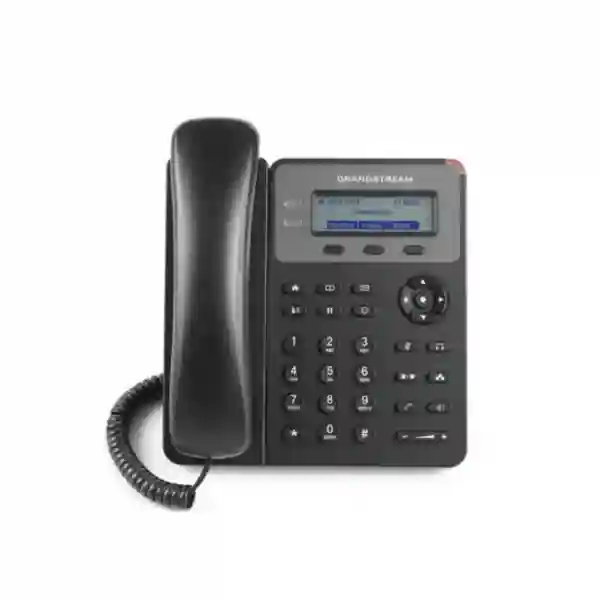
Grandstream GXP1610P Tanzania
The Grandstream GXP1610P is a straightforward small-business IP phone built for users who need dependable SIP calling without the complexity or cost of a high-end executive handset. Grandstream positions the GXP1610 family as a simple desktop VoIP platform with one SIP account, up to two call appearances, a 132×48 graphical LCD, three programmable context-sensitive soft keys, dual 10/100 Mbps Ethernet ports, three-way conferencing, headset support, centralized provisioning and security technologies such as TLS and SRTP. The GXP1610P variant adds integrated IEEE 802.3af Power over Ethernet, allowing a compatible PoE switch to carry both network connectivity and power to the phone through the Ethernet cabling. For organisations planning standard office extensions, shared desks, branch users, common-area phones or cost-conscious VoIP migrations, that combination makes the GXP1610P a focused endpoint rather than an overloaded feature phone.
Choose the GXP1610P when the requirement is a basic wired SIP desk phone with PoE, practical call handling and simple fleet provisioning. For users who need several SIP accounts, Gigabit Ethernet, colour displays, Wi-Fi, Bluetooth or many programmable line keys, evaluate a more advanced model instead.
A focused configuration for standard users who do not need multiple independent SIP identities on one handset.
The GXP1610P supports IEEE 802.3af PoE, helping simplify desks when a compatible PoE switch and structured cabling are available.
Useful for quick internal or external discussions without moving every call into a separate meeting platform.
Grandstream documents TR-069 and encrypted XML configuration methods, useful when administrators need repeatable deployment.
What the GXP1610P is designed to solve
Many businesses do not need an advanced desk phone at every seat. A finance clerk, warehouse desk, back-office employee, small branch user, reception overflow position or shared administrative station may only require one registered SIP identity, clear call handling, transfer, hold, conferencing, a phonebook, voicemail access and a dependable wired network connection. The GXP1610P is aimed at that practical requirement. It avoids features that may be unnecessary for standard users while retaining core VoIP functions and enterprise-friendly deployment mechanisms.
The most important design question is therefore not whether the phone has every modern feature. It is whether its one-account architecture, Fast Ethernet interfaces, PoE requirement and call-handling capabilities match the user role. Procurement teams should separate standard seats from reception, management, contact-centre and mobility users. Standardising the GXP1610P only where its feature set fits can make a deployment easier to budget and support. For broader telephony planning, FourTeck Tanzania’s business technology shop provides related purchasing context, while the Tanzania services page explains network, telephony and infrastructure support considerations.
Verified GXP1610P features and technical planning points
| SIP / call appearances | One SIP account with up to two call appearances in Grandstream’s current product documentation. |
| Display | 132×48 graphical LCD, designed for straightforward status, directory and call information rather than rich colour applications. |
| Networking | Dual switched auto-sensing 10/100 Mbps Ethernet ports. Confirm that Fast Ethernet is adequate for the intended desk and pass-through use. |
| Power | Integrated IEEE 802.3af PoE on the GXP1610P. Grandstream’s datasheet identifies PoE Class 2 operation for the PoE-capable model. |
| Audio and conferencing | Full-duplex speakerphone, wideband codec support including G.722, and three-way audio conferencing. |
| Headset | RJ9 headset connectivity with electronic hook switch support documented for compatible Plantronics headsets. |
| Security | Grandstream documents TLS, SRTP, HTTPS, 802.1x and encrypted configuration capabilities. Actual security depends on the PBX, provisioning method and network configuration. |
| Provisioning | Firmware upgrade through TFTP, HTTP or HTTPS and mass provisioning through TR-069 or encrypted XML configuration are documented options. |
Compatibility and buying guidance
The GXP1610P is a SIP endpoint, but a SIP label by itself does not guarantee that every PBX, hosted service or carrier feature will operate identically. Before ordering a fleet, confirm registration method, supported codecs, extension authentication, voicemail signalling, transfer behaviour, dial plan, directory requirements, VLAN settings, QoS, time synchronisation and provisioning. If the phone will connect to a Grandstream UCM platform, Grandstream documents Zero Config provisioning integration for this product family. For any other PBX, validate the exact firmware and feature set with a pilot unit or the system administrator.
PoE should also be checked as a system requirement. Confirm that the access switch supports 802.3af and that its total PoE budget can supply all phones, access points, cameras and other powered devices connected to it. A switch may have enough PoE-labelled ports but still lack sufficient aggregate power for the complete load. Where voice continuity matters during short mains interruptions, connect the PoE switching and PBX infrastructure to appropriately sized UPS protection. This keeps the power path, network path and call-control path aligned.
Who should consider the Grandstream GXP1610P?
Standard office extensions
A useful fit for users whose daily workflow centres on answering, transferring, holding and placing ordinary business calls rather than managing several accounts or large numbers of programmable keys.
Branches and shared desks
Its wired Ethernet, PoE option and centralized provisioning methods can suit repeatable branch rollouts where IT teams want consistent settings and reduced desk-side power clutter.
Budget-controlled VoIP migrations
When organisations are replacing analogue phones with IP extensions, the GXP1610P can provide a focused starting point if the existing or planned PBX supports the required SIP workflow.
Grandstream GXP1610P Tanzania
Businesses evaluating the Grandstream GXP1610P in Tanzania commonly need a practical desktop VoIP phone rather than a feature-heavy executive endpoint. The GXP1610P can fit offices that are introducing SIP telephony, standardising basic extensions or extending an existing IP PBX to more desks. The first procurement task should be to classify users. General administration, finance, operations, stores, small branch desks and common work areas may be well served by one SIP account and ordinary call controls. Receptionists or supervisors who monitor many extensions may need a different handset with more programmable keys, while mobile teams may be better served by Wi-Fi phones or softclients. This role-based approach prevents a single model from being forced into jobs it was not designed to handle.
Network readiness is equally important in Tanzania deployments. Because the GXP1610P includes integrated 802.3af PoE, an organisation can power phones through compatible access switches, reducing the number of individual adapters at desks. That benefit depends on structured cabling, correct switch configuration and sufficient PoE budget. Voice VLANs can help separate telephony from general data traffic, while Quality of Service settings may protect call traffic when shared links are busy. Where short power interruptions are operationally disruptive, consider UPS support for the PoE switches, PBX and connectivity equipment so phones do not remain powered while the call-control platform is unavailable, or vice versa.
A Tanzania quotation should identify phone quantity, user roles, existing PBX or hosted voice service, PoE-switch capacity, cabling status, SIP-provider information, required headsets, extension plan and desired provisioning method. It is also useful to state whether the phones will pass a PC connection through the second Ethernet port, because the GXP1610P uses Fast Ethernet rather than Gigabit. For wider procurement planning, FourTeck’s Tanzania portfolio covers IP phones, IP PBX, switching, cabling, UPS and related infrastructure. The objective should be a complete functioning voice environment rather than a box-only purchase whose network and call-control dependencies are discovered during installation.
Grandstream GXP1610P Dar es Salaam
For organisations in Dar es Salaam, the Grandstream GXP1610P can suit office environments where many employees require dependable desk calling but only a modest set of handset features. Commercial offices, logistics operations, clinics, professional practices, schools, warehouses and service businesses often have a mix of phone-user profiles. Rather than equipping every user with a premium endpoint, businesses can identify standard positions that need one SIP identity, call hold, transfer, three-way conferencing, a directory and hands-free calling. The GXP1610P is designed around that type of straightforward workflow. Users who require intensive call monitoring, colour displays, multiple SIP accounts or extensive BLF keys should be separated into a different handset profile during planning.
Dar es Salaam sites frequently combine voice with existing data, Wi-Fi and security traffic on the same network infrastructure. A deployment should therefore examine the switch layer before phones are purchased in volume. The GXP1610P’s PoE capability can simplify desk power, but the switch must provide compatible 802.3af service and enough total wattage for all powered endpoints. Administrators should document which switch ports belong to voice, which VLAN carries phone traffic, whether LLDP-MED is used, and how QoS marks are handled across access and upstream links. Where a PC is connected through the phone, remember that the device has 10/100 Mbps Ethernet interfaces, so the user’s desktop throughput requirement should be reviewed before using the phone as the pass-through network point.
A strong Dar es Salaam quote request should include the number of desk phones, extension ranges, call groups, receptionist requirements, PBX model, SIP trunk or hosted-voice details, network-switch inventory and any branch connections. Businesses with multiple premises should decide whether extensions register to a central PBX across WAN links and what happens if a branch loses connectivity. Testing a small pilot group can confirm audio quality, transfer behaviour, voicemail access and provisioning before a larger rollout. This creates a more predictable deployment and avoids treating the handset as an isolated purchase.
Grandstream GXP1610P Mwanza
Mwanza businesses considering the Grandstream GXP1610P may be looking for an economical way to standardise basic office calling across administrative desks, service counters, branch offices, stores or small operational teams. The phone is most appropriate where a user needs one SIP account rather than several independent identities. Procurement should start with a list of positions rather than simply a headcount. Some employees may rarely make external calls, while a receptionist or customer-facing team may handle far greater call volume and need more line keys or visibility. The GXP1610P can form the standard-user tier in a mixed handset design, leaving more advanced phones for roles that justify them.
For Mwanza deployments linked to a PBX in another city, connectivity quality becomes part of the phone-system design. Voice is sensitive to latency, packet loss, jitter and sudden congestion. Bandwidth alone does not guarantee good calls. Businesses should examine WAN performance, prioritisation and failover behaviour, especially where the branch depends on a central IP PBX. Local internet resilience or a secondary WAN path may be appropriate where telephone availability is business critical, but the exact design should reflect risk, cost and carrier options. The GXP1610P supports standard network and security capabilities such as VLAN/QoS-related protocols, TLS and SRTP, yet those features need matching configuration in the PBX and network to deliver practical benefit.
When PoE is used in Mwanza, size the switch around both port count and total power. Include current phones plus expected growth, access points or cameras sharing the same switch. Ensure the upstream switch, router, firewall and PBX remain powered if continuity is required. A quotation request should also state whether the organisation wants central provisioning. TR-069 or encrypted XML configuration can reduce repetitive manual setup for a fleet, but the provisioning server, firmware policy, credentials and configuration templates should be planned deliberately. This turns a set of phones into a manageable communications environment.
Grandstream GXP1610P Arusha
Arusha organisations such as hospitality businesses, tour operators, NGOs, professional offices, training institutions and multi-department enterprises can consider the Grandstream GXP1610P for standard desk extensions where straightforward voice service is the priority. In a hospitality or travel environment, for example, the handset may suit back-office administration, stores, accounting or staff workspaces, while front-desk and reservations teams may require phones with additional keys and call visibility. In an NGO or professional-services office, it can serve general users who need one registered extension, a clear directory and simple transfer or conference functions. Matching the phone to job role is more important than choosing one model for the entire building.
Arusha sites with multiple buildings or remote offices should assess how the GXP1610P reaches the PBX. If the call server is centralised, branch traffic may cross VPN or managed WAN links. Network teams should review QoS, routing, firewall policy, DNS, NTP and SIP traversal before deployment. If a hosted PBX is used, check the provider’s supported registration and provisioning methods and confirm whether every intended feature is available on this endpoint. A phone may successfully register yet behave differently for transfer, voicemail, caller identification or directory integration if the service uses platform-specific features.
PoE can be particularly useful where a neat desk layout and centralised power are desired. However, the switch’s power budget and UPS design should be calculated for the whole site. If phones must remain available during short outages, protecting only individual endpoints is not enough; the PoE switch, router, firewall, PBX and any required internet equipment must stay operational. For an Arusha quotation, provide extension quantities, building or floor distribution, PBX details, existing network switches, cabling condition, internet architecture, headset needs and future growth. This helps determine whether the GXP1610P is a suitable standard endpoint and what supporting network work belongs in the project.
Grandstream GXP1610P Dodoma
In Dodoma, the Grandstream GXP1610P can be considered for administrative, institutional and commercial environments that need a simple wired SIP phone for routine office communication. The phone’s one-account architecture makes the intended use clear: it is not a multi-line executive console but a standard endpoint for users who primarily need to place and receive calls, transfer callers, consult a directory, use hands-free audio and join basic three-way conferences. This can be useful when an organisation wants consistent endpoints across many ordinary desks while reserving advanced handsets for reception, management or high-call-volume teams.
A Dodoma deployment should be planned around the underlying LAN. Integrated 802.3af PoE means compatible switches can power the GXP1610P over Ethernet, reducing local adapter dependence and allowing central UPS protection where required. Procurement should not stop at counting PoE ports. Calculate total switch power budget, identify spare capacity, document voice VLAN settings and confirm that the uplinks can carry both voice and business data during busy periods. If a computer connects through the phone, check whether the 10/100 Mbps interface is adequate for that workstation. Employees transferring large files or using bandwidth-heavy applications may need a direct Gigabit switch connection instead.
For organisations with branches, document whether extensions are centralised in Dodoma or registered to systems elsewhere. Call continuity during WAN outages should be discussed before rollout. The chosen PBX, SIP trunk and firewall design determine how calls are routed and what recovery options exist. A procurement brief should therefore include PBX platform, extension numbering, call groups, voicemail requirements, carrier arrangements, branch topology, network equipment, firmware expectations and the number of phones that need headsets. A structured brief makes it easier to compare quotations on equal assumptions and helps the implementation team prepare configuration templates before the phones reach desks.
Grandstream GXP1610P UAE
For UAE organisations, the Grandstream GXP1610P can fit offices seeking a basic PoE SIP handset for standard users, secondary locations or cost-controlled desk-phone rollouts. Businesses should first decide whether the endpoint’s one SIP account and Fast Ethernet interfaces fit the workplace. In modern offices where each desk requires Gigabit pass-through for a computer, a different model may be more appropriate. Where the handset has its own switch connection or the attached workstation does not need Gigabit throughput, the GXP1610P can provide a straightforward calling experience with transfer, hold, conferencing, directory functions, headset connectivity and centralized provisioning support.
UAE projects should verify the selected PBX or hosted-voice service, telecom requirements and SIP-provider interoperability before purchasing large quantities. The handset supports SIP and a broad set of standard protocols, but carrier services, number plans, emergency-calling rules and hosted-platform features are separate considerations. Confirm whether the PBX administrator will use manual configuration, TR-069, XML provisioning or another supported workflow. For large fleets, consistency of firmware, templates, passwords and VLAN settings can have more operational value than manual desk-by-desk configuration.
Power design is also important. The integrated 802.3af capability can reduce power adapters at desks, provided the switches have enough aggregate PoE budget. In offices with many phones and access points, calculate worst-case powered-device demand and preserve headroom for expansion. Where uptime matters, connect network and voice infrastructure to suitable UPS protection. Organisations operating across the UAE and East Africa may also want consistent endpoint standards across branches, but each site should still be validated for PBX connectivity, WAN quality and local telecom conditions. For regional technology context, see FourTeck UAE; the final bill of materials should remain specific to the actual phone system and site design.
Grandstream GXP1610P Uganda
Uganda organisations assessing the Grandstream GXP1610P can use it as a standard desk-phone option where one SIP account, PoE, ordinary call control and centralized provisioning are sufficient. A practical deployment might combine GXP1610P units for general office users with more advanced handsets for reception, supervisors or teams that need several lines and programmable presence keys. That mixed approach helps match cost to job function. It also reduces the chance that users outgrow the endpoint because requirements were not differentiated before procurement.
For branches, connectivity and PBX architecture should be evaluated together. If the main call server is located in Kampala or another regional data centre, branch phones may depend on WAN links for registration and external calling. Network teams should measure packet loss, jitter and latency, configure voice prioritisation where appropriate and decide how calls should behave when the primary link fails. The GXP1610P supports common security and provisioning mechanisms, but those features need coordination with the PBX and network. Do not assume that enabling TLS or SRTP on one side is enough; certificates, ciphers, server settings and endpoint configuration need to agree.
Uganda quotations should include handset quantity, extension design, PBX or cloud-voice platform, internet topology, PoE switch information, structured cabling, headsets and expected growth. If several locations are being standardised, document a common firmware version, naming convention and provisioning template so support teams can identify devices consistently. For Uganda-specific infrastructure information, organisations can also consult FourTeck Uganda. The purchasing decision should still be based on the exact calling workflow, network design and service provider used at each site.
Grandstream GXP1610P Kampala
Kampala offices often have varied user groups across reception, customer service, finance, management and back-office operations. The Grandstream GXP1610P is best treated as a standard-user handset within that mix. Its one SIP account and two call appearances can be adequate for ordinary extensions, while teams that monitor multiple lines or require heavy BLF use may need a higher-feature endpoint. A simple handset can be valuable when the organisation wants familiar physical keys, wired reliability, PoE and a consistent user experience without deploying advanced phones everywhere.
Before a Kampala rollout, map the network path from each desk to the PBX and SIP service. Confirm switch capacity, voice VLAN configuration, DHCP and DNS behaviour, firewall rules and QoS. If phones share switch ports with computers through the built-in dual 10/100 Mbps Ethernet interfaces, check the desktop bandwidth requirement. Users working with large cloud files, high-resolution video or other data-intensive applications may be better connected directly to Gigabit switching while the phone uses a separate port. This is a design decision rather than a defect: the endpoint is built as a basic Fast Ethernet business phone.
Kampala organisations with multiple branches should also define how extensions work during WAN outages. A phone registered to a central PBX cannot provide all normal services if the path to that PBX disappears. The organisation may choose redundant links, local survivability options in the broader phone system or an acceptance that branch calling will pause during rare outages. Whatever approach is selected should be documented before procurement. A complete quotation brief should therefore include extension counts, branch locations, call-flow diagrams, SIP provider, network switches, power protection, user profiles and implementation expectations rather than only the model and quantity.
Grandstream GXP1610P Arua
For Arua businesses and branch offices, the Grandstream GXP1610P can be suitable when the requirement is a basic SIP desk phone that can be managed as part of a central VoIP system. Branch deployments often benefit from simple, repeatable endpoints because local IT resources may be limited. Administrators can prepare configuration templates centrally, assign extensions consistently and ship phones with a documented process for connection and testing. The GXP1610P’s TR-069 and XML provisioning capabilities support this type of fleet-management approach when the broader platform is configured correctly.
The main design question for Arua is often not the handset itself but the reliability of the connection to call control. If the PBX is elsewhere, voice traffic depends on the WAN. Businesses should evaluate primary and backup connectivity, measure quality during busy hours and decide whether voice should receive priority over less time-sensitive traffic. A link can have adequate headline bandwidth while still producing poor call quality if jitter or packet loss is high. The GXP1610P supports standard codecs and QoS-related technologies, but the routers, switches and PBX must be configured consistently for those capabilities to matter.
PoE can simplify branch installation because phones do not each need a local power adapter, although the access switch then becomes a critical component. Confirm its 802.3af support, PoE budget and UPS strategy. Keep spare switch capacity for future extensions or other powered devices. For an Arua quote, include phone quantity, branch-to-head-office connectivity, PBX location, SIP trunk arrangement, extension plan, headset needs, switch model and any requirement for remote provisioning. A small pre-deployment test can validate the complete path—from desk port to PBX and carrier—before dozens of phones are installed.
Grandstream GXP1610P Mbarara
Mbarara organisations may consider the Grandstream GXP1610P when they need standardised desktop extensions for offices, education, healthcare administration, hospitality back offices, professional services or growing commercial sites. The phone is deliberately simple. That makes it easier to explain to users and can reduce unnecessary configuration, but it also means procurement should not assign it to roles that need multiple SIP identities, Gigabit pass-through, large colour screens or many programmable line keys. A user-role matrix is a useful first step: mark positions as standard, reception, high-call-volume, executive, mobile or shared, then select endpoints accordingly.
Mbarara businesses deploying phones across several floors or buildings should plan PoE and cabling before ordering. The GXP1610P can draw power through 802.3af PoE, allowing central control at the switch. Verify cable quality, switch-port availability and total PoE capacity. If the environment also powers cameras and wireless access points from the same switches, include those loads in the calculation. Voice VLANs can improve organisation and policy control, but network segmentation should be documented so administrators know which DHCP scope, gateway and QoS settings apply to phones.
The PBX and carrier side deserve equal attention. Confirm extension credentials, codec preferences, dial plan, inbound and outbound number behaviour, transfer features and voicemail. If the phone system is hosted outside the branch, test network quality and firewall traversal. A quotation should separate endpoint cost from the surrounding solution: PoE switching, PBX licensing, SIP services, cabling, installation and ongoing support are different components. Clear separation helps procurement compare offers and understand which element is responsible when a future change is required.
Grandstream GXP1610P Gulu
Gulu offices looking to move from analogue extensions or ad-hoc calling tools to managed SIP telephony can evaluate the Grandstream GXP1610P as a basic wired endpoint. Its strongest use case is a standard desk where one SIP account is sufficient and the user benefits from a familiar handset, speakerphone, transfer, hold and conferencing controls. A business should avoid assuming that every role requires the same phone. Receptionists, supervisors and contact-centre staff may need devices with more line keys, while roaming staff may prefer cordless, Wi-Fi or softclient options. The GXP1610P can therefore be one tier within a broader endpoint strategy.
Gulu branch connectivity should be designed with voice sensitivity in mind. If registration and calls traverse the public internet or a WAN to another city, packet loss and jitter matter. Organisations should test voice quality during normal and peak periods, review firewall handling of SIP and RTP, and consider link redundancy where telephone availability is important. Security should be planned at both endpoint and system levels. Grandstream documents TLS, SRTP, HTTPS, encrypted configuration and access-control capabilities, but actual protection depends on secure passwords, PBX policies, firmware management and network segmentation.
A PoE rollout can simplify the physical installation at desks, yet it concentrates power dependency in the switching layer. Ensure switches and upstream network devices are included in UPS planning if short-outage resilience is required. Keep spare ports and PoE headroom for expansion. For procurement, record the exact quantity, firmware policy, PBX platform, user groups, extension ranges, provider details and network design. This information also helps support teams troubleshoot consistently because every phone can be tied to a known user, switch port, VLAN and configuration profile.
Grandstream GXP1610P Kenya
Kenya businesses evaluating the Grandstream GXP1610P can use the model for basic office calling where an affordable PoE-enabled SIP endpoint is more important than advanced display or mobility features. It can fit standard staff desks, branch offices, back-office positions, service counters and shared work areas. The one-SIP-account design should be checked against user requirements before purchase. If a user handles several independent accounts, needs numerous monitored extensions or expects Gigabit connectivity through the phone, selecting a more capable model from the outset can reduce later replacement.
For Nairobi headquarters with branches elsewhere in Kenya, endpoint standardisation can simplify support. IT teams can create naming rules, firmware policies and provisioning templates so devices are configured consistently regardless of location. However, WAN performance and carrier arrangements still need site-specific review. Confirm whether calls are carried to a central PBX, a hosted platform or a local branch system, and define what should happen when an internet connection fails. Where a central design is used, QoS and link resilience may be more important than adding handset features.
The GXP1610P’s integrated 802.3af PoE is useful when the LAN is built around PoE access switches. Calculate switch budget across phones, access points and cameras rather than considering the phone fleet alone. If PCs connect through the handset, remember that its Ethernet ports operate at 10/100 Mbps. A quotation should therefore include network context as well as endpoint quantity. For regional procurement information, FourTeck Kenya provides market-specific technology context. Compatibility with any PBX, hosted service or carrier should still be verified for the exact deployment before a bulk order.
Grandstream GXP1610P Kuwait
Kuwait organisations can consider the Grandstream GXP1610P for straightforward SIP telephony at ordinary user desks, secondary offices or back-office positions where PoE and basic calling functions are sufficient. Procurement teams should assess the handset in the context of the complete phone system. The one-account design is appropriate for users with a single extension identity, while reception or multi-line workflows may justify a more advanced endpoint. The 132×48 LCD is intended for simple call and menu information rather than rich graphical applications, and the dual Ethernet ports are Fast Ethernet rather than Gigabit.
PBX and telecom-provider compatibility should be checked before large deployments. SIP standards provide a common foundation, yet providers can differ in authentication, codecs, number formatting and supplementary feature behaviour. Test registration, inbound and outbound calling, transfer, hold, caller ID, voicemail indications and conferencing with the intended system. If centralized provisioning is planned, confirm the preferred method and create a controlled process for firmware updates. Administrators should avoid allowing every handset to drift to a different version or configuration, particularly in larger estates.
PoE planning is especially useful for tidy office installations and central power management. Verify switch compliance with 802.3af, total power budget, port count and UPS capacity. If handsets are part of a broader network refresh, voice VLANs and QoS can be designed at the same time rather than added after users report poor calls. A Kuwait quotation should identify handset count, switch models, PBX or cloud-voice platform, carrier details, required headsets, desktop network requirements and implementation scope. The goal is to ensure that the endpoint, network and telephony platform function as one system.
Grandstream GXP1610P Ghana
Ghana organisations searching for a simple Grandstream business phone can evaluate the GXP1610P for standard SIP extensions that benefit from PoE and familiar desktop controls. It can be suitable for ordinary administrative users, branch employees, store offices and shared service desks where one SIP account is enough. The main advantage is not a long list of premium features; it is a focused set of everyday VoIP functions combined with centralized provisioning and wired connectivity. That makes the model easier to position in a tiered endpoint plan.
Before deployment, businesses should map the telephony architecture. Determine whether the phone registers to an on-premises PBX, a cloud service or a central system in another location. Confirm SIP credentials, codecs, dial plan, voicemail and directory integration. If the service crosses public internet links, review firewall and NAT behaviour and test call quality. Security settings should be coordinated end to end. TLS and SRTP support on the phone can help protect signalling and media when the PBX also supports and correctly configures those features.
PoE can simplify cabling and power at desks, but the access switch must have sufficient capacity for the whole powered environment. Organisations that run phones, Wi-Fi access points and cameras on the same switch should calculate combined demand. Consider UPS-backed switching if voice availability is required through short power events. Ghana procurement teams should also note the Fast Ethernet interfaces when deciding whether a computer will be connected through the handset. For users with higher desktop bandwidth requirements, a direct Gigabit switch connection may be preferable. A quote should therefore include network and user-role information instead of only model and quantity.
Grandstream GXP1610P Nigeria
Nigeria businesses can use the Grandstream GXP1610P as a basic SIP endpoint in offices that want physical desk phones, PoE and centralized management without equipping every user with an advanced handset. Standard staff extensions, shared administrative areas and branch offices are logical use cases. High-call-volume roles should be assessed separately. A receptionist or contact-centre user may require more line appearances, BLF keys, headset controls or a larger display than the GXP1610P provides. Defining user groups before procurement helps keep the endpoint mix efficient.
For multi-site Nigerian organisations, the WAN architecture can determine the user experience. If branch phones register to a central PBX, busy links, packet loss or unstable internet can affect audio. Network teams should document voice VLANs, QoS, firewall rules and failover behaviour. A secondary connection may be justified at critical locations, but the design should reflect business impact and budget. The phone’s security and provisioning features are useful when combined with disciplined configuration management. Strong administrator credentials, controlled firmware, encrypted configuration and restricted management access are important parts of a secure rollout.
Integrated PoE helps reduce individual power adapters, while central UPS can improve resilience. The switch’s aggregate power budget must still be calculated. If a phone shares its network connection with a PC, consider the GXP1610P’s 10/100 Mbps limit and the employee’s data workload. A Nigeria quotation request should capture phone quantity, site list, user roles, PBX platform, carrier or SIP service, switch models, cabling, headset requirements and intended provisioning. That detail allows suppliers and integrators to identify hidden dependencies before installation rather than after the phones arrive.
Grandstream GXP1610P Seychelles
Seychelles organisations in hospitality, professional services, administration and multi-site operations can consider the Grandstream GXP1610P when they need uncomplicated wired SIP phones for standard users. In a hotel or resort environment, for example, the endpoint may be more appropriate for staff offices and back-of-house administration than for specialised guest-room telephony. In a professional office, it can serve employees who need one extension and standard call controls. The procurement team should separate those ordinary positions from reception and supervisory roles that may require more keys or richer display features.
Island and multi-building deployments should pay particular attention to network topology. If voice is centralised at one site, links between buildings or locations become part of the phone system. Test latency, jitter and loss, and establish QoS where other applications compete for bandwidth. A hosted PBX may simplify server ownership but still depends on internet quality and firewall behaviour. Before ordering in volume, run a pilot with the intended PBX or provider and validate call setup, transfer, voicemail, caller ID, conferencing and directory functions.
PoE can simplify installation because the handset receives power and network access through Ethernet, but this makes switch and UPS design important. Confirm 802.3af support, available PoE capacity and spare ports. In sites where network cabinets support phones, Wi-Fi and surveillance equipment together, calculate power and uplink demand for all systems rather than independently. The GXP1610P’s Fast Ethernet interfaces should also be considered if a workstation connects through the phone. A Seychelles quotation should include location count, user profiles, PBX architecture, connectivity, switch specifications, cabling, power protection and future expansion so the complete voice path is understood before deployment.
Deployment checklist for a reliable GXP1610P rollout
Verify that one SIP account, basic display and Fast Ethernet match the user’s real daily workflow.
Test registration, calling, transfer, voicemail, directory and codec behaviour with the target platform.
Check both the number of PoE ports and the aggregate power budget, including other powered devices.
Document VLAN, DHCP, DNS, NTP, QoS, firewall and routing requirements before rollout.
Use controlled firmware and repeatable templates so support does not become a collection of one-off configurations.
Test a representative desk, branch and calling workflow before purchasing or deploying a large fleet.
GXP1610P quotation checklist
For a useful quotation, include more than the phrase “Grandstream GXP1610P price.” Provide the expected quantity, deployment locations, user roles, existing PBX or desired phone-system platform, SIP service or telecom provider, extension ranges, call groups, receptionist needs, voicemail requirements, headset requirements, switch models, PoE capacity, cabling condition, VLAN design, UPS requirements and installation expectations. If the project replaces an older phone system, list analogue devices, fax workflows, door phones, paging or other interfaces that may require gateways or redesign.
Also state whether configuration and provisioning are part of the scope. A box-only handset quote is different from a managed deployment that includes extension creation, firmware preparation, network changes, desk installation, testing and handover. Separating these items produces a clearer procurement record and makes future support easier. It also helps compare two offers that may appear similar in hardware price but include very different implementation assumptions.
Frequently asked questions
Does the GXP1610P support Power over Ethernet?
Yes. Grandstream’s current documentation identifies integrated IEEE 802.3af PoE on the GXP1610P. Confirm the access switch supports the required PoE standard and has enough total power budget for all connected devices.
How many SIP accounts does the GXP1610P support?
Grandstream lists one SIP account with up to two call appearances for the GXP1610P product family. Users who need several independent SIP accounts should consider a different endpoint.
Can the GXP1610P work with a third-party PBX?
It is a standards-based SIP phone, but exact PBX feature compatibility should be validated. Test registration, codecs, transfer, voicemail, directory, provisioning and supplementary functions with the intended platform before a large purchase.
Does the GXP1610P have Gigabit Ethernet?
No. Grandstream documents dual 10/100 Mbps Ethernet interfaces for this model. If a workstation will connect through the phone and requires Gigabit speed, consider a network or handset design that provides Gigabit connectivity.
Can administrators provision many GXP1610P phones centrally?
Grandstream documents automated provisioning options including TR-069 and encrypted XML configuration files. The best method depends on the PBX, provisioning server and operational process.
What should I verify before asking for a GXP1610P quote?
Confirm user quantity and roles, PBX or hosted voice platform, SIP provider, switch and PoE capacity, cabling, headset needs, network design, provisioning method, installation scope and whether PCs will use the phone’s Ethernet pass-through.
Decision recap
The Grandstream GXP1610P is best viewed as a purpose-built basic business phone. Its value comes from combining SIP calling, PoE, dual Fast Ethernet, three-way conferencing, speakerphone audio, headset support, security capabilities and centralized provisioning in a simple endpoint. It is not intended to replace higher-end phones for every role. The strongest procurement outcome comes from placing it at desks where one SIP account and standard call handling are genuinely sufficient.
Before purchase, validate the complete voice environment: PBX compatibility, SIP provider, network quality, PoE budget, VLAN and QoS design, firmware, provisioning and user roles. That small amount of preparation can prevent issues that are often wrongly attributed to the phone itself. A successful deployment is the combination of a suitable endpoint, a well-configured network and a correctly designed telephony platform.
Plan your Grandstream GXP1610P requirement with FourTeck
Share the quantity, office locations, existing PBX or desired VoIP platform, user roles, PoE-switch details, cabling status and any headset or installation requirements. FourTeck can use that information to frame the handset requirement together with the network and telephony dependencies that need to be considered. No stock, price, delivery time or compatibility should be assumed until the exact project scope is reviewed.


Reviews
There are no reviews yet.