
Grandstream GBX20 Extension Module Tanzania
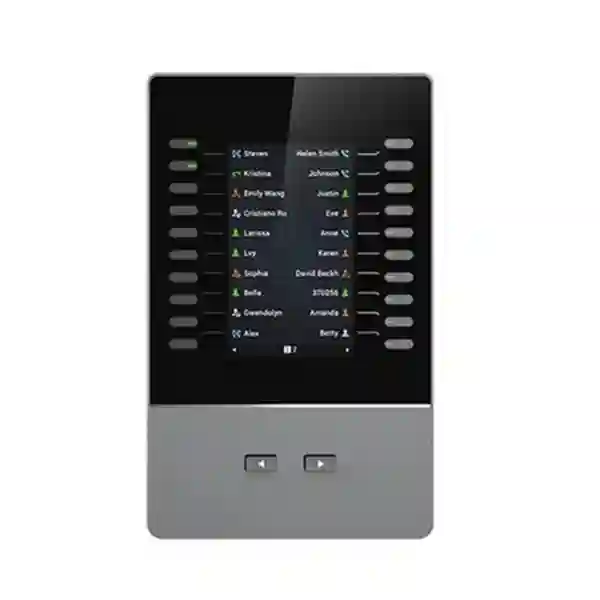
The Grandstream GBX20 is designed for users who need faster visual control of multiple extensions, line appearances and frequently used call functions from a compatible Grandstream desk phone. Rather than forcing receptionists, operators and high-volume users to navigate through long on-screen lists, the GBX20 adds dedicated programmable keys alongside a 4.3-inch color display. Each module provides 20 programmable keys per page and two pages, supporting up to 40 contacts or extensions. Up to four compatible modules can be connected for a total of up to 160 contacts or extensions. For organizations in Tanzania planning a reception console, executive call-control station, front-desk telephone or busy departmental phone, the GBX20 can provide a practical way to make call handling more visible and immediate.
Verified compatibility
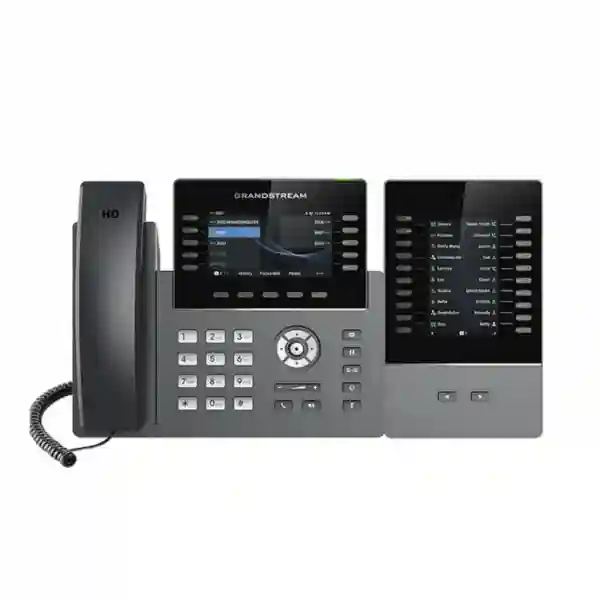
Grandstream lists the GBX20 as compatible with the GRP2615, GRP2624, GRP2650, GRP2670, GXV3350 and GXV3450. Compatibility should be confirmed against the exact phone model and firmware before procurement.
High-volume call control
The GBX20 supports programmable functions including BLF, BLA/SCA, call park and pickup, speed dial, presence, intercom, conference, transfer and forward when supported and configured by the host phone and telephony platform.
Expandable design
A single module offers two pages of keys for up to 40 contacts or extensions. Grandstream supports daisy-chaining up to four GBX20 modules for environments that need significantly more monitored or programmable positions.
Grandstream GBX20 overview
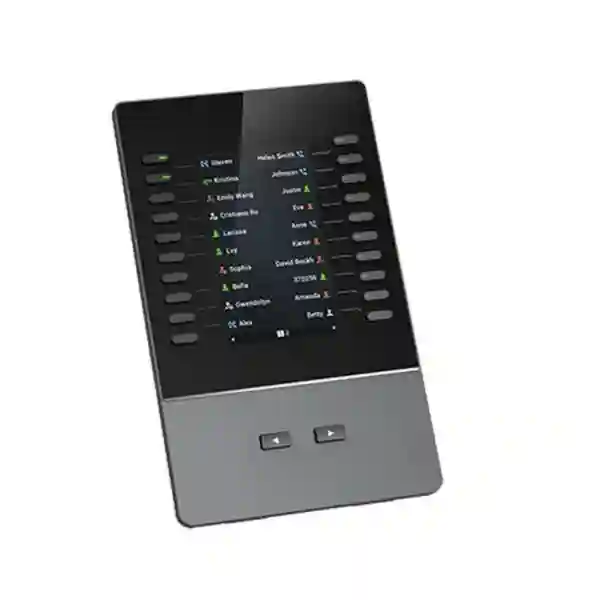
The GBX20 is an extension board, not a standalone IP phone. It is connected to a supported Grandstream host phone and is managed from the phone. The module uses a 4.3-inch 480 × 272 TFT color LCD and provides 20 programmable dual-color keys, plus page controls that allow the user to move between two sets of assignments. In practical terms, a receptionist can use the keys to monitor selected extensions with Busy Lamp Field indicators, place calls using speed-dial assignments, park or retrieve calls, or access other programmable functions made available by the phone and PBX configuration. This makes the module relevant when the number of people, departments or call-handling actions exceeds what is convenient on the base phone alone.
Grandstream states that one GBX20 can be powered by the host phone on supported models, while configurations with two or more modules require the supplied 12V power supply arrangement. The module is linked through the extension connection and is configured from the host phone web interface. Because power, firmware and configuration behavior depend on the host phone and deployment design, buyers should plan the GBX20 together with the exact Grandstream endpoint rather than treating it as an unrelated accessory.
For procurement teams, the most important pre-purchase checks are the host-phone model, the number of monitored extensions or programmable functions required, the PBX features that need to be exposed on the keys, available desk space, power requirements when multiple modules are planned, and the organization’s provisioning method. These checks reduce the risk of ordering an expansion module that does not match the endpoint fleet or operational workflow.
| Item | Verified GBX20 detail |
|---|---|
| Display | 4.3-inch TFT color LCD, 480 × 272 |
| Programmable keys | 20 per page, two pages, up to 40 contacts/extensions per module |
| Maximum expansion | Up to four daisy-chained modules for up to 160 contacts/extensions |
| Compatible phones | GRP2615, GRP2624, GRP2650, GRP2670, GXV3350, GXV3450 |
| Supported programmable functions | BLA/SCA, BLF, call park/pickup, speed dial, presence, intercom, conference, transfer and forward |
| Physical dimensions | 210 × 124 × 33.5 mm; unit weight 360 g according to Grandstream datasheet |
Where the GBX20 fits in a business phone system
A GBX20 is most useful when a person needs to see and act on many extension states or call-control functions without opening menus repeatedly. Reception desks are a common example because the operator may need to monitor managers, departments, meeting rooms, service desks or branch extensions. A front-desk user can assign keys to frequently called destinations and use dual-color indicators to help interpret line or presence status where the PBX and configured feature support it. Executive assistants may use similar functions to monitor principals and key teams, while departmental coordinators can use programmable keys for internal routing and speed access.
The module is also valuable when an organization wants a consistent physical workflow. Users can be trained around a clear key layout, for example arranging management extensions on one section, departments on another and shared call functions on a second page. This can reduce reliance on memorized extension numbers and improve call transfer speed. The exact result depends on PBX configuration, permissions and how the programmable keys are mapped, so good deployment should include a key-assignment plan rather than simply connecting the hardware.
FourTeck Tanzania can place the GBX20 in the wider context of an IP telephony project. Buyers can review the FourTeck Tanzania technology portfolio, browse related products in the Tanzania FourTeck shop, and review broader deployment capabilities on the FourTeck Tanzania services page. These resources are relevant when the module forms part of a larger IP PBX, switching, cabling or endpoint rollout.
Buying and deployment checklist
Grandstream GBX20 Tanzania
For organizations searching for the Grandstream GBX20 in Tanzania, the strongest purchasing case is usually tied to a defined call-handling role rather than a generic accessory requirement. A reception desk, executive support point, customer-service coordinator or operations office may already use a compatible Grandstream phone but require more direct keys than the base handset can comfortably expose. In that situation, the GBX20 provides a structured way to surface frequently monitored extensions and call-control actions on dedicated keys. Tanzania deployments should start by confirming the installed or proposed handset model because Grandstream officially lists support for the GRP2615, GRP2624, GRP2650, GRP2670, GXV3350 and GXV3450. If the organization is standardizing new endpoints, the module and host phone should be evaluated as one workstation.
A practical Tanzania procurement brief should state the number of operator positions, the number of extensions each operator must monitor, the PBX platform, whether BLF subscriptions are already working, and whether the deployment needs one, two, three or four modules. One GBX20 supports up to 40 contacts or extensions across two pages, so many small and medium reception environments may need only one module. Larger switchboard-style roles can expand further, but the additional desk space and power arrangement should be considered early. When two or more modules are planned, Grandstream documentation calls for the supported external power arrangement rather than assuming the host phone alone will supply every chained unit.
Network readiness also matters even though the GBX20 is not itself a standalone network endpoint. The host IP phone depends on stable LAN connectivity, correct voice VLAN design where used, appropriate PoE planning for the phone, dependable access to the PBX, and sensible quality-of-service policies. In Tanzania offices with mixed data, Wi-Fi, surveillance and voice traffic, a coordinated LAN can make troubleshooting easier. A receptionist may perceive a failed BLF key as a module issue when the actual cause is PBX registration, network reachability or configuration. Documentation of the phone IP, extension number, programmable-key layout and firmware baseline is therefore useful.
For Tanzania buyers, a quote request should include the host phone model, required quantity, destination, desired number of monitored extensions, PBX details and any installation or configuration assistance needed. Avoid relying on unverified online prices or stock statements because regional availability and project requirements can change. The useful goal is a compatible, correctly configured operator position that fits the business workflow and can be supported as part of the wider voice environment.
Grandstream GBX20 Dar es Salaam
In Dar es Salaam, the GBX20 is particularly relevant to organizations with busy reception areas, multi-department offices, hotels, service businesses, logistics operations and corporate front desks where one person may coordinate many internal destinations. Instead of expecting the operator to remember a long list of extension numbers or navigate a phone directory for every transfer, the module can present selected users and functions directly on programmable keys. The 20-key physical layout and two-page design allow an administrator to build a practical call-control map around the organization’s workflow. For example, frequently contacted departments can remain on the first page while less common destinations, call parks or special functions can be placed on the second.
A Dar es Salaam deployment should also consider the desk environment. Reception stations often include a computer, visitor log, headset, paperwork and other equipment. The GBX20 adds width beside the host phone, so physical space and cable routing should be checked before installation. If several modules are daisy-chained, the footprint increases further. A clean setup should keep the phone and module at a comfortable viewing angle, avoid tightly bent cables and leave the page keys and programmable buttons accessible. Where headsets are part of the operator workflow, the host phone’s supported headset options should be planned alongside the module so the user can handle calls hands-free without losing quick access to transfer and monitored-extension keys.
Dar es Salaam businesses frequently operate environments where internet, voice, Wi-Fi, security cameras and cloud applications share the same network. Although the GBX20 is controlled by the host phone, call handling depends on the larger telephony path. A stable switch connection, correct VLAN and QoS design, supported PBX configuration and properly provisioned extension keys are more important than the accessory alone. If BLF indicators do not update, the administrator should check the phone and PBX settings before assuming the expansion board has failed. Good acceptance testing should include inbound calls, attended and blind transfer scenarios, call park and pickup if used, presence or BLF behavior, and recovery after a phone reboot.
For quotation planning in Dar es Salaam, specify whether the GBX20 will be added to an existing supported phone or purchased as part of a new Grandstream desk-phone deployment. Include the number of operator desks, target key count, current PBX brand or platform, and whether configuration is required. This information produces a more useful proposal than requesting a generic “GBX20 price” without context.
Grandstream GBX20 Mwanza
Organizations in Mwanza can use the Grandstream GBX20 where a central phone user needs faster access to many internal contacts or operational functions. Typical scenarios include reception desks, distribution offices, clinics, educational administration, hospitality front desks and branch coordination points. The value of the module is not simply the number of buttons; it is the ability to arrange those buttons around real call flows. A branch coordinator might place management, warehouse, finance and customer-service extensions on one page, then reserve the second page for branch locations, speed dials, call parks or intercom keys. That arrangement can make the workstation more intuitive for both regular staff and backup reception users.
Before buying in Mwanza, confirm that the base phone is one of the officially supported models. The GBX20 works with the GRP2615, GRP2624, GRP2650, GRP2670, GXV3350 and GXV3450 according to current Grandstream information. An older phone may use a different extension module, so matching accessories by appearance is not sufficient. Buyers should also determine whether all desired key functions are supported by the PBX. BLF, shared line appearance, presence and call park behaviors depend on telephony configuration and SIP platform capabilities. The expansion module presents configured functions; it does not create PBX features that have not been enabled.
For Mwanza sites that depend on a central office or remote PBX, network stability should be part of the solution review. Packet loss, unstable WAN links or incorrect firewall behavior can affect phone registration and status monitoring. A useful deployment plan therefore separates hardware acceptance from service validation. First confirm that the GBX20 boots, displays correctly and responds to configured keys. Then test extension monitoring, outbound speed dials, transfer workflows and any remote-branch extensions under normal network conditions. Recording the final key map in a simple document helps support teams restore the same layout after future phone changes.
Procurement teams in Mwanza should request the GBX20 together with any compatible phone, power requirements for multiple modules, mounting or desk considerations, and configuration assistance needed. Where the organization is expanding an existing system, providing the current phone model and firmware level will help reduce compatibility uncertainty before equipment is dispatched or installed.
Grandstream GBX20 Arusha
In Arusha, the Grandstream GBX20 can suit hotels, tour operators, corporate offices, institutions and service organizations where a receptionist or coordinator handles frequent calls across departments. Hospitality and travel-related businesses often route calls between reservations, accounts, management, transport coordination and guest services. A programmable extension module can give the front desk a clear visual panel of selected destinations, reducing the need to search directories during active conversations. The module’s dual-color keys can support BLF-style status indication when properly configured, while speed-dial, transfer, call park and pickup assignments can streamline common front-desk actions.
Arusha buyers should define their operator workflow before assigning buttons. A poor layout can make 40 available positions feel confusing, while a deliberate layout can make a smaller set of frequently used keys highly effective. It may be useful to group destinations by department, building, floor or operational importance. The first page can prioritize daily call destinations and the second can contain overflow contacts and administrative functions. If more than 40 contacts are genuinely necessary, additional GBX20 units can be chained up to Grandstream’s stated limit of four modules, but each extra unit should have a clear purpose because more keys also increase training and labeling needs.
Power and endpoint compatibility should be checked as part of the bill of materials. One GBX20 may be powered through the compatible host-phone arrangement, while multiple-module deployments require the specified external power arrangement. The base phone itself may be powered by PoE depending on model and network design. Therefore, a complete Arusha telephony deployment should check switch PoE budget, UPS protection for the network rack, PBX reachability and any required SIP trunk or service-provider settings. Keeping the voice network stable is especially important for front-desk users because they are often the first point to notice communication issues.
When asking for a GBX20 quote in Arusha, provide the current Grandstream handset model, required number of modules, number of operator stations and the approximate extension count to be monitored. If the system is new, include the expected PBX platform and user count. This enables the accessory to be specified as part of a workable communication design rather than as an isolated purchase.
Grandstream GBX20 Dodoma
For offices and institutions in Dodoma, the Grandstream GBX20 can support reception and administrative teams that need a controlled view of many extensions. Government-related organizations, professional services, educational offices and multi-department facilities may have frequent internal transfers and a need to reach key personnel quickly. The module lets an administrator map important extensions and call functions onto physical keys next to a supported Grandstream phone. This can be particularly useful where visitors and callers expect quick routing and where reception staff must maintain a professional call flow during busy periods.
A good Dodoma implementation begins with call-flow discovery. Identify the departments that receive the most transfers, which extensions need status monitoring, how unanswered calls should be handled, and whether call parking is part of the operating procedure. Once the PBX behavior is understood, the GBX20 key layout can reflect it. The module supports functions such as BLF, BLA/SCA, speed dial, presence, intercom, conference, transfer and forward, but the exact availability depends on the host phone and telephony system. This distinction is important because the expansion board is a control surface for configured functions, not an independent communications platform.
For larger Dodoma offices, expansion planning should be proportionate. One module gives up to 40 contacts or extensions across two pages. Before adding a second or third unit, consider whether every extension truly needs a dedicated key or whether departmental ring groups, queues and well-designed call routing could simplify the operator role. Sometimes PBX design can reduce the number of manual transfers required. Where multiple modules are justified, ensure the workstation has sufficient physical space and the required power arrangement. Users should also receive a printed or digital key map, especially if several staff rotate through the reception position.
A useful quotation request for Dodoma includes the host phone model, firmware if known, PBX type, module quantity, monitored-extension count and any setup or training requirements. This supports correct compatibility checking and gives the supplier enough information to discuss related needs such as IP phones, switching, cabling or network readiness.
Grandstream GBX20 UAE
For UAE organizations, the Grandstream GBX20 is relevant where receptionists, operators and executive assistants need dense call-control capability on a compatible Grandstream handset. Offices in fast-moving commercial environments often manage multiple departments, shared lines and frequent transfers. The GBX20 can reduce menu navigation by placing monitored extensions and common actions on dedicated programmable keys. Its 4.3-inch color display gives the user a clear visual reference, while two pages provide up to 40 assignments per module. Larger operations can connect up to four units for as many as 160 contacts or extensions, subject to correct host-phone and power configuration.
UAE procurement teams should avoid treating extension modules as universally compatible accessories. Grandstream currently lists the GRP2615, GRP2624, GRP2650, GRP2670, GXV3350 and GXV3450 for the GBX20. If a site has a mixed estate of older GXP phones and newer GRP phones, each phone model should be mapped to its supported expansion option. This is especially important in phased office migrations, where an apparently similar handset may require a different module. The PBX should also be reviewed for BLF subscription limits, call park methods and shared-line behavior because those features influence the value users receive from the physical keys.
In enterprise UAE environments, centralized provisioning can help keep multiple reception desks consistent. Administrators can document key assignments, extension naming and firmware baselines so replacement or additional phones can be configured predictably. Network design should include voice VLANs where appropriate, QoS policy, resilient switching and UPS protection for key communications equipment. For high-volume front desks, a headset strategy should also be considered, allowing staff to speak hands-free while using the module for transfers and monitoring.
Customers coordinating projects between Tanzania and the UAE can also review FourTeck UAE IT and telecom solutions. A quote should state the host phone, desired module count, PBX environment and configuration requirements rather than relying on a generic market price, because the complete operator workstation is what determines usability.
Grandstream GBX20 Uganda
In Uganda, the Grandstream GBX20 can support organizations that want to improve reception and operator call handling without moving to a separate console application. A compatible Grandstream phone with one extension module can present up to 40 configured contacts or functions across two pages. This is useful for businesses with multiple departments, schools, clinics, hotels and branch offices where callers are routinely transferred and where front-desk staff need quick access to the same destinations throughout the day. The physical keys can make the workflow easier for users who prefer visible, tactile control instead of navigating through phone directories.
Uganda deployments should be designed around the actual PBX. If the business uses BLF to monitor extension availability, confirm that the PBX and phone are configured for the required subscriptions. If call park or pickup is important, define the exact key behavior and test it with real call scenarios. If presence or shared line appearance is needed, verify platform support and user permissions. The GBX20 can expose these functions, but successful operation depends on the host phone and communications platform. A configuration workshop with the reception team can therefore be more valuable than simply filling every programmable position.
Branch connectivity may also influence the deployment. If a Ugandan office registers its phones to a PBX at another site or in the cloud, WAN stability, firewall rules and latency can affect call experience and status monitoring. The module itself does not fix network issues, so phone-system troubleshooting should distinguish accessory behavior from network and PBX conditions. Administrators should keep configuration backups and a key map so service can be restored consistently if a phone is replaced.
For broader regional planning, buyers can review FourTeck Uganda communication solutions. A procurement request should include compatible phone model, number of reception positions, expected extension count and whether the deployment needs installation, provisioning or user training.
Grandstream GBX20 Kampala
Kampala businesses with busy reception desks, shared-service teams and multi-department offices may benefit from the GBX20 when call routing depends on quick decisions. The module gives the operator a visible set of programmable keys that can represent extensions, speed dials and supported call functions. A receptionist who frequently transfers callers to sales, accounts, operations, managers and meeting areas can organize those destinations logically rather than repeatedly searching a directory. The two-page structure means the most important keys can remain immediately accessible while less frequent destinations occupy the second page.
The procurement question in Kampala should not be only “how many keys does the GBX20 have?” It should also ask how many monitored destinations are genuinely needed, whether BLF is enabled, and whether the current Grandstream phone is compatible. One module supports up to 40 contacts or extensions. If the requirement approaches or exceeds that number, the business should decide whether additional modules are justified or whether call queues, ring groups and automated routing can reduce operator workload. Combining good PBX design with a sensible number of physical keys often produces a cleaner system than assigning a button to every possible extension.
Installation should include host-phone firmware checks, secure physical connection, appropriate power planning for multiple modules, and verification of every programmed key. Acceptance testing in Kampala offices should cover incoming calls, transfer to busy and idle users, call park if used, speed-dial accuracy, page switching and status updates. Staff should also know what indicators mean so they do not interpret every light state incorrectly. Where the operator uses a headset, call-control behavior should be tested with the headset connected because that will be the real daily workflow.
When requesting pricing for Kampala, include destination details, required quantity and the complete Grandstream phone model. If the project is a new IP PBX deployment, provide the expected number of users and departments as well. This lets the solution be sized around the call-handling process rather than around a single accessory line item.
Grandstream GBX20 Arua
For organizations in Arua, the GBX20 can be useful where a central administrative or reception phone connects callers to many internal users. Regional offices, NGOs, educational institutions, clinics and service organizations may operate with a small number of staff handling a broad range of communication tasks. A programmable expansion module can make those tasks easier by placing frequently used extensions and actions within direct reach. Because the module supports two pages, the operator can separate daily contacts from occasional destinations or administrative functions without overcrowding the first view.
Arua projects should give special attention to complete system dependencies. The GBX20 depends on a supported Grandstream phone, and the phone depends on the PBX and network. If the organization uses a remote or cloud-hosted PBX, reliable connectivity becomes part of the user experience. Status indicators, registration and call features can be affected by WAN interruptions or firewall behavior. It is therefore sensible to test the system during normal business conditions and document which functions require internet or inter-site connectivity. A local power strategy for network equipment and the phone system can also help maintain continuity during short power events, depending on the broader infrastructure design.
Compatibility remains the first hardware check. Grandstream identifies the GBX20 for the GRP2615, GRP2624, GRP2650, GRP2670, GXV3350 and GXV3450. A buyer with another model should not assume the same module will fit. If several extension boards are chained, the specified power supply arrangement is required. Administrators should also keep spare capacity on the key layout rather than filling all 40 positions immediately, because future staff additions or new departments may require changes.
For Arua procurement, share the exact phone model, current PBX information, extension count and required key functions. If the organization needs remote assistance, configuration documentation and screenshots of the host-phone programmable-key settings can make support more efficient. The goal is a repeatable, understandable call-handling station that can be maintained even when staff change.
Grandstream GBX20 Mbarara
In Mbarara, businesses and institutions that operate a shared reception or front-office function can use the Grandstream GBX20 to organize call-handling tasks around visible programmable keys. The module is especially useful when the operator deals with many known internal destinations and benefits from seeing extension status information where BLF is configured. Instead of memorizing numbers, a receptionist can use labels and a planned key arrangement to transfer callers, trigger speed dials or use supported call-park and pickup functions. This can improve consistency when more than one person covers the same desk across different shifts.
Mbarara buyers should decide whether the requirement is a single-module workstation or a larger console. One GBX20 supports 20 keys per page and two pages. For many offices, that provides enough capacity to cover management, departments and common service points. If the organization requires more, Grandstream supports multiple modules up to four in a chain. However, multiple boards increase power and space requirements and can create a visually dense console. A better design may combine a manageable number of monitored extensions with PBX features such as queues and ring groups so the operator is not responsible for every routing decision manually.
Installation should include labeling and documentation. Even though the LCD identifies assignments, a simple written map helps technicians understand why each key exists. The host phone web interface is used to configure extension-board keys, so administrator access and a configuration backup are valuable. Firmware should be maintained according to Grandstream guidance, and the phone should not be interrupted during upgrade activity. If two or more boards are connected, the deployment should follow Grandstream’s power instructions rather than improvised adapters.
A Mbarara quotation request should mention whether the organization already owns a supported phone, the quantity of GBX20 units required, the number of call-handling desks, and any PBX configuration assistance needed. For multi-site organizations, standardizing the key layout across branches can simplify training and remote support.
Grandstream GBX20 Gulu
Gulu organizations can use the GBX20 where a central phone user needs a clearer way to manage frequent internal calls. Offices with multiple units, education campuses, medical facilities, hotels and service operations may all have reception functions that depend on rapid transfer and accurate extension selection. By placing known contacts and functions on programmable keys, the GBX20 can reduce the number of steps needed to reach a destination. The dual-color indicators are useful for BLF-style monitoring when configured by the phone and PBX, helping an operator make better routing choices before transferring a caller.
The module should be planned as part of the workstation. A supported phone is required, and Grandstream currently names the GRP2615, GRP2624, GRP2650, GRP2670, GXV3350 and GXV3450. This is important for Gulu organizations that may have inherited mixed phone models over several years. An asset list can identify which desks can accept the GBX20 and which may need a phone upgrade. Procurement teams should also estimate how many key assignments the operator truly needs. Forty contacts per module is substantial for many offices, and the second page can be reserved for less frequent destinations.
Operational resilience should include network and power considerations. If the PBX is remote, stable WAN service and appropriate firewall configuration are essential. If the phone is powered from a PoE switch, UPS protection at the network rack can help preserve the voice endpoint during short local power interruptions, provided upstream systems remain available. For multiple GBX20 modules, follow the specified power arrangement. These infrastructure details matter because a reception phone is often a critical communication point and will reveal service interruptions immediately.
For Gulu procurement, specify host phone model, PBX platform, extension count, desired programmable functions, module quantity and whether remote or on-site setup is required. The final handover should include a tested key layout and a short user guide so reception staff understand page navigation and the intended function of each assigned key.
Grandstream GBX20 Kenya
Kenyan businesses searching for the Grandstream GBX20 are typically looking for a reception or operator accessory that works with selected Grandstream enterprise phones. The module is useful where the user needs immediate access to many extensions, shared lines or call functions. Its 4.3-inch display and 20 dual-color keys per page create a dedicated control area next to the phone, while two pages increase the capacity to 40 contacts or extensions per module. Up to four modules can be chained where a very large monitored set is required, though the practical benefit should be weighed against desk space and operational complexity.
In Kenya, compatibility checking is especially important for organizations with mixed endpoint generations. The GBX20 is intended for the GRP2615, GRP2624, GRP2650, GRP2670, GXV3350 and GXV3450. Older Grandstream phones may use the GXP2200EXT or another accessory, so model matching should happen before any order. Buyers should also check the exact PBX feature set. Busy Lamp Field, shared line appearance, presence, call park and other programmable behaviors may require specific PBX configuration and subscriptions. The expansion board will only be as effective as the call workflow it is configured to control.
For Nairobi and other Kenyan deployments, standardized provisioning can be useful when several sites share the same reception process. Administrators can define a common key-template philosophy, such as management first, departments second, shared services third and special call functions on page two. Local variations can then be documented without redesigning every console from scratch. Network readiness should include reliable voice connectivity, switching and QoS considerations because the host phone remains the actual SIP endpoint.
Regional buyers can review FourTeck Kenya IT and VoIP solutions when coordinating cross-border projects. A complete quote request should provide host phone model, required quantity, PBX type, destination and configuration scope. This creates a more accurate procurement conversation than comparing accessory prices without confirming compatibility.
Grandstream GBX20 Kuwait
In Kuwait, the Grandstream GBX20 can support receptionists, executive assistants and busy office operators who use compatible Grandstream phones and need more direct keys for call control. Corporate offices, clinics, hospitality operations and service desks often have repeated transfer patterns throughout the day. Mapping those destinations to physical keys can reduce search time and make call handling more consistent. The two-page arrangement allows up to 40 contacts or extensions on one module, which can cover a substantial department list without turning the base phone display into the only navigation tool.
Kuwait buyers should confirm both hardware and workflow compatibility. The supported-phone list includes the GRP2615, GRP2624, GRP2650, GRP2670, GXV3350 and GXV3450. The organization should then identify which PBX features are actually available. For example, a BLF key relies on proper subscription and extension permissions, while call park and shared-line behavior depend on platform configuration. If the business uses a third-party SIP platform, the administrator should validate the desired functions with the host phone before rolling out dozens of identical key assignments.
Larger Kuwait deployments can standardize operator stations by documenting firmware versions, key layouts and host-phone configuration. This is helpful for companies with several reception points or branches because support staff can troubleshoot against a known baseline. The module firmware is coordinated through the host phone environment, so phone firmware management is part of accessory maintenance. Power planning is also important when chaining multiple modules, and only the specified power equipment should be used.
A procurement brief for Kuwait should include the exact Grandstream phone model, expected number of modules per workstation, number of operator positions, PBX platform and required configuration services. Buyers should also confirm desk space and headset requirements. The objective is not to maximize the number of keys but to create a call-control layout that is fast, readable and easy for staff to learn.
Grandstream GBX20 Ghana
For Ghanaian organizations, the Grandstream GBX20 is a focused accessory for compatible Grandstream IP phones where users need more programmable call-control positions. It can be particularly helpful at reception desks, hotels, clinics, educational institutions and business offices with many internal extensions. Instead of relying entirely on directory search, the operator can place priority extensions and functions on dedicated keys. This approach can improve transfer speed and reduce errors when the same destinations are contacted repeatedly throughout the day.
Ghana procurement should begin with exact endpoint identification. The GBX20 is supported on the GRP2615, GRP2624, GRP2650, GRP2670, GXV3350 and GXV3450 according to Grandstream. If the phone is not on that list, compatibility should not be assumed. Once the host phone is confirmed, the organization should define how many positions are required. A single module provides 20 keys per page and two pages. Adding multiple modules is possible up to four units, but not every environment needs the maximum. Reception workflow, call queues and ring-group design may reduce the number of individually monitored users.
The system administrator should test all configured functions. BLF status, speed dials, call park, pickup, transfer and presence behavior should be verified under the actual PBX. If the phone connects across a VPN or to a hosted system, WAN stability and firewall rules should be included in troubleshooting. A key map and configuration backup should be kept for future changes, especially in organizations where receptionist duties rotate among several employees.
When requesting a GBX20 quotation for Ghana, provide the phone model, required quantity, destination, PBX information and any need for programming support. For regional standardization, the same principles can be applied across branches while allowing each site to customize the extensions that matter most. The result should be a call-control station designed for the organization’s real communication pattern rather than an accessory installed without a workflow plan.
Grandstream GBX20 Nigeria
Nigeria businesses with high call volumes can use the Grandstream GBX20 to extend compatible Grandstream desk phones with a dedicated visual and programmable control surface. Receptionists in corporate offices, hotels, healthcare facilities, educational institutions and service centers often need to transfer callers quickly while tracking the availability of key users. A properly configured GBX20 can place those users on BLF keys, assign frequently called destinations to speed dial and provide direct access to call park, pickup and other supported functions. Because the module offers two pages, a business can separate primary contacts from secondary destinations or operational functions.
Nigeria procurement teams should be cautious with online product listings that may show outdated compatibility information. Grandstream’s current documentation includes the GRP2615, GRP2624, GRP2650, GRP2670, GXV3350 and GXV3450. This verified list should be the starting point. The PBX configuration should also be checked because features such as BLF and shared-line appearance may behave differently across platforms. If the organization uses a hosted PBX, the provider’s feature support and account permissions should be validated before promising a specific key behavior to users.
For large sites, multiple modules can be chained, but call-flow design should come first. A single well-organized 40-position module may be more practical than several boards filled with rarely used extensions. Teams can group keys by function, geography or department and train operators on a consistent layout. Network switching, voice VLAN design and reliable power for the phone environment should be included in the broader project. When two or more GBX20 units are connected, follow Grandstream’s power guidance and use the intended supply arrangement.
A Nigeria quote request should include host phone model, number of reception stations, module quantity and deployment location, together with any configuration or training scope. This helps compare like-for-like proposals and avoids buying accessories that cannot deliver the expected workflow.
Grandstream GBX20 Seychelles
In Seychelles, the Grandstream GBX20 can be especially relevant to hospitality, tourism, professional-services and administrative environments where a front desk routes calls among rooms, departments or staff. The module’s practical value comes from turning frequently used destinations into visible programmable keys. A receptionist can use the first page for the most important departments and the second for secondary contacts, call parks or operational speed dials. When paired with a correctly configured PBX, BLF indicators can help the operator understand whether selected extensions are available before attempting a transfer.
Seychelles procurement should account for logistics and compatibility before shipment. The exact host phone must be confirmed because the GBX20 is designed for the GRP2615, GRP2624, GRP2650, GRP2670, GXV3350 and GXV3450. If a hotel or office has a mixed set of endpoints, only the compatible operator stations should receive the module. The number of modules should be determined by real contact requirements, not by the maximum possible configuration. One board supplies up to 40 contacts or extensions, which may be enough for many front-desk roles.
For island deployments where replacement logistics may take longer, documentation becomes valuable. The organization should retain the phone configuration, key map, firmware baseline and details of how the module is physically connected. Staff should know that the extension board relies on the phone and PBX, so a failed key indication may be a configuration or network issue rather than hardware failure. If multiple modules are chained, use the specified power supply arrangement. A small amount of upfront documentation can make remote troubleshooting much faster.
When requesting a GBX20 quotation for Seychelles, include delivery destination, quantity, compatible phone model, number of operator desks and whether remote configuration assistance is needed. Where the project includes new telephony infrastructure, also provide PBX user count, call-flow requirements and network details so the module is integrated into a complete communication design.
Compatibility, configuration and integration guidance
The GBX20 is configured through the host phone rather than as an independent SIP device. On supported GRP phones, programmable extension-board settings are available through the phone administration interface, while supported GXV models provide their own extension-board settings path. This means administrators should include host-phone credentials, configuration backup and provisioning policy in the deployment plan. When a phone is centrally provisioned, any local changes should be checked against the provisioning template so automatic updates do not overwrite the desired key map.
For BLF use, the PBX must provide the appropriate status information and allow the phone to subscribe to monitored extensions. The visual indicator is therefore a combined result of module hardware, host-phone configuration and PBX behavior. If an extension is not showing the expected state, test the same BLF assignment on the phone itself where possible, verify SIP registration and inspect PBX settings. Similar logic applies to shared line appearance and presence functions. The module is an efficient interface, but it cannot bypass platform limitations.
For multi-site systems, consistent naming is valuable. Use recognizable extension labels, keep departments in predictable key positions and document page-one and page-two logic. If four modules are connected, the operator could theoretically manage up to 160 contacts or extensions, but a very large key surface should be justified by real operational need. In many environments, call queues, auto attendants and department groups can reduce complexity while the GBX20 handles priority users and exceptional routing.
FAQ: Grandstream GBX20
Is the GBX20 a standalone IP phone?
No. It is an extension module that connects to a compatible Grandstream host phone and uses the phone for configuration, control and communications.
Which phones support the GBX20?
Grandstream currently lists the GRP2615, GRP2624, GRP2650, GRP2670, GXV3350 and GXV3450 as compatible models.
How many extensions can one GBX20 show?
Each module has 20 programmable keys per page and two pages, allowing up to 40 contacts or extensions per module.
Can multiple GBX20 modules be connected?
Yes. Grandstream supports up to four daisy-chained modules for up to 160 contacts or extensions. Multi-module deployments must follow the documented power requirements.
Does the GBX20 support BLF?
Yes, BLF is among the supported programmable functions. Actual operation depends on the host phone and PBX being correctly configured for BLF subscriptions and status reporting.
Can the GBX20 be used for call park and speed dial?
Yes. Grandstream documents support for call park/pickup, speed dial, presence, intercom, conference, transfer, forward and related programmable functions.
What should I include in a quote request?
Provide the host phone model, required quantity, number of monitored extensions, PBX platform, destination and whether configuration, installation or user training is required.
Decision recap
Choose the GBX20 when a compatible Grandstream phone needs more direct programmable keys for monitored extensions, speed dials or supported call-control functions. Confirm compatibility first, decide how many positions the operator actually needs, verify PBX feature support, and plan power correctly when multiple modules are used. The strongest deployments are those where the key layout reflects a documented call flow rather than simply filling every available position.
For Tanzania projects, include the GBX20 in the wider voice-system discussion: host phone, PBX, SIP service, LAN switching, voice VLAN, power protection, headsets, provisioning and support. This produces a more reliable operator workstation and makes future troubleshooting easier.
Quotation checklist
When requesting a quotation, share the exact host phone model, GBX20 quantity, number of operator desks, approximate number of monitored extensions, PBX platform, installation location, whether multiple modules will be chained, and whether programming support is required. If the project includes new phones, specify the number and type of users so the endpoint model can be selected together with the extension module.
For product and project enquiries, use the verified FourTeck Tanzania contact page and provide enough technical context for compatibility checking.
Consultation panel
Confirm phone model, PBX, firmware, extension count and desired keys before purchase.
Size reception phones, modules, PBX call flow, switching, power and user training together.
Standardize layouts and configuration principles across Tanzania, East Africa and other supported project locations.


Reviews
There are no reviews yet.