
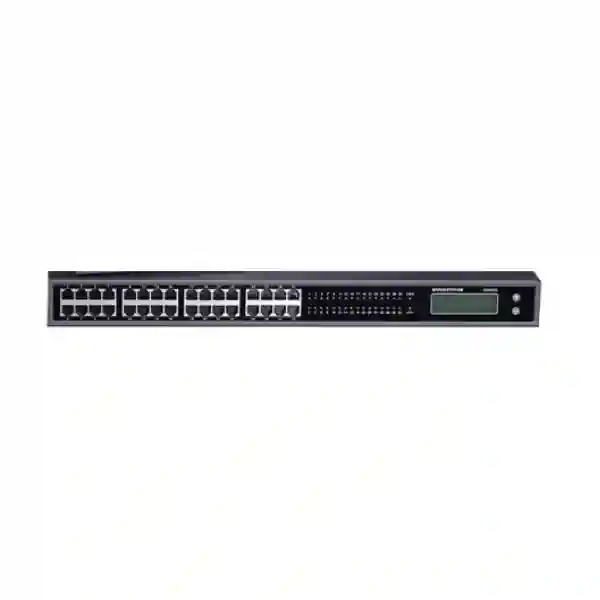
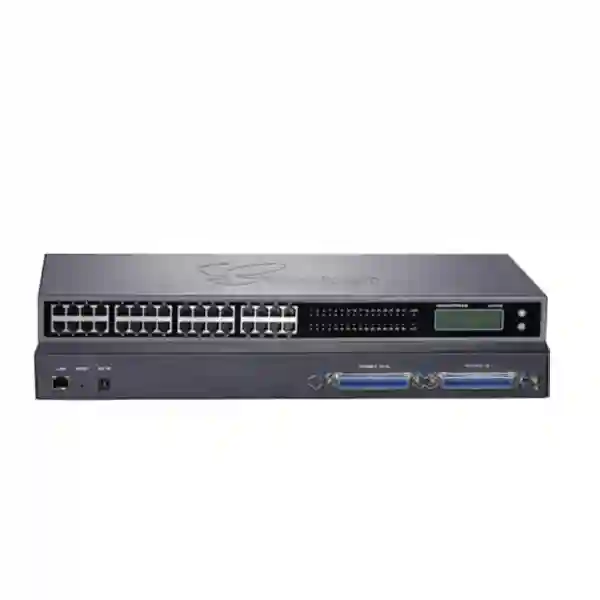
Grandstream GXW4232 V2 Tanzania
The Grandstream GXW4232 V2 is a high-density 32-port FXS VoIP gateway for organizations that need to connect substantial numbers of analog phones, fax devices, legacy extensions or traditional telephony equipment to a SIP-based IP communications environment. It is especially useful where a business wants to modernize the core voice platform while retaining existing analog endpoints that remain operational, familiar to users, or embedded in rooms, facilities, lifts, reception areas and service points. With 32 FXS ports, 32 SIP accounts across four SIP profiles, a single Gigabit Ethernet interface, broad voice codec support and rack or desktop mounting, the GXW4232 V2 provides a structured migration path between traditional analog telephony and modern IP PBX or hosted SIP services.
Designed for high-density analog endpoint integration through individual FXS interfaces and telco connectivity.
Supports 32 SIP accounts organized across four configurable SIP profiles for flexible deployment.
A 10/100/1000 Mbps network interface connects the gateway to the LAN and SIP infrastructure.
Installation flexibility helps it fit communications rooms, server racks and structured office environments.
What the GXW4232 V2 solves
Many organizations still rely on analog devices even after moving to IP telephony. Replacing every endpoint at once can create unnecessary cost and operational disruption. The GXW4232 V2 addresses this problem by acting as the bridge between analog endpoints and SIP-based networks. Each FXS port can serve an analog device while the gateway registers to an IP PBX, softswitch or SIP service. This allows businesses to phase their migration, preserve useful existing equipment and centralize voice management without abandoning established workflows.
Typical environments include hotels with room phones, schools with classroom or office handsets, hospitals with analog extensions, warehouses with rugged legacy phones, apartment or campus deployments, call environments that retain selected fax machines, and enterprises transitioning from a legacy PBX. The 32-port capacity is particularly useful where a smaller ATA would require too many separate units but a 48-port gateway would provide more capacity than the site needs.
| Capability | GXW4232 V2 detail | Business relevance |
|---|---|---|
| Telephone interfaces | 32 FXS ports, with RJ11 and RJ21 connectivity | Consolidates many analog endpoints into one managed gateway |
| SIP provisioning | 32 SIP accounts, four profiles | Supports structured SIP deployment and profile separation |
| Network interface | 10/100/1000 Mbps RJ45 | Suitable for modern switched business networks |
| Voice functions | Echo cancellation, jitter handling, VAD, CNG, PLC and multiple codecs | Supports stable voice operation across SIP networks when correctly engineered |
| Mounting | Desktop and rack mount | Fits both dedicated communications rooms and smaller technical spaces |
Key deployment features and technical considerations
Voice interoperability
The GXW42xx family is designed for interoperability with SIP-based IP PBXs, softswitches and service platforms. Supported voice codecs include G.711, G.722, G.723.1A, G.726, G.729 and iLBC, while T.38 supports fax transport scenarios. Final codec selection should match the capabilities and policy of the connected PBX or SIP provider.
Provisioning and management
The gateway supports centralized provisioning and remote administration functions suitable for larger deployments. Administrators should plan management access, firmware policy, device credentials, configuration backups and network segmentation before rollout, particularly when dozens of analog extensions are consolidated on a single device.
V2 firmware discipline
GXW42xx V2 hardware uses different firmware from V1 devices. The model label should be checked before maintenance, and firmware instructions should be followed carefully. This is important for mixed estates where older and newer GXW42xx hardware may coexist.
For broader unified communications planning, businesses can also review FourTeck Tanzania technology solutions as a starting point for related voice, networking and infrastructure requirements. Regional projects involving East African sites may also benefit from coordinated planning through FourTeck Kenya and FourTeck Uganda, while broader cross-border requirements can be aligned with FourTeck Africa. Organizations with UAE operations can reference the specialist Grandstream UAE solutions portal when coordinating Grandstream deployments across regions.
Grandstream GXW4232 V2 Tanzania
For organizations in Tanzania, the Grandstream GXW4232 V2 is a strong fit where analog telephony remains operationally useful but the core communications strategy is moving toward SIP. A business may have dozens of room phones, office handsets, fax units or legacy extensions that are still working properly, yet the PBX platform is being modernized or consolidated. The gateway enables these endpoints to continue serving users while the network side transitions to IP. This is especially relevant to hotels, healthcare sites, schools, universities, logistics facilities, industrial compounds, office buildings and multi-tenant environments where replacing every analog device can be expensive or disruptive.
Procurement teams in Tanzania should begin by confirming the required number of analog endpoints, the future expansion margin and the SIP platform that will terminate or manage the extensions. The GXW4232 V2 offers 32 FXS ports, so it is most economical when a site needs substantial analog density. A smaller deployment may be better served by lower-port models, while larger estates may require multiple gateways or the 48-port option. Engineers should also review rack space, power arrangements, cable presentation, network VLAN design, DHCP or static addressing policy, and the availability of reliable upstream switching before installation.
Tanzania deployments often span headquarters, branch offices and operational sites with different connectivity profiles. Because the GXW4232 V2 communicates over IP on the network side, voice quality depends not only on the gateway but also on LAN design, WAN stability, QoS policy and SIP platform configuration. Organizations using hosted SIP or a centralized IP PBX should validate latency, packet loss, firewall behavior and NAT traversal requirements. Where voice is mission critical, resilience planning should include power protection, backup connectivity and documented recovery procedures rather than focusing only on the gateway hardware.
A useful quotation request for Tanzania should identify the number and type of analog devices, current PBX or SIP service, desired extension plan, site count, rack availability, network topology and any fax requirement. Providing this information allows a supplier to recommend the correct port density and deployment approach without making assumptions. The GXW4232 V2 is therefore best treated as part of a complete voice migration design rather than a standalone box: its value comes from integrating existing analog assets into a manageable SIP architecture while preserving operational continuity.
Grandstream GXW4232 V2 Dar es Salaam
In Dar es Salaam, the GXW4232 V2 suits businesses that are modernizing voice infrastructure across offices, hotels, healthcare facilities, educational campuses, property developments and service organizations. The city contains a wide range of environments where analog extensions may still be embedded into day-to-day operations. Replacing all of them can create unnecessary cost, especially when the handsets themselves remain functional. A 32-port FXS gateway lets IT teams retain those devices while moving call control to an IP PBX, softswitch or SIP service, creating a practical bridge between older endpoints and newer communications platforms.
For a Dar es Salaam deployment, physical infrastructure planning matters. Thirty-two analog ports mean cabling needs to be labelled, documented and presented cleanly, particularly where the gateway is installed in a communications rack. Engineers should map each analog extension to the appropriate SIP account and verify dial plans, caller ID behavior, emergency or service numbers, fax requirements and hunting groups before cutover. A phased migration is often easier than changing every line at once: groups of extensions can be moved, tested and documented progressively, reducing disruption for reception desks, guest rooms, departments and shared service areas.
Network design is equally important. The GXW4232 V2 uses Gigabit Ethernet, but raw link speed alone does not guarantee good voice. The surrounding LAN should be engineered for consistent packet delivery, appropriate QoS and controlled broadcast or congestion conditions. If the SIP server is remote or cloud hosted, WAN reliability should be examined and firewall policies should be tested. Organizations with dual internet links can design failover at the network edge, while ensuring SIP registration and NAT handling remain predictable during link changes. Power resilience through suitable UPS infrastructure can also protect both the gateway and upstream network devices.
Buyers in Dar es Salaam should request a solution-level quotation rather than a simple unit price when deployment assistance is required. The scope can include the gateway, rack accessories where applicable, cabling considerations, network readiness review, SIP configuration, migration planning and post-cutover testing. By defining these requirements early, organizations can compare proposals on equivalent scope. The GXW4232 V2 is particularly compelling when the goal is not merely to buy hardware, but to preserve a sizable analog endpoint investment while introducing the control, scalability and management benefits of SIP-based communications.
Grandstream GXW4232 V2 Mwanza
Organizations in Mwanza evaluating the Grandstream GXW4232 V2 are often looking for a way to modernize voice systems without discarding usable analog phones. The 32-port gateway can connect a meaningful number of extensions at one site, making it relevant to hotels, clinics, schools, administrative offices, warehouses and businesses with multiple departments. Where an older PBX is being replaced by a SIP-based platform, the gateway allows the analog side of the estate to remain in service while call control moves to a modern IP environment.
The strongest deployments start with an extension inventory. IT staff should count active analog endpoints, identify spare or unused lines, note fax or special-purpose devices, and estimate near-term growth. This determines whether a 32-port model provides the right balance between capacity and headroom. The GXW4232 V2 should not be selected solely because it has more ports than a small ATA; it should be matched to a real density requirement. Where analog lines are spread across buildings, structured cabling and distance should also be assessed, because physical line design remains an important part of any FXS deployment.
Mwanza sites that connect to a centralized PBX in another location need to review WAN performance and business continuity. SIP traffic is sensitive to packet loss, jitter and interruptions, so the network should be monitored under actual business loads. Voice VLANs, QoS rules, appropriate firewall configuration and reliable DNS or addressing plans help reduce avoidable problems. If the network path changes during failover, administrators should verify how SIP registrations recover. The gateway can support a solid deployment, but the surrounding network architecture determines how consistently users experience calls.
Procurement discussions should therefore cover the full system context. A Mwanza buyer can provide details about the current PBX, target SIP platform, number of analog devices, cabling layout, rack environment and required support scope. This makes it easier to decide whether the GXW4232 V2 is appropriate, whether additional gateways are required, and how migration should be staged. For organizations that want to extend the life of existing analog handsets while standardizing on IP telephony, the product offers a practical middle path between keeping a legacy PBX indefinitely and replacing every endpoint immediately.
Grandstream GXW4232 V2 Arusha
In Arusha, the Grandstream GXW4232 V2 can support organizations that need high-density analog connectivity within a modern SIP environment. Hospitality, tourism operations, education, healthcare, administration and multi-building businesses may have installed analog phones that continue to meet user needs even as the underlying communications platform changes. The GXW4232 V2 provides 32 FXS interfaces, making it practical for medium-to-large analog clusters without deploying many small adapters. This simplifies rack layout, centralizes management and can reduce the number of separate power supplies and network connections compared with numerous low-density devices.
Arusha hospitality environments are a good example of why a high-density gateway can be useful. Guest rooms may already contain analog phones connected through established cabling. Instead of replacing those handsets during a PBX modernization, the gateway can register the extensions to a SIP platform while preserving room-side devices. Similar logic applies to school offices, clinic extensions, reception points and back-office areas. The business can modernize call control and networking while retaining endpoint hardware that remains suitable for its function.
Deployment planning should include a documented port map, SIP credential strategy, dial plan, codec policy and failure procedure. Because 32 extensions may depend on one gateway, a configuration backup and clear recovery method are essential. Administrators should use the correct V2 firmware and follow model-specific upgrade guidance, especially in environments that may also contain older GXW42xx V1 units. Network access controls should be designed so that management interfaces are available to authorized staff without being unnecessarily exposed.
When requesting a quotation in Arusha, buyers should specify whether they need hardware only or a broader implementation service. A complete scope can include gateway supply, configuration, SIP registration, integration with an existing PBX, migration of extension groups, testing, documentation and administrator handover. This prevents a low hardware price from being confused with a complete deployment cost. The GXW4232 V2 is most valuable when paired with disciplined planning: analog lines are organized, network readiness is verified, and the SIP platform is configured with a clear understanding of how users, numbers and call flows should operate after migration.
Grandstream GXW4232 V2 Dodoma
For institutions and businesses in Dodoma, the Grandstream GXW4232 V2 provides a structured way to retain analog telephony while adopting SIP. Government-related facilities, offices, education sites, health services, accommodation providers and commercial organizations may operate buildings where analog cabling and phones are already widely deployed. A 32-port FXS gateway lets those endpoints connect to an IP-based call-control system without requiring immediate handset replacement. This can reduce the disruption associated with communications upgrades, particularly in facilities where many users rely on simple, familiar analog phones.
A Dodoma project should start with a communications audit. Teams should identify which lines are actually used, which devices are fax machines or special-purpose endpoints, which extensions must remain reachable during migration, and whether any numbers require specific routing. The GXW4232 V2 supports 32 SIP accounts and four SIP profiles, giving administrators flexibility in how extensions are grouped. However, the design should remain simple enough to document and support. Clear naming, labeling and configuration standards are especially important when a gateway serves many departments.
Environmental and infrastructure conditions should also be considered. The gateway should be placed in a suitable technical area with stable power, ventilation and secure access. Upstream switches and routers should have appropriate capacity and resilient power if voice availability is important. Where SIP services cross a WAN connection, QoS and firewall policies should be tested under realistic usage. Administrators should verify expected behavior for inbound calls, outbound dialing, caller ID, codec negotiation and fax transport before moving the entire user base.
Dodoma buyers can improve procurement accuracy by giving suppliers a written requirement rather than asking only for a GXW4232 V2 price. Useful details include endpoint count, existing PBX model, target IP PBX or SIP service, rack availability, networking setup and support expectations. This enables better comparison between hardware-only offers and complete deployment proposals. For organizations that need to modernize steadily rather than replace everything in one phase, the GXW4232 V2 provides a practical technical bridge that can protect existing endpoint investment while introducing the manageability and flexibility of IP telephony.
Grandstream GXW4232 V2 UAE
In the UAE, the Grandstream GXW4232 V2 is relevant to organizations consolidating analog voice endpoints into a SIP-based communications platform across offices, hospitality sites, residential developments, clinics, schools and service facilities. High-density gateways are particularly useful where room phones, desk handsets, fax equipment or building-related analog extensions are already installed in large numbers. The 32-port capacity reduces the need for numerous small adapters and helps centralize configuration inside a communications room or rack.
UAE deployments frequently form part of wider technology refreshes involving IP PBX, structured cabling, switching, firewall and WAN modernization. In this context, the GXW4232 V2 should be integrated into the overall network design rather than treated as an isolated endpoint. VLAN segmentation, QoS, SIP security policy, management access and firmware procedures should be planned before installation. Where the gateway connects to hosted SIP services, NAT traversal and edge firewall behavior must be validated. Where it connects to an on-premises PBX, routing and redundancy requirements should be documented.
For businesses with offices in both the UAE and East Africa, standardizing on a common gateway family can simplify training and support. Nevertheless, each site should be sized independently because endpoint counts, cabling layouts and network conditions vary. The GXW4232 V2 supports 32 analog ports, but that does not automatically make it the correct model for every branch. Proper sizing can minimize unused capacity while ensuring sufficient headroom for growth. A project can also define consistent extension numbering, configuration templates and firmware policy across regions.
Quotation requests in the UAE should distinguish product supply from installation and systems integration. Buyers may require preconfiguration, PBX integration, rack installation, testing, documentation or support. By listing these items explicitly, procurement teams can compare offers on the same basis. The Grandstream GXW4232 V2 is therefore a useful component in hybrid analog-to-SIP projects, especially where preserving existing devices is financially or operationally sensible. Regional organizations can coordinate specifications across sites while still adapting each deployment to local network architecture and business requirements.
Grandstream GXW4232 V2 Uganda
For Ugandan organizations, the GXW4232 V2 offers a practical migration tool when a significant analog telephone estate must connect to a SIP-based PBX or service. Banks, hotels, schools, hospitals, offices, logistics businesses and distributed enterprises may have analog handsets or fax devices that remain usable even though the legacy PBX has reached the point where modernization is desirable. The gateway enables up to 32 analog endpoints to be integrated through FXS ports while call control moves into an IP environment.
A national or multi-site deployment should not assume every branch requires the same port density. Larger sites may justify GXW4232 V2, while smaller locations could use lower-density models. The planning process should inventory endpoints by site, document cabling and identify the SIP platform to be used. Central IT teams can then establish standard naming, firmware, provisioning and security practices across the estate. This creates a more manageable architecture than deploying gateways ad hoc without a shared operational standard.
WAN connectivity is a central consideration when the IP PBX or SIP service is remote. Voice performance should be tested across real network paths, and organizations should monitor latency, jitter and packet loss. QoS policies are useful only when applied coherently across switching, routing and WAN links. Firewall rules, NAT handling and registration timers may also influence reliability. A gateway cannot compensate for an unstable network, so the communications design should include network readiness as part of the voice migration.
Ugandan buyers should request both product and design information when evaluating a proposal. Beyond the device itself, questions should cover rack installation, power protection, configuration, extension migration, testing and documentation. A clear statement of requirements makes it easier to compare options and avoid hidden project gaps. The GXW4232 V2 is well suited to organizations that want to retain analog phones where they still add value while centralizing voice services on a SIP platform that can be managed more consistently across departments and locations.
Grandstream GXW4232 V2 Kampala
Kampala businesses considering the Grandstream GXW4232 V2 often need to support many analog extensions while upgrading the central telephony platform. The gateway’s 32 FXS ports can serve office floors, hotel rooms, clinic areas, school departments and other environments where analog phones remain practical. Rather than carrying forward an aging PBX solely to keep those endpoints alive, organizations can place the gateway between the analog devices and a SIP-based communications system.
For larger Kampala offices, rack density and administrative simplicity can be important advantages. Managing one 32-port gateway may be cleaner than operating many separate ATAs, especially when extension counts are concentrated in one location. IT teams should still document every port, assigned user or location, SIP credential and dial plan rule. This documentation becomes essential during troubleshooting, adds and changes, and future migration to fully IP handsets. A good deployment treats the gateway as part of a managed lifecycle, not merely an installation-day solution.
Network preparation should address voice VLANs, QoS, DHCP or static addressing, DNS, firewall policy and management security. If a hosted SIP service is used, the edge firewall should be tested for registration stability and media flow. If an on-premises PBX is used, local switching and server resilience should be considered. Power protection is equally important because a single gateway may support many extensions. A UPS strategy can keep the gateway, switch, router and PBX operating during short power events when the broader design supports it.
A Kampala quotation should identify whether the customer needs only the GXW4232 V2 or a complete implementation. The difference matters because integration may involve existing PBX data, number plans, analog cabling, rack installation and user acceptance testing. Providing endpoint counts and technical context helps a supplier propose the right scope. For organizations transitioning gradually to IP telephony, the gateway offers a controlled migration approach: existing analog equipment continues serving users while the organization gains the flexibility to upgrade endpoints over time according to operational priorities and budget.
Grandstream GXW4232 V2 Arua
In Arua, the Grandstream GXW4232 V2 can help organizations connect a substantial analog telephone base to a centralized or hosted SIP platform. This can be useful for schools, health facilities, hospitality businesses, administrative offices and enterprises that want the benefits of IP telephony while continuing to use installed analog phones. The gateway provides 32 FXS ports, making it better suited to concentrated analog requirements than a collection of small two- or four-port adapters.
Arua projects should focus on practical infrastructure readiness. Where existing analog wiring is reused, lines should be identified and tested so that faults in old cabling are not mistaken for gateway problems. Engineers should map each physical port to a logical SIP extension and verify call flows methodically. If fax machines are included, fax requirements should be tested with the intended SIP environment rather than assumed. The gateway supports T.38, but end-to-end success also depends on the PBX, provider and network path.
Connectivity planning is particularly important when the SIP server is located in another city or country. WAN performance should be measured, and failover behavior should be understood. A secondary internet path can improve resilience, but SIP registration and NAT behavior during failover must be tested. Administrators should also consider how remote support will be performed, how configuration backups will be stored, and how firmware updates will be controlled so that maintenance is predictable and documented.
When buying the GXW4232 V2 in Arua, organizations can reduce project risk by including installation context in the quotation request. The supplier should know how many ports will be active, what PBX or SIP platform is involved, whether rack space exists, and what level of configuration or training is expected. This allows the proposal to reflect the real deployment. For organizations that need a cost-conscious modernization path, the GXW4232 V2 offers a way to preserve analog endpoint investment while introducing IP-based call control and centralized management.
Grandstream GXW4232 V2 Mbarara
The Grandstream GXW4232 V2 is relevant to Mbarara organizations that have many analog endpoints but want to adopt a SIP communications platform. Hotels, hospitals, educational institutions, businesses and larger facilities may have working handsets attached to established copper cabling. Replacing every phone at once may deliver limited additional value if user requirements are simple. A high-density FXS gateway allows the network and call-control layer to modernize first while analog endpoints remain operational.
Sizing is an important buying decision. The GXW4232 V2 provides 32 FXS ports, so planners should compare the active line count with expected growth. A gateway that is significantly oversized may not be economical, while one with insufficient capacity can force another purchase shortly after deployment. Port planning should include not only user phones but also fax devices and other analog equipment that genuinely requires FXS service. Spare capacity can be reserved for expansion without leaving excessive unused hardware.
Mbarara deployments should also define how the gateway will be monitored and maintained. Because many extensions depend on one device, configuration backups and recovery procedures should be part of the project documentation. V2 firmware must be handled according to Grandstream’s V2 guidance rather than using V1 firmware files. Network administrators should protect management access, use strong credentials and ensure that only authorized personnel can change SIP and network settings.
A complete procurement request can describe the existing telephony system, target PBX, line count, rack and power environment, network addressing and support needs. This provides enough context for a meaningful recommendation and avoids reducing the decision to headline price. The GXW4232 V2 can be an efficient bridge for organizations that value their installed analog devices but want to move toward centralized SIP infrastructure, more flexible call routing and a platform that can evolve incrementally as future endpoint replacements become necessary.
Grandstream GXW4232 V2 Gulu
In Gulu, the GXW4232 V2 can support telephony modernization where businesses or institutions still depend on analog extensions. A 32-port FXS gateway is useful when endpoints are concentrated in a single campus, hotel, hospital, education facility, administrative office or commercial building. By translating between analog endpoint interfaces and SIP-based IP communications, the gateway gives organizations more freedom to replace the central PBX without forcing a simultaneous handset refresh.
The technical design should reflect the actual site. If phones are spread across distant parts of a property, cabling condition and line routes should be checked. If many endpoints terminate in one distribution frame, the gateway can be installed near that cabling to simplify presentation. Port labels should match extension records so that future fault finding does not depend on memory. The value of a high-density gateway increases when the physical and logical configuration is documented clearly.
Gulu organizations using a remote IP PBX should verify the network path with voice in mind. Internet speed alone is not enough; consistency matters. Packet loss, jitter and sudden congestion can affect calls even on a nominally fast connection. QoS, sensible bandwidth planning and resilient edge equipment can improve outcomes. Where critical calls are involved, organizations may also consider backup WAN and power options, while testing how SIP registrations behave during recovery.
For procurement, a good requirement includes the number of analog lines, PBX or hosted SIP platform, desired numbering, rack conditions and support expectations. Buyers should ask whether configuration, testing and migration assistance are included rather than assuming these services come with the hardware. The Grandstream GXW4232 V2 is most effective when chosen as part of a migration plan: it protects useful analog investments today while establishing a SIP foundation that can support later transition to IP phones or other unified communications endpoints as business needs evolve.
Grandstream GXW4232 V2 Kenya
Kenyan organizations can use the GXW4232 V2 where a modern SIP platform needs to coexist with a substantial analog estate. This is common in hospitality, education, healthcare, property, industrial and administrative environments. Thirty-two FXS ports give the gateway enough density to consolidate many analog handsets or fax devices into one managed unit, reducing the sprawl that can result from deploying numerous small adapters.
For multi-site Kenyan businesses, the product can be standardized at branches with similar analog requirements while smaller or larger sites use other port-count models from the same family. Standardization can simplify training, configuration templates and spare strategy. However, a common model should not replace site-by-site sizing. Each location should be assessed for active ports, future growth, cabling, network design and the availability of suitable rack or desktop space.
Integration planning should cover the intended IP PBX or SIP provider, dial plans, caller ID, codec policy, fax requirements and security. The gateway’s Gigabit Ethernet interface connects to the LAN, but consistent voice performance depends on the rest of the network. Voice VLAN design, QoS, WAN capacity and firewall behavior all matter. If calls traverse VPN or internet links between sites, administrators should monitor actual performance and avoid assuming that a generic broadband specification guarantees voice quality.
Kenyan buyers should request quotations based on the desired outcome. Hardware-only pricing is appropriate for experienced internal teams that will manage integration, while other organizations may need configuration, PBX changes, migration testing and support. Listing these services separately makes offers easier to compare. The GXW4232 V2 is particularly useful for businesses that want a controlled transition: existing analog devices remain in use, SIP infrastructure becomes the new core, and endpoint replacement can happen gradually rather than through an expensive all-at-once project.
Grandstream GXW4232 V2 Kuwait
In Kuwait, the Grandstream GXW4232 V2 can support enterprises, hotels, healthcare environments, education facilities and other organizations that need to preserve analog endpoints while moving to SIP. The 32-port FXS design makes it suitable for medium-to-high density use, particularly where analog phones are concentrated in a property or communications room. Instead of keeping a legacy PBX purely for analog support, organizations can connect those devices to an IP PBX or SIP service through the gateway.
A well-designed Kuwait deployment should start with physical and logical inventories. Physical inventory confirms lines, cabling, patching and rack requirements. Logical inventory confirms extension numbers, SIP credentials, call permissions and routing. Bringing those two layers together before migration reduces mistakes during cutover. The 32 ports should be mapped clearly so that support teams can identify which room or department corresponds to each interface without tracing cables during a fault.
Network and security policy are equally significant. Management interfaces should be protected, credentials controlled and firmware maintained according to Grandstream’s V2 instructions. If the SIP platform is cloud hosted, edge firewall and NAT settings should be tested. If it is on premises, administrators should plan local server resilience and network segmentation. Where voice availability is important, power protection for the gateway and its supporting network equipment should be part of the design.
Kuwait procurement teams can improve decision quality by comparing total solution scope rather than unit cost alone. A supplier may provide hardware only, preconfiguration, rack installation, PBX integration, testing, documentation or support. The requirement should state which of these services are expected. For organizations with a significant installed analog base, the GXW4232 V2 provides a pragmatic modernization path: it keeps familiar endpoint devices working while the core communications platform becomes more flexible, scalable and centrally managed through SIP.
Grandstream GXW4232 V2 Ghana
Ghanaian organizations that operate many analog extensions can use the Grandstream GXW4232 V2 to connect those devices to a SIP-based communications platform. High-density FXS gateways are useful in hotels, office buildings, hospitals, schools, warehouses and campuses where analog phones remain functional and cabling is already in place. The gateway allows organizations to modernize the network and PBX layer while avoiding a forced replacement of every endpoint.
The 32-port capacity should be evaluated against actual line requirements. A site with around two dozen active analog devices may value the extra headroom for expansion, while a much smaller site may be better served by a lower-density model. Procurement teams should also determine whether fax devices are included, because fax operation should be tested with the chosen SIP environment. The GXW4232 V2 supports T.38, but successful faxing remains an end-to-end design matter involving the gateway, PBX, provider and network path.
For Ghana deployments with centralized call control, WAN reliability should be part of the design process. Network teams should review latency, jitter, packet loss, QoS and failover. A resilient voice solution depends on more than the gateway itself; switches, routers, firewalls, internet links and power infrastructure all contribute. Security procedures should also cover management access and firmware maintenance. Because V2 hardware uses V2 firmware, mixed estates should be labelled carefully to avoid maintenance errors.
When requesting a quote, Ghana buyers can provide line count, current telephony platform, target SIP service, physical installation details and desired support level. This makes proposals more precise and helps distinguish between a product sale and an integration project. The Grandstream GXW4232 V2 is most compelling where the business wants to modernize in stages: retain analog handsets now, migrate call control to SIP, centralize management, and replace endpoints selectively over time as requirements and budgets justify further change.
Grandstream GXW4232 V2 Nigeria
In Nigeria, the GXW4232 V2 is suited to organizations that need high-density integration between analog endpoints and modern SIP communications. Enterprises, hotels, campuses, hospitals, banks, public-facing offices and industrial locations can have many working analog phones that are expensive or unnecessary to replace immediately. A 32-port FXS gateway provides a centralized connection point so that those devices can register through a SIP platform while the organization upgrades its core telephony architecture.
For larger Nigerian deployments, one design question is whether to centralize analog lines on a few gateways or distribute gateways closer to endpoint clusters. The answer depends on cabling topology, building layout, rack availability and support practices. Keeping gateways near analog distribution points may simplify wiring, while centralization may simplify administration. The right approach should be decided from a site survey rather than from port count alone. Clear documentation is essential whichever architecture is chosen.
Network resilience deserves significant attention where voice traffic traverses shared WAN or internet links. QoS, bandwidth management and firewall tuning should be validated with real traffic. Power protection for gateways and network equipment can also be important in environments where short interruptions would otherwise affect many extensions simultaneously. Administrators should maintain configuration backups and ensure V2 firmware procedures are followed so that maintenance is controlled and recoverable.
Nigerian procurement teams should ask suppliers to state exactly what a quotation includes. Hardware, configuration, rack installation, PBX integration, extension migration, testing and support can be separate elements. Comparing only device price may hide the real cost of implementation. The GXW4232 V2 offers strong value when it enables a staged transition: preserve usable analog endpoint investment, introduce SIP call control, reduce dependence on aging PBX hardware and create a platform that can be expanded or gradually converted to IP endpoints over time.
Grandstream GXW4232 V2 Seychelles
In Seychelles, the Grandstream GXW4232 V2 is particularly relevant to hospitality, resorts, commercial properties, healthcare and organizations where many analog room or service phones are already installed. Replacing a large analog estate during a PBX upgrade can add cost without proportionate benefit if those endpoints still meet user needs. A 32-port FXS gateway allows the analog layer to remain in service while call control moves to a SIP-based IP platform.
Hospitality projects illustrate the value clearly. Guest-room phones may be simple analog units with established cabling and operational procedures. The GXW4232 V2 can aggregate these ports and present them to a SIP system, helping the property modernize the core without disturbing every room. The same principle applies to reception areas, back offices, service desks and operational spaces. Capacity planning should consider occupied port count, spare lines and future room or service expansion so that the chosen model has adequate headroom.
Because island operations can depend heavily on reliable infrastructure, resilience planning should be included early. If the SIP platform is hosted remotely, organizations should assess internet stability, latency and failover options. Local network switching, firewall policy and UPS protection should support the gateway and upstream equipment. Configuration backups and documented recovery procedures are valuable because a single 32-port gateway can serve many users. Maintenance should follow V2-specific firmware guidance and avoid mixing V1 and V2 files.
Seychelles buyers should define whether they need hardware supply only or an integrated telephony migration. A detailed request can include room or extension counts, PBX information, analog cabling details, SIP provider requirements, rack environment and desired support. This makes it easier to receive a quotation that reflects the actual project. The GXW4232 V2 is a practical choice where the objective is to modernize communications architecture without unnecessary endpoint replacement, allowing organizations to balance continuity, cost control and long-term migration toward IP telephony.
Compatibility, integration and selection guidance
The GXW4232 V2 is designed for SIP environments, but every deployment should confirm compatibility with the actual IP PBX, softswitch or hosted SIP service. Administrators should review registration method, authentication, codecs, DTMF, caller ID, NAT traversal and fax requirements. Where a legacy PBX is involved, the exact integration method depends on how the analog interfaces are being used. The gateway’s FXS ports are intended to serve analog endpoint devices; they should not be confused with FXO ports used for analog PSTN line input.
When comparing the GXW4216 V2, GXW4224 V2, GXW4232 V2 and GXW4248 V2, the central distinction is analog port density: 16, 24, 32 and 48 FXS ports. Choosing the correct size is therefore mainly a capacity and physical deployment decision. A project should count active endpoints, include reasonable growth, consider rack density and compare the cost and operational impact of one larger gateway versus multiple smaller units. The 32-port GXW4232 V2 sits in the middle of the family and is often attractive when analog requirements are substantial but do not justify the 48-port model.
The V2 designation is operationally important. Grandstream documentation notes that V2 devices use different firmware from V1 devices, so support teams should confirm the product label before upgrading. Maintaining an asset register with model, hardware revision, firmware and configuration backup location can prevent maintenance mistakes and speed recovery. This is especially relevant in organizations with multiple sites or a mixture of generations.
Quotation checklist for Grandstream GXW4232 V2
Frequently asked questions
How many analog devices can the GXW4232 V2 connect?
The GXW4232 V2 provides 32 FXS ports, allowing up to 32 analog endpoint connections subject to the design and configuration of the overall solution.
Can it work with an IP PBX?
Yes. The GXW42xx family is designed for interoperability with SIP-based IP PBXs, softswitches and service environments. Compatibility and configuration should still be verified with the specific platform used in the project.
Does it support fax?
The documented voice capabilities include T.38 fax support. Successful fax operation should be tested end to end because PBX, SIP provider and network conditions also influence results.
What is the difference between GXW4232 V1 and V2?
V2 is identified on the product label and uses V2-specific firmware. Grandstream documentation states that V1 and V2 firmware files differ, so administrators should confirm hardware generation before upgrading.
Is the GXW4232 V2 rack mountable?
Yes. Grandstream documentation lists both desktop and rack mounting options, which makes the device suitable for communications rooms and structured rack deployments.
What should I provide when requesting a quote?
Provide the number of analog endpoints, PBX or SIP service details, location, rack and power conditions, network information, fax requirements and whether you need configuration or integration services. This helps ensure the quotation reflects the complete requirement.
Decision recap
Choose the Grandstream GXW4232 V2 when the site has a genuine need for high-density analog endpoint integration and the communications strategy is moving toward SIP. Its 32 FXS ports, 32 SIP accounts, four profiles, Gigabit Ethernet, rack or desktop mounting and broad telephony feature set make it a practical bridge for staged migration. The product is not a substitute for good network design: voice quality, resilience and manageability depend on the PBX, switching, WAN, firewall, power and operational processes around it.
For a reliable purchasing decision, size the port count accurately, verify platform compatibility, plan firmware management and document the migration. A well-scoped deployment can extend the useful life of analog phones while creating a cleaner path toward future IP communications.
Plan your GXW4232 V2 deployment
Before ordering, prepare your endpoint count, SIP or PBX details and desired implementation scope. FourTeck can use that information to discuss a suitable quotation and help you evaluate how the GXW4232 V2 fits into the wider voice and network environment. A structured consultation is especially useful when the project involves multiple buildings, legacy PBX migration, hosted SIP, regional sites or a mix of analog and IP endpoints.


Reviews
There are no reviews yet.