
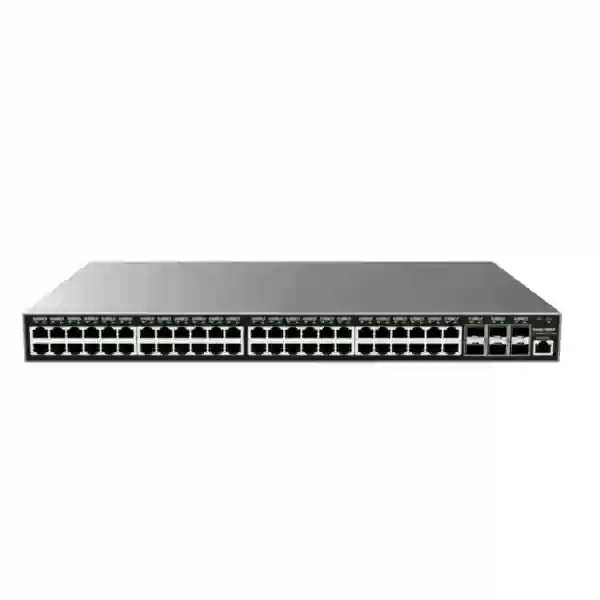
Grandstream GWN7806 Tanzania
The Grandstream GWN7806 is an enterprise-grade Layer 2+ managed network switch for organizations that need a dense access layer, high-speed uplinks and mature controls for segmentation, availability and traffic management. The model provides 48 Gigabit Ethernet ports and six 10 Gigabit SFP+ ports, giving IT teams a practical way to aggregate users, servers, wireless access points, IP telephony systems, surveillance infrastructure and other Ethernet-connected equipment into a structured LAN. With a published switching capacity of 216Gbps, non-blocking throughput of 108Gbps and forwarding performance of 160.704Mpps, the GWN7806 is positioned for demanding small-to-medium enterprise and campus-style networks where a basic unmanaged switch would not provide enough control.
Gigabit Ethernet access ports for dense wired endpoint connectivity.
SFP+ uplinks for high-speed aggregation, server links or fiber backbones.
Published switching capability for high-volume enterprise traffic.
Managed switching with VLANs, static routing, QoS, ACL and security controls.
Grandstream GWN7806 Overview
The GWN7806 is designed for networks that have outgrown simple port expansion and now require structured segmentation, predictable uplink capacity and centralized administration. Its 48 copper Gigabit interfaces can consolidate a large number of desktops, printers, servers, IP PBX equipment, access-control controllers and other LAN devices in one rack-mounted platform. Six 10G SFP+ ports provide the uplink headroom required for switch-to-switch trunks, aggregation links and high-bandwidth connections to suitable servers or backbone equipment. This combination is particularly useful in buildings where many edge devices operate at 1Gbps while the core or distribution path needs substantially more aggregate bandwidth.
Grandstream publishes support for IPv4 and IPv6, IEEE 802.1Q VLAN functionality, voice VLAN, link aggregation, spanning-tree mechanisms, static routing, multicast controls, DHCP functions, QoS, ACLs and multiple management and diagnostics options. Security features include 802.1X and MAC authentication, RADIUS and TACACS+, port isolation, port security, sticky MAC, IP source guard, ARP inspection, DHCP snooping, storm control and DoS protection. These controls make the switch suitable for administrators who need to separate business departments, guest services, voice, surveillance and infrastructure traffic while applying policies appropriate to each segment.
Management flexibility is another important buying factor. The GWN7806 can be administered through its local interface and can participate in Grandstream management workflows using GDMS Networking and GWN Manager. That is useful for organizations standardizing around Grandstream networking, especially when multiple switches, routers or wireless products must be monitored consistently. Buyers should note that the GWN7806 is the non-PoE model. If endpoints must receive power from the switch, the GWN7806P is the related PoE/PoE+ variant and should be evaluated separately rather than assuming the GWN7806 supplies PoE.
Verified Technical Highlights
| Ethernet ports | 48 x Gigabit Ethernet | SFP+ uplinks | 6 x 10Gbps |
| Switching capacity | 216Gbps | Non-blocking throughput | 108Gbps |
| Forwarding rate | 160.704Mpps | MAC addresses | Up to 32K |
| VLAN scale | Up to 4K VLANs | Management | Local interface, GDMS Networking, GWN Manager and supported provisioning methods |
| Mounting | Desktop or rack-mount | Operating range | 0°C to 45°C, 10% to 90% RH non-condensing |
Where the GWN7806 Fits
High-density office access
Use the 48 Gigabit ports to consolidate many wired users and devices while reserving 10G uplinks for distribution or core connectivity. VLANs can separate departments, voice and infrastructure traffic.
Campus and multi-floor networks
The six SFP+ interfaces provide flexibility for fiber or DAC-based switch interconnects where distance, backbone capacity or rack-to-rack connectivity requires more than standard 1Gbps uplinks.
Voice, video and business applications
QoS, voice VLAN and traffic-management capabilities help administrators prioritize delay-sensitive services and maintain clearer network policy boundaries.
Grandstream GWN7806 Tanzania
Organizations evaluating the Grandstream GWN7806 in Tanzania are usually looking for more than a 48-port replacement switch. The real requirement is often to create a structured LAN that can support office users, wireless access points, IP telephony, surveillance systems, servers and branch connectivity without placing every device on one flat network. The GWN7806 addresses that design need with a high port count, six 10G SFP+ interfaces and managed Layer 2+ capabilities. In a Tanzanian head office, education campus, hospitality property, healthcare environment or multi-tenant facility, that means the switch can act as an access or aggregation platform while VLANs and ACLs help establish clear boundaries between different traffic classes. Before procurement, buyers should document how many copper ports are needed today, which systems require separate VLANs and how much uplink bandwidth is expected during busy periods.
Tanzania deployments also benefit from careful attention to topology and infrastructure rather than selecting equipment only by port count. If a building uses fiber between floors, the six 10G SFP+ ports can be assigned to distribution links, but the optic type, distance and fiber plant must match the intended design. If the switch will be installed in a rack supporting servers, firewalls and storage, the design should consider redundancy, cable management, airflow and UPS capacity as part of the project. The GWN7806 itself does not supply PoE, so any project that expects to power IP phones, cameras or wireless access points from the access switch should compare the GWN7806P or another PoE-capable model. This distinction is important for accurate budgeting because a network may appear complete on a device list while still missing its endpoint power requirement.
For procurement, a useful Tanzania quotation request should include the model, required quantity, number of 1Gbps endpoints, expected SFP+ uplinks, fiber type, rack environment, any existing Grandstream networking equipment and whether centralized cloud or on-premise management is preferred. FourTeck Tanzania also presents broader technology services and a business technology shop that can be reviewed when the switch is part of a larger infrastructure requirement. The goal should be a switch that fits the complete LAN plan, including segmentation, uplink capacity, power strategy and future expansion rather than a simple one-for-one replacement.
Grandstream GWN7806 Dar es Salaam
For businesses in Dar es Salaam, the Grandstream GWN7806 is especially relevant where a central office, hotel, commercial building, warehouse or professional-services environment has a large number of wired devices and needs higher-capacity backbone connectivity. A common design challenge is that user devices may only need 1Gbps interfaces while multiple departments, virtualization hosts, wireless networks or surveillance systems share the same uplink path. The GWN7806 solves that imbalance by pairing 48 Gigabit access ports with six 10G SFP+ ports. That gives network planners room to build faster uplinks to a core switch, server segment or another floor while keeping the edge cost and cabling model familiar.
Dar es Salaam projects should start by mapping traffic classes. Corporate data, guest access, IP telephony, CCTV and management traffic should not automatically share the same broadcast domain. The GWN7806 supports VLAN-based segmentation and ACL policies that can help keep these environments logically separated. QoS can also be applied where voice or interactive traffic needs priority during congestion. If the site uses several access switches, spanning-tree and link-aggregation features can be included in the design to improve resiliency and aggregate bandwidth. These functions are valuable only when configured deliberately, so the procurement scope should include the intended topology and management plan rather than treating them as checkbox features.
Another practical consideration in Dar es Salaam is equipment-room readiness. The GWN7806 is rack-mountable and uses active cooling, so the cabinet should provide appropriate airflow, organized power and sufficient UPS support for the switch and connected network equipment. Because the model is non-PoE, an office deploying many IP phones, access points or cameras needs either separate endpoint power or a PoE-capable switch such as the GWN7806P. Buyers can use FourTeck Tanzania’s verified contact page to submit model, quantity, site type, uplink requirements and related network information. Providing those details helps move the discussion from a generic 48-port switch request to a more accurate network quotation.
Grandstream GWN7806 Mwanza
In Mwanza, the GWN7806 can suit organizations expanding from smaller unmanaged or lightly managed networks into a more structured environment. A 48-port managed switch is useful when a business wants to consolidate multiple workgroups in one communications room while retaining logical separation between departments and applications. The six SFP+ interfaces are particularly valuable if the network needs fiber uplinks to another building, floor or distribution point, although the actual optic choice should always be matched to fiber type and distance. For growing enterprises, this architecture avoids using every Gigabit port for inter-switch connections and reserves higher-speed interfaces for backbone traffic.
Mwanza buyers should evaluate the switch in the context of future network growth. The 32K MAC-address capability and support for thousands of VLANs provide significant logical scale, but practical design still depends on endpoint quantities, broadcast-domain size and routing strategy. Static routing can support selected Layer 3 use cases, while more complex dynamic-routing requirements may call for a different core platform. The GWN7806 is therefore a strong access or Layer 2+ aggregation choice where administrators want rich segmentation, multicast controls, DHCP relay, QoS and security without moving every switching function into a full Layer 3 chassis.
A Mwanza quotation should identify whether the project is a new installation or an upgrade. For an upgrade, listing the current switch model, uplinks, VLAN IDs, server connections and any performance bottlenecks makes the replacement plan more useful. For a new site, include user count, wired device count, expected wireless access points, cameras, phones, server connections and fiber runs. This information also clarifies whether the non-PoE GWN7806 is appropriate. If endpoint power is required, selecting a PoE model at the start can avoid separate injectors and power supplies. A disciplined requirements list helps align budget, rack space, cabling and management with the actual business need.
Grandstream GWN7806 Arusha
Arusha organizations in hospitality, tourism, education, administration and professional services may need a switch that can carry several types of business traffic while remaining straightforward to administer. The GWN7806 provides a suitable foundation when the requirement includes dozens of Gigabit-connected endpoints and multiple 10G uplinks. Hotels and larger offices, for example, may have separate networks for staff systems, guest services, surveillance, voice and infrastructure management. VLANs, ACLs and port-security controls allow administrators to enforce clearer boundaries, while QoS can prioritize applications such as voice and interactive communications that are sensitive to delay.
When planning the GWN7806 for Arusha, pay close attention to how wireless infrastructure and surveillance are powered. The GWN7806 does not provide PoE output. If Wi-Fi access points, IP phones or cameras need to receive power through Ethernet, either the GWN7806P or another PoE-capable access layer should be specified. In mixed networks, the non-PoE model can still work well as an aggregation switch, with PoE edge switches connecting upstream over SFP+ or Gigabit links. This approach can be effective when a building has several wiring closets and a central rack that concentrates fiber connections.
Operational simplicity should also influence the buying decision. Grandstream supports centralized management through its networking platforms, which can reduce the burden of handling multiple switches individually when a site expands. Before ordering, define whether the switch will be managed locally, through GDMS Networking, through GWN Manager or as part of a broader Grandstream environment. Include that preference in the project scope along with VLAN count, IP addressing, uplink speeds and resilience requirements. For organizations comparing broader regional expertise, the FourTeck Africa network can also provide a regional reference point for enterprise IT and networking discussions.
Grandstream GWN7806 Dodoma
The Grandstream GWN7806 is relevant in Dodoma for offices, institutions and multi-department environments that need centralized control over a large number of network ports. Its 48 Gigabit Ethernet interfaces support dense endpoint connectivity, while six 10G SFP+ ports offer faster paths toward servers, a distribution layer or fiber-linked buildings. This makes the platform useful where a single rack serves many users but the network cannot tolerate a 1Gbps uplink bottleneck between access and core layers. Careful uplink design is still essential: the number of active 10G links, redundancy model and fiber specifications should be documented before purchasing optics or DAC cables.
Dodoma network administrators can use VLANs to separate departments or applications and can apply access controls at the switch layer to reduce unnecessary lateral connectivity. Functions such as DHCP snooping, ARP inspection, IP source guard and 802.1X authentication can strengthen the access network when they are integrated with an overall security policy. They should not be enabled without planning, because authentication, DHCP and endpoint behavior need to match the chosen configuration. For organizations with limited IT staff, standardized templates and centralized management can make these controls easier to operate consistently across multiple switches.
Procurement should account for lifecycle and documentation as well as hardware. A well-prepared Dodoma deployment records port assignments, VLANs, uplinks, management addresses, firmware strategy and configuration backups. It also identifies which ports connect to critical systems so troubleshooting is faster later. Buyers should verify whether non-PoE switching is acceptable; if phones, cameras or access points rely on Power over Ethernet, the project may need GWN7806P or dedicated PoE access switches. FourTeck Tanzania’s services content emphasizes coordinated design across switches, Wi-Fi, firewalls, IP telephony and surveillance, which is useful when the GWN7806 forms one part of a larger office infrastructure project.
Grandstream GWN7806 UAE
UAE buyers considering the GWN7806 often compare it against other 48-port managed switches for branch offices, commercial buildings, hospitality sites and enterprise access layers. The important differentiator is not only the number of RJ45 ports but the combination of six 10G SFP+ uplinks and the Grandstream management ecosystem. Organizations already using Grandstream wireless or communications equipment may value a management approach that brings networking devices into a common operational workflow. The switch supports IPv4 and IPv6, VLANs, QoS, multicast controls and security functions suited to segmented corporate networks.
A UAE deployment may use the GWN7806 as an access switch for wired users or as an aggregation switch for smaller downstream switches. The six 10G ports create several topology choices, including redundant uplinks, connections to a core, server links or inter-switch trunks. Network teams should determine whether short-range DAC, multimode optics or single-mode optics are appropriate based on distance and cabling. The official documentation limits DAC cable use to supported lengths, so the physical design should be checked before ordering accessories. Cooling, rack depth and power should also be confirmed for dense equipment rooms.
Because UAE procurement frequently includes mixed voice, Wi-Fi and security systems, it is especially important to distinguish the GWN7806 from the GWN7806P. The GWN7806 is non-PoE; the P variant adds PoE/PoE+ on its copper ports. A quote should therefore state whether connected endpoints need switch-supplied power. Buyers seeking Grandstream-focused regional information can review FourTeck’s Grandstream UAE resource as part of the broader solution discussion, while the exact model, quantity, optics, management preference and intended topology should be specified in the enquiry.
Grandstream GWN7806 Uganda
In Uganda, the GWN7806 can provide a structured switching platform for businesses that are increasing user density or consolidating several network services. The 48 Gigabit copper ports suit office and campus access requirements, while six 10G SFP+ interfaces can connect the switch to a server room, distribution layer or fiber backbone. This architecture is valuable where several VLANs share the same physical infrastructure, because the switch can keep traffic logically segmented while the uplink layer carries aggregated loads at a higher speed than individual edge ports.
Ugandan organizations should consider management and security from the start. Features such as 802.1X, MAC authentication, RADIUS, TACACS+, port security and DHCP snooping can support a controlled access environment, but they work best when IT teams have a clear identity, addressing and policy plan. QoS can prioritize voice or other latency-sensitive traffic. Multicast controls such as IGMP and MLD snooping are also useful where video or other multicast applications are present. These capabilities make the GWN7806 more appropriate for managed business environments than a basic unmanaged 48-port switch.
When requesting a Uganda quote, provide the number of users and devices, expected uplink type, existing rack and fiber infrastructure, VLAN requirements and whether endpoints need PoE. The non-PoE GWN7806 is suitable when connected devices have their own power or when PoE is delivered by other edge switches. Buyers who need regional support context can review FourTeck Uganda, which covers networking and related business IT solutions. A complete request should also state whether the installation is standalone or part of a multi-site network that needs consistent management and configuration standards.
Grandstream GWN7806 Kampala
Kampala businesses with growing office networks can use the GWN7806 where 24-port switching is no longer sufficient and where uplink capacity has become a concern. Forty-eight Gigabit ports reduce the need to split a single office across multiple small switches, while six 10G SFP+ ports provide options for high-speed links to a core, servers or adjacent wiring closets. This simplifies rack design and can reduce bottlenecks if traffic from many users converges on centralized services.
A practical Kampala design should identify which traffic needs isolation. Finance, administration, guest Wi-Fi, voice, CCTV and management traffic can each have different security and performance requirements. The GWN7806 supports VLAN tagging and ACL policies that allow those services to share cabling while remaining logically distinct. Link aggregation can increase capacity or resilience between compatible devices, and spanning-tree functions can reduce the risk of switching loops. Administrators should document these settings carefully so failover and redundancy operate as intended rather than introducing unexpected paths.
Kampala buyers should also decide whether Grandstream centralized management is a priority. A site with one switch may be comfortable with local administration, while an organization with multiple branches or several GWN devices may benefit from GDMS Networking or GWN Manager. The procurement list should therefore include the operational model, not just hardware. It should also confirm whether PoE is needed. If phones, cameras or wireless access points require power over Ethernet, select the GWN7806P or another suitable PoE model. This single clarification can prevent a common mismatch between a 48-port switch order and the power needs of edge devices.
Grandstream GWN7806 Arua
For organizations in Arua, the GWN7806 offers a path from simple connectivity toward a more manageable business LAN. Its value becomes clear when administrators need to separate users and services, monitor switch behavior and create a faster backbone between network zones. The 48 Gigabit interfaces provide density for offices, education facilities, healthcare sites or operational buildings, while six 10G SFP+ ports can be assigned to fiber links where distance and bandwidth requirements justify them.
Arua deployments should focus on right-sizing. A 48-port switch may be appropriate even when fewer than 48 ports are active initially if growth is expected and rack consolidation is desirable. However, the number of ports should not be the only sizing criterion. Consider traffic patterns, uplink utilization, VLAN count, server connections and whether the switch is expected to route between subnets or primarily provide Layer 2 access. Static routing is supported, but networks requiring extensive Layer 3 protocols may need a different core solution.
The physical environment matters as well. The switch should be installed in a secure, ventilated location with reliable power and a suitable UPS strategy. Fiber patching, labeling and rack organization should be planned so the six SFP+ interfaces can be used effectively. Where local endpoints require PoE, remember that GWN7806 is the non-PoE model. A request for quotation should specify whether the project needs GWN7806, GWN7806P or a mixed architecture. By providing these details, buyers can obtain a more accurate bill of materials and avoid treating optics, patch cords, racks and power as afterthoughts.
Grandstream GWN7806 Mbarara
Mbarara businesses planning an office expansion, campus network or larger communications room can use the GWN7806 as a high-density managed switching platform. The 48 Gigabit ports allow many wired devices to connect through a single managed device, while six 10G SFP+ ports create room for fast uplinks. This is useful when users rely on centralized applications, file servers, cloud services or network storage and the access layer must not be constrained by a single 1Gbps trunk.
Segmentation is another reason to move to this class of switch. Organizations can create separate VLANs for administrative users, operations, voice, security systems and guests, then apply ACL and security features to control how those zones interact. DHCP snooping, ARP inspection, port security and source-guard capabilities can strengthen the access layer when correctly configured. QoS can prioritize voice and other time-sensitive traffic. The result is a network that is easier to govern than a flat LAN, but configuration discipline remains essential.
For Mbarara procurement, document port utilization and growth. Count not only desktops but also printers, servers, controllers, uplinks and any non-PoE devices attached to the switch. Then identify endpoints that require power. Because the GWN7806 does not provide PoE, a project with many access points, IP cameras or phones may need the GWN7806P or separate PoE switching. Also identify required SFP+ modules and fiber types instead of leaving uplink accessories unspecified. A complete requirement makes it easier to quote the switch as part of a functioning network rather than as an isolated hardware purchase.
Grandstream GWN7806 Gulu
In Gulu, the Grandstream GWN7806 can support organizations that need a stable, controlled wired network with enough port density for current operations and room for expansion. It combines 48 Gigabit Ethernet interfaces with six 10G SFP+ ports, allowing access traffic to be aggregated onto faster backbone links. This model is particularly relevant when a site has several departments or systems that should share the same physical switching infrastructure without operating as one unrestricted LAN.
The switch’s VLAN and ACL functions allow logical separation, while QoS helps administrators prioritize important traffic. Voice VLAN support can simplify IP telephony segmentation, and multicast controls can improve environments that use multicast services. Link aggregation and spanning-tree features support more resilient or higher-capacity inter-switch designs when configured with compatible upstream equipment. For Gulu sites using fiber between rooms or buildings, the SFP+ ports provide flexibility, but the optic type must match the installed fiber and distance.
An equipment selection discussion should include management skills and support processes. Grandstream provides centralized management options, but an organization should decide who will own configuration changes, firmware updates, backups and monitoring. Documenting this responsibility is as important as selecting the switch itself. Buyers should also confirm endpoint power requirements because GWN7806 is non-PoE. If phones, cameras or access points rely on PoE, specify the GWN7806P or a compatible PoE access layer. Including user counts, connected systems, uplinks, VLAN requirements and management preference in the quotation request will result in a more useful recommendation.
Grandstream GWN7806 Kenya
Kenyan enterprises evaluating the GWN7806 can use it as a dense Layer 2+ access or aggregation switch for offices, campuses, hotels, education facilities and branch environments. The 48 Gigabit ports are suited to endpoints that need reliable wired connectivity, while six 10G SFP+ ports provide the bandwidth needed for uplinks, server connectivity and building-to-building fiber. The combination helps reduce the common situation where many 1Gbps access ports converge on a single low-capacity uplink.
The feature set is also well matched to segmented enterprise networks. VLANs, voice VLAN, ACLs, QoS, DHCP functions, multicast controls and security mechanisms provide the tools needed to build separate zones for users, servers, voice, surveillance and guests. Centralized management can be useful for organizations operating more than one Grandstream switch or branch. The purchasing team should therefore involve the network administrator early so the quote reflects topology, management and security requirements instead of simply listing a switch quantity.
For Kenya, the bill of materials should identify whether the deployment uses copper or fiber uplinks, which SFP+ modules are required, how many rack units are available and whether a UPS is part of the design. It should also state whether endpoint PoE is necessary. The GWN7806 itself is non-PoE; projects powering phones, access points or cameras from the switch need the GWN7806P or another PoE-capable option. Buyers seeking local market context can review FourTeck Kenya, which presents enterprise networking among its business technology solutions. A complete enquiry should include model, quantity, topology and integration requirements.
Grandstream GWN7806 Kuwait
Kuwait organizations selecting a managed 48-port switch may prioritize rack density, high-speed uplinks and administrative control. The GWN7806 addresses those needs with 48 Gigabit copper interfaces, six 10G SFP+ ports and a 216Gbps switching capacity. In office towers, commercial environments and centralized server rooms, it can consolidate a significant number of endpoints while providing faster paths to the core or server network.
Network planners can use VLANs and ACLs to separate departments and services, while QoS can prioritize voice and interactive traffic. Security capabilities such as 802.1X, DHCP snooping, ARP inspection and port security can add useful access-layer controls. These functions should be aligned with the organization’s authentication, addressing and support procedures. For example, 802.1X requires an authentication workflow and cannot be treated as a standalone checkbox. A well-designed switch configuration is therefore part of the overall security architecture.
Kuwait buyers should also verify optics and thermal conditions for the rack. The switch is designed for standard enterprise installation, but high-density cabinets require disciplined airflow and power planning. The six SFP+ ports may use compatible optical modules or supported DAC cabling for appropriate short connections. As in other markets, the GWN7806 is the non-PoE version, so projects with powered endpoints must account for that separately. A purchasing request should include endpoint quantities, expected PoE devices, fiber distances, required uplink speed, VLAN plan and management preference so the quotation covers the real network requirement rather than only the base switch.
Grandstream GWN7806 Ghana
In Ghana, the GWN7806 can provide a practical enterprise switching layer for organizations that need many Gigabit connections plus faster uplinks. The 48 access ports suit workplaces with a high number of wired devices, and the six 10G SFP+ interfaces provide capacity for server rooms, core switches or fiber distribution. This makes the device relevant to business offices, educational environments, hospitality, healthcare and larger operational sites where simple unmanaged switching no longer offers enough visibility or control.
The GWN7806 supports traffic segmentation and policy through VLANs and ACLs, which can help separate user groups and reduce unnecessary cross-network access. QoS features are useful for IP voice and other time-sensitive services. Security functions such as DHCP snooping, source guard and ARP inspection can protect the access layer against certain local network threats when integrated into a proper design. Administrators can also use diagnostic and monitoring features to troubleshoot links and maintain configuration consistency.
For Ghana projects, make the quotation specific. State the number of switches, expected copper-port utilization, required 10G links, fiber type and whether redundant uplinks are planned. Clarify whether PoE is required; GWN7806 does not provide PoE output, while GWN7806P is the related powered variant. Include rack, UPS and cabling requirements if the project is a new installation. These details give suppliers a better basis for confirming accessories and alternatives. The result should be a network design that meets current capacity needs while leaving a sensible path for expansion rather than an isolated hardware purchase based only on port count.
Grandstream GWN7806 Nigeria
Nigeria has many enterprise environments where port density and uplink capacity are important, from multi-floor offices and education campuses to hospitality properties and industrial administration sites. The Grandstream GWN7806 fits these use cases by offering 48 Gigabit access ports and six 10G SFP+ interfaces. A network architect can dedicate the 10G ports to core uplinks, servers or switch interconnects while keeping the copper ports available for users and infrastructure devices.
Managed switching is particularly valuable where an organization needs formal segmentation. VLANs can separate departments, voice, management and surveillance traffic, while ACLs can enforce permitted flows. QoS can prioritize applications that are sensitive to congestion. Security features such as 802.1X, port security, DHCP snooping and ARP inspection can strengthen the edge when supported by the wider network design. Grandstream’s centralized management options are also relevant to businesses with multiple branches or many GWN devices, since configuration and monitoring can be handled in a more coordinated way.
Nigeria procurement teams should distinguish product capability from project requirements. The GWN7806 is not a PoE switch, so it should not be specified to power IP cameras, phones or wireless access points directly. If those devices need Ethernet power, compare the GWN7806P or a dedicated PoE access layer. Also include SFP+ module types, fiber lengths, rack conditions, UPS needs and management preferences in the quote. This improves bill-of-material accuracy and reduces the risk of purchasing a switch without the accessories or complementary infrastructure required for commissioning.
Grandstream GWN7806 Seychelles
For Seychelles businesses, resorts, offices and institutions, the GWN7806 can serve as a compact high-density managed switch where network services need to be consolidated in a central communications room. Forty-eight Gigabit Ethernet ports support a large number of edge devices, while six 10G SFP+ interfaces provide faster uplinks to servers, another switch or a fiber backbone. This is useful where several network services share the infrastructure and the site needs predictable performance during busy periods.
Hospitality and multi-service environments can benefit from VLAN segmentation because guest access, staff systems, voice, surveillance and building systems may have very different security requirements. The GWN7806 supports VLAN and ACL controls, along with QoS and multicast features, so network administrators can build separate logical zones over the same physical switch. When redundant uplinks or multiple switches are involved, link aggregation and spanning-tree functions can be incorporated into the topology to improve resilience and reduce loop risk.
Procurement in island environments should also consider the complete spares and accessory strategy. The quotation should specify compatible SFP+ modules, patching, rack hardware, UPS capacity and any expected replacement units or critical spares. Because the GWN7806 is non-PoE, powered endpoints need either the GWN7806P or another PoE source. Management should also be planned: local administration may be adequate for one site, while centralized Grandstream platforms can be useful for multiple switches or properties. A well-defined request should include the number of active ports, traffic types, fiber distances, VLAN needs and operational support model.
Compatibility, Integration and Deployment Guidance
The GWN7806 can operate in mixed-vendor networks because it uses standard Ethernet, VLAN, spanning-tree, link-aggregation, IPv4 and IPv6 technologies. However, interoperability should still be validated for any advanced feature that spans multiple devices. For example, link aggregation must be configured compatibly on both ends, VLAN tagging must match the upstream switch or firewall, and 802.1X requires an authentication infrastructure. SFP+ optics must be chosen for the intended fiber type and distance. Network teams should therefore treat the switch as part of an architecture rather than an isolated appliance.
For voice networks, voice VLAN and QoS can help prioritize IP telephony. For surveillance, VLAN segmentation can isolate cameras and recording systems, while multicast controls may be relevant depending on the video architecture. For wireless networks, multiple SSIDs can map to separate VLANs that traverse the GWN7806 toward the router or firewall. Because this model does not supply PoE, wireless access points and cameras must receive power elsewhere. In a layered design, downstream PoE switches may connect to the GWN7806 using 10G or 1G uplinks while the GWN7806 acts as a high-capacity aggregation point.
GWN7806 vs GWN7806P: Choose the Correct Model
GWN7806
Choose the standard GWN7806 when you need 48 Gigabit access ports, six 10G SFP+ uplinks and managed Layer 2+ functions but do not need the switch to supply PoE. It is suitable for desktops, servers, printers, controllers and downstream equipment with independent power.
GWN7806P
Choose the GWN7806P when the same high-density switching platform must also power PoE/PoE+ endpoints. Grandstream specifies 48 PoE ports and up to 400W total PoE output for the P model. Confirm the device power budget before ordering.
Buying and Quotation Checklist
A useful GWN7806 quotation request should include the exact model, quantity, current and future port count, whether PoE is required, number and speed of uplinks, fiber type and distance, SFP+ module requirement, rack location, UPS or power requirement, VLAN plan, management preference, connected servers, voice systems, Wi-Fi access points, cameras and any existing switches or firewalls that must interoperate. If the project includes multiple sites, also state whether configuration standardization and centralized management are required.
Do not assume the switch price alone represents the full project cost. Depending on the site, a complete bill of materials may include optics, fiber patch leads, copper patch cords, rack accessories, UPS equipment and installation or configuration services. Accurate project context helps avoid under-scoping and enables the supplier to identify whether GWN7806 is the best fit or whether another model is more appropriate.
Frequently Asked Questions
Does Grandstream GWN7806 provide PoE?
No. The standard GWN7806 is the non-PoE model. The related GWN7806P provides PoE/PoE+ output. Choose the model based on whether connected phones, access points, cameras or other devices need power through Ethernet.
How many ports does GWN7806 have?
It provides 48 Gigabit Ethernet RJ45 ports and six 10 Gigabit SFP+ uplink ports, for a total of 54 physical network interfaces serving different access and uplink roles.
What is the switching capacity of GWN7806?
Grandstream specifies 216Gbps switching capacity, 108Gbps total non-blocking throughput and a forwarding rate of 160.704Mpps.
Can GWN7806 be centrally managed?
Yes. Grandstream supports centralized networking management through platforms including GDMS Networking and GWN Manager, in addition to local administration options.
Is GWN7806 suitable for VLAN-based office networks?
Yes. It supports IEEE 802.1Q VLAN capabilities, voice VLAN and other VLAN functions. The specific VLAN design should match the upstream firewall, router and access requirements.
What information should I provide for a Tanzania quote?
Provide the exact model, quantity, port requirements, PoE requirement, uplink speeds, fiber distances, VLAN plan, rack environment and management preference. Also list connected systems such as servers, IP phones, Wi-Fi access points or cameras so the scope can be checked for compatibility.
Decision Recap
Choose Grandstream GWN7806 when you need a high-density non-PoE Layer 2+ managed switch with 48 Gigabit access ports, six 10G SFP+ uplinks and strong VLAN, QoS, security and management capabilities. It is a good fit for enterprise access and aggregation roles where uplink headroom matters and endpoint power is handled separately. Choose GWN7806P instead when the same 48-port platform must power PoE/PoE+ devices. In either case, confirm optics, topology, rack power, management method and endpoint requirements before procurement.
Talk to FourTeck Tanzania About Your GWN7806 Requirement
For a more useful quotation, send the exact model and quantity together with your site type, current network, uplink requirements and whether the switch will be used for office access, aggregation, servers or a broader infrastructure project. FourTeck Tanzania’s contact workflow is designed to collect this context so product selection can be discussed alongside compatibility, capacity and integration.


Reviews
There are no reviews yet.