
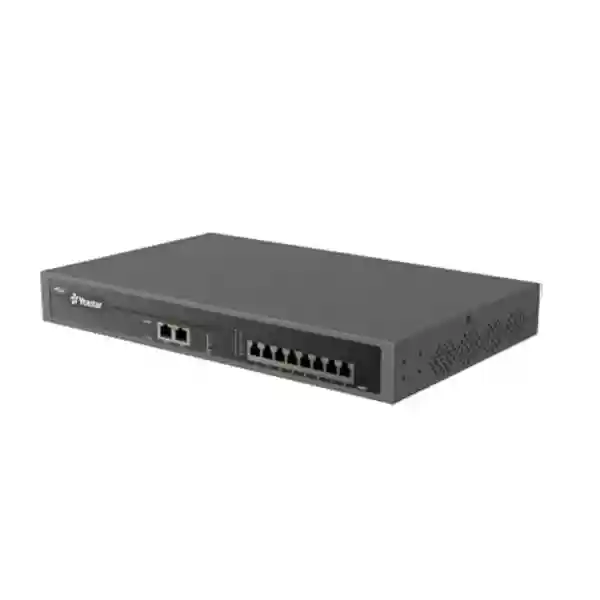
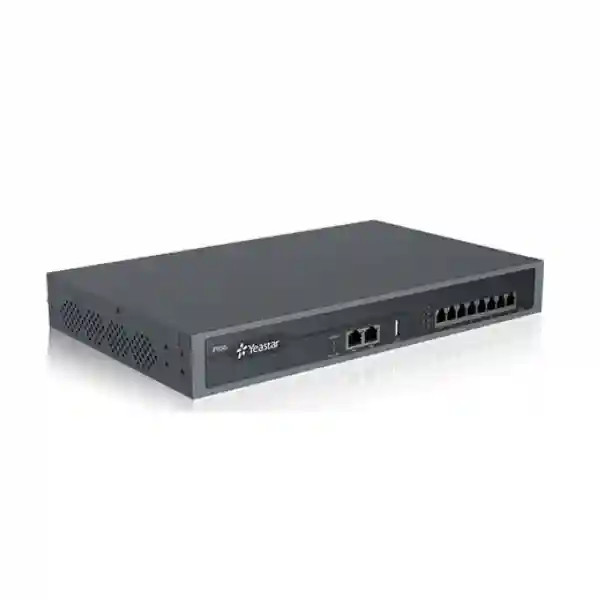
Yeastar P550 IP PBX
The Yeastar P550 is a compact P-Series Appliance Edition IP PBX for organisations that need an on-premises business phone system with unified communications, flexible trunk choices and a practical 50-user ceiling. Official Yeastar specifications list 50 base and maximum users, up to 25 concurrent calls, up to eight FXS ports, up to eight FXO/BRI ports and up to four cellular ports depending on installed modules. The model does not provide an E1/T1/J1 interface. For Tanzanian organisations evaluating a new office telephone platform, the important buying question is not only whether the appliance fits today’s extension count, but whether the complete design fits call volumes, trunk availability, IP-phone compatibility, remote users, reception workflows, branch communication and network quality.
What the Yeastar P550 is designed to solve
Businesses moving from basic analog telephone systems or fragmented VoIP services often need one manageable platform for extensions, inbound call handling, department routing, voicemail, reception, remote users and reporting. The P550 addresses that requirement as an on-premises appliance while retaining support for SIP trunks and optional traditional telephony interfaces through modular hardware. That combination is useful where a company wants the flexibility of IP telephony without immediately abandoning every existing line type or analog endpoint.
Yeastar positions the P-Series Appliance Edition as a unified communications platform rather than a voice-only PBX. Linkus UC clients extend business calling to web, desktop and mobile devices, while features across the P-Series include visual call management, remote work, call-centre functions and browser-based collaboration capabilities. Exact feature availability can depend on the service plan and software version, so procurement should separate the appliance’s physical capacity from any optional subscription-based functions required by the project.
A successful P550 deployment therefore begins with the call flow. FourTeck recommends documenting how inbound calls should be answered, which users belong to ring groups or queues, what happens outside business hours, whether calls must be recorded, whether branch or remote users need extensions, and which existing PSTN, BRI, cellular or SIP services must be retained. That produces a system design that matches business operations rather than a PBX configured around default settings.
Unified communications
Use compatible Linkus clients to bring extension calling and communications workflows to desktop, web and mobile users, reducing dependence on a desk handset for every situation.
Modular telephony
The P550 supports up to four optional telephony modules. Depending on module selection, projects can integrate analog extensions, PSTN lines, BRI or cellular connectivity while maintaining SIP-based calling.
Business call handling
Build reception and department workflows around IVR, ring groups, queues, voicemail, schedules and call routing so customers reach the correct team with fewer manual transfers.
Network-aware deployment
Voice quality depends on stable LAN and internet infrastructure. VLAN design, PoE switching, QoS, firewall policy, trunk reachability and UPS protection should be planned together with the PBX.
Yeastar P550 technical planning summary
| Users | 50 base / 50 maximum | Concurrent calls | 25 maximum |
| FXS | Up to 8 | FXO / BRI | Up to 8 |
| Cellular interfaces | Up to 4 GSM/3G/4G depending on module availability | E1/T1/J1 | Not supported on P550 |
| Ethernet | Dual network interfaces with single, bridge and dual network modes documented by Yeastar | Installation | Desktop or rack-oriented business deployment; leave adequate ventilation and plan protected power |
These figures are capacity limits, not a substitute for sizing. A 50-user company can still need a larger platform if simultaneous-call demand exceeds 25, if PRI/E1 connectivity is mandatory, or if growth beyond 50 extensions is expected. Conversely, a smaller organisation may choose the P550 because it requires its interface flexibility or wants a defined capacity margin. FourTeck can compare the P550 with other P-Series models when extension growth or trunk architecture suggests a different appliance.
Compatibility, trunks and network integration
The P550 supports SIP-based telephony and optional telephony modules. Yeastar documents S2 modules for two FXS ports, O2 modules for two FXO ports, SO modules for one FXS plus one FXO, B2 modules for two BRI ports and cellular module choices for supported GSM/3G/4G scenarios. Module choice should be based on the actual line service and endpoint requirement. A quotation should therefore state the exact module configuration rather than listing only the base appliance.
For IP endpoints, confirm SIP interoperability, provisioning method, codec support, PoE needs and any function keys expected by reception or call-centre users. Existing IP phones may be reusable if technically compatible, but that should be tested rather than assumed. For analog devices such as fax machines or legacy handsets, identify how many FXS ports are needed. For analog public-network lines, count FXO requirements. For BRI services, confirm local availability and the line presentation with the telecom provider before module selection.
The network should be designed for real-time traffic. Voice VLANs can separate phones from general data devices, QoS can prioritise time-sensitive packets, managed switches simplify troubleshooting, and UPS-backed switching helps keep phones online during brief power interruptions. Remote access should use the PBX’s supported secure methods rather than exposing management interfaces indiscriminately. Firewall rules, DNS, NAT behaviour and SIP-provider requirements should be documented before cutover.
Related FourTeck Tanzania resources
For broader purchasing context, visit the FourTeck Tanzania technology shop, which explains how to evaluate capacity, compatibility, infrastructure and lifecycle before ordering. The FourTeck Tanzania services page covers integrated telecom, networking, security and support considerations that often sit around a PBX project.
The FourTeck Tanzania solutions overview explains how IP PBX, IP phones, switching, Wi-Fi and firewalls fit into the wider business technology environment. Buyers that need company context can review the About FourTeck Tanzania page. When your extension count, trunk requirement and preferred deployment scope are ready, use the Tanzania enquiry and quotation page to submit the project details.
For organisations coordinating regional standards, the wider FourTeck network includes FourTeck UAE technology solutions, FourTeck Kenya, FourTeck Uganda, FourTeck Africa and FourTeck Ghana for country or regional technology discussions.
Yeastar P550 IP PBX Tanzania
For organisations in Tanzania, the Yeastar P550 is most relevant when the planned business phone system stays within 50 users and the expected busy-hour call load fits within 25 concurrent calls. That makes it suitable for many offices, professional firms, schools, clinics, hospitality operations, service businesses and branch environments where structured call routing is required without moving to a much larger appliance. Procurement should start by listing extensions, departments, reception positions, remote users, branch links and the number of external lines or SIP channels that need to be active at peak time. That workload determines whether the P550 is correctly sized.
Tanzania projects can involve a mixture of newer SIP services and existing telephony infrastructure. The P550’s modular design is valuable because analog, BRI or cellular interfaces can be planned where technically and commercially appropriate. However, the exact local line type must be confirmed with the telecom provider before hardware is ordered. The P550 has no E1/T1/J1 interface, so organisations that require PRI-class connectivity should discuss a different model or gateway architecture rather than assuming an expansion module can add it later.
Network readiness matters just as much as the PBX. Voice traffic benefits from stable switching, suitable PoE capacity for IP phones, VLAN separation, QoS, protected power and a firewall configuration that does not interfere with the selected SIP trunk. Where users work remotely, secure remote access, extension policy and call-routing controls should be agreed in advance. FourTeck Tanzania can use this information to prepare a more accurate quotation covering the P550 appliance, required telephony modules, compatible handsets, switching, UPS or network work where needed, and configuration scope.
When requesting a Yeastar P550 price in Tanzania, include the user count, expected simultaneous calls, preferred trunk provider, number and type of IP phones, analog devices, branch locations, call recording needs and any CRM or contact-centre requirements. That avoids a misleading base-hardware price that excludes essential modules or supporting infrastructure.
Yeastar P550 IP PBX Dar es Salaam
Dar es Salaam businesses often need an office phone system that can manage a main reception, departmental extensions, mobile staff and customer-facing call flows in one platform. The Yeastar P550 can be a practical fit for organisations with up to 50 users when 25 concurrent calls provide sufficient peak capacity. Rather than sizing from employee count alone, businesses should consider how many calls can be active at the busiest period. A 40-person office with a busy reservations or sales team can create more concurrent traffic than a 50-person administrative office.
For a Dar es Salaam deployment, prepare a line inventory before ordering: current telephone numbers, SIP trunks, analog PSTN lines, BRI services if still present, cellular routes and any extensions connected to fax or analog equipment. The P550 supports optional modules for several of these interfaces, but module quantities must be mapped to the project. Its lack of E1/T1/J1 means PRI requirements need a different design. If the office is migrating from an older PBX, preserve the business call flow in the migration plan: receptionist handling, hunt groups, IVR options, after-hours messages, voicemail and emergency fallback should all be documented.
Dar es Salaam offices also benefit from reviewing the LAN before cutover. IP phones can share physical switch infrastructure with computers while remaining logically separated with VLANs. PoE switching reduces desk power adapters, while UPS-backed networking can help the phone service survive short utility interruptions. Internet quality and firewall behaviour influence SIP and remote-extension performance, so testing should include inbound and outbound calls, transfers, DTMF, caller ID, hold, conferencing and failover scenarios.
When asking FourTeck Tanzania for a P550 quotation in Dar es Salaam, provide the office location, user count, current phone system, trunk details, number of handsets and any cabling or switch limitations. That gives procurement a complete view instead of pricing the PBX as an isolated box.
Yeastar P550 IP PBX Mwanza
Organisations in Mwanza evaluating the Yeastar P550 should focus on operational continuity and the practical relationship between local office users, remote employees and any branch sites. The appliance supports up to 50 users and 25 simultaneous calls, giving SMEs a defined capacity envelope for reception, administration, sales, customer service and management extensions. For businesses with multiple departments, call queues and IVR can make incoming calls easier to route, while Linkus clients can give approved users more flexibility when they are away from their desk.
A Mwanza project may involve an existing mix of analog handsets, PSTN services or IP phones. The P550’s four module slots allow the configuration to be adapted with supported FXS, FXO, BRI or cellular modules, but the physical interface design should be confirmed before purchase. Count every analog extension and outside line that must remain connected. If the organisation expects future growth beyond 50 users, consider that early; the P550 itself is capped at 50 users, so a larger P-Series model may offer a more economical growth path than replacing the appliance after a short period.
Connectivity between Mwanza and other offices should be treated as a network design requirement. Inter-site calling, remote extensions and centralised administration depend on stable IP connectivity and secure routing. Voice traffic should be separated where appropriate, bandwidth should be checked during busy periods, and firewalls should allow only the necessary communications. A backup-power plan for the PBX, switches and internet equipment is especially important because a phone server cannot remain useful if the access switch or router loses power.
For quotation planning, Mwanza buyers should include extension numbers, concurrent-call estimates, branch requirements, preferred phones, trunk technology, call recording needs and whether existing cabling or switches will be reused. This helps FourTeck assess the complete solution and identify any compatibility checks before deployment.
Yeastar P550 IP PBX Arusha
Arusha organisations in hospitality, travel, professional services, education and general commerce often need predictable reception and customer-call handling. The Yeastar P550 can support up to 50 users and 25 concurrent calls, making it useful where the business requires structured routing but does not need enterprise-scale extension capacity. A good design starts by separating ordinary office extensions from high-call-volume roles such as front desk, reservations, sales or support because those users influence concurrent-call and queue requirements more strongly than headcount alone.
For hospitality or service environments in Arusha, clarify how calls should move during busy periods and after hours. IVR menus can route callers, ring groups can distribute calls across teams, queues can manage waiting callers and voicemail can provide an alternative when staff are unavailable. If managers or mobile employees need to keep their business identity while away from the desk, Linkus clients may form part of the unified-communications plan. Any advanced features tied to Yeastar service plans should be identified in the quotation so recurring costs are not discovered after installation.
Infrastructure planning should include IP phones, PoE switching, voice VLANs, QoS and protected power. If the site includes guest Wi-Fi, CCTV or other bandwidth-heavy applications, voice traffic should not be left to compete unpredictably on an unmanaged network. Businesses using SIP trunks should confirm provider settings and number presentation before cutover. Existing analog or BRI services may be integrated through supported modules where appropriate, but the required module count must be specified.
Arusha buyers requesting the Yeastar P550 should provide the number of rooms, desks or staff requiring extensions, reception requirements, busy-hour call estimate, existing trunks and any integration needs. This information lets FourTeck Tanzania distinguish a simple appliance supply from a full deployment involving phones, switching, configuration, testing and user handover.
Yeastar P550 IP PBX Dodoma
In Dodoma, the Yeastar P550 can serve offices, NGOs, professional organisations, institutions and growing businesses that need an on-premises PBX with unified communications. Its official capacity of 50 users and 25 concurrent calls is easy to understand, but procurement should translate those figures into a real call model. List departments, direct extensions, reception activity, queue agents, conference calling and remote users. If a large proportion of staff spend most of the day on the phone, the 25-call ceiling deserves closer review.
The P550 is particularly useful when a project needs more than SIP trunks. Supported optional modules can add FXS, FXO, BRI or cellular interfaces. That can help during migration from older telephony or where specific line types remain necessary. Nevertheless, each interface should be justified. Adding unused analog or cellular modules increases cost and support complexity. Conversely, ordering the base appliance without required interfaces can delay deployment. The correct bill of materials comes from a line-and-device inventory prepared before quotation.
Dodoma sites should also review switching and power continuity. If IP phones depend on PoE, both the access switch and PBX should be protected appropriately. A voice VLAN can make addressing and policy clearer, while QoS can prioritise voice over less time-sensitive traffic. Secure remote administration and controlled remote-user access should replace ad-hoc port forwarding. Configuration backups, firmware maintenance and a documented extension plan help keep the system supportable after the initial installation.
For a Dodoma P550 quotation, state whether the requirement is appliance-only or a complete communication solution. Include the number of users, phones, trunks, analog devices, branch offices, call queues and expected growth. FourTeck Tanzania can then assess whether the P550 is the right model or whether a higher-capacity P-Series appliance is more suitable for the planned lifecycle.
Yeastar P550 IP PBX UAE
For UAE organisations or regional groups standardising telephony across Middle East and African sites, the Yeastar P550 provides a compact 50-user appliance that can fit branches, project offices and smaller headquarters. The design should still be based on local telecom requirements because trunking, numbering and regulatory conditions vary by country. In the UAE, confirm the selected carrier service and the supported SIP or legacy interface arrangement before purchasing modules or committing to a migration schedule.
Regional procurement teams often value consistency more than simply obtaining the lowest device price. Standardising on one PBX family can simplify extension planning, administration, user training and support documentation across sites. The P550 can participate in that strategy where the branch remains within 50 users and 25 concurrent calls. Larger offices should be sized independently rather than forcing every site onto the same appliance. Where E1/T1/J1 is required, remember that the P550 itself does not offer that interface.
UAE projects may also require a detailed bill of materials covering IP phones, headsets, PoE switches, rack accessories, UPS protection and licences or service plans. Linkus can help users work across desktop, browser and mobile contexts, but remote access should be configured with security and company policy in mind. For branches connected through VPN or SD-WAN, voice quality should be validated across the WAN rather than assumed from bandwidth alone.
FourTeck’s wider regional network can help buyers compare a P550 branch design with broader IP PBX and network requirements. Provide user numbers, simultaneous-call expectations, carrier details, required interfaces and integration targets so the proposal separates base hardware from optional services and deployment work.
Yeastar P550 IP PBX Uganda
Ugandan organisations considering the Yeastar P550 can use it as an on-premises communications core for up to 50 users where peak simultaneous calls stay within 25. It can support conventional office extensions, reception, department routing, queues and mobile or desktop UC users. For distributed organisations, the most important early decision is whether each branch will have its own PBX or whether extensions will be centralised. That choice affects WAN dependence, numbering, failover and support.
Legacy connectivity should be mapped carefully. Optional FXS and FXO modules can help retain analog phones or PSTN lines, BRI modules can serve compatible services, and cellular modules may suit specific voice or connectivity scenarios. The P550 supports up to four telephony modules, but the final combination must remain within the appliance’s supported port limits. PRI-class E1/T1/J1 is not available on this model, which is an important distinction when replacing older enterprise PBXs.
For network design, give voice traffic predictable paths. Managed switches, separate voice VLANs, appropriate QoS, controlled firewall rules and stable internet connectivity improve reliability and troubleshooting. Sites with intermittent power should protect the PBX, switches and carrier equipment together. Backing up only the PBX while the switch loses power does not preserve service. Remote workers should use supported secure access methods and clearly defined extension policies.
When requesting a Uganda quotation, provide the number of offices, extensions, IP phones, analog endpoints, trunks and expected call peaks. Mention any existing Yeastar or third-party PBX environment that must interconnect. FourTeck Uganda and the regional FourTeck network can then help structure the equipment and integration discussion around verified requirements rather than a generic product bundle.
Yeastar P550 IP PBX Kampala
Kampala businesses frequently require reception, sales, support and management users to share one consistent office calling platform. The Yeastar P550 can suit this profile when the organisation stays within 50 users and 25 concurrent calls. The recommended design should identify the busy-hour load, not only total extensions. Call-centre or customer-service teams can consume a large share of simultaneous-call capacity even when total staff numbers are modest.
A Kampala deployment should document inbound numbers, SIP trunks, analog lines, BRI services and any cellular paths that must remain in use. The P550’s modular architecture lets the appliance be configured around those needs, but it is better to order only the interfaces that the verified carrier environment requires. If the business plans to retire analog lines soon, a temporary migration design may be more economical than over-equipping the appliance for legacy connectivity.
IP phones and Linkus clients can be allocated by user role. Receptionists may need phones with more keys or attendant features, managers may value mobility, and ordinary staff may need simpler endpoints. The network should support PoE, VLANs and QoS where appropriate, and the firewall should be configured around the chosen trunk and remote-access architecture. Testing should include calls to and from all important number ranges, DTMF, transfers, voicemail, queue behaviour and after-hours routes.
For Kampala procurement, ask for a quotation that separates the P550 appliance, telephony modules, IP phones, licences or service plans, switches, installation and configuration. This makes competing proposals easier to compare and reduces the risk that one price appears cheaper simply because necessary components were omitted.
Yeastar P550 IP PBX Arua
Arua organisations considering a business VoIP upgrade can use the Yeastar P550 where a 50-user ceiling and 25 concurrent calls match the expected workload. The system can centralise extensions and call handling for administrative offices, service teams, clinics, education environments, NGOs and commercial operations that want more structure than stand-alone telephone lines. Its value comes from bringing call routing, voicemail, groups, queues and user mobility into one administered platform.
Arua deployments should give particular attention to connectivity resilience. If SIP trunks or remote extensions depend on internet access, the quality and availability of the WAN connection directly affect communications. Where multiple internet paths are available, failover should be designed carefully with the firewall and SIP provider rather than assumed to work automatically. Cellular modules may be considered for supported scenarios, but the technical and commercial use case should be verified before ordering.
The local network should also be prepared for IP telephony. Managed PoE switching simplifies power and segmentation, while a UPS can protect the PBX, switches and routing equipment through short interruptions. Where existing analog phones or lines must remain, the required FXS or FXO modules can be added within the P550’s supported limits. If BRI exists, confirm line compatibility. E1/T1/J1 is not an option on this model.
A useful Arua quotation request should include current carrier services, user count, IP-phone quantity, analog devices, branch links, remote workers and expected growth. FourTeck can then determine whether the P550 is the correct appliance or whether a different design would provide a better expansion path for the organisation.
Yeastar P550 IP PBX Mbarara
For Mbarara businesses, a Yeastar P550 project should begin with communication workflow rather than hardware selection. Identify who answers the main number, which departments receive the most inbound traffic, whether callers need IVR choices, how unanswered calls should be handled, and which employees need remote access. The P550 can support up to 50 users and 25 concurrent calls, a capacity that fits many SMEs but should be checked against sales, reservations, support or service-desk peaks.
The appliance can integrate different line types through optional telephony modules. This matters when an organisation is moving gradually from analog to SIP or needs to retain selected legacy services. Count FXS ports for analog phones or fax devices, FXO ports for PSTN lines and BRI ports where relevant. Cellular modules may fit specific use cases. Because the P550 has no E1/T1/J1 interface, businesses with PRI requirements should evaluate another P-Series model or a suitable gateway architecture.
Mbarara sites should protect voice infrastructure as a system. IP phones, access switches, PBX, firewall and internet equipment all participate in a call. PoE and UPS planning can reduce desktop clutter and improve resilience. VLANs and QoS can make voice traffic easier to prioritise, while documented firewall rules simplify troubleshooting. User permissions should also be defined so that administrative access is limited to authorised staff.
For a P550 quotation in Mbarara, include equipment quantity, extension count, existing phone model, trunk services, call recording expectations, reception requirements and whether installation or remote configuration is needed. A complete requirement helps the proposal reflect the actual deployment rather than only the price of the base appliance.
Yeastar P550 IP PBX Gulu
Gulu organisations planning a new office telephone system can consider the Yeastar P550 when they require an on-premises PBX for no more than 50 users and up to 25 concurrent calls. The system is suitable for businesses and institutions that need controlled call routing, voicemail, departmental groups, reception handling and remote-user options. The planning process should estimate growth over the expected service life rather than only counting current employees.
Where existing telephony must be retained, the P550’s optional modules can add analog, BRI or cellular interfaces. This allows a staged migration in some environments, but it also makes accurate bill-of-materials planning important. A PBX ordered with the wrong module mix can be difficult to deploy without additional parts. Confirm every outside line, analog endpoint and special device, and verify provider compatibility before purchase. If E1/T1/J1 is required, select a different architecture because the P550 does not provide that interface.
Voice quality in Gulu will depend on the LAN and any internet-based trunk or remote connection. Managed switches, adequate PoE power, voice VLANs, QoS and reliable DNS and routing are useful foundations. The PBX and supporting network devices should be connected to appropriate backup power where continuity matters. Remote administration should be secured and configuration backups should be maintained so recovery is easier after hardware or configuration incidents.
Buyers should submit a structured requirement including user count, concurrent-call expectation, trunk types, phone quantities, remote users, branch connectivity and preferred features. This lets FourTeck discuss the P550 in the context of the full communications environment and identify supporting network or endpoint requirements before procurement approval.
Yeastar P550 IP PBX Kenya
Kenyan buyers searching for the Yeastar P550 often compare appliance price, licences, IP phones, modules and installation as separate items. A better comparison uses a complete solution bill of materials. The P550 itself supports 50 users and 25 concurrent calls. Optional interfaces can extend support for analog, BRI or cellular connectivity, while SIP trunks provide the main IP-based carrier route in many deployments. The exact configuration should match the carrier service, not a reseller’s standard bundle.
Businesses in Nairobi and other Kenyan locations should estimate busy-hour calls, queue agents and future growth before choosing the model. If the company expects to pass 50 users, planning around a larger P-Series platform can avoid a premature replacement. Where existing phones are being reused, test SIP compatibility and provisioning. For a new deployment, choose phone models by user role and confirm PoE budget, headset requirements and receptionist needs.
Network preparation should include voice VLANs where appropriate, QoS, firewall rules, stable internet connectivity and UPS protection. Branch connectivity can be designed through secure IP links, but latency, packet loss and WAN reliability should be measured rather than assumed. Linkus clients can provide flexibility for mobile and remote users, while call queues and routing can help customer-facing teams handle inbound demand more consistently.
When comparing a Yeastar P550 price in Kenya, check whether the quotation includes the exact telephony modules, licences or service plans, IP phones, power accessories, installation, configuration and support. FourTeck Kenya can help structure these requirements so buyers compare like with like instead of judging only the headline price of the PBX chassis.
Yeastar P550 IP PBX Kuwait
Kuwait organisations can consider the Yeastar P550 for branch offices and SMEs requiring a 50-user on-premises IP PBX with unified communications. The platform supports up to 25 concurrent calls, so call-volume analysis is important for businesses with reception, customer service or sales teams. Procurement should identify whether users need desk phones, Linkus clients or both, and whether branch or remote access is part of the design.
Carrier integration must be verified against the local telecom service. SIP trunks may provide the primary external calling path, while optional P550 modules can support selected analog, BRI or cellular interfaces. The appliance does not provide E1/T1/J1, so any requirement for that class of trunk should be addressed with a different platform or gateway solution. Exact interface requirements should be recorded in the quotation to prevent assumptions about what the base appliance includes.
In a Kuwait office, voice performance depends on switching, PoE, firewall behaviour and the reliability of local internet or private connectivity. IP phones can be grouped on a voice VLAN, and QoS can help protect voice traffic during periods of network congestion. Rack, power and cooling arrangements should be documented. Configuration backups and firmware maintenance should also be included in the operational plan rather than treated as one-time installation tasks.
A useful quotation request includes extension count, estimated simultaneous calls, trunk type, phone quantities, analog devices, remote users, branch sites and desired call-management features. Regional FourTeck resources can then help compare the P550 with other PBX choices and assemble a complete telephony and network proposal.
Yeastar P550 IP PBX Ghana
Ghanaian organisations looking for a Yeastar P550 supplier should first determine whether the appliance’s capacity aligns with their actual call pattern. The P550 supports 50 users and 25 concurrent calls, which can suit a wide range of offices, schools, clinics, hospitality sites and professional organisations. However, a customer-service operation with many agents may reach the call limit sooner than an administrative office with the same staff count.
The modular telephony design helps when an organisation must retain some traditional interfaces during a VoIP migration. Supported modules can provide FXS, FXO, BRI or cellular connectivity within the P550’s limits. Exact carrier compatibility should be confirmed before purchase. The model does not support E1/T1/J1 directly, an important point for organisations replacing older PBXs that used PRI connectivity.
For IP calling, prepare the LAN for real-time traffic. Managed PoE switches can power desk phones, VLANs can segment voice, QoS can prioritise calls and a suitable firewall can control trunk and remote-user traffic. The PBX, switches and WAN equipment should share an appropriate backup-power strategy where uptime matters. Remote administration should be protected, and configuration backups should be stored securely.
When requesting a Ghana quotation, ask for the full deployment scope: P550 appliance, telephony modules, IP phones, licences or service plans, switches, UPS equipment, configuration and support. Provide user count, external line requirements, call recording, queue needs and expected growth. FourTeck Ghana and the wider regional network can use these inputs to develop a proposal that reflects the complete communications requirement rather than only the appliance price.
Yeastar P550 IP PBX Nigeria
Nigerian businesses evaluating the Yeastar P550 can use the appliance as a controlled on-premises communications platform for up to 50 users. Its 25-concurrent-call limit should be compared with real inbound and outbound traffic, especially for sales, support and service teams. Where multiple offices are involved, decide whether each site will operate independently or share a centrally managed telephony design, because WAN quality and failover requirements differ between those approaches.
The P550 can support SIP trunks and optional traditional telephony modules, providing a migration path where businesses still rely on analog lines, BRI or selected cellular connectivity. Procurement should identify how many physical ports are required and which modules provide them. Do not assume that all listed maximum ports are present in the base unit. E1/T1/J1 is not supported on the P550, so PRI-dependent organisations need another design.
Network and power design are central to reliability. IP phones, the PBX, PoE switches, router and firewall must operate together. Use managed switching where practical, separate voice with VLANs, configure QoS appropriately and provide backup power according to the required continuity level. SIP deployments should be tested for NAT behaviour, DTMF, caller ID, call transfer and failover. Remote users should be provisioned through supported secure methods and governed by sensible password and access policies.
For a Nigeria P550 quotation, provide the number of users and sites, phone quantities, existing PBX details, trunk types, queue or call-centre needs, recording requirements and expected growth. A complete requirement lets procurement evaluate equipment, licensing, installation and support as one solution rather than comparing incomplete chassis-only prices.
Yeastar P550 IP PBX Seychelles
For Seychelles businesses, the Yeastar P550 can be attractive where a single office, resort operation, service company or branch requires an on-premises PBX for up to 50 users. Its 25 concurrent calls provide a practical mid-sized capacity, but hospitality and reservation-heavy environments should estimate peak traffic carefully. A front desk and reservations team may need queues, ring groups and routing rules that are more important to daily operations than the total number of extensions.
Because island deployments can involve longer replacement and logistics cycles, configuration accuracy before shipment is especially valuable. Identify every required telephony module, phone type, rack accessory and power component in advance. The P550 supports optional FXS, FXO, BRI and cellular interfaces within defined limits. It does not support E1/T1/J1, so any PRI-related requirement should be solved through another supported architecture. Carrier compatibility should be confirmed before finalising the bill of materials.
Resilience planning should include UPS protection, spare PoE capacity, configuration backups and documented network settings. If voice services depend on internet connectivity, review the primary and backup WAN path and test how SIP registration behaves during failover. Remote support can be easier when the network, PBX and phones use clear addressing, VLANs and documented credentials. Linkus clients may also help authorised staff maintain communications away from fixed desks.
A Seychelles quotation request should therefore include site type, number of users, external line services, handset quantities, call-flow requirements, backup-connectivity expectations and preferred support scope. With these details, FourTeck can assess whether the P550 is the right fit and reduce the risk of missing components during procurement and deployment.
Buying, sizing and quotation checklist
Count current extensions, planned hires, shared-area phones and remote users. The P550 maximum is 50 users, so expected growth should fit comfortably inside that limit.
Estimate busy-hour simultaneous calls, including queue traffic, conferences and external calls. The P550 supports up to 25 concurrent calls.
List SIP channels, PSTN lines, analog extensions, BRI and cellular needs. Specify the exact optional modules required rather than assuming the base appliance includes physical telephony ports.
Record IP-phone models, PoE demand, VLAN design, firewall, internet connectivity, branch links and UPS requirements. Voice quality depends on this infrastructure.
Yeastar P550 FAQs
How many users does the Yeastar P550 support?
Official Yeastar specifications list 50 base users and 50 maximum users for the P550. If growth is expected beyond 50 users, evaluate a higher-capacity P-Series model before purchase.
How many concurrent calls can the P550 handle?
The P550 supports up to 25 concurrent calls. Busy-hour traffic should be estimated before sizing, particularly for call queues, sales teams, support teams and reception-heavy businesses.
Does the Yeastar P550 support analog lines and phones?
It can support analog connectivity through optional telephony modules. FXS modules are used for analog endpoints and FXO modules for analog PSTN lines. The exact module combination should be specified in the bill of materials.
Does the P550 support E1 or PRI?
No. Yeastar lists no E1/T1/J1 interface for the P550. If PRI connectivity is mandatory, discuss another model or a suitable gateway design.
Can remote staff use the P550?
The P-Series supports Linkus UC clients and remote-work capabilities. Exact service-plan requirements and secure remote-access configuration should be confirmed for the intended deployment.
What information is needed for a P550 quotation?
Provide user count, expected simultaneous calls, trunk type, phone quantities, analog or BRI requirements, remote users, branches, call queues, recording needs, existing network equipment and expected growth. This allows a complete quotation rather than a chassis-only price.
Decision recap
Choose the Yeastar P550 when your organisation needs an on-premises P-Series PBX for up to 50 users, expects no more than 25 concurrent calls and can meet external-line requirements through SIP or the P550’s supported modular FXS, FXO, BRI or cellular options. Look at another design if the project requires more than 50 users, more simultaneous calls or native E1/T1/J1 connectivity.
Before ordering, confirm the trunk service, telephony modules, IP-phone models, PoE and VLAN design, remote-user method, licensing or subscription features, backup power and support scope. This is the difference between buying a PBX appliance and deploying a complete business communications system.
Talk to FourTeck about your P550 requirement
Send the number of users, existing telephone lines, desired IP phones, branch or remote-user needs and your expected call volume. FourTeck can use those details to check whether the P550 is appropriately sized and to identify the modules, network components and configuration work required for a practical deployment.


Reviews
There are no reviews yet.