
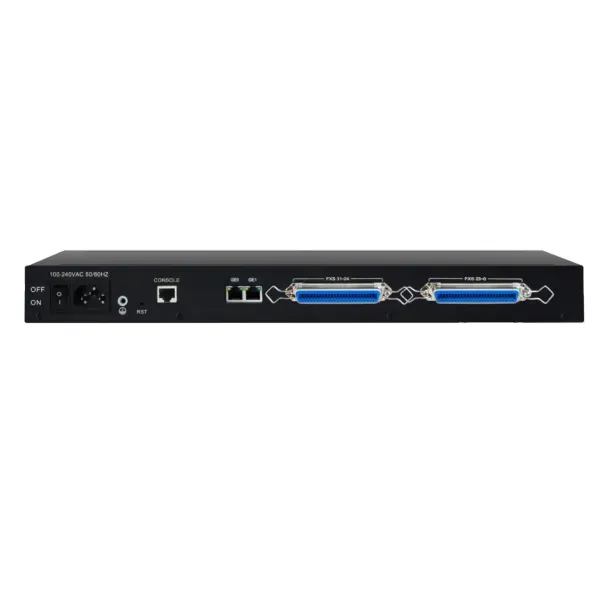
Dinstar DAG2000-32S GE FXS VoIP Gateway
The Dinstar DAG2000-32S GE FXS VoIP Gateway is built for organizations that need to keep valuable analog telephones, fax machines, legacy PBX extensions or other FXS-connected devices while moving the core voice network to SIP and IP telephony. It combines 32 FXS interfaces with dual Gigabit Ethernet, standard SIP/IMS interoperability, fax-over-IP capabilities, routing and dial-plan controls, network segmentation options, security functions and remote management features. For Tanzanian businesses, institutions, hospitality properties, service providers and distributed enterprises, this creates a practical bridge between established analog endpoint investments and modern IP-based communications without forcing an immediate replacement of every analog device.
What the DAG2000-32S GE solves
Many organizations want SIP trunks, IP PBX functions, centralized voice management and better integration with data networks, but they still depend on analog phones, fax machines, lift phones, legacy extensions or existing copper cabling. Replacing every endpoint at once can increase project cost, training effort and operational risk. The DAG2000-32S GE gives network and telecom teams a migration layer: analog devices remain connected on FXS ports, while the gateway translates the voice service into SIP for connection to an IP PBX, SIP server, softswitch or IMS platform.
Where it fits best
The 32-port density makes this model especially relevant where a single-site or rack-based deployment must serve a meaningful number of analog extensions without moving into very high-density chassis platforms. Typical projects can include hotels, schools, clinics, offices, call-related environments, factories, branch networks, apartment or campus telephony, legacy PBX migration and service-provider access. The exact design should be based on extension count, cabling, SIP platform, fax requirements, failover expectations and the number of analog devices that must remain in service.
Verified capabilities and practical benefits
32 FXS interfaces
Thirty-two FXS ports allow a substantial group of analog telephones, fax machines or compatible analog devices to access a SIP-based voice environment from one gateway. This can simplify phased migration projects and reduce the need for numerous small adapters.
Gigabit network uplinks
The GE version provides two 10/100/1000 Mbps RJ45 Ethernet interfaces. This is useful where voice gateways are integrated into modern switched networks and administrators want appropriate bandwidth, VLAN design and structured network connectivity.
SIP and IMS interoperability
Support for SIP-based telephony allows the gateway to connect with compatible SIP servers, IP PBX platforms, softswitches and IMS/NGN environments. Interoperability should always be validated against the exact target platform, firmware release and required feature set before rollout.
Fax over IP
T.38 and pass-through fax support helps organizations preserve fax workflows when moving away from purely analog voice infrastructure. Fax reliability depends on SIP provider support, codec policy, packet loss, jitter, network design and matching configuration at both ends.
Security and segmentation
TLS and SRTP support can help secure SIP signaling and media where supported by the surrounding platform. VLAN, QoS and DiffServ capabilities support separation and prioritization of voice traffic as part of a properly designed network.
Provisioning and monitoring
Web management, SNMP, TR-069, configuration backup and restore, firmware upgrade functions and system logging can make administration easier for telecom teams managing distributed or repeated deployments.
Deployment and integration guidance
A successful analog-to-SIP gateway deployment is not simply a matter of connecting copper pairs and entering a SIP account. The project should begin with an endpoint inventory. Count active analog telephones, fax machines and any specialist analog devices, confirm whether they require pulse or DTMF dialing, determine whether caller ID presentation is needed, and document existing extension numbering. Next, confirm how the SIP platform handles registration, trunks, authentication, outbound proxy settings, codecs, DTMF transport and emergency or priority calling requirements. Network teams should then define IP addressing, VLAN membership, QoS policy, DNS, NTP, firewall rules and management access. For remote or branch deployments, primary and backup SIP server behavior should be tested under realistic outage conditions.
Copper-side design matters as well. The official Dinstar specification publishes support for long analog loops, but actual line performance depends on cable gauge, quality, joints, environmental conditions, attached devices and site electrical conditions. For hotels, campuses and older buildings, an RJ21-based structured cross-connect may simplify high-density termination compared with managing dozens of individual patch leads. Before production cutover, test inbound and outbound calling, transfer behavior, voicemail access, fax transmission, caller ID, DTMF menu navigation, failover, alarm and monitoring visibility, and call quality during periods of network load.
Dinstar DAG2000-32S GE FXS VoIP Gateway Tanzania
For organizations in Tanzania, the Dinstar DAG2000-32S GE provides a practical way to modernize voice infrastructure while continuing to use analog endpoints that remain operationally useful. This is especially relevant for businesses that have accumulated analog handsets across offices, hotels, schools, clinics, warehouses or mixed-use facilities and now want SIP trunks or an IP PBX without replacing every device at the same time. The 32-port density supports projects that sit between small ATA deployments and larger high-density gateway platforms. It can therefore fit a staged migration strategy where one floor, building, department or branch is moved to SIP while analog extensions remain in place.
Tanzanian buyers should approach the gateway as part of a wider communications design. Confirm the number of active analog lines, the exact PBX or SIP server to be used, expected concurrent calls, codec policies, fax requirements and whether devices are connected through direct RJ11 cabling or structured cross-connects. In environments where the access network is shared with business data, voice VLANs and QoS can help reduce the effect of congestion on call quality. The gateway’s dual Gigabit Ethernet interfaces make it easier to integrate into contemporary switched infrastructure, but good voice performance still depends on correct LAN design, stable upstream connectivity and appropriate SIP-provider configuration.
Security is another important buying consideration. Where the IP PBX or SIP service supports it, TLS and SRTP can protect signaling and media. Access to the gateway’s management interface should be restricted to authorized administrators, with strong credentials, controlled management networks and current firmware. For multi-site deployments, standardized templates, documented dial plans and consistent numbering make ongoing operations easier. SNMP, TR-069, logs and configuration backup features can help support structured management practices.
When requesting a quotation in Tanzania, include the number of analog extensions, required connectors, target SIP/IP PBX platform, expected fax usage, network topology and whether professional configuration or migration planning is needed. For broader voice infrastructure planning, visit FourTeck Tanzania to review the wider technology portfolio and contact options. Buyers with regional projects can also reference FourTeck Africa for cross-border solution context. The best procurement outcome comes from matching the gateway to the actual extension count, deployment architecture and integration requirements rather than choosing solely on port density.
Dinstar DAG2000-32S GE FXS VoIP Gateway Dar es Salaam
Dar es Salaam organizations often operate larger office footprints, hotels, commercial buildings, logistics operations, customer-service teams and multi-branch networks where analog devices remain embedded in daily workflows. In these environments, a 32-port FXS gateway can serve as a useful migration boundary between existing endpoint cabling and a newer SIP-based core. Instead of performing a disruptive all-at-once replacement, a business can keep reliable analog handsets or fax devices in service while centralizing call control on an IP PBX or SIP platform. That approach may simplify budget planning and allow telecom changes to be scheduled around operational priorities.
For a Dar es Salaam installation, network readiness should be assessed before deployment. Office and hospitality networks can carry substantial traffic, so voice VLANs, QoS and a documented switching design are important. Confirm whether SIP traffic will remain on a private WAN, traverse a firewall to a hosted service or register to a local IP PBX. The DAG2000-32S GE supports network and security features that can participate in these designs, including VLAN tagging, DiffServ, IPv4/IPv6, TLS and SRTP, but the surrounding switches, firewall and PBX must be configured consistently.
Facilities with legacy copper distribution should inspect cabling before cutover. The availability of RJ11 and RJ21 interfaces can be especially useful when the analog side is terminated through structured voice blocks. Document which room, department or service corresponds to each port so moves and fault diagnosis remain manageable. If fax is still required for finance, administration or external partners, test T.38 or pass-through end to end with the selected SIP provider rather than assuming all fax scenarios behave identically.
A quotation request from Dar es Salaam should identify the target IP PBX or SIP provider, total analog device count, whether all 32 ports are needed immediately, required call features, rack and power arrangements, and the desired level of implementation assistance. For projects that include modern IP handsets alongside analog endpoints, the specialist FourTeck IP Phone resource can help buyers consider where native SIP phones make sense and where retaining analog devices through the gateway is the more economical path.
Dinstar DAG2000-32S GE FXS VoIP Gateway Mwanza
In Mwanza, businesses and institutions considering VoIP migration may have a mixture of newer data infrastructure and older analog voice cabling. The Dinstar DAG2000-32S GE is useful in this mixed environment because it separates the endpoint-replacement decision from the PBX-migration decision. An organization can deploy SIP call control or a new IP PBX while continuing to serve analog phones through 32 FXS ports. This is valuable where existing handsets are still functional, where users need familiar devices, or where replacing phones across many rooms would add unnecessary cost.
Planning should start with a physical and logical audit. On the physical side, record analog outlets, cable routes, patch panels and any devices that depend on special signaling. On the logical side, record extension numbers, hunt groups, inbound routes, outbound dialing rules and the call features users expect. The gateway supports flexible routing, number manipulation and hunting-related functions, but the final behavior also depends on the attached PBX or SIP server. A migration worksheet that maps each old extension to the new SIP-side configuration helps reduce surprises during cutover.
Network reliability should be treated as a voice-service dependency. If the gateway registers to a remote platform, test WAN performance, packet loss, latency, jitter and DNS resolution. If the SIP server is local, verify switch capacity, VLAN configuration, gateway addressing and firewall policy. The model’s primary/backup SIP server capability can support resilient designs when used with compatible upstream platforms, but failover behavior should be tested rather than assumed.
For Mwanza procurement, buyers should ask for the exact GE variant, confirm 32-port requirements, identify whether RJ21 connectivity will be used, and provide details of the intended SIP platform. Where growth is expected, compare current active extensions with the number likely to be needed over the next few years. Buying too few ports can force an additional gateway too soon, while buying far more than needed may not be cost efficient. The right design balances present demand, realistic expansion and operational simplicity.
Dinstar DAG2000-32S GE FXS VoIP Gateway Arusha
Arusha organizations in hospitality, tourism, education, professional services and administration can use the Dinstar DAG2000-32S GE when analog room phones, desk phones or fax devices need to remain connected during a move to SIP. Hospitality deployments are a particularly clear example: a property may want an IP PBX for centralized management and SIP connectivity while keeping existing room handsets and analog cabling. A 32-port FXS gateway can bridge one portion of that estate without requiring an immediate replacement of every endpoint.
Hospitality and guest-facing environments need careful feature testing. Check wake-up-call workflows, front-desk transfer behavior, hunt groups, voicemail access and any property-management integration at the PBX layer. The gateway itself provides analog access and SIP translation; it does not replace application-layer functions that belong to the PBX, hotel system or service platform. For schools and office campuses, the same principle applies: document which functions are local to the gateway and which are controlled by the IP PBX.
Arusha installations should also account for site power and network conditions. Stable AC power, appropriate UPS protection, surge protection and suitable rack ventilation help protect communications equipment. On the LAN, voice traffic should be prioritized where congestion is possible. Administrators can use VLAN and DiffServ capabilities as part of an end-to-end QoS design, but QoS only works properly when switches, routers and WAN services are configured coherently.
A useful quotation brief for Arusha includes the number of analog devices by type, extension numbering, fax quantity, PBX or hosted-SIP platform, WAN architecture, network switches and expected support scope. Buyers should also decide whether they want to migrate some users directly to SIP phones while leaving room, corridor or specialist analog endpoints on the gateway. This hybrid approach can produce a smoother transition and allows endpoint replacement to follow business value rather than a fixed technical deadline.
Dinstar DAG2000-32S GE FXS VoIP Gateway Dodoma
In Dodoma, government-related organizations, education providers, offices, NGOs and growing enterprises may have established analog telephony that still performs useful work even as wider infrastructure moves toward IP. The Dinstar DAG2000-32S GE gives these environments a structured way to preserve 32 analog ports while adopting SIP-based call control. It is especially useful where the organization wants to centralize extensions, connect branches or use SIP services without discarding all existing phones in the first project phase.
Procurement teams should separate hardware selection from system design. The gateway provides FXS ports, Ethernet connectivity and SIP translation, but a complete solution may also require an IP PBX or hosted service, network switches, firewall rules, UPS protection, cabling work and configuration services. When these elements are scoped together, the quotation is more meaningful and there is less risk of discovering missing dependencies after hardware delivery. Extension lists and call-routing requirements should be prepared before configuration begins.
For institutions with multiple buildings, consider whether a single centralized analog gateway is appropriate or whether smaller distributed gateways closer to endpoint cabling would reduce copper complexity. The answer depends on existing cabling topology, rack locations, network availability and resilience goals. While the DAG2000-32S GE can support long analog loops under published conditions, project engineers should still validate actual cable quality and route length on site.
Security and administration are important for public-sector and institutional deployments. Use restricted management access, strong credentials, controlled firmware processes and configuration backups. SNMP and logging can feed operational monitoring, while TR-069 may be useful in managed deployment scenarios. Before acceptance, test inbound and outbound calls, caller ID, DTMF, transfers, fax, failover and voice quality. A formal test plan helps ensure the new SIP environment meets the expectations of users who previously relied on the analog PBX.
Dinstar DAG2000-32S GE FXS VoIP Gateway UAE
For UAE enterprises and regional groups, the Dinstar DAG2000-32S GE can support branch modernization, hotel telephony, office migrations and legacy-device integration where 32 analog FXS ports are required. Many organizations operate mixed environments in which headquarters has already moved to IP telephony while branches, warehouses or accommodation sites still depend on analog phones or fax devices. A 32-port gateway provides a controlled bridge into a central SIP or IP PBX architecture and can reduce the need to replace all analog endpoints at once.
The UAE market often includes multi-site businesses with structured IT operations, so centralized management and repeatable configuration become important. Before deployment, define a standard template for IP addressing, VLANs, SIP servers, codec policy, dial plans, time settings, monitoring and management access. Configuration backup and restore functions help operational teams maintain consistent devices. Where multiple branches connect to central call control, validate WAN quality and confirm how the SIP platform handles branch survivability or server failover.
Security should be part of the initial design. If supported by the PBX and provider, TLS and SRTP can secure signaling and media. Firewall rules should be limited to the traffic that is actually required, and the management interface should not be left broadly accessible from untrusted networks. Where the gateway is used in a hospitality property, ensure room-phone numbering, front-office transfers and emergency-dialing rules are tested carefully. For warehouses or industrial offices, confirm environmental placement and cable routing.
Organizations coordinating Tanzania and UAE voice projects may also review FourTeck UAE for wider regional solution context. A strong quotation request should state the exact model, port count, IP PBX or SIP provider, site count, desired deployment services and whether the project includes additional IP phones, switches, firewalls or WAN changes.
Dinstar DAG2000-32S GE FXS VoIP Gateway Uganda
Ugandan businesses and institutions can use the Dinstar DAG2000-32S GE to extend SIP telephony into sites where analog extensions still have operational value. A common scenario is a branch, hotel, school or healthcare facility that wants centralized IP PBX management but has dozens of installed analog handsets. Rather than rewiring and replacing all endpoints immediately, the gateway allows up to 32 analog devices to connect through SIP, supporting a phased migration and preserving existing investment.
For Uganda-wide deployments, location diversity makes standardization especially valuable. Establish a consistent extension plan, naming convention, network template, SIP registration policy and monitoring approach across sites. The gateway’s management capabilities can assist with repeatable deployment, but operational teams should keep their own inventory of serial numbers, firmware versions, IP addresses, site contacts and configuration backups. Consistency shortens troubleshooting time when a remote branch reports a call issue.
WAN design deserves particular attention where gateways register to a centralized IP PBX. Voice quality is sensitive to latency, jitter and packet loss, so data congestion and unstable connectivity can become audible. QoS and VLAN features are useful within the local network, while WAN performance and provider behavior must be validated separately. Primary and backup SIP server functionality can be incorporated into resilient designs when both servers and the network path are configured appropriately.
For regional buyers, FourTeck Uganda provides a relevant reference point for communications and infrastructure projects. When requesting the DAG2000-32S GE, specify whether the requirement is for branch migration, PBX replacement, hotel extensions, fax preservation or service-provider access. That context helps determine whether this 32-port model is the right density or whether a smaller or larger gateway would fit better.
Dinstar DAG2000-32S GE FXS VoIP Gateway Kampala
Kampala has a broad mix of corporate offices, hotels, schools, clinics, financial services, logistics companies and service organizations that can benefit from a controlled analog-to-SIP migration. The Dinstar DAG2000-32S GE is particularly relevant when an organization has around one to several dozen analog endpoints clustered at a site and wants to connect them to a modern IP PBX. Thirty-two FXS ports provide useful density without moving into a much larger access platform.
A Kampala deployment should begin with discovery. Identify every active analog extension and note whether it is a normal telephone, fax machine or specialist device. Confirm whether any numbers are part of hunt groups, reception queues or emergency procedures. Then map those functions into the new SIP environment. Although the gateway supports call features and routing options, the PBX remains responsible for many user-facing functions. Clear separation of roles helps avoid configuration conflicts.
If the site uses a hosted PBX, evaluate firewall traversal, DNS reliability and Internet performance. If the PBX is on-premises, focus on local switching, power resilience and backup strategy. In either case, use VLANs and QoS consistently where appropriate. The gateway’s dual Gigabit interfaces integrate well with business switching environments, but adding bandwidth alone does not guarantee voice quality; network policy and stability matter more.
Procurement should also consider installation support. A gateway can be installed quickly when the cabling is labeled, extension plan is documented and SIP credentials are ready. Projects slow down when legacy analog distribution is undocumented. A pre-installation survey or detailed cabling diagram can therefore save significant time. For businesses planning multiple Uganda branches, the Kampala site can also serve as the configuration baseline for a repeatable rollout.
Dinstar DAG2000-32S GE FXS VoIP Gateway Arua
For organizations in Arua, the practical value of the Dinstar DAG2000-32S GE is its ability to modernize the call-control layer without requiring every analog handset to be replaced. Branch offices, institutions and hospitality sites may have established copper voice cabling that remains usable. Connecting those endpoints to a 32-port FXS gateway can make it possible to adopt SIP trunks or a centralized IP PBX while preserving the local analog distribution.
Remote-site planning should emphasize resilience and manageability. If technical staff are not permanently on site, configuration should be documented thoroughly and remote management access should be controlled securely. Logs, SNMP monitoring and configuration backups can help support teams diagnose faults without immediately dispatching a technician. At the same time, management exposure should be limited and strong credentials should be used to reduce security risk.
Connectivity quality must be considered before moving all voice traffic to a remote SIP platform. Measure WAN performance during normal and busy periods, not only during a quiet test. Where possible, prioritize voice traffic and avoid routing-sensitive applications over unstable links without a fallback plan. The gateway can work with primary and secondary SIP servers, but that feature is most useful when the overall architecture provides genuinely independent paths or services.
Arua buyers should prepare a simple technical brief: number of analog ports, endpoint types, current extension numbers, required calling features, PBX location, SIP-provider details, LAN addressing and support expectations. This gives the supplier enough context to confirm model suitability and prepare a realistic scope. If only a small number of analog devices are required, a lower-density gateway may be more appropriate; if the site expects growth beyond 32 ports, a higher-density option could reduce future expansion complexity.
Dinstar DAG2000-32S GE FXS VoIP Gateway Mbarara
Mbarara organizations that are upgrading communications can use the Dinstar DAG2000-32S GE as a bridge between analog endpoint infrastructure and IP-based voice services. The model is suitable where the business has enough analog phones or fax machines that individual ATAs would become difficult to manage, but where a 32-port device provides a sensible consolidation point. This can apply to offices, education facilities, health-related environments, hospitality properties and distributed commercial operations.
Consolidation offers operational benefits. Instead of configuring many one- or two-port adapters, administrators can manage a larger set of analog extensions from a single rack-mounted gateway. That reduces device count and can simplify backups, firmware processes and troubleshooting. The trade-off is concentration: if the gateway loses power or network connectivity, multiple extensions are affected at once. Proper UPS protection, network redundancy planning and spare strategy should therefore be considered in important environments.
Analog cabling should be tested before cutover. Old copper pairs may have faults that were tolerated by a previous PBX but become noticeable during migration. Label every pair, verify dial tone, caller ID and ringing behavior, and test longer runs. Where RJ21 is used, maintain clear cross-connect documentation. For fax devices, conduct real transmission tests to external numbers using the chosen SIP service.
Mbarara procurement teams should also think about lifecycle management. Record the firmware version at commissioning, define who is authorized to update the device, and maintain a tested configuration backup. A future support call becomes much easier when the team can state the exact gateway model, software version, SIP platform, network settings and affected extension range. These operational disciplines are as important as the hardware choice itself.
Dinstar DAG2000-32S GE FXS VoIP Gateway Gulu
In Gulu, organizations modernizing telephony can use the Dinstar DAG2000-32S GE to keep analog endpoints connected while transferring call control to a SIP platform. This can reduce disruption in facilities where users are familiar with current desk phones or where replacing large numbers of handsets provides little immediate benefit. A 32-port FXS gateway also helps consolidate multiple analog extensions into a centrally managed device rather than spreading many small adapters across the site.
The migration process should be staged and tested. Start with a small group of extensions, confirm inbound and outbound calls, transfer behavior, voicemail, caller ID, DTMF and fax, then expand to the remaining ports. A staged method reduces the impact of dial-plan or provider configuration errors. It also gives support staff time to understand how the new gateway, PBX and network interact before the entire site depends on them.
Network monitoring is valuable after go-live. If users report intermittent voice quality, review packet loss, latency, jitter, interface errors and network congestion rather than assuming the gateway is at fault. Voice problems can originate in the LAN, WAN, ISP, SIP provider, PBX or endpoint. SNMP and logs provide useful evidence, while a documented test call can help correlate issues with network events.
For Gulu buyers, the quotation should state whether the requirement is a new installation, a replacement for an older gateway or part of a PBX migration. Include any need for configuration support, remote commissioning, rack installation or analog cable re-termination. This avoids comparing hardware-only prices with solution quotes that include engineering work. A well-scoped project gives a more accurate view of total cost and reduces operational risk during cutover.
Dinstar DAG2000-32S GE FXS VoIP Gateway Kenya
Kenyan enterprises with analog endpoints can deploy the Dinstar DAG2000-32S GE where a 32-port bridge is needed between existing telephones and SIP-based systems. Multi-branch businesses, hospitality groups, schools, clinics, manufacturing sites and service organizations often reach a point where the PBX core needs modernization but analog endpoint replacement can be phased. The gateway supports that strategy by allowing analog devices to register into a broader IP telephony design.
In multi-site Kenyan projects, standardization is a major advantage. Use consistent VLAN IDs, addressing conventions, extension patterns, codec priorities, NTP settings, management rules and backup procedures across branches. A standard build sheet means a replacement unit can be configured faster and makes remote troubleshooting more predictable. Where SIP is centralized in a data center or cloud platform, test each branch WAN separately because performance can vary by location and provider.
Kenyan buyers should also check interoperability before mass rollout. The official Dinstar positioning emphasizes compatibility with leading SIP-based telephony platforms, but production environments can differ in registration methods, DTMF handling, fax, TLS certificates and supplementary features. A pilot deployment with the actual PBX or provider is the safest way to validate behavior. If the project includes native IP phones, retain the gateway only for devices that genuinely need analog interfaces.
For local and regional planning, FourTeck Kenya provides additional context for technology projects in the Kenyan market. A complete quotation request should include the number of gateways, analog extension count per site, SIP platform, installation requirements and whether ongoing support is expected.
Dinstar DAG2000-32S GE FXS VoIP Gateway Kuwait
Kuwait-based businesses can use the Dinstar DAG2000-32S GE in office, hospitality, service and industrial environments where analog phones must connect to an IP PBX or SIP service. The 32-port design is well suited to sites with a concentrated group of analog extensions, particularly where existing cabling is still serviceable. Rather than treating analog and IP telephony as mutually exclusive, the gateway allows them to coexist during a controlled migration.
Environmental and infrastructure planning should be part of the installation. Place the gateway in a suitable rack or communications room with stable power, ventilation and UPS protection. Maintain clear separation between network patching and analog cross-connects, especially when RJ21 termination is used. Accurate labeling saves time during moves, additions and troubleshooting.
From a network perspective, define the management IP, voice VLAN, DNS and NTP settings before installation. If calls traverse an Internet connection to a hosted platform, coordinate firewall and NAT behavior with the SIP provider. Where encryption is required, confirm certificate and cipher support between the gateway and PBX. The presence of TLS and SRTP features does not automatically mean they will be enabled successfully without matching configuration on both sides.
Kuwait procurement teams should decide whether they require a hardware-only purchase or a fully configured voice solution. The latter may include PBX integration, dial-plan development, testing, documentation and training. Clarifying that scope early makes vendor comparisons more meaningful. For regional organizations, standardizing on the same gateway model across sites can reduce spare-part complexity, but only after interoperability and local network conditions have been validated.
Dinstar DAG2000-32S GE FXS VoIP Gateway Ghana
For Ghanaian organizations moving from legacy voice systems toward SIP, the Dinstar DAG2000-32S GE offers a balanced 32-port FXS platform for preserving analog devices. This can be useful in office blocks, schools, hospitals, hotels and branch networks where cabling already exists and handset replacement is not the immediate priority. The gateway lets teams modernize the PBX core and trunk connectivity while keeping the endpoint layer stable.
A good deployment starts with accurate port planning. Count active extensions rather than simply counting wall outlets, and identify unused lines that can be retired. This prevents overestimating capacity requirements. If the final number is close to 32 and growth is expected, decide whether leaving spare ports is sufficient or whether a higher-density platform would be more economical. Capacity planning should also consider concurrent calls and the capabilities of the upstream SIP platform.
Fax and analog specialist devices deserve separate testing. While the gateway supports T.38 and pass-through, success depends on the far-end service and network conditions. Some applications may work better with a particular mode or codec policy. Establish test cases before migration so the organization knows which devices are business-critical and what constitutes acceptable performance.
For Ghana projects, remote management can reduce travel for routine configuration and diagnostics, but it should be secured carefully. Restrict administrative access, keep software current, back up configuration files and monitor logs. During procurement, request the exact DAG2000-32S GE variant, confirm connector requirements and provide the target PBX information. A detailed technical request reduces ambiguity and improves the quality of the proposed solution.
Dinstar DAG2000-32S GE FXS VoIP Gateway Nigeria
Nigerian enterprises frequently operate large and diverse branch networks, making a 32-port analog gateway useful where regional offices or facilities still rely on conventional handsets. The Dinstar DAG2000-32S GE can bridge those analog extensions into SIP-based call control, supporting a gradual transition to IP telephony. This is particularly attractive where a full handset refresh would be expensive or where analog devices serve specific functions that do not justify replacement.
Branch standardization should be a design goal. Define a baseline configuration and use it across comparable locations, adjusting only IP addressing, extension ranges and site-specific routing. Maintain central records of firmware versions, port assignments and PBX registrations. This simplifies support across a wide geographic footprint and makes capacity planning easier when branches grow.
Because voice depends on network quality, Nigerian multi-site deployments should test each WAN path under realistic traffic conditions. If a branch connects to a central PBX over VPN or the public Internet, measure packet loss, jitter and latency. Apply QoS locally and coordinate WAN prioritization where available. The gateway’s VLAN and DiffServ capabilities are useful building blocks, but end-to-end performance depends on every network segment.
Security controls should include restricted management access, credential policy, controlled firmware updates and review of SIP exposure. Where TLS and SRTP are supported end to end, they can strengthen protection for signaling and media. Buyers should include security expectations in the quotation instead of treating them as a post-installation task. For large rollouts, a pilot site can validate PBX compatibility, fax, failover and support processes before hardware is deployed more widely.
Dinstar DAG2000-32S GE FXS VoIP Gateway Seychelles
In Seychelles, hospitality, tourism, administration and multi-building organizations may need to preserve analog room phones or office extensions while upgrading the central telephony platform. The Dinstar DAG2000-32S GE is well suited to these hybrid environments because it can present 32 analog FXS ports to legacy devices while connecting upstream through SIP. This makes it possible to modernize call control and external connectivity without immediately replacing every room or desk handset.
Island and distributed-site operations often place a premium on remote manageability and clear documentation. Technical teams should keep configuration backups, extension maps, IP details and cable records so support can be provided efficiently. If replacement hardware or on-site visits require planning, good documentation helps local staff complete initial checks before escalation.
Hospitality properties should validate guest-facing workflows carefully. Room-to-room dialing, reception transfer, wake-up functions, voicemail and emergency dialing may depend on the PBX or hotel application rather than the gateway itself. The gateway should therefore be tested as part of the complete solution. Where fax is used for administration, verify T.38 or pass-through with the real SIP provider.
Network resilience is equally important. Protect the gateway and associated switches with suitable UPS capacity, and decide how telephony should behave during WAN outages. If a local PBX is used, local extension calling may continue even if external connectivity fails; if the system is fully cloud-hosted, WAN availability becomes more critical. These architecture decisions should be discussed during quotation so the hardware, network and support plan match the operational needs of the site.
Selection and sizing guidance
The DAG2000-32S GE is appropriate when the project genuinely requires a medium-density group of analog FXS interfaces. If only a few analog endpoints remain, a smaller gateway may reduce cost and simplify installation. If there are more than 32 active analog endpoints at one site, a larger platform or multiple gateways may be required. The decision should also account for failure domains: two smaller gateways can provide operational separation, while one larger gateway can reduce device count and management overhead. There is no universal answer; the correct design depends on extension distribution, rack locations, redundancy requirements, budget and support capability.
Before placing an order, confirm the exact model suffix and Ethernet variant, target firmware, analog connector preference, SIP interoperability and any optional codec or feature requirements. Verify whether the project uses individual RJ11 connections, RJ21 distribution or both. If the gateway will replace an existing analog PBX, collect the old extension plan and routing rules before decommissioning the legacy system. This makes it easier to reproduce essential behaviors in the new environment.
Quotation checklist
Frequently asked questions
What is the Dinstar DAG2000-32S GE used for?
It is a 32-port FXS analog VoIP gateway used to connect analog telephones, fax machines and compatible legacy PBX-side devices to SIP-based IP telephony networks. It is commonly used during migration from analog telephony to IP PBX or hosted SIP environments.
Does it support Gigabit Ethernet?
Yes. The GE variant provides two 10/100/1000 Mbps RJ45 Ethernet interfaces according to the official Dinstar datasheet.
Can the gateway connect fax machines?
The model supports T.38 fax and pass-through. Actual fax reliability depends on the SIP provider, PBX, codec settings and network conditions, so end-to-end testing is recommended before production use.
Is it compatible with any IP PBX?
Dinstar positions the gateway for interoperability with leading SIP-based IP PBX, softswitch and IMS/NGN platforms. Compatibility should still be validated with the exact PBX software version and required features, especially for TLS, fax, DTMF and supplementary services.
Does the DAG2000-32S GE support IPv6?
Yes. Official Dinstar documentation lists IPv4 and IPv6 support.
What should be tested before go-live?
Test inbound and outbound calling, extension dialing, caller ID, DTMF, transfer behavior, fax, codec negotiation, SIP failover, voice quality, network QoS and remote management. Also verify labeling and continuity of analog cable pairs.
Decision recap
Choose the Dinstar DAG2000-32S GE when you need a concentrated 32-port FXS bridge between analog devices and a SIP/IP telephony platform, and when Gigabit Ethernet, fax support, VLAN/QoS, IPv4/IPv6, centralized management and secure SIP options align with your project. Confirm interoperability and port requirements before ordering.
Consultation panel
For a useful quotation, share your extension count, current PBX, target SIP platform, site location, fax requirements and network design. FourTeck can use this information to assess whether the DAG2000-32S GE fits the project and identify any related voice or network components that should be considered.



Reviews
There are no reviews yet.