
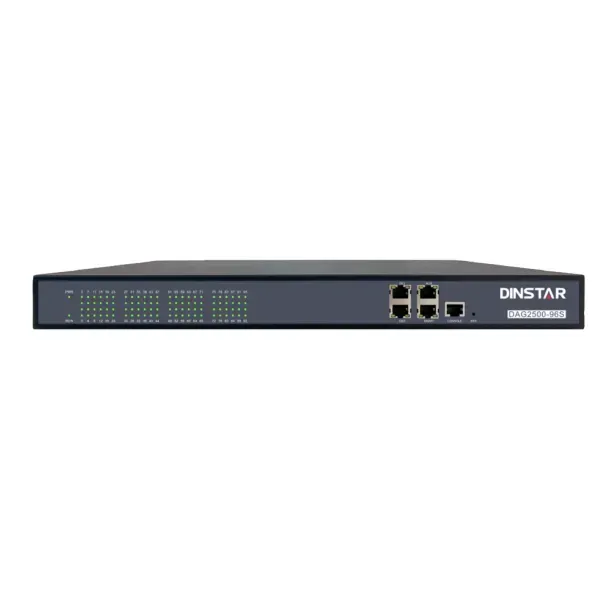
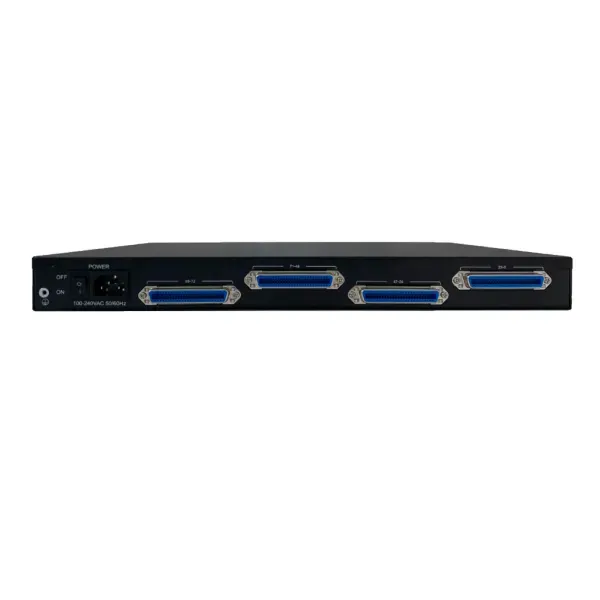
Dinstar DAG2500-96S FXS VoIP Gateway
The Dinstar DAG2500-96S is a high-density analog-to-VoIP gateway built for organisations that need to keep large numbers of analog telephones, fax machines, modems, POS-related analog devices or legacy PBX interfaces in service while moving the core voice environment to SIP and IP. The 96S model provides 96 FXS interfaces in a compact 1U chassis, making it particularly relevant where rack space, port density and structured migration are more important than replacing every analog endpoint at once.
For buyers in Tanzania, the practical value is straightforward: the gateway creates a bridge between existing analog wiring and a modern IP PBX, SIP server, softswitch, IMS/NGN platform or hosted communications service. That can make it useful for hotels with many room phones, hospitals with distributed extensions, schools and campuses, apartment or residential developments, service providers and enterprises with large established analog estates.
High-density analog extension connectivity in a 1U form factor.
Designed for integration with SIP-based IP PBXs, softswitches and communications platforms.
Supports traditional analog services while the backbone moves to IP.
Web management, provisioning and monitoring functions can simplify larger deployments.
What the Dinstar DAG2500-96S is designed to solve
A complete replacement of analog telephony can be expensive and disruptive when a building already has hundreds of installed telephone pairs, room phones, lift phones, service phones, fax devices or legacy extensions. The DAG2500-96S is designed for a different migration path. It converts analog FXS-side connectivity into IP voice, allowing an organisation to modernise the central call-control platform while retaining endpoint investments that still serve a useful operational purpose.
This approach is especially relevant when the existing cabling is difficult to replace, when endpoint replacement would create unnecessary cost, or when the project must be completed in phases. Instead of forcing an immediate all-IP handset rollout, a gateway can preserve the analogue edge and place SIP at the core. The result can be a more manageable migration strategy, provided the project is properly engineered around port count, cabling, numbering, call routing, SIP compatibility, power, network segmentation and failure scenarios.
Verified Dinstar DAG2500-96S capabilities
| Area | DAG2500-96S capability |
|---|---|
| Analog interfaces | 96 FXS ports; Dinstar lists RJ45 or RJ21/50-pin connector options for the series. |
| Form factor | High-density 1U chassis. |
| Networking | Two 10/100/1000Base-T interfaces plus a 10/100Base-T interface are listed in the current datasheet. |
| Core VoIP | SIP v2, RTP/SDP family support, IPv4/IPv6, VLAN and QoS-related features. |
| Fax and modem | T.38 and pass-through functionality, with modem/POS support referenced by Dinstar. |
| Voice handling | Multiple codecs, echo cancellation, jitter buffering, packet-loss concealment, comfort-noise generation and voice-activity features. |
| Call control | Flexible routing, digit maps, number manipulation, transfer, forwarding, hunting/ringing functions and three-way conferencing. |
| Management | Web configuration, automatic provisioning, SNMP, TR-069 and Dinstar cloud-management options are identified by the manufacturer. |
Planning a 96-port analog-to-SIP migration
The physical port count is only the first design decision. A deployment should begin with an inventory of every analogue endpoint and the telephone-pair route that serves it. Identify which ports are ordinary phones, which support fax or modem functions, which connect to emergency or operational devices, and which extensions can be retired. Numbering should then be mapped to the target IP PBX or SIP platform so that the cutover does not create ambiguous extension assignments.
Network readiness is equally important. Voice traffic should be placed on a stable LAN with suitable QoS, VLAN and security design. The gateway’s management plane should be protected, and firewall policies should allow only the signalling and media flows that the chosen architecture actually requires. If the gateway registers to more than one SIP server, failover behaviour should be tested rather than assumed. Fax paths should be validated with the actual upstream platform and trunk provider because fax performance depends on the full end-to-end environment, not just the gateway.
For supporting infrastructure, FourTeck Tanzania’s technology services page explains how telephony, switching, security and cabling requirements can be planned together. The Tanzania technology shop provides related product categories, while the FourTeck Tanzania solutions overview provides context for IP PBX, IP phones, network switches, firewalls and infrastructure that may sit around a gateway deployment.
Use cases for the DAG2500-96S
Hotels and hospitality
Room phones, service-area extensions, reception lines and back-office analogue devices can remain connected while call control moves to an IP PBX or hosted UC environment.
Hospitals and campuses
Large buildings often contain analogue phones distributed over existing copper cabling. A high-density FXS gateway can centralise conversion without requiring immediate endpoint replacement.
Residential developments
Apartments, staff housing and compounds with analogue handsets can be integrated into a SIP-based communications platform while preserving established wiring.
Service-provider environments
Providers can use high-density FXS access where customer-side analogue presentation is still required even though upstream transport and call control are IP based.
Dinstar DAG2500-96S Tanzania
For organisations sourcing the Dinstar DAG2500-96S in Tanzania, the most important buying question is whether a 96-port FXS gateway fits the existing extension estate and the target voice architecture. Tanzania deployments often span a mixture of modern IP networks and long-established analogue wiring. Hotels, hospitals, schools, government facilities, commercial buildings and multi-tenant properties may already have large copper-extension networks that remain operationally useful. In these situations, a high-density gateway can reduce the need to replace every handset and every cable during the first stage of an IP migration.
Procurement teams should document the exact number of live analogue endpoints, spare capacity required, connector preference, target SIP platform, trunking model and failover expectation. They should also separate simple voice ports from devices that depend on fax, modem or special analogue behaviour. This makes the quotation more accurate and prevents a project from being sized only around a headline port count. Rack space, UPS capacity, switching, VLAN design and management access should be included in the same review.
In Tanzania, a gateway deployment may also need to account for internet reliability if SIP services are hosted off-site. A local IP PBX can reduce dependence on external connectivity for internal calls, while cloud or carrier SIP services introduce WAN considerations. The correct design depends on the organisation’s call flow and availability requirements. FourTeck can help customers frame these questions before purchase instead of treating the DAG2500-96S as an isolated appliance. Related regional support resources are available across the wider FourTeck network, including FourTeck Africa for broader African technology context.
Dinstar DAG2500-96S Dar es Salaam
Dar es Salaam has a concentration of hotels, offices, hospitals, institutions, logistics businesses and multi-floor commercial buildings where telephony systems can grow over many years. A building may already have analogue extension cabling terminating in a central communications room even if the organisation is upgrading its network, firewall and PBX. The DAG2500-96S can be considered when the goal is to keep those analogue endpoints functioning while moving central call processing to SIP.
A Dar es Salaam deployment should begin with a floor-by-floor extension audit. In a hotel, this means mapping room numbers, reception, housekeeping, service lifts, kitchens, administration and emergency or maintenance phones. In an office or hospital, the same discipline applies to departments, wards, reception points and operational areas. The gateway’s 96 ports can consolidate many lines, but the cabling and patching plan must remain clear so technicians can trace faults later.
Network design should consider the voice VLAN, IP addressing, SIP server location, redundancy and firewall policies. If the voice platform is hosted, the internet link and failover design become important; if the PBX is on-site, UPS-backed LAN and server infrastructure may be more critical. Buyers should also decide whether they need future expansion beyond 96 analogue endpoints or whether analogue usage is expected to decline over time. A good proposal should therefore address current load, spare capacity and the migration roadmap together rather than simply quoting one gateway.
Dinstar DAG2500-96S Mwanza
For organisations in Mwanza, the DAG2500-96S can suit sites where established telephone cabling remains useful but management wants more flexible IP-based call control. Campuses, hotels, healthcare facilities, administrative buildings and industrial sites may have many analogue extensions spread over large premises. Replacing each endpoint with an IP phone can require new switching, PoE capacity and structured cabling, whereas an FXS gateway can allow staged modernisation.
The planning emphasis in Mwanza should include the distance and condition of existing copper loops, identification of essential lines and the way the new SIP platform will be managed. Dinstar publishes a maximum line-length capability for the series, but real deployment quality still depends on cable condition, interference and endpoint characteristics. A site survey and port-by-port test plan therefore remain valuable. Fax or modem-dependent lines should be tested separately because their performance can be more sensitive than ordinary voice.
Procurement should also cover mounting, patching, power protection and documentation. A 1U gateway saves rack space, but the surrounding telco termination can still require disciplined cable management. For organisations operating between Mwanza and other branches, the SIP architecture may also be designed around branch-to-branch calling or centralised PBX services. The gateway then becomes one element in a broader WAN, firewall and voice-routing design, not a standalone replacement for a PBX.
Dinstar DAG2500-96S Arusha
Arusha’s hospitality, tourism, education, healthcare and business sectors create a strong practical use case for high-density analog-to-IP conversion. Hotels and lodges can have many room telephones and service extensions wired back to a communications room. Replacing every room handset may add cost without improving the guest experience if the existing phones are still functional. The DAG2500-96S offers a route to modern SIP call control while retaining the room-side analogue interface.
For hospitality projects, the design should map guest rooms, reception, housekeeping, security, kitchens, offices and back-of-house services. Call permissions and dial plans can then be built around operational roles. Integration with the selected IP PBX should be confirmed before commissioning, and the numbering plan should be documented so staff can support the system after handover. If the property uses fax or analogue devices for specific workflows, those functions should be included in acceptance testing.
For non-hospitality buyers in Arusha, the same gateway can be relevant to campuses, institutions and multi-building environments. The decision should compare the cost and disruption of replacing analogue endpoints against the lifecycle benefit of moving directly to IP phones. A phased approach may be preferable when the network is being upgraded gradually. FourTeck’s IT services practice provides wider context for deployment and support disciplines that can complement voice projects.
Dinstar DAG2500-96S Dodoma
Dodoma organisations considering the DAG2500-96S may be planning telephony for government-related facilities, institutions, offices, campuses, hospitality properties or large compounds. In these environments, the key advantage of a 96-port FXS gateway is the ability to centralise a large number of analogue connections while using an IP-based call-control platform. This can be especially useful where existing telephone wiring is widespread and remains serviceable.
Before ordering, buyers should establish how many analogue lines are active today, how many must remain for the next several years and whether future expansion is more likely to use analogue or native SIP endpoints. This determines whether a single 96-port gateway is appropriate, whether spare capacity should be reserved, or whether the migration should use a combination of gateway sizes. The project should also identify the target SIP server, extension numbering, trunk access and emergency calling policy.
Operational resilience is another important topic. The gateway, switching infrastructure and PBX should be connected to appropriate UPS protection if voice availability matters during short power interruptions. Configuration backups, administrator access control and documentation should be part of handover. For procurement teams, the quotation request should therefore include not only the gateway model but connector preference, deployment context, desired configuration scope and any testing or migration assistance expected from the supplier.
Dinstar DAG2500-96S UAE
In the UAE, high-density FXS gateways are often relevant to hotels, staff accommodation, hospitals, education, large offices and legacy PBX migrations where large analogue extension estates coexist with modern SIP platforms. The DAG2500-96S allows projects to retain analogue endpoints while consolidating voice control through IP PBX, softswitch or hosted communications infrastructure. This can reduce endpoint-replacement pressure during a staged migration.
UAE buyers should pay close attention to interoperability with the chosen PBX, SIP trunk, numbering plan and any property-management or operational workflow that depends on telephony. In hotel environments, room-extension mapping and reception workflows are particularly important. In enterprise environments, the design may instead focus on branch connectivity, centralised call routing and managed SIP services. The network should support stable signalling and RTP media, with suitable firewall and QoS policies.
A quotation should specify the exact 96S model, connector preference, quantity, rack and power requirements, installation scope and whether configuration, testing or migration support is required. Buyers comparing alternatives should evaluate density, management features and compatibility rather than looking only at per-port acquisition cost. UAE customers can also review the broader FourTeck UAE technology portfolio for related voice, network and infrastructure requirements.
Dinstar DAG2500-96S Uganda
Uganda businesses and institutions can use a high-density FXS gateway when they need to preserve analogue phones while modernising the core voice system. The DAG2500-96S is relevant to hotels, hospitals, schools, campuses, residential developments and large enterprises with many analogue extensions. Its 96-port density can reduce the number of separate gateway appliances needed for larger projects.
The procurement process should define the actual analogue endpoint count and distinguish ordinary handsets from fax, modem or specialised devices. Each category may require different testing. The proposed SIP platform should be checked for registration, codec, DTMF, fax and routing compatibility. Network teams should also design VLAN, QoS and firewall rules before cutover so the gateway does not become a troubleshooting point between an unstable LAN and a new PBX.
For sites outside Kampala, remote management can be important because technical staff may not be permanently present. Web administration, provisioning and monitoring functions can support a more structured support model when used securely. Configuration backups and a clear port map should form part of handover. Uganda customers can reference FourTeck Uganda for related regional technology requirements.
Dinstar DAG2500-96S Kampala
Kampala has many multi-floor offices, hotels, hospitals, institutions and commercial properties that may have mature analogue telephone systems alongside newer data networks. The DAG2500-96S provides a practical bridge when a business wants SIP-based call control but still has a large installed base of analogue phones. Because the device concentrates 96 FXS ports in 1U, it can be useful in central communications rooms where rack space is limited.
A Kampala project should review the existing MDF or telephone distribution layout before selecting connector and patching options. The technical team should map each extension to its physical pair and planned SIP identity. This reduces cutover errors and makes fault isolation easier. If the organisation has multiple sites, the voice architecture should define whether each site registers to a central PBX, a hosted platform or a local call server with inter-site SIP connectivity.
Reliability planning should consider power, LAN switching, internet or WAN availability and PBX redundancy. The gateway itself cannot compensate for a failing upstream network, so system-level design matters. Where critical calls must continue during an outage, the customer should define the required survivability and test it. Procurement teams should request a proposal that clearly separates hardware supply from configuration, installation, migration and ongoing support so scope remains transparent.
Dinstar DAG2500-96S Arua
In Arua, the DAG2500-96S may be attractive to institutions, hospitality properties, healthcare sites and large facilities that need to modernise voice without replacing established analogue extension networks all at once. A single high-density gateway can centralise many ports, which can simplify management compared with deploying numerous small adapters across a site.
Remote-support planning deserves particular attention. If the gateway is deployed at a site where specialist telephony support is not always on location, the network should provide secure administrative access, monitoring and configuration backup procedures. Every analogue port should be labelled physically and documented digitally. This creates a usable support record when faults occur months or years after installation.
The buyer should also define how the gateway reaches the SIP platform. A local PBX, centralised PBX over a private WAN, or hosted SIP service each produces different dependencies. Internet-based architectures should consider link stability and failover. On-premises architectures need appropriate server, UPS and switching resilience. The correct choice depends on operational priorities, not on the gateway alone. A quotation should therefore include the full environment so compatibility and deployment scope can be reviewed before purchase.
Dinstar DAG2500-96S Mbarara
Mbarara organisations can consider the DAG2500-96S when a large analogue telephone estate needs to connect into a SIP-based voice environment. Hospitals, universities, hospitality properties, factories and administrative facilities may have many analogue handsets already installed through building telephone cabling. Preserving those endpoints can reduce migration disruption while still enabling a new IP PBX, centralised dial plan and SIP trunk strategy.
The design should start with a live-port audit because old PBX systems frequently contain extensions that are no longer in use. Removing obsolete ports from the project can improve sizing. The remaining lines should then be grouped by function: ordinary voice, fax, modem or operational device. Each group should have an acceptance test after migration. DTMF, caller ID, transfer, forwarding and fax behaviour should be validated with the real upstream platform.
Network readiness includes stable Ethernet, VLAN design, QoS and protected management access. Where the new PBX or SIP service is remote, WAN stability also becomes part of voice quality. Mbarara buyers should ask suppliers to clarify what is included: hardware only, preconfiguration, on-site installation, migration assistance, testing or support. This avoids comparing quotations with different assumptions and gives procurement teams a more reliable basis for decision-making.
Dinstar DAG2500-96S Gulu
For Gulu, the DAG2500-96S is relevant where organisations want modern SIP communications but have a practical reason to keep analogue endpoints. Educational institutions, health facilities, hotels, administrative campuses and large compounds can have extensive existing copper voice cabling. A high-density FXS gateway enables the central telephony platform to modernise without requiring every endpoint to become an IP phone immediately.
A successful deployment should make the physical and logical numbering plans match clearly. Each analogue port should be associated with a room, department or device, and the corresponding SIP account or route should be recorded. This is especially important when 96 ports are concentrated in one chassis because poor labelling can make troubleshooting difficult. Patch panels, RJ21 or RJ45 breakouts and cable management should be planned before installation day.
The project should also decide how failures will be handled. Dinstar provides mechanisms such as SIP server failover and routing controls, but the complete service depends on the network, PBX and trunk architecture. Testing should include the conditions the organisation actually cares about, such as WAN loss, PBX restart or power interruption. Procurement should therefore combine device selection with a defined test and handover plan rather than treating commissioning as an afterthought.
Dinstar DAG2500-96S Kenya
Kenya has a broad base of hotels, campuses, hospitals, enterprises and service-provider environments where high-density analogue gateways can support staged IP migration. The DAG2500-96S provides 96 FXS interfaces for connecting analogue endpoints to SIP-based infrastructure, making it suitable when organisations have substantial legacy cabling or endpoint investments they are not ready to replace.
Kenyan buyers should compare the gateway against both smaller distributed gateways and a full IP-phone replacement. A single high-density chassis can simplify central management and rack usage, but it also concentrates many extensions in one location. The building’s telephone distribution design must therefore align with the gateway location. For multi-building campuses, additional distribution considerations may apply.
The voice platform should be validated for SIP registration, codecs, DTMF and fax requirements. Where cloud PBX services are used, internet resilience and firewall configuration matter. Where on-premises PBX is used, local server and power availability become more significant. Customers sourcing for Kenya can also reference FourTeck Kenya for related regional infrastructure and procurement requirements.
Dinstar DAG2500-96S Kuwait
Kuwait deployments of high-density FXS gateways are commonly relevant to hospitality, residential, healthcare, education and large enterprise environments where analogue room or desk phones remain installed. The DAG2500-96S can consolidate up to 96 FXS connections into a SIP-enabled architecture while keeping the analogue edge intact.
A project should validate the gateway against the chosen PBX, SIP trunk and required feature set. The team should map all ports, define extension numbering and check whether any lines rely on fax or modem operation. Rack cooling, UPS power and cabling organisation should also be included in the design. For larger environments, centralised management and configuration backup reduce support complexity across multiple gateways.
Kuwait buyers comparing proposals should ask whether the scope includes installation, patching, PBX configuration and acceptance testing or only hardware supply. This distinction can materially affect project cost and risk. Regional information is also available through FourTeck Kuwait, which can provide a broader procurement context for enterprise telephony, networking and infrastructure projects.
Dinstar DAG2500-96S Ghana
Ghana organisations with extensive analogue telephony can use the DAG2500-96S as a bridge to IP PBX, SIP trunk and softswitch environments. Hotels, campuses, hospitals, offices and housing developments may have large numbers of analogue handsets connected through existing copper cabling. Retaining those endpoints while modernising central call control can reduce the disruption of a full handset replacement.
The gateway should be selected as part of a system design. The project team should confirm the number of active lines, physical connector approach, SIP platform, numbering plan, network VLAN, firewall policy and failover requirements. Fax and modem functions need dedicated validation because they depend on the complete path between endpoint and remote service.
For geographically distributed organisations, remote configuration and monitoring can improve manageability, but administrative access must be secured. Documentation should include firmware, configuration backup, port mapping and escalation procedures. A purchase request that captures these operational details will be more useful than one that simply asks for a 96-port gateway. Ghana customers can consult FourTeck Ghana for related technology procurement context.
Dinstar DAG2500-96S Nigeria
Nigeria’s large hotels, hospitals, campuses, estates, call environments and enterprise facilities can create strong demand for high-density analog-to-SIP conversion. The DAG2500-96S can aggregate 96 analogue FXS ports in one 1U chassis, allowing a modern PBX or softswitch to control calls while analogue endpoints remain in place.
Power and network resilience should be addressed at the system level. The gateway, switches, PBX and edge connectivity may all require UPS-backed operation depending on service expectations. For hosted SIP architectures, the WAN path and failover approach should be tested. For on-premises designs, local server, storage and backup procedures matter. Neither architecture is universally better; the choice should follow the organisation’s operating model and acceptable outage risk.
Procurement should define whether the project is hardware supply only or a complete migration. A complete scope may include extension audit, rack installation, telco patching, SIP registration, dial-plan configuration, testing, documentation and support. Keeping these elements explicit allows quotations to be compared fairly. Nigerian buyers can also use FourTeck Nigeria as a regional reference for associated enterprise technology needs.
Dinstar DAG2500-96S Seychelles
In Seychelles, hospitality properties and multi-building organisations can have a strong reason to preserve analogue telephone infrastructure while modernising the communications core. Resort rooms, staff areas, service facilities and back-office extensions may already be wired for analogue telephones. A 96-port FXS gateway can centralise these connections and present them to an IP PBX or SIP platform without requiring an immediate room-by-room handset replacement.
For island and resort environments, remote management and clear documentation can be especially valuable. The gateway should be integrated into a secure management network with configuration backups and a detailed port schedule. Spare ports may be reserved for future rooms or service areas, but the quantity should reflect a realistic growth plan rather than arbitrary overprovisioning. Fax and special analogue lines should be identified before migration.
Connectivity to a hosted PBX must be assessed alongside WAN reliability, while an on-site PBX introduces local server and power considerations. In either case, the acceptance plan should test internal calls, external calls, DTMF, caller ID, transfer behaviour and any fax or modem functions that matter to operations. A well-documented gateway deployment can give the property a controlled bridge between established analogue room systems and a newer IP communications architecture.
Buying and quotation checklist
Before requesting a quotation for the Dinstar DAG2500-96S, prepare the following information so the proposed solution can be checked against the real environment:
- Required number of active FXS ports and desired spare capacity.
- RJ45 or RJ21/50-pin connector preference and existing telco termination.
- Target IP PBX, softswitch, IMS/NGN or hosted SIP platform.
- SIP trunk provider and any known codec, DTMF or fax requirements.
- Number of fax, modem or specialised analogue endpoints.
- Rack location, power and UPS availability.
- LAN/VLAN, IP addressing, QoS and firewall requirements.
- Required installation, configuration, migration and acceptance-test scope.
- Whether centralised or remote management is needed.
- Expected future migration from analogue phones to native IP endpoints.
Frequently asked questions
How many analogue phones can the DAG2500-96S connect?
The DAG2500-96S is the 96-FXS-port model in Dinstar’s DAG2500 family, so it is designed for up to 96 analogue FXS-side endpoints, subject to the project design and supported use case.
Can it work with an IP PBX?
Yes. Dinstar positions the gateway for SIP-based IP PBXs, softswitches, IMS/NGN platforms and SIP servers. Exact interoperability should still be validated with the chosen platform, firmware and required features.
Does it support fax?
Dinstar lists T.38 and pass-through fax support. Successful faxing also depends on the PBX, SIP trunk, remote fax endpoint and network conditions, so end-to-end testing is recommended.
Why choose a 96-port gateway instead of IP phones?
A high-density FXS gateway is useful when a site has valuable existing analogue handsets or cabling and wants to modernise call control without replacing every endpoint at once. Native IP phones may still be preferable for users who need advanced endpoint features.
Can the DAG2500-96S be remotely managed?
Dinstar documents web management, provisioning, SNMP/TR-069 and cloud-management capabilities for the series. Remote administration should be protected through secure network design and controlled credentials.
Decision recap
Choose the Dinstar DAG2500-96S when the requirement is specifically for a high-density 96-port FXS bridge between analogue endpoints and a SIP-based communications platform. It is most compelling when existing analogue handsets and cabling still have operational value, rack space is limited, and the organisation wants to modernise the central PBX or softswitch in a controlled way. Before purchase, confirm port count, connector type, SIP interoperability, fax requirements, network design and migration scope.
Plan your Dinstar DAG2500-96S deployment
Share your analogue extension count, current PBX, target SIP platform, site type and preferred migration approach. FourTeck can use that information to frame the hardware, connectivity and deployment requirements for a more complete quotation.




Reviews
There are no reviews yet.