
HYBRID ANALOG-TO-IP VOICE CONNECTIVITY
Dinstar DAG1000-2S2O Hybrid VoIP Gateway
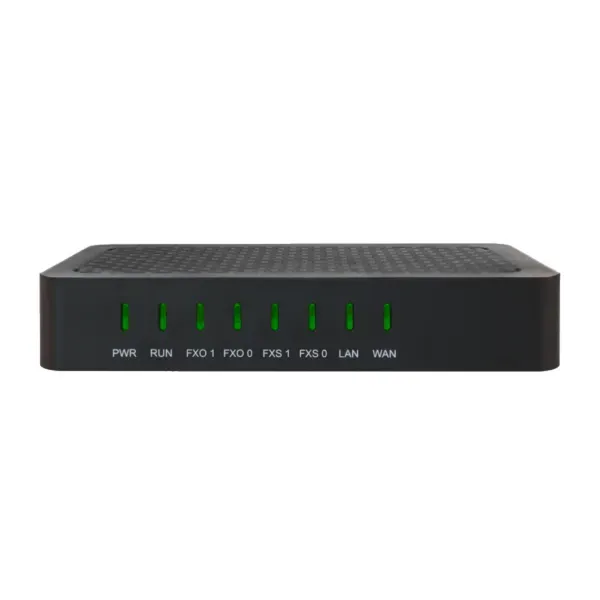
The Dinstar DAG1000-2S2O is a compact hybrid analog VoIP gateway created for organizations that need to connect traditional telephone equipment and PSTN lines with modern SIP-based communications. Its balanced 2 FXS and 2 FXO configuration makes it especially useful in small offices, branch sites, migration projects, backup calling arrangements and environments where an existing analog PBX or telephone line still has operational value. Instead of replacing every legacy endpoint at once, the gateway can form a practical bridge between established analog infrastructure and a newer IP PBX, softswitch or SIP platform.
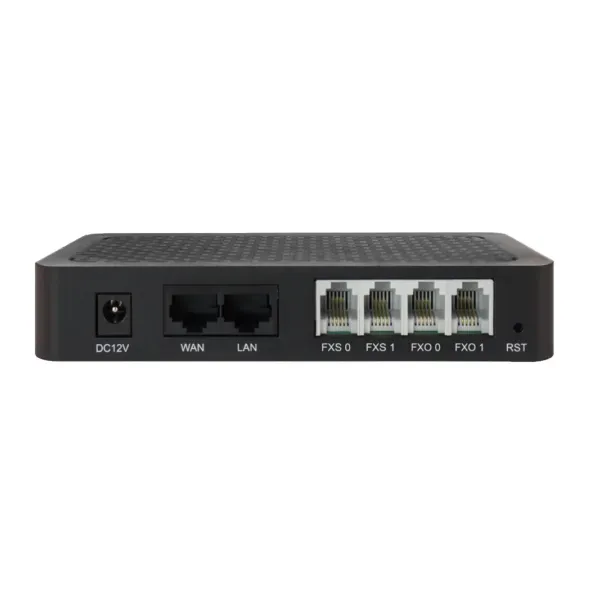
For Tanzania buyers, the key purchasing question is not simply whether a gateway has analog ports. It is whether the port mix, SIP compatibility, failover behavior, fax support, network design and call-routing options suit the actual communication workflow. The DAG1000-2S2O provides 2 FXS ports for analog endpoints and 2 FXO ports for analog PSTN or PBX connectivity, alongside WAN and LAN interfaces. Dinstar documents SIP/IMS support, T.38 fax, flexible routing and dial plans, main/secondary SIP server failover, TLS/SRTP security, SNMP and TR-069 management, automated provisioning and web-based configuration.
2 FXS + 2 FXO
A hybrid port mix for connecting analog extensions or fax equipment while also interfacing with PSTN lines or analog PBX resources.
SIP and IMS
Designed for interoperability with SIP-based IP telephony systems, mainstream IP PBX platforms and softswitch environments.
Failover Functions
Power and network failure lifeline functions, plus main and secondary SIP server failover, support continuity-oriented designs.
Fax and Security
T.38 and pass-through fax support are complemented by TLS/SRTP capabilities for secured SIP signaling and media scenarios.
What the Dinstar DAG1000-2S2O Solves
Many businesses modernize telephony gradually rather than through a single wholesale replacement. A company may already have an analog fax machine that still serves a business process, a pair of trusted analog phones, one or two PSTN lines used for incoming or backup calls, or an older PBX that cannot yet be retired. At the same time, the organization may be adopting a SIP trunk, IP PBX or hosted voice platform. The DAG1000-2S2O addresses this mixed environment by creating a controlled interface between analog and IP domains.
The two FXS ports can provide analog station connectivity for compatible legacy endpoints. The two FXO ports can connect toward analog lines or an analog PBX side, depending on the approved design. This combination can be useful for small migration projects where both types of analog interfaces are needed at the same site. It may also reduce the need to deploy separate FXS-only and FXO-only gateways when the requirement fits two ports of each type.
A gateway should be planned as part of the complete call path. Before purchase, the buyer should identify which devices connect to FXS, which lines connect to FXO, which SIP platform will register or route calls, what happens during an internet or power event, and which dial-plan rules are required. This avoids a common procurement mistake: buying the right number of ports but not defining how calls should move between those ports and the IP system.
Verified Feature Highlights
Voice and SIP Functions
Dinstar lists SIP v2.0 based on UDP, TCP and TLS, SIP/IMS support, call waiting, call transfer, call forwarding, speed dial, three-way conference, hunting group, voicemail and message waiting indication among supported functions.
Fax Capability
Fax over T.38 and fax pass-through are documented, allowing the gateway to participate in voice-and-fax migration scenarios where analog fax workflows remain important.
Routing and Dial Plan
Flexible routing and dial-plan functions help determine how calls are directed between analog ports and SIP destinations. Proper configuration is important for extension mapping, PSTN breakout and fallback behavior.
Network and QoS
The product supports IPv4 and IPv6 along with Layer-3 DiffServ and 802.1p/Q VLAN tagging, which can support voice-network segmentation and traffic-priority planning when the surrounding LAN is configured correctly.
Management
Dinstar documents an intuitive web interface, HTTP/HTTPS firmware and configuration automation, SNMP, TR-069, configuration backup and restore, system logs, CDR and cloud-management support.
Security and Reliability
TLS/SRTP security, embedded operation, main/secondary SIP server failover, power failover and IP/SIP failover are among the reliability and continuity-related capabilities highlighted by Dinstar.
Dinstar DAG1000-2S2O Technical Overview
| Area | DAG1000-2S2O Detail | Planning Relevance |
|---|---|---|
| Analog ports | 2 FXS + 2 FXO | Supports small hybrid analog endpoint and PSTN/PBX requirements. |
| Ethernet | 1 WAN + 1 LAN | Provides network connectivity for SIP communication and management. |
| Protocols | SIP, IMS; SIP v2.0 over UDP/TCP/TLS | Supports integration with compatible IP PBX, softswitch and SIP systems. |
| Fax | T.38 and pass-through | Useful where analog fax processes must remain during VoIP migration. |
| Codecs | G.711, G.729, G.723, G.726, AMR | Codec selection should align with the SIP platform, bandwidth and voice-quality policy. |
| Security | TLS/SRTP | Can support secured signaling and media where the overall SIP environment is configured compatibly. |
| QoS / VLAN | L3 DiffServ; 802.1p/Q VLAN tagging | Helps voice-segmentation and prioritization strategies on managed networks. |
| Management | Web interface, SNMP, TR-069, automated provisioning, backup/restore | Supports deployment, monitoring and maintenance workflows. |
Specifications and supported functions should be validated against the current Dinstar documentation and the firmware version planned for deployment. Interoperability also depends on the configuration and capabilities of the connected SIP platform, carrier service, analog line and endpoint.
Compatibility and Integration Planning
Dinstar positions the DAG1000-2S2O for compatibility with leading softswitches, IP PBXs, SIP servers and IMS/NGN environments. That broad positioning is useful, but a professional deployment should still confirm the exact SIP profile and operational features required by the customer. Registration method, authentication, DTMF handling, caller ID presentation, codec policy, fax method, NAT behavior and failover rules can vary among systems and carriers.
On the analog side, FXS and FXO interfaces have different roles and must not be treated interchangeably. FXS normally presents an analog station interface for compatible phones, fax machines or PBX trunks, while FXO receives an analog line interface from a PSTN line or compatible PBX port. Before installation, label every connection and document which port is expected to send or receive each class of call. Clear documentation makes troubleshooting easier, especially when the gateway sits between several systems.
The network path deserves equal attention. A gateway can be perfectly configured and still deliver a poor user experience if the WAN link is unstable, if voice packets are competing with large data transfers, or if NAT and firewall policies are incomplete. Managed switching, appropriate VLANs, Quality of Service and reliable DNS/NTP settings can all contribute to predictable operation. For a broader Tanzania voice environment, review FourTeck’s business technology and IP telephony overview, which explains how voice, switching, internet, firewall and power infrastructure fit together.
For organizations planning a larger implementation, the gateway may be one component in a broader project involving an IP PBX, SIP phones, PoE switches, firewall rules, UPS protection and structured cabling. FourTeck’s Tanzania technology services page provides context for integrated deployment, configuration and lifecycle planning rather than treating the gateway as an isolated box.
Who Should Consider the DAG1000-2S2O?
This model is most relevant when the requirement genuinely needs both FXS and FXO interfaces in a small port count. Typical scenarios include a branch office retaining one or two PSTN lines while moving users to an IP PBX, a site that needs analog fax or phone connectivity alongside SIP trunks, a legacy PBX migration where analog trunks and extensions must coexist temporarily, or a small operational location that needs local survivability options.
It is less suitable when the project needs many analog endpoints or many analog trunks. In those cases, a higher-density model may reduce device count and administration. Likewise, if the site has no analog equipment and no PSTN requirement, a hybrid analog gateway may add unnecessary complexity. Buying should start from the actual interface count and call flow, not from the assumption that every VoIP installation needs an analog gateway.
A simple pre-purchase checklist should confirm the number of analog phones or fax devices, the number of analog PSTN lines, the intended SIP server or IP PBX, expected simultaneous calls, fax requirements, failover expectations, network addressing, VLAN design, power protection and administrator access. Those details make it easier to determine whether the DAG1000-2S2O is a precise fit or whether another gateway size is more appropriate.
Dinstar DAG1000-2S2O Tanzania
For businesses in Tanzania, the Dinstar DAG1000-2S2O can be considered where analog telephony still intersects with a modern IP communications strategy. Many organizations do not begin an IP telephony project with a completely clean environment. Existing PSTN lines may still be important for published business numbers, fallback calling or site continuity. Fax machines may remain linked to finance, procurement or administrative workflows. A small office may have analog handsets that do not need immediate replacement. In these situations, a compact hybrid gateway can help preserve useful assets while the organization moves call control to SIP.
A Tanzania procurement discussion should begin with the telephone service currently delivered at the site. The buyer should confirm whether the external lines are true analog PSTN connections, whether the provider has already migrated them to another type of service, and whether caller ID, polarity reversal or other line behaviors matter to the planned application. The SIP side should also be defined: will the gateway register to an on-premises IP PBX, a cloud PBX, an enterprise softswitch or another SIP system? Dinstar supports standard SIP and publishes compatibility positioning for mainstream platforms, but project-specific interoperability should always be checked before rollout.
Network readiness is equally relevant in Tanzania deployments. Voice quality is influenced by packet loss, jitter, latency and congestion. If the office internet connection carries cloud applications, video meetings, backups and voice traffic at the same time, the network should have a sensible prioritization policy. The DAG1000-2S2O supports DiffServ and VLAN tagging, which can participate in a broader QoS design. Those capabilities are most useful when the switches, router and firewall are configured consistently from end to end.
Power resilience deserves planning as well. The gateway offers power and network failure lifeline functions, but the surrounding PBX, switch, router and internet equipment also determine how much of the communications environment remains available during an outage. UPS capacity, line placement and failover routing should therefore be discussed as a system. Buyers requesting a Tanzania quotation should provide the analog port requirement, PBX or SIP platform, site network details, power-protection plan and the intended fallback behavior so the gateway can be assessed in context.
FourTeck Tanzania can be approached for integrated voice and network planning through the verified Tanzania contact page. A useful request should describe the current telephone system and the desired future state rather than listing only a model number. This helps frame the DAG1000-2S2O as part of a working communication design.
Dinstar DAG1000-2S2O Dar es Salaam
Dar es Salaam organizations often operate in communication-intensive environments where reception desks, customer service teams, suppliers and branch offices depend on reliable calling. The DAG1000-2S2O is relevant for smaller sites that need to preserve a limited number of analog lines or endpoints while adopting SIP-based call control. A professional-services office, retail operation, clinic, workshop, hospitality site or branch location may not need a high-density gateway, but it may still need a controlled connection between two analog stations and two analog trunks.
For a Dar es Salaam deployment, begin by mapping incoming and outgoing call paths. For example, a business may want incoming PSTN calls on an FXO port to route to an IP PBX IVR, while outgoing calls from selected SIP extensions use the analog line only as a backup. Another project may use the FXS ports to keep a fax machine and an analog emergency phone in service while the main user base moves to IP phones. These are different call flows and require different routing rules even though they use the same gateway.
Connectivity planning should account for the office LAN and internet design. Voice traffic should not be left unmanaged on a congested flat network if the site also handles cloud storage, video streaming, CCTV and business applications. The Dinstar gateway’s VLAN and QoS capabilities can support a structured design, but the managed switch and firewall need matching policies. The WAN path should be monitored for stability, and the SIP platform should have clear registration or trunk parameters.
A Dar es Salaam buyer preparing a quote request should specify the number and type of analog lines, the devices connected to FXS, the IP PBX or SIP service, whether fax is required, the expected failover behavior and whether installation or configuration support is part of the scope. Those details help avoid under-scoping the job and make it easier to decide whether the compact 2S2O model is sufficient.
Dinstar DAG1000-2S2O Mwanza
Businesses in Mwanza evaluating a hybrid VoIP gateway may be trying to solve a practical transition issue rather than redesign an entire phone system. A regional office might have an established analog line for customers, an analog fax process, or an older PBX trunk that must remain while a new SIP platform is introduced. The DAG1000-2S2O fits projects where two FXS and two FXO ports are enough to bridge that legacy requirement without deploying a larger gateway.
The most important design step is to document what should happen when each number is called. If the FXO line receives a customer call, should it ring a reception group, route to an IVR or reach a specific extension? If the IP connection fails, which calls should fall back to analog? If the analog fax device is connected to FXS, will the SIP side use T.38 or pass-through, and does the upstream service support the chosen method? Answering these questions before configuration is more valuable than simply activating ports one by one.
Mwanza sites should also review network and power conditions. The gateway itself includes continuity-oriented functions, but an IP PBX still depends on switching, routing and power. A small UPS protecting the gateway while the router or PBX remains unprotected does not create a resilient voice system. The complete chain should be considered: line input, gateway, LAN, PBX, phones and internet access. Where remote administration is required, secure management practices and configuration backups should be included in the handover process.
For procurement, share the current PBX brand or SIP platform, analog-line count, endpoint types, office network layout and target call flow. This gives the supplier enough information to validate suitability and quote any required supporting components rather than treating the gateway as a stand-alone purchase.
Dinstar DAG1000-2S2O Arusha
Arusha has a broad mix of hospitality, tourism, professional-service, NGO, education and commercial environments, many of which operate with a combination of modern IP services and established telephone processes. The Dinstar DAG1000-2S2O can be useful where a site wants to retain selected analog lines or devices while introducing SIP call control. The small 2 FXS + 2 FXO footprint suits targeted integration rather than high-density analog replacement.
A hospitality or office project might use the FXO side to bring analog carrier lines into an IP PBX so calls can reach extensions, reception groups or automated attendants. The FXS side might support a fax machine, analog handset or legacy device. The actual arrangement should be based on equipment compatibility and call-flow requirements. Where the use case involves safety, emergency calling or a regulated service, the design should be reviewed carefully against local rules and the behavior of the connected service rather than assuming a generic failover pattern.
For tourism and multi-site organizations, branch connectivity may also matter. A SIP platform can centralize call control, but branch voice still depends on local network quality and internet performance. The gateway’s SIP failover options can contribute to resilience, while TLS/SRTP capabilities may support security requirements when the connected system uses compatible settings. A broader security plan should still include firewall policy, strong administrator credentials, firmware management and restricted management access.
An Arusha quotation request is stronger when it includes the existing telephone line type, current PBX, planned SIP provider, analog device list, number of simultaneous calls and network topology. That information allows the 2S2O model to be evaluated against a real system rather than selected solely from its port count.
Dinstar DAG1000-2S2O Dodoma
Dodoma organizations planning a telephony modernization project may need to balance continuity with gradual migration. Offices often have long-established contact numbers, analog handsets, fax workflows or PBX connections that cannot be changed at the same pace as the rest of the IT environment. The DAG1000-2S2O provides a practical interface for a limited number of those analog resources while introducing SIP-based communication.
The hybrid design is particularly valuable when both sides of the analog equation exist at the same site. Two FXO ports can receive analog line connections, while two FXS ports can support suitable analog endpoints. Routing rules then determine how those analog resources interact with the IP PBX. Dinstar also documents power and network failure lifeline functions, so the model can be considered in continuity-oriented designs. However, the final behavior should be tested with the actual line service, connected equipment and power architecture.
Government-adjacent, education, NGO and enterprise offices in Dodoma may also prioritize manageability. The gateway supports web management, SNMP, TR-069, automatic provisioning, logs, CDR and configuration backup/restore. These features can simplify support when administration is documented and access is controlled. Centralized management is useful only if the organization also maintains consistent addressing, naming, configuration records and security policies.
Before procurement, Dodoma buyers should define whether the gateway is part of a new IP PBX project, a legacy-PBX interconnection or a backup-line design. They should also specify fax use, caller ID expectations, SIP registration details and who will manage changes after deployment. This converts the product decision from a simple hardware purchase into a supportable communications plan.
Dinstar DAG1000-2S2O UAE
In the UAE, the DAG1000-2S2O can serve branch offices and small business environments that still have a limited analog requirement while operating a SIP-enabled PBX or unified-communications platform. The important procurement step is to confirm the local carrier service and approved telephony architecture. Analog-line availability, SIP trunk rules and enterprise security requirements can vary, so the gateway should be selected only after the service interface is confirmed.
A common migration scenario is a business that wants to preserve an analog fax device or selected legacy phone while moving its main users to IP phones. Another is a branch that wants two analog lines integrated into an IP PBX for incoming, outgoing or fallback purposes. The DAG1000-2S2O’s 2 FXS + 2 FXO layout is well aligned with these small hybrid designs. Flexible routing and dial plans allow administrators to define which calls use which path, while SIP server failover can add another layer of continuity to the IP side.
Security is important for any internet-connected voice platform. TLS and SRTP support can protect SIP signaling and media where the upstream system is configured compatibly. Network segmentation, firewall policy and management-access restrictions should be implemented at the same time. The gateway should not be exposed unnecessarily to untrusted networks, and configuration backups should be retained after commissioning.
For related regional IT and telecom planning, FourTeck’s UAE technology solutions site can provide broader context for IP telephony, networking and business infrastructure requirements. A quote request should still specify the exact line and PBX environment so the gateway can be checked against the intended deployment.
Dinstar DAG1000-2S2O Uganda
Uganda businesses adopting VoIP often need to integrate new SIP systems with existing analog assets. The Dinstar DAG1000-2S2O can suit small sites where two analog stations and two analog trunks are enough to complete that bridge. The product is not a replacement for an IP PBX; it is an access gateway that connects analog interfaces to a SIP environment and helps make mixed-generation telephony manageable.
Project planning should identify the exact analog resources first. If a company has two PSTN lines and a fax plus one analog handset, the port balance may be appropriate. If there are six or eight analog lines, a higher-density gateway may be more efficient. Likewise, if the organization plans to eliminate every analog device immediately, a hybrid gateway may not be needed. Good procurement therefore starts with a simple inventory and desired end state.
The network needs to be ready for voice. Uganda sites with multiple business applications sharing one internet connection should consider QoS, VLAN segmentation and reliable firewall rules. Dinstar’s support for DiffServ and 802.1p/Q VLAN tagging can participate in that architecture. Main/secondary SIP server failover can also help where the PBX platform offers redundant registration targets.
For wider Uganda communication-system planning, the FourTeck Uganda IT and VoIP solutions site covers IP PBX, VoIP and supporting network infrastructure. The gateway should be quoted together with any configuration, cabling, UPS or network work required by the final design.
Dinstar DAG1000-2S2O Kampala
Kampala offices often have a practical mix of legacy and modern communications. A company may have an established analog business number, an older PBX line interface or a fax requirement while also adopting cloud applications and SIP-based telephony. The DAG1000-2S2O gives small deployments a way to handle that transition with two FXS and two FXO ports rather than deploying separate gateways.
The call-routing design should be clear before installation. Incoming PSTN calls connected to FXO may need to reach a receptionist, queue or IVR on the IP PBX. Outgoing calls may prefer SIP under normal operation but use analog only under selected conditions. FXS devices may need specific dialing rules and caller ID behavior. Dinstar’s flexible routing and dial plan functions are valuable here, but the rules should be documented so later support does not depend on one administrator’s memory.
A Kampala deployment also benefits from deliberate voice-network separation. An office running CCTV, cloud backups, guest Wi-Fi and video meetings can create congestion that affects real-time audio. QoS markings and VLANs are helpful when switches and routers respect them. Monitoring the WAN connection and recording baseline call quality can make future troubleshooting much easier.
Procurement teams should include the SIP platform, carrier line details, analog endpoint type, required fax behavior and expected failover sequence in the request. That gives technical teams enough information to validate the gateway rather than simply confirming that the model has four analog ports.
Dinstar DAG1000-2S2O Arua
In Arua, a compact hybrid gateway can be useful for branch offices, service organizations and distributed operations that need to retain analog communication resources while connecting into a centralized SIP system. The DAG1000-2S2O is particularly suitable when the requirement remains small and clearly defined: up to two FXS-side analog endpoints and two FXO-side analog lines or compatible PBX connections.
Remote-site planning should focus on survivability and supportability. If the branch depends on a central IP PBX across an internet connection, the team should define what happens if that link fails. Dinstar provides IP/SIP failover and power/network failure lifeline capabilities, but the behavior should be tested against the real configuration. Local analog-line availability, router behavior, DNS and power backup can all influence the result.
Management features are also relevant in a distributed environment. Web administration, SNMP, TR-069, automated provisioning, logs and configuration backup can reduce the need for repeated on-site intervention if remote access is implemented securely. A clean configuration record should include IP addressing, SIP account details, port labels, routing rules and the firmware baseline.
For an Arua purchase, provide the head-office or cloud PBX details, branch internet characteristics, analog-line information, endpoint list and support model. The gateway can then be evaluated as part of the branch communication architecture rather than as a generic VoIP accessory.
Dinstar DAG1000-2S2O Mbarara
Mbarara businesses that are upgrading from conventional telephony to SIP can use the DAG1000-2S2O where a small quantity of analog connectivity must remain in service. It can be relevant to offices, education sites, clinics, hospitality environments and branch locations that want to connect legacy phones, fax devices or PSTN lines into a modern IP PBX without replacing every component immediately.
The product’s value is strongest when the port mix exactly matches the requirement. Two FXS ports are intended for compatible analog station devices, while two FXO ports interface toward analog line sources. If a site needs only FXS or only FXO, a single-purpose gateway may be simpler. If the site needs many analog interfaces, a larger model can reduce management overhead. The 2S2O should therefore be chosen because its hybrid design fits the call flow, not merely because it is compact.
Fax requirements should be discussed before deployment. Dinstar supports T.38 and pass-through, but the correct method depends on the SIP system and provider. Likewise, codecs such as G.711 and compressed alternatives should be selected according to compatibility, bandwidth and quality targets. Consistent configuration between the gateway and PBX prevents avoidable one-way audio or negotiation problems.
A complete Mbarara quote request should specify analog line count, endpoint count, IP PBX model or hosted platform, number plan, fax use, internet connection, VLAN requirements and the person responsible for ongoing administration. That creates a clear deployment scope and reduces surprises during commissioning.
Dinstar DAG1000-2S2O Gulu
Gulu sites considering a hybrid VoIP gateway may need to connect a branch to centralized SIP services while maintaining a local analog calling path. The DAG1000-2S2O offers a compact combination of two FXS and two FXO ports and supports SIP, IMS, routing, fax and failover features that make it suitable for carefully scoped branch integrations.
The branch should first determine whether local analog lines are intended for normal calling, backup only, inbound-only service or a mix of purposes. Dial plans can then be designed to direct calls appropriately. On the FXS side, each connected endpoint should be identified and tested for caller ID, DTMF, ringing and fax behavior where relevant. On the SIP side, registration, authentication, codec order and network addressing should be confirmed with the PBX administrator.
Remote support can be important for Gulu deployments connected to a central IT team. The gateway’s management capabilities can assist, but remote administration should use secure practices and avoid broad internet exposure. Configuration backups, firmware records and change logs are worth maintaining because they reduce recovery time after equipment replacement or troubleshooting.
A buyer should also consider power and network resilience beyond the gateway itself. UPS protection for the router, switch and PBX may be necessary if voice continuity matters. The correct design connects the gateway’s built-in failover functions with the site’s broader continuity strategy.
Dinstar DAG1000-2S2O Kenya
Kenya businesses with mixed analog and SIP environments can consider the DAG1000-2S2O for branch and small-office integration. The gateway is useful where two analog lines and two analog endpoints need to coexist with an IP PBX or SIP service. Rather than forcing immediate replacement of legacy equipment, the hybrid gateway can support a staged migration that protects existing operational workflows.
The technical design should still be specific. FXO ports may connect to approved analog lines or analog PBX interfaces, while FXS ports may serve phones or fax devices. Routing and dial plans determine how calls cross between those resources and the SIP platform. Dinstar documents support for major voice functions, T.38 fax, multiple codecs, TLS/SRTP and server failover, giving administrators flexibility when the surrounding system supports the same capabilities.
Kenya deployments should include network readiness in the scope. The gateway may be one small device, but voice quality depends on switches, routers, firewalls and internet links. VLANs and QoS are especially important in offices where video, CCTV, cloud services and file transfers share network capacity. Secure management and configuration backup should be treated as standard operational practice.
For broader regional communication planning, the FourTeck Kenya IT solutions site covers IP PBX, VoIP phones and related network infrastructure. A purchase request should identify the exact analog and SIP requirements so the 2S2O model can be validated against the real design.
Dinstar DAG1000-2S2O Kuwait
Kuwait organizations modernizing business telephony may encounter legacy analog equipment during a move to SIP. The DAG1000-2S2O can provide a compact bridge when the requirement is limited to two FXS endpoints and two FXO line interfaces. This can help a branch or small office preserve selected analog resources without maintaining a completely separate legacy telephone system.
Before selecting the gateway, the organization should confirm the telecom service presented at the site and the SIP platform used for call control. Carrier services and enterprise voice policies vary, so physical connector availability does not by itself guarantee a working deployment. Caller ID, tone plans, DTMF, fax, registration and routing should all be tested in the target environment.
Security and continuity are also key. TLS/SRTP can support protected signaling and media, while SIP server failover can contribute to resilient call control. Power and network failure lifeline functions can support continuity scenarios, but only when the full architecture—including PBX, router, switch, internet service and UPS—is designed accordingly. The gateway should be included in configuration backup and firmware-maintenance procedures.
A Kuwait procurement specification should include the line service type, PBX or softswitch, call-routing requirements, fax use, desired failover logic and network management standards. That information helps determine whether a compact hybrid gateway is preferable to a dedicated FXS or FXO device.
Dinstar DAG1000-2S2O Ghana
In Ghana, the DAG1000-2S2O can be considered for organizations that are adopting SIP while retaining a small number of analog assets. A branch may still receive calls through established analog lines, use a fax machine for administrative documents or rely on an analog endpoint for a specific operational role. The gateway’s 2 FXS and 2 FXO interfaces provide a compact way to bring those elements into an IP-based voice environment.
A well-designed installation starts with service mapping. Each FXO line should have an identified purpose and routing policy. Each FXS device should have a defined extension or call route. The SIP platform should be configured with compatible codecs, DTMF behavior and security options. Fax testing should confirm whether T.38 or pass-through is suitable for the connected provider and PBX.
Branch connectivity is another practical concern. If the IP PBX is centralized at another location or hosted in the cloud, WAN stability will influence voice quality. QoS and VLAN capabilities on the DAG1000-2S2O can participate in traffic management, but the entire network path should be aligned. A high-quality gateway cannot compensate for unmanaged congestion or poor internet service by itself.
Ghana buyers should therefore provide the current telephone setup, network topology, SIP provider details and continuity expectations when requesting a quotation. This creates a more accurate scope for supply, configuration and any supporting network work.
Dinstar DAG1000-2S2O Nigeria
Nigeria has a diverse business communications landscape, and many organizations maintain a mix of legacy voice services and IP telephony during modernization. The Dinstar DAG1000-2S2O can suit compact integrations where a business needs two FXS interfaces and two FXO interfaces alongside a SIP PBX. This may be useful for small branches, professional offices, retail sites, clinics or organizations that want to retain selected analog functions during a phased migration.
Power planning can be especially important in continuity-oriented deployments. The gateway includes power and network failure lifeline functionality, but the complete calling chain still depends on the power state of the router, PBX, switch and connected endpoints. A UPS strategy should therefore be defined according to the desired operating time and the importance of maintaining calls through local or SIP paths.
On the network side, call quality benefits from controlled bandwidth and a predictable path to the SIP server. DiffServ and VLAN tagging can help when implemented with matching policies on the LAN. Security should include TLS/SRTP where supported end to end, restricted administrative access, strong credentials, firmware maintenance and configuration backups.
Nigeria procurement teams should avoid buying purely on port count. The quote should state whether FXO is for normal PSTN calling or backup, whether FXS is for phones or fax, which SIP platform is in use and what routing outcomes are required. With those details, the 2S2O gateway can be evaluated accurately and supporting components can be identified early.
Dinstar DAG1000-2S2O Seychelles
Seychelles businesses in hospitality, professional services, retail and distributed operations may use hybrid voice designs when established analog lines or devices need to work with a newer SIP system. The DAG1000-2S2O is suited to smaller requirements where two analog stations and two analog line interfaces are sufficient. Its compact hybrid format can reduce the need to operate separate FXS and FXO gateways.
Hospitality and island operations can place a premium on predictable communications, so failover behavior should be carefully tested. The gateway supports power and network failure lifeline functions and SIP failover, but the actual continuity achieved depends on the surrounding equipment and services. The PBX, router, switch, carrier connection and power protection should be treated as one system.
If the gateway is administered remotely, management security should be part of the deployment specification. Web access should be restricted to trusted networks or secure administration paths. Configuration should be backed up after commissioning, and port labels plus call-routing rules should be documented. These simple controls reduce support effort when personnel change or the site is serviced later.
For a Seychelles quotation, include the analog service details, devices connected to FXS, SIP platform, fax requirement, network topology and intended failover sequence. This gives the integrator the context needed to determine whether the DAG1000-2S2O is the right size and whether any additional network or power components are required.
Deployment Checklist
List every PSTN line, analog PBX port, phone, fax machine or legacy device that must connect through the gateway.
Record the IP PBX, softswitch or SIP server, registration method, authentication, codecs, DTMF method and security requirements.
Document how inbound, outbound, internal, fax and failover calls should move between FXS, FXO and SIP destinations.
Confirm IP addressing, DNS, NTP, VLANs, QoS, firewall policy and management access before commissioning.
Test the specific provider, PBX and endpoint behavior rather than assuming every analog or fax function operates identically.
Verify the desired behavior during SIP-server, internet, network and power events, and document recovery procedures.
Buying Guidance: Is 2S2O the Right Port Mix?
The most important buying decision is whether the hybrid port mix matches the site. Choose a 2 FXS + 2 FXO gateway when the deployment genuinely requires both analog station ports and analog line ports in small quantities. This is common in phased migrations and branch sites. If the project is purely about connecting analog phones or fax machines to SIP, an FXS-focused gateway may be simpler. If the requirement is only to connect PSTN lines to an IP PBX, an FXO-focused gateway may be more direct. Higher-density hybrid models are more suitable when port counts are expected to grow significantly.
Also consider administration. One compact gateway can be easy to manage, but adding many small gateways to achieve a larger port count can create unnecessary configuration work. Capacity planning should therefore include expected growth over the next deployment cycle. If a site needs exactly four analog interfaces today but may double shortly, compare the operational cost of expansion with selecting a larger gateway at the outset.
Finally, decide what is included in the quotation. Hardware-only pricing is not the same as a fully configured deployment. A complete scope may include gateway configuration, PBX integration, line testing, dial-plan creation, VLAN changes, firewall policy, UPS protection, documentation and support. Comparing quotations is easier when those elements are separated clearly.
Quotation Checklist
For a more accurate Dinstar DAG1000-2S2O quotation, provide the following information with your request:
- Country, city and project site.
- Number of analog PSTN lines and how they are currently used.
- Number and type of analog phones, fax machines or PBX ports.
- Existing or planned IP PBX, softswitch or hosted SIP platform.
- Required incoming and outgoing call-routing behavior.
- Whether T.38 fax or fax pass-through is needed.
- Expected simultaneous calls and growth plan.
- LAN addressing, VLAN and QoS requirements.
- Internet/WAN design and any redundancy expectations.
- Power backup and continuity objectives.
- Whether installation, remote configuration, onsite work or post-deployment support is required.
Frequently Asked Questions
What is the Dinstar DAG1000-2S2O?
It is a hybrid analog VoIP gateway with 2 FXS ports and 2 FXO ports. It is designed to connect analog endpoints and analog line interfaces with SIP-based IP telephony systems.
What is the difference between FXS and FXO?
FXS normally provides the analog station interface used by compatible analog phones or fax devices. FXO normally connects to an analog line source such as a PSTN line or compatible PBX port. The exact wiring and service behavior should be verified for the deployment.
Does the DAG1000-2S2O support fax?
Yes. Dinstar documents fax over T.38 and fax pass-through. Successful fax operation also depends on the PBX, SIP provider, codec/network conditions and configuration.
Can it connect to an IP PBX?
Dinstar positions the gateway for interoperability with leading IP PBXs, SIP servers, softswitches and IMS/NGN systems using standard SIP. Project-specific compatibility and the required SIP features should be validated before deployment.
Does it support secure SIP?
The product supports SIP over TLS and SRTP. End-to-end security requires compatible configuration on the IP PBX, SIP service and network.
Does it provide failover?
Dinstar documents power and network failure lifeline features as well as main/secondary SIP server failover and IP/SIP failover. The actual continuity behavior depends on how the gateway, analog lines, PBX and power/network infrastructure are configured.
How is the gateway managed?
Dinstar lists a web interface, SNMP, TR-069, automated provisioning, system logs, CDR, configuration backup/restore and cloud-management capability among the management options.
Should I choose 2S2O or a larger gateway?
Choose based on current and planned analog port counts. If two FXS and two FXO ports cover the requirement with reasonable growth headroom, the 2S2O is compact and efficient. Larger installations may benefit from a higher-density model to reduce device count and administration.
Decision Recap
The Dinstar DAG1000-2S2O is best understood as a migration and integration tool for small hybrid telephony environments. It combines two analog station interfaces and two analog trunk interfaces with SIP-based IP connectivity. Its value comes from allowing an organization to preserve useful analog resources while modernizing call control, rather than forcing a complete replacement of every endpoint and line at once.
The strongest reasons to shortlist it are the balanced 2 FXS + 2 FXO configuration, SIP/IMS support, T.38 fax, flexible routing and dial plans, TLS/SRTP, VLAN/QoS functions, web/SNMP/TR-069 management, configuration backup and continuity-oriented failover features. The strongest reasons to choose another model are higher port requirements, a purely FXS or FXO use case, or a deployment with no analog requirement at all.
A successful project depends on design quality as much as hardware capability. Define the call flows, verify the analog service, confirm SIP interoperability, prepare the network, test fax and caller ID, secure management access and document failover behavior. With those steps completed, the gateway can serve as a clean bridge between traditional telephony and an IP-based communications platform.
Plan Your Dinstar DAG1000-2S2O Deployment
Share your analog line count, analog device requirements, IP PBX or SIP platform, site location, call-routing goals, fax requirements and network details. FourTeck can use those inputs to frame a more complete gateway quotation and integration scope without making assumptions about your environment.


Reviews
There are no reviews yet.