
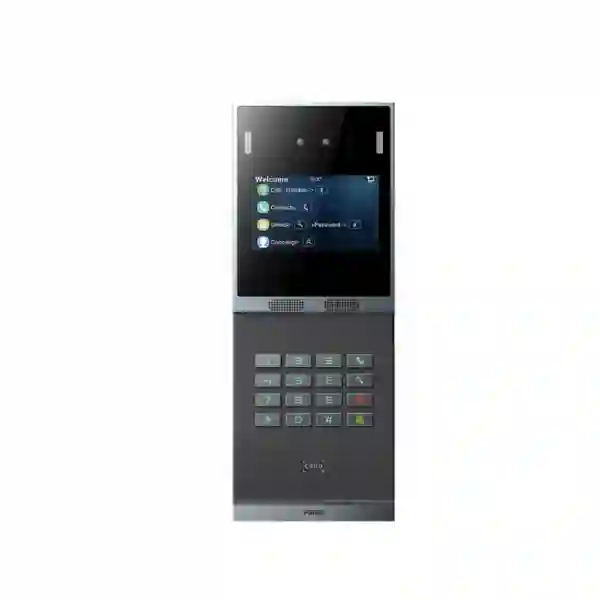
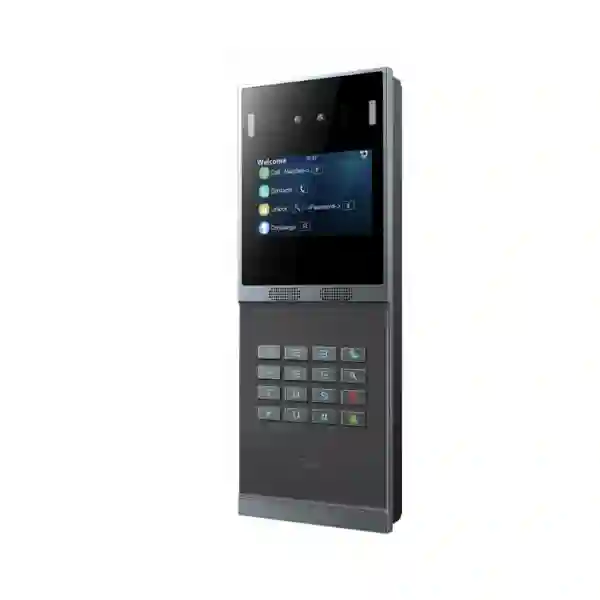
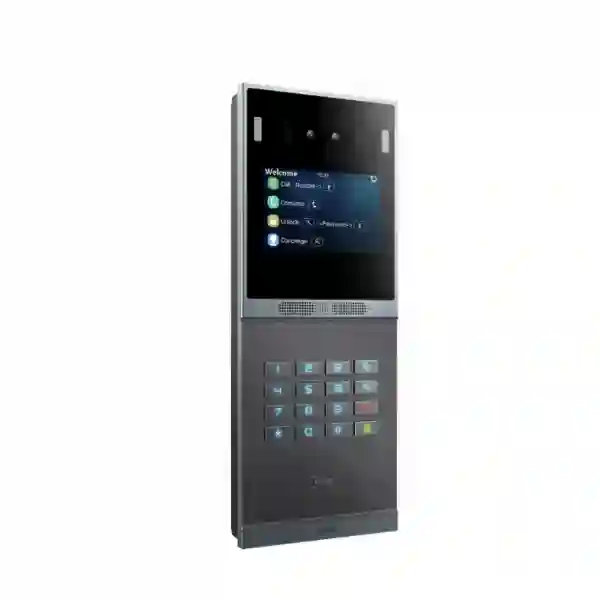
Fanvil i66 Face Recognition Door Phone
The Fanvil i66 Face Recognition Door Phone is designed for organizations that want one entrance device to handle visitor communication and several credential methods without separating intercom and access-control functions into unrelated systems. Fanvil positions the i66 for communities, apartments and office buildings, and its published documentation confirms a 4-inch 800×480 colour display, an aluminium body, dual 2 MP cameras, face and card storage for up to 10,000 records each, SIP 2.0, ONVIF Profile S, Wiegand, relay and I/O connectivity, PoE and an IP66/IK07 protection rating. For buyers in Tanzania, the practical value is not simply the feature list: the device has to be matched with the door lock, exit button, cabling, PoE design, SIP environment, credential policy and installation position so that recognition, calling and unlocking work together as intended.
Why businesses consider the Fanvil i66
The i66 is built around a straightforward access workflow: identify the user or visitor, communicate when verification is required, and trigger the appropriate door-opening action. Fanvil documentation lists face recognition, IC/ID card, PIN code, QR code, DTMF code and remote door opening among supported methods. This flexibility matters when a site has different user groups. Employees may use enrolled faces or cards, visitors may need a temporary workflow, reception staff may answer a SIP call, and security teams may want the entrance video available to compatible surveillance systems through ONVIF. A good deployment therefore starts with policy decisions rather than simply enabling every feature.
Face recognition and liveness protection
Fanvil states that the i66 uses high-precision face recognition with anti-spoofing and liveness detection intended to identify attempts involving images, videos and masks. For higher-risk entrances, credential design should still follow the site’s security policy; Fanvil’s own installation guidance notes that biometric recognition should not be treated as perfect for every scenario and recommends combined authentication when security requirements are high.
SIP audio and video intercom
The i66 supports SIP 2.0 over UDP, TCP and TLS and is intended to communicate with IP phones, indoor stations or compatible mobile workflows. That makes it relevant to sites that already operate an IP-PBX or want entry calls to reach reception, a security desk or an indoor station rather than relying on a standalone analogue intercom.
Outdoor-oriented enclosure
Fanvil specifies an aluminium body and IP66/IK07 protection. These ratings are useful indicators for dust, water and impact resistance, but enclosure ratings do not replace site planning. Mounting position, cable entry, drainage, direct sun, lighting and the condition of the surrounding wall or gate can all affect reliability and recognition performance.
Integration-ready interfaces
Published specifications include Wiegand input/output, short-circuit input/output, a built-in relay, an open API, motion detection, tamper alarm functionality and ONVIF Profile S. These interfaces allow the i66 to participate in a broader entrance design, but compatibility should be checked against the exact lock, controller, VMS, SIP platform and security policy used at the site.
Fanvil i66 technical specifications
The following details are based on Fanvil’s published i66 documentation. Buyers should verify firmware, accessories and project-specific compatibility at the time of quotation because capabilities can evolve through firmware updates and because a complete access-control solution depends on more than the door phone itself.
| Item | Published specification |
|---|---|
| Display | 4-inch, 800×480 colour screen |
| Body / colour | Aluminium / gunmetal |
| Camera | 2 MP × 2 with automatic lighting; 1/2.8-inch sensor |
| Video | H.264 Baseline/Main Profile; listed viewing angle 62° horizontal and 37.4° vertical |
| Credential capacity | Up to 10,000 cards and 10,000 faces |
| Access methods | Face recognition, IC/ID card, PIN, QR code, DTMF and remote door opening |
| Network / intercom | SIP 2.0 over UDP/TCP/TLS; full-duplex high-definition audio |
| Security / surveillance integration | ONVIF Profile S, Wiegand 26/34 bit, open API, motion detection and tamper alarm |
| Power | PoE 802.3at Class 4 or 12 V DC / 2 A when not using PoE+ |
| Environmental rating | IP66 / IK07; published operating range -20°C to +60°C |
| Dimensions | 300 × 115.6 × 33.2 mm |
| Mounting | Wall mounting; flush mounting using separately purchased EX103 accessory |
Planning the i66 as part of a complete entrance solution
A door phone sits at the boundary between networking, physical security and user experience. For that reason, a quotation should be based on the complete entrance rather than the endpoint alone. Start with the door type and lock. Confirm whether the project uses an electric strike, magnetic lock or another mechanism, what fail-safe or fail-secure behavior is required, whether an exit button or emergency release is needed, and how local life-safety requirements affect the design. Then map the relay and input requirements to the i66 or to an external access controller when the architecture calls for one.
Network planning is equally important. PoE can simplify installation by combining power and Ethernet on one cable, but the upstream switch must have the required 802.3at capability and sufficient PoE budget. Voice and video traffic should be placed on a network that is stable enough for visitor calls, and SIP registration, firewall rules, VLANs and QoS should be considered where the device connects to an IP-PBX or unified communication environment. ONVIF integration can be useful when entrance video is required in a compatible VMS, but the exact supported functions should be tested with the target platform rather than inferred from protocol support alone.
Face recognition also depends on installation quality. Fanvil recommends avoiding difficult lighting such as strong backlight, direct sunlight and problematic close illumination. Camera height, user approach direction and the position of the screen affect the experience. For sites with stronger security requirements, consider dual-authentication policies, visitor procedures, credential revocation, enrollment controls and logs. A secure access project combines technology with administration; a well-chosen device cannot compensate for uncontrolled credentials or unclear operating procedures.
Related FourTeck resources
For Tanzania projects that combine access control with networking, IP telephony, CCTV or wider infrastructure, review the FourTeck Tanzania technology portfolio. It provides context on the surrounding systems that often matter to a door-phone deployment, including PoE switching, IP communications, security and structured infrastructure.
Projects with regional operations can also use the FourTeck Uganda site when planning requirements for Uganda and Kampala, and the FourTeck Kenya site for Kenyan projects where access, voice and network requirements need to be coordinated locally.
For multi-country requirements across the continent, the FourTeck Africa technology hub is relevant to buyers standardizing systems across different sites. Organizations with UAE requirements can refer to FourTeck UAE when the same entrance or communications architecture needs to be considered for Gulf operations.
Regional procurement and deployment guidance
The same Fanvil i66 can serve different business needs depending on building type, user population and integration environment. The sections below are intentionally different because a sensible specification for a head office may not match an apartment block, a branch, a hospitality site or a distributed multi-country organization.
Fanvil i66 Face Recognition Door Phone Tanzania
For organizations evaluating the Fanvil i66 Face Recognition Door Phone in Tanzania, the buying decision should begin with the entrance workflow rather than with facial recognition alone. A corporate site may want employees to enter using enrolled faces or cards while visitors call reception. An apartment project may prioritize resident credentials, delivery access and communication with indoor stations. A school, clinic or managed commercial property may need reception staff to verify a visitor before remote release. The i66 can support these patterns through multiple credentials and SIP-based audio/video calling, but each method should be deliberately assigned to a user group.
Tanzania deployments also benefit from early infrastructure checks. Confirm that the cable route can support Ethernet to the entrance, that the selected switch offers the necessary PoE class and budget, and that network segmentation separates building-security devices from ordinary user traffic where appropriate. If SIP calling is required, document the IP-PBX, extension plan, destination for unanswered calls and any firewall rules between the door phone and the communication system. If ONVIF video is intended for an NVR or VMS, perform compatibility testing with the actual platform because protocol support describes a common interface, not a guarantee that every advanced feature will behave identically across products.
Physical installation deserves equal attention. The i66 carries IP66 and IK07 ratings, yet the entrance environment still determines success. Avoid placing the recognition camera where strong backlight or direct sunlight makes faces difficult to capture. Plan mounting height so typical users can approach naturally. Check the lock type, door closer, request-to-exit button, emergency-release arrangement and whether an external controller is needed. The project team should also document who is allowed to enroll users, who can revoke access, how temporary visitors are handled and how lost cards are disabled.
For procurement, specify quantity, site name, door count, preferred credential methods, existing PBX or VMS platform, switch model, lock type and whether wall or flush mounting is planned. The EX103 accessory is required for Fanvil’s documented flush-mount approach, so mounting preference affects the bill of materials. Ask for a complete solution review rather than a price for the endpoint alone. That makes the quotation more useful and reduces the risk of discovering missing power, door hardware or network components after the device has already been selected.
Fanvil i66 Face Recognition Door Phone Dar es Salaam
In Dar es Salaam, the i66 is particularly relevant to offices, apartment buildings, mixed-use properties, gated premises and reception-controlled facilities where the entrance must combine identification with fast visitor communication. A useful design starts by separating routine staff entry from exception handling. Registered staff can use an approved credential such as face, card or PIN, while visitors can be routed to a receptionist or security position through SIP. This separation can reduce unnecessary manual checks without making the entrance dependent on one authentication method.
Commercial properties in Dar es Salaam should pay close attention to the physical entrance. Outdoor gates and semi-exposed lobbies can have changing light throughout the day. Fanvil advises against recognition positions with strong backlight, direct sun or other difficult illumination, so camera placement should be tested during the hours when the entrance is busiest. The i66’s automatic lighting and dual-camera design support the recognition task, but good placement remains essential. A canopy, adjusted mounting angle or controlled approach path may improve consistency more than software changes after installation.
For multi-tenant buildings, decide whether the door phone will call a central reception, specific tenant extensions or indoor stations. SIP architecture, numbering and call routing should be documented before configuration. If a VMS is already in place, ONVIF Profile S can be considered for video integration, subject to platform testing. Where the entrance includes a magnetic lock or strike, define the relay logic and safety behavior, including what happens during power loss. The door phone may be network powered, but the door lock itself can have separate power and battery-backup considerations.
When requesting a Dar es Salaam quotation, include door photographs, cable distance, network-switch information, current access-control equipment, approximate number of enrolled users, expected visitor volume and the desired response point for calls. This allows the design to distinguish a simple single-door deployment from a broader access-control project. It also helps identify whether additional switching, UPS capacity, controller interfaces, exit hardware or indoor stations are needed. A complete request produces a more realistic procurement plan than asking for the i66 in isolation.
Fanvil i66 Face Recognition Door Phone Mwanza
For Mwanza businesses and institutions, the Fanvil i66 can be considered where a controlled entrance needs both access credentials and two-way communication. The first design question is usually operational: who must enter without staff assistance, and who should be challenged or routed to a human operator? This determines whether face recognition, card, PIN, QR or remote release is appropriate for each group. Avoid assigning the same access method to everyone simply because the device supports it. Employees, contractors, residents, cleaners, visitors and delivery personnel often require different rules.
Network readiness should be confirmed before the unit is installed. The i66 supports PoE 802.3at Class 4, which can reduce the number of cables at the entrance, but the selected PoE switch must have sufficient capacity and should be connected to suitable power protection if the access system must remain stable during short power disturbances. Where voice or video calls traverse several switches or routed networks, check VLANs, addressing, SIP reachability and quality-of-service policy. A door phone is a real-time endpoint, so unstable LAN design can affect visitor calls even when the access relay itself is functioning.
Mwanza projects that integrate the i66 with cameras or a VMS should define what they expect from ONVIF. Some buyers only need the entrance stream visible to security staff; others expect event-driven recording, pop-ups or cross-system actions. Those are different requirements and should be validated with the selected VMS. Similarly, Wiegand connectivity can be useful when an existing access controller remains in the architecture, but wiring direction, credential format and controller behavior must be confirmed during design.
For procurement, document the number of entrances, user count, chosen mounting style, any indoor stations, IP-PBX platform, lock type and whether enrollment will be administered centrally or at the device. If the site is being upgraded from a basic intercom, identify which existing components can remain and which should be replaced. A staged upgrade may be appropriate when multiple doors cannot be changed at once. The goal is a system that is understandable for local administrators, not merely a collection of advanced features that no one is assigned to manage.
Fanvil i66 Face Recognition Door Phone Arusha
In Arusha, the Fanvil i66 can fit office compounds, hospitality-related properties, apartments and managed facilities where entrance presentation matters alongside security. The aluminium gunmetal enclosure and colour screen give the unit a modern appearance, but design quality should be evaluated by how well the entrance works during daily operations. For a hotel or serviced property, for example, permanent staff may need a reliable credential while guests and suppliers should have a clearly defined visitor process. For an office, reception routing and staff enrollment may be the primary requirements.
Face-recognition performance depends heavily on how people approach the device. Installers should assess sunlight, reflections, shadows and night lighting at the actual entrance. Fanvil’s guidance warns against several difficult lighting conditions, and these conditions can vary by time of day. A short on-site test before final drilling can prevent a device from being placed where users have to lean, step backward or shield their faces. The best entrance encourages a natural approach and gives the camera a consistent view.
Hospitality and mixed-use environments may also need careful credential lifecycle control. Temporary staff, contractors and seasonal workers should not retain indefinite access. Define enrollment approval, expiry, deletion and audit procedures before commissioning. If QR credentials or remote unlocking are used, determine who is authorized to issue or approve them. For high-security spaces, Fanvil’s documentation supports the idea of combined authentication rather than relying on biometric recognition alone. The required level should match the risk of the specific door, not the prestige of the building.
A quotation for Arusha should list whether the entrance is indoor, sheltered or exposed; whether wall or flush mounting is desired; the quantity of users and cards; the lock and exit hardware; network availability; the SIP destination; and any VMS integration requirement. Include future expansion if more doors may be added. That allows the initial switch, addressing plan and administrative process to scale without unnecessary redesign. Buyers should also ask for documented handover covering user enrollment, credential removal, basic troubleshooting and backup of relevant configuration.
Fanvil i66 Face Recognition Door Phone Dodoma
For Dodoma projects, the Fanvil i66 is relevant to offices, institutions, apartment developments and controlled campuses that need a networked entrance point rather than a simple buzzer. The product’s combination of face recognition, cards, PIN, QR, DTMF and remote opening gives system designers several ways to separate everyday access from visitor handling. An institution may enroll staff while requiring visitors to call a reception desk. A residential building may combine resident credentials with indoor-station communication. A secure administration area may require a more restrictive policy.
Public-sector and enterprise-style projects often benefit from a written design record. Define who owns the access database, how new users are approved, how rapidly credentials must be revoked, and whether the system needs logs or VMS visibility. The i66 can hold large credential sets, but capacity alone does not answer governance questions. Ten thousand available face or card records are useful only when the organization has a controlled enrollment process that keeps the database current.
Infrastructure planning should include PoE, backup power, network segmentation and cybersecurity. SIP over TLS is listed among supported protocol options, but secure deployment also depends on password policy, firmware maintenance, firewall configuration and limiting management access. Recent Fanvil firmware releases continue to add functions and security-related controls, which is a reminder that the device should be treated as a managed network endpoint. Establish responsibility for checking vendor firmware and change notes rather than leaving the unit indefinitely at its commissioning state.
When preparing a request for Dodoma, provide a simple door schedule. For each door, list location, lock type, desired credential method, number of users, call destination, available network port, PoE capability and whether camera integration is required. If the project includes several buildings, state whether user administration should be independent at each site or coordinated. This information makes the quotation easier to validate and helps separate essential components from optional enhancements. It also supports a cleaner installation plan and clearer acceptance testing after commissioning.
Fanvil i66 Face Recognition Door Phone UAE
Organizations evaluating the Fanvil i66 in the UAE often have a strong need for integration across office towers, villas, warehouses, staff accommodation and multi-site business premises. The device’s SIP foundation is useful where an existing IP telephony environment can receive entrance calls, while ONVIF can provide a path to compatible video-management platforms. Buyers should map these capabilities to the actual architecture rather than assuming that protocol names alone guarantee a complete integration. Test the PBX registration, video behavior, DTMF opening, VMS stream and event expectations using the target platforms.
Environmental design is especially important for entrances exposed to intense sunlight and heat. Fanvil specifies an operating range up to +60°C and an IP66/IK07 enclosure, but positioning remains a project responsibility. Direct sun on the recognition camera, reflective glass behind the user or very strong backlight can reduce the quality of captured faces. A sheltered mounting location and a controlled approach angle can improve the user experience. For outdoor gates, inspect cable entry, grounding, lock power and protective enclosures for associated equipment.
Many UAE businesses operate multiple nationalities and a high visitor turnover, so administration matters as much as hardware. Decide how temporary access is issued, how contractor access expires and how staff credentials are revoked after role changes. If mobile or QR workflows are used, document who can create them and for how long they remain valid. For executive, data-centre or other sensitive areas, consider stronger authentication combinations and separate access policies from general office doors.
When requesting pricing, include the quantity of doors, user population, mounting preference, required indoor stations, lock and exit hardware, switching environment and preferred SIP/VMS integrations. For organizations operating across Tanzania and the UAE, maintaining a common product family can simplify training and spares, but each site still needs its own power, cabling, compliance and installation review. Standardization should therefore focus on operational principles and configuration templates while allowing local project engineering to address the physical environment.
Fanvil i66 Face Recognition Door Phone Uganda
For Uganda, the Fanvil i66 is a practical candidate for businesses that want to combine a network video intercom with employee or resident access at the same entrance. Offices, apartment projects, education facilities and managed compounds can all use the same core device differently. A head office may connect the i66 to the corporate PBX and send visitor calls to reception. A residential development may pair it with indoor stations. A campus may use cards or faces for staff while keeping visitor release under security control.
The design should start with the network and power path. If PoE is used, confirm the switch standard, available power budget and cable condition. Where the entrance is distant from the main communications room, check Ethernet distance and determine whether intermediate network infrastructure is required. If the door must remain available during short power outages, consider UPS support for the network switch and separate backup requirements for the lock or controller. Maintaining the door phone alone does not keep a magnetic lock or strike operating if its own power supply fails.
For security administration, establish a consistent enrollment policy. Face recognition reduces the need to carry a token, but lost or changed staff records still have to be managed. Cards must be disabled when lost. PINs should not be shared casually. Temporary visitor credentials should expire. These are procedural controls, not hardware features. The i66’s capacity and credential choices can support a controlled process, but only the organization can define and enforce it.
Uganda buyers should also define whether the entrance video needs to appear in a VMS. ONVIF Profile S provides a standards-based integration path, yet platform testing remains important. For quotation, provide a site list, number of doors, planned credentials, approximate user population, PBX details, camera-system details and required mounting. Multi-site organizations should state whether each branch is administered locally or centrally. That decision affects documentation, networking and operational support and is often more important than adding another access method.
Fanvil i66 Face Recognition Door Phone Kampala
Kampala deployments commonly involve busy reception areas, commercial buildings, apartments and office compounds where visitor flow can be high. The Fanvil i66 can help separate predictable access from visitor exceptions. Staff can use assigned credentials while guests use the intercom workflow. Because the device supports full-duplex audio and video, reception or security personnel can speak with the visitor before deciding whether to release the door. That can be more useful than a standalone access reader where unregistered visitors are frequent.
A busy entrance needs careful call routing. Determine what happens during peak periods, after hours and when the primary receptionist does not answer. SIP architecture can route calls to groups or alternate destinations depending on the PBX, but those rules belong in the communication design. Do not wait until installation day to decide the extension number or call destination. If the i66 will be monitored by a security team, place the receiving endpoint where staff can see and respond quickly without disrupting other duties.
For face recognition, test the real lobby or gate rather than relying on a bench setup. Glass doors, bright exterior backgrounds, dark interiors and uneven evening lighting can all change recognition conditions. Fanvil’s anti-spoofing functions are an important security feature, but lighting still affects image quality. Where a very high assurance level is required, combined authentication should be considered. The appropriate policy may differ between the main lobby and restricted internal areas.
A Kampala quotation should identify the door hardware and any existing controller, because Wiegand and relay options allow different integration approaches. It should also record the intended VMS or PBX, PoE switch, user count and enrollment method. If a building has tenants, clarify who administers users and whether tenants need separate calling destinations. This avoids a technically functional installation that creates administrative confusion after handover. Include training for the nominated system administrator and a basic process for adding, changing and deleting users.
Fanvil i66 Face Recognition Door Phone Arua
For Arua, organizations considering the Fanvil i66 should focus on maintainability and clear operating procedures. A networked door phone can offer far more capability than a basic intercom, but that capability should be matched to the site’s technical resources. If a branch has limited on-site IT staff, a simpler policy using a small number of credential types may be preferable to enabling every available option. Face plus card for staff, for example, may be easier to manage than a mixture of several temporary methods without a defined administrator.
Network resilience should be part of the design discussion. The i66 depends on Ethernet for SIP and IP-based integrations, so the cable path, PoE source and upstream switch matter. If the device is at an external gate, examine distance, surge exposure and the practical route back to the network. Where the link cannot be provided reliably, that infrastructure problem should be solved before product installation. A strong door phone on an unreliable network will still produce poor call performance.
Physical entry hardware must be documented as well. Confirm whether the existing lock can be controlled directly through a relay arrangement or should remain under a separate access controller. Check request-to-exit inputs, door contact requirements and emergency release. If the project later expands to additional doors, the initial naming, IP addressing and administration model should make that expansion easy. Even a single-door project benefits from organized documentation.
For procurement in Arua, supply photographs and dimensions of the entrance, the expected number of users, required call destination, cable availability and the lock model if known. If wall appearance is important, decide whether the standard wall-mounted arrangement is acceptable or whether the separately purchased EX103 flush-mount accessory is required. Clarify whether user enrollment will be performed at the device, through the web interface or through a broader management workflow supported by the chosen deployment. This information helps convert a product request into a practical solution scope.
Fanvil i66 Face Recognition Door Phone Mbarara
Mbarara organizations can use the Fanvil i66 where secure access needs to be paired with visitor communication at offices, residential developments, clinics, education facilities or business compounds. The main benefit is consolidation: one device can recognize approved users, accept cards or PINs and also place audio/video calls. Consolidation should not be confused with oversimplification, however. The surrounding door hardware, network, power and administrative policy still have to be engineered correctly.
For healthcare or education environments, user groups can change frequently. Employees, students, contractors and visitors may have different durations of access. The enrollment process should therefore include expiry or review procedures rather than accumulating old credentials indefinitely. Card records should be removed when a token is lost. Facial records should be deleted when no longer required by the organization’s policy. Administrators should have clear permissions and avoid shared management accounts where the platform allows individualized control.
If the i66 is used as part of a broader security environment, define how reception, guards and CCTV operators will interact. ONVIF support can help place the device’s video in a compatible VMS, but operational workflow determines whether this is useful. A security desk may want an entrance camera view alongside other cameras, while a small office may only need the video presented during a SIP call. The correct design depends on who needs to see the visitor and when.
For an Mbarara quotation, state whether the entrance is exposed to weather, the available Ethernet route, switch PoE capability, lock type, number of enrolled people, preferred credentials and the required call target. If the deployment is part of a branch network, include VPN or firewall considerations for remote management. Keep the system manageable: document addresses, credentials, firmware versions and configuration ownership. Clear handover records reduce dependence on memory when staff changes or when the device needs service later.
Fanvil i66 Face Recognition Door Phone Gulu
In Gulu, the Fanvil i66 can suit sites that want to modernize from a basic call button or card reader to a combined IP entrance endpoint. The strongest use case is where both known users and unknown visitors use the same doorway. Known users can authenticate through an assigned method, while visitors can make an audio/video call to a responsible person. This approach can improve consistency at reception points where manual gatekeeping is currently separated from access-control hardware.
Before installation, identify the minimum functions the site truly needs. Face recognition may be the primary credential, but cards can provide a useful backup. PINs can be practical for selected users, while QR workflows may be reserved for planned visits. Too many active methods without clear policy can make access harder to audit. A simple credential matrix listing user group, primary method, backup method, validity and approver is useful even for a modest deployment.
The device’s IP66 and IK07 ratings support demanding locations, but the surrounding installation needs equivalent care. Outdoor cable joints, exposed power supplies or an unsuitable lock can become the weak point. Mount the unit where the camera can see the user’s face without strong backlight. Provide strain relief and protected cable entry. If flush mounting is selected, account for the EX103 accessory and wall preparation before procurement and installation scheduling.
Gulu buyers should provide the number of sites and doors, approximate employee or resident count, visitor pattern, existing telephony, CCTV and network details, and the expected access policy. If there is no IP-PBX today, decide whether the intercom should call indoor stations or whether a broader SIP solution is part of the project. If there is an existing PBX, confirm compatibility, extension licensing and call routing. This prevents the door phone from becoming an isolated device and ensures the communication function is actually usable after installation.
Fanvil i66 Face Recognition Door Phone Kenya
Kenya has an active market for IP telephony and networked access products, so buyers comparing the Fanvil i66 should look beyond headline pricing. The key question is what is included in the complete entrance solution. One quotation may cover only the door phone, while another may include PoE switching, lock power, electric strike or magnetic lock, exit button, cabling, mounting accessories, IP-PBX configuration and commissioning. A useful comparison aligns the same scope across suppliers before evaluating cost.
For Nairobi offices, apartment developments or distributed branch environments, the i66’s SIP capability can fit well with existing voice systems. Clarify whether the door phone will register directly to the PBX, whether calls need video, which extension or group receives them and whether remote DTMF opening is part of the desired workflow. If the PBX is cloud-hosted, confirm network and security requirements before deployment. If the system is on-premises, make sure VLAN routing and firewall policies permit only the necessary traffic.
Face recognition and card access should be treated as credential-management projects. Kenya buyers often compare products based on storage numbers, but the real administrative question is how records are enrolled, updated, backed up and removed. The i66’s published 10,000-face and 10,000-card capacity is substantial for many sites, yet governance remains essential. Define who can enroll a face, what evidence is required, how contractors expire and how lost cards are blocked.
For regional organizations with operations in Kenya and Tanzania, a common Fanvil platform can simplify training and support documentation. Still, each location should be surveyed independently because door construction, lighting, network topology and existing security systems vary. Include these differences in the bill of materials instead of forcing identical hardware around the endpoint. Standardize naming, configuration templates, firmware policy and administrative procedures while allowing site-specific choices for mounting, locks, switches and power backup.
Fanvil i66 Face Recognition Door Phone Kuwait
For Kuwait, the Fanvil i66 can be evaluated for offices, residential buildings, compounds and controlled commercial entrances where a combination of face recognition and video intercom is desirable. The product’s IP66/IK07 rating and aluminium construction are relevant to robust installations, but very hot, bright environments demand careful placement. Fanvil publishes an operating range to +60°C; installers should still avoid unnecessary direct solar exposure and provide a mounting position that keeps the camera view consistent.
A Kuwait deployment should also account for the behavior of associated equipment. PoE switches, lock power supplies, controllers and indoor stations may be located in different environments from the door phone and can have their own thermal limitations. Check enclosure ventilation, equipment-room cooling and UPS design. If a gate is distant from the building, review cable length and surge exposure rather than extending copper casually. The access system is only as reliable as its weakest infrastructure component.
Organizations with high visitor volumes may want QR or temporary workflows, while staff use face or card credentials. The i66 supports several opening methods, but security policy should determine which are enabled. For high-security doors, combined authentication and manual verification may be appropriate. For general office entrances, convenience may have greater weight. Apply different controls to different doors instead of assuming one global rule is suitable for every area.
A complete quotation request should include door count, user count, mounting style, exposed/sheltered status, lock type, PBX or indoor-station requirement, VMS integration and the expected credential mix. If a company already uses Fanvil phones or other SIP endpoints, state the PBX platform and firmware environment so intercom behavior can be tested in the same ecosystem. Regional operators with Tanzania and Kuwait sites can use a shared project template covering naming, access policy, call flow and documentation while allowing local engineering to handle climate and building differences.
Fanvil i66 Face Recognition Door Phone Ghana
Ghana businesses considering the Fanvil i66 can use it as a bridge between visitor communication and controlled entry. Offices, apartments, schools and mixed-use properties often need two separate experiences at the same door: fast access for known users and a clear escalation path for everyone else. The i66 supports that model because authorized people can use stored credentials while unknown visitors can place a SIP audio/video call to a defined destination.
Before purchasing, verify the current network and door hardware. PoE reduces local power cabling for the device, but the switch must support the required standard and have remaining power budget. If the building already has an access controller, decide whether the i66 is replacing the reader/controller role or integrating through Wiegand and relay interfaces. That decision affects wiring, commissioning and long-term troubleshooting. Avoid duplicating control logic across systems without a clear reason.
For larger organizations, access data management deserves a written process. The device can store thousands of faces and cards, yet accuracy and security depend on keeping the database clean. Duplicate or outdated records should be avoided. Departing users should be removed promptly. Temporary users should have defined expiration. If administrators manage the device over the network, management access should be limited to trusted networks and strong credentials should be used. Firmware maintenance should become part of routine security operations.
When seeking a Ghana quotation, provide entrance photos, the number of users, preferred access methods, existing CCTV or VMS information, PBX details and whether the site needs wall or flush mounting. Add the expected operating hours and after-hours call route. A 24-hour facility may need a different workflow from an office that closes in the evening. These details help configure a system that supports the actual building routine rather than simply demonstrating the i66’s feature set.
Fanvil i66 Face Recognition Door Phone Nigeria
Nigeria deployments may range from single-office entrances to large residential estates and distributed corporate sites. The Fanvil i66 is most useful when the project team defines a consistent access architecture first. For an estate, the emphasis may be resident recognition, visitor calling and gate release. For a corporate office, it may be employee access plus reception video. For a warehouse, the focus may be controlled staff entry and security-desk communication. The same hardware can support these scenarios, but configuration and connected components differ.
Power and network resilience can be important design topics. The i66 supports PoE, which centralizes device power at the switch, making it possible to place the switch on UPS if continuity is needed. The lock, however, can have a separate power system, so the full door circuit must be reviewed. If an electric lock, controller and PoE switch respond differently to an outage, the final door behavior may not match the security or life-safety requirement. Document desired fail behavior before hardware selection.
Multi-site organizations should establish a firmware and configuration policy. Fanvil publishes firmware updates for the i66, and recent releases have added functions such as dual-authentication, QR unlocking and management improvements. New features can be useful, but firmware changes should be tested before broad rollout. Maintain a record of device version, configuration backup and integration dependencies so an update can be evaluated systematically rather than applied ad hoc.
For procurement in Nigeria, request a bill of materials that clearly separates the i66 from the supporting infrastructure. Include number of doors, number of users, credentials, SIP destination, VMS, controller, switch, UPS and lock hardware. Ask for commissioning and handover requirements as part of the same discussion. If deployment spans several cities, create a standard acceptance checklist covering recognition, card access, PIN or QR behavior, visitor calling, remote release, door sensor response and management login. Consistency at handover can be more valuable than minor differences in unit price.
Fanvil i66 Face Recognition Door Phone Seychelles
For Seychelles properties, the Fanvil i66 can be relevant to hospitality, offices, apartments and managed residential environments where a visually clean entrance and reliable visitor communication are important. Coastal conditions make installation details especially significant. An IP66-rated endpoint is designed for strong environmental protection, but connectors, cable glands, back boxes, nearby power supplies and lock hardware also need suitable protection. The overall installation should be evaluated as a system rather than assuming the door phone’s rating protects every connected component.
Hospitality sites may want a different user model from ordinary offices. Staff credentials can be permanent or role-based, while guests and service providers may use temporary workflows. Visitor calls might route to reception, concierge or a security desk. If indoor stations are used in villas or apartments, define the calling plan carefully so visitors reach the correct destination without exposing unnecessary internal numbering. SIP allows flexible architecture, but the user experience should remain simple.
Lighting and entrance orientation also matter in island properties with bright outdoor areas. Position the face-recognition camera so users are not heavily backlit against the sky or reflective water-facing glass. If the entrance is under a canopy, verify lighting after sunset as well as during daytime. The device’s liveness detection improves resistance to spoofing attempts, yet recognition still relies on image conditions and enrollment quality. Capture clear enrollment images and define a fallback access method for authorized users who cannot be recognized reliably in a particular situation.
For a Seychelles quotation, include environmental exposure, distance to the network room, available PoE, lock type, user and visitor patterns, integration with reception phones and any video-management requirement. For resorts with several buildings, decide whether each building has a local call destination or whether entrances route centrally. Also plan spare units, firmware management and documentation because remote islands can make unplanned maintenance more disruptive. Good project planning reduces dependence on emergency replacement and makes day-to-day administration easier for local staff.
Selection, sizing and buying guidance
The i66 should be selected when its combination of face recognition, keypad, card reading, SIP intercom and integration interfaces matches the entrance requirement. Buyers who only need a basic call button may not need the administrative overhead of biometric credentials. Conversely, sites that need a large touchscreen directory or different mounting options should compare the wider Fanvil i6 family. The correct choice is the device that fits the workflow, not the model with the longest specification list.
Choose i66 when
A 4-inch interface is sufficient, face recognition is required, SIP calling is part of the entrance workflow, multiple credential choices are valuable and wall mounting fits the site. It is also relevant where ONVIF or Wiegand integration may be needed.
Clarify before ordering
Door lock type, fail behavior, PoE standard, available switch budget, cable path, mounting style, user capacity, PBX, VMS, credential policy, visitor process, exit hardware and backup-power expectations should all be confirmed.
Test before large rollout
For multi-door or multi-site projects, pilot the actual recognition environment, SIP call flow, lock release, card types, QR workflow, VMS connection and administrative process before deploying a common template everywhere.
Quotation checklist for the Fanvil i66
A useful quotation request should describe the complete entrance. Include the points below so the proposed bill of materials can be reviewed for compatibility and scope.
- Number of i66 units and number of physical doors.
- Site and region for each entrance.
- Wall-mounted or flush-mounted preference.
- Approximate number of users and cards.
- Preferred credentials: face, card, PIN, QR, DTMF or remote release.
- Existing electric strike, magnetic lock, controller, exit button and door contact details.
- Available Ethernet cabling and PoE switch model.
- IP-PBX or SIP platform and the extensions that should receive calls.
- VMS/NVR platform if ONVIF video integration is required.
- UPS or backup-power requirement.
- Expected visitor flow and after-hours procedure.
- Any need for centralized multi-site administration or common configuration standards.
Fanvil i66 FAQs
Does the Fanvil i66 support face recognition?
Yes. Fanvil identifies the i66 as a face-recognition door phone and states that it includes anti-spoofing liveness detection intended to detect attempts using images, videos and masks. Recognition quality still depends on enrollment, lighting, installation angle and user position.
What access methods can the i66 use?
Published Fanvil specifications list face recognition, IC/ID cards, PIN code, QR code, DTMF code and remote door opening. The deployment should enable only the methods that match the site’s security policy and operational workflow.
Can the Fanvil i66 connect to an IP-PBX?
The i66 supports SIP 2.0 over UDP, TCP and TLS and is intended for audio/video communication with IP phones and indoor stations. Exact PBX interoperability, provisioning and video behavior should be validated with the target platform and firmware.
Does the i66 support PoE?
Yes. Fanvil lists PoE 802.3at Class 4. It also lists 12 V DC / 2 A when PoE+ is not used. The upstream switch and power design should be sized for the full installation, including any lock or controller power that is separate from the door phone.
Is the Fanvil i66 suitable for outdoor use?
Fanvil specifies IP66 and IK07 protection and a published operating range from -20°C to +60°C. Outdoor suitability still depends on correct mounting, cable sealing, sun exposure, associated equipment and the conditions of the specific entrance.
Can the i66 integrate with CCTV or a VMS?
Fanvil lists ONVIF Profile S support, which can provide a standards-based path for compatible video systems. Buyers should test the actual VMS because stream, event and management behavior can vary by platform.
How many faces and cards can the i66 store?
Fanvil’s published i66 specification lists storage for up to 10,000 faces and 10,000 cards. The effective management model should still be designed around the real number of active users, credential lifecycle and administrator responsibilities.
Can the Fanvil i66 be flush mounted?
Fanvil documents both wall mounting and flush mounting. The flush-mount method requires the separately purchased EX103 accessory, so this choice should be made before the bill of materials is finalized.
What should be checked before buying the i66 in Tanzania?
Confirm door hardware, lock behavior, available Ethernet and PoE, mounting location, user population, preferred credentials, PBX or indoor-station call destination, VMS integration and backup power. Providing these details with the quotation request reduces the risk of missing accessories or incompatible infrastructure.
Decision recap
The Fanvil i66 is a strong fit for buyers who need face recognition and multiple credential methods together with SIP video intercom in a rugged, networked door phone. Its published capabilities cover the main building-entry functions, but the value of the deployment depends on integration quality. Treat the lock, exit hardware, PoE, SIP, VMS, user enrollment, lighting and mounting location as part of the same design.
For quotation accuracy, provide a door-by-door requirement rather than only a model name and quantity. This makes it easier to identify the required accessories and confirm that the i66 is the right model for each entrance.
Consult FourTeck about your Fanvil i66 project
Share the number of doors, building type, user count, lock type, network and PoE environment, preferred access methods, SIP platform, CCTV/VMS platform and target location. FourTeck can then review the requirement as a complete access and communication system rather than treating the door phone as an isolated item. This is especially useful for multi-site projects where a common configuration standard is desired across Tanzania and other regional markets.


Reviews
There are no reviews yet.