
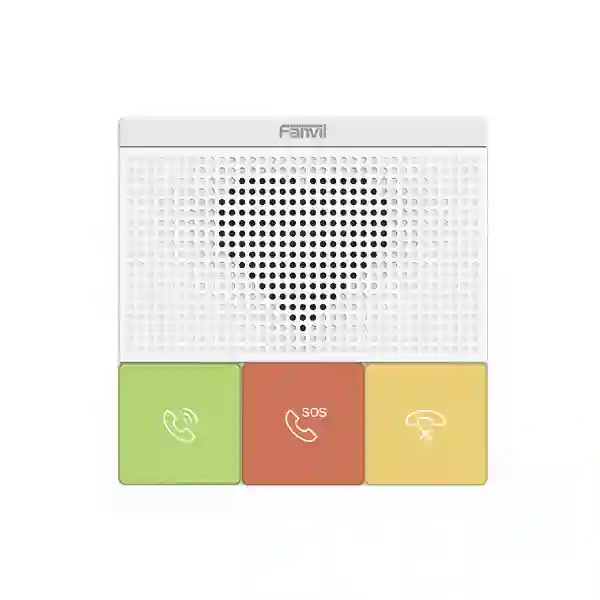
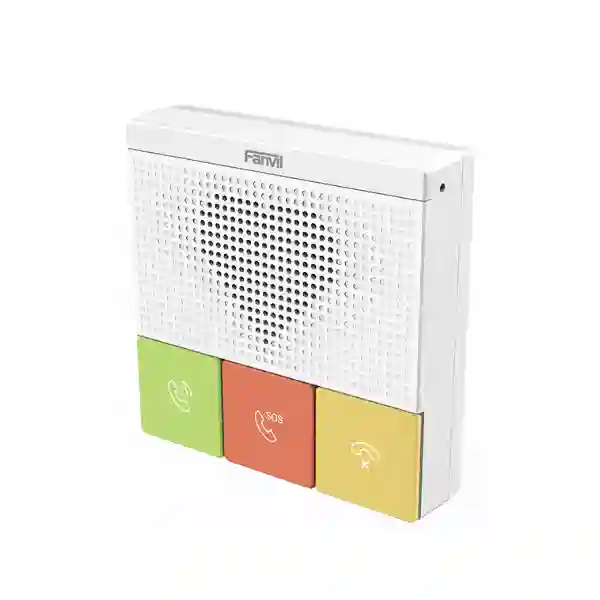
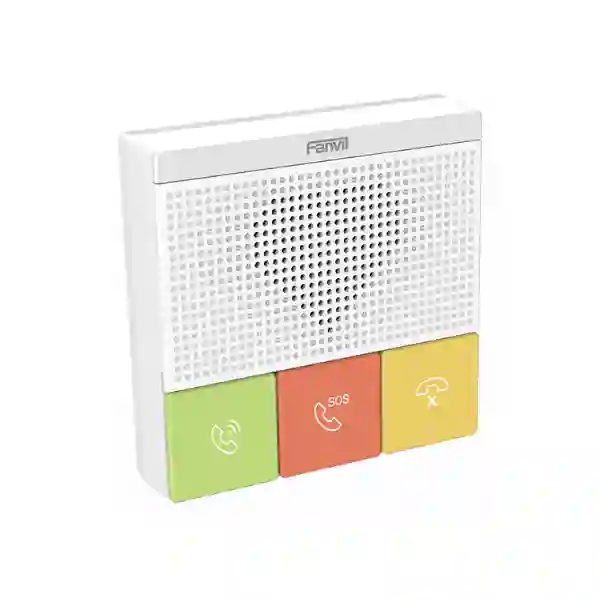
Fanvil Y501-E SIP Healthcare Intercom
The Fanvil Y501-E SIP Healthcare Intercom is built for indoor healthcare and care-related communication where a simple, highly visible endpoint must connect patients, residents or staff with a SIP-based voice system. Within Fanvil’s Y501 family, the Y501-E is the embedded-installation model intended for a standard 86 box. It combines high-definition audio, two SIP accounts, three detachable antibacterial-material DSS buttons, a status indicator, PoE or 12V DC power, an IP54-rated enclosure, one relay and one short-circuit input. The platform also supports compatible 433 MHz wireless buttons, making it useful where a fixed bedside or room endpoint must be complemented by a portable call trigger.
For Tanzanian hospitals, clinics, assisted-living facilities, nursing environments, rehabilitation centres and other indoor care sites, the Y501-E can form part of a structured SIP communication design rather than operating as an isolated consumer alert device. Procurement teams can assess it alongside their IP-PBX, nurse-call workflow, PoE switching, VLAN design, emergency escalation rules and room-layout requirements. FourTeck’s role is to help buyers translate the hardware capabilities into a deployable project plan, confirm the intended topology, and prepare a quotation around the required quantity and related infrastructure.
HD SIP Communication
Wideband codecs including G.722 and Opus support clear voice communication, while two SIP accounts provide flexibility for registration and call-routing designs.
Embedded 86-Box Installation
The Y501-E variant is intended for standard 86-box embedded mounting, helping projects create a clean bedside, room-wall or care-area installation.
Healthcare-Oriented Controls
Three detachable DSS buttons can be assigned to commonly needed actions such as speed dial, emergency and cancel, while the button material is specified as antibacterial.
What the Fanvil Y501-E is designed to solve
Healthcare communication projects often need a device that is easier to understand and operate than a standard desk IP phone. A patient or resident may need one clearly defined action, staff may require a predictable emergency workflow, and the IT team may want the endpoint to remain within an existing SIP architecture. The Y501-E addresses this design problem by combining a compact healthcare-oriented interface with standard IP voice connectivity. It is particularly relevant where room-based endpoints must call a nurse station, reception point, security desk, caregiver extension or other predefined destination.
Because the device uses SIP, planners can treat call routing as part of the voice network rather than building a completely separate proprietary calling environment. Its relay and short-circuit input allow projects to consider peripheral signaling or alarm integration, subject to the exact design and compatibility checks for the chosen third-party equipment. The optional 433 MHz wireless-button support can further extend the call trigger to users who may not always be immediately beside the wall endpoint.
The IP54 rating is useful for indoor environments where dust and incidental splashing are considerations, but the Y501-E remains an indoor product and should be deployed accordingly. For project planning, the combination of PoE and 12V DC power options provides electrical flexibility, while 10/100 Mbps Ethernet supports standard wired network connectivity.
Verified technical highlights
| Area | Y501-E capability | Project relevance |
|---|---|---|
| SIP | 2 SIP accounts; SIP 2.0 over UDP/TCP/TLS | Fits standards-based IP voice and intercom designs. |
| Audio | HD audio with wideband G.722 and Opus; additional narrowband codecs | Supports intelligible two-way voice where the network and remote endpoint support the selected codec. |
| Controls | 3 detachable DSS buttons; speed dial, emergency and cancel functions are documented | Helps simplify user interaction in care environments. |
| Wireless button | Support for specified 433 MHz wireless buttons; up to 10 wireless buttons documented for the series | Can provide a portable call trigger when compatible accessories are selected. |
| I/O | 1 short-circuit input and 1 relay with NC/NO contacts | Useful for properly engineered alarm, indicator or control integrations. |
| Power | PoE or 12V DC | Allows centralized PoE designs or local DC power where appropriate. |
| Protection | IP54 | Provides dust and splash resistance for suitable indoor environments. |
| Installation | Standard 86-box embedded installation for the Y501-E variant | Supports a compact, flush-style room or bedside deployment. |
Compatibility, network and management planning
The Y501 series documentation lists IPv4 and IPv6 networking, DHCP, PPPoE, VLAN, LLDP and QoS-related capabilities, along with protocols used in SIP deployments such as RTP/RTCP and SRTP. It also supports web-based management and auto-provisioning options that include FTP, TFTP, HTTP, HTTPS, DHCP option 66, SIP PnP and TR-069. These functions matter most when a deployment includes multiple rooms or facilities, because repeatable configuration and network segmentation can reduce manual effort and help operations teams maintain consistent settings.
Compatibility should still be confirmed against the actual PBX, nurse-call platform, switch, VLAN policy and peripheral devices in the project. Standard SIP support creates a strong basis for interoperability, but specific call-state behavior, emergency priority, auto-answer, multicast paging, relay activation and third-party camera or alarm integration should be validated in the intended system design. Buyers should provide their PBX platform, expected call flow, switch model and accessory requirements when requesting a project quotation.
Related FourTeck resources
Use the Tanzania site as the primary source for local product and solution enquiries.
FourTeck Uganda
Useful for organizations coordinating healthcare communication requirements across Uganda.
FourTeck Kenya
Relevant to regional East African projects that extend into Kenya.
FourTeck Africa
A regional FourTeck resource for multi-country technology planning and procurement.
Fanvil Y501-E SIP Healthcare Intercom Tanzania
In Tanzania, the Fanvil Y501-E is most relevant to projects where hospitals, clinics, long-term care providers, assisted-living settings and institutional healthcare facilities want a room-based communication endpoint that can be incorporated into an IP voice architecture. Procurement teams often begin with the visible device, but the more useful approach is to design the full communication path: who presses the button, where the call rings, how quickly it escalates, whether the call should auto-answer, what happens when the destination is busy, and how the event is represented to caregivers. The Y501-E gives the project a compact SIP endpoint with three clear DSS controls, embedded 86-box installation and support for external call triggers through compatible 433 MHz wireless buttons.
For Tanzania deployments, planners should map the device count room by room and confirm whether existing Ethernet cabling and PoE switching reach each installation point. A PoE design can simplify power delivery and reduce the need for local adapters, but switch capacity, UPS protection and VLAN policy should be checked before procurement. Where local DC power is preferred, the Y501-E also supports 12V DC. The endpoint’s IP54 rating is useful for indoor healthcare spaces where incidental dust and splashing are considerations, yet it should still be treated as an indoor intercom and placed according to the manufacturer’s environmental guidance.
A Tanzania quotation should ideally include the number of Y501-E units, the required wireless buttons, PBX or SIP platform details, PoE-switch requirements, installation accessories, any relay or alarm integration, and the intended nurse-station or caregiver endpoints. This information helps distinguish a simple device purchase from a complete nurse-call or healthcare communication project. FourTeck can use the requirement list to help buyers compare the Y501-E with related Fanvil healthcare endpoints and create a solution that is technically consistent with the site’s voice and network architecture.
Fanvil Y501-E SIP Healthcare Intercom Dar es Salaam
Dar es Salaam healthcare organizations evaluating the Fanvil Y501-E will usually benefit from treating the device as part of an integrated communications project. Large clinics, private hospitals, specialist centres, rehabilitation facilities and residential care environments may have different room layouts and escalation needs, so a single generic call-flow template is rarely enough. The Y501-E’s three DSS keys can support a simplified user interface, while the SIP architecture allows the destination to be a compatible nurse console, IP phone, PBX extension or other configured SIP endpoint. Designers can also evaluate multicast or broadcast functions where announcements are needed as part of the broader system.
In a busy Dar es Salaam facility, network planning is particularly important. Separate voice or healthcare-device VLANs can help administrators organize traffic and access policies. PoE switching can centralize endpoint power, and a UPS-backed switch can be considered where continuity is required. The Y501-E supports 10/100 Mbps Ethernet and is designed for wired connectivity; buyers choosing the embedded model should therefore verify the cable route and standard 86-box preparation before installation. Where a wireless version is desired, the Y501W-E is the separate dual-band Wi-Fi model in the family and should not be confused with the wired Y501-E.
For procurement, Dar es Salaam buyers should document room quantities, expansion plans and the call-answering workflow before requesting pricing. If the project includes door control, alarm indicators, sensors or other external devices, the built-in relay and short-circuit input may be useful, but the electrical and logical behavior must be engineered and tested with the selected equipment. A structured requirement also makes it easier to budget for switching, PBX licensing if applicable, accessories and installation rather than looking only at the endpoint price.
Fanvil Y501-E SIP Healthcare Intercom Mwanza
For healthcare facilities in Mwanza, the Fanvil Y501-E can serve as a straightforward patient-to-caregiver communication endpoint in indoor rooms where the network can provide wired Ethernet. The embedded form factor is suited to projects that want the intercom to sit neatly in a standard 86-box location instead of protruding like a conventional desktop phone. This can be useful in wards, assisted-care rooms, observation spaces and other environments where a large screen or full keypad is unnecessary and users need only clearly defined call actions.
A Mwanza deployment should begin with a room schedule and an escalation matrix. Project teams can decide which DSS key initiates a normal call, which action represents an emergency and how cancellation is handled. They should also decide whether the system needs portable triggers for patients with limited mobility. Fanvil documents support for specified 433 MHz wireless buttons, and the Y501 series supports multiple wireless buttons, allowing planners to consider bedside or wearable-style call triggers according to the selected accessory and coverage conditions. The wireless accessory path is separate from Wi-Fi connectivity; the Y501-E itself is the wired embedded model.
Network administrators should verify PoE budget, switch-port availability, VLAN design, SIP registration and QoS policies before rollout. For a smaller clinic, this may be a compact design with a single PBX and a few endpoints. For a larger institution, centralized provisioning and standardized templates become more important. The Y501 family supports auto-provisioning methods and web management that can reduce repetitive configuration work. When requesting a quotation for Mwanza, including these operational details helps ensure that accessories, switching and configuration effort are not overlooked.
Fanvil Y501-E SIP Healthcare Intercom Arusha
Arusha organizations considering the Fanvil Y501-E may include private medical centres, rehabilitation environments, elder-care facilities, hospitality-linked medical areas and institutional health services that need a simple SIP endpoint for urgent or routine voice communication. The practical value of the Y501-E is its focused interface: users are not presented with a conventional phone keypad, while staff can configure the DSS buttons for predefined functions. This can reduce decision steps for a patient or resident who needs to request assistance quickly.
Facility planners should consider where the intercom will be installed, the height and reach of the buttons, Ethernet availability and whether portable 433 MHz wireless buttons are required. The embedded 86-box format makes early coordination with electrical and interior work important. If a site is still under construction or renovation, confirming the intercom locations before wall finishing can reduce rework. If the building is already operational, the installation survey should check whether existing boxes and network routes match the Y501-E’s physical and cabling requirements.
The SIP side should be validated against the organization’s PBX or healthcare communication platform. Two SIP accounts provide flexibility for registration schemes, while TLS and SRTP support can be considered within the overall security policy. Management and provisioning options also help when devices need consistent configuration across many rooms. An Arusha quotation is most useful when it specifies endpoints, wireless buttons, expected integrations, PoE switch ports, PBX information and whether configuration assistance is required. This approach turns the product choice into a deployment-ready bill of requirements rather than a standalone hardware request.
Fanvil Y501-E SIP Healthcare Intercom Dodoma
In Dodoma, the Fanvil Y501-E can be considered for healthcare, public-sector and institutional care facilities that need room-level SIP communication with clearly defined emergency or assistance actions. The endpoint is compact, supports embedded installation and can be integrated into an IP network using wired Ethernet. For sites that already operate a SIP voice platform, this creates an opportunity to extend the communications environment to patient or care spaces without requiring a conventional desk handset at every location.
For public and institutional procurement, documentation matters as much as the device itself. Buyers should identify the number of rooms, expected operating workflow, endpoint naming convention, IP addressing strategy, switch and UPS requirements, and any need for centralized provisioning. The Y501 series supports auto-provisioning and web management, which can support repeatable deployments when many endpoints are involved. A room and bed naming convention can also make maintenance easier by helping staff identify the correct device during troubleshooting or configuration changes.
The built-in relay and short-circuit input can be considered for integrations such as indicators or signaling devices, but these should be engineered according to electrical limits and the actual third-party equipment. The IP54 enclosure is intended to provide protection against dust and splashing within appropriate indoor deployments, not to convert the unit into an outdoor device. Dodoma buyers requesting a quotation should therefore provide both the communications requirement and the physical installation conditions. Doing so allows FourTeck to frame the Y501-E alongside the correct power, network and accessory requirements for the intended site.
Fanvil Y501-E SIP Healthcare Intercom UAE
For UAE healthcare and care-related projects, the Fanvil Y501-E is relevant where a facility wants a standards-based SIP intercom with embedded installation rather than a general-purpose telephone. The UAE market often includes new-build hospitals, fit-outs, clinics, senior-care environments and multi-site healthcare groups, so the Y501-E should be evaluated against both room design and the central communications architecture. Its PoE capability is particularly useful in structured cabling projects because power and network connectivity can be delivered over the same Ethernet run, subject to the PoE switch design.
The device’s three DSS buttons can be configured around the specific service model, while optional compatible 433 MHz wireless buttons can extend emergency calling away from the wall unit. For larger projects, auto-provisioning and web management can help standardize configuration. Integration teams should verify SIP registration, codec selection, call priority, TLS/SRTP policies, VLANs, QoS and the behavior of any external relays or alarms. Where Wi-Fi is a formal requirement, the Y501W-E should be considered instead because the Y501-E itself is the wired embedded variant.
UAE buyers should avoid treating healthcare intercom selection as a simple unit-price comparison. The practical project cost may also include PoE switching, nurse-station or reception endpoints, PBX resources, accessories, installation, configuration and testing. A detailed bill of quantities helps suppliers quote consistently and gives consultants a clearer basis for technical evaluation. Cross-region organizations can coordinate requirements through the broader FourTeck network while keeping the exact model, installation method and SIP workflow consistent across sites.
Fanvil Y501-E SIP Healthcare Intercom Uganda
Uganda healthcare organizations can use the Fanvil Y501-E as part of a wired SIP communication plan for patient rooms, residential care, clinics and institutional facilities. Its embedded design and simplified buttons can be helpful where end users need an obvious assistance or emergency control instead of a full IP phone. The unit can register with SIP systems and provides two SIP accounts, giving network and voice administrators options when designing registration or failover logic.
A practical Uganda deployment should assess network quality and power continuity in addition to feature requirements. PoE allows the endpoint to be powered from a central switch, which can be paired with UPS protection where the project requires resilient communication. The Y501-E can alternatively use 12V DC. For multi-room projects, switch capacity should be calculated for both port count and power budget. VLAN separation, QoS and consistent DHCP or static-address policies can simplify support after handover.
For organizations operating more than one healthcare site, standardized configuration is valuable. Fanvil’s documented provisioning methods can support reusable configuration templates, while web management helps with troubleshooting and updates. Uganda procurement teams should include the PBX platform, room count, wireless-button requirement, relay/integration requirement and expected project phasing in the quotation request. Related regional enquiries can be coordinated through FourTeck Uganda, while Tanzania-based projects can remain anchored to FourTeck Tanzania for the primary sales workflow.
Fanvil Y501-E SIP Healthcare Intercom Kampala
Kampala hospitals, clinics and care facilities considering the Fanvil Y501-E should first define the human workflow around the device. A successful healthcare intercom design is not only about SIP registration; it is about making sure that a patient’s call reaches the correct staff member, is audible and understandable, and can be escalated when necessary. The Y501-E’s three DSS keys support a focused interface for common actions, while the status indicator can help installers and support staff understand registration or network conditions.
In larger Kampala sites, project teams may choose to separate healthcare communication devices onto a voice or dedicated service VLAN. PoE switching can make embedded endpoints easier to power and centrally manage, while network monitoring can provide visibility if ports or devices go offline. The Y501-E supports common provisioning methods that help reduce room-by-room manual configuration. IT teams should still test firmware, PBX compatibility and emergency-call behavior before large-scale rollout.
The embedded 86-box requirement should be included in the physical survey, particularly for retrofit buildings. New projects can coordinate box locations with electrical and interior drawings, while existing facilities may need to confirm wall depth, cable routes and access for service. Kampala quotation requests should therefore include drawings or room schedules when possible, the planned quantity of endpoints and wireless call buttons, the IP-PBX details and any required third-party alarm interfaces. This creates a clearer basis for configuration, installation and lifecycle support than simply asking for a single device price.
Fanvil Y501-E SIP Healthcare Intercom Arua
For care providers and medical facilities in Arua, the Fanvil Y501-E offers a compact path to IP-based patient or resident calling where wired network infrastructure is available. The model is suited to indoor use and can be embedded into a standard 86 box, which helps keep the endpoint fixed and accessible in a defined location. Its large, dedicated function-button approach can be easier to operate than a full phone interface for users who need a simple request-for-assistance action.
Arua projects should carefully plan resilience because the endpoint depends on the IP network and SIP call path. A design review should consider switch power, UPS runtime, PBX availability and what staff should do if the network is unavailable. The Y501-E can use PoE or 12V DC, allowing engineers to choose the most appropriate power method for the facility. Where portable calling is needed, compatible 433 MHz wireless buttons can be included, but their practical positioning and radio behavior should be checked in the actual building environment.
For procurement, specifying the complete need can prevent later gaps. Include the number of rooms, whether each room needs one or more wireless triggers, the target extension or nurse station, any relay-controlled indicator, and how calls should be cancelled or acknowledged. Network details such as VLAN, addressing and PBX credentials can then be prepared during implementation. A project-oriented quotation helps the buyer understand which elements are Fanvil hardware, which are network infrastructure, and which relate to configuration or third-party systems.
Fanvil Y501-E SIP Healthcare Intercom Mbarara
Mbarara healthcare and assisted-care environments can consider the Fanvil Y501-E when they need a wired SIP endpoint dedicated to room communication rather than general office telephony. The device’s compact embedded installation helps it blend into a patient-room design, while its configurable DSS keys can be aligned to the facility’s assistance and emergency workflow. HD audio support is valuable for intelligible conversation, particularly when staff need to confirm the nature of a request before arriving at the room.
Before purchase, Mbarara project teams should check the PBX and switch environment. The Y501-E supports two SIP accounts and standards-based SIP signaling, but actual interoperability with call queues, hunt groups, auto-answer policies or nurse-console functions should be tested against the intended platform. If the facility expects expansion, it is also useful to reserve network capacity and standardize endpoint naming so new rooms can be added without redesigning the entire system.
The relay and short-circuit input provide integration possibilities, but buyers should specify exactly what they expect the intercom to control or monitor. Examples might include a corridor indicator, alarm input or other low-voltage signaling function, subject to proper engineering and device limits. Including these details in the quotation request helps avoid ambiguity between what the Y501-E can do internally and what requires an external controller or accessory. For multi-site organizations, maintaining a common configuration template across Mbarara and other locations can simplify staff training, spares planning and technical support.
Fanvil Y501-E SIP Healthcare Intercom Gulu
In Gulu, the Fanvil Y501-E can be deployed in indoor care environments where simple room-to-staff communication needs to ride on an IP network. The model supports PoE, making it possible to centralize endpoint power through the network switch, and it supports 12V DC where local power is preferred. This choice is useful in both new deployments and upgrades because the system designer can adapt the power method to the available infrastructure.
For retrofit work, the standard 86-box embedded requirement should be checked against the existing wall construction. The unit’s dimensions and network cabling route matter because a neat installation depends on having the correct box and Ethernet termination in the right position. In a new ward or facility, these details can be built into the construction drawings early. In an occupied site, a pilot installation can validate physical fit, acoustic performance and the practical reach of optional wireless call buttons before the remaining rooms are completed.
Gulu buyers should also define who will administer the endpoints after installation. The Y501 series offers web management, firmware upgrade tools, configuration import/export and several auto-provisioning options. These functions are more valuable when ownership is assigned to an IT or biomedical support team with documented settings and backup configurations. A request for quotation should therefore state whether the organization needs hardware only, configuration guidance, integration planning or a broader solution that includes the supporting network and call-answering endpoints.
Fanvil Y501-E SIP Healthcare Intercom Kenya
Kenya buyers searching for the Fanvil Y501-E often compare the device with other healthcare intercom and nurse-call endpoints, so it is useful to focus on the exact model characteristics. The Y501-E is the wired embedded member of the Y501 series. It supports HD SIP audio, two SIP accounts, three detachable antibacterial-material DSS buttons, PoE or 12V DC, IP54 protection and connection to supported 433 MHz wireless buttons. Its design is oriented to indoor healthcare communication rather than outdoor door-entry use.
For hospitals and clinics, selection should be based on the intended workflow. If a bedside handset is required, a Y501-Y family variant may be more appropriate. If built-in Wi-Fi is required, the Y501W-E is the corresponding embedded wireless model. Choosing the correct suffix at procurement prevents substitutions that appear similar but change installation or connectivity. Kenya projects should also confirm whether a standalone SIP PBX design is enough or whether a fuller nurse-call system with console functions and call-event management is required.
A structured quotation should include endpoint quantities, room locations, wireless buttons, PBX details, PoE capacity and integration requirements. Larger projects may also require a staging process where devices are provisioned and tested before they reach the site. Standard naming, VLAN and firmware policies can simplify deployment and later support. Kenya organizations coordinating with Tanzania or Uganda can align model selection through the regional FourTeck network while keeping the local project bill of materials specific to each site.
Fanvil Y501-E SIP Healthcare Intercom Kuwait
Kuwait healthcare and assisted-care projects can consider the Fanvil Y501-E when they require a compact embedded SIP endpoint for patient, resident or staff communication. The unit’s wired Ethernet design can fit structured cabling environments, and PoE can simplify installation by avoiding a separate local power adapter at each endpoint. Its IP54 enclosure rating is useful for appropriate indoor care spaces, while the device remains intended for indoor deployment.
Consultants and integrators should distinguish the Y501-E from related variants during specification. The E suffix identifies the embedded-installation version, while W variants add dual-band Wi-Fi and Y variants relate to the handset-equipped family. This distinction matters for tender documents because physical installation and connectivity are not interchangeable. The Y501-E’s three DSS controls can be configured for common healthcare actions, and compatible 433 MHz wireless buttons can add a portable trigger where the room workflow requires it.
Kuwait projects should define SIP server compatibility, call routing, QoS, VLANs, provisioning method and security settings such as TLS/SRTP as part of the technical submittal. If relay or alarm integration is required, the exact electrical interface and third-party device should be documented for engineering review. Buyers seeking a quotation should provide a room schedule and quantity, accessory list, PBX platform and expected scope of installation or configuration. This makes the commercial comparison more meaningful because competing quotes can be assessed against the same technical requirement.
Fanvil Y501-E SIP Healthcare Intercom Ghana
Ghana healthcare providers evaluating IP-based nurse-call or room-intercom options can use the Fanvil Y501-E where a simple embedded endpoint is appropriate. The device supports standards-based SIP communication and can be managed through a web interface, making it suitable for organizations that already have IT teams familiar with IP telephony. Its compact interface can be configured around a few specific user actions instead of exposing a full telephone keypad.
For a Ghana deployment, the physical room survey should confirm box dimensions, Ethernet cabling and the availability of PoE. The project team should also decide whether each room needs one fixed unit only or additional 433 MHz wireless buttons for users who need a movable call trigger. Because the Y501-E supports a relay and short-circuit input, planners can explore integration with low-voltage signaling devices, but any connection should be validated against the third-party equipment and electrical limits before implementation.
Centralized provisioning becomes increasingly valuable as the number of endpoints grows. Standard configuration files, firmware policy and naming conventions help an IT team replace or reconfigure devices consistently. Ghana procurement requests should therefore include not only product quantity but also system topology, PBX details, desired button functions and support expectations. Multi-country healthcare groups can use the same design principles across their estates, while still adjusting switch capacity, cabling and operational workflows to each local facility.
Fanvil Y501-E SIP Healthcare Intercom Nigeria
Nigeria’s large and varied healthcare sector creates several potential use cases for the Fanvil Y501-E, from private hospitals and diagnostic centres to elder-care and institutional environments. The endpoint is best suited to indoor sites that want a fixed embedded SIP call station with a small number of highly visible controls. It can provide two-way voice communication and route calls over a SIP platform, enabling organizations to integrate the room endpoint into a wider IP telephony architecture.
Power and network resilience should be central to the design. PoE makes centralized power possible, but the switch and upstream network must be protected according to the facility’s continuity requirements. Where alternative powering is preferable, 12V DC is supported. The network design should also address VLAN segmentation, IP addressing, QoS and PBX redundancy where the project requires it. These infrastructure decisions determine whether the endpoint’s practical availability matches the expectations of the care workflow.
Nigeria buyers should ask for a project quotation that clearly separates Y501-E endpoints, supported wireless buttons, switching, PBX-related components, installation accessories and configuration services. If the project uses third-party alarm lights, sensors or other interfaces, the requirement should be documented early so the relay and short-circuit input can be engineered correctly. For national or multi-site organizations, a pilot at one facility can establish the button mapping, call escalation and provisioning template before the design is replicated more widely.
Fanvil Y501-E SIP Healthcare Intercom Seychelles
In Seychelles, the Fanvil Y501-E can be relevant to hospitals, clinics, residential care facilities and hospitality-linked healthcare environments that need a compact indoor assistance or emergency communication point. Its embedded 86-box format supports a tidy wall installation, and its IP-based SIP architecture allows calls to be delivered to suitable staff endpoints through the configured voice system. The simplified interface helps reduce unnecessary controls for patients or residents.
Because island deployments can make maintenance logistics important, buyers should plan device configuration and spares carefully. Standardized provisioning, configuration backups and documented network settings can make replacement easier if an endpoint needs service. PoE is attractive because centralized power can reduce the number of local adapters, but switch spares, UPS strategy and port capacity should form part of the overall resilience plan. The Y501-E can also use 12V DC if the site design calls for it.
A Seychelles quotation should specify whether the project is a standalone SIP intercom deployment or part of a fuller nurse-call system. Buyers should identify the call destination, number of rooms, wireless-button requirements and any alarm or relay interfaces. For resorts or mixed-use sites that include a clinic or medical room, it is especially important to separate healthcare emergency-call workflows from general guest telephony. Clear scope at the quotation stage helps ensure that the selected Fanvil endpoint, PBX configuration and network design work together as one operational system.
Selection and buying guidance
Choose the Y501-E when the project requires a wired, embedded healthcare intercom with three DSS buttons and no medical handset. Choose carefully among related variants: Y501 is wall-mountable; Y501-E is embedded; Y501W adds Wi-Fi to the wall-mountable format; Y501W-E adds Wi-Fi to the embedded format. The Y501-Y family adds the medical handset and additional healthcare-oriented controls. This model distinction should be written explicitly into purchase orders and tenders.
Before ordering, confirm the SIP platform, room count, 86-box installation, Ethernet route, PoE capacity, wireless-button quantity, button mapping and any I/O integration. For larger projects, request a pilot or staged deployment process so call flow and PBX behavior can be verified before all rooms are commissioned.
Quotation checklist
Frequently asked questions
Is the Fanvil Y501-E a Wi-Fi model?
No. The Y501-E is the wired embedded-installation model. The Y501W-E is the embedded model with built-in 2.4 GHz and 5 GHz Wi-Fi.
Can the Y501-E use PoE?
Yes. Fanvil documents PoE support as well as 12V DC power, giving projects two possible power approaches.
How many SIP accounts does it support?
The Y501 series supports two SIP accounts. The actual registration and call-routing design should be confirmed with the selected PBX.
Does the Y501-E support wireless emergency buttons?
Yes. Fanvil documents support for specified 433 MHz wireless buttons, with up to 10 supported on the series. The exact accessory model and deployment conditions should be confirmed before ordering.
Is it an outdoor intercom?
No. The Y501-E is specified for indoor installation. Its IP54 rating provides protection against dust and splashing under appropriate conditions but does not make it an outdoor product.
Can it connect to a third-party SIP PBX?
The Y501-E uses standard SIP and is designed for IP communications integration, but interoperability and the required call features should be validated with the specific PBX or nurse-call platform used in the project.
Decision recap
The Fanvil Y501-E is a strong fit when the requirement is a compact, wired, embedded SIP healthcare intercom with HD audio, three simple DSS buttons, PoE/DC power, IP54 protection and support for compatible wireless call buttons. It is not the Wi-Fi model and it does not include the medical handset of the Y501-Y family. Those distinctions are essential when comparing quotations.
For a reliable deployment, evaluate the Y501-E together with the PBX, PoE switching, room layout, call escalation, wireless-button requirements and support process. A well-defined project scope gives procurement teams a much better basis for selecting quantities, accessories and integration services.
Consult FourTeck about your healthcare intercom design
Share your room count, SIP/PBX platform, preferred call workflow, PoE environment and wireless-button requirements. FourTeck can use those details to prepare a more relevant Fanvil Y501-E quotation for Tanzania or coordinate a regional requirement where multiple countries are involved.


Reviews
There are no reviews yet.