
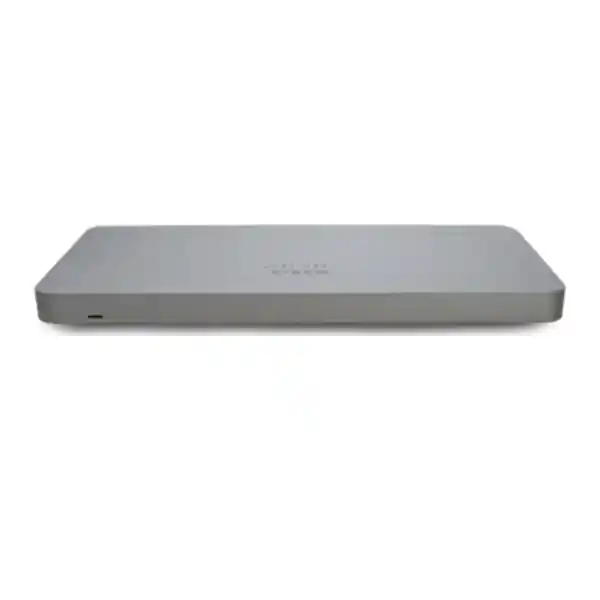
Cisco Meraki MX75
The Cisco Meraki MX75 is a compact enterprise security and SD-WAN appliance positioned by Cisco for small branch deployments of up to 200 users. It brings firewall, VPN, application control, WAN resilience and centralized cloud management into one platform, giving distributed organizations a practical way to standardize branch security without relying on complex on-site administration.
Verified MX75 highlights
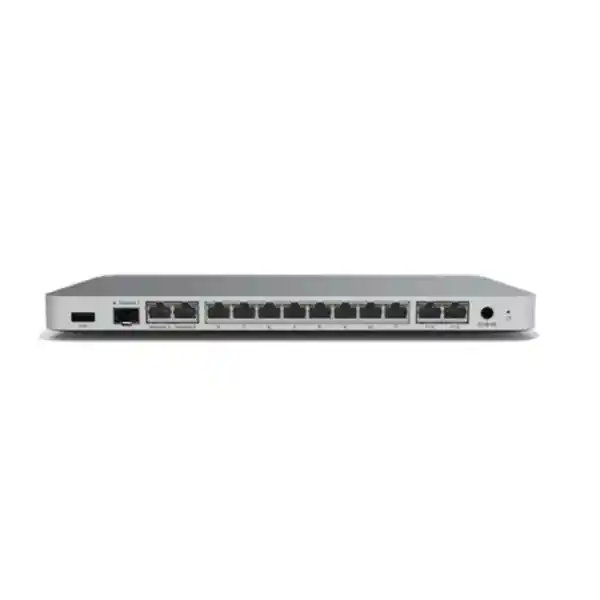
Cisco lists the MX75 with 1 Gbps firewall throughput, three dedicated WAN interfaces consisting of one Gigabit SFP and two Gigabit RJ45 ports, ten Gigabit RJ45 LAN ports with two PoE-capable ports, cloud-based Meraki Dashboard management and support for distributed branch deployments. Always size a production deployment against real traffic, inspection services, VPN load and future growth rather than a single headline throughput figure.
Cisco Meraki MX75 overview
Cisco describes the MX75 as a flagship small-branch security and SD-WAN appliance. It belongs to the Meraki MX family, which combines cloud-managed networking and security functions with centralized policy, monitoring and troubleshooting through the Meraki Dashboard. The MX75 is especially relevant where a business wants a repeatable branch design: headquarters can define policies and templates, remote sites can be deployed with minimal local configuration, and administrators can monitor connectivity, users, applications and VPN health from a common interface.
For buyers in Tanzania, the practical value is not simply the number of ports. The MX75 can become the policy point between internet links, local users, servers, wireless networks, VoIP systems, CCTV networks and remote corporate resources. Good deployment therefore starts with a network plan: internet bandwidth, ISP handoff type, required VLANs, VPN destinations, user count, application priorities, switch topology and the security features that will actually be enabled.
The MX75 should also be considered as part of a broader Meraki architecture rather than an isolated appliance. Meraki switching, wireless and security products can be viewed through the same cloud-managed ecosystem, while third-party LAN infrastructure can also be integrated when VLANs, routing and policy boundaries are correctly designed. FourTeck Tanzania’s firewall, VPN and network-security planning is relevant when the MX75 will replace an existing gateway or become part of a wider secure branch rollout.
1 Gbps firewall throughput
Cisco’s current MX75 product material lists 1 Gbps firewall throughput. Real application performance depends on traffic profile, enabled services, VPN use and configuration.
Three WAN interfaces
One Gigabit SFP and two Gigabit RJ45 WAN interfaces give the appliance flexible physical connectivity for branch internet and failover designs.
Ten Gigabit LAN ports
The integrated LAN ports suit compact branch deployments and can reduce the need for an immediate additional switch when endpoint counts are modest.
Meraki Dashboard
Centralized browser-based management supports policy administration, visibility, diagnostics, monitoring and multi-site operational consistency.
What problems does the Cisco Meraki MX75 solve?
Many branch networks grow in stages: one ISP router becomes two, unmanaged switching is added, guest Wi-Fi shares the same subnet as office users, remote access is handled differently by each department and troubleshooting depends on someone visiting the site. The MX75 provides a centralized security and WAN control point that can simplify this environment. Policies can be structured by network, user or application requirements, while monitoring gives administrators a clearer view of traffic and link health.
For distributed businesses, site-to-site connectivity is a major concern. Meraki Auto VPN is designed to simplify building secure connections between Meraki MX networks, reducing the amount of repetitive manual tunnel configuration compared with conventional branch-by-branch approaches. Application-aware traffic policies and SD-WAN capabilities can also help organizations decide how important traffic should use available WAN paths.
The appliance is not a substitute for network design. Businesses should still define IP addressing, VLAN boundaries, user groups, guest access, server protection, DNS strategy, logging requirements, remote-access policy and incident-response responsibilities. The best MX75 project is one where those decisions are made before deployment, documented clearly and aligned with the customer’s operational reality.
Technical specifications and deployment facts
| Recommended use case | Small branch, up to 200 users according to Cisco positioning |
| Firewall throughput | 1 Gbps |
| WAN interfaces | 1 × GbE SFP and 2 × GbE RJ45 |
| LAN interfaces | 10 × GbE RJ45, including two PoE-capable ports |
| Management | Cisco Meraki cloud dashboard |
| Mounting | Desktop or wall mount |
| Dimensions | Approximately 283 × 148 × 27 mm |
| Operating temperature | 0 °C to 45 °C in Cisco’s published MX family data |
Specifications should be checked against the current Cisco datasheet and the exact license or software release applicable to the purchase. Headline throughput should not be treated as a guarantee for every inspection and VPN workload.
Security, SD-WAN and management capabilities
The Meraki MX platform includes next-generation firewall functions, NAT, VLAN support, DHCP services, static and dynamic routing options, application visibility, traffic shaping and multiple VPN approaches. Depending on licensing and configuration, the platform can support advanced security services such as intrusion detection and prevention, malware protection and content filtering. The distinction between hardware capability and licensed service is important: a quotation should clearly state the appliance, license tier, license term and any implementation work so procurement teams understand what is included.
For WAN resilience, the MX platform supports automatic layer-3 failover and SD-WAN functions that can make use of multiple uplinks. In real projects, failover design should include more than plugging in a second circuit. Teams should verify whether the two circuits are genuinely diverse, whether both provide appropriate public addressing, how DNS and inbound services behave during failure, and whether critical cloud or voice applications need specific traffic rules.
Centralized Meraki management is particularly useful for multi-site operations. Administrators can use a consistent operational model across branches and can troubleshoot many issues without being physically present. This does not eliminate the value of local documentation. Port maps, circuit details, VLAN tables, device names, support contacts and recovery steps should remain documented because they speed up escalation when physical cabling, power or ISP issues occur.
Licensing and quotation guidance
Cisco publishes multiple MX licensing approaches and license tiers, including Enterprise, Advanced Security and Secure SD-WAN Plus options in product documentation, with available terms depending on the licensing program. Buyers should avoid comparing quotations solely by hardware price because the operational features and support entitlement may depend on the selected license. The correct quotation should identify the MX75 hardware, the intended license model, tier, term and any deployment services separately.
Before requesting a quote, share the number of users, internet speeds, number of ISP links, expected VPN sites, remote-user requirement, major applications, VLAN count and whether the appliance will connect to Meraki or third-party switches and wireless access points. If security inspection is central to the project, include expected encrypted traffic levels and the services that will be enabled. This creates a more meaningful sizing discussion than asking only for “an MX75 price.”
Procurement should also confirm power, rack or wall-mount location, SFP requirements, copper handoff requirements and whether the customer expects installation, migration and after-change validation. FourTeck’s Tanzania IT services overview is relevant for customers who need the product integrated into a broader network rather than supplied as a standalone box.
Compatibility and integration planning
The MX75 can sit upstream of managed LAN switches and wireless access points, with VLANs and trunk links used to separate business traffic. In a compact office, some devices may connect directly to the built-in LAN interfaces. In a larger branch, the MX75 will normally connect to one or more managed switches that provide the required port density, PoE budget and uplink design. FourTeck’s network switching and LAN planning is useful when deciding how the MX75 should hand off to access switches.
Wireless networks often need several security zones: staff, guest, voice, IoT and operational systems may require different access policies. The MX75 can provide routed policy boundaries while the wireless platform handles radio access. The business Wi-Fi and wireless access-point guidance helps place the firewall decision within the complete branch architecture.
For voice and collaboration, application performance can depend on WAN stability, latency, jitter, packet loss and QoS policy. A security appliance should therefore be configured with the actual business applications in mind. The same principle applies to CCTV and servers: segmentation should reduce unnecessary lateral access while allowing approved services to function. If a branch hosts important local systems, include those dependencies in the migration plan before replacing the existing gateway.
Related FourTeck Tanzania resources
Firewall and VPN solutions
Review broader firewall, VPN, segmentation and secure-network planning on the FourTeck Tanzania network-security section.
Switching and LAN
Use the network switches, routing and LAN section when branch access ports, PoE and VLAN design are part of the project.
Wireless infrastructure
The Wi-Fi and wireless section is relevant for organizations combining secure WAN with segmented staff and guest access.
Servers and backup
See server, storage and backup planning when protected branch or data-center resources sit behind the MX75.
Structured cabling and racks
The structured cabling, fiber, racks and UPS section helps customers plan the physical layer supporting firewall and network equipment.
Integrated IT services
Review integrated IT solutions and lifecycle support for projects involving assessment, deployment and documentation.
Contact and quotation
Use the verified FourTeck Tanzania contact page to share your MX75 sizing and licensing requirements.
Regional FourTeck network
Organizations managing several countries may need consistent procurement and architecture discussions across regions. Relevant FourTeck network resources include FourTeck UAE for UAE projects, FourTeck Kenya for Kenyan business technology requirements, FourTeck Uganda for Uganda networking projects, FourTeck Ghana for Ghana enquiries and FourTeck Nigeria for Nigeria requirements. These links are intended as regional project resources; exact availability, delivery and service scope should be confirmed in each quotation.
Cisco Meraki MX75 Tanzania
Businesses evaluating Cisco Meraki MX75 Tanzania solutions are commonly trying to solve several requirements at once: protect internet access, connect branches securely, simplify administration and create a network platform that can be managed without placing a senior engineer at every location. The MX75 is well matched to that conversation because Cisco positions it for small branches of up to 200 users and combines firewall, VPN, SD-WAN and cloud-managed operational visibility. In Tanzania, that can suit corporate offices, NGOs, education environments, professional services, distribution businesses, hospitality operations and regional branches where the IT team needs consistent policy across multiple sites.
A Tanzania deployment should begin by documenting the primary and secondary internet links, their speeds and handoff types. Where two providers are available, the design should confirm whether they enter the building through genuinely different paths and whether important applications can continue when one service fails. The MX75 can support multi-uplink strategies, but resilience also depends on power, internal switching and upstream provider diversity. For locations where power quality is a concern, the firewall, ISP equipment and core switches should be considered together in the UPS design.
Procurement teams looking for a Cisco Meraki MX75 price in Tanzania should request a complete bill of materials rather than a hardware-only number. Meraki operation depends on licensing, and the suitable tier depends on the required security and SD-WAN capabilities. A clear request should include user count, internet bandwidth, branch count, VPN requirements, remote-access requirements and the desired license term. Where the appliance will replace an existing firewall, share current VLANs, public IP services, site-to-site tunnels and any port-forwarding rules so migration risk can be assessed.
FourTeck can use that information to prepare a more accurate product and deployment discussion. Customers should avoid assuming stock, delivery time or service coverage until these are confirmed for the specific quotation. The outcome should be a documented branch architecture that fits Tanzania operations today and leaves sensible capacity for growth rather than a purchase based only on a model name.
Cisco Meraki MX75 Dar es Salaam
Cisco Meraki MX75 Dar es Salaam requirements often come from organizations with busy head offices, customer-facing branches, warehouses, professional offices and multi-floor workplaces where internet continuity and centralized policy matter. A Dar es Salaam business may have fiber connectivity, a secondary ISP, cloud applications, IP telephony, video meetings, CCTV and guest Wi-Fi all sharing the same underlying network. The MX75 can serve as the security and WAN policy point, but the design should explicitly decide which traffic belongs to which VLAN and how business-critical services are prioritized.
For an office with multiple departments, common segmentation might separate corporate users, voice, guest access, cameras, servers and building systems. Those are design examples rather than mandatory templates. The right policy depends on application flows and operational responsibilities. When a branch uses Meraki switching or wireless, cloud management can provide a consistent administrative experience; when third-party infrastructure is retained, VLAN and routing compatibility should be mapped carefully before migration.
Dar es Salaam deployments also benefit from good change planning because many sites cannot afford lengthy internet interruption during office hours. Before cutover, capture the existing WAN addressing, PPPoE information if used, DNS settings, VPN peers, NAT rules, DHCP scopes and static routes. Establish a rollback plan and test critical services immediately after migration. If remote workers rely on VPN, test authentication and endpoint configuration rather than assuming it will behave exactly like the previous platform.
A quote for Cisco Meraki MX75 in Dar es Salaam should therefore include the desired hardware and license as well as any configuration, migration, testing or documentation required. Buyers should confirm actual availability and project scope at the time of quotation. The strongest purchasing decision is one that connects the MX75 to a clear branch-network objective: more dependable multi-WAN operation, simpler site-to-site connectivity, stronger segmentation, better visibility or a standardized Meraki operating model.
Cisco Meraki MX75 Mwanza
For Cisco Meraki MX75 Mwanza projects, distributed management can be particularly valuable when technical decision-makers are not physically present at the branch every day. The cloud-managed architecture allows authorized administrators to inspect network status, apply policy and troubleshoot many connectivity issues remotely. That operating model can reduce dependence on ad-hoc local changes and can make branch configurations easier to standardize across a wider organization.
Mwanza businesses should still plan local physical resilience. The firewall depends on ISP equipment, stable power, correct cabling and a reliable LAN. A branch that experiences power interruptions should consider UPS protection for the MX75, modem or fiber termination equipment and critical switching. If wireless access points or IP phones are powered from PoE switches, the UPS runtime and PoE power draw should be considered together. Security resilience is not useful if the supporting infrastructure powers down immediately.
When connecting Mwanza to a head office or other branches, define which applications actually need private site-to-site access. ERP, file services, directory services, CCTV management or voice systems may have different traffic patterns and latency sensitivity. Meraki Auto VPN can simplify connectivity among Meraki MX sites, but application performance still depends on the quality of the underlying WAN. Monitoring link latency, packet loss and utilization helps identify whether a problem is local, ISP-related or application-side.
Procurement teams should provide a simple site profile: number of users, current and planned bandwidth, number of branch links, local subnets, critical applications and whether remote users need client VPN. This makes it easier to determine whether the MX75 is appropriate and which license tier should be evaluated. FourTeck can then frame the quotation around the actual Mwanza branch requirement rather than treating the firewall as a generic box purchase.
Cisco Meraki MX75 Arusha
Cisco Meraki MX75 Arusha deployments may be relevant for hospitality, travel, professional services, education, NGOs, retail operations and branch offices that need a secure business gateway with remote administration. Environments with guest internet access deserve particular attention because guest traffic should normally be separated from internal business systems. The MX75 can participate in that segmentation strategy by enforcing routed policies between VLANs and the internet while the wireless and switching layers carry the tagged networks.
For hospitality or customer-facing environments, application priorities may differ from a standard office. Payment systems, booking platforms, voice traffic and business applications may need predictable access even when guest usage rises. Application-aware traffic management can be part of the design, but policy should be based on measured usage and business importance rather than arbitrary limits. Monitoring after deployment is useful because actual traffic often differs from estimates made during procurement.
Arusha customers considering two internet links should document what “failover” means operationally. Some organizations only need outbound browsing to continue. Others need VPN tunnels, cloud phones, remote access and externally published services to remain reachable. Those requirements affect WAN architecture and testing. Where public services depend on fixed IP addressing, a second link may not provide seamless continuity without additional design decisions.
A practical MX75 request for Arusha should include whether the appliance is for a new site, a replacement or a Meraki standardization project. For a new site, cabling, switching, Wi-Fi and IP addressing can be planned together. For a replacement, migration documentation is more important. For standardization, template and dashboard organization should be considered so the new branch fits the customer’s wider Meraki environment. Ask FourTeck for a quotation based on the complete requirement, with licensing and deployment scope clearly separated.
Cisco Meraki MX75 Dodoma
Organizations researching Cisco Meraki MX75 Dodoma often need an appliance that can secure an office while remaining manageable from a central IT team. Public-sector-adjacent organizations, professional offices, education sites, NGOs and corporate branches may all benefit from a standardized branch architecture where policies, VPN connectivity and monitoring are centrally controlled. The MX75’s cloud-management model is designed around this distributed operational requirement.
Security policy should start with business roles. Administrative users, finance systems, guest devices, IoT equipment, cameras and servers should not automatically share the same trust level. VLAN segmentation combined with firewall rules can create clearer boundaries, but the policy must still permit legitimate workflows. Before deployment, identify cross-network dependencies such as printing, directory authentication, DNS, NTP, server access and application integrations so security rules do not accidentally interrupt operations.
For Dodoma sites connected back to Dar es Salaam or another hub, VPN design should consider both security and application behavior. If large backups or replication jobs share the tunnel with interactive applications, scheduling and traffic policy may matter. If cloud applications dominate, local internet breakout may be more efficient than backhauling all traffic to a distant hub. These are architecture choices that should be confirmed from business requirements rather than assumed from the appliance model.
When requesting a Cisco Meraki MX75 quote for Dodoma, include bandwidth, user count, VPN topology, security expectations and preferred licensing term. Also identify whether deployment services are required and whether configuration must fit an existing Meraki organization. FourTeck can then discuss the product in context, while actual availability, delivery, warranty and support scope remain items to confirm on the formal quotation rather than claims to assume in advance.
Cisco Meraki MX75 UAE
Cisco Meraki MX75 UAE projects often involve fast-growing branch networks, retail sites, professional offices and organizations that operate across multiple emirates or countries. The cloud-managed platform can be useful when a central IT team wants to deploy common security, WAN and VPN standards while retaining site-level visibility. Cisco positions the MX75 for up to 200 users, making it a candidate for small and mid-sized branches that need more capability than entry-level appliances without moving immediately to a larger chassis.
In UAE environments with high-speed fiber, buyers should compare the expected internet service to the MX75’s published performance and the security features that will be enabled. A 1 Gbps firewall rating is not the same as guaranteed 1 Gbps performance under every combination of inspection, VPN and application traffic. If the site is expected to move beyond current bandwidth during the appliance lifecycle, sizing should include growth rather than matching today’s circuit exactly.
Multi-site UAE deployments can also benefit from consistent dashboard organization. Site naming, templates, alert recipients, administrator roles and change-control practices should be defined early. For businesses spanning UAE and Africa, the same operating model can help a network team support branches across different geographies without maintaining a different management method at every site. Regional buyers can also review FourTeck’s Cisco network switch UAE guidance when the MX75 will be paired with Cisco switching.
A UAE quotation should clearly state the MX75 hardware, license tier, term, required transceivers or accessories and implementation scope. Ready-stock, price and delivery claims change over time and should be confirmed at the moment of purchase. For cross-border projects, procurement teams should also confirm destination-specific logistics and licensing requirements rather than assuming a quotation for one market applies unchanged to another.
Cisco Meraki MX75 Uganda
Cisco Meraki MX75 Uganda deployments can help organizations standardize secure branch connectivity across locations where on-site network expertise may vary. The Meraki Dashboard is designed for remote administration, giving authorized teams a common place to review WAN status, clients, application usage, VPN health and configuration. That can be valuable for organizations operating branches, education sites, NGOs, healthcare offices, logistics facilities and professional-service locations across Uganda.
The network design should account for local link characteristics. Some sites may have a strong primary fiber circuit and a different backup method; others may operate with more constrained connectivity. The MX75 can support multi-WAN policies, but application expectations should be realistic when failover moves to a lower-capacity link. Business-critical services should be identified so traffic policies can preserve essential operations during degraded conditions.
For organizations linking Uganda to Tanzania, Kenya, UAE or other offices, site-to-site VPN design should start with a clear addressing plan. Overlapping private subnets can complicate mergers or multi-site connectivity, so new branches should use an organized IP scheme where possible. Meraki Auto VPN simplifies many operational steps among Meraki sites, but clean addressing and documented routing remain good engineering practice.
FourTeck Uganda’s regional IT solutions resource provides context for business networking requirements in the country. A request for MX75 should identify the target site, users, ISP links, VPN topology and licensing needs. Actual supply, local implementation scope and timing should be confirmed on the quotation rather than inferred from the general product page.
Cisco Meraki MX75 Kampala
Cisco Meraki MX75 Kampala enquiries frequently relate to head offices, branch offices, financial and professional environments, NGOs, hospitality sites and growing businesses that depend heavily on cloud applications. Kampala organizations with multiple WAN links can use the MX75 as a central policy point for internet access and branch VPN, while cloud-based management gives the IT team a consistent view of site health and security configuration.
A common design goal is to keep critical applications usable during ISP problems. That requires knowing which traffic matters most. Cloud productivity, ERP, voice, video meetings, payment platforms and remote desktop traffic have different tolerance for latency and packet loss. When the secondary link has less bandwidth than the primary, traffic policy can be designed to prioritize essential business activity. Testing during commissioning should include an intentional failover event so staff know what behavior to expect.
Kampala sites replacing legacy firewalls should inventory all existing dependencies. NAT entries, inbound services, remote-access users, VPN peers, DHCP reservations, VLAN interfaces and static routes should be captured before the change. A migration that focuses only on internet browsing can overlook important back-office services that fail later. Documentation also makes rollback and troubleshooting significantly faster.
For procurement, ask for the MX75 hardware and suitable Meraki license as separate line items where possible, with implementation work described clearly. If the branch will join an existing Meraki organization, share organization and network design requirements with the implementing team. Customers can use the FourTeck Uganda contact page for region-specific project discussion while confirming current commercial terms directly.
Cisco Meraki MX75 Arua
Cisco Meraki MX75 Arua requirements may come from distributed organizations that want central IT control without complex local management. Cloud administration can make it easier to monitor a remote branch, review connectivity and maintain policy consistency. For an Arua site, this operational model can be more important than raw throughput if the organization’s main challenge is supporting a branch from another city or country.
The first design question should be connectivity. Document the primary internet service, realistic bandwidth, backup options and the applications users depend on. If a backup link is significantly slower, the security appliance can only work with the capacity available. Plan which services should continue during failover and which bandwidth-heavy tasks can wait. This may include limiting software downloads, cloud backups or guest traffic while preserving ERP, email, voice and essential remote access.
Physical deployment is equally important in remote branches. Use organized cabling, clear port labels, reliable power and documented ISP equipment. If the MX75 is wall mounted or placed on a shelf, maintain airflow and respect Cisco’s environmental guidance. Keep serial and asset records with the network documentation so remote support teams can identify the device without depending on visual inspection from local staff.
For a quote, Arua customers should share the branch size, desired VPN connections, expected remote administration model and whether the firewall will connect to an existing switch or a new LAN deployment. This allows the product to be evaluated as part of an operational design. Availability, delivery routes and on-site service scope should be confirmed for the specific project rather than assumed from general regional coverage statements.
Cisco Meraki MX75 Mbarara
Cisco Meraki MX75 Mbarara deployments can suit growing organizations that are formalizing branch security and moving away from basic ISP gateways. The appliance gives the network team a platform for firewall rules, VLAN routing, VPN and WAN policy while the Meraki cloud provides centralized monitoring. This is useful when Mbarara is one location in a larger organization and configuration standards need to match other branches.
Businesses should size the LAN alongside the firewall. The MX75 includes ten Gigabit LAN ports, but a branch with many users, access points, phones or cameras will still need managed switching. Choose switch capacity based on port count, PoE requirements, uplink speed and future expansion. If several VLANs are used, trunks between the firewall and switches need to be planned and documented so later changes do not create unexpected network loops or policy bypass.
If the Mbarara location uses cloud voice or frequent video meetings, WAN quality should be measured rather than judged only by speed. Packet loss and latency can affect real-time applications even when a bandwidth test appears acceptable. Meraki monitoring can assist operational visibility, but the design should also define how issues are escalated to the ISP and what logs or measurements are retained for troubleshooting.
A strong procurement request describes the business objective: secure a new office, connect to headquarters, add ISP redundancy, replace an end-of-life firewall or standardize on Meraki. Include current internet speed and expected growth, users, remote users, VPN sites and license preference if known. FourTeck can use these details to structure a more relevant MX75 discussion while keeping commercial availability and implementation commitments tied to the formal quote.
Cisco Meraki MX75 Gulu
Cisco Meraki MX75 Gulu projects may involve branch offices, NGOs, service organizations, schools and businesses that need a secure connection to centralized systems. In these scenarios, simple remote administration and repeatable configuration can reduce operational complexity. The Meraki cloud-management model allows policies and monitoring to be handled from a central dashboard while local staff focus on basic physical checks such as power, cable status and ISP equipment.
For a Gulu site, network segmentation can improve both security and troubleshooting. Business workstations, guest devices, cameras and voice systems have different risk profiles and should not automatically share unrestricted access. VLANs can provide separation and the MX75 can enforce inter-network policy. Before implementing restrictive rules, map which systems need to communicate; overly broad blocking can disrupt printers, authentication, PBX services or management platforms.
Branch resilience should include practical procedures. Document who can contact each ISP, where account references are stored, how the backup link behaves and which person is authorized to change firewall policy. If the site is difficult for senior engineers to reach quickly, clear documentation and remote diagnostics become even more important. A tested configuration backup and an accurate network diagram reduce recovery time when hardware or circuits change.
When requesting an MX75 quotation for Gulu, include installation location, branch size, WAN services, VPN destinations and security expectations. If a Meraki network already exists elsewhere in the organization, identify whether templates or existing standards must be followed. Do not assume stock, delivery or site attendance until those items are confirmed. The value of the product is strongest when hardware, licensing, configuration and branch operating procedures are treated as one coordinated deployment.
Cisco Meraki MX75 Kenya
Cisco Meraki MX75 Kenya deployments can support multi-branch organizations in Nairobi, Mombasa and other business centers that want centralized firewall and SD-WAN operations. Cisco’s cloud-managed approach is especially relevant for retail chains, professional services, education, NGOs, logistics and distributed enterprises that want a common configuration model across multiple sites. The MX75’s up-to-200-user positioning makes it a candidate for substantial branches that still fit within the small-branch class.
Kenya buyers should compare the appliance against both current and planned internet bandwidth. If a site is already near Gigabit service or expects rapid bandwidth growth, sizing should consider enabled security features and future traffic. A model selected only around current average utilization may become restrictive during peak periods or after new cloud services are introduced. Business applications, guest usage, backups, CCTV traffic and VPN load should all be considered.
Where offices connect across Kenya or to Tanzania, Uganda and UAE operations, addressing and VPN topology should be standardized. Hub-and-spoke may suit centralized services, while other organizations may need more direct branch-to-branch connectivity. Meraki Auto VPN is designed to simplify secure site-to-site connectivity, but the topology should still reflect application flows, regulatory requirements and the location of shared services.
FourTeck Kenya provides a regional networking and firewall solutions resource for Kenyan requirements. Customers should request the MX75 with the correct license tier and term, and clearly identify configuration, migration or support needs. Stock status, delivery and commercial terms should be verified at quotation time rather than treated as permanent product attributes.
Cisco Meraki MX75 Kuwait
Cisco Meraki MX75 Kuwait requirements often come from branch environments that need centralized security and network operations with minimal local administration. The MX75 can provide firewall, WAN, VPN and SD-WAN functionality in a compact form, while Meraki Dashboard gives IT teams a consistent web-based operational interface. This can suit professional offices, retail locations, project sites and regional organizations that manage Kuwait together with UAE or other MEA branches.
High-quality internet links can make it tempting to size only around raw bandwidth, but branch security design needs a broader view. Consider simultaneous users, application mix, site-to-site VPN, remote workers and advanced inspection services. If bandwidth is expected to rise during the product lifecycle, leave practical headroom. A firewall that appears adequate on today’s circuit may become the limiting factor after an ISP upgrade or new cloud workload.
Operational governance also matters. Define administrator roles, multi-factor authentication practices, alert recipients, maintenance windows and change logging. Cloud management makes remote changes easy, which increases the need for disciplined change control. A small undocumented modification can affect an entire branch, so organizations should record approved policies and keep a simple rollback procedure.
For a Kuwait quotation, include hardware, licensing, required transceivers, implementation scope and expected support. Cross-region customers can use FourTeck Kuwait as a regional project entry point. Availability, exact shipping arrangements and service commitments should be confirmed for the specific transaction and should not be inferred from general product descriptions.
Cisco Meraki MX75 Ghana
Cisco Meraki MX75 Ghana projects can support businesses that need a centrally managed security gateway for branches, offices, education environments, NGOs and service organizations. A cloud-managed platform can be particularly useful when sites are spread across cities and the central network team wants consistent configuration, monitoring and VPN connectivity. The MX75 is positioned for small branches up to 200 users, but actual suitability should be confirmed from traffic and security requirements.
Ghana deployments should consider WAN diversity carefully. Two internet services only create meaningful resilience if failures are sufficiently independent. Shared last-mile infrastructure, common power dependencies or the same provider backbone can reduce the benefit of a second circuit. During design, ask providers about handoff, addressing and fault domains, and test failover after installation rather than assuming it works because both links show as connected.
Organizations with a mix of cloud and on-premises services should decide which traffic uses VPN and which uses direct internet access. A central data center may host ERP or file systems, while Microsoft 365, SaaS applications and web services may be better served through local breakout. SD-WAN and policy features can support this architecture when rules are aligned with the application landscape.
Use FourTeck Ghana for regional project discussion. A useful MX75 quote request includes user count, bandwidth, branch connectivity, license term and deployment expectations. Customers should confirm actual product availability, delivery and any on-site support separately. The technical objective is a manageable branch network with clear policies and documented dependencies, not simply installation of a new firewall model.
Cisco Meraki MX75 Nigeria
Cisco Meraki MX75 Nigeria deployments can be relevant for organizations operating multiple offices, retail branches, service centers and professional environments that need centralized network security. Meraki’s cloud model helps a central team standardize policy, VPN and monitoring while reducing the amount of branch-specific administration. For growing organizations, this consistency can be more valuable than managing a different firewall style at every location.
Nigeria branches may have diverse internet conditions, so WAN design should focus on measurable performance and resilience. Document the primary circuit, backup service, public addressing and service-level expectations. Test link failover with the actual business applications. A secondary link that keeps web browsing active may still behave differently for VPN, voice or services that rely on fixed public IP addresses.
Security policy should also reflect branch function. A sales office, warehouse, clinic, school and financial-services branch will have different application and segmentation requirements. The MX75 provides a platform for enforcing policy, but the configuration should be built from the business workflow. Separate IoT and guest networks where appropriate, restrict management interfaces and keep administrative access controlled through strong authentication and role-based permissions.
Customers can use FourTeck Nigeria for country-specific engagement. Ask for the MX75 hardware and the required licensing with deployment scope clearly described. If this is part of a multinational Meraki environment, include organization naming, templates, VPN architecture and administrator-role requirements. Commercial availability, logistics and local implementation should be verified for the specific project rather than assumed from a regional web page.
Cisco Meraki MX75 Seychelles
Cisco Meraki MX75 Seychelles requirements may be especially relevant to hospitality, professional services, tourism-related businesses, distributed enterprises and organizations where remote management reduces the need for frequent specialist site visits. The cloud-managed MX architecture can give centralized teams visibility into branch status, applications and VPN connectivity while keeping configuration consistent with other sites.
For island environments, careful planning of internet resilience is important. If multiple connectivity options are available, assess not only headline speed but also latency, route diversity, provider independence and how applications behave during failover. Critical booking, payment, voice or operational systems may require a different policy from guest browsing or large software updates. The MX75 can provide WAN policy and traffic management, but the design must define business priorities clearly.
Physical considerations should also be documented. Maintain suitable indoor environmental conditions, stable power, surge protection where appropriate and organized cabling. If network equipment is placed in a compact communications cabinet, ensure airflow and cable bend radii are not compromised. A small branch appliance still depends on sound physical infrastructure for dependable service.
When requesting a Cisco Meraki MX75 Seychelles quotation, provide site location, user count, bandwidth, number of ISP connections, VPN destinations and required license term. Explain whether the project needs remote configuration only or broader on-site integration. Because logistics and service arrangements can vary by destination, confirm delivery, warranty handling and implementation scope on the formal quote. The goal should be a documented, remotely manageable branch design that supports the site’s actual operational priorities.
Selection and sizing checklist
Before finalizing the MX75, use a sizing checklist that goes beyond user count. Record peak internet utilization, expected growth, number of WAN links, site-to-site VPN topology, remote-access users, security inspection requirements, cloud applications, voice/video traffic, branch-to-data-center traffic and internal VLANs. Consider whether a future ISP upgrade may push the branch toward a higher-capacity model.
Frequently asked questions
Is Cisco Meraki MX75 suitable for 200 users?
Cisco positions the MX75 as a small-branch appliance for up to 200 users. That figure is a planning reference, not a substitute for sizing. Internet bandwidth, security services, VPN load, application mix and growth should be assessed before purchase.
What is the Cisco Meraki MX75 firewall throughput?
Cisco’s current product material lists 1 Gbps firewall throughput for the MX75. Real-world performance can vary with enabled services, traffic profile and configuration, so do not size solely from this number.
Does the MX75 support dual WAN?
The MX75 provides multiple dedicated WAN interfaces: one Gigabit SFP and two Gigabit RJ45. Meraki MX capabilities include automatic failover and SD-WAN functions. The exact WAN design should be planned around ISP handoffs and application requirements.
Does Cisco Meraki MX75 require a license?
Meraki MX operation is tied to Cisco’s licensing programs. Cisco publishes Enterprise, Advanced Security and Secure SD-WAN Plus options for MX75 in its product documentation, with terms and licensing methods depending on the program. Confirm the correct license on the quote.
Can MX75 connect multiple branches?
Yes. The Meraki MX platform supports site-to-site VPN, including Meraki Auto VPN for Meraki-to-Meraki deployments. Topology, addressing, bandwidth and application routing should be planned before rollout.
Can the MX75 work with non-Meraki switches?
Yes, standard Ethernet, VLAN and IP networking allow the appliance to integrate with third-party managed switches. Meraki switches may provide a more unified cloud-management experience, but they are not required for basic interoperability.
What details are needed for an MX75 quote?
Provide site location, users, devices, primary and backup internet speeds, VPN sites, remote-user requirements, critical applications, desired license term and whether migration or configuration support is required.
Quotation checklist
To speed up a useful quotation, send the exact product name Cisco Meraki MX75, your target location, user count, current internet service, planned backup link, branch-to-branch VPN requirements, remote-access requirement, preferred license term and whether you need configuration, migration or only supply. If replacing an existing firewall, attach a sanitized network diagram or list of VLANs, VPN peers and published services where possible.
Do not send passwords or private keys in the initial quotation request. Sensitive configuration material should only be shared through an approved secure process after the project scope is established.
Decision recap
Choose the Cisco Meraki MX75 when the requirement aligns with a cloud-managed small-branch security and SD-WAN platform, the published performance fits the traffic profile with appropriate headroom, and the organization values centralized dashboard administration. Reconsider sizing if internet bandwidth, inspection load, VPN volume or future growth suggests a larger platform would be more suitable.
The most important purchasing step is to match the hardware with the correct Meraki license and a documented deployment plan. A well-scoped project should cover WAN connectivity, VLANs, routing, VPN, security policy, administrator roles, migration, rollback and testing. This turns the MX75 from a hardware purchase into a controlled branch-network platform.
Discuss your Cisco Meraki MX75 requirement
Share your branch size, WAN links, license preference and deployment objectives with FourTeck Tanzania. The team can use these details to prepare a product and project discussion suited to your environment. Current pricing, availability, delivery, warranty and implementation scope should be confirmed in the formal quotation.



Reviews
There are no reviews yet.