
FortiExtender WAN Failover Solutions
FortiExtender WAN Failover Solutions give organisations a structured way to add cellular connectivity to branches, offices, retail sites, service points and distributed networks that cannot depend on one fixed internet circuit. Fortinet positions FortiExtender 5G/LTE gateways for wireless WAN, high availability, failover, out-of-band management and Secure SD-WAN integration. That makes the platform relevant when a fibre, fixed wireless, DSL, cable or other primary service needs a diverse backup path, or when a new location must connect before its permanent circuit is ready.
The strongest design is not simply a router with a SIM card. A resilient deployment combines the correct FortiExtender model, verified mobile-operator compatibility, signal-aware placement, realistic data plans, tested failover logic, FortiGate routing and security policy, monitoring, power protection and a written recovery procedure. FourTeck helps buyers turn those requirements into a practical quotation without assuming that every location, carrier or branch has the same network conditions.
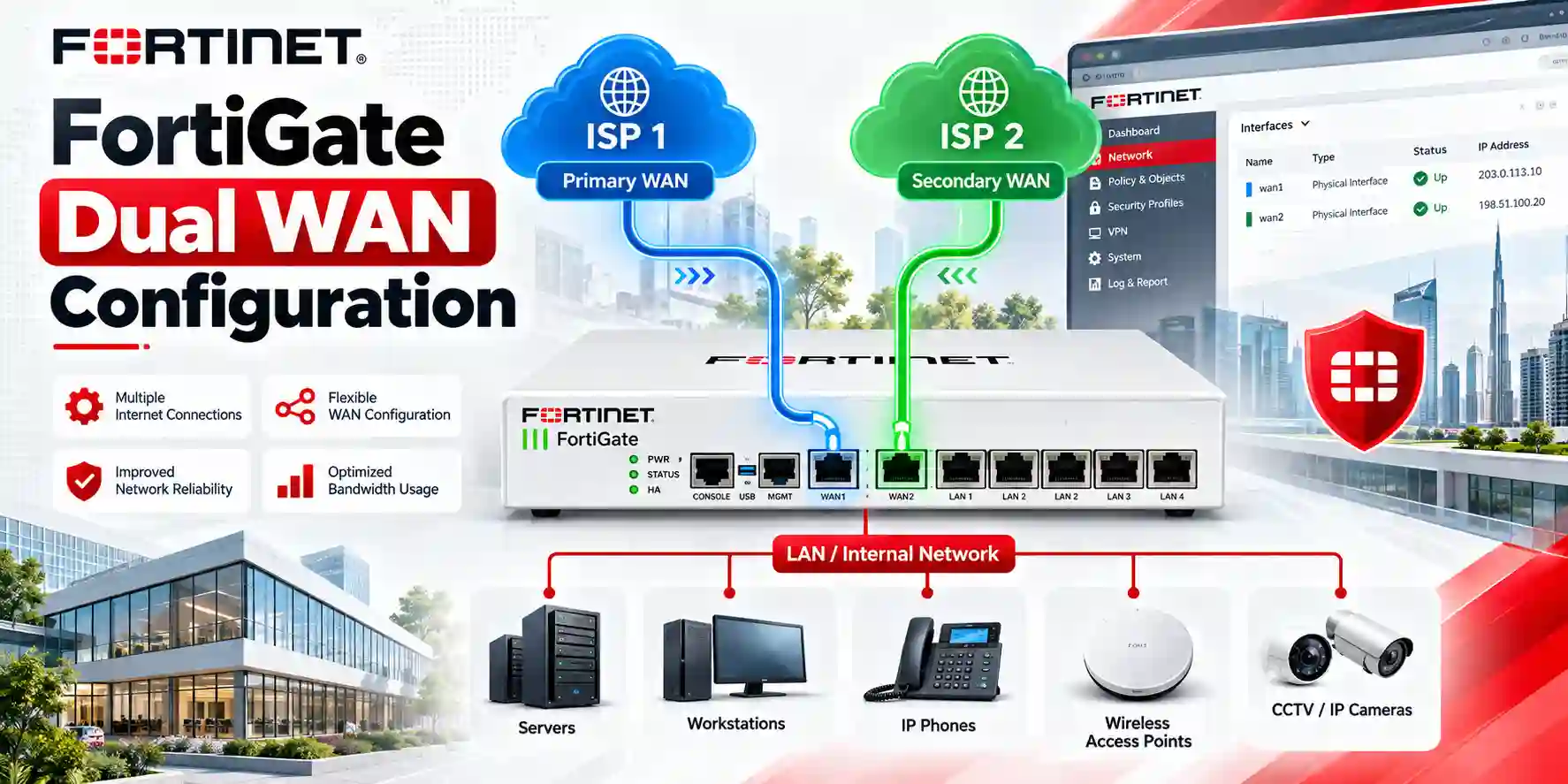
WAN resilience works best when the firewall, health checks, routing policy, cellular gateway and application priorities are planned as one system.
What FortiExtender WAN failover solves
Many organisations discover the weakness of a single-WAN design only after an outage. A branch may still have working computers, switching, Wi-Fi, phones, point-of-sale terminals and local servers, but cloud applications, hosted voice, payment authorisation, remote support and inter-branch services can stop when the only internet path is unavailable. FortiExtender adds another transport option by bringing 4G LTE or 5G connectivity into the network as a managed WAN connection. Depending on the model and architecture, that cellular path can operate as primary connectivity, standby failover, active/active cellular, a Secure SD-WAN member or a separate out-of-band management route.
Fortinet documents dual-SIM and dual-modem FortiExtender options. Dual-SIM designs can be configured for active/passive cellular behaviour, while dual-modem products can support active/active use cases. Current FortiExtender documentation also describes failover decisions based on link health, signal, data-plan conditions and connectivity state. In a FortiGate-integrated design, the cellular connection can become a logical interface that participates in routing and Secure SD-WAN policy. This is useful because the network can make a deliberate decision about which traffic moves to the backup path instead of treating every application identically.
A good failover policy also considers the return path. When the primary service recovers, sessions, DNS behaviour, public IP dependencies and stateful applications may respond differently to failback. Testing should therefore include both directions: primary-to-cellular failover and cellular-to-primary recovery. The aim is not to promise that every existing session survives an access-circuit change. The aim is to create predictable continuity for the applications that matter and to document how the branch behaves during an outage.
Primary-to-cellular failover
Keep selected business services reachable when the fixed WAN fails, subject to carrier coverage, data capacity, routing and tested policy.
Dual-carrier resilience
Applicable dual-SIM and dual-modem FortiExtender models can support carrier-diversity strategies when both services are verified at the site.
Secure SD-WAN integration
Use cellular alongside wired WAN paths in compatible FortiGate designs so path selection can reflect link health, business priority and policy.
Out-of-band access
A separate cellular management path can help administrators reach network equipment when the normal wired route is unavailable, provided access is secured.
FortiExtender features that matter in failover design
5G/LTE wireless WAN
FortiExtender uses mobile broadband as a business WAN transport rather than as an ad-hoc hotspot. Current families include LTE and 5G options with Ethernet connectivity into the branch network. The practical result depends on the carrier, frequency bands, signal level, building construction, congestion, data plan and selected model.
Flexible placement with PoE
Several FortiExtender models can be powered through Ethernet. Fortinet highlights this because the cellular gateway can be positioned away from a network rack, closer to a location with better radio signal, while a quality Ethernet cable links it back to the firewall or switch. Placement should still respect model limits and cabling standards.
FortiGate and FortiManager workflows
Fortinet documents FortiExtender as a natural extension of Secure SD-WAN. In compatible designs, FortiGate can manage the cellular interface, while FortiManager can support broader provisioning and multi-site administration. Compatibility should be checked against the exact FortiExtender model and FortiOS release.
Standalone and cloud management
FortiExtender can also be deployed as a standalone wireless router or under Fortinet cloud management options. The correct management path affects licensing, operational ownership and how administrators monitor SIM state, usage, alarms and configuration across branches.
Current FortiExtender family guidance for WAN continuity
FortiExtender is a product family, not one universal appliance. Fortinet’s current documentation includes several indoor, rugged and vehicle-oriented platforms, and the correct selection depends on cellular generation, expected throughput, environment, interface needs, Wi-Fi requirements, carrier plan and management architecture. Procurement teams should avoid replacing model comparison with a single headline such as “5G router.” A lower-bandwidth LTE design may be sufficient for a small branch that only protects payment and cloud administration, while a larger branch may need a current 5G platform with faster Ethernet connectivity and a more capable traffic profile.
| Example current family | Cellular role | Useful buying question | Failover relevance |
|---|---|---|---|
| FortiExtender 101G | LTE Cat 6 class indoor gateway | Is LTE capacity sufficient for the protected applications and carrier conditions? | Branch backup, primary LTE and controlled continuity |
| FortiExtender 211G | Higher-category LTE indoor gateway | Does the site need more LTE headroom while retaining dual-SIM planning? | Higher-capacity LTE backup or primary wireless WAN |
| FortiExtender 511G | 5G Sub-6 GHz indoor gateway | Is 5G available at the actual mounting point, and is the non-Wi-Fi base model appropriate? | High-speed cellular WAN, branch resilience and rapid activation |
| FortiExtender WAN 50G | High-speed 5G WAN gateway | Does the project need a newer high-throughput 5G WAN edge and compatible Ethernet handoff? | High-performance wireless WAN and resilient edge design |
Model availability, exact regional order code, mobile-operator support, included accessories, management subscriptions, FortiCare term and lifecycle status should be confirmed in the quotation. Do not assume that an older model found in an online listing is the best choice for a new deployment. The FourTeck Africa FortiExtender FEX-511G guide provides additional regional buying context for organisations comparing 5G branch connectivity.
Designing failover with FortiGate and Secure SD-WAN
FortiExtender becomes particularly useful when the failover link is treated as part of a policy-driven FortiGate design. Fortinet documentation describes 4G/5G wireless WAN as an SD-WAN transport that can be added as a logical interface. Health checks can determine whether a path is usable, while SD-WAN rules can direct traffic according to priority, cost or application policy. This helps a business reserve cellular capacity for high-value services rather than automatically sending every video stream, operating-system update and backup job across the mobile link.
For example, a branch can keep cloud ERP, payment, DNS, email and voice reachable during a fixed-line outage while restricting large downloads or nonessential guest traffic. That policy must be designed before the incident. Waiting until the fibre circuit fails is a poor time to discover that the cellular data plan is too small, the required APN is wrong, the carrier uses addressing that blocks inbound management, or an application is tied to a public IP on the primary connection.
FourTeck Tanzania’s FortiGate 30G Tanzania page is useful for smaller branch projects that need a compact FortiGate with SD-WAN capability. The broader FourTeck Tanzania services page explains how firewall, switching, Wi-Fi and WAN dependencies should be designed together rather than treated as separate purchases.
Five checks before FortiExtender deployment
Confirm frequency support, operator acceptance, APN, SIM type, coverage and actual signal where the gateway will be installed.
A backup link is stronger when it does not share the same last-mile failure or provider dependency as the primary service.
Define which applications may use cellular during failover and whether guest, backup or bulk traffic should be limited.
A cellular link cannot protect the site if the FortiExtender, firewall, PoE source or switch loses power during the same incident.
Test primary loss, cellular activation, critical applications, alarms, data usage and failback under controlled conditions.
Related Tanzania network and infrastructure resources
WAN failover rarely stands alone. The backup gateway depends on the firewall, LAN, power, addressing and operational processes behind it. The following verified Tanzania FourTeck pages provide useful adjacent guidance. The FourTeck Tanzania home page summarises the wider IT, telecom and security portfolio. The Tanzania technology shop explains firewall, switch, Wi-Fi and infrastructure buying considerations. The About FourTeck Tanzania page gives context on the integrated approach to business technology projects. For a quotation or project discussion, use the verified FourTeck Tanzania contact page.
The Tanzania catalogue currently exposes a limited number of individual product pages, so this page deliberately avoids inventing category or model URLs. Where a specific FortiExtender model is required, the correct order code, support term and regional compatibility should be confirmed during quotation rather than inferred from an unrelated product listing.
Regional FortiExtender WAN failover planning
Each market below has different carrier, site, procurement and operating considerations. The product capability is consistent, but a dependable deployment still requires local operator verification, power and cabling checks, correct regional hardware, tested signal and a support plan.
FortiExtender WAN Failover Solutions Tanzania
For Tanzania, FortiExtender WAN failover is most valuable when the organisation first defines what must remain available during a primary internet outage. A head office, branch, retail location, clinic, school, warehouse or service centre may rely on cloud applications, email, payment services, IP telephony, remote administration and inter-site VPNs. These services do not all need the same bandwidth during an incident. A well-designed cellular backup policy can therefore protect critical operations while keeping nonessential traffic under control. The mobile data plan should be sized for realistic outage duration, not only for a short test, and the selected carrier should be evaluated at the actual installation point.
Tanzania also benefits from a standardised approach when an organisation operates branches in more than one city. The same FortiGate policy template, SD-WAN health-check strategy, FortiExtender naming convention, SIM-labelling method and escalation process can be reused while still allowing each site to use the carrier that performs best locally. This is preferable to assuming that one operator or one antenna position will behave identically across Dar es Salaam, Mwanza, Arusha and Dodoma. Where two mobile providers are used for resilience, test that they provide meaningful diversity at the branch rather than simply carrying two SIM cards that depend on the same local conditions.
Procurement should include more than the gateway. Confirm the model, cellular generation, support term, required management subscription, PoE source or DC adapter, SIMs, data plans, Ethernet or fibre accessories, mounting, firewall port availability, UPS protection and configuration scope. If the branch already runs FortiGate, provide the exact firewall model and FortiOS release so compatibility can be checked. If the site is new, include the planned internet handoff, switch layout, VLANs and expected user count. FourTeck’s Tanzania enquiry route can be used to send these details for quotation.
The practical objective is predictable continuity rather than an unqualified promise of “always-on” internet. Cellular services can also experience congestion, tower faults, planned maintenance or power issues. Testing, monitoring, UPS-backed network equipment and documented failback procedures are therefore part of the solution. A business that treats FortiExtender as one component of a wider resilience plan is better positioned to keep essential workflows operating when its preferred WAN path is unavailable.
FortiExtender WAN Failover Solutions Dar es Salaam
Dar es Salaam businesses often place a large amount of operational dependency on cloud connectivity. Offices, logistics companies, hospitality sites, financial-service branches, retailers, professional firms and service centres may have fibre or fixed wireless as their primary circuit, yet the business impact of losing that circuit can be immediate. FortiExtender can add an LTE or 5G path that is physically and operationally distinct from the main handoff. The benefit is strongest when the backup path is designed for specific business traffic rather than opened without limits to every device on the LAN.
Dense buildings and communications rooms create another design issue: the best place for the firewall is not always the best place for a cellular radio. Fortinet’s PoE-capable FortiExtender options can help installers position the gateway closer to a window or another signal-friendly indoor point while linking it back to the secured network through Ethernet. Before mounting, test signal, latency and practical throughput at several candidate positions and at different times. Mobile performance can change with building materials, nearby development, congestion and operator capacity, so a coverage map alone should not replace an on-site check.
For organisations with two fixed ISPs, cellular can still have value as a third transport or as a dedicated out-of-band route. Two terrestrial circuits can share ducts, building entry points or upstream dependencies, while cellular may fail differently. The network team should document which event triggers cellular use, what traffic is permitted, how DNS and VPNs behave after the route changes, and how administrators are alerted. For branch environments using FortiGate, SD-WAN policy can be designed to protect ERP, email, payment, voice or remote-support traffic while preventing large recreational or guest downloads from consuming the backup plan.
A Dar es Salaam quotation should specify branch address, intended carrier or carriers, current WAN design, expected bandwidth, FortiGate model, application priorities, data-plan expectations, mounting location, PoE availability and power-backup arrangements. The purpose of this information is not to make the purchase process complicated; it is to ensure the gateway, support, accessories and configuration work all match the site. A controlled pilot at one representative branch can also provide useful evidence before a larger city-wide or national rollout.
FortiExtender WAN Failover Solutions Mwanza
Mwanza organisations can use FortiExtender to reduce dependence on a single last-mile connection at branches that support sales, administration, healthcare, education, distribution, hospitality or customer service. The first planning step is to identify the operational impact of a WAN failure. If staff only need cloud email and a small ERP workload, backup bandwidth can be tightly controlled. If the branch also carries voice, video meetings, remote desktop sessions or centralised applications, the cellular plan and FortiGate policy need more headroom and more careful prioritisation.
A useful WAN resilience design distinguishes between internet availability and application availability. The FortiExtender may successfully establish LTE or 5G service, yet a business application can still fail if it expects the public IP address of the primary connection, uses a route that is not advertised across the backup path or depends on a tunnel that has not been configured for failover. Mwanza deployments should therefore test the complete application path rather than only checking whether a web browser can reach the internet after the primary link is unplugged.
Remote operations are another reason to consider FortiExtender. An IT team supporting several locations may use a cellular path for out-of-band management so that a router, firewall or switch can still be investigated when the standard WAN route is down. Such access must be protected with appropriate authentication and network policy; it should not become an unmonitored back door. Documentation should include SIM ownership, APN details, administrator access, carrier escalation, device serial number, support term and the physical location of the gateway.
For procurement in Mwanza, include the primary circuit type, mobile operators available at the site, expected applications, approximate users, FortiGate environment and whether cellular will be standby only or used actively. Where branches are part of a wider Tanzania network, use a standard baseline configuration but allow local carrier and signal conditions to determine final placement and data-plan choice. This combination of standardisation and site-specific testing makes the solution easier to operate without pretending that every branch has identical connectivity.
FortiExtender WAN Failover Solutions Arusha
Arusha businesses in tourism, hospitality, travel services, professional services, education, NGOs, retail and branch operations may depend on reliable internet for reservations, cloud platforms, payments, guest services, communications and remote access. A failover design should separate customer-facing continuity from internal business continuity. Guest Wi-Fi, for example, can consume substantial bandwidth but may be less important during an outage than booking systems, payment terminals, staff communications or secure access to headquarters. FortiGate policy can be used to enforce that distinction when FortiExtender becomes the active WAN path.
Signal placement can also be important in properties with thick walls, multiple buildings or equipment rooms that are not radio-friendly. Rather than extending long antenna cables from the rack, supported PoE FortiExtender models can be placed at a better indoor signal location and connected by Ethernet. The installation should still account for cable length, ventilation, physical security, lightning and surge considerations for connected infrastructure, and dependable power at the switch or injector. Cellular performance should be measured at the intended mounting point and not inferred only from a staff member’s mobile phone.
For hospitality or travel operations, failover testing should include the systems that generate revenue or serve guests. Confirm whether booking applications, payment gateways, VoIP, cloud-based property systems, email and remote support work across the backup route. If public-facing services or site-to-site VPNs use fixed addressing, plan how they behave when the upstream provider changes. It may be appropriate to reserve the mobile connection for outbound business traffic while handling inbound dependencies through a separate architecture.
An Arusha quotation should state the site type, user and device count, current ISP, preferred mobile operators, priority applications, expected outage tolerance, FortiGate model, Wi-Fi design and required installation scope. For multi-property or multi-branch organisations, a pilot can be used to create a documented template covering SIM labels, health checks, allowed applications, alerts, power protection and failback. That operational template is often as important as the gateway hardware because it defines how staff and administrators respond when the primary WAN is actually unavailable.
FortiExtender WAN Failover Solutions Dodoma
Dodoma offices, institutional sites, professional organisations, education facilities, branches and service locations can use FortiExtender to create a secondary WAN path for cloud and inter-site connectivity. The right design begins with application dependency. An organisation that relies heavily on centralised document systems, cloud productivity, identity services, VPN access or hosted voice should define which services must continue immediately and which can wait until the main circuit is restored. That priority list becomes the basis for the mobile data plan and SD-WAN policy.
For a branch connected to headquarters, IP addressing deserves attention before failover is enabled. Overlapping subnets, tunnel routes and firewall policies can turn a working cellular link into an unusable business path if the network has not been documented. Where FortiGate manages the branch, the cellular interface can be incorporated into Secure SD-WAN and health monitoring. The team should test tunnel establishment, DNS resolution, authentication, application reachability and return traffic while the primary WAN is deliberately disabled.
Dodoma deployments may also benefit from out-of-band access where a remote technical team needs to investigate network equipment without sending someone on-site immediately. This function should be treated as privileged infrastructure. Limit who can use it, protect credentials, record the intended access method and keep the support contract and SIM information current. A backup management route is valuable only if administrators know it exists and can use it safely during an incident.
Procurement should avoid assuming that the same FortiExtender model and carrier plan fit every site. Share expected traffic, carrier options, FortiGate model, branch role, power design, cabinet or wall location and whether the connection is backup-only or part of normal load distribution. If the organisation has offices in several Tanzanian cities, use a common configuration standard while allowing each site to choose the mobile service and placement that provide the strongest verified local performance. This produces a repeatable architecture without ignoring site reality.
FortiExtender WAN Failover Solutions UAE
In the UAE, FortiExtender can complement high-speed fixed broadband by providing a mobile WAN path for branches, retail sites, offices, logistics facilities, hospitality properties and temporary locations. Because strong fixed circuits are common in many business districts, the cellular link is often most valuable as diversity rather than as a replacement. A fibre outage, provider edge issue, building handoff problem or delayed new-site installation can still affect operations, and 5G or LTE offers a different access method that can be incorporated into FortiGate policy.
High mobile speeds should not remove the need for disciplined design. Verify the exact FortiExtender regional compatibility, operator support, building signal, APN behaviour and data-plan terms. Indoor 5G reception can vary dramatically between a window-facing location and a metal communications cabinet. Where PoE is supported, placing the gateway away from the rack can improve the radio path while keeping the security appliance in its normal location. For larger branches, confirm that the chosen Ethernet interfaces and firewall capacity do not become the bottleneck after a faster cellular service is introduced.
UAE organisations with several branches can use FortiManager and FortiGate workflows to standardise policy and visibility, while FortiExtender provides the additional WAN transport. A well-defined outage profile can keep payment, cloud productivity, corporate VPN, DNS and voice available while limiting guest traffic, operating-system downloads or backup jobs. The FourTeck Fortinet UAE resource covers FortiGate, Secure SD-WAN and related Fortinet security options for regional projects.
When requesting a UAE quote, provide the branch city, carrier preference, primary internet service, FortiGate model, expected applications, cellular role, management preference and required support term. Do not assume that advertised 5G coverage guarantees indoor performance or that the mobile path will preserve every session when public addressing changes. Controlled testing should include failover and failback, business applications, VPNs, alarms and mobile data usage so the continuity plan reflects the actual site rather than a laboratory expectation.
FortiExtender WAN Failover Solutions Uganda
Uganda organisations operating in Kampala and regional cities can use FortiExtender to create a common branch-resilience architecture while selecting carriers and data plans site by site. This approach is useful for retail, finance, NGOs, healthcare, education, distribution, service centres and other multi-location operations where the business applications are centralised but access conditions differ. Cellular can act as the backup to fibre, fixed wireless or another primary service, or it can bring a new branch online while permanent connectivity is still being arranged.
The business case should identify the cost of downtime and the amount of traffic that must continue. A small branch may only need payment, ERP, email and remote management during an outage. A larger office may need voice, collaboration and site-to-site access as well. Those differences affect model selection, mobile data allowance and SD-WAN rules. If backup traffic is not prioritised, a few large downloads or cloud backups can consume capacity that should have been reserved for operational systems.
Carrier diversity needs practical verification. Two SIMs are useful only when the selected networks provide appropriate coverage, supported bands and usable service at the location. Test each operator at the planned mounting point and document APN, SIM ownership, signal indicators and failover behaviour. For branches without local IT staff, FortiExtender’s remote management and out-of-band functions can reduce dependence on immediate site visits, but privileged access must be secured and documented.
FourTeck’s Uganda technology site provides a regional contact point for networking requirements. A useful FortiExtender enquiry should include the city, number of branches, current WAN type, FortiGate environment, preferred operators, data-plan expectations, applications that must survive an outage and the desired deployment scope. For nationwide rollouts, establish one configuration and documentation standard, but do not force one carrier or one physical installation method onto every branch when local conditions show that a different choice performs better.
FortiExtender WAN Failover Solutions Kampala
Kampala branches often combine cloud applications, business Wi-Fi, VoIP, payment systems, remote administration and access to central resources over one primary internet service. FortiExtender can give the site a second route based on LTE or 5G, allowing the firewall to maintain selected business connectivity when the primary path is degraded or unavailable. The key word is selected: the backup service should be designed around business priorities rather than treated as unlimited capacity.
Urban signal conditions can vary within the same building. A mobile phone with good reception at reception may not predict performance inside a rack room. Test the intended gateway position and consider PoE-supported placement where the model allows it. Keep the unit physically secure, provide a protected cable path and make sure the switch or PoE injector supplying it is backed by appropriate power protection. A redundant WAN path is less useful if the devices that deliver it switch off at the same moment as the main network equipment.
Kampala organisations with sensitive or revenue-critical applications should also test how those applications behave after the public IP changes. Site-to-site IPsec tunnels can be designed to use more than one WAN path, but both ends must have correct routing and authentication. SaaS services normally adapt more easily, while inbound services or allow-lists tied to a fixed public address may require a different plan. DNS, payment gateways, voice registration and corporate authentication should all be included in the failover test script.
A quotation request should state primary ISP type, mobile carrier candidates, user count, application list, current FortiGate model, current FortiOS version, required failover behaviour and whether cellular is standby or active. For multi-site organisations, it is also useful to define a monthly mobile-data policy, alert thresholds and who receives incident notifications. This turns FortiExtender from a spare connectivity device into an operationally managed component of branch continuity.
FortiExtender WAN Failover Solutions Arua
For Arua, FortiExtender can be particularly valuable where a branch needs a second transport that is easier to deploy than another fixed circuit. The gateway can support business continuity for cloud systems, secure access and remote management while a primary service is unavailable, or it can provide temporary connectivity during a branch opening. The design should begin by measuring the cellular services that are actually usable at the site rather than ordering hardware first and testing coverage afterward.
Remote support planning deserves extra attention. If technical staff are based in another city, an out-of-band path can help them diagnose a failed router, firewall or upstream service without immediately dispatching someone to the branch. FortiExtender documentation includes out-of-band management capabilities on supported models. That path should be isolated from normal user traffic, protected with strong administration controls and included in the network diagram. It also needs an active SIM and enough data allowance to remain useful when an incident occurs.
Power and physical installation are part of the availability equation. Confirm whether the gateway uses PoE or a DC adapter, whether the supplying switch or injector is protected by UPS, and whether the selected mounting point stays within the product’s environmental limits. If an indoor model does not suit the conditions, do not improvise by placing it in an exposed location. Fortinet offers different form factors for vehicle, rugged and outdoor-oriented use, and the environment should guide the final family selection.
For an Arua quote, include site coordinates or a clear site description if available, preferred mobile operators, current WAN, expected users, priority applications, FortiGate model and installation environment. Also state whether the organisation is standardising multiple Ugandan branches. A central template can define routing, security, monitoring and documentation, while the local site assessment determines carrier, placement and exact data-plan choice. This avoids both extremes: a one-off configuration that cannot be supported consistently and a rigid national template that ignores local radio conditions.
FortiExtender WAN Failover Solutions Mbarara
Mbarara businesses can use FortiExtender to protect branch connectivity for retail, distribution, professional services, hospitality, healthcare, education and other operations that depend on internet access throughout the working day. The system can be configured so that a fixed broadband service remains the preferred path while cellular becomes active only when health checks indicate a genuine problem. This is more useful than simple link-state monitoring because an Ethernet interface can remain electrically “up” even when the upstream internet service is no longer usable.
The SD-WAN health-check design should therefore probe destinations that reflect real service availability without generating unnecessary cellular data. Thresholds must also avoid rapid switching when a connection is only briefly unstable. Network administrators should define how long a failure must persist before traffic moves, how long the recovered primary should remain healthy before failback and which applications can tolerate the change. These choices depend on business priorities, not on one universal timer value.
A Mbarara deployment can also use carrier diversity through dual-SIM options on applicable FortiExtender models. Two mobile services can reduce dependence on one operator, but both should be tested for signal, latency and congestion at the branch. Data plans should be labelled and documented, especially when one SIM has a lower cap or higher cost. Administrators need visibility into which service is active so an outage does not quietly consume an expensive or limited plan for several days.
When preparing a quote, share the intended FortiExtender role, branch applications, current ISP, mobile operators, firewall model, user count, WAN bandwidth, power method and support expectations. If the branch is part of a broader Uganda estate, include the common FortiGate and switch standards so compatibility and cabling can be reviewed together. The objective is a repeatable continuity design with enough local flexibility to reflect actual carrier performance, building layout and business traffic.
FortiExtender WAN Failover Solutions Gulu
Gulu organisations with branch offices, education sites, NGO operations, healthcare locations, retail points, logistics functions or service facilities may need a backup WAN that can be deployed without waiting for a second terrestrial circuit. FortiExtender can provide cellular connectivity for that role while remaining part of a structured Fortinet branch design. The gateway should be selected according to available LTE or 5G service, required capacity, physical environment, FortiGate integration and the applications that must remain reachable.
For a branch supported remotely, operational simplicity matters. Use consistent device names, SIM labels, administrator roles, configuration backups and monitoring across sites. Keep a record of the primary and secondary carrier, APN, data-plan renewal, gateway serial number, support contract and mounting location. If an incident occurs, the central IT team should be able to determine quickly whether the failure is the fixed ISP, the mobile carrier, power, FortiExtender, FortiGate or a downstream application.
Failover policy should also reflect cost. Mobile bandwidth can be more constrained or priced differently from the main WAN. During a backup event, it may be sensible to permit cloud applications and secure administration while blocking large software downloads, personal streaming or automatic backup jobs until the primary link returns. FortiGate application controls and SD-WAN policy can support this type of controlled continuity when designed and licensed appropriately.
For Gulu procurement, provide a branch description, number of users, current connectivity, preferred mobile operators, critical applications, FortiGate model, required duration of backup operation and desired management method. If installation support is required, note wall or rack location, available PoE, UPS, cable routes and whether a signal survey has been performed. This information helps ensure that the quote includes the gateway plus the practical components needed for a working solution rather than only a hardware line item.
FortiExtender WAN Failover Solutions Kenya
Kenyan organisations with operations in Nairobi and other cities can use FortiExtender as part of a standard Fortinet branch architecture that combines fixed WAN, cellular, FortiGate security and SD-WAN policy. This can be useful for retailers, financial services, logistics, hospitality, healthcare, education and distributed enterprise networks where individual sites need another way to reach cloud and central resources. A common design can simplify support, but each branch should still verify mobile signal, carrier options and data-plan terms locally.
For larger branches, the cellular connection should be sized against the traffic it must protect rather than against the total speed of the primary circuit. A 1 Gbps fibre service does not automatically mean the backup must carry 1 Gbps. If essential workloads consume a fraction of that capacity, the backup can be designed around business-critical applications. Conversely, a site with video collaboration, cloud-hosted desktops or high-volume transactions may need a more capable 5G model and stricter application prioritisation to provide a useful user experience during failover.
Kenya-based multi-site teams can also use cellular for rapid branch activation. A new office may begin with FortiExtender as the primary WAN while permanent fibre is being provisioned, then convert the same device into a backup role afterward. This makes the original hardware investment useful beyond the opening phase. The implementation plan should specify how routing changes when the fixed service arrives and how the site will be monitored during both phases.
The FourTeck Kenya site provides a regional route for networking and security enquiries. A useful FortiExtender request should include site cities, quantity, current or planned WAN services, FortiGate models, required cellular generation, preferred operators, application priorities, management method, support term and installation scope. For cross-border organisations, the same policy framework can be coordinated with Tanzania and Uganda while carrier, power and delivery details remain specific to each country.
FortiExtender WAN Failover Solutions Kuwait
Kuwait businesses can use FortiExtender to add LTE or 5G diversity to offices, retail locations, warehouses, hospitality operations, service branches and temporary sites that otherwise depend on one fixed internet provider. A cellular path can serve as backup, rapid-activation connectivity or an additional SD-WAN member. Because mobile services may offer high bandwidth, it is tempting to treat them as identical to fixed WAN, but the network team should still verify indoor coverage, latency, data-plan terms, carrier acceptance and real performance at the mounting point.
Temperature and physical placement are also important in Gulf environments. Indoor FortiExtender models should be installed within their published environmental limits and should not be placed in exposed locations or unconditioned spaces simply to improve signal. Where a site has challenging conditions, select a form factor designed for that environment. Supported PoE deployment can often improve indoor placement without moving the firewall or running long RF antenna cables, but the cable route and PoE source must still be engineered correctly.
In a FortiGate branch, use SD-WAN policy to decide which traffic receives cellular capacity when the primary service fails. Business applications, payment, corporate voice, authentication and remote management may be prioritised, while guest traffic and bulk transfers are restricted. Test the complete process, including alerts and failback. Some applications may re-establish automatically after the source public IP changes; others may need a new session or a specific routing design.
FourTeck’s Kuwait technology site can support regional enquiry routing. For a quotation, include branch address, quantity, carrier preferences, FortiGate model, primary ISP, expected traffic, application priorities, support term and whether supply, configuration, installation or testing is required. The objective is to align the cellular gateway with the actual business-continuity requirement instead of selecting a model solely because it has the highest advertised wireless speed.
FortiExtender WAN Failover Solutions Ghana
Ghana organisations can use FortiExtender to improve branch resilience where cloud applications, payments, ERP, hosted communications or remote support depend on stable internet access. The gateway can add mobile broadband alongside a primary fibre or fixed wireless service and can become part of a FortiGate SD-WAN policy. For distributed organisations, this creates an opportunity to standardise the network architecture while choosing local mobile operators according to measured signal and service quality at each branch.
The most useful question is not “which SIM has the highest advertised speed?” but “which carrier remains stable at this location and during the hours when the business operates?” A failover link may sit unused for most of the month and then be expected to perform during a difficult incident. Periodic testing is therefore important. Administrators should confirm that the SIM is active, the data plan has not expired, the APN is still correct and the gateway can actually pass the business traffic expected during an outage.
Ghana deployments can also use FortiExtender for staged branch openings. Cellular may act as the primary WAN for a new location while fixed connectivity is being installed, then become a backup service later. This transition should be planned in the FortiGate routing and management design so the branch does not require a complete network rebuild after the permanent circuit arrives. Power protection should cover the gateway, firewall and relevant switch because a second network path does not help if all equipment loses power together.
The FourTeck Ghana site provides a regional path for related IT and networking enquiries. For a FortiExtender quote, include the city, number of sites, existing firewall, primary WAN, mobile carrier options, expected applications, support period and deployment responsibility. If carrier diversity is required, state whether two separate operators should be tested. A written pilot result can then become the baseline for a wider branch rollout.
FortiExtender WAN Failover Solutions Nigeria
Nigeria has many business environments where connectivity resilience can be operationally important, including multi-branch retail, finance, logistics, professional services, healthcare, education, hospitality and distributed enterprise operations. FortiExtender provides a way to add cellular WAN to those branches without treating mobile access as a separate consumer device. In a compatible FortiGate environment, LTE or 5G can be incorporated into SD-WAN, routing and security policy so critical traffic follows a defined backup path when the primary service is unavailable.
For large multi-city deployments, carrier selection should be decentralised enough to reflect local conditions while management remains standardised. A network team can define one FortiGate policy model, one monitoring standard, one naming convention and one incident process, then validate the best mobile service at each branch. Where dual-SIM resilience is used, both providers should be tested for independent performance. It is possible for two services to be affected by the same local congestion or infrastructure event, so two SIM cards should not be treated as a guarantee.
Power continuity is another design layer. The FortiExtender, firewall and Ethernet switch or PoE injector should be considered together when selecting UPS protection. If the primary ISP fails because of a broader site power event, the branch needs enough protected power for the backup path to remain useful. Administrators should also monitor mobile data usage and define what happens when a branch remains on cellular for an extended period. Policy may need to restrict large updates, guest access or cloud backups until the main WAN returns.
FourTeck’s Nigeria technology site provides a regional enquiry path. A useful request should include cities, branch count, current WAN providers, FortiGate models, critical applications, mobile operators, expected backup duration, data-plan preference and installation scope. For a phased national rollout, begin with representative pilot sites, document actual signal and failover behaviour, then refine the standard before wider deployment.
FortiExtender WAN Failover Solutions Seychelles
Seychelles organisations in hospitality, professional services, retail, administration and island-based operations can use FortiExtender where cellular provides a useful alternative to the primary internet path. The value of the solution depends heavily on local operator coverage and the exact site. Island geography, building construction and service availability can produce different conditions between properties, so carrier verification and signal testing should be completed before a specific model or data plan is approved.
Hospitality environments deserve especially careful traffic policy. During a primary WAN outage, guest demand can quickly consume a cellular connection that was intended to keep reservations, payment, staff communications and property systems working. A FortiGate-integrated SD-WAN design can prioritise operational applications and restrict or rate-limit nonessential traffic while the backup link is active. The policy should be communicated to operations staff so a temporary reduction in guest bandwidth is understood as part of the continuity plan rather than as an unexplained fault.
Remote support can also be important where technical resources are not physically present at every location. An out-of-band cellular route can provide an alternative management path, but it should be protected, monitored and documented. SIM renewal dates, data allowances, administrator access and device support terms should be part of the site’s operational records. If the FortiExtender is powered by PoE, the switch or injector providing power should be protected appropriately, and the mounting location should remain within the environmental specification of the selected model.
For a Seychelles quotation, share the island or site location, primary ISP, preferred mobile operators, FortiGate model, user and device count, critical applications, physical installation details and desired support level. Where several properties or branches are involved, pilot the design at a representative location and document signal readings, application performance, data consumption, failover timing and failback behaviour. That evidence provides a stronger basis for expansion than assuming that one site’s cellular experience will be identical everywhere.
Compatibility, licensing and lifecycle questions
FortiExtender compatibility should be checked at the model and software level. Fortinet publishes hardware-to-FortiOS compatibility matrices because not every FortiExtender generation was introduced at the same time or supports every software release. Before ordering for a FortiGate-managed deployment, record the current FortiOS version and confirm that the selected gateway is supported. For a new branch standard, consider whether the firewall software can be brought to a supported release before the deployment begins.
Management and support terms also matter. FortiExtender can be FortiGate-managed, cloud-managed or used in standalone configurations depending on model and design. The commercial bundle may include different FortiCare or cloud-management entitlements. A quotation should therefore show the hardware, support term, management subscription where required, accessories and implementation separately enough that procurement can see what is included. Hardware-only pricing should not be compared directly with a quote that includes management, support and configuration services.
Lifecycle status should be verified for any model being considered, especially if the request was based on an older online page. Fortinet continues to introduce newer FortiExtender models and publishes compatibility and ordering guidance. For a new deployment, prioritise a model that fits the required bands, performance and current support path rather than selecting an older device simply because it is familiar. Existing installations may have valid support reasons to keep older hardware until a planned migration, but that is a separate decision from a new purchase.
FortiExtender quotation checklist
A useful FortiExtender quotation starts with the role of the connection, not only with a model name. Send the following information so the gateway, carrier strategy, support and deployment scope can be reviewed together.
Country, city, number of branches, rollout phases and target dates.
Fibre, fixed wireless, DSL, cable or other service, with speed and handoff type.
Preferred operators, tested signal, SIM ownership, APN and expected data plan.
FortiGate model, FortiOS version, FortiManager or cloud-management requirements.
ERP, payment, voice, VPN, cloud apps, remote support and other services that must continue.
Supply, staging, configuration, installation, failover testing, documentation and ongoing support.
Frequently asked questions about FortiExtender WAN failover
What is FortiExtender used for?
FortiExtender is Fortinet’s family of cellular and edge connectivity gateways. Depending on the model, it can provide LTE or 5G primary WAN, backup WAN, high-availability cellular, Secure SD-WAN integration, remote Ethernet extension and out-of-band management. The exact feature set varies by model and software.
Can FortiExtender automatically fail over when the main ISP is down?
Yes, FortiExtender and FortiGate designs can be configured for failover, but the behaviour must be engineered and tested. Health checks should detect real internet failure, routing must move to the cellular path, firewall policy must permit the required traffic and the return to the primary service should also be validated.
Does FortiExtender support dual SIM?
Many FortiExtender models support dual-SIM designs, and Fortinet also offers dual-modem models in parts of the family. Dual-SIM can provide an active/passive carrier strategy; dual-modem options can support active/active use cases. Confirm the exact current model before ordering.
Can FortiExtender work with FortiGate SD-WAN?
Yes. Fortinet documents FortiExtender as a 4G/5G wireless WAN option that can be integrated into FortiGate Secure SD-WAN. Compatibility depends on the FortiExtender model, FortiGate model and software release, so the published compatibility matrices should be checked before rollout.
Is 5G always better than LTE for backup internet?
Not automatically. 5G can provide higher performance where coverage and spectrum are available, but a stable LTE service may be a better backup at a particular branch than weak or inconsistent 5G. The decision should be based on measured performance, application needs, operator support, cost and the expected life of the deployment.
Can FortiExtender be used without FortiGate?
Fortinet supports standalone FortiExtender deployment modes as well as FortiGate-managed and cloud-managed designs. The correct choice depends on routing, security, management and support requirements. A standalone gateway still needs appropriate firewalling and operational controls for the intended environment.
What should be tested before relying on cellular failover?
Test signal, primary-link failure detection, route change, critical applications, VPNs, DNS, voice, payment systems, data usage, alarms, remote management and failback. Also test the power path and verify that the SIM and data plan remain active. A test that only checks general web browsing is not enough for a business-continuity design.
Can FortiExtender provide out-of-band management?
Supported FortiExtender models can provide out-of-band management so administrators have an alternative path to network equipment when the normal wired route is unavailable. This access should be treated as privileged infrastructure and protected with appropriate authentication, restrictions and monitoring.
Does FortiExtender include a Wi-Fi access point?
It depends on the exact model. Some FortiExtender variants include Wi-Fi while others are cellular WAN gateways without client Wi-Fi. For example, the base FEX-511G and the FEX-511G-WiFi are different choices. Confirm whether the branch already has FortiAP or another wireless system before choosing the variant.
How do I request a FortiExtender quote for Tanzania?
Provide the city, quantity, primary ISP, mobile carrier preferences, FortiGate model and FortiOS version, critical applications, expected backup duration, data-plan needs, mounting environment, management preference and required support term. Use the FourTeck Tanzania contact page to send the requirement.
Decision recap: build continuity around the application, not only the backup link
FortiExtender is well suited to organisations that need managed LTE or 5G as part of a resilient WAN architecture. The platform can support primary wireless WAN, failover, dual-carrier designs, out-of-band management and FortiGate Secure SD-WAN integration. The hardware choice should follow the site requirement: available mobile service, critical traffic, desired capacity, indoor or rugged environment, management model, interface needs and lifecycle position.
The most successful deployment is one that has already answered the difficult questions before an outage happens. Which applications continue? Which traffic is restricted? How is failure detected? How is the branch monitored? Who receives the alert? What happens when the primary service returns? How long can the site run on its cellular data plan? How are the gateway, firewall and switch powered? When these decisions are documented and tested, FortiExtender becomes a practical business-continuity component rather than an emergency device that may or may not work when it is finally needed.
Plan your FortiExtender WAN failover with FourTeck
Share your branch locations, existing FortiGate models, primary WAN services, mobile operator options and the applications that must stay available. FourTeck can help structure the requirement around the correct FortiExtender family, carrier strategy, management approach, support term and deployment scope. For multi-country operations, FourTeck maintains regional technology resources for Kenya, Uganda, UAE Fortinet projects, Kuwait, Ghana and Nigeria, with the Africa FortiExtender FEX-511G guide available for 5G model context.
For Tanzania, use the verified contact route to request current model guidance, quotation and deployment discussion. Product availability, carrier suitability, support terms, delivery timing and installation coverage should be confirmed in the formal commercial response rather than assumed from general web content.