
FortiGate Next-Generation Firewall Solutions
FortiGate Next-Generation Firewall Solutions give organizations a unified way to protect internet access, users, applications, servers, branch links and hybrid infrastructure while bringing networking and security policy into the same FortiOS platform. Fortinet positions FortiGate NGFWs for physical, virtualized and cloud environments, with deployment choices spanning branches, campuses, data centers and cloud-connected networks. FortiGuard AI-Powered Security Services extend the platform with continuously updated threat protection, while Fortinet Secure SD-WAN brings application-aware WAN steering and security together at the edge.
For a Tanzania buyer, the most important decision is not simply which appliance has the largest firewall number. A useful design starts with inspected traffic, current and future internet bandwidth, application mix, encrypted traffic, site-to-site connectivity, remote access, interface requirements, high-availability objectives, logging needs and the FortiGuard services that will actually be enabled. FourTeck helps translate those operational details into a clearer FortiGate selection and quotation process.
Converges core networking and security functions so routing, segmentation, firewall policy, SD-WAN and security controls can be coordinated rather than treated as isolated systems.
FortiGuard AI-Powered Security Services provide layered security capabilities such as intrusion prevention, antivirus, web and DNS security, application control and other services according to the selected subscription.
Fortinet Secure SD-WAN combines path selection, application awareness, WAN resilience and integrated security, helping branch networks use multiple links more intelligently.
FortiGate is available for physical, virtual and public or private cloud environments, allowing a common security approach to extend beyond a single office edge.
What FortiGate Next-Generation Firewall Solutions Solve
Traditional packet filtering is only one part of modern network security. Business traffic now includes SaaS applications, encrypted web sessions, cloud workloads, voice and video, remote users, branch tunnels, IoT devices and a growing number of applications that may share the same standard ports. FortiGate NGFWs are designed to give administrators deeper visibility into applications, users and devices while enforcing security controls at network edges and between zones. Depending on the selected model, license and design, the platform can support next-generation firewall policy, intrusion prevention, malware protection, application control, web and DNS security, IPsec VPN, remote-access use cases, segmentation, secure SD-WAN and integration with broader Fortinet Security Fabric components.
A strong deployment also addresses operational problems. Branch networks need consistent policy without requiring a different manual configuration at every location. High-value applications need predictable connectivity when an ISP path degrades. Security teams need logs that can be reviewed and retained. Remote access should be tied to clear identity and authorization practices. Guest Wi-Fi, CCTV, servers, point-of-sale systems and employee devices should not automatically share one flat trusted network. FortiGate can act as a central policy enforcement point in these designs, with FortiManager providing centralized management capabilities and FortiAnalyzer supporting consolidated telemetry, analytics and security operations where those products are appropriate.
The buying implication is important: two organizations with the same number of employees can require very different firewalls. A company with light web access may have modest inspection needs, while another with high-speed cloud backups, encrypted business applications, many VPN users, heavy east-west segmentation or multiple WAN links can demand substantially more processing and interfaces. FourTeck therefore recommends sizing from the real traffic profile and intended security services rather than from employee count alone.
Verified FortiGate Capability Areas
AI-powered threat services
FortiGuard AI-Powered Security Services integrate with FortiGate and are designed to provide continuously updated, layered protection against known, unknown and emerging threats. Exact services depend on the chosen subscription or bundle.
Secure SD-WAN
Fortinet Secure SD-WAN runs on FortiOS and supports application-aware path selection, real-time path monitoring and local security enforcement, which can simplify branch connectivity where multiple WAN circuits are used.
Segmentation and policy
FortiGate policy can separate trusted, guest, server, voice, CCTV, wireless, branch and other traffic zones. The precise design should follow business risk, data flows and application requirements rather than a generic VLAN template.
VPN and zero-trust options
FortiGate supports secure connectivity patterns for site-to-site and remote access, and Fortinet also provides universal ZTNA capabilities within its secure networking portfolio. Identity, endpoint posture and application access requirements should be planned before deployment.
Central management
FortiManager can centralize policy, configuration and orchestration across FortiGate deployments, including physical, virtual and cloud form factors. It becomes increasingly useful as the number of sites and policy changes grows.
Logging and analytics
FortiAnalyzer is Fortinet’s platform for consolidated telemetry, analytics, threat detection and security operations. Logging architecture should be sized around event volume, retention, reporting and incident-response expectations.
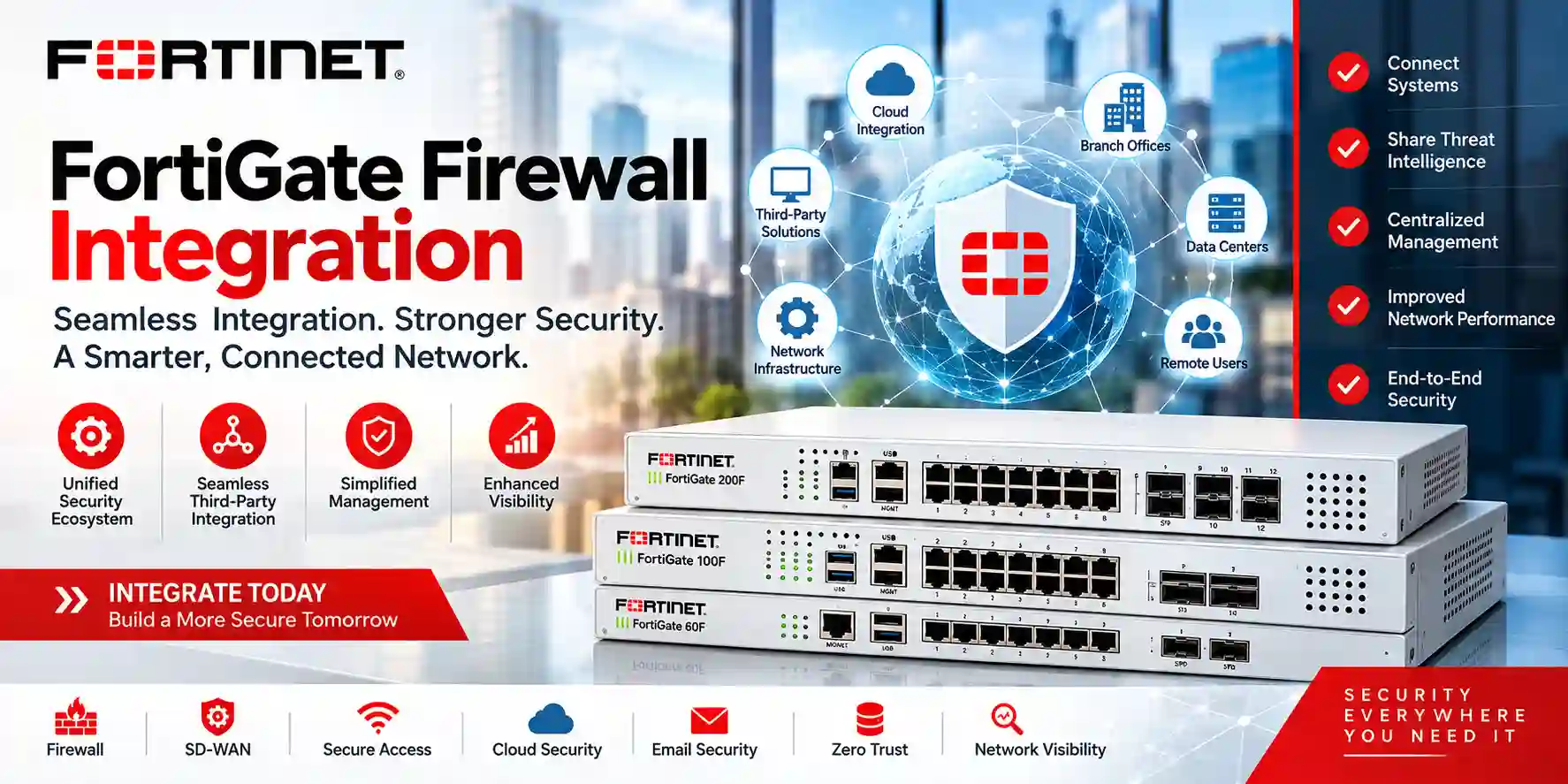
FortiGate Architecture and Integration
A FortiGate can operate as the secure edge for one office, but the platform is most valuable when the firewall is planned as part of the complete network. WAN links, switches, wireless networks, servers, cloud applications, DNS, authentication, endpoints and branch routing all influence firewall policy. A clean design maps the intended trust boundaries first, then chooses interfaces, VLANs, routing, NAT, VPN, security profiles and logging to match those boundaries.
For multi-site environments, consistency matters. Standard address objects, naming conventions, security zones, SD-WAN rules, VPN templates and change control can reduce support friction. FortiManager can help centralize those tasks, while FortiAnalyzer can support a consolidated view of security telemetry. These are separate products and should be included only when their management or analytics value is justified by the deployment.
How to Size a FortiGate Correctly
Model selection should begin with the security workload that will actually pass through the firewall. Marketing tables often show several different throughput figures because firewall forwarding, IPsec VPN, intrusion prevention, next-generation firewall inspection, threat protection and SSL inspection are not the same workload. A device selected only by headline firewall throughput can be under-sized once deeper inspection is enabled. A proper requirement therefore records the current WAN speed, expected upgrade path, peak traffic, proportion of encrypted traffic, critical SaaS applications, VPN tunnels, remote users, number of network zones, interface speed, session behavior and required security profiles.
Hardware form factor is another decision. A compact branch appliance may be appropriate for a small site, while a busy campus, head office or data center can require faster interfaces, greater inspection capacity, redundant power, storage options or high-availability design. Virtual FortiGate instances can fit private cloud, public cloud and virtualized environments where a physical appliance is not the right enforcement point. Fortinet also offers cloud-oriented consumption and licensing choices, so a cloud project should be quoted against its platform, traffic, scaling and subscription model rather than treated as a copy of an on-premises appliance purchase.
| Sizing input | Why it matters | What to provide for a quotation |
|---|---|---|
| WAN bandwidth | Sets the baseline traffic volume and future headroom requirement. | Current speed, planned upgrade and number of ISP links. |
| Security inspection | IPS, malware inspection and encrypted traffic inspection add processing load. | Services to be enabled and approximate encrypted traffic profile. |
| Users and devices | Session count and application behavior can differ greatly between sites. | Users, servers, endpoints, guest devices, IoT and branch count. |
| VPN and SD-WAN | Encryption and path steering affect capacity and design. | Remote users, site tunnels, WAN types and failover objectives. |
| Interfaces and resilience | Ports, fiber, higher-speed links and HA requirements can determine model class. | LAN/WAN speeds, transceivers, HA plan, power and rack constraints. |
FortiGuard Subscription and Renewal Planning
FortiGate hardware and FortiGuard security subscriptions should be planned together. Fortinet offers a-la-carte security services and bundles intended for different levels of protection. Current Fortinet material references Enterprise Protection, Unified Threat Protection and Advanced Threat Protection bundle approaches, but the exact included services, support terms and commercial packaging can change by product generation and ordering region. A quotation should therefore identify the exact appliance, service bundle, term and FortiCare support rather than using a generic description such as “one-year license.”
Renewal timing is operationally important because many active protection functions depend on current subscriptions and threat intelligence. Procurement teams should record contract start and end dates, serial numbers, support entitlement and the services attached to each firewall. For HA pairs and multi-site fleets, aligned renewal dates can simplify budgeting and administration. If a business is replacing an older FortiGate, the project should also check migration scope, subscription transfer rules where applicable, configuration compatibility and whether the new model changes interface or licensing requirements.
Related FourTeck FortiGate Resources
Tanzania Project & Quotation ContactShare bandwidth, user count, branch requirements, VPN needs, existing firewall details and target timeline so the quotation can reflect a real deployment.
FortiGate Firewall KenyaUseful for organizations coordinating East African FortiGate standards, regional branches or procurement requirements across Tanzania and Kenya.
FortiGate 30G UgandaA regional product example for compact branch firewall requirements where buyers are comparing a small FortiGate platform, licensing and deployment needs.
Fortinet UAE Specialist SiteRelevant for businesses with UAE headquarters, GCC operations or regional Fortinet procurement that must align with African branch security standards.
FortiGate Next-Generation Firewall Solutions Tanzania
Tanzania organizations evaluating FortiGate should begin by defining the role of the firewall in the complete network rather than treating it as an isolated internet appliance. A small office may only need secure internet access, a few VLANs and remote-user connectivity, while a larger business can require site-to-site VPN, multiple ISP links, branch routing, segmented server networks, secure guest access, application visibility, detailed logging and centralized policy control. FortiGate can cover these use cases across different appliance and virtual form factors, but the correct selection depends on the inspected workload. Internet speed, the proportion of encrypted traffic, enabled FortiGuard services, number of simultaneous users, VPN traffic and future bandwidth upgrades all affect the model decision. This is why a Tanzania FortiGate quotation should document both the appliance and the intended security profile.
For national or multi-site projects, standardization can be as valuable as raw throughput. A consistent FortiOS design can define common VLAN naming, address objects, branch VPN templates, SD-WAN rules, logging policies and administrative access controls. This helps reduce configuration drift when offices are added later. Businesses using several internet circuits can also evaluate Secure SD-WAN so critical applications can be steered according to link health and policy rather than relying on basic failover alone. Where a head office manages many FortiGate devices, FortiManager can be considered for centralized configuration and orchestration. FortiAnalyzer may be appropriate when consolidated log retention, reporting, analytics or security operations are needed.
Procurement should separate confirmed technical requirements from optional improvements. Record current firewall make and model, internet circuits, public IP requirements, server publishing, remote users, branch locations, expected user growth, rack and power constraints, required interfaces and any compliance-driven logging needs. Then identify the exact FortiGuard bundle and support term. A well-prepared request helps avoid buying too little capacity for full security inspection or paying for hardware that offers capabilities the site cannot use. FourTeck can review these inputs and prepare a Tanzania-focused FortiGate recommendation without assuming stock, price, delivery time or service scope before the project is checked.
FortiGate Next-Generation Firewall Solutions Dar es Salaam
Dar es Salaam deployments often need the firewall to protect a dense mix of business applications, cloud services, voice, video, Wi-Fi, servers and remote-access traffic from one edge. The correct FortiGate architecture starts with traffic flows. Internet-facing systems may need a separate DMZ, internal servers may require restricted access from user VLANs, guest Wi-Fi should be isolated, and management interfaces should be limited to trusted administrators. If the organization operates several buildings or branches, the head-office firewall may also terminate site-to-site VPNs and route application traffic between locations. These requirements change session load, encryption load and interface needs, so a head-office design should not be sized like a simple branch even when the number of users appears similar.
Businesses that rely heavily on SaaS, collaboration platforms and cloud-hosted ERP should also think about WAN behavior. A second ISP circuit can provide resilience, but the value depends on policy. Fortinet Secure SD-WAN can monitor path quality and steer defined application traffic according to business rules. The design can distinguish critical services from bulk downloads or guest browsing and can decide how traffic should behave during degradation. This is different from merely having two cables connected to the firewall. The WAN plan should document provider handoff, addressing, public services, NAT, failover objectives and any applications that need stable source IP behavior.
For procurement in Dar es Salaam, request a quotation that separates hardware, FortiGuard services, FortiCare support, optional centralized management, deployment tasks and migration work. If the site already uses another firewall, include existing VPN peers, VLANs, public IP mappings and policy count so the migration can be scoped. If the network is new, provide a diagram showing switches, access points, servers, CCTV, voice and guest networks. The goal is a firewall design that supports the whole environment, not just a product box. FourTeck can use these details to compare FortiGate options against the actual inspected traffic, redundancy and integration requirements.
FortiGate Next-Generation Firewall Solutions Mwanza
A Mwanza FortiGate project can be designed around branch connectivity, secure internet access and predictable operations for a business that may have warehouses, retail counters, service locations, offices or distributed teams. The first step is to separate the services that must remain available from those that can tolerate interruption. Point-of-sale traffic, cloud accounting, email, voice, remote support or access to a central ERP may have different priorities. FortiGate Secure SD-WAN can be relevant when a site uses more than one WAN path, because policy can consider link quality and application identity rather than relying only on a primary-versus-backup sequence.
Network segmentation should also be considered at the branch level. CCTV cameras, staff devices, guest wireless, printers, payment systems and local servers do not need identical access. Creating clear network zones and applying least-privilege firewall rules can reduce unnecessary lateral movement and make troubleshooting easier. The FortiGate model must have enough physical or logical interface capacity for the design, and the connected switching infrastructure must support the VLAN structure. Where FortiSwitch or other managed switches are used, the project should define where routing occurs, how trunks are configured and how administrator access is protected.
For Mwanza buyers, the quotation checklist should include current WAN speeds, expected upgrades, branch-to-head-office traffic, remote support requirements, any locally hosted services, number of users and devices, desired web or DNS controls, VPN needs and log retention. If power resilience is important to the site, the firewall, ISP handoff and core switches should be considered together for UPS capacity rather than protecting only the FortiGate. Subscription planning should identify the exact FortiGuard bundle and term so security services can be budgeted from the beginning. This produces a more dependable branch-security plan than selecting a model from a user-count chart alone.
FortiGate Next-Generation Firewall Solutions Arusha
Arusha organizations in hospitality, professional services, education, tourism support, non-profit operations and other business sectors can use FortiGate as a policy point between staff networks, guest access, cloud applications, local systems and remote users. Environments with guest Wi-Fi deserve particular attention because internet access for visitors should not automatically provide a path to office devices, CCTV, administration systems or internal servers. A segmented design can place guest traffic in its own zone with controlled internet-only policy while staff, management and operational devices receive access according to business need. Web and DNS security services can be added according to the selected FortiGuard subscription.
Remote administration is another key design area. IT support may be provided from another office or by a specialist team, but management interfaces should not be exposed casually. Administrative access should use defined trusted sources, strong authentication and controlled roles. If employees need remote access to applications, the project should identify which applications they require and whether traditional VPN, identity-aware access or Fortinet ZTNA-related capabilities best fit the requirement. The decision should be based on the application and user workflow rather than enabling broad network access for every remote user.
When requesting FortiGate pricing for Arusha, provide the number of buildings or sites, internet speeds, expected guest-user load, business applications, existing switching and Wi-Fi platform, branch VPN requirements and any services hosted locally. Hospitality or public-facing environments should also describe peak occupancy patterns, because peak sessions can differ greatly from average office usage. Include future expansion so the firewall is not immediately constrained by the next bandwidth upgrade or additional branch. FourTeck can then review physical, virtual or higher-capacity FortiGate options and identify the subscription, management and logging components that belong in the project scope.
FortiGate Next-Generation Firewall Solutions Dodoma
Dodoma FortiGate deployments for administrative offices, service organizations, education, public-sector contractors and multi-department environments can benefit from a structured approach to segmentation and policy control. Different departments may use the same physical LAN but should not automatically have unrestricted access to every server or application. A FortiGate design can separate user groups, server segments, guest wireless, voice systems, surveillance networks and management traffic, with explicit policy between zones. This improves clarity for audits and makes it easier to understand why a connection is allowed rather than relying on a large flat network with implicit trust.
Logging and change control are especially important where multiple administrators or support providers touch the network. The project should define who is permitted to change policies, how configuration backups are retained, where logs are stored and how alerts are reviewed. FortiAnalyzer can be evaluated where consolidated telemetry, security analytics or longer-term reporting is required. FortiManager can be evaluated for organizations managing several FortiGate devices or many standardized policies. These tools are not mandatory for every deployment, so their inclusion should follow operational need, device count and reporting expectations.
A Dodoma procurement request should state whether the FortiGate will be a new edge, a replacement for a legacy firewall or part of a wider network redesign. Include current WAN services, public IPs, branch tunnels, remote users, server publishing, VLANs, switch uplinks, rack availability and resilience expectations. If two FortiGates are being considered for high availability, the quotation should clearly include both appliances, subscriptions, support and any necessary interfaces or transceivers. This level of detail helps commercial teams compare like-for-like proposals and helps technical teams avoid discovering missing dependencies after purchase.
FortiGate Next-Generation Firewall Solutions UAE
UAE organizations often use FortiGate in fast-changing environments that combine headquarters, branches, cloud workloads, remote users and regional offices. A regional architecture should decide which policies must be common across locations and which must remain site-specific. Standard templates can simplify branch rollout, while a central management platform can reduce the burden of maintaining repeated objects, SD-WAN rules, VPN settings and security profiles manually. FortiManager is Fortinet’s centralized management platform for FortiGate and related FortiOS-based environments, and it can become useful when policy consistency and scale matter more than a single-device interface.
High-speed internet and cloud application use make encrypted traffic inspection an important sizing consideration. A firewall that forwards packets quickly without inspection may not deliver the same performance when IPS, malware protection and SSL inspection are active. Buyers should therefore compare the correct inspected-throughput metrics for the security profile they intend to use. Interface speed is also important: an appliance with enough security processing but insufficient port capacity, fiber options or uplink speed can still become the wrong choice. Data center and campus designs may require redundant links, high availability and faster interfaces that are unnecessary for a small branch.
For UAE procurement, include the exact FortiGuard service bundle, FortiCare term and deployment scope in the commercial comparison. If the UAE firewall will connect to Tanzania, Kenya, Uganda or other regional branches, document the expected VPN traffic, application routes and centralized logging plan. This makes it easier to choose a model that supports both current office traffic and cross-border architecture. FourTeck’s specialist Fortinet UAE resource can help regional teams align procurement terminology and deployment planning with the FortiGate strategy used by African branches.
FortiGate Next-Generation Firewall Solutions Uganda
Uganda FortiGate projects can range from a single compact branch to a national network of offices that needs repeatable security policy and protected access to shared applications. For a small site, the key requirements may be secure internet, application control, web protection and a site-to-site VPN. For a larger organization, the challenge shifts toward policy consistency, traffic engineering, logging and centralized change control. FortiGate can support both ends of that spectrum, but the model and management design should reflect the number of locations, WAN capacity and inspected traffic rather than assuming one appliance class fits every branch.
A multi-site Uganda rollout should define an addressing and VPN standard before ordering hardware. Overlapping private networks can complicate branch tunnels, while inconsistent VLAN naming makes support harder. SD-WAN policies should identify which applications are important, what link health thresholds matter and whether internet breakout is local or centralized. If branches use different types of WAN service, the design should confirm modem or handoff compatibility and decide whether FortiExtender or another connectivity component is part of the solution. These details belong in the network plan rather than being left until installation day.
Commercially, each site should have a clear bill of materials showing appliance, FortiGuard bundle, FortiCare, optional management, required optics or accessories and configuration scope. Renewal dates should be tracked centrally so protection does not become inconsistent between branches. For a compact-site example, FourTeck’s FortiGate 30G Uganda page shows the type of small-branch use case that can be discussed, but every project should still be validated against current Fortinet specifications and the buyer’s traffic profile before a final model is selected.
FortiGate Next-Generation Firewall Solutions Kampala
Kampala businesses with headquarters, professional offices, retail networks, healthcare sites, education facilities or service branches can use FortiGate to combine secure internet policy with branch connectivity and remote access. A headquarters firewall may carry many more responsibilities than an edge router: it can terminate VPNs, segment internal networks, inspect internet traffic, publish selected services, steer applications across multiple WAN links and send logs to a central analytics platform. These combined functions increase the importance of sizing from the real workload. The project should capture peak traffic and critical application behavior rather than estimating from average bandwidth alone.
Where several branches report to Kampala, FortiManager can reduce repetitive administration by centralizing templates and policy workflows. The goal is not simply convenience; it is consistency. A standard approach to administrator access, DNS security, web policy, VPN parameters, SD-WAN health checks and log settings makes it easier to audit branches and troubleshoot differences. FortiAnalyzer can be considered when the organization needs consolidated log visibility, incident investigation or reporting across multiple firewalls. The products should be sized and licensed separately from the FortiGate hardware itself.
A Kampala buyer preparing a FortiGate request should list branch count, current firewall estate, internet circuits, cloud applications, local servers, remote-user population, guest Wi-Fi, voice or CCTV segments and any high-availability requirement. If the organization plans a staged migration, identify which sites move first and how old and new environments will interoperate during the transition. This gives suppliers enough information to propose the right model classes and avoids mixing different security bundles without a reason. The result is a more maintainable rollout with clearer renewal and support planning.
FortiGate Next-Generation Firewall Solutions Arua
Arua branch deployments should be designed around application availability, manageable remote support and sensible WAN resilience. A remote or satellite office may depend on a smaller number of critical services than a headquarters, which makes prioritization easier if those services are identified before configuration. Cloud ERP, email, voice, payment applications, remote desktop or access to a central database can be placed into distinct policy groups. If the site has two internet connections, Secure SD-WAN can be configured so path decisions reflect measured link quality and application priority instead of waiting for a complete circuit failure.
Remote management needs special care when technical staff are not physically present at the site. Administrative access should use protected management paths, restricted source networks and strong authentication. Configuration backups should be stored outside the appliance, and changes should follow an agreed process so troubleshooting does not depend on memory. If many similar branches are deployed, central management can provide templates and visibility. This reduces the chance that one remote location accumulates different rules, outdated objects or inconsistent security profiles over time.
For quotation preparation in Arua, provide the number of staff and devices, WAN handoff types, expected bandwidth, critical applications, branch VPN destination, Wi-Fi and switch design, any public services, and the FortiGuard functions required. Avoid selecting a model solely because it is marketed for a small office: a compact site with encrypted backups, heavy cloud use or several VPN tunnels can still need more inspection capacity. Power protection for the firewall, ISP device and core switch should also be considered as one chain, because keeping only the firewall powered does not preserve connectivity if the upstream equipment goes offline.
FortiGate Next-Generation Firewall Solutions Mbarara
Mbarara organizations in education, healthcare, professional services, distribution, agriculture-linked operations and growing branch networks can use FortiGate to create clearer trust boundaries between business systems. A clinic may need separation between staff workstations, medical devices, guest wireless and administration. An education environment may require different browsing policies for staff, students and management systems. A distribution company may need protected VPN access to central inventory and accounting applications. The common principle is segmentation: each network receives only the access it needs, and the firewall records and controls the traffic between zones.
Bandwidth management should be based on business importance rather than simply blocking high-volume traffic. Video meetings, backups, cloud synchronization and software updates can compete for the same WAN link. Secure SD-WAN and FortiOS traffic policies can be part of a design that protects critical application experience while still allowing legitimate bulk activity. The project should identify which applications require low latency, which can be scheduled and which should use an alternate path when available. This helps the technical team build rules around business outcomes rather than generic port numbers.
When sourcing FortiGate for Mbarara, ask for the exact appliance and subscription term, and include installation or migration scope separately. If the buyer needs web filtering, IPS, antivirus, DNS security or other FortiGuard services, confirm that the selected bundle contains the required capabilities. If local logging alone is insufficient, specify retention and reporting expectations so an appropriate FortiAnalyzer or cloud logging option can be assessed. Finally, include future user growth and planned internet upgrades, because the best purchase should remain useful after the next expansion rather than only meeting today’s minimum.
FortiGate Next-Generation Firewall Solutions Gulu
Gulu offices that coordinate projects, field teams, NGOs, service operations, education programs or regional branches can benefit from a FortiGate design that makes remote access and site connectivity predictable. Instead of giving remote users broad access to the full office network, start by listing the specific applications and systems they need. Authentication, endpoint posture, user roles and access paths can then be planned around those applications. Fortinet supports both VPN-oriented connectivity and zero-trust access approaches within its portfolio, so the right method depends on how users work and where the applications are hosted.
Branch links should also be documented with expected traffic patterns. A Gulu site may mainly consume cloud services, or it may regularly reach a central data center. Those two cases can lead to different routing and security choices. Local internet breakout with security inspection can reduce unnecessary backhaul for SaaS, while site-to-site VPN remains useful for private applications. Secure SD-WAN can help steer traffic when multiple paths exist. Logging should capture enough detail for remote troubleshooting without creating an unrealistic retention requirement for a small branch.
For procurement, describe the site as an operational profile rather than only a user count. Include business applications, WAN links, remote-support model, VPN peers, guest access, CCTV or IoT devices, wireless requirements, local servers and expected growth. Ask the supplier to identify the FortiGuard bundle, support level and any centralized management or analytics components separately. This makes costs easier to compare and gives the technical team a clear picture of what is included. FourTeck can then review whether the proposed FortiGate class has enough inspected throughput and interface capacity for the site.
FortiGate Next-Generation Firewall Solutions Kenya
Kenya-based regional businesses can use FortiGate to standardize secure connectivity between Nairobi or other Kenyan sites and operations in Tanzania, Uganda, the UAE or additional markets. Standardization does not require every office to use the same appliance. A small branch and a regional headquarters can run different FortiGate models while sharing common policy objects, VPN design, logging standards and subscription strategy. This keeps procurement right-sized while preserving an operational framework that network teams can understand across locations.
The regional WAN design should identify where applications live. If major workloads are in public cloud, direct internet access with local security inspection may make more sense for some traffic than sending every session through a headquarters. Private applications can still use IPsec VPN or other controlled access methods. Secure SD-WAN can help make path choices based on application and link quality. Where branch count increases, centralized management with FortiManager can reduce repetitive changes and help enforce consistent settings. FortiAnalyzer can add consolidated telemetry where the organization needs cross-site reporting or security investigation.
Kenya procurement teams should compare quotes on the complete solution: exact FortiGate model, FortiGuard bundle, FortiCare support term, any management or analytics licensing, required accessories, deployment, migration and renewal. Do not compare a hardware-only offer with a bundled security proposal as though they are equivalent. FourTeck’s FortiGate Firewall Kenya resource provides a regional reference for model-selection discussions, while a Tanzania project should still be validated against its own bandwidth, applications, interface and security requirements before a final bill of materials is approved.
FortiGate Next-Generation Firewall Solutions Kuwait
Kuwait business networks can use FortiGate for secure office internet, branch connectivity, application control, VPN, segmentation and multi-WAN resilience. The most important design question is what the firewall must inspect at peak load. High internet speed does not automatically mean the same security workload for every organization. A company with heavy encrypted cloud applications, remote-user VPN and frequent large file transfers can require more inspection headroom than an office with similar bandwidth but lighter application use. The specification should therefore include the intended FortiGuard security services and SSL inspection approach when comparing models.
Multi-WAN projects should document how each path is expected to behave. Some organizations need simple failover, while others want application-aware steering, quality monitoring and load distribution. Fortinet Secure SD-WAN can support those requirements within FortiOS. If the office connects to Tanzania or other regional branches, the design should also account for site-to-site encryption, route control and centralized application access. Consistent policy objects and VPN standards make cross-country support easier, even when local WAN providers and interface types differ.
A Kuwait quotation should name the specific appliance, subscription bundle, FortiCare term, HA requirements if any, and the deployment or migration work. Renewal dates should be documented from the start, particularly if several branches are purchased at different times. Buyers should also confirm power and rack requirements, interface types and any optics before order. The objective is to avoid a firewall that is technically powerful but operationally mismatched to the site. Where the company uses a regional FourTeck procurement process, the same documentation can be shared with Tanzania teams so both locations follow a compatible security standard.
FortiGate Next-Generation Firewall Solutions Ghana
Ghana organizations evaluating FortiGate for finance, professional services, mining support, logistics, education, retail or distributed operations should map the security design to data flows and business risk. The firewall can sit at an internet edge, between network segments, at a branch or in a virtual cloud environment. These roles impose different requirements. An internet edge emphasizes external threat inspection and WAN connectivity, while internal segmentation emphasizes east-west policy and interface capacity. A cloud FortiGate VM adds platform, licensing and virtual-network considerations that do not exist in the same way for a physical appliance.
Where teams operate across several Ghana locations, common FortiOS templates can improve maintainability. Policy naming, address objects, VPN parameters, SD-WAN health checks, logging levels and administrator roles can be standardized. FortiManager becomes useful when the cost of manual device-by-device administration exceeds the simplicity of a central console. FortiAnalyzer can be considered when security teams require consolidated events, reports and incident investigation. The correct architecture depends on the number of devices and operational maturity, not on a rule that every FortiGate deployment must include every Fortinet platform component.
Procurement should ask suppliers to distinguish hardware from security services and support. FortiGuard subscriptions provide important active protections, while FortiCare covers vendor support entitlements according to the purchased level. Exact bundle contents and commercial terms should be confirmed for the selected model and year. A Ghana buyer planning links to Tanzania or other African offices should also state expected VPN traffic and cross-site applications. This allows model sizing and routing design to reflect regional use instead of treating each country as an isolated firewall purchase.
FortiGate Next-Generation Firewall Solutions Nigeria
Nigeria deployments can scale from a small branch to large multi-site enterprise networks, so FortiGate selection should be built around tiers rather than one standard appliance. A practical design can define small-branch, medium-branch, headquarters and data-center profiles, each with minimum inspected throughput, interface, redundancy and subscription requirements. This makes procurement more repeatable while allowing different sites to receive capacity that matches their role. FortiOS policy standards can remain consistent across the tiers, and central management can help the security team push controlled changes without logging into every firewall separately.
Large environments should place particular attention on logging, high availability and change management. A high-availability firewall pair may protect against an appliance failure, but the design must also consider switch redundancy, WAN diversity and routing behavior so the firewall pair is not the only resilient component. Logging volume can become substantial when multiple security profiles inspect busy traffic. FortiAnalyzer can provide a centralized telemetry and security-operations platform, but storage, retention and report requirements should be estimated so the deployment is sized appropriately.
Commercial comparisons in Nigeria should use a consistent bill of materials. Each line should identify appliance, bundle, term, support, HA quantity, optics or accessories, management, analytics and professional services. Migration from a legacy platform should include policy review rather than blindly copying old rules, because years of accumulated exceptions can carry unnecessary risk into the new firewall. For organizations linking Nigeria with Tanzania, Ghana, Kenya, UAE or other offices, standard VPN, naming and renewal practices can simplify the regional network. FourTeck can review these requirements before quotation without making assumptions about stock or delivery until availability is confirmed.
FortiGate Next-Generation Firewall Solutions Seychelles
Seychelles organizations in hospitality, professional services, retail, administration and island-based operations can use FortiGate to protect business networks while giving IT teams control over how critical applications use available connectivity. Where a site has multiple WAN options, Secure SD-WAN can help evaluate link health and steer selected applications. The design should identify what must remain usable during a degraded path: reservations, payment systems, cloud communications, remote administration or corporate VPN may have higher priority than guest downloads or non-critical synchronization.
Hospitality and guest-facing networks also benefit from clear separation. Guest Wi-Fi, staff devices, point-of-sale systems, CCTV, building systems and administration should not all share the same trust level. A FortiGate can enforce zone-based policy between these networks, while managed switching and wireless infrastructure carry the VLAN design to the access layer. The firewall model must have enough capacity for peak guest sessions and encrypted inspection if those services are enabled. This is why seasonal or event-driven peaks should be considered alongside average usage when gathering requirements.
For Seychelles procurement, share internet bandwidth, number and type of WAN links, users and guest devices, critical cloud services, remote-support method, site-to-site VPN requirements and desired FortiGuard protections. If local IT resources are limited, the design should favor clear documentation, configuration backups and controlled remote administration. Subscription renewal dates should be recorded before deployment so active security services remain planned rather than becoming an emergency purchase later. A well-defined quotation can then separate appliance, security bundle, support and professional services, allowing the buyer to understand both the initial purchase and the ongoing operational commitment.
Deployment and Migration Checklist
Record internet circuits, user and device counts, VLANs, public services, VPN peers, remote users, critical applications, current firewall rules and expected growth.
Compare inspected throughput, VPN capacity, sessions, interfaces, storage, HA features and form factor against the intended security profile rather than raw firewall throughput alone.
Select the FortiGuard bundle or services and FortiCare term, then document renewal ownership, dates and support contacts.
Create zones, routes, SD-WAN rules, VPNs, security policies, DNS strategy, administrative controls, logging and backup procedures before cutover.
Review old rules rather than copying everything. Test critical applications, NAT, VPN, failover, remote access and security services with a rollback plan.
Maintain backups, firmware planning, rule reviews, log monitoring, subscription renewals and documented administrator access after handover.
FortiGate Buying Questions to Answer Before Requesting Price
A price request becomes much more useful when the buyer supplies the details that change the recommendation. Start with internet bandwidth and expected upgrade speed, then add users, devices, branch count, remote users, VPN tunnels, locally hosted services, cloud applications, security services, interface speed and availability objectives. If encrypted traffic inspection is required, say so. If the business plans a two-firewall HA pair, include it. If a second WAN line is only for backup, describe the desired failover behavior; if the business wants application-aware steering, note that Secure SD-WAN is part of the requirement.
For an existing FortiGate, include the current model and serial number only through a private quotation channel, not in public page content. For renewal, provide the product, current entitlement and target term. For a new deployment, include the preferred subscription duration and whether the project needs installation, migration, policy build, VPN configuration, SD-WAN, logging, user authentication or ongoing support. These inputs allow commercial and technical teams to build the same scope and reduce price surprises later.
Frequently Asked Questions
What is a FortiGate Next-Generation Firewall?
FortiGate is Fortinet’s next-generation firewall platform. It combines firewalling with secure networking and, when licensed and configured, can use FortiGuard security services for functions such as intrusion prevention, malware protection, web and DNS security and application control. FortiGate is available across physical, virtualized and cloud deployment options.
Which FortiGate model is suitable for my business?
The correct model depends on inspected throughput, internet speed, encrypted traffic, VPN load, sessions, interfaces, number of sites, high-availability needs and the security services you intend to enable. User count is only one input and should not be used as the sole sizing method.
Does FortiGate include Secure SD-WAN?
Fortinet positions Secure SD-WAN as part of its FortiOS secure networking approach, with application-aware path selection, monitoring and integrated security. The exact model, design and any additional services should be confirmed for the project.
Do I need FortiGuard subscriptions?
If you need active security services such as IPS, malware protection, web or DNS security and other FortiGuard capabilities, the relevant subscription is part of the solution. Fortinet offers individual services and bundled options. Confirm the exact bundle contents and term for the selected product.
Can FortiGate support branch-to-head-office VPN?
Yes. FortiGate supports IPsec VPN and is commonly used for site-to-site connectivity. The correct design depends on branch count, topology, route design, encryption load, redundancy and whether the organization also wants SD-WAN or centralized management.
Can FortiGate protect cloud environments?
Fortinet provides FortiGate VM and cloud deployment options for private and public cloud environments. Cloud projects should be sized according to vCPU or instance architecture, throughput, availability, virtual-network design and the selected licensing model.
What is the difference between FortiManager and FortiAnalyzer?
FortiManager focuses on centralized management, policy, provisioning and orchestration across Fortinet devices. FortiAnalyzer focuses on consolidated telemetry, analytics, reporting and security operations. Some multi-site organizations use both because they solve different operational problems.
Can FortiGate replace a traditional router?
FortiGate includes routing capabilities and can be the edge routing and security platform in many designs. Whether it replaces every routing function depends on WAN handoff, dynamic routing, carrier requirements, interface scale and the wider network architecture.
How should I compare FortiGate quotations?
Compare the exact appliance, FortiGuard bundle, FortiCare support term, HA quantity, accessories, management and analytics products, installation, migration and renewal term. A hardware-only quote is not equivalent to a security bundle with support and professional services.
Quotation Checklist for FortiGate Next-Generation Firewall Solutions
Before asking for a FortiGate quotation, prepare these details: target country and site, number of sites, current firewall, internet links and speeds, expected bandwidth growth, user and device counts, critical applications, local servers, VPN tunnels, remote users, VLANs, guest Wi-Fi, CCTV or IoT networks, public IP services, web and DNS controls, IPS and malware protection expectations, SSL inspection requirements, SD-WAN objectives, HA requirement, interface speed, rack or desktop preference, logging retention, preferred subscription term and installation or migration scope.
This information makes the quotation more accurate and allows the supplier to explain why a given FortiGate class fits the inspected workload. It also helps procurement teams compare proposals on equivalent terms instead of comparing two model names that include different subscriptions and services.
Decision Recap
FortiGate Next-Generation Firewall Solutions are suitable when an organization wants firewalling, secure networking, FortiGuard threat services, VPN, segmentation, SD-WAN and hybrid deployment choices in a coordinated Fortinet platform. The right product is determined by the inspected traffic profile, not a single headline throughput figure. The right commercial package includes the appliance, required FortiGuard services, FortiCare support, any centralized management or analytics components, necessary accessories and the deployment scope.
For Tanzania and regional projects, standardize the architecture where it helps operations, but size each location according to its actual role. A compact branch, head office, data center and cloud environment do not need identical hardware. FourTeck can review your bandwidth, users, applications, VPN, interfaces, resilience and renewal requirements and prepare a clearer bill of materials for technical and procurement approval.
Talk to FourTeck About Your FortiGate Design
Share the site location, number of users, internet speed, expected growth, current firewall, branch count, VPN requirements, critical applications, security services and preferred subscription term. If you already know the exact FortiGate model, include it; if not, describe the workload and FourTeck can help narrow the options. Use the Tanzania contact page for a project discussion and quotation request.