
Fortinet Cellular WAN Failover Design
A resilient WAN should not wait for users to report that the internet is down. A well-designed Fortinet cellular WAN failover solution continuously evaluates link health, keeps a controlled LTE or 5G path available, and moves suitable business traffic to that path when the preferred wired connection becomes unavailable or fails defined quality thresholds. The design can combine a FortiGate next-generation firewall with a FortiExtender cellular gateway, Fortinet Secure SD-WAN, performance SLAs, policy controls and carrier-aware data-plan decisions.
FourTeck focuses on the complete design rather than treating a SIM card or modem as an isolated backup device. The useful result is a documented continuity architecture that covers link roles, application priority, NAT and public-address changes, VPN behavior, cellular signal placement, failover and failback logic, data consumption, remote management and operational testing.
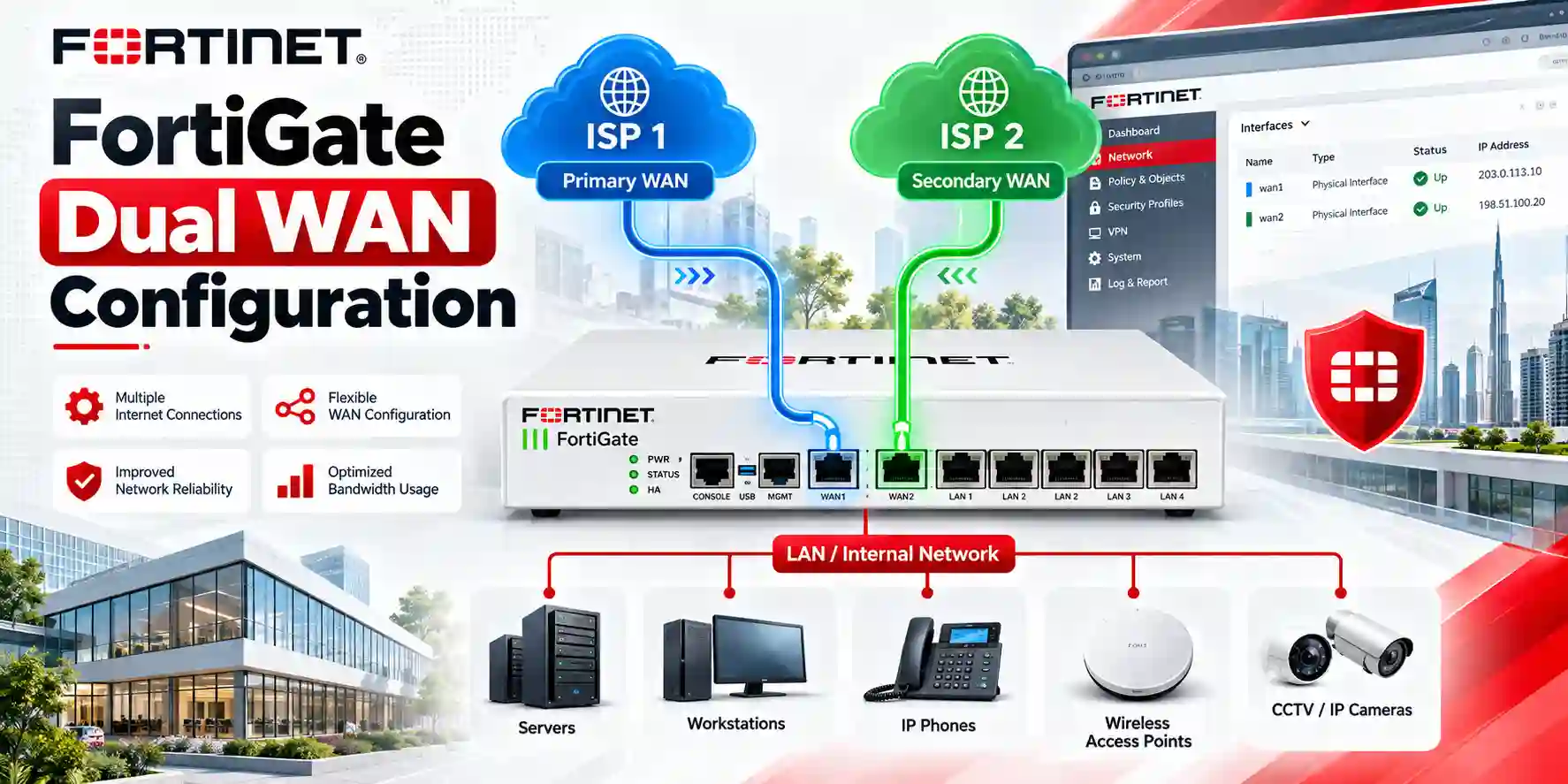
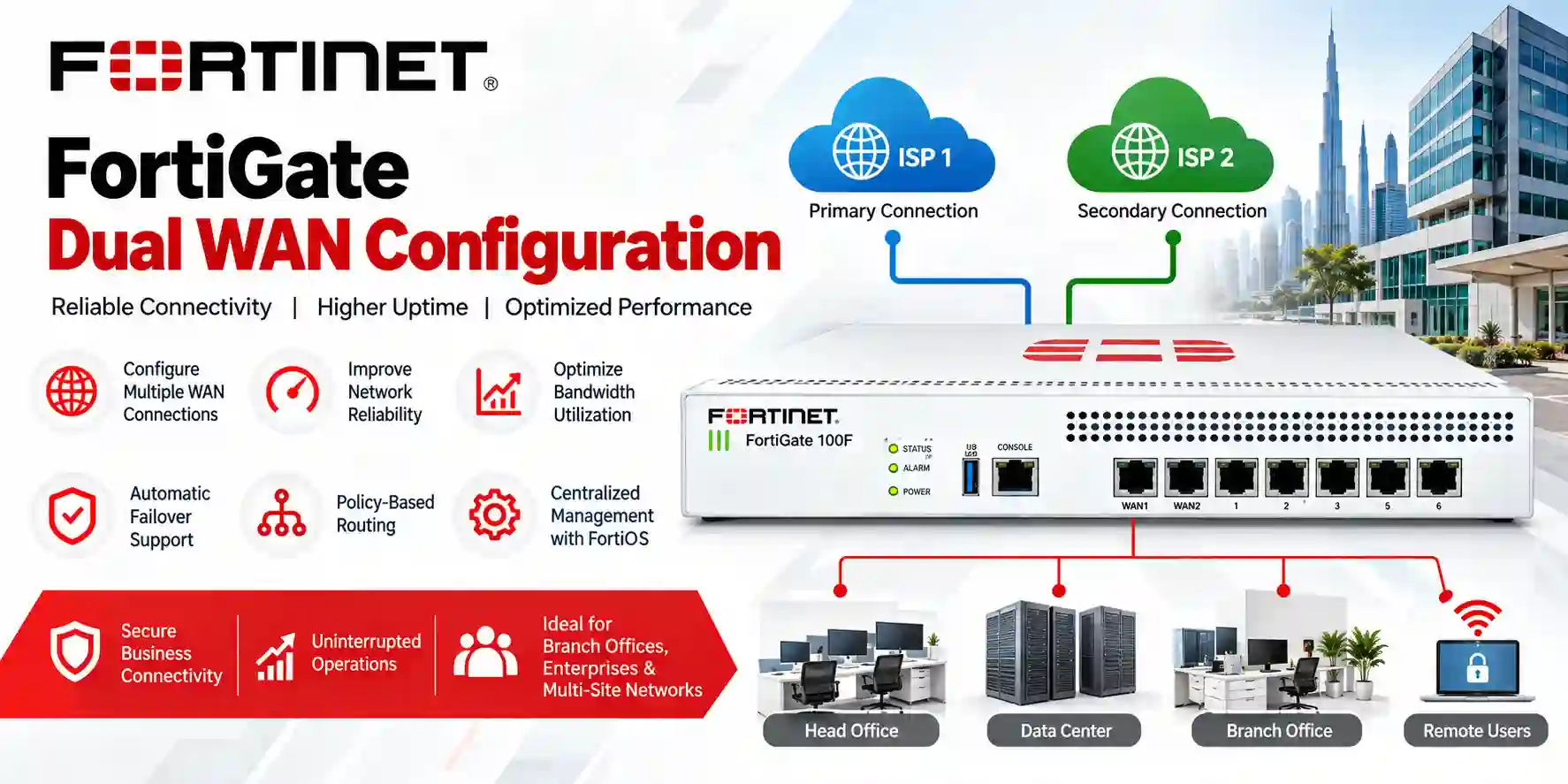
What is a Fortinet cellular WAN failover design?
A Fortinet cellular WAN failover design is an architecture in which a FortiGate can use a 3G, 4G LTE or 5G connection as another WAN transport, commonly through FortiExtender. Fortinet documentation describes FortiExtender as a wireless WAN platform that can provide a primary connection, a backup interface or a load-balanced WAN path. When FortiExtender is managed as a FortiGate WAN extension, the cellular path can appear as a FortiGate interface and can participate in security policy and SD-WAN decisions. This matters because the backup path is not merely “internet from a modem”; it becomes part of the routing, security and visibility model.
For SD-WAN deployments, FortiGate performance SLAs can measure the health of member links using reachability and quality criteria such as latency, jitter and packet loss. If a link fails the health checks, FortiOS can remove that path from the active SD-WAN forwarding decision and direct eligible traffic through another link. When health returns, the path can be reinstated according to the configured strategy. Fortinet also documents a specific cellular-backup mode in which FortiExtender cellular internet can be brought up when a monitored Ethernet WAN is down and brought back down when the wired interface returns.
The design decision therefore has several layers: how the cellular interface is presented to FortiGate, whether SD-WAN or a simpler redundant mode is used, what constitutes a failed primary path, how applications are prioritised, what happens to VPNs and inbound services when the public IP changes, how much cellular data may be consumed, and how administrators retain access during an outage. These details determine whether failover is merely technically available or operationally useful.
Core architecture: FortiGate, FortiExtender and Secure SD-WAN
1. FortiGate policy and path control
FortiGate remains the security and routing decision point. In an SD-WAN design it can group wired and cellular links, apply application-aware steering, use health checks, and keep the firewall policy attached to the SD-WAN zone rather than to a single physical provider. This can simplify branch designs when the same traffic needs to use either path.
2. FortiExtender cellular transport
FortiExtender provides the wireless WAN connection and can be positioned where cellular reception is better rather than forcing long RF antenna runs back to the network rack. Current Fortinet material describes indoor, vehicle and rugged form factors and supports LTE/5G use cases including branch continuity, mobility and industrial connectivity.
3. Carrier and SIM diversity
Fortinet offers dual-SIM and dual-modem approaches on applicable FortiExtender models. Dual-SIM designs can provide active/passive carrier switching, while dual-modem designs can support simultaneous cellular paths for higher availability or load-balancing scenarios. The exact model, regional modem variant, frequency support, SIM arrangement and carrier compatibility must be verified before procurement.
Direct design answer: when should cellular be backup instead of active traffic?
Cellular is usually best treated as standby capacity when the wired circuit is cheaper, faster, more predictable or includes a public-address arrangement that business applications depend on. In that model, normal traffic stays on the preferred wired path and the cellular connection becomes active only when a genuine outage or unacceptable quality condition is detected. This limits mobile-data consumption and keeps application behavior predictable.
Active cellular can still be useful. A dual-active SD-WAN design may steer selected traffic over LTE/5G during normal operation, use cellular for a specific application group, or maintain a second active path to reduce failover delay. The correct choice depends on carrier pricing, coverage quality, expected throughput, public-IP behavior, security policy, application tolerance and outage cost. A financial branch processing transactions may justify a different design from a small office where backup internet is needed only for email, cloud collaboration and emergency access.
Eight design checks before configuration
Decide whether “failed” means interface down, inability to reach a remote target, excessive packet loss, unacceptable latency, excessive jitter or a combination.
Measure the usable carrier signal where the FortiExtender will actually be installed. Rack location may not be the best radio location.
Identify monthly limits, billing behavior and what applications can consume large amounts of data after failover.
Inbound NAT, allowlists, hosted services and third-party VPN peers may depend on the primary public address and need alternate handling.
Determine whether site-to-site tunnels have secondary peers, dynamic discovery or other methods to re-establish when the underlay address changes.
The backup path should not become a shortcut around the security controls applied to the primary internet path.
WAN failover has limited value if the FortiGate, switch, FortiExtender or upstream power supply drops during the same incident.
Test what happens when the primary link returns. Existing sessions may not migrate seamlessly when NAT addresses or paths change.
| Design area | Question to answer | Why it matters |
|---|---|---|
| Health check | What target proves that the internet path is actually usable? | Interface-up status alone cannot detect every upstream failure. |
| Traffic scope | Which users and applications are allowed on cellular? | Prevents backup capacity and data allowance from being consumed by low-priority traffic. |
| Carrier design | Does the backup use a failure domain independent of the primary service? | A backup that shares too much infrastructure with the primary may fail during the same event. |
| VPNs | Can the remote peer accept a new underlay address or alternate tunnel? | Internet access can recover while private site connectivity remains down if VPN failover was not designed. |
| Operations | Who receives alerts and who can test failover safely? | Continuity depends on monitoring, documentation and periodic proof, not configuration alone. |
FortiExtender model selection and compatibility guidance
Current Fortinet product information lists multiple FortiExtender families for different deployment types, including indoor gateways as well as vehicle and rugged models. The current product page includes models such as FortiExtender WAN 50G, FortiExtender 101G, 211G, 511G and 511G-WiFi in the indoor portfolio. Fortinet documentation also maintains compatibility and regional hardware information for earlier and current platforms. A design should never choose a FortiExtender solely because the model number appears suitable. The mobile-radio bands, target carrier, country, form factor, environmental requirements, power method, FortiOS/FortiExtender OS compatibility and intended management mode all need confirmation.
Dual-SIM and dual-modem capability also need to be interpreted correctly. A dual-SIM device may provide carrier redundancy using one active and one standby SIM on a single modem, while a dual-modem design can provide two simultaneously active cellular paths on applicable hardware. That distinction affects failover speed, carrier diversity, data-plan strategy and cost. It can also influence whether the project requires one cellular path as emergency backup or a more ambitious active/active wireless WAN design.
FortiGate compatibility is equally important. Fortinet publishes platform-dependent FortiExtender integration limits and version-specific documentation, so a quotation should include the exact FortiGate model, current FortiOS version and proposed FortiExtender model before final approval. For Tanzania buyers already evaluating a compact FortiGate, the FortiGate 30G Tanzania product page provides a useful related reference; however, suitability for a cellular failover project still depends on throughput, inspection features, interfaces, users, VPNs and growth rather than model name alone.
Implementation workflow for a controlled failover project
Discovery: document the primary WAN, critical applications, user count, cloud dependencies, VPN topology, inbound services, carrier coverage, rack and power environment, current FortiOS, change window and outage tolerance. The goal is to identify what must remain available, not simply to add a second interface.
Design: choose the cellular architecture, FortiExtender management mode, SIM strategy, SD-WAN zone membership, performance SLA targets, priority or quality rules, firewall policies, DNS implications, VPN behavior, routing and data-use restrictions. Define which high-bandwidth services should be blocked or deprioritised during cellular operation.
Deployment: install FortiExtender where radio conditions are usable, verify carrier/APN settings, authorise or manage the device according to the chosen mode, create the required interfaces, add SD-WAN members when used, build health checks, update policies and monitoring, and preserve configuration backups before and after changes.
Validation: perform a controlled primary-link failure, confirm application recovery, verify routing and security policy, validate site-to-site and remote-access behavior, check cellular data usage, test restoration of the primary link, and record the observed failover/failback outcome. FourTeck’s broader Tanzania technology services page is useful when the failover project also involves network assessment, installation, configuration, testing and documentation.
Regional deployment and procurement guidance
The following sections address the same Fortinet cellular failover objective from different operating contexts. They are intentionally not model-specific because carrier bands, service plans, FortiGate models, FortiOS versions and site conditions vary. Each project should validate the exact FortiExtender hardware, carrier support and configuration before purchase.
Fortinet Cellular WAN Failover Design Tanzania
For organisations in Tanzania, cellular WAN failover is most valuable when it is designed around the actual business services that stop during an internet outage. A head office may depend on Microsoft 365, cloud ERP, IP telephony, video meetings, payment systems, remote access and site-to-site VPNs. A branch may only need transaction traffic, email, messaging and a secure tunnel back to headquarters. A hotel, logistics site, warehouse or field operation can have a different continuity priority again. The first Tanzania design task is therefore to classify essential traffic and determine the minimum connectivity required to keep operations safe and productive when the primary circuit fails.
The second task is to treat cellular coverage as a site measurement, not an assumption. FortiExtender can be positioned away from the firewall rack when that improves radio conditions, but installation still has to consider power, Ethernet path, physical security, heat, weather exposure and maintainability. The selected mobile service should be checked at the intended installation location, and the project should confirm APN requirements, address behavior, data allowance and whether the cellular provider offers features needed by the application. Where dual-SIM or dual-carrier resilience is planned, the purpose should be clear: carrier switching can add another layer of continuity, but it also introduces additional plans, monitoring and operational decisions.
For FortiGate SD-WAN, Tanzania deployments can use performance SLAs to distinguish a usable path from one that is merely connected. That is particularly important when the primary circuit remains electrically up while upstream reachability or quality has deteriorated. The health-check targets, failure thresholds and recovery criteria should be conservative enough to avoid unnecessary flapping yet sensitive enough to protect critical applications. Data-heavy backups, operating-system updates, media streaming and non-essential transfers may need different policy treatment during cellular operation so that the emergency path is preserved for important users.
Procurement should include the FortiGate model and software version, proposed FortiExtender model, number and type of SIMs, carrier information, power method, installation location, required cables or accessories, licensing/support expectations and a test plan. The objective is not simply “LTE backup”; it is a repeatable continuity design with documented dependencies, safe failback and a clear operational owner.
Fortinet Cellular WAN Failover Design Dar es Salaam
Dar es Salaam businesses frequently operate environments where connectivity is tightly linked to customer service, supply chains, finance, cloud applications and communication. A Fortinet cellular WAN failover design for an office, retail outlet, professional-services firm, hospitality site or logistics operation should begin with the impact of a primary ISP interruption. If point-of-sale, cloud ERP, customer portals, voice services or branch VPN traffic are critical, the cellular path should be sized and governed for those services rather than opened indiscriminately to every user and background process.
Urban sites also create practical radio-placement questions. A FortiGate may sit in an internal rack, basement, secure room or dense equipment space where mobile signal is poor even though coverage is strong elsewhere in the building. FortiExtender’s architecture allows the cellular gateway to be placed at a more suitable network-connected location, reducing the need to drag long RF antenna cables from the rack. During planning, test the candidate position and confirm the physical route, PoE or local power approach, access control and protection against accidental disconnection. Multi-floor premises may benefit from testing several positions before the final mount is selected.
Dar es Salaam deployments should also account for public-IP changes during failover. Outbound web and SaaS use commonly recovers more easily than inbound services or partner systems that whitelist the primary ISP address. Site-to-site VPNs may need alternate peer definitions or a design that can establish the tunnel through the cellular underlay. Hosted applications, remote-access portals and published services should be analysed separately because a successful internet failover does not automatically guarantee that every inbound workflow survives.
A useful acceptance test disconnects or disables the preferred WAN under controlled conditions, checks whether FortiGate identifies the failure as intended, confirms that priority applications use LTE/5G, verifies security inspection and logging, tests VPN recovery, and measures cellular data consumption. After the primary link returns, the same team should verify failback, session behavior and alert clearance. This gives the IT team evidence that the design works instead of relying on a green interface indicator.
Fortinet Cellular WAN Failover Design Mwanza
A Mwanza cellular failover design should focus on continuity for the specific mix of branch operations, distribution, professional services, hospitality, education, healthcare or regional administration present at the site. The most effective design normally starts by identifying the critical transaction set. An organisation may discover that only a subset of traffic needs immediate recovery: ERP sessions, secure access to head office, essential cloud applications, payment services, email and selected voice traffic. Separating these requirements from bulk updates, cloud backups and recreational traffic can make a cellular backup more predictable and economically manageable.
Carrier diversity deserves attention. Using a mobile provider as backup can reduce dependence on the same last-mile technology as the primary fixed circuit, but the project should examine whether the two services share upstream dependencies or power risks at the site. Where the business impact of losing connectivity is high, a dual-SIM FortiExtender configuration on a compatible model can add a second mobile-carrier option. For more demanding environments, applicable dual-modem models can support active cellular paths. These are architectural options rather than automatic requirements; the additional cost should be tied to the outage risk and service-continuity objective.
Mwanza projects should also consider the LAN and power side of resilience. A working cellular signal does not help if the switch feeding FortiExtender loses power or if the FortiGate and ISP equipment are not on appropriate UPS protection. Critical network devices should have documented power feeds, and the installation should avoid creating a single loose patch cable or unprotected adapter that can disable the entire backup path. Monitoring should make the cellular state visible so IT knows whether the backup is healthy before an outage.
For procurement, provide the intended application list, primary ISP type, FortiGate model, FortiOS release, target carrier or carriers, expected outage duration, typical and peak bandwidth needs during an emergency, VPN topology and public-IP dependencies. Those inputs support a more useful FortiExtender and SD-WAN recommendation than simply asking for “a 5G backup device.”
Fortinet Cellular WAN Failover Design Arusha
Arusha organisations often combine office connectivity with hospitality, tourism, services, education, administration or distributed operational needs. In those environments, an internet outage can affect booking platforms, cloud finance, email, guest services, IP telephony, remote support and secure connections to other sites. The failover design should therefore distinguish internal business continuity from guest or public internet. A hotel or customer-facing venue, for example, may choose to keep essential back-office and transaction applications on the cellular link while limiting bandwidth available to non-critical guest traffic during an outage.
FortiGate SD-WAN is useful when the project needs more than a simple interface-down trigger. Performance SLAs can monitor quality and remove an unhealthy primary path when measured conditions fail the defined thresholds. This can protect voice and interactive applications from a broadband link that is technically online but unusable. The selected SLA target should represent meaningful upstream reachability, and the configuration should be tested against real failure cases. Overly aggressive thresholds can cause unnecessary path changes; overly relaxed thresholds can leave users on a poor link for too long.
Physical planning also matters in Arusha. The best cellular signal may be at a window, higher floor, external protected area or another location away from the main rack. The FortiExtender form factor must suit that environment, and the cable path, mounting, power and weather exposure should be designed accordingly. If the project needs an outdoor or rugged deployment, use a Fortinet model intended for that purpose rather than improvising an indoor gateway into an unsuitable enclosure.
Finally, define what staff should do when the site is on backup connectivity. An alert can tell administrators that failover occurred; a traffic policy can automatically protect the link; and a short operating procedure can explain which large transfers should be postponed. A cellular failover plan is strongest when technology, monitoring and user behavior are aligned around the same continuity objective.
Fortinet Cellular WAN Failover Design Dodoma
Dodoma deployments may support administrative offices, institutions, professional services, education, healthcare, branch networks and growing private-sector operations that rely heavily on cloud applications and centralised services. A Fortinet cellular WAN failover design should start from a continuity map: which services can tolerate a few minutes of interruption, which require rapid recovery, and which should be intentionally blocked from the metered backup path. This classification helps the SD-WAN rule set serve business priorities rather than merely shifting all traffic from one interface to another.
For a branch linked to a data centre or head office, the design must test private connectivity as carefully as normal internet access. If the primary VPN tunnel is bound to the fixed WAN address, a cellular failover may require a second tunnel, dynamic peer handling or another supported architecture. DNS and third-party allowlists can also become relevant when the source public IP changes. The right answer depends on the application and remote peer; there is no universal assumption that every session will survive an underlay change.
Where a FortiExtender is integrated as a FortiGate WAN extension, administrators gain a design in which the cellular transport can be managed within the Fortinet environment rather than as an opaque consumer modem. That can simplify visibility, policy and SD-WAN membership. Model and firmware compatibility should still be checked against current Fortinet documentation before procurement. The project should also document SIM ownership, PIN and APN information, plan limits, billing cycle, escalation contacts and responsibility for renewal.
Testing should include more than one scenario. Simulate a physical primary-link loss, an upstream reachability failure, a degraded-quality condition if the design uses quality thresholds, and restoration of the main link. Record recovery behavior for critical applications and confirm that logging clearly identifies the event. That test evidence becomes part of the operational handover and helps future administrators understand how the design is supposed to behave.
Fortinet Cellular WAN Failover Design UAE
For UAE businesses, Fortinet cellular WAN failover can support branch offices, retail, hospitality, warehouses, construction environments, temporary sites, logistics operations and corporate networks where service interruption directly affects customer transactions or staff productivity. The design may use LTE/5G strictly as standby or include the cellular path in active SD-WAN decisions. In either case, the key is to define the role of the path before configuration. A metered emergency circuit should be protected from background traffic, whereas a high-capacity active cellular service may be intentionally used for selected applications during normal operation.
UAE deployments should verify carrier compatibility and the exact FortiExtender radio variant against the chosen service. Indoor placement can be challenging in large concrete buildings, equipment rooms and lower floors, so signal testing is important. FortiExtender can be positioned where reception is stronger and connected back to the FortiGate over the appropriate Ethernet path. For vehicle, industrial or exposed locations, Fortinet offers purpose-designed form factors; the environmental model should match the actual operating conditions.
Large multi-site organisations may also use the failover project as an opportunity to standardise branch policy. A repeatable template can define SD-WAN members, SLA probes, priority applications, VPN behavior, cellular restrictions, logging and alerting while still allowing carrier and bandwidth details to vary by site. Central management can be considered for environments with many FortiGates and FortiExtenders. Standardisation makes testing and support easier because each branch follows the same operating logic instead of a collection of one-off configurations.
Customers coordinating requirements across the Gulf can review FourTeck UAE IT and network-security solutions as a regional reference. For any cellular failover quotation, include the FortiGate model, intended carrier, site type, primary WAN, critical applications, VPN requirement, public-IP dependencies and desired failover behavior so the recommendation can be matched to the operating environment.
Fortinet Cellular WAN Failover Design Uganda
Uganda businesses with offices, branches, retail locations, hospitality sites, schools, clinics and distributed operations can use Fortinet cellular failover to reduce dependence on a single fixed internet path. The most useful design begins with application continuity. For some branches, the essential requirement may be secure access to a head-office system and cloud email. For others, point-of-sale, IP voice, transaction processing, SaaS applications and remote management all need to continue. Those priorities should drive the failover policy and bandwidth allocation.
Carrier diversity is a practical design question. A dual-SIM FortiExtender on an applicable model can provide a way to switch between mobile carriers when the active cellular path is unavailable or fails configured conditions. That does not remove the need to test signal and service quality at the actual site. A carrier that performs well in one part of a city may not provide the same experience inside another building or in another district. For branch rollouts, capture signal observations, APN details and SIM ownership as part of the site record.
FortiGate SD-WAN can protect application experience by evaluating more than physical link state. Performance SLAs can test the quality and reachability of the preferred link, then shift traffic to the cellular member when the defined failure condition is met. The policy should avoid wasting data on large backups or software distributions during an outage unless those transfers are genuinely business critical. Rate limits, traffic selection and application policies can be used to preserve the link for essential work.
Organisations with regional operations can use the FourTeck Uganda technology site for related local networking and communication context. A complete design request should include branch count, primary ISP, FortiGate model and software, target cellular carrier, critical applications, VPN topology, power environment, required recovery time and whether the backup must support inbound services.
Fortinet Cellular WAN Failover Design Kampala
Kampala offices and customer-facing sites can experience a very different outage impact depending on their application mix. A law firm or finance office may prioritise secure SaaS access, email and VPN. A retailer may prioritise point-of-sale and inventory systems. A hotel may need booking, payment and operational communications while temporarily restricting guest bandwidth. A Fortinet failover design should convert those business priorities into SD-WAN and firewall policy so that the cellular path remains useful when demand rises during an incident.
The backup path also needs a credible trigger. If FortiGate only reacts to a physically down port, some upstream failures can leave the interface technically active while users have no usable internet. Performance SLA monitoring can test actual path reachability and quality. For interactive services such as voice or remote desktop, latency, jitter and packet loss may matter even before the link is completely unreachable. Thresholds should be tuned and tested to avoid frequent path oscillation.
In a dense building, FortiExtender placement should be part of the project scope. The network rack may be convenient for installers but unsuitable for mobile reception. The installer should identify a location with appropriate signal and a secure, maintainable path back to FortiGate. If PoE is used, confirm power budget and UPS protection. If local power is used, avoid creating a backup design whose adapter is on an unprotected circuit. The same resilience thinking should apply to switches, FortiGate and any equipment required to maintain the WAN path.
Kampala projects should finish with a documented failure exercise: disable the preferred circuit, confirm the correct SD-WAN event, verify priority applications and VPNs, check that cellular usage is visible, then restore the primary service and observe failback. The result should be recorded with configuration references and responsibilities so future troubleshooting does not depend on the memory of the original installer.
Fortinet Cellular WAN Failover Design Arua
Arua deployments may include regional offices, NGOs, institutions, clinics, education sites, logistics points, retail operations or other branches where internet alternatives can differ from those available in a capital city. That makes the design process especially important. Instead of assuming that a specific carrier or radio technology is suitable, test the available cellular services at the actual premises and document signal, stability and expected capacity. The FortiExtender should then be selected for the required network generation, regional compatibility and environmental conditions.
For a remote or operational branch, continuity may depend more on a small number of services than on total bandwidth. Secure access to a central system, messaging, finance transactions, cloud records or remote support may be enough to keep the site functioning. The FortiGate policy can prioritise these applications while restricting bulk downloads, cloud synchronisation and other non-essential traffic during backup operation. This approach often delivers more practical resilience than trying to make a cellular link behave exactly like the primary service.
Power protection should be reviewed at the same time as connectivity. If the outage risk includes local electrical interruption, the network devices participating in failover need appropriate UPS support. It is also useful to confirm how administrators will reach the site when the primary provider is unavailable. FortiExtender includes out-of-band management capabilities in applicable designs, and cellular connectivity can become an important troubleshooting path, but remote access should be planned securely rather than enabled ad hoc during an emergency.
Arua procurement should describe the critical applications, number of users, preferred and alternate carriers, existing FortiGate, primary connection type, site power arrangement and maximum acceptable downtime. That information helps determine whether a simple active/passive cellular backup is sufficient or whether dual-SIM, dual-carrier or a more advanced SD-WAN approach is justified.
Fortinet Cellular WAN Failover Design Mbarara
Mbarara businesses and institutions can use cellular backup to preserve business communication and cloud access when a fixed WAN is unavailable, but the failover should be engineered for the local workload. A branch with fifty staff and large cloud transfers has a different emergency bandwidth profile from a small outlet that only needs payment processing and a secure VPN tunnel. The design should estimate the traffic generated by essential services and define which users, VLANs or applications may use the backup path.
FortiGate SD-WAN offers a structured way to express that policy. The primary wired connection can remain preferred while FortiExtender provides LTE/5G as a lower-priority member. Performance SLAs monitor the availability and quality of the primary path, while SD-WAN rules determine where traffic should go. This is more precise than relying only on static routes, particularly when the project needs application-aware path selection or separate behavior for voice, business SaaS and general browsing.
Cellular data cost should be designed rather than discovered after an outage. Determine the plan allowance, what happens when it is exceeded, who receives usage alerts, and whether the organisation needs an automatic restriction for high-volume services. Operating-system updates, cloud backup, video streaming and large file synchronisation can consume substantial data quickly. During an emergency, those services may need to pause so the cellular link can support transactions and communications.
The final Mbarara test should include a maintenance-window failover and a restoration test. Confirm that users regain the intended services, security policies continue to apply, VPNs behave as designed, administrators can see the cellular status, and the primary path is preferred again after recovery. Record the test date, carrier, observed behavior and any application exceptions. Periodic retesting is worthwhile because carrier conditions, firmware and business applications can change over time.
Fortinet Cellular WAN Failover Design Gulu
Gulu sites planning Fortinet cellular backup should begin by separating the continuity objective from the hardware purchase. The question is not only which FortiExtender to buy, but what the branch must still be able to do when the main internet service fails. A healthcare facility may need access to cloud records and communications. An institution may prioritise central systems and remote administration. A commercial branch may need inventory, payments, email and a VPN to headquarters. These requirements define the minimum bandwidth and policy scope for the backup path.
Signal verification is an important pre-installation activity. Test more than one carrier where practical and evaluate the proposed FortiExtender position rather than a mobile phone at a random point in the building. Antenna environment, walls, equipment rooms and mounting height can affect radio conditions. If the best placement is away from the rack, plan the Ethernet connection, PoE or local power, physical protection and UPS coverage as part of the installation bill of materials.
Where the business requires dual-carrier resilience, compatible dual-SIM FortiExtender models can switch between cellular services based on defined conditions. The benefit should be balanced against plan management and testing requirements. A backup SIM that has expired, lacks data or uses an incorrect APN is not a usable resilience layer. The operations checklist should therefore include SIM status, billing, data plan, PIN and carrier account ownership.
The FortiGate side should be configured with health checks that reflect real internet reachability and with policies that retain the expected security inspection. After implementation, perform both failure and recovery testing. If the design includes site-to-site VPN, confirm the tunnel through the cellular path rather than assuming it follows ordinary web traffic. A clear handover should state what automatically fails over, what requires manual action and which services may be intentionally unavailable while the site is using backup connectivity.
Fortinet Cellular WAN Failover Design Kenya
Kenya multi-site businesses, retail chains, hospitality operators, professional firms and distributed enterprises can use Fortinet cellular failover to add a diverse WAN path alongside fiber, broadband or private connectivity. The best branch standard normally defines a common FortiGate policy framework while allowing carrier and bandwidth details to vary by location. A template can include SD-WAN zones, SLA targets, critical-application rules, cellular restrictions, logging, VPN behavior and failback expectations. This reduces configuration drift as more branches are added.
At each site, verify the cellular carrier and FortiExtender placement independently. A national standard does not guarantee identical RF conditions in every building. The network team should record signal observations, SIM details, APN settings, data plan and physical installation location. If the project uses dual-SIM or dual-modem hardware, clearly document the purpose of each carrier and how switching or active traffic is expected to work. The organisation should also know which team owns mobile-plan renewals, because a technically correct backup cannot function when the service is suspended.
Kenya enterprises with cloud-heavy workloads should consider how much traffic will suddenly move onto cellular during a primary outage. Backup software, video collaboration, large SaaS synchronisation and operating-system updates can compete with payment, ERP or voice traffic. SD-WAN and firewall policies can differentiate those flows so the cellular connection protects the applications that keep the branch operational. Performance SLA thresholds should be matched to the applications rather than copied blindly from another site.
For organisations coordinating East African infrastructure, FourTeck Kenya IT and firewall solutions can provide related regional context. A procurement request should include branch count, current FortiGate models, software versions, primary circuits, candidate carriers, critical applications, VPN needs, acceptable outage time and whether a standardised branch template is required.
Fortinet Cellular WAN Failover Design Kuwait
Kuwait organisations considering cellular WAN resilience can use FortiExtender to add LTE/5G transport to a FortiGate-based branch architecture. The most important design choice is whether cellular acts as an emergency standby, a normal SD-WAN member, or an active path reserved for particular applications. A standby design is often appropriate when fixed connectivity provides predictable capacity and the mobile plan is intended only for continuity. Active designs can be useful when the organisation deliberately wants transport diversity or application steering across both links.
Indoor radio conditions should be checked carefully in high-rise offices, dense commercial buildings, data rooms and sites with reflective or shielded construction. The FortiExtender can be placed in a location with stronger reception and connected to FortiGate over the network path, but the installation must still be physically secure and supportable. Power resilience is equally important. Cellular failover does not improve availability if the FortiExtender or switch loses power during the same event that affects the primary circuit.
Applications that depend on a fixed public IP need separate review. Whitelisted SaaS systems, inbound NAT, published servers and third-party VPN peers may not automatically accept the cellular address. For outbound cloud access, source NAT usually changes without requiring user action, but existing sessions can reset. Site-to-site VPN should be designed with an alternate path or peer strategy where continuity is required. These behaviors need to be part of acceptance testing rather than discovered during a real outage.
Kuwait procurement teams should request a solution bill of materials that identifies the FortiExtender model, carrier compatibility, FortiGate integration mode, SIM quantity, power accessories, cabling, management approach and support expectations. The quotation should also state assumptions about the primary ISP, required application continuity and whether cellular usage is restricted. This makes commercial comparison more meaningful because each proposal is based on the same continuity objective.
Fortinet Cellular WAN Failover Design Ghana
Ghana businesses can use cellular WAN failover to protect cloud access, transactions, branch VPNs and communications when a primary fixed connection becomes unavailable. The design should begin with a business-impact review. A retail outlet may require point-of-sale and inventory connectivity. A professional office may rely on SaaS, email and VoIP. A warehouse may prioritise ERP and remote support. Once the critical application set is defined, FortiGate policies can reserve the mobile path for those workloads and keep lower-priority traffic from exhausting capacity or data allowance.
Carrier and signal validation are part of the engineering task. A dual-SIM model can add mobile-provider diversity on supported FortiExtender hardware, but each service should be tested at the premises. Where business continuity is especially important, document both the preferred cellular carrier and the alternate one, including APN, billing cycle, data allowance and contact ownership. If the backup has not been exercised for months, periodic health checks and planned tests can reveal an expired or misconfigured SIM before an outage does.
FortiGate SD-WAN can monitor the wired primary and steer traffic when health criteria fail. The correct thresholds depend on the services. Voice and interactive remote access may become unusable at quality levels that general web browsing can tolerate. The design can therefore apply different application strategies rather than using a single rule for every session. Security inspection and logging should remain consistent so the backup path does not weaken the control posture during an incident.
Ghana deployments that extend across branches should use a common documentation format: FortiGate model and version, FortiExtender serial/model, SIM details, carrier, installation position, SLA targets, traffic restrictions, VPN behavior and last tested date. This makes troubleshooting faster and supports future replacement planning. The final acceptance test should prove both automatic failover and return to the primary service.
Fortinet Cellular WAN Failover Design Nigeria
Nigeria enterprises with distributed branches, retail operations, financial services, logistics, hospitality, professional offices and industrial sites can benefit from a WAN design that avoids dependence on one access circuit. Fortinet cellular failover can use LTE/5G as a secondary transport under FortiGate control, but the architecture should be tied to the site’s outage cost and application profile. High-value transactional sites may justify multi-carrier cellular resilience, while a small office may only need a single backup link for core SaaS and communication.
When a primary connection fails, it is tempting to move every flow to cellular. That can create immediate congestion or rapid data consumption. A better design classifies traffic before an outage occurs. Payment, ERP, authentication, business messaging, approved VPN and essential cloud services can receive priority. Large backups, operating-system updates, entertainment and other non-critical transfers can be restricted or delayed. FortiGate policy and SD-WAN rules can enforce this emergency-mode behavior consistently.
Carrier choice and physical placement should be validated at each site. FortiExtender allows the cellular radio to be placed where reception is stronger than inside the firewall rack, but the cable path and power must remain secure. For industrial or outdoor environments, use appropriate rugged hardware rather than assuming an indoor model is sufficient. Dual-SIM and dual-modem options can increase carrier resilience where supported, but they should be specified with clear expectations for active/passive or active/active operation.
Nigeria branch projects should also test VPN and public-address dependencies. A new cellular source address can break third-party allowlists, inbound services or static VPN peers even though general internet browsing works. The acceptance plan should therefore test every critical workflow. After failback, confirm that routes, sessions and tunnels return to the intended primary state and that monitoring records the full event for audit and troubleshooting.
Fortinet Cellular WAN Failover Design Seychelles
Seychelles businesses in hospitality, professional services, retail, government, education or other island operations may value cellular WAN failover because a single connectivity incident can affect cloud applications, booking, payment, voice and remote support at the same time. The design should identify the minimum application set needed to keep the site functional and then confirm that the selected mobile service can support that traffic at the premises. It is more useful to guarantee continuity for essential systems than to promise that every user will experience normal broadband behavior during an outage.
Physical deployment can require particular attention because site layout, building construction and equipment-room placement affect radio conditions. FortiExtender can be separated from the main firewall rack and installed in a better reception area, provided the chosen model and installation method are suitable. For properties with multiple buildings or exposed locations, the cable path, environmental rating, power source, surge protection and maintainability should be evaluated. A cellular gateway mounted in a hard-to-access location should still be documented and serviceable.
For hospitality, a useful policy may keep property-management, booking, payment, staff communication and administrative cloud services available while reducing or temporarily restricting guest bandwidth. For an office, the priority may be SaaS, email, secure VPN and remote administration. FortiGate SD-WAN rules can express these priorities and performance SLAs can detect when the preferred service is unusable. The failover threshold should be tested so the site does not switch back and forth unnecessarily during brief quality fluctuations.
A complete Seychelles proposal should include carrier verification, FortiExtender model and radio compatibility, SIM plan, FortiGate model, primary WAN details, critical application list, VPN requirements, public-IP dependencies, power protection and a controlled acceptance test. If the site is especially dependent on connectivity, dual-carrier planning may be appropriate, but it should be justified by business continuity requirements and validated against available services.
Related network planning for a cellular failover project
WAN resilience often exposes dependencies elsewhere in the environment. The FortiGate must have enough capacity for the security services and VPN load it will run on either path. The switch port feeding FortiExtender must be stable and, when PoE is used, have appropriate power budget and UPS coverage. DNS, DHCP and authentication services need to remain reachable. If voice is considered critical, the IP PBX or cloud voice platform must work from the backup public address. If a branch uses site-to-site VPN, the alternate underlay path must be represented in the VPN design.
For wider branch and LAN planning, FourTeck can coordinate firewall, switching, wireless, structured cabling, UPS and documentation as part of one design. The goal is to avoid a situation in which the cellular backup works perfectly but a different single point of failure prevents the business from using it.
Fortinet cellular WAN failover FAQ
Can FortiExtender be used only as a backup WAN?
Yes. Fortinet documents FortiExtender cellular connectivity as suitable for backup use and provides a redundant mode in which cellular internet can come up when a monitored Ethernet WAN goes down. FortiExtender can also participate in SD-WAN as a backup member. The best method depends on how much path control, application steering and monitoring the site requires.
Does FortiGate SD-WAN detect poor quality or only complete outages?
Performance SLA health checks can evaluate reachability and measurements such as latency, jitter and packet loss. A design can therefore move traffic when the primary path is degraded beyond defined conditions rather than waiting for a physical link-down state.
Will every application continue automatically when the WAN changes to cellular?
Not necessarily. New outbound sessions may recover easily, but existing sessions can reset when NAT addresses change. Inbound services, IP allowlists and site-to-site VPNs may require specific alternate-path design. Each critical application should be tested during acceptance.
Should the cellular link carry all traffic during an outage?
Usually not by default. If the mobile link is metered or lower capacity, prioritise business-critical traffic and limit high-volume background services. The policy should reflect the business impact of each application and the data-plan economics.
What is the difference between dual-SIM and dual-modem FortiExtender?
On applicable FortiExtender hardware, dual-SIM typically provides carrier redundancy on one modem with active/passive switching, while dual-modem designs can support two active cellular paths. Exact behavior varies by model and software, so the current Fortinet datasheet and ordering guide should be checked for the chosen hardware.
Why place FortiExtender away from the FortiGate rack?
Cellular signal may be much better near a window, upper floor or other radio-friendly location. FortiExtender is designed so the cellular gateway can be placed where signal is better and connected back over Ethernet rather than relying on long, lossy RF antenna runs.
How often should WAN failover be tested?
There is no universal interval. Test after initial deployment and after meaningful changes to firmware, routing, VPNs, carriers or critical applications. Many organisations also schedule periodic controlled tests so expired SIMs, changed allowlists or broken failback behavior are discovered before an incident.
Quotation checklist
For a useful Fortinet cellular failover quotation, provide:
✓ FortiGate model and FortiOS version
✓ Primary WAN type and bandwidth
✓ Site location and branch count
✓ Preferred cellular carrier or carriers
✓ Critical applications and user count
✓ Site-to-site and remote-access VPN requirements
✓ Public-IP, NAT and allowlist dependencies
✓ Desired failover and failback behavior
✓ Cellular data-plan constraints
✓ Power, rack and installation conditions
✓ Required monitoring, documentation and testing scope
Decision recap
Choose the cellular design after deciding what the organisation is protecting. Simple standby can be enough for a small branch. SD-WAN is useful when path health, application steering and multiple transports need coordinated control. Dual-SIM or dual-modem resilience is valuable when the outage impact justifies carrier diversity.
The final measure of success is not the number of WAN interfaces shown in the dashboard. It is whether the critical applications continue through a realistic outage, whether security controls remain active, whether data usage stays within expectations, and whether the network returns cleanly to the preferred path.
Consultation panel: build the failover plan before selecting the hardware
A productive consultation starts with your current FortiGate, primary internet service, critical applications, carrier options and outage impact. From there, the architecture can determine whether you need a FortiExtender WAN extension, SD-WAN member, dual-SIM approach, application-specific policy, VPN redesign or additional power and switching resilience. This requirement-first method helps avoid buying a cellular device that is technically capable but poorly integrated with the business network.
For multi-country organisations, the same design principles can be standardised while local carrier and site conditions are validated individually. The aim is a documented, supportable continuity pattern that can be repeated without assuming every branch has identical radio, bandwidth, power or application conditions.