
Fortinet secure networking buyer guide for Tanzania and regional projects
Fortinet Network Security Product Comparison
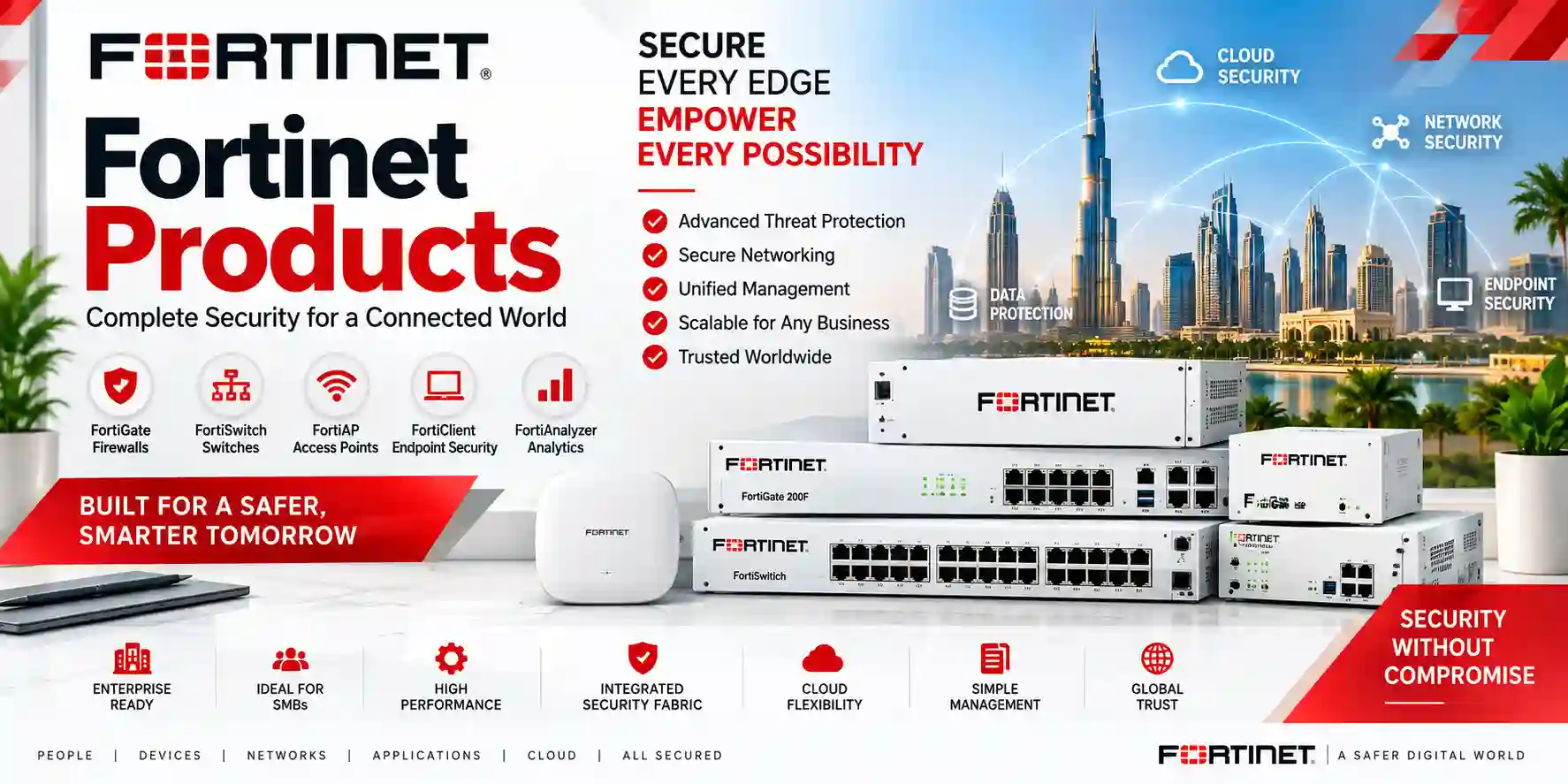
Fortinet network security is a portfolio rather than a single appliance. FortiGate provides next-generation firewall enforcement and secure networking, FortiSwitch extends controlled Ethernet access, FortiAP provides managed wireless access, FortiExtender adds 5G/LTE connectivity, FortiManager centralizes configuration, FortiAnalyzer adds logging and security analytics, FortiClient connects endpoint posture with secure access, and FortiNAC strengthens device visibility and network access control. This comparison explains where each product family fits, how the components work together, and what Tanzanian buyers should confirm before requesting a quotation.
Quick answer: which Fortinet product does what?
Choose FortiGate when the requirement is firewalling, segmentation, VPN, Secure SD-WAN or security inspection. Add FortiSwitch for managed wired access, FortiAP for wireless LAN, and FortiExtender for cellular WAN or failover. Add FortiManager when many Fortinet devices or sites need centralized administration, and FortiAnalyzer when logs, reporting, investigation and security analytics become important. FortiClient and FortiNAC address endpoint access and connected-device control. The correct design may use one product family or several; selection should follow the actual network, risk and operational requirements.
What should be compared before buying?
Compare the security functions you will enable, inspected traffic volume, internet speed, internal east-west traffic, number of users and devices, wired and wireless access needs, VPN usage, branch count, uplink types, high-availability requirements, logging retention, management model, subscription needs and growth plan. For FortiGate in particular, raw firewall throughput is not a complete sizing method. Buyers should review the performance figures relevant to the security services they intend to use and confirm current datasheets, software support and lifecycle status before ordering.
Fortinet secure networking product families compared
Fortinet’s current secure networking portfolio spans hybrid mesh firewalls, Ethernet switches, Wi-Fi access points, 5G/LTE gateways, centralized management and security operations tools. The important distinction is functional role. A switch does not replace a firewall, an access point does not replace a switch, and a management platform does not replace the enforcement device. The products become more valuable when they are deliberately combined around a clear architecture rather than purchased as isolated boxes.
| Product family | Primary role | Typical reasons to select it | Works especially well with |
|---|---|---|---|
| FortiGate | Next-generation firewall and secure networking | Internet edge security, segmentation, VPN, Secure SD-WAN, application control and threat inspection | FortiSwitch, FortiAP, FortiExtender, FortiManager, FortiAnalyzer |
| FortiSwitch | Secure Ethernet switching | Managed ports, VLANs, PoE, access-layer visibility, campus and branch switching | FortiGate through FortiLink, plus FortiAP and endpoint devices |
| FortiAP | Secure wireless LAN | Staff Wi-Fi, guest wireless, campus coverage, branch wireless and high-density access | FortiGate, FortiSwitch and cloud or centralized management |
| FortiExtender | 5G/LTE wireless WAN | Primary cellular links, backup WAN, out-of-band access and mobile or rugged deployments | FortiGate, Secure SD-WAN, FortiManager and FortiEdge Cloud |
| FortiManager | Centralized network and security management | Multi-site policy control, templates, orchestration, zero-touch provisioning and operational consistency | FortiGate, FortiSwitch, FortiAP and FortiExtender estates |
| FortiAnalyzer | Logging, analytics and security operations visibility | Central logs, reporting, investigation, analytics and operational security workflows | FortiGate and wider Fortinet Security Fabric telemetry |
| FortiClient | Endpoint agent for secure access and protection | ZTNA, VPN, endpoint posture, web filtering and endpoint protection depending on edition | FortiGate, FortiSASE and FortiClient EMS |
| FortiNAC | Network access control | Device visibility, onboarding, dynamic access control, segmentation and automated response | FortiGate and mixed-vendor switching or wireless estates |
FortiGate model comparison: start with inspected performance, not only port count
Fortinet currently lists entry and mid-range FortiGate appliances covering branch, small-business and campus requirements. The values below use Fortinet-published threat-protection figures available during this research. They are comparison points, not automatic sizing recommendations. Encrypted traffic, security profiles, concurrent sessions, VPN load, routing, high availability, interfaces, internal segmentation and future bandwidth growth can materially change the correct choice. Current model lifecycle and datasheet details should be reconfirmed for every quotation.
| FortiGate model | Published threat protection | Selected interface note | Planning position |
|---|---|---|---|
| 30G | 500 Mbps | 4 × GE RJ45 | Compact branch or small-site evaluation |
| 40F | 600 Mbps | 5 × GE RJ45 | Small office or branch evaluation |
| 50G | 1.1 Gbps | 5 × GE RJ45 | Small site needing more inspected headroom |
| 60F | 700 Mbps | 10 × GE RJ45 | Branch or SMB where interface density matters |
| 70G | 1.3 Gbps | 10 × GE RJ45 | Growing branch and inspection-heavy edge |
| 90G | 2.2 Gbps | GE plus 10GE shared port pairs | Medium branch or higher-capacity edge |
| 120G | 2.8 Gbps | 10GE SFP+, GE RJ45 and SFP connectivity | Large branch or campus-edge evaluation |
| 200G | 6 Gbps | 10GE SFP+, multi-gigabit RJ45, GE RJ45 and SFP | Higher-throughput campus or enterprise edge |
Published performance and interfaces can change with product revisions and datasheet updates. Always validate the exact model, software release, subscription bundle, transceivers, power requirements and lifecycle status at the time of purchase.

How the Fortinet products fit into one architecture
1. Protect and route
FortiGate sits at the policy and enforcement layer. It can secure internet access, inter-VLAN traffic, branch links and remote access while providing routing and Secure SD-WAN functions. It is often the architectural anchor, but its exact position depends on whether the design is a branch, campus, data center or hybrid environment.
2. Extend policy to the LAN
FortiSwitch can be managed directly or integrated through FortiLink so switching becomes part of a coordinated access architecture. This is useful where VLANs, PoE devices, endpoint visibility and access-layer policy need to be managed with the firewall environment rather than as a completely separate system.
3. Add secure wireless access
FortiAP extends the same network design to Wi-Fi. Indoor, outdoor, wall-jack and high-density choices serve different radio environments. The number of access points should come from coverage and capacity planning, not a simple users-per-AP formula, because walls, interference, client types and application demand vary by site.
4. Add resilient WAN options
FortiExtender can provide LTE or 5G connectivity as a primary link, backup WAN, mobile gateway or out-of-band path. For sites where fixed internet is uncertain or business continuity needs a diverse secondary path, cellular WAN can become part of the resilience design alongside FortiGate and SD-WAN policies.
5. Centralize operations
FortiManager becomes more useful as the number of sites, devices and policy objects grows. Templates, centralized workflows and zero-touch deployment can help reduce configuration drift. A single-site customer may not need the same management architecture as a national or multi-country estate, so operational scale should guide the decision.
6. Retain and analyze security data
FortiAnalyzer supports centralized logs, reports and security operations visibility. Logging strategy should be designed around investigation needs, audit requirements, retention expectations and available storage rather than enabled without a plan. Larger environments may require more structured analytics and response workflows.
Licensing, FortiGuard services and lifecycle planning
Hardware is only part of the Fortinet purchase. Security services, support, cloud management options and endpoint or management licenses may be separate depending on the product and deployment. FortiGuard AI-Powered Security Services add threat intelligence and protection capabilities used by FortiGate and other Fortinet products, while FortiCare support options address vendor support and hardware service. FortiClient, FortiNAC, FortiManager, FortiAnalyzer and cloud-managed services each have their own licensing considerations. The exact bundle names, included capabilities and term lengths should be confirmed against the current quotation rather than assumed from an older deployment.
Procurement teams should ask for a bill of materials that separates hardware, subscriptions, support, transceivers, power supplies, mounting accessories, endpoint licenses, management licenses and professional services. They should also confirm renewal dates, entitlement ownership, administrative account control and how licenses will be transferred or expanded. This avoids a common problem in which the firewall is correctly sized but the subscription scope, log capacity, wireless management or endpoint count is incomplete.

Fourteck Tanzania planning resources
A Fortinet comparison is more useful when it is connected to the rest of the site design. The following verified Tanzania Fourteck pages provide broader context for procurement, networking and security discussions.
Use the main Tanzania site to understand how firewall, switching, Wi-Fi, servers, voice, CCTV and infrastructure are planned as connected business systems.
Business technology shop guide
Review practical buying considerations for firewalls, network switches, wireless access points and other business technology categories.
Networking and cybersecurity services
See how firewall sizing, segmentation, network switching and related technology services fit into an implementation plan.
About Fourteck Tanzania
Understand the solution-led approach used to connect technology requirements with compatible infrastructure and lifecycle planning.
Request a Tanzania technology discussion
Share user counts, internet speeds, branch requirements, current equipment and preferred outcomes so a more useful Fortinet quotation can be prepared.
Fortinet Network Security Product Comparison Tanzania
For buyers in Tanzania, Fortinet product selection should begin with the shape of the business network rather than the appliance label. A small office using cloud applications, a multi-floor headquarters, a retail chain, a warehouse, a hotel, a school and a distributed enterprise can all need Fortinet security, but the bill of materials can be very different. The firewall may be the first component discussed because it controls internet and inter-network traffic, yet its success depends on the switching, Wi-Fi, WAN resilience, endpoint access and management design around it. A Tanzania comparison should therefore ask whether the project is primarily a firewall replacement, a full secure-LAN refresh, a branch standardization program, a remote-access improvement, a logging project or a multi-site transformation.
FortiGate is usually the starting point where next-generation firewalling, VPN, segmentation and Secure SD-WAN are required. The model should be matched to inspected throughput, session demand, interfaces, high availability and planned internet growth. FortiSwitch becomes relevant when the organization wants controlled wired access, VLAN design, PoE for phones or access points, and tighter operational integration with FortiGate. FortiAP is appropriate where wireless coverage, capacity, guest access and staff mobility must be managed as part of the same policy framework. FortiExtender deserves attention at sites that need cellular backup or a primary 5G/LTE path. FortiManager and FortiAnalyzer become increasingly valuable as the number of Fortinet devices, branches and security events grows.
Tanzania procurement planning should also account for the environment in which equipment will operate. Rack space, cooling, UPS capacity, stable power, cabling, fiber uplinks and internet diversity can affect the reliability of the security platform. A powerful firewall cannot correct an overloaded access switch, poor wireless placement or an undersized uplink. Likewise, a secondary WAN circuit only improves resilience when routing, SD-WAN or failover policies are deliberately configured and tested. For organizations operating beyond a single city, standardized naming, VLANs, firmware policy, configuration backup and documentation can reduce support effort across sites.
A useful quotation request should therefore include the current firewall model if one exists, internet bandwidth, estimated users and devices, branch count, VPN requirements, important cloud applications, internal server traffic, required security services, existing switches and wireless access points, and any expected bandwidth upgrades. That information allows FortiGate capacity to be considered alongside FortiSwitch, FortiAP, FortiExtender, FortiManager and FortiAnalyzer rather than quoted as disconnected products. Fourteck Tanzania can use the verified Tanzania contact page as the starting point for this requirement.
Fortinet Network Security Product Comparison Dar es Salaam
Dar es Salaam organizations frequently need network security that can support dense office environments, internet-dependent applications, branch connectivity and a mix of wired and wireless users. In this context, comparing Fortinet products means looking beyond the perimeter firewall. A headquarters may have multiple floors, meeting rooms, IP phones, access points, cameras, servers and cloud services, all sharing the same switching and WAN infrastructure. FortiGate can enforce security policies and connect branches, but FortiSwitch and FortiAP may be equally important if the objective is consistent access control from the wired port to the wireless client. A customer planning an office relocation or network refresh should map users, departments, device categories and critical applications before selecting hardware.
For a Dar es Salaam head office, FortiGate sizing should reflect the security features that will actually be enabled during busy hours. If encrypted traffic inspection, IPS, application control, VPN and web protection are expected, the design needs enough capacity for those services with growth headroom. Interface choice matters when the firewall will connect to redundant ISPs, core switches, server networks or high-availability peers. FortiSwitch can then be sized by port count, PoE demand, uplink speed and redundancy. FortiAP selection should consider floor plans, wall materials, meeting-room density, guest access, voice or video traffic and the client devices in use. Wireless performance is an RF design issue as much as an access-point model issue.
Resilience is another practical comparison point. A business that cannot tolerate internet interruption may evaluate dual fixed links, FortiExtender cellular backup or a combination of WAN paths under Secure SD-WAN. The value comes from tested failover logic, not simply owning a second modem. The organization should define which applications must remain reachable, how quickly traffic should move to a backup path, whether public services depend on a specific address, and how bandwidth limitations on the backup connection will affect users. For distributed businesses, FortiManager can provide consistent policy administration, while FortiAnalyzer can centralize security logs and reports.
The Tanzania contact page currently identifies Dar es Salaam among its listed office locations, so buyers can describe a requirement using practical inputs such as user count, internet speed, floor layout, existing FortiGate or other firewall model, PoE device count, branch connections and expected growth. A comparison based on these facts is more useful than choosing between FortiGate models solely by headline throughput. It also makes it easier to determine whether the project needs only a firewall or a broader Fortinet secure networking design.
Fortinet Network Security Product Comparison Mwanza
For a business in Mwanza, the right Fortinet design can depend heavily on site type and connectivity. A city office, lakeside hospitality property, warehouse, education facility or multi-site operation can each have different priorities. A single compact branch may need a FortiGate with straightforward internet security and VPN, while a larger property may need FortiSwitch PoE for access points and cameras, FortiAP for staff and guest wireless networks, and cellular or diverse WAN connectivity for continuity. The comparison should therefore begin with the operational dependency on the network: which services stop when the internet fails, which devices need segmentation, and which users require remote or branch access.
FortiGate is the core decision when security inspection and site-to-site connectivity are required. Buyers should review the throughput associated with the security services they intend to enable and not assume that raw firewall speed represents real inspected performance. If the site has servers, high-resolution surveillance traffic or large local transfers, internal traffic paths must be considered as well. FortiSwitch can provide a cleaner access-layer design for office PCs, IP phones, printers, cameras and wireless APs. PoE power budget deserves specific attention because a switch may have enough ports but insufficient power for the devices connected to those ports.
Wireless planning in Mwanza should be based on building layout and client density. FortiAP models support different Wi-Fi generations, radio configurations and indoor or outdoor form factors, so selection should follow coverage surveys or at least a realistic floor plan. Guest networks should be separated from business systems, and operational devices such as cameras or IoT equipment can be placed in their own network segments with controlled access. Where a branch needs a backup path independent of fixed broadband, FortiExtender can be evaluated for LTE or 5G connectivity subject to local carrier coverage and the required data plan.
A Mwanza quotation is most useful when the buyer provides the address or site type, internet options, number of users, expected Wi-Fi coverage, wired device count, PoE requirements, any existing firewall or switch, and the applications that must stay available. If the organization has other sites in Tanzania, FortiManager and FortiAnalyzer may justify consideration earlier because centralized policy and logs can simplify operations across distance. The result is a comparison based on business continuity and manageability, not simply on which Fortinet appliance has the largest number.
Fortinet Network Security Product Comparison Arusha
Arusha buyers may be evaluating Fortinet for corporate offices, hospitality environments, travel and tourism businesses, education, professional services or branch operations. These settings can combine guest internet access with sensitive business applications, creating a clear need for segmentation. FortiGate can separate and inspect traffic between network zones, FortiSwitch can map wired ports to the appropriate VLANs, and FortiAP can maintain distinct wireless networks for staff, guests and operational devices. A comparison should ask what each user group must access and what it should be prevented from reaching. This produces a much stronger design than placing all devices on one flat network.
In a hospitality or guest-facing property, Wi-Fi capacity and user experience can be as important as firewall performance. FortiAP selection should consider room construction, public spaces, outdoor areas, peak occupancy and roaming. FortiSwitch capacity should reflect access-point uplinks, PoE requirements and aggregation between floors or buildings. The firewall then needs enough inspected capacity for guest and business traffic plus any VPN or SD-WAN connections. If internet resilience is important, the design may include multiple WAN links and possibly FortiExtender cellular connectivity, but the backup path must be tested under realistic traffic conditions rather than assumed to work because it exists.
Arusha organizations with several properties or branches should compare local management with centralized management. FortiManager can help standardize device configuration and policy across sites, while FortiAnalyzer can consolidate security logs and reporting. These tools are not mandatory for every deployment, but their value rises when administrators need a consistent method to update rules, review events or onboard new branches. FortiClient may also be relevant for employees who need remote application access with endpoint posture or ZTNA capabilities, depending on the selected edition and access design.
The verified Fourteck Tanzania contact page lists Arusha among its office locations. When asking for a Fortinet comparison, include the number and type of sites, guest and staff Wi-Fi requirements, internet bandwidth, current network equipment, remote access needs, any cameras or phones requiring PoE, and whether the organization wants centralized management. These details help determine if the project is mainly a FortiGate purchase or a broader secure networking architecture involving FortiSwitch, FortiAP, FortiExtender, FortiManager and FortiAnalyzer.
Fortinet Network Security Product Comparison Dodoma
Dodoma network security projects can range from compact offices to institutions and multi-building environments. Fortinet product comparison should be tied to governance, availability and network structure. FortiGate can provide the security enforcement point, but a larger campus may also need an intentional access architecture with FortiSwitch and FortiAP. The first step is to identify trust zones: administrative users, general staff, guests, servers, surveillance devices, building systems and management interfaces may not require the same access. Segmentation works best when the VLAN, switch-port, wireless SSID and firewall policy design are planned together.
When comparing FortiGate models for Dodoma, procurement teams should define actual traffic patterns. Internet bandwidth matters, but so do encrypted applications, site-to-site VPNs, remote users, internal server access and the security services expected to run simultaneously. High availability may be appropriate where a single firewall failure would interrupt critical operations. The design should also reserve capacity for realistic growth. An organization expecting faster internet, more cloud applications or additional branches during the equipment lifecycle should not size only for today’s average traffic.
FortiSwitch becomes a significant part of the comparison when PoE endpoints, VLANs and higher-speed uplinks are required. A switch serving Wi-Fi access points, IP phones and cameras needs sufficient PoE budget and appropriate uplink capacity. FortiAP selection should account for user density and building construction; simply installing more access points can worsen interference if channel and power settings are not coordinated. FortiExtender may be useful where cellular WAN offers practical diversity from the primary internet path, while FortiManager and FortiAnalyzer can support centralized operations and security visibility for multiple locations.
The Fourteck Tanzania contact page lists Dodoma among its office locations, which gives buyers a direct place to submit the information needed for a technical comparison. Useful details include floor plans, user counts, branch topology, expected VPNs, primary and backup internet options, wired port quantities, PoE endpoints, wireless coverage goals, existing firewall rules and logging expectations. With that information, the product decision can be made as a complete network-security design instead of a one-dimensional model comparison.
Fortinet Network Security Product Comparison UAE
For UAE organizations, Fortinet comparison often spans sophisticated office, branch, campus, cloud and data-center requirements. FortiGate can cover a broad range of edge and internal segmentation roles, but the correct model and form factor depend on inspected throughput, interface speeds, high availability, routing and the security services in use. FortiSwitch and FortiAP become important when the customer wants a coordinated LAN edge rather than separate switching, wireless and firewall silos. FortiManager and FortiAnalyzer are particularly relevant for organizations with many branches or strict operational processes because centralized configuration and logging can improve consistency.
A UAE buyer should distinguish between hardware scale and architectural scope. A larger firewall is not automatically a more complete solution. Secure access to applications may require FortiClient or SASE-related services, wired segmentation may require FortiSwitch, wireless policy may require FortiAP, cellular resilience may require FortiExtender, and device admission may require FortiNAC. The comparison is therefore best structured around use cases: protect the internet edge, segment internal networks, connect branches, secure remote users, improve LAN visibility, provide resilient WAN links, centralize administration, and retain logs for investigation or audit.
Lifecycle and subscription planning is also important in the UAE because enterprise projects may have multi-year budgets and standardized refresh cycles. Procurement should confirm the exact support term, FortiGuard service bundle, management licenses, log-retention capacity, transceivers, redundant power options and professional-services scope. If a project spans multiple countries, keeping model families, firmware standards and policy templates consistent can reduce operational complexity, but local connectivity and compliance requirements still need to be reviewed individually.
For additional regional Fortinet context, the verified Fortinet UAE Fourteck site covers FortiGate, license renewal, FortiManager, FortiAnalyzer, Secure SD-WAN, FortiSwitch and FortiAP. A useful UAE comparison request should include office or data-center role, bandwidth, branch count, high-availability needs, cloud dependencies, user count, remote access, interface speeds and expected security services so the discussion remains grounded in the actual deployment.
Fortinet Network Security Product Comparison Uganda
Uganda buyers can use the Fortinet portfolio to build security from the branch edge through the wired and wireless LAN. A single-site business may only need a FortiGate and a well-designed existing LAN, while a growing organization may benefit from FortiSwitch, FortiAP and centralized management. The comparison should identify whether the main problem is perimeter security, unreliable connectivity, unsegmented users and devices, weak wireless coverage, branch-to-branch communication or limited visibility. Each problem maps to a different combination of Fortinet products, and solving all of them with a firewall alone can leave important gaps.
FortiGate model selection should consider inspected traffic, VPN demand and growth rather than raw bandwidth alone. Branches that depend on cloud services can evaluate Secure SD-WAN and multiple links to improve path selection. If fixed connectivity varies by site, FortiExtender may be considered as a cellular primary or backup option where carrier coverage is suitable. FortiSwitch and FortiAP can then organize the local network so business users, guests, IP phones, cameras and operational devices are placed in appropriate segments. This improves troubleshooting as well as security because administrators can more clearly see which network a device belongs to.
Multi-site operations in Uganda should compare local administration with FortiManager-based centralized control. Configuration templates can help standardize new branches, while FortiAnalyzer can provide a consolidated place for logs and reports. Centralization does not eliminate the need for site-specific design; different branches may have different internet links, Wi-Fi coverage and port counts. It does provide a repeatable framework for policy names, objects, upgrades, backups and change control.
The verified Fourteck Uganda site provides regional IT and networking context. For a Fortinet comparison, buyers should prepare the number of sites, users, internet links, remote users, wired ports, PoE devices, wireless areas and existing security equipment. Where the project also connects back to Tanzania or another country, include the inter-site VPN, application and management requirements so the architecture can be assessed as one regional network rather than separate branch purchases.
Fortinet Network Security Product Comparison Kampala
In Kampala, a typical Fortinet comparison may involve office users, cloud applications, guest Wi-Fi, IP telephony, cameras and branch links sharing the same network. The strongest designs treat those device groups differently according to risk and function. FortiGate can enforce the policy between them, FortiSwitch can place wired devices into defined access networks, and FortiAP can map wireless SSIDs to the same segmentation model. This is more scalable than creating exceptions after the network becomes crowded. A new office fit-out is therefore a good opportunity to design security and access together from the start.
Kampala businesses comparing FortiGate appliances should look at the services that will consume processing capacity. VPN, IPS, application control, web filtering and encrypted-traffic inspection can all matter. If the organization uses several internet connections, Secure SD-WAN can be considered for path selection and failover, but policies should be based on application importance and link quality rather than simple round-robin balancing. For organizations that require an independent cellular path, FortiExtender can be assessed alongside the primary WAN design.
Wireless should be compared as an access service, not a box count. FortiAP models differ by radio capabilities, form factor and deployment role. Office corridors, meeting rooms, high-density training spaces and outdoor areas need different placement strategies. FortiSwitch PoE budget and uplink capacity must support the selected access points. If the network grows across several Kampala locations, FortiManager can reduce repetitive configuration work, while FortiAnalyzer can centralize logs for security review and troubleshooting.
A Kampala buyer should include the current network diagram or at least a simple description of internet links, firewalls, core switches, floors and remote sites when requesting a comparison. Add peak user counts, important applications, remote-access methods, wireless pain points and any regulatory or audit logging expectations. This converts the question from “which FortiGate is best?” into “which Fortinet architecture fits this environment?”, which is the more useful procurement decision.
Fortinet Network Security Product Comparison Arua
Arua sites can have different connectivity and support considerations from a large capital-city headquarters, so Fortinet product comparison should emphasize simplicity, resilience and remote manageability. A branch may not need a large appliance, but it can still need strong segmentation, encrypted connectivity to head office and a reliable backup path. FortiGate can combine firewall policy, routing, VPN and Secure SD-WAN functions in one platform. FortiSwitch and FortiAP can simplify the local wired and wireless design when administrators want consistent policies and visibility without maintaining separate management systems for each layer.
Connectivity resilience deserves early attention. If the primary service is interrupted, the business should already know which applications must continue, what reduced bandwidth is acceptable and how failover will occur. FortiExtender can be evaluated for LTE or 5G backup where coverage and a suitable data plan are available. The decision should also include antenna placement, signal quality, power protection and whether the cellular link is intended for normal traffic, emergency use or out-of-band management. Testing failover before an outage is far more valuable than discovering configuration issues during the incident.
For a remote or lightly staffed branch, centralized tools can improve support. FortiManager may enable administrators elsewhere to maintain templates and policies, while FortiAnalyzer can collect logs for investigation. Zero-touch deployment approaches can also be considered where the platform and operational process support them. Local switching still needs thoughtful design: PoE for access points or phones, VLANs for user groups, and enough spare ports and uplink capacity for realistic growth.
An Arua quotation should identify whether the site is a standalone business or part of a larger network, who will administer it, what primary and backup internet services are available, how many users and PoE devices are expected, and whether the branch needs VPN access to central servers. These practical details help determine whether a compact FortiGate alone is sufficient or whether FortiSwitch, FortiAP, FortiExtender and centralized management should be included from the beginning.
Fortinet Network Security Product Comparison Mbarara
For organizations in Mbarara, Fortinet product comparison can be framed around operational continuity and growth. A site that begins with a few office users may later add wireless coverage, IP phones, cameras, cloud applications or another branch. Choosing a firewall with reasonable headroom and an access architecture that can expand is more valuable than buying the smallest possible device and redesigning the network soon afterward. FortiGate can anchor security and routing, while FortiSwitch and FortiAP can create a more structured LAN for different device categories.
The FortiGate decision should include the internet speed expected during the appliance lifecycle, not only the current package. Security inspection performance, concurrent sessions, VPN usage and interfaces matter. If the business expects multiple WAN links, the design can include Secure SD-WAN policies. For environments that need a secondary access method independent of the main wired service, FortiExtender may be assessed for cellular connectivity, but carrier signal, data limits and physical placement should be confirmed at the site.
FortiSwitch comparison should consider more than port numbers. Power over Ethernet can be essential for wireless access points, cameras and IP phones, and the total PoE budget must be calculated across the expected devices. Uplink speed matters if traffic from many endpoints converges toward the firewall or server. FortiAP planning should map capacity to actual rooms, users and applications. A warehouse, clinic, school and office have very different wireless patterns even when their floor area is similar.
If a Mbarara location is one branch in a wider organization, centralized management and logging may reduce the need for local specialist intervention. FortiManager can support consistent configuration, while FortiAnalyzer can help centralize security visibility. The quotation request should therefore state the wider topology, who manages the network, existing standards, expected branch links and whether future sites will use the same template. This helps the Fortinet comparison support expansion instead of solving only the immediate site requirement.
Fortinet Network Security Product Comparison Gulu
Gulu businesses and institutions evaluating Fortinet should compare security products against the critical services that depend on the network. A site may rely on cloud email and business applications, local servers, surveillance, wireless access or branch communication. FortiGate provides the control point for internet and inter-network security, but the broader result depends on access switching, wireless design and WAN reliability. FortiSwitch and FortiAP are therefore relevant where the customer wants a coordinated LAN with consistent segmentation and central visibility.
A practical Gulu firewall sizing exercise should capture peak traffic, number of users, device count, VPN tunnels, remote users and enabled security profiles. If the business will upgrade bandwidth later, that should be included. High availability may or may not be necessary depending on the cost of downtime and the availability of spare equipment or support. The right answer is operational, not simply technical: the organization should decide how long it can tolerate an outage and which components would create a single point of failure.
Wireless and PoE infrastructure should be planned together. FortiAP access points may require indoor or outdoor placement depending on the property, and FortiSwitch needs the port density and power capacity to support them. User, guest, voice, camera and management networks can be separated so that each group receives only the access it needs. Where fixed internet redundancy is limited, FortiExtender may provide another WAN option subject to local cellular conditions. For branches managed from another city, FortiManager and FortiAnalyzer can support remote administration and centralized logs.
A Gulu procurement request should include site size, number of buildings, existing cabling, available internet providers, current firewall, branch links, user and device counts, wireless coverage needs and any existing Fortinet equipment that should be reused. This information helps compare product families and avoids overbuying one component while under-designing another. The goal is a secure and supportable network architecture that can be documented, backed up and expanded with clear operational ownership.
Fortinet Network Security Product Comparison Kenya
Kenya organizations evaluating Fortinet may range from single offices to regional companies with branches, warehouses, retail sites and cloud-connected operations. The comparison should distinguish edge security from access networking and management. FortiGate handles firewall, VPN, segmentation and Secure SD-WAN functions; FortiSwitch provides the controlled Ethernet layer; FortiAP provides secure wireless access; FortiExtender can add cellular WAN; and FortiManager plus FortiAnalyzer can help operate larger estates. This modular approach allows the bill of materials to reflect actual requirements instead of forcing the same stack into every site.
For a Nairobi-style headquarters or larger campus, the security design may need higher-throughput FortiGate models, faster interfaces, redundant firewalls, core or aggregation switching and a greater number of access points. Smaller branches may use compact appliances and simpler access switching but still follow the same policy structure. Standardizing VLAN names, address ranges, VPN templates, administrative roles and configuration backup can make the network easier to support across locations. FortiManager can be valuable when that standardization needs to be enforced at scale.
Procurement should separate hardware capacity from subscriptions and operational tooling. A firewall may be correctly sized but still require the appropriate FortiGuard services, support, transceivers and log architecture. FortiAnalyzer should be considered when centralized logs, reports or investigation are important. FortiClient may be relevant for remote users or endpoint posture, while FortiNAC can address device visibility and controlled network admission in environments with many endpoint types. Each addition should answer a defined requirement rather than be added only because it belongs to the same vendor.
The verified Fourteck Kenya site provides regional IT and network-security context. A Kenya Fortinet quotation should include branch count, bandwidth, cloud usage, required VPNs, number of wired and wireless users, PoE devices, existing network brands and growth plans. If the same organization also operates in Tanzania or Uganda, include the regional connectivity and policy-standardization goals so the comparison can support one coherent operating model.
Fortinet Network Security Product Comparison Kuwait
Kuwait organizations comparing Fortinet may have high-bandwidth internet, cloud applications, distributed offices and strict availability expectations. The FortiGate model should be selected around security-inspected performance and interfaces rather than raw firewall speed alone. Where the network uses fast fiber uplinks, data-center connections or high-capacity internal segmentation, interface type and east-west traffic can be as important as WAN bandwidth. Redundant FortiGate appliances may be appropriate where downtime at the firewall would interrupt critical operations, but high availability should be designed together with redundant switching, power and carrier paths.
FortiSwitch and FortiAP are relevant for organizations that want policy and visibility extended into the access layer. Large offices should review PoE budgets, multigigabit access for newer wireless equipment, uplink capacity and core design. FortiAP selection should match density, client capabilities and the physical environment. Guest, staff and operational wireless networks can be separated and governed by appropriate policy. Where remote or temporary sites need mobile connectivity, FortiExtender can provide 5G/LTE options, subject to carrier availability and the specific model selected.
Centralized administration is often a major comparison point in Kuwait enterprise deployments. FortiManager can support configuration consistency across many devices, while FortiAnalyzer can provide centralized log storage and analytics. Organizations should define retention requirements and estimate log volume rather than selecting storage blindly. Endpoint and zero-trust requirements may bring FortiClient into the architecture, and environments with large numbers of unmanaged or specialized devices may evaluate FortiNAC for access control and visibility.
A Kuwait quotation should specify the required internet and internal speeds, firewall availability target, branch topology, cloud dependencies, remote-access users, switch port and PoE quantities, wireless density and logging expectations. Procurement should also request explicit line items for subscriptions, support, optics, redundant power where applicable and professional services. This produces a comparison that can be evaluated commercially over its lifecycle rather than only by the initial appliance price.
Fortinet Network Security Product Comparison Ghana
Ghana buyers can compare Fortinet products by separating the security control plane, access network, wireless network and management layer. FortiGate is suited to firewall enforcement, VPN, secure routing and SD-WAN. FortiSwitch supports the wired edge, FortiAP the wireless edge, and FortiExtender cellular WAN. FortiManager and FortiAnalyzer then address operational scale. This framework is useful because it prevents a procurement exercise from becoming a long list of model numbers without a clear architectural purpose.
For offices in Accra or branches elsewhere, FortiGate sizing should account for the security services that will be enabled and the expected bandwidth during the device lifecycle. If a site uses multiple internet circuits, the design should decide how traffic is steered and how failures are detected. A backup link should have enough capacity for the applications that must continue during an outage. FortiExtender may be relevant where mobile connectivity provides useful carrier diversity. For the local LAN, FortiSwitch port density, PoE capacity and uplinks should be calculated against actual endpoints and growth.
FortiAP planning should consider indoor and outdoor coverage, user density, guest access and application performance. High user counts in meeting or training spaces require a different approach from broad low-density coverage. If the organization has many branches, FortiManager can help maintain standard policies and configuration templates, while FortiAnalyzer can consolidate security logs. These platforms should be sized and licensed according to the number of devices, administrative workflow and retention requirements.
The verified Fourteck Ghana site offers regional technology context. A Ghana Fortinet request should include user and device numbers, internet services, branch connectivity, current security equipment, Wi-Fi areas, switch and PoE requirements, remote-access needs and any audit or reporting objectives. If the business is standardizing with Tanzania or another regional office, add the desired common policy and management approach so model selection supports the wider network.
Fortinet Network Security Product Comparison Nigeria
Nigeria organizations can have very different network profiles, from small professional offices to large multi-site enterprises, financial operations, education, retail and logistics. Fortinet product comparison should therefore focus on scale and operational risk. FortiGate can protect internet edges and connect branches, but a multi-site organization may also need FortiManager for centralized policy control and FortiAnalyzer for logs and reporting. FortiSwitch and FortiAP provide a stronger foundation when wired and wireless access need to follow the same segmentation strategy across many locations.
WAN design can be especially important for distributed operations. If a branch uses more than one provider, FortiGate Secure SD-WAN can be evaluated for application-aware path selection and resilience. Where a cellular link is useful for primary, backup or out-of-band connectivity, FortiExtender can be considered. The design should document which traffic is allowed over the backup path, what happens to active sessions during failover, and whether bandwidth-sensitive applications should be limited. This turns a second connection into a managed continuity solution rather than an unused cable.
At the campus and branch edge, FortiSwitch should be compared by access speed, uplinks, PoE budget and the number of endpoints. FortiAP should be selected through coverage and density planning. FortiNAC may become relevant where the network contains many unmanaged devices and administrators need stronger admission control, profiling and segmentation. FortiClient may support remote access, endpoint posture and endpoint protection depending on edition. These products should be added only where their functions address identified risks and operating requirements.
The verified Fourteck Nigeria site provides regional IT and security context. A Nigeria Fortinet comparison should include the number of locations, user and device counts, WAN providers, remote users, internet and internal bandwidth, current firewall estate, wireless density, PoE endpoints, log-retention needs and growth forecasts. A standardized regional architecture can then use different FortiGate sizes at different sites while maintaining consistent policy and management principles.
Fortinet Network Security Product Comparison Seychelles
Seychelles network-security projects can place special emphasis on connectivity resilience, hospitality environments, distributed properties and remote administration. A resort, office, service business or multi-island organization may depend heavily on internet services while also needing secure guest and staff networks. FortiGate can provide the security and routing layer, but FortiSwitch and FortiAP often become central to the user experience because wireless access and PoE-connected devices are integral to the property. The comparison should therefore include coverage, segmentation, uplink design and management alongside firewall specifications.
Where internet links are expensive or have different performance characteristics, Secure SD-WAN policies can be evaluated to steer applications according to link quality and business importance. FortiExtender may offer a cellular option where suitable 4G or 5G coverage exists, but the value depends on local carrier availability, signal, data limits and the intended failover role. If a remote site cannot easily receive technical support, out-of-band access and centralized management can be particularly useful. FortiManager can support consistent configuration from another location, while FortiAnalyzer can centralize logs for review.
Hospitality and guest environments should separate customer internet traffic from staff, payment, property-management, CCTV and infrastructure networks. FortiAP selection should consider rooms, corridors, outdoor areas, building materials and peak occupancy. FortiSwitch should be sized for access-point and camera PoE requirements plus resilient uplinks. If the firewall inspects a large volume of guest traffic, its threat-protection capacity should be evaluated under realistic load rather than against raw firewall throughput.
A Seychelles quotation should include the number of buildings or properties, expected guest and staff devices, available WAN services, critical applications, Wi-Fi coverage objectives, cameras or phones needing PoE, VPN connections to other countries and the level of remote administration required. The goal is to select a Fortinet architecture that remains manageable when technical staff are not physically present and that can separate guest convenience from business security without unnecessary complexity.
How to choose between FortiGate, FortiSwitch, FortiAP and the management tools
Use the product role as the first filter. If the requirement is to inspect and control traffic between networks, evaluate FortiGate. If the requirement is wired endpoint connectivity with managed access, VLANs and PoE, evaluate FortiSwitch. If the requirement is business Wi-Fi, evaluate FortiAP. If the requirement is 5G/LTE WAN or out-of-band connectivity, evaluate FortiExtender. If the requirement is to administer many Fortinet devices consistently, evaluate FortiManager. If the requirement is centralized logs, reporting and security analytics, evaluate FortiAnalyzer. For secure user access and endpoint posture, evaluate FortiClient. For device discovery, onboarding and network access control, evaluate FortiNAC.
The second filter is scale. One small office can operate with a much simpler design than a national branch network. The third filter is operational maturity: centralized tools create value when there are people and processes to use them. The final filter is lifecycle cost. Include subscriptions, support, optics, power, rack requirements, log storage, endpoint counts and renewal terms. A comparison is complete only when both technical fit and operating cost are visible.
Quotation checklist for a Fortinet network security project
Users, devices, branches, internet speed, expected growth, internal server traffic and peak usage periods.
IPS, application control, web security, encrypted inspection, VPN, segmentation, ZTNA and any other required controls.
Primary and backup providers, public addressing, SD-WAN goals, failover priorities and possible LTE/5G use.
Switch port counts, uplink speeds, cameras, phones, access points, PoE budget, VLANs and fiber requirements.
Floor plans, indoor and outdoor areas, peak client density, guest access, roaming and application needs.
Who will manage the system, logging retention, reporting, multi-site templates, backups, firmware and change control.
Frequently asked questions
Is FortiGate enough for a complete business network?
FortiGate can provide firewall, routing, VPN and secure networking functions, but a complete business network also needs switching, wireless access, cabling, power, endpoint controls and operational management. FortiSwitch and FortiAP can integrate closely with FortiGate when a coordinated access architecture is required.
How should I compare FortiGate models?
Compare the performance metric that reflects the enabled security services, plus interfaces, concurrent traffic, VPN needs, high availability and growth. Raw firewall throughput by itself can lead to undersizing when advanced inspection is enabled.
What is the difference between FortiSwitch and FortiAP?
FortiSwitch provides wired Ethernet connectivity and can deliver PoE to devices. FortiAP provides wireless LAN connectivity. They often work together because the access points connect to switches, and both can be integrated with FortiGate policy and management.
When is FortiManager useful?
FortiManager becomes useful when an organization needs centralized management, templates, provisioning and consistent policy across multiple FortiGate and related Fortinet devices. A small single-site deployment may not require the same centralized workflow as a multi-branch estate.
What is FortiAnalyzer used for?
FortiAnalyzer provides centralized security logs, reporting, analytics and operational visibility. It is useful when organizations need a structured way to retain and investigate Fortinet security data rather than relying only on local device logs.
Can FortiExtender be used as a backup internet connection?
FortiExtender supports 5G/LTE connectivity and can be used for primary WAN, failover and out-of-band scenarios. The actual design should confirm carrier coverage, signal quality, data plan, antenna placement and how FortiGate or SD-WAN policies will use the cellular path.
Does Fortinet licensing need to be included in the quotation?
Yes. The quotation should make required subscriptions, support, management licenses and endpoint licenses explicit. Bundle names and included services can change, so the exact entitlement should be confirmed at the time of purchase rather than assumed from older deployments.
What information helps Fourteck prepare a Fortinet quote?
Provide internet speed, users and devices, branch count, current firewall, VPN users, security services, switch ports, PoE devices, Wi-Fi requirements, logging expectations and expected growth. A floor plan or simple network diagram can improve the recommendation for larger deployments.
Decision recap
FortiGate is the central security and networking platform for most Fortinet secure-network deployments, but it is not the only product to compare. FortiSwitch extends policy to wired access, FortiAP to wireless access, FortiExtender to cellular WAN, FortiManager to centralized management, FortiAnalyzer to logs and analytics, FortiClient to endpoints and secure access, and FortiNAC to connected-device access control. The correct combination depends on the environment, not on a universal bundle.
For Tanzania procurement, define the site, traffic, applications, users, branches, WAN resilience, security services, LAN, wireless, management and subscription requirements first. Then compare the current Fortinet models against those requirements and confirm datasheets and lifecycle at quotation time. This produces a design that is easier to justify, deploy, support and expand.
Consultation panel: prepare a better Fortinet comparison
Before requesting pricing, collect the current firewall model, internet bandwidth, number of users, branch locations, VPN requirements, wireless areas, wired port count, PoE endpoints, critical applications, backup-link options, expected growth and preferred support term. This allows the quotation to identify both the Fortinet products you need and the products you do not need.