
Fortinet Network Security Solutions
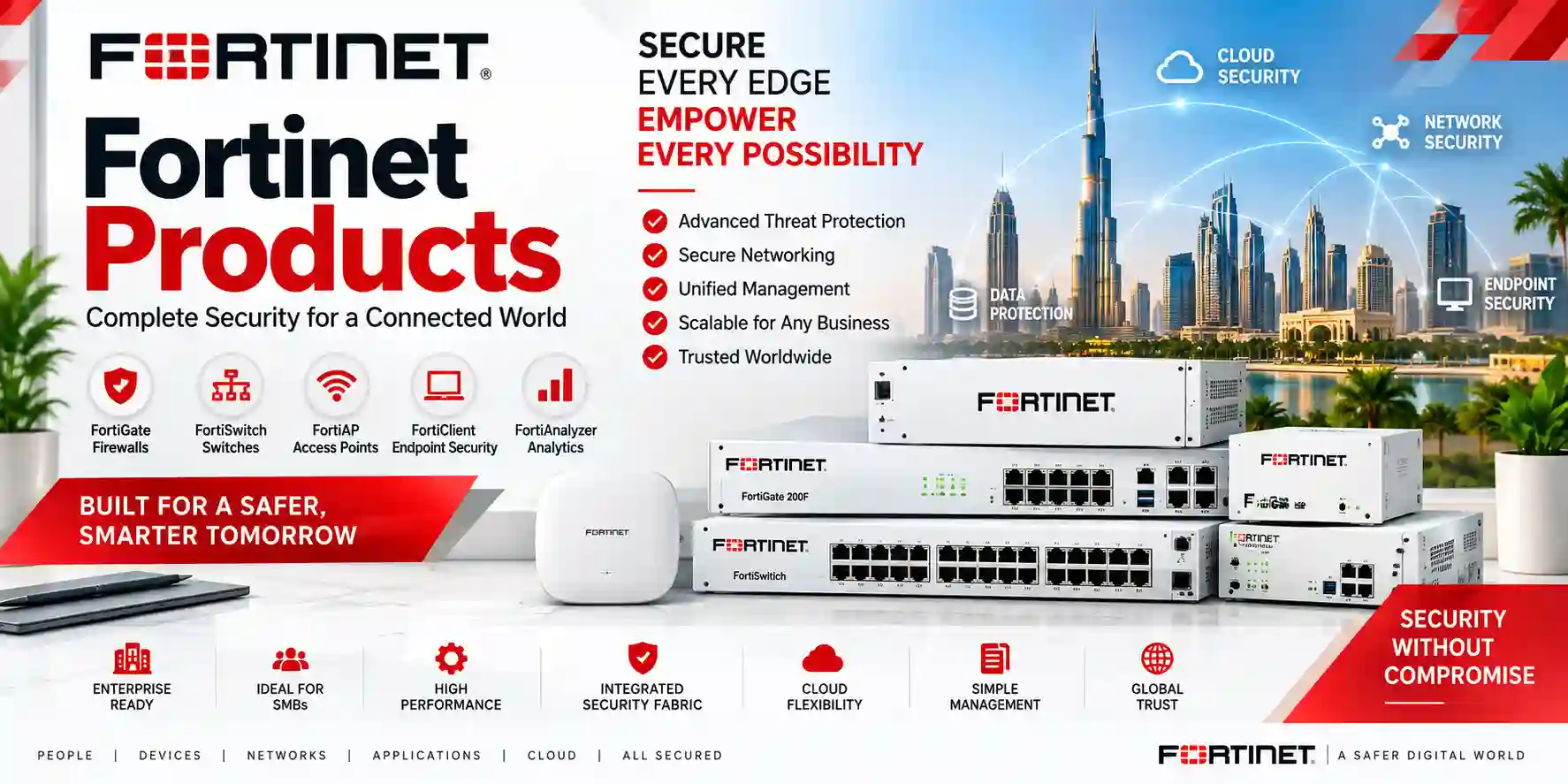
Fortinet Network Security Solutions bring firewalling, secure WAN, wired access, wireless networking, security services and centralized operations into a connected security architecture. Fortinet’s current Secure Networking portfolio spans FortiGate next-generation firewalls, FortiSwitch Ethernet switching, FortiAP wireless access points, FortiExtender connectivity, FortiGuard AI-Powered Security Services and management technologies such as FortiManager and FortiAnalyzer. For organizations in Tanzania, the practical value is not simply having more security features. The value comes from choosing the right components for the traffic profile, business applications, site layout, branch structure, remote-access requirement, internet links and operational skills available to the IT team.
FourTeck helps customers approach Fortinet procurement as an architecture decision rather than a box purchase. A useful requirement should define users and devices, internet bandwidth, expected encrypted traffic, branch-to-branch connectivity, VLANs, Wi-Fi demand, PoE devices, security services, logging needs, availability targets and future growth. This makes it easier to compare FortiGate models, subscription terms and supporting products on equal assumptions and to prepare a deployment plan that remains understandable after handover.

Physical, virtual and cloud firewall options for branch, campus, data-center and hybrid environments, with model selection based on inspected traffic and required services.
Policy-driven WAN connectivity that combines networking and security in FortiOS and can use multiple transport types where the design requires resilience or application steering.
Secure wired and wireless access for offices, branches and campuses, with Fortinet management options that can bring LAN visibility closer to firewall policy.
FortiManager centralizes policy and device administration, while FortiAnalyzer consolidates security and network telemetry for visibility, investigation and reporting workflows.
What Fortinet Secure Networking is designed to solve
Modern business networks rarely have one edge. Employees use cloud applications, branches connect to headquarters, guests and contractors join wireless networks, cameras and building systems share switching infrastructure, remote staff need controlled access, and applications can sit on-premises or in public cloud environments. When each requirement is handled by a separate appliance or management console, operations become difficult to standardize. Fortinet’s Secure Networking strategy is built around converging security and networking across these edges so policy, visibility and administration can be more consistent.
That convergence does not remove the need for design. A FortiGate that is suitable for a small branch may not be appropriate for an internet-heavy campus or data center. A FortiSwitch with enough ports can still be wrong if its PoE budget, uplinks or management mode do not match the access layer. A FortiAP must be selected and placed according to coverage, capacity and client behavior, not marketing speed alone. FortiManager and FortiAnalyzer become more useful as the environment grows, but they should be included for a defined operational purpose. The objective is a right-sized architecture with clear responsibilities, documented dependencies and subscriptions aligned to the security services the business actually intends to use.
Core Fortinet network security components
FortiGate Next-Generation Firewall
FortiGate provides the firewall and secure-networking foundation across multiple deployment forms. Depending on model, software version and licensed services, deployments can combine firewall policy, routing, IPsec connectivity, secure SD-WAN, application visibility, intrusion prevention and other threat-protection functions. Buyers should compare performance with the relevant inspection features enabled rather than using only raw stateful firewall throughput.
FortiGuard AI-Powered Security Services
FortiGuard services extend Fortinet platforms with threat intelligence and security capabilities such as intrusion prevention, malware protection, application control and web or DNS-related security services according to the selected subscription. Service names and bundle contents can change, so a quotation should identify the exact entitlement and term instead of describing the appliance as simply “licensed.”
FortiSwitch Secure Ethernet
FortiSwitch covers access, campus and data-center switching use cases. Fortinet supports standalone and integrated management choices, including FortiLink-based operation with FortiGate. Selection should consider port speed, uplinks, PoE, redundancy, device density, segmentation, stacking or aggregation needs and the traffic that must cross the access layer.
FortiAP Secure Wireless LAN
FortiAP extends secure networking to wireless users and devices. Fortinet supports FortiGate-managed and cloud-management approaches depending on design. A professional WLAN plan still requires attention to floor plans, RF conditions, client density, roaming, channel use, authentication, SSID-to-VLAN mapping and wired backhaul capacity.
FortiManager
FortiManager is designed for centralized management of Fortinet network and security environments, including FortiGate and related secure-networking use cases. It can help teams standardize policy, configuration and operational workflows across multiple sites. The business case becomes stronger when many devices or branches would otherwise be managed individually.
FortiAnalyzer
FortiAnalyzer consolidates telemetry and supports analytics, dashboards, investigation and response workflows across the Fortinet Security Fabric. Logging architecture should be sized around event volume, retention, reporting expectations and operational use; collecting data without a clear review process does not automatically improve security.
How to size a Fortinet solution before requesting a quote
Start with the real workload. Record primary and backup internet speeds, expected growth, number of users, approximate device count, cloud usage, site-to-site VPNs, remote-access requirements, public services, number of network segments, wireless density, PoE devices and critical applications. Then define the security services that will be used continuously. Intrusion prevention, malware inspection, application control, encrypted-traffic inspection and detailed logging can change the usable performance envelope compared with simple forwarding. The right platform should have enough headroom for busy periods, firmware evolution and realistic growth without being needlessly oversized.
The same principle applies to switching and wireless. Count today’s wired ports, then include growth and spare capacity. Calculate the actual PoE load from access points, cameras, phones and other powered devices. Check uplink bandwidth between access and core layers. For Wi-Fi, plan for people and applications rather than square metres alone. In multi-site environments, document which settings should be standardized and which must remain local. A consistent VLAN pattern, device naming convention, policy structure, logging approach and change process often creates more operational value than using identical hardware everywhere.
Deployment patterns: branch, campus, data center and hybrid work
A branch deployment often emphasizes compact firewalling, secure SD-WAN, IPsec connectivity, local segmentation and simplified remote administration. A campus adds larger switching and wireless requirements, more device categories, higher user density and stronger needs for consistent access policy. A data center can require higher throughput, high availability, internal segmentation, rich interfaces and detailed visibility. Hybrid-work and distributed-access designs may add FortiSASE or other zero-trust and endpoint considerations beyond the site firewall.
These patterns can share a common Fortinet ecosystem while still requiring different models and operational methods. That is why a bill of materials should follow the architecture, not the other way around. Start by defining the traffic paths, trust boundaries, availability requirements and management model. Then map Fortinet products to those needs and confirm the exact data sheets, software compatibility, licensing and lifecycle status for the specific models selected.
Fortinet Network Security Solutions Tanzania
Fortinet Network Security Solutions Tanzania buyers commonly need to protect a mixture of head offices, branches, customer-facing locations, warehouses, education sites, clinics, hospitality properties, project offices and operational facilities. These environments rarely have identical connectivity or risk profiles, so model selection should be based on each site’s real traffic and business role. A Dar es Salaam head office with large cloud usage, many remote users and several WAN links can require a different FortiGate class from a compact regional branch. Likewise, a campus with dozens of wireless access points and PoE devices should be planned around switching, uplinks and centralized management rather than treating the firewall as the only security component. Fortinet’s Secure Networking portfolio is useful because it can connect firewall, SD-WAN, switching, wireless and management decisions within one broader architecture, while still allowing each site to be sized appropriately.
For Tanzania procurement, request a quotation that separates hardware, support, FortiGuard security services, management or analytics subscriptions, implementation and any migration work. Do not assume that every FortiGate quotation contains the same services or term. If the organization is replacing an existing firewall, provide the current model, internet speeds, VPNs, published services, VLANs, authentication dependencies and any special policies that cannot be interrupted. Where branches depend on cloud applications or headquarters systems, review WAN continuity and secure SD-WAN requirements alongside the security design. If a secondary internet link exists, define which traffic should fail over, what performance is acceptable on the backup path and how public-IP dependencies will be handled.
FourTeck Tanzania can help turn those inputs into a clearer procurement request. Buyers can review the FourTeck Tanzania services overview for network, firewall, Wi-Fi and infrastructure planning, use the Tanzania technology shop to understand product-selection dependencies, and study the FortiGate 30G Tanzania product page as an example of model-specific sizing and licensing guidance. The aim is to obtain a Fortinet solution whose firewall capacity, inspection services, LAN design, wireless architecture and operational processes fit the organization instead of purchasing from a model name alone.
Fortinet Network Security Solutions Dar es Salaam
Fortinet Network Security Solutions Dar es Salaam projects often involve offices and commercial sites with heavy dependence on fibre internet, SaaS platforms, video meetings, cloud storage, ERP systems, IP telephony, CCTV and guest Wi-Fi. The security gateway can become the meeting point for multiple ISP circuits, internal VLANs, remote access and inter-branch VPNs. In that environment, a firewall should be sized around inspected traffic and concurrency, not only the advertised internet package. A company may have a 1 Gbps link but still require less or more firewall capacity depending on how much traffic is encrypted, how broadly intrusion prevention is applied, whether application control is enabled, and how much headroom is needed for future growth. Network design should also identify whether security policy is enforced between internal segments or only at the internet edge.
Dar es Salaam organizations with more than one provider can consider Fortinet Secure SD-WAN to steer traffic according to application policy and link health. The design should define which applications prefer each path, how failures are detected, whether long-lived sessions can tolerate a path change and what happens to services that depend on a fixed public IP address. For offices with several floors or departments, FortiSwitch and FortiAP can be evaluated as part of the same Secure Networking architecture so wired and wireless access align with segmentation and management policy. Guest users, staff devices, IP phones, cameras and infrastructure management should not automatically share the same trust level. Where suitable, VLANs and firewall policy can create clearer boundaries and make troubleshooting more predictable.
Before requesting a Dar es Salaam quote, document user count, device count, WAN circuits, approximate traffic profile, number of VLANs, IPsec tunnels, remote-access method, wireless access points, PoE demand, logging expectations and planned security services. State whether the scope is supply only, staged configuration, complete migration or ongoing operational assistance. FourTeck’s Tanzania contact page provides the verified enquiry route and explains which project details help build a meaningful quotation. A clear scope makes it easier to compare Fortinet proposals and reduces the risk that licensing, migration, WAN failover or supporting LAN requirements are discovered only after equipment arrives.
Fortinet Network Security Solutions Mwanza
Fortinet Network Security Solutions Mwanza can support regional offices, healthcare sites, schools, hospitality operations, trading businesses, warehouses and branch locations that need professional network control while maintaining practical remote manageability. For many regional deployments, connectivity is one of the first design questions. The site may use fibre, fixed wireless, mobile connectivity or more than one provider. Nominal bandwidth does not fully describe the user experience; packet loss, latency, path stability and peak-hour behavior can matter just as much. A FortiGate deployment should therefore be designed around the real WAN handoff and the applications that depend on it. If the site connects to headquarters, IPsec routing and addressing must be planned so local subnets do not overlap and so required business systems cross the tunnel without exposing unnecessary services.
A second Mwanza priority is reducing the dependence on undocumented local changes. Regional branches are easier to support when firewall interfaces, VLANs, administrator access, DNS, NTP, policy names, VPN parameters and configuration backups follow a repeatable standard. FortiManager may become useful when an organization has enough Fortinet devices to justify centralized templates and policy administration, while FortiAnalyzer can support centralized visibility and reporting where log review is an operational requirement. These tools should be included for a defined management outcome rather than simply added to the bill of materials. If the site also uses FortiSwitch or FortiAP, a consistent access-layer design can make guest Wi-Fi, staff networks, cameras and other devices easier to separate and document.
For a Mwanza quotation, provide the firewall’s intended role, current internet service, expected bandwidth upgrades, critical cloud applications, user and device counts, required VPNs, remote-management constraints and the security services expected from FortiGuard. If a secondary WAN exists, specify whether it is for full failover, selected applications or emergency-only use. Also identify UPS, rack, cabling and environmental requirements because security appliances still depend on reliable power and physical installation. A well-prepared request helps determine whether a compact FortiGate is adequate or whether additional capacity and management capabilities should be considered before purchase.
Fortinet Network Security Solutions Arusha
Fortinet Network Security Solutions Arusha are relevant to hospitality companies, travel and tourism businesses, professional offices, NGOs, schools, clinics, retail operations and regional branches where staff, guests and operational devices often share the same property. These users do not necessarily belong in the same security zone. A guest wireless user should not automatically have a route to office computers, cameras, printers or management interfaces. Staff may need access to cloud applications and internal services, while building systems and IoT devices can have narrowly defined communication needs. FortiGate policy can form part of that segmentation, but the switches and wireless platform must preserve the intended VLAN and SSID structure from the access edge to the firewall.
Hospitality and customer-facing sites should also account for traffic variability. Guest usage can rise sharply at busy times, and the internet circuit may carry business systems, collaboration, payment traffic and public Wi-Fi simultaneously. Firewall sizing should use expected inspected traffic rather than a quiet-period average. FortiAP planning should consider room layout, construction materials, user density and roaming behavior. FortiSwitch selection should include the PoE power required by access points, phones, cameras and other devices. Where dual WAN is used, Secure SD-WAN policy can prioritize business-critical applications while treating guest traffic differently during a degraded or backup-link condition. The failover plan should be tested in a way that reflects real user workflows.
An Arusha procurement request should therefore combine security and access-layer details: internet bandwidth, number of wireless users, number and location of access points, wired devices, guest-network requirements, VPN destinations, remote administration, security subscription expectations and any central logging requirement. Businesses that need broader guidance can review the FourTeck Tanzania solution-led approach, which explains why networking, security and infrastructure should be planned as connected systems. The goal is a Fortinet design that remains secure without making normal hospitality or office use unnecessarily difficult.
Fortinet Network Security Solutions Dodoma
Fortinet Network Security Solutions Dodoma can be planned for government-adjacent organizations, professional services, education, NGOs, project offices, business branches and institutions that require clearer control over internet access, inter-site connectivity and internal segmentation. These deployments often benefit from documented policy and change control because security is not only about the initial installation. Administrators need to know who can modify firewall rules, how configuration backups are stored, which firmware branch is approved, how emergency access is handled and how changes are reviewed. FortiManager can support centralized operations when multiple FortiGate devices need consistent templates and workflows, while FortiAnalyzer can support reporting and investigation where the organization has defined logging and retention objectives.
For a Dodoma site, the design should begin with trust boundaries. Staff, servers, guest Wi-Fi, cameras, voice systems, administrative interfaces and any exposed services should be mapped before policy is written. Flat internal networks make it difficult to apply different controls and can allow unnecessary communication between device groups. If the LAN supports segmentation, firewall policy can limit paths according to business need. Branch connectivity to Dar es Salaam, Arusha, Mwanza or other offices can use IPsec where appropriate, but address plans must be coordinated so networks do not overlap. Where dual internet links are available, SD-WAN monitoring and routing policy should be designed around critical applications and tested against actual failure scenarios.
When requesting a Dodoma Fortinet quote, specify whether the project requires new architecture, replacement of an older firewall, multi-branch standardization or integration with an existing Fortinet environment. Include internet speeds, anticipated upgrades, VLANs, VPN peers, remote users, important applications, security-service expectations, reporting needs and implementation constraints. Also ask the supplier to identify subscriptions and support terms separately from hardware so renewal responsibilities are clear. The verified FourTeck Tanzania technology overview provides broader context for how firewalls fit with switching, Wi-Fi, servers and other business systems rather than operating as an isolated edge device.
Fortinet Network Security Solutions UAE
Fortinet Network Security Solutions UAE projects frequently combine high-speed internet, cloud applications, branch connectivity and larger security-inspection requirements. A common procurement mistake is to select a FortiGate according to raw firewall throughput while ignoring the services that will actually run. If an office expects broad intrusion prevention, malware scanning, application control, web security, encrypted-traffic inspection or detailed logging, the sizing exercise should use the relevant performance references for those functions and preserve operational headroom. The same applies to multi-site organizations: an appliance that is suitable for a small retail branch may not fit a headquarters, campus or internet-facing data center even when both sites use the Fortinet platform.
UAE organizations with offices across the Middle East or Africa can benefit from standardizing Fortinet design principles without assuming every country has identical connectivity. A common FortiOS policy structure, VLAN convention, administrator model, logging strategy and IPsec template can simplify operations, while local WAN interfaces and bandwidth policies remain site specific. Secure SD-WAN is especially relevant where multiple broadband, MPLS or 5G paths are used and applications need policy-driven steering. FortiManager and FortiAnalyzer can help larger environments centralize changes and telemetry, but capacity and licensing should be matched to the actual number of devices, logs and operational workflows.
FourTeck maintains a dedicated Fortinet UAE resource covering FortiGate, Fortinet license renewal, Secure SD-WAN, FortiSwitch, FortiAP, FortiManager and FortiAnalyzer. For procurement teams coordinating UAE and Tanzania sites, provide the exact country and deployment location, current firewall, WAN bandwidth, required security services, VPN design, branch count, implementation scope and preferred subscription term. A transparent bill of materials should distinguish appliance, subscriptions, support, configuration and migration so regional teams compare the same scope instead of only comparing the first hardware price.
Fortinet Network Security Solutions Uganda
Fortinet Network Security Solutions Uganda can support organizations that need consistent branch security, secure internet access, VPN connectivity, segmented LANs and improved control over distributed networks. The architecture should start from the business role of each site. A Kampala headquarters, a regional office, a retail outlet and a project location can all require different FortiGate capacities even when they share the same policy framework. Internet bandwidth, application mix, user density, VPN traffic and enabled inspection services are stronger sizing inputs than employee count alone. A smaller team using large cloud backups, continuous video meetings and deep inspection may generate more demand than a larger office with mostly light web and email traffic.
For multi-branch Ugandan networks, standardization should focus on configuration quality. Each site should have a documented address plan, VLAN scheme, firewall naming standard, VPN parameters, administrator permissions, backup process and logging destination. FortiManager can reduce repeated manual administration where enough sites justify centralized control, while FortiAnalyzer can provide a common source of telemetry and reports where the security team actively uses that data. If FortiSwitch and FortiAP are deployed, wired and wireless policy can be aligned with the same segmentation principles. Guest access, cameras, voice devices and staff systems should be grouped according to trust and operational requirements rather than convenience alone.
The FourTeck Uganda website provides a regional contact point for broader IT and networking requirements. A useful Fortinet quotation request should include city, number of sites, current ISP speeds, planned upgrades, devices, branch tunnels, remote access, security-service bundle expectations and whether staging or migration is required. For cross-border networks linking Uganda and Tanzania, coordinate private addressing and routing before VPN deployment so subnets do not overlap. The aim is to create a repeatable branch architecture that can be understood centrally while still respecting local bandwidth, power, site layout and operational constraints.
Fortinet Network Security Solutions Kampala
Fortinet Network Security Solutions Kampala are well suited to businesses that combine cloud applications, IP telephony, Wi-Fi, CCTV, point-of-sale, branch VPNs and internet-facing services on one corporate network. In an urban office, traffic patterns can change quickly as companies adopt more SaaS platforms or increase video collaboration. Firewall sizing should therefore include realistic growth and the amount of encrypted traffic to be inspected. The security team should also decide which internal flows require control. Routing every VLAN through a firewall can provide stronger visibility and policy, but it also increases traffic through the security gateway. That design choice must be accounted for when selecting the FortiGate and access-layer architecture.
Kampala deployments with several departments can use segmentation to create clearer boundaries between employees, guests, cameras, voice, servers and network-management interfaces. FortiSwitch can provide managed Ethernet and PoE for access points, phones and cameras, while FortiAP can provide centrally managed wireless access. The value of integration is strongest when the VLAN, SSID, authentication and firewall-policy plan is documented in advance. If primary and backup internet links are available, Fortinet Secure SD-WAN can use health measurements and policy to steer traffic, but the business should determine what happens during backup operation. A secondary circuit may not have enough capacity to carry guest Wi-Fi, large backups and business applications at full quality simultaneously.
When asking for Fortinet pricing in Kampala, define whether the project covers a single office or a broader Ugandan rollout. Share WAN speeds, approximate users and devices, VPN requirements, number of access points, switch port and PoE requirements, security services, desired reporting and the current firewall if one is being replaced. If the organization has a head office in another country, identify the networks and applications that must cross site-to-site tunnels. Clear information enables the supplier to recommend a complete architecture rather than a firewall that may later need unplanned switch, license or management changes.
Fortinet Network Security Solutions Arua
Fortinet Network Security Solutions Arua should be designed with remote manageability and operational simplicity in mind. Regional branches can have fewer on-site IT resources than a main office, which makes configuration standards, remote visibility and good documentation especially valuable. A branch firewall should have clearly named interfaces, understandable policies, current configuration backups and a known management method. If the organization operates several FortiGate devices, centralized administration can reduce the risk that every site becomes a unique build. The goal is not to remove local differences but to control them: WAN addressing, provider characteristics and local VLAN counts can vary while policy structure and operational procedures remain familiar to central IT.
Connectivity conditions should be validated before Secure SD-WAN or failover rules are written. A secondary path may use a different technology and may have much less bandwidth than the primary service. Policy should therefore identify essential traffic such as ERP, cloud productivity, voice or VPN access and determine what can be deprioritized during degraded operation. Link monitoring should measure paths that reflect real business reachability instead of testing only whether the local modem responds. Where a branch connects to a central office, IPsec routing and DNS dependencies need to be documented so services continue to function when a path changes.
For an Arua quotation, include WAN types, approximate speeds, whether public addressing is available, local subnets, tunnel destinations, user count, device count, wireless needs and FortiGuard services expected. If deployment will be staged remotely, define who will connect ISP equipment, local switches, power and console access, and how acceptance testing will be completed. A robust regional rollout is built as much from preparation and documentation as from the appliance itself. This approach can reduce avoidable travel and help the security platform arrive with a configuration that matches the site instead of a generic factory setup.
Fortinet Network Security Solutions Mbarara
Fortinet Network Security Solutions Mbarara can support growing branches, professional firms, healthcare sites, education locations, retail operations and regional businesses that rely on cloud services and central applications. Growth planning is a central part of the design. A branch may have moderate internet bandwidth today but expect faster service, additional staff, more cameras, more wireless clients or larger cloud workloads during the firewall’s useful life. Selecting a platform that operates near its practical inspected-traffic limit on day one can create an early replacement problem. The sizing exercise should therefore look at the future traffic profile and the security features that will remain enabled continuously, not only at the current router’s load.
Mbarara sites that connect to Kampala, Tanzania or another head office can use IPsec for encrypted inter-site communication where appropriate. Consistent private addressing and routing are important because overlapping subnets make multi-branch connectivity more difficult. If there are two internet links, Secure SD-WAN policy can monitor performance and decide which applications use each path. The backup link should be treated as a capacity-constrained business resource rather than a magical duplicate of the primary circuit. During a failure, guest traffic or large updates may need different treatment so transactional and operational applications remain usable.
A useful procurement request should describe the existing firewall, current WAN speed, planned upgrades, critical applications, branch tunnels, required security services, VLANs, access points and switch requirements. Ask for separate identification of FortiGuard, support and any centralized-management components so ongoing costs are understood. If the project includes migration, list public services, VPN peers, NAT rules and any whitelisted external systems that rely on current public IP addresses. These details help the implementation team build a controlled cutover plan and reduce the chance of discovering hidden dependencies during the maintenance window.
Fortinet Network Security Solutions Gulu
Fortinet Network Security Solutions Gulu are relevant where branch security must remain manageable despite distance from the primary IT team. A clear design should minimize the number of emergency changes that require local technical presence. That means documenting WAN handoffs, switch uplinks, VLANs, firewall interfaces, policy purpose, VPN settings and administrator access. Configuration backups should be maintained, and firmware changes should be planned rather than performed casually. If FortiManager is introduced, it can support standardized administration across distributed FortiGates; if FortiAnalyzer is used, the organization should define which logs, reports and alerts are operationally important so the telemetry contributes to real security work.
Internet continuity may be a major driver for a Gulu site that uses cloud applications. A secondary connection can improve resilience, but only when the failover design matches the available bandwidth and application behavior. Secure SD-WAN can monitor path quality and steer traffic, while firewall rules continue to enforce security. The business should identify priority applications, decide how guest or bulk traffic behaves during backup operation, and test recovery when the primary link returns. For branch-to-head-office access, IPsec design should include routing, authentication, address uniqueness and the services permitted across the tunnel.
When requesting Fortinet options for Gulu, state whether the location is standalone or part of a broader branch standard. Include expected users, internet circuits, VPNs, security inspection requirements, Wi-Fi and PoE devices, logging expectations and any restrictions on onsite support. If FortiSwitch or FortiAP are part of the architecture, verify wired uplink and power requirements before ordering. A good regional deployment focuses on resilience and operability: the platform should be secure, but it should also be understandable to the teams that must troubleshoot it months or years later.
Fortinet Network Security Solutions Kenya
Fortinet Network Security Solutions Kenya can be used across offices, retail networks, clinics, schools, hospitality sites, logistics operations, data centers and distributed branches. The most important planning principle is to avoid forcing one FortiGate model onto sites with very different traffic. A Nairobi headquarters, warehouse, small branch and remote operational location can share the same policy standards while using different appliance capacities. Each site should be assessed for WAN bandwidth, inspected traffic, user and device counts, VPN demand, number of segments and expected growth. Where FortiSwitch and FortiAP are deployed, access-layer scale, PoE, wireless density and uplink design should be considered alongside firewall performance.
Kenyan businesses with several branches may benefit from centralized FortiManager administration and FortiAnalyzer telemetry, especially when local configuration drift becomes difficult to control. Secure SD-WAN can support application-aware path selection over multiple transports, but the design must still define business priorities and test failure behavior. For regional organizations connecting Kenya to Tanzania, Uganda or UAE operations, use a coordinated private address plan and documented IPsec standards. DNS, identity, cloud services and public-IP dependencies should be reviewed as part of the architecture rather than assuming the tunnel alone completes the design.
The FourTeck Kenya website provides a regional route for firewall and enterprise-networking discussions. A Kenya procurement request should identify the cities and sites involved, current WAN services, likely bandwidth changes, important applications, branch connectivity, required FortiGuard security services and whether implementation, staging or migration is part of the scope. The objective is a repeatable Fortinet architecture that accommodates local site differences without creating unnecessary operational variation across the business.
Fortinet Network Security Solutions Kuwait
Fortinet Network Security Solutions Kuwait projects may involve business offices, retail, professional services, hospitality, industrial operations and multi-site enterprises that require secure internet access and consistent policy. High-speed connectivity can make firewall sizing deceptively simple if buyers look only at raw throughput. The more relevant question is how much traffic will be inspected with the selected security services and how much headroom is required for growth. Encrypted web applications, SaaS, cloud backup and video collaboration can place different demands on the platform, while branch VPNs and internal segmentation can add further traffic through the firewall. Exact model selection should therefore use current Fortinet data sheets for the specific appliance and software context.
For organizations with several Kuwait sites, secure SD-WAN can help apply policy across multiple WAN paths while FortiManager can centralize administration when scale justifies it. FortiAnalyzer can support centralized telemetry and reporting where the team has defined review processes. FortiSwitch and FortiAP can also be evaluated when the goal is to extend secure-networking principles into the LAN and WLAN. Procurement should identify the desired FortiGuard services, subscription duration, support, management tools and implementation separately so proposals can be compared on equivalent scope.
The FourTeck Kuwait website provides a verified regional resource for network security and business IT enquiries. When preparing a Fortinet request, include internet speeds, number of sites, users, VPNs, security services, wireless requirements, existing firewall models and expected changes during the appliance lifecycle. If the Kuwait site must connect with Tanzania or other regional offices, align IP addressing and inter-site routing before implementation. This gives the project team a clearer technical baseline and helps ensure that security, connectivity and operational management are designed together.
Fortinet Network Security Solutions Ghana
Fortinet Network Security Solutions Ghana can support enterprises, professional offices, retail networks, education, healthcare, hospitality and distributed organizations that need stronger control over internet access and branch connectivity. A practical design begins with inventory: what users, servers, cloud applications, cameras, phones, wireless clients and operational devices depend on the network? Which of those systems are business critical, and which need to communicate with each other? From that map, the security team can define VLANs, firewall policy, VPN relationships and access controls instead of deploying a perimeter appliance around an otherwise flat network.
Where Ghana sites use multiple internet providers, Fortinet Secure SD-WAN can combine path monitoring with security policy, but the organization should set realistic expectations for failover. The backup circuit may be slower or use a different handoff, and some sessions can reset when public source addresses change. Critical applications, DNS behavior, cloud whitelisting and voice traffic should be tested under failure conditions. FortiSwitch and FortiAP can be used to align wired and wireless access with segmentation, while centralized tools such as FortiManager and FortiAnalyzer may help when device count and operational requirements warrant them.
The FourTeck Ghana website is a verified regional resource for technology requirements. For a Fortinet quotation, provide the city, number of sites, internet speeds, projected growth, user and device counts, branch VPNs, remote access, security-service expectations, logging requirements and installation scope. If the organization operates across Ghana, Tanzania or other markets, standardize the parts of the design that improve support—naming, policy structure, IP planning, backups and documentation—while still allowing the hardware and WAN settings to fit each location’s real demand.
Fortinet Network Security Solutions Nigeria
Fortinet Network Security Solutions Nigeria can be designed for enterprises with substantial internet use, multi-branch operations, data-center workloads, retail locations and distributed business systems. The market contains organizations of very different scale, so the Fortinet platform should be matched to each role. A large headquarters may require high inspected throughput, high availability and centralized management, while a small branch may prioritize secure SD-WAN, IPsec and simple remote support. Standardization does not require identical hardware; it means using repeatable policies, naming conventions, addressing principles and operational controls so sites can be managed consistently.
For Nigerian multi-site networks, WAN variability can make secure SD-WAN especially relevant. The design can incorporate broadband, dedicated circuits or wireless alternatives where available, but business priorities must be explicit. Critical transactions, collaboration, cloud systems and inter-branch traffic can be treated differently from guest access or bulk transfers. Firewall sizing should use the inspection profile that will actually be enabled, while switch and wireless planning should account for device density, PoE and uplink capacity. Where centralized control is needed, FortiManager and FortiAnalyzer can reduce policy variation and bring logs into a common operational view.
The FourTeck Nigeria website offers a verified regional entry point for related IT and security requirements. A quotation request should state deployment locations, internet services, current firewalls, users, branch connectivity, required security services, reporting, migration scope and expected growth. Organizations linking Nigeria with Tanzania or other markets should coordinate IP addressing and VPN design early. This avoids overlapping networks and supports a cleaner regional architecture where local teams can follow the same operational model without forcing every site into the same physical configuration.
Fortinet Network Security Solutions Seychelles
Fortinet Network Security Solutions Seychelles can be relevant to hospitality properties, professional offices, financial services, government-related organizations, retail, education and island-based operations where connectivity and remote support need careful planning. A hotel or resort network can include guests, staff, point-of-sale, cameras, access control, building systems, IP phones and operational devices on shared infrastructure. These systems should not automatically trust one another. Segmentation, role-appropriate firewall policy and well-designed wired and wireless access can reduce unnecessary exposure while preserving the services guests and staff need.
Connectivity resilience deserves particular attention because a site may have limited choices compared with a major mainland commercial center. If primary and secondary internet paths exist, Fortinet Secure SD-WAN can monitor path quality and apply policy, but the failover design must be based on the actual backup capacity. During a constrained-link condition, business applications, payment traffic or voice may require priority over guest streaming or large software updates. FortiAP planning should account for building materials, room layouts, outdoor spaces and user density, while FortiSwitch design should include PoE and uplink capacity. If the organization operates several properties, centralized FortiManager and FortiAnalyzer can be evaluated for policy consistency and shared visibility.
For a Seychelles Fortinet quotation, provide the island or site location, internet handoffs, user and device counts, access points, switch requirements, guest-network design, VPN destinations, expected FortiGuard services and remote-support constraints. Include power, rack and environmental considerations where equipment is installed outside a standard office. If a property is part of a group with operations in Tanzania, UAE or another country, a common policy and documentation standard can simplify remote support while allowing each site to use the hardware class and WAN configuration appropriate to its workload.
Related FourTeck Tanzania resources
Use these verified Tanzania pages to connect Fortinet planning with the broader network environment. Each link has a different purpose, so procurement and technical teams can move from general architecture to model-specific guidance and then to a quotation discussion.
Explains how firewalls, switching, Wi-Fi, servers, CCTV and business systems fit into one integrated infrastructure plan.
Describes the outcome-led approach to product selection, integration, lifecycle planning and supportable solution design.
Provides practical guidance around firewall sizing, network segmentation, managed switching, Wi-Fi and infrastructure planning.
Helps buyers check capacity, compatibility, PoE, lifecycle and security dependencies before choosing a device.
A model-specific example showing how published FortiGate performance, VPN capability, licensing and branch deployment should be evaluated together.
A verified product-category archive that currently includes the FortiGate 30G listing and other available catalogue entries.
The verified FourTeck Tanzania contact route for sharing users, devices, bandwidth, site details, current equipment and deployment scope.
Small-business and branch Fortinet planning
Small-business security should not be treated as a smaller copy of a data-center design. Compact offices need the right balance of internet protection, segmentation, VPN, Wi-Fi, switching and manageability without unnecessary complexity. Start with the business services that must remain available, the devices that require different trust levels and the internet paths that carry those services. Then choose the Fortinet components that meet those needs with enough performance and lifecycle headroom.
For branch rollouts, consistency matters. Standard policy names, VLAN conventions, IP address templates, backup procedures and documentation can reduce support time across locations. Hardware can still vary by site size. This is usually preferable to forcing a large appliance onto a small site or an undersized appliance onto a high-demand branch merely for the sake of standardization.

Fortinet licensing, FortiGuard and lifecycle planning
Fortinet hardware and Fortinet security services should be treated as related but separate commercial components. The same appliance can be quoted with different support levels, service bundles and subscription terms. Ask for the exact FortiCare and FortiGuard entitlements, duration, start conditions and renewal responsibility. If the environment uses FortiManager, FortiAnalyzer, FortiSASE or other licensed products, include those items explicitly rather than assuming they are part of the FortiGate purchase.
Lifecycle planning also includes software compatibility, configuration backup, firmware policy, administrator access, certificate expiry, VPN dependencies and documentation. Before replacing an older FortiGate, identify features that may have changed between models or FortiOS generations. Build a migration checklist that includes interfaces, routes, NAT, policies, security profiles, VPNs, DNS, authentication, public services and rollback. A controlled migration is safer than copying an old configuration without checking whether every rule is still required.
Quotation checklist for Fortinet Network Security Solutions
List countries, cities, number of locations, approximate users, devices and expected growth.
Provide primary and backup speeds, handoff types, public IP requirements and branch connectivity.
State whether IPS, malware protection, application control, web or DNS security and encrypted inspection are required.
Include switch ports, PoE demand, VLANs, access points, guest networks, uplinks and growth.
List site-to-site peers, remote-user requirements, authentication and applications that must cross tunnels.
Define central management, retention, reporting, alerting and operational review expectations.
Identify current firewall, policy conversion, public services, change window, testing and rollback requirements.
Separate hardware, subscriptions, support, staging, installation, configuration, documentation and training.
Frequently asked questions
What products are included in Fortinet network security solutions?
Fortinet Secure Networking currently includes FortiGate next-generation firewalls, FortiSwitch Ethernet switching, FortiAP wireless access points, FortiExtender connectivity, FortiGuard AI-Powered Security Services and management technologies such as FortiManager. FortiAnalyzer is commonly used for centralized telemetry, analytics and reporting. The exact architecture depends on the required use case.
How do I choose the right FortiGate for Tanzania?
Use internet bandwidth, expected inspected traffic, user and device counts, IPsec demand, enabled security services, number of network segments, interface requirements, growth and availability targets. Do not choose only from raw firewall throughput. Compare the performance figures that correspond to the security functions you plan to enable.
Does Fortinet Secure SD-WAN require separate bandwidth licensing?
Fortinet states that Secure SD-WAN does not use licensing based on bandwidth, data transfer or service tiering. Other security services, support and products can still have their own licenses or subscriptions, so the complete commercial bundle should be confirmed for the selected design.
Can FortiSwitch and FortiAP work with FortiGate?
Yes. Fortinet provides integrated Secure Networking approaches in which FortiSwitch and FortiAP can be managed through Fortinet platforms, including FortiGate-based management in supported designs. Exact compatibility, feature support and software versions should be checked for the selected models before procurement.
When is FortiManager useful?
FortiManager becomes valuable when an organization needs centralized policy and configuration management across multiple Fortinet devices or sites. It can help enforce consistent templates and reduce repetitive administration. Whether it is necessary depends on device count, governance and the operational model.
What is the role of FortiAnalyzer?
FortiAnalyzer consolidates telemetry from network, endpoint and cloud environments and provides dashboards, analytics, threat intelligence integration and investigation capabilities. A deployment should be sized around data volume, retention and the way the security team will use the information.
What information should I send for a Fortinet quote?
Send the country and city, number of sites, internet speed, users, devices, WAN links, VLANs, VPNs, remote-access needs, security services, current firewall, wireless and switching environment, expected growth, preferred subscription term and whether installation or migration is required. This gives the supplier enough context to quote a solution instead of an isolated appliance.
Decision recap: buy the architecture, not only the firewall
A Fortinet network security project works best when FortiGate sizing, FortiGuard services, WAN design, switching, Wi-Fi, segmentation, VPN, logging and operational management are considered together. The correct solution can be a compact branch deployment or a much larger multi-site architecture, but in both cases the design should be tied to traffic, risk, applications and growth.
Before ordering, verify the exact model data sheet, subscriptions, support term, software compatibility and implementation scope. For cross-border projects, standardize policy and documentation where practical while allowing each site to use the capacity and connectivity appropriate to its environment. FourTeck can use your user count, bandwidth, branches, VPN requirements and security priorities to help structure a clearer quotation request.
Regional FourTeck network for related requirements
Organizations with technology requirements across several countries can also use verified FourTeck regional sites for local context: FourTeck Kenya for Kenyan networking and firewall requirements, FourTeck Uganda for Ugandan IT and connectivity enquiries, Fortinet UAE by FourTeck for Fortinet-specific UAE buying and renewal guidance, FourTeck Kuwait for Kuwait networking and cybersecurity requirements, FourTeck Ghana for Ghana technology projects, and FourTeck Nigeria for Nigerian IT and security requirements. These links support regional procurement planning without implying that every country should use an identical product or deployment scope.