
Fortinet Secure SD-WAN Deployment
Fortinet Secure SD-WAN brings WAN steering, routing, next-generation firewall security and branch connectivity together on FortiGate. A successful deployment is not simply a matter of enabling a second WAN interface. It begins with the applications the business must protect, the internet and private links available at each site, the service levels those applications need, the security policy that must remain consistent across branches and the operational model that will be used after go-live.
For Tanzania organizations building new branch networks, replacing traditional routers, adding backup internet or connecting operations across countries, a disciplined Fortinet Secure SD-WAN deployment can use multiple transports, health measurements, application-aware rules, encrypted overlays and centralized management to create a more manageable WAN edge. The exact architecture should be selected from verified Fortinet capabilities and the customer’s real traffic profile rather than copied from a generic template.

Build SD-WAN members from appropriate physical, VLAN, aggregate or IPsec interfaces and define how paths are used for business traffic.
Use FortiOS SD-WAN rules and performance measurements so important traffic can prefer links that meet defined health and service objectives.
Combine encrypted IPsec overlays with routing and security policy to connect branches, hubs, data centers and approved cloud destinations.
FortiManager and FortiAnalyzer can be incorporated where centralized configuration, policy control, analytics, logging and multi-site administration are required.
What Fortinet Secure SD-WAN deployment solves
Traditional branch WANs are often built around a single fixed path or a primary circuit with a basic backup. That approach can leave cloud applications, voice, video, ERP traffic and branch-to-branch services sharing the same path even when another available link is performing better. Fortinet Secure SD-WAN adds policy intelligence at the WAN edge. FortiOS can measure path conditions, classify traffic and apply SD-WAN rules that steer sessions according to the requirements defined by the network team. Fortinet documents both static and dynamic application steering, active/active and active/standby forwarding, multi-WAN transport support, encrypted overlays and SLA-based path selection.
The security element matters just as much as the routing element. Fortinet positions Secure SD-WAN as part of the FortiGate platform rather than as a separate branch router that must be protected by another appliance. That means network security, routing, VPN and SD-WAN policy can be coordinated in FortiOS. In a real project this can reduce architectural duplication, but it also makes correct sizing critical: the FortiGate model must be selected for the security inspection, encrypted traffic, sessions, interfaces and throughput the site will actually use, not only for raw stateful firewall performance.
For an organization with many locations, standardization becomes a major operational benefit. Site types can be grouped into repeatable patterns such as small branch, large branch, head office, hub, data center or cloud-connected site. Addressing, SD-WAN zones, performance SLA targets, security rules, overlay conventions and management templates can then be designed so that the deployment remains understandable as it grows. Fortinet’s deployment guidance emphasizes modeling, templates, staging, provisioning and reusable designs, which is especially useful when the same architecture must be repeated across many branches.
Recommended Fortinet Secure SD-WAN deployment workflow
List sites, user groups, critical applications, cloud services, voice and video traffic, internet-facing services, VPN dependencies, current WAN circuits, latency-sensitive systems, public IP requirements and planned growth. Identify which traffic must survive a link outage and which traffic can accept a brief interruption.
Document each ISP or private WAN handoff, addressing method, gateway, bandwidth, routing behavior, modem or ONT ownership, public IP use and provider restrictions. SD-WAN cannot compensate for an undocumented underlay. Link diversity should be evaluated physically and commercially, not assumed because two service names are different.
Add appropriate interfaces as SD-WAN members and group them into zones that make policy intent clear. Fortinet documentation allows different interface types to participate in SD-WAN, subject to configuration requirements. Naming should remain consistent so administrators can understand the design quickly.
Choose health-check targets that represent the services that matter and define realistic thresholds for latency, jitter and packet loss where appropriate. A probe should answer a useful operational question. Reaching an ISP gateway does not always prove that a cloud application is usable, so measurement strategy deserves careful design.
Prioritize business-critical traffic according to policy and path quality. Voice, video meetings, ERP, SaaS, backups and general browsing may require different behavior. Avoid creating so many rules that troubleshooting becomes difficult. Start with clear business classes and document exceptions.
Where sites must communicate privately, plan IPsec overlays, hub-and-spoke or more advanced topologies, route advertisement, dynamic routing and segmentation. Fortinet supports designs using technologies such as IPsec, BGP and ADVPN; the right choice depends on scale, site relationships and operational skill.
Define zones, allowed applications, inspection profiles, NAT behavior, inter-VLAN access, administrative access and logging. Subscribed FortiGuard security services should be selected according to the protection functions required and the commercial bundle purchased.
Back up existing configurations, define rollback, pre-stage devices where possible, test both links, force failure scenarios, verify route convergence, confirm application reachability and check that security inspection remains active after failover. Record results so the site is not considered complete until expected behavior is demonstrated.
Dual-WAN, load balancing and failover are only part of SD-WAN
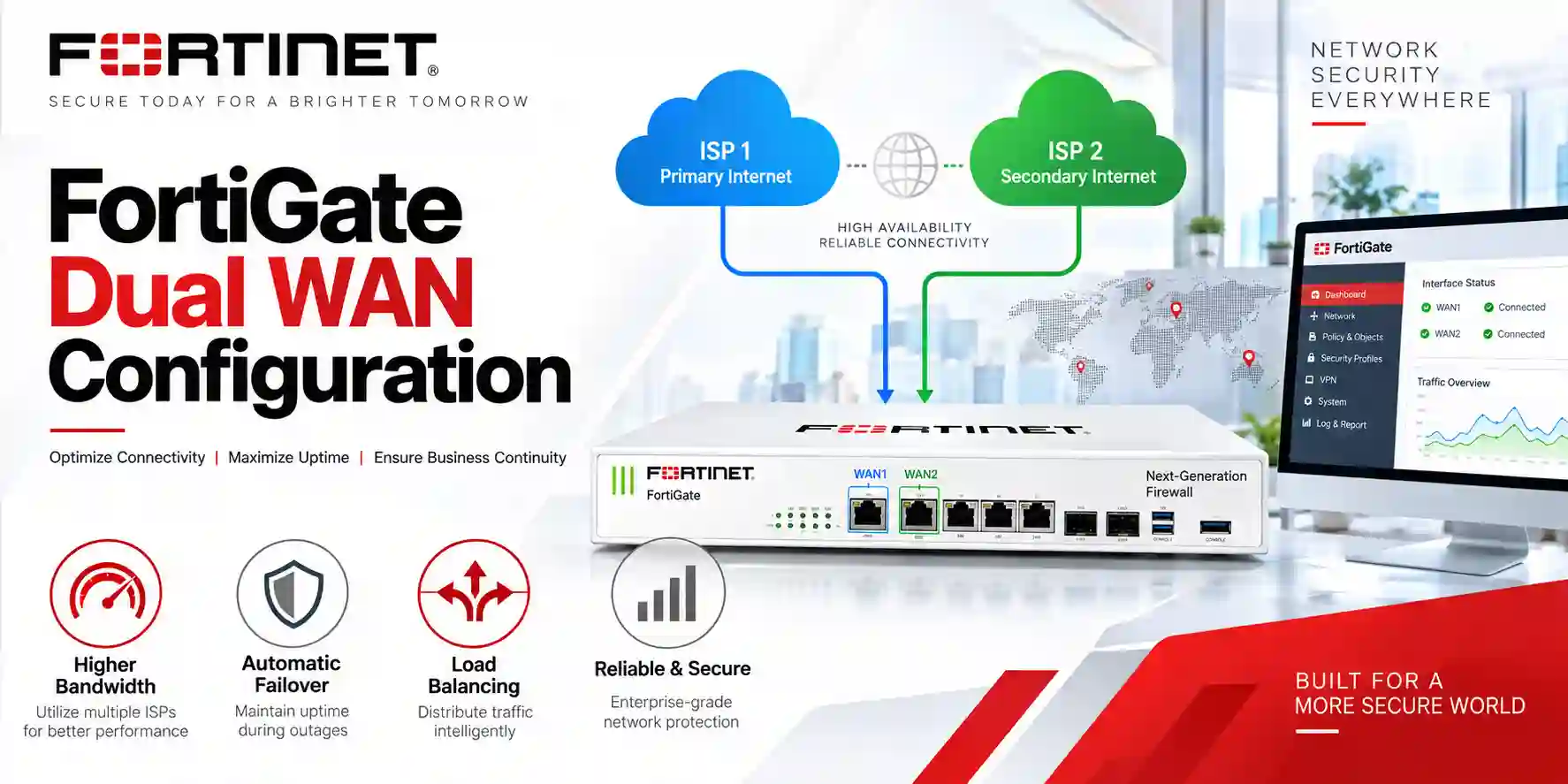
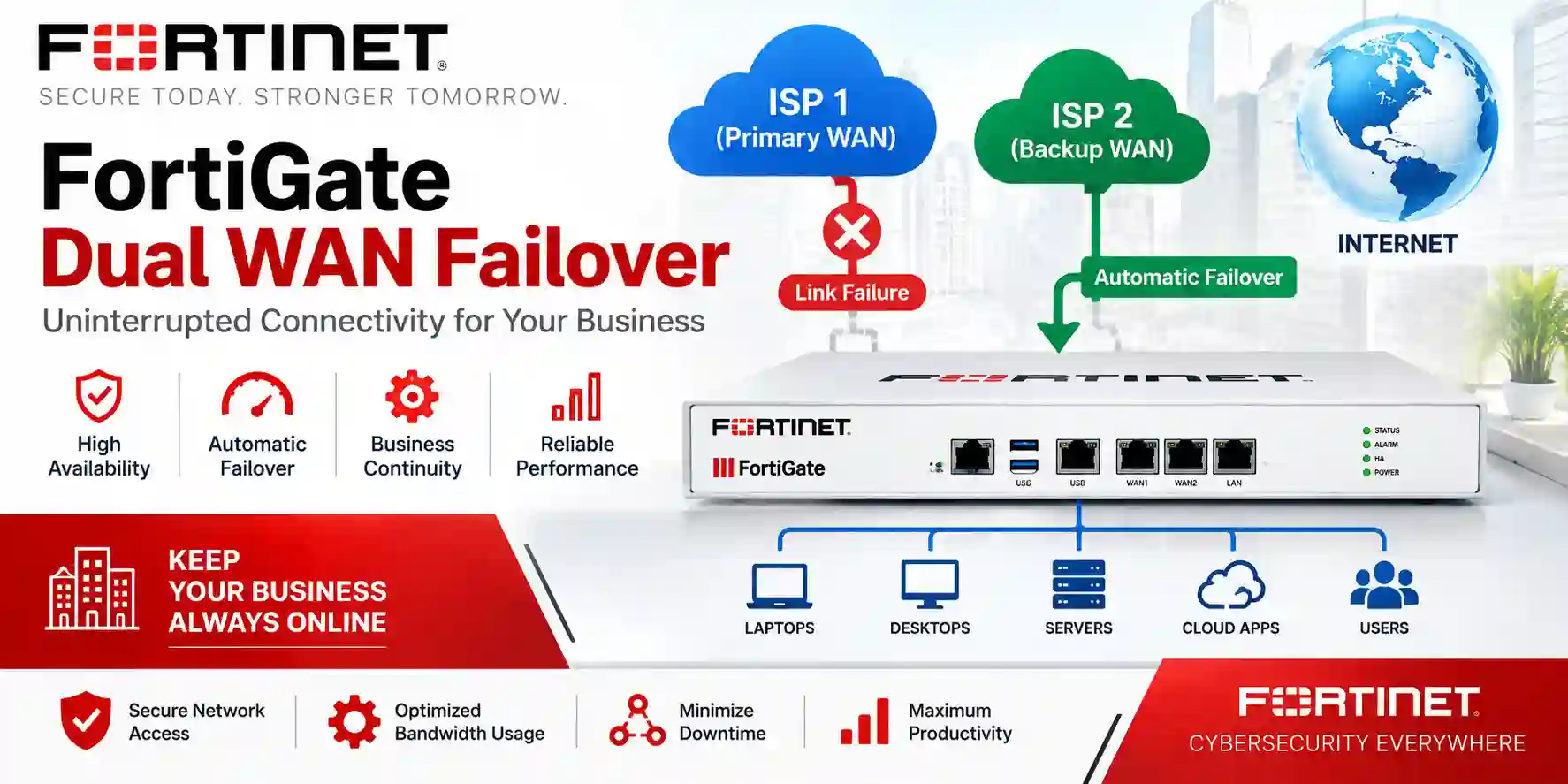
A common starting requirement is “use ISP 1 as primary and ISP 2 as backup.” FortiGate can support that type of design, but Secure SD-WAN can go further. Instead of treating every application identically, policy can evaluate traffic classes and path health. A business may choose to keep collaboration traffic on the link with better latency and loss characteristics while sending software updates or noncritical browsing through another available circuit. Another design may use both links actively and reserve a specific path for an application that depends on a known source address.
These decisions must account for session behavior. When a WAN path fails, an existing session may need to be re-established because the source path, NAT address or remote peer changed. Therefore, “automatic failover” should not be interpreted as a promise that every application session will continue without interruption. Good acceptance testing measures what users actually experience and documents the behavior of important applications during link degradation and hard failure.
Fortinet Secure SD-WAN technical planning points
| Area | What to define | Why it matters |
|---|---|---|
| Underlay | ISP links, addressing, bandwidth, gateways, diversity, public IP needs | SD-WAN decisions are only as reliable as the paths being measured. |
| Health checks | Targets, latency, jitter, packet loss and failure criteria | Poor thresholds can cause unnecessary path changes or hide degraded service. |
| Applications | Critical SaaS, voice, video, ERP, backup, guest and general traffic | Application classes drive meaningful path-selection policy. |
| Overlay | IPsec topology, hubs, routing, segmentation and address plan | A scalable overlay avoids manual tunnel sprawl and routing conflicts. |
| Security | Firewall policy, security profiles, inspection, administrator controls | Connectivity should not bypass the controls that protect the branch. |
| Operations | FortiManager, FortiAnalyzer, backups, change control and monitoring | Repeatable operations matter more as branch count increases. |
| Acceptance testing | Path failure, degraded link, VPN reachability, DNS and app tests | A site is not validated until expected behavior is proven under failure. |
Licensing, subscriptions and management
Fortinet Secure SD-WAN capabilities are delivered through FortiOS on FortiGate, but a complete commercial solution may include much more than the appliance. Security inspection functions can depend on active FortiGuard subscriptions, support depends on the FortiCare entitlement, and centralized management or analytics can involve FortiManager, FortiAnalyzer or related services and licenses according to the selected deployment model. Cloud-delivered or advanced services can have their own commercial terms. For that reason, two quotations that both say “Fortinet SD-WAN” may not be commercially equivalent.
Procurement teams should request a line-by-line bill of materials showing the exact FortiGate model, support level, FortiGuard package, subscription duration, FortiManager or FortiAnalyzer requirement, any virtual or cloud components, professional deployment scope and renewal assumptions. It is also useful to clarify whether the proposal covers design, migration, policy conversion, IPsec overlay creation, SD-WAN rules, testing, documentation, administrator handover and post-cutover assistance. This prevents implementation effort from being hidden behind the hardware price.
Related FourTeck resources for planning the wider environment
Tanzania technology shopUse the product-selection guidance to consider firewalls, switches, access points and supporting infrastructure as one design.
FortiGate 30G TanzaniaSee an example of a compact FortiGate branch platform and the importance of sizing security throughput, VPN and subscriptions correctly.
Fortinet UAE resourceUseful for multi-country procurement teams comparing FortiGate, FortiManager, FortiAnalyzer and Secure SD-WAN requirements in the UAE.
FourTeck AfricaRegional reference for organizations coordinating network, security and branch technology requirements across African operations.
Fortinet Secure SD-WAN Deployment Tanzania
Fortinet Secure SD-WAN Deployment Tanzania is most relevant to organizations that operate more than one site, depend on cloud applications, need stronger internet resilience or want branch routing and security to be managed as one architecture. A Tanzania deployment can range from a head office with dual fiber circuits and many remote branches to a compact site that uses fiber as primary connectivity and wireless broadband as an alternate path. The correct design begins by documenting what each connection can actually provide: committed or typical bandwidth, public addressing, upstream NAT behavior, latency, outage history, handoff type and whether the second link is genuinely diverse from the first. Two services can appear independent on invoices while still sharing the same physical route, power dependency or upstream infrastructure.
The next step is to define which business services justify intelligent path selection. Cloud productivity, voice, video meetings, ERP, payment or transaction traffic, remote desktop, backups and guest browsing should not automatically receive identical treatment. FortiOS SD-WAN rules can be built around application identity, addresses, services and measured path health. For critical applications, the project should establish useful SLA measurements and decide what happens when a path becomes degraded rather than fully unavailable. This distinction matters because a link may still pass traffic while packet loss or latency makes an application unusable.
For organizations with branches in Dar es Salaam, Mwanza, Arusha, Dodoma or other locations, the overlay design should use a consistent IP addressing plan and clearly documented VPN or routing conventions. Fortinet supports encrypted overlays and dynamic routing options that can scale beyond a collection of individually configured tunnels. Whether the topology is hub-and-spoke, dual-hub or another supported design should be based on where applications live, whether branches need direct communication, the available data-center or cloud locations and the failure scenarios the organization can tolerate.
Procurement for Tanzania should therefore include more than FortiGate hardware. A complete request should state the number of sites, WAN links per site, internet speeds, expected security inspection, critical applications, VPN topology, remote-access requirements, required FortiGuard services, management platform, logging expectations, implementation responsibility and support period. Stock, price, delivery time and local service coverage should be confirmed at quotation stage rather than assumed. This produces a deployable bill of materials and a testable implementation scope instead of a collection of appliances with no agreed operating model.
Fortinet Secure SD-WAN Deployment Dar es Salaam
Fortinet Secure SD-WAN Deployment Dar es Salaam often centers on dense commercial environments where a head office, retail location, professional office, logistics facility, hospitality property or service center depends heavily on cloud access and stable connectivity. The design challenge is rarely a simple lack of bandwidth. Many sites already have strong primary internet but still experience business disruption when the circuit fails, when latency changes during busy periods or when noncritical traffic competes with collaboration and business systems. Secure SD-WAN provides a structured way to use two or more available paths according to policy, but the business must first identify which applications are important enough to receive preferred treatment.
A Dar es Salaam office may have fiber from one provider and a second wired or wireless service from another. During discovery, the technical team should confirm whether each circuit terminates on separate provider equipment, how public IP addresses are assigned, whether inbound services depend on one fixed path and whether both links can carry encrypted tunnels to branch or cloud destinations. If voice or video meetings are business-critical, health checks should measure conditions that affect real-time traffic rather than only link reachability. If a SaaS application depends on regional internet routing, it may be useful to test the path toward that service rather than use a single generic probe target for every rule.
Cutover planning deserves special attention in a busy city office because many services can depend on the current firewall. DNS forwarding, DHCP, NAT, site-to-site VPN, remote access, published servers, Wi-Fi authentication and VLAN routing may all need to be preserved or redesigned. A staged migration should include a configuration backup, a rollback method, pre-created policy objects, agreed change window and acceptance tests. After activation, engineers should deliberately disconnect or degrade each WAN path and verify that the observed behavior matches the design. Testing only normal operation leaves the most important resilience features unproven.
For procurement teams in Dar es Salaam, a good Fortinet SD-WAN proposal should identify the exact FortiGate sizing basis, security subscriptions, management tools, overlay design, number of circuits, professional services and documentation deliverables. It should also state who owns coordination with internet providers if addressing or modem changes are required. The result should be a network that is understandable by the customer’s IT team and maintainable after installation, not a one-time configuration that only the original implementer can interpret.
Fortinet Secure SD-WAN Deployment Mwanza
Fortinet Secure SD-WAN Deployment Mwanza can be valuable for branch offices, trading operations, healthcare sites, education environments, hospitality businesses and logistics organizations that need secure access to headquarters, cloud services and shared applications. The local site may have different connectivity options from a head office in Dar es Salaam, so a repeatable corporate standard should define policy and security while still allowing site-specific WAN behavior. Standardization works best when it describes intent—such as preferred path for real-time applications, encrypted connectivity to corporate resources and isolated guest traffic—rather than assuming every branch has the same providers or bandwidth.
When a Mwanza site uses a primary fixed connection and a secondary wireless or alternative carrier path, the secondary link should be tested for realistic capacity before it is treated as full business continuity. It may be able to support ERP, email and voice while not having enough capacity for large backups, guest browsing and software downloads at the same time. FortiOS SD-WAN policy can be designed so that essential applications retain priority during a degraded state and lower-priority traffic is limited or steered differently. This is more useful than simply sending all sessions to the backup link without considering its constraints.
If the branch connects to a corporate hub through IPsec, the address plan must avoid overlap with other locations. Route advertisement, tunnel selection and security policy should be documented so that future branches can be added without manual exceptions. Where the organization needs branch-to-branch communication, direct paths or dynamic overlay designs may be evaluated against a simpler hub-and-spoke model. The design should favor operational clarity unless scale or application flow provides a clear reason for additional complexity.
A Mwanza implementation should also include environmental and infrastructure checks. The FortiGate and provider equipment need stable power, suitable rack or secure mounting, correct cabling and documented WAN handoffs. The switch and Wi-Fi network behind the firewall should preserve VLAN separation so SD-WAN and security policy are not undermined by a flat LAN. A quotation request should therefore include WAN details, site users, critical applications, existing network equipment, VLANs, VPN needs, requested FortiGuard services, management requirements and the expected level of onsite or remote implementation assistance.
Fortinet Secure SD-WAN Deployment Arusha
Fortinet Secure SD-WAN Deployment Arusha can address the needs of hospitality, tourism, professional services, education, NGOs, healthcare, retail and branch operations that use a mix of cloud and private applications. These environments often combine staff traffic with guest Wi-Fi, point-of-sale systems, video meetings, cameras, phones and cloud-managed services. The WAN design should therefore separate business priorities rather than treat internet access as one undifferentiated flow. Staff and operational applications may require predictable performance, while guest traffic can be allowed to use available capacity without receiving the same path preference.
For hotels or customer-facing environments, outages can affect reservations, payments, communications and the guest experience at the same time. A second WAN circuit improves options, but resilience depends on how the applications behave when public IP addresses or paths change. Services that initiate outbound sessions may recover quickly, while inbound published applications, IP-based allow lists or third-party systems can require additional design. The project should identify those dependencies before cutover and decide whether specific traffic should remain pinned to a preferred circuit while other applications can switch dynamically.
FortiGate can combine SD-WAN steering with firewall security and segmentation. In an Arusha site, this makes it practical to keep guest, staff, voice, surveillance and management networks in separate VLANs with policy between them. The firewall should not become a substitute for sound switching and wireless design; it should enforce the boundaries created by the wider network architecture. Where FortiSwitch or FortiAP forms part of the environment, the design can be extended toward Fortinet’s Secure SD-Branch approach, but those components should only be added where they match the operational requirement.
Implementation should finish with evidence-based testing. Engineers should confirm expected link preference, application steering, VPN reachability, DNS behavior, guest isolation, logging and administrative access. They should then test failure of each path and verify that priority services behave as agreed. For procurement, the Arusha quotation should distinguish hardware, FortiGuard subscriptions, FortiCare support, management products and implementation services, with assumptions about ISP coordination, cabling and site access stated clearly instead of being left implicit.
Fortinet Secure SD-WAN Deployment Dodoma
Fortinet Secure SD-WAN Deployment Dodoma may be considered by institutions, professional organizations, project offices, branch networks, education facilities and businesses that need secure connectivity to headquarters, cloud platforms or other regional sites. In environments where change control and documentation are important, SD-WAN should be treated as an architecture project rather than a quick failover configuration. The design should show how WAN links are measured, which applications receive preference, how encrypted overlays are established, which routes are advertised and how security policy is kept consistent across locations.
A useful Dodoma deployment starts with service classification. Corporate identity, ERP, finance systems, document platforms, collaboration, remote administration and general internet traffic can have very different tolerance for latency or outages. Instead of assigning dozens of rules immediately, the team can group applications into a manageable number of service classes and define a desired path strategy for each. That approach is easier to monitor and audit. Exceptions can then be added only when a verified business requirement cannot be met by the base policy.
If the organization uses dual hubs or multiple data centers, routing policy becomes especially important. Fortinet reference architectures describe single-hub and multi-hub approaches, and the selected topology should reflect actual resiliency objectives. A second hub adds value only when the underlay, routing, applications and operational procedures support it. Similarly, high availability at a branch may require more than a second ISP; organizations with very low tolerance for downtime may need to evaluate firewall high availability, power resilience, switching redundancy and independent provider paths as separate design layers.
For a Dodoma quotation, provide the current topology, site count, WAN details, security requirements, existing FortiGate or other firewall models, expected FortiGuard services, logging needs and management model. Ask the implementer to document configuration templates, site-specific variables, backup procedures, administrator roles, test results and rollback steps. This creates a maintainable platform that can be expanded without rebuilding the WAN logic every time a new branch is opened.
Fortinet Secure SD-WAN Deployment UAE
Fortinet Secure SD-WAN Deployment UAE is often evaluated by businesses with distributed offices, retail sites, warehouses, clinics, hospitality locations or regional headquarters that need predictable cloud connectivity and unified security policy. A UAE head office may also act as a hub for operations in East Africa, which increases the importance of careful address planning, encrypted overlays and application routing. The architecture should separate local internet breakout from private inter-site traffic and determine whether cloud applications are better reached directly from each branch or through a central security path.
High-speed internet services are common in many UAE business environments, so FortiGate sizing must consider security inspection throughput rather than only whether the appliance has WAN ports fast enough for the circuit. If IPS, application control, web security, malware inspection or TLS inspection will be enabled broadly, the proposed model should retain operating headroom at the expected traffic level. Multi-gigabit connectivity may also influence switch uplinks and interface selection. Procurement teams should therefore evaluate the complete branch architecture instead of comparing the nominal speed of the internet package with a single firewall throughput figure.
For multi-country organizations, policy consistency is usually more important than forcing every site to use identical hardware. A UAE hub can use a larger FortiGate while smaller branches in Tanzania, Uganda or Kenya use appropriately sized models, provided FortiOS versions, object naming, overlay conventions, security profiles and management workflows are compatible with the chosen central platform. FortiManager can support templating and centralized configuration when the number of devices makes manual management inefficient, while FortiAnalyzer can support centralized logs and analysis where required.
A UAE deployment proposal should identify the number of sites, circuits, cloud dependencies, expected inspection services, VPN topology and central management requirements. It should also clarify support registration, subscription terms, implementation location, staging, shipping responsibility for cross-border projects and who will validate final handoffs at each site. These commercial details are important because a technically sound SD-WAN design still depends on accurate procurement and operational ownership.
Fortinet Secure SD-WAN Deployment Uganda
Fortinet Secure SD-WAN Deployment Uganda can support companies that need consistent branch connectivity between offices, retail operations, logistics facilities, education sites, healthcare environments and regional headquarters. The main design value is the ability to combine multiple available links with application-aware policy while maintaining FortiGate security at the edge. For organizations that already standardize on Fortinet, SD-WAN can extend the same FortiOS operational model to routing and link selection instead of introducing a separate WAN appliance at every branch.
Uganda sites can have different access technologies and provider characteristics, so the WAN template should allow each branch to declare its real underlay without changing corporate policy logic. One location may have two fixed links, while another relies on a fixed primary and wireless secondary. The project should specify whether backup capacity is expected to support all users or only essential services. If the secondary path is smaller, rules can be built so business-critical applications retain access while large transfers or guest traffic are deprioritized during failover.
For branch-to-hub connectivity, IPsec overlays should use non-overlapping address space and documented route policy. A central team should know which networks belong to each branch and how routes behave when one WAN path is unavailable. If the estate grows, dynamic routing and Fortinet-supported overlay designs can reduce manual configuration. However, automation should not obscure design intent. Device templates, variable names and routing policy must be understandable to the administrators responsible for troubleshooting after deployment.
A Uganda quotation should include the FortiGate model per site type, service subscriptions, support term, management platform, overlay deployment, application-steering configuration and acceptance testing. Organizations operating both Uganda and Tanzania can also define common documentation standards for IP addressing, VLANs, tunnel names, administrator roles and backup procedures. That standardization reduces troubleshooting time and makes it easier to add Kampala or up-country branches without creating a different network design at every site.
Fortinet Secure SD-WAN Deployment Kampala
Fortinet Secure SD-WAN Deployment Kampala is particularly relevant to head offices and busy branches that use cloud productivity platforms, VoIP, video meetings, ERP systems and VPN-connected resources. Because several business services can compete for WAN capacity at the same time, a Kampala implementation should define application priorities before it defines technical rules. Senior management video calls, transactional systems and voice may have strict latency requirements, while file synchronization and backups can tolerate delay. Mapping those differences allows SD-WAN steering to support business outcomes instead of merely balancing bandwidth.
Kampala offices may also host public-facing services or maintain IP allow lists with external providers. Those dependencies can complicate failover because traffic leaving through a different circuit may use another public address. The discovery phase should therefore identify every application that depends on source IP, inbound NAT, provider ACLs or VPN peer addresses. Some services may need a fixed preferred path, a DNS strategy or a redesigned hosting model. Without that analysis, a dual-WAN deployment can look successful during internet browsing tests while a critical business integration fails when the primary link changes.
Security segmentation is another important part of the design. A central office can contain staff workstations, guest Wi-Fi, phones, cameras, servers, building systems and network management interfaces. These should not automatically share unrestricted access. FortiGate policy, managed switching and wireless VLANs can create intentional boundaries, while SD-WAN rules decide how approved external traffic leaves the site. This coordination keeps performance policy and security policy aligned.
For a Kampala deployment scope, require tests for both hard link failure and degraded quality. Record the expected recovery behavior of key applications, tunnel routing, DNS resolution and management access. The quotation should state whether provider coordination, after-hours cutover, rollback support, user-impact testing and post-change monitoring are included. This makes commercial expectations as clear as the technical configuration and reduces disagreement when the production migration begins.
Fortinet Secure SD-WAN Deployment Arua
Fortinet Secure SD-WAN Deployment Arua should be designed around the actual connectivity and operational constraints of the site rather than copied from a metropolitan head-office template. A branch that depends on one fixed service and one wireless alternate may have very different latency, bandwidth and availability on each path. SD-WAN adds value when those differences are measured and reflected in policy. The secondary link can be reserved for essential applications during a primary outage, while noncritical traffic is restricted so the backup path does not become unusable under load.
For organizations connecting Arua to Kampala, Tanzania or another regional hub, encrypted IPsec connectivity should be planned together with routing. The local network must use address space that does not overlap with other branches, and the hub should have a clear route-advertisement strategy. If local internet breakout is allowed, security profiles and web policy should remain consistent with corporate requirements. If internet traffic is backhauled through a hub, the design should account for additional latency and bandwidth consumption before assuming that central inspection is the better choice.
Remote-site resilience also includes power and physical infrastructure. FortiGate, ISP equipment, switches and wireless devices should be connected to appropriate power protection where the business requires continuity. Cables and WAN handoffs should be labeled so support personnel can identify which physical connection corresponds to each SD-WAN member. Configuration backups and a simple network diagram become especially valuable when support must be coordinated remotely.
A quotation for Arua should describe the WAN assumptions, implementation method and acceptance criteria. If remote deployment is planned, confirm who will connect the appliance, provide console access if needed and coordinate with each ISP. If an onsite visit is required, define whether cabling, rack work and provider equipment changes are included. The FortiGate hardware and subscriptions are only one part of a successful rollout; clear responsibility for the physical and operational steps is equally important.
Fortinet Secure SD-WAN Deployment Mbarara
Fortinet Secure SD-WAN Deployment Mbarara can help distributed businesses build a repeatable branch standard without ignoring local conditions. Retail, education, hospitality, healthcare, professional offices and logistics sites may need secure cloud access, branch VPN and better continuity than a single ISP provides. The design should define a small set of business traffic classes, then use FortiOS SD-WAN rules to steer those classes according to link health and business priority. This is easier to operate than a large rule set built around individual users or temporary exceptions.
A branch can also benefit from direct local internet access for cloud applications instead of sending all traffic through a distant hub, provided security inspection and policy remain appropriate at the FortiGate. Local breakout can reduce unnecessary backhaul and improve user experience for SaaS, while private applications continue across encrypted overlays. The final choice should be made application by application. Some environments may still require central egress for compliance, logging or fixed-source-IP reasons, and those constraints should be documented before policy is created.
When the deployment includes multiple FortiGate devices, central management can improve consistency. Templates can define common objects, security policy and SD-WAN structure while variables hold site-specific WAN addresses, local subnets and device names. Administrators should test template changes on a controlled scope before broad rollout so a configuration mistake does not affect every branch at the same time. FortiAnalyzer or another approved logging platform can support troubleshooting by showing path changes, security events and traffic behavior.
For Mbarara procurement, include expected internet speeds, users, local VLANs, Wi-Fi networks, critical apps, VPN routes, FortiGuard requirements and the desired support model. If the site already has a router or firewall, provide its current addressing and dependencies so migration can be planned rather than improvised. The implementation should conclude with an updated network diagram, configuration backup and test record showing how each WAN path, overlay and priority application performed.
Fortinet Secure SD-WAN Deployment Gulu
Fortinet Secure SD-WAN Deployment Gulu can be structured for organizations that need dependable branch access to cloud services, centralized applications and other offices while keeping configuration manageable for a small IT team. The project should begin by identifying the minimum set of services that must remain available during a WAN incident. This list might include email, ERP, point-of-sale, voice, remote administration or cloud-based business systems. Once those priorities are known, the backup link can be evaluated against the capacity needed to sustain them.
Health monitoring is important because a path can remain technically up while users experience poor performance. FortiOS performance SLA mechanisms can be used to measure relevant characteristics and influence SD-WAN decisions. Thresholds should be based on application tolerance rather than chosen arbitrarily. A very strict threshold can cause unnecessary path changes, while an overly loose threshold may leave traffic on a degraded circuit. During pilot testing, network teams should review measurements over time and adjust policy based on observed behavior.
Gulu branch security should also remain consistent during failover. Traffic that moves from one WAN member to another should still pass through the intended FortiGate policy and subscribed security controls. Administrators should verify NAT, DNS, IPsec and any source-address dependencies on both paths. If the branch uses local servers, cameras or voice systems, internal VLAN policy should be reviewed at the same time so the migration does not accidentally flatten or expose internal networks.
A Gulu implementation scope should state who will provide ISP details, onsite access, cabling and power preparation. For remote-managed sites, out-of-band access or a clear fallback procedure can make troubleshooting safer. The quotation should separate appliance cost, FortiGuard services, FortiCare support, central management, implementation and recurring operational support. That commercial clarity is especially useful for organizations deploying the same architecture across several Uganda branches because it makes site-to-site cost and scope comparisons more meaningful.
Fortinet Secure SD-WAN Deployment Kenya
Fortinet Secure SD-WAN Deployment Kenya is relevant to enterprises and growing businesses that connect Nairobi headquarters, branches, retail sites, logistics operations, hospitality locations, clinics, schools or regional offices. A Kenya design can also form part of an East African standard that includes Tanzania and Uganda. The architecture should define common security and routing principles while allowing each country and city to use different carrier options. This creates a consistent operating model without pretending that every site has identical connectivity.
For cloud-heavy organizations, local internet breakout can be an important design decision. Sending Microsoft 365, Google Workspace, collaboration and other SaaS traffic directly to the internet can reduce backhaul through a headquarters link, but only when local security inspection, DNS and policy are properly designed. Private ERP, file services or data-center applications can remain on encrypted overlays. FortiOS SD-WAN rules can then select paths separately for cloud and private traffic based on the organization’s priorities and measured conditions.
Where a Kenya hub connects to Tanzania or Uganda branches, route summarization, non-overlapping addressing and clear hub selection become important. Fortinet reference designs support scalable hub-and-spoke and multi-hub patterns, but the simplest architecture that meets availability goals is usually easier to support. Dual hubs should be introduced with a defined failover strategy and clear application testing rather than because redundancy sounds desirable in principle.
A Kenya procurement package should include model sizing, subscription bundle, support level, management tools, site count, implementation method, acceptance tests and documentation. It should also state whether any circuits require provider changes or static public addresses. Cross-border organizations benefit from aligning renewal dates and management conventions where practical, but should verify local commercial terms and support arrangements for each market. The goal is a standardized architecture with transparent local procurement, not a single undifferentiated contract that hides regional differences.
Fortinet Secure SD-WAN Deployment Kuwait
Fortinet Secure SD-WAN Deployment Kuwait can be used by multi-site businesses that need secure branch connectivity, predictable access to cloud applications and centralized policy across offices, retail environments, warehouses or service locations. The WAN design should start with accurate circuit information, including bandwidth, handoff, public addressing and service-provider routing. If sites have high-speed internet, FortiGate sizing should reflect the security services and encrypted traffic expected at peak periods rather than being based only on nominal WAN speed.
For organizations with regional links to the UAE, Tanzania, Kenya or other markets, the overlay architecture should define where hubs are located and which services should traverse them. A Kuwait branch may use local breakout for common SaaS platforms while maintaining IPsec connectivity to a UAE or private-cloud hub for internal applications. SD-WAN can help select the preferred underlay for those tunnels, but routing and tunnel design must be coordinated so failure of one circuit does not create black holes or asymmetric paths that are difficult to troubleshoot.
Operational governance is also important. Administrator access should use controlled accounts and strong authentication, configuration changes should be backed up and documented, and firmware planning should account for compatibility across the managed estate. If FortiManager is used, template changes should follow a staged process. If FortiAnalyzer is used, log retention and reporting objectives should be defined rather than simply enabling logging without a plan for how the data will be used.
For procurement in Kuwait, request an exact bill of materials and avoid assuming that “Fortinet SD-WAN” automatically includes every FortiGuard service, management component or implementation task. Ask the proposal to distinguish hardware, subscriptions, support, central management, installation, migration, testing and documentation. For a multi-country rollout, confirm who owns staging and registration in each market and how site-specific WAN variables will be captured before equipment is shipped or configured.
Fortinet Secure SD-WAN Deployment Ghana
Fortinet Secure SD-WAN Deployment Ghana can support organizations that are expanding branch networks, adopting cloud applications or improving resilience beyond a single internet circuit. The design should evaluate the role of each site. A headquarters location may need multiple WAN links, centralized logging and hub services, while a smaller branch may only need resilient internet, encrypted connectivity and a compact set of application policies. Using site profiles helps keep the bill of materials proportional to real requirements.
A Ghana branch using two providers should not assume that link diversity is complete until the physical and provider paths are understood. Where possible, technical teams can ask carriers about separate last-mile routes and termination points. Even when full physical diversity is not available, SD-WAN can still improve policy and failover behavior, but the risk should be documented. Health checks should also reflect the applications users depend on, particularly if the ISP gateway remains reachable during upstream internet problems.
For multi-site security, a common FortiOS policy framework can make administration easier. Guest networks, staff devices, servers, voice and operational equipment can be separated with VLANs and firewall policy. SD-WAN then decides how approved traffic leaves the site or reaches an overlay. This separation of security intent from path selection helps troubleshooting because engineers can determine whether a problem is caused by policy, routing, underlay quality or the application itself.
A Ghana quotation should ask for the exact FortiGate family and model proposed for each site type, the sizing assumptions, FortiGuard subscriptions, FortiCare term, FortiManager or FortiAnalyzer where required, implementation services and support. Include the current topology and application list so the supplier can identify migration dependencies. For organizations coordinating Ghana with East Africa or the Gulf, standardize documentation and naming where practical while confirming local procurement, taxes, delivery and support conditions separately.
Fortinet Secure SD-WAN Deployment Nigeria
Fortinet Secure SD-WAN Deployment Nigeria can address complex multi-provider environments where businesses need to use available connectivity more intelligently. Large offices, retail networks, financial or professional services, logistics, healthcare, education and distributed enterprises can have many applications competing across circuits with different performance characteristics. The first deployment task is to build a traffic and dependency map: which services are cloud based, which require private connectivity, which are latency sensitive, which depend on fixed public addresses and which can be delayed during an outage.
With that map, SD-WAN rules can be designed around a small number of meaningful service classes. Real-time applications can prefer paths that meet latency and loss thresholds, while general internet traffic can use remaining capacity. Backups and software distribution can be scheduled or steered away from periods when they would affect interactive applications. If a secondary link has materially lower capacity, failover policy should protect essential services instead of trying to preserve every noncritical activity unchanged.
For enterprises with many Nigerian branches, FortiManager-based templating can reduce manual configuration effort, and FortiAnalyzer can support centralized visibility where the project requires it. However, centralized tools do not remove the need for site-specific data. Each location still needs accurate WAN addressing, provider information, local subnets, device names and any exceptions. A controlled source of truth for those variables is important if zero-touch or low-touch provisioning is being considered.
A Nigeria deployment quotation should therefore cover design and operational process as well as hardware. Ask for migration planning, template creation, overlay and routing setup, application-steering policy, security configuration, staged rollout, pilot acceptance criteria and final documentation. Where branch count is high, require a pilot group before mass deployment. The pilot should include at least one representative site type and test both normal operation and failure scenarios so any template or policy issue is corrected before broad rollout.
Fortinet Secure SD-WAN Deployment Seychelles
Fortinet Secure SD-WAN Deployment Seychelles can be evaluated by hospitality, professional services, government-related organizations, tourism operations and distributed businesses that depend on reliable access to cloud and regional services. Because island connectivity can make upstream path characteristics especially important, SD-WAN planning should distinguish local link failure from wider upstream degradation. A circuit may remain physically active while a regional path experiences poor performance. FortiOS health checks and policy can help react to measured conditions when more than one suitable transport is available.
Hospitality and guest-facing environments should carefully separate operational systems from guest internet traffic. Reservations, finance, staff communications, property systems, security devices and management interfaces can have different trust and performance requirements from guest browsing. Managed switching and wireless VLANs can create those boundaries, while FortiGate applies security policy and SD-WAN steering at the edge. During a constrained backup state, the organization can prioritize operational services and limit the effect of guest traffic on essential business functions.
If the Seychelles site connects to a regional hub in the UAE or Africa, the design should consider latency and the location of cloud services before deciding to backhaul all internet traffic. Local breakout may provide a better user experience for SaaS, while private applications remain on encrypted tunnels. The choice should be validated with measurements and security requirements rather than assumed. DNS behavior, public IP dependencies and third-party allow lists should also be included in failover testing.
A Seychelles quotation should specify the appliance and support package, security subscriptions, number of WAN links, overlay requirements, management model and implementation method. For remote or cross-border delivery, clarify staging, registration, shipping responsibility, onsite installation, provider coordination and remote support access. Documentation should include the final network diagram, WAN details, SD-WAN rules, VPN topology, security zones, administrator contacts and test results so future troubleshooting does not depend on undocumented knowledge.
Deployment validation: what should be tested before sign-off
Confirm every SD-WAN member is detected correctly and performance measurements match expected link conditions.
Verify critical application classes choose the intended path in normal and degraded conditions.
Disconnect or disable each WAN link safely and observe route, tunnel and user-session behavior.
Test branch-to-hub and permitted branch-to-branch routes on every expected transport.
Confirm firewall and inspection policy remain active when traffic changes paths.
Validate logging, alerts, backups, administrative access, documentation and rollback readiness.
Fortinet SD-WAN buying and quotation checklist
Provide the supplier or implementation team with enough information to design the solution rather than guess. Include all sites, city and country, current firewall or router, internet providers, WAN speeds, handoff type, public IP requirements, number of users, critical applications, voice and video use, VLANs, server networks, guest Wi-Fi, existing site-to-site VPNs, remote-access requirements, cloud services, logging needs, expected FortiGuard security services and preferred support term.
Also state whether the requirement includes assessment, design, hardware supply, license registration, staging, onsite installation, migration, policy conversion, VPN creation, FortiManager templates, FortiAnalyzer configuration, ISP coordination, after-hours cutover, acceptance testing, documentation, training or ongoing support. A complete scope makes proposals easier to compare and reduces the risk that the selected quote is missing essential professional services.
Fortinet Secure SD-WAN frequently asked questions
Is Fortinet Secure SD-WAN a separate appliance from FortiGate?
Fortinet delivers Secure SD-WAN capabilities through FortiOS on FortiGate. This allows routing, SD-WAN and security policy to be combined on the same platform. The final solution may also include FortiManager, FortiAnalyzer, FortiGuard services or other components according to the required architecture and commercial package.
Can FortiGate use two or more internet connections?
FortiOS SD-WAN supports multiple WAN transports and can place eligible interfaces into SD-WAN zones. The design can use active paths, preferred paths or backup behavior according to rules and measured performance. The exact interface and transport design depends on the FortiGate model and site requirements.
What is the difference between basic failover and SD-WAN?
Basic failover usually changes to another path when the preferred route becomes unavailable. SD-WAN can add application-aware rules and performance measurements so different traffic classes can use different paths according to policy and link quality. This makes the WAN more responsive to business requirements than a simple primary/backup design.
Does Fortinet Secure SD-WAN require MPLS?
No single transport is mandatory for every design. Fortinet Secure SD-WAN can work with supported internet, private WAN, wireless and encrypted overlay options. Some organizations retain MPLS for specific applications while adding broadband or other links; others use internet-based overlays. The transport mix should be selected for application, availability, security and commercial needs.
What should be measured in a performance SLA?
Useful measurements can include reachability, latency, jitter and packet loss, depending on the application. The important part is choosing targets and thresholds that represent user experience. A probe to a nearby gateway may show the link is up even when the path to a critical cloud service is degraded.
How do FortiManager and FortiAnalyzer fit into SD-WAN?
FortiManager can support centralized device configuration, policy and templating for multi-site Fortinet environments. FortiAnalyzer can support centralized logging, analytics and reporting. Their exact role, sizing and licensing should be planned according to device count, retention needs, operational workflows and the selected Fortinet solution.
Can SD-WAN improve voice and video performance?
It can help when multiple suitable paths are available and policy is designed to prefer paths that meet the performance needs of real-time traffic. SD-WAN cannot create capacity that the underlay does not have, so link quality, congestion, local switching, Wi-Fi and application behavior must still be considered.
What information is needed for a Fortinet Secure SD-WAN quote?
Provide site count, users, WAN circuits, internet speeds, current firewalls or routers, critical applications, VPN requirements, VLANs, cloud dependencies, security services, central management requirements and the expected deployment scope. More accurate inputs allow the proposal to separate hardware, subscriptions, support and implementation work clearly.
Decision recap
A strong Fortinet Secure SD-WAN deployment has five foundations: correctly sized FortiGate hardware, well-understood underlay links, meaningful application and performance policy, secure and scalable overlays, and an operational model that includes monitoring, backups, documentation and controlled change. The technology can support multi-WAN steering, secure branch connectivity and centralized administration, but the result depends on design choices that match real applications and failure scenarios.
Before approving a project, confirm the exact commercial bundle and verify that hardware, FortiCare, FortiGuard services, management components, deployment work and ongoing support are all represented. Then require acceptance testing that proves how the network behaves when links fail or degrade. This converts the SD-WAN project from a feature purchase into a measurable business connectivity design.
Prepare your Fortinet Secure SD-WAN consultation
For a useful design discussion, prepare a simple site list and network diagram. Include each office, WAN provider and speed, current firewall, local subnet, critical applications, VPN peers, guest networks, cloud services and any known outage or performance problem. Add your target for resilience: for example, “keep ERP and voice available if the primary ISP fails” is more actionable than “we need SD-WAN.”
With that information, the deployment can be evaluated around site roles, FortiGate sizing, application steering, performance SLAs, VPN overlays, FortiManager or FortiAnalyzer needs, FortiGuard subscriptions and a phased migration plan. Pricing, stock, lead time, licensing terms and regional delivery or support arrangements should be confirmed in the current quotation rather than assumed from this planning page.