
Fortinet Threat Detection and Response Solutions
Fortinet Threat Detection and Response Solutions bring together endpoint protection, network analytics, security-event correlation, orchestration, centralized telemetry and managed expertise so security teams can detect suspicious activity earlier, investigate with more context and coordinate response across a mixed IT, cloud, branch and operational-technology environment. The right design is not a single appliance or license. It is a security-operations architecture built around the organization’s assets, data sources, attack paths, staffing model and response requirements.
For buyers in Tanzania and organizations operating across East Africa, the Gulf and wider African markets, FourTeck can help structure the technical and procurement discussion around FortiEDR, FortiNDR, FortiSIEM, FortiSOAR, FortiAnalyzer, FortiDeceptor and FortiGuard managed detection services, while also considering FortiGate and the broader Fortinet Security Fabric already present in the environment.
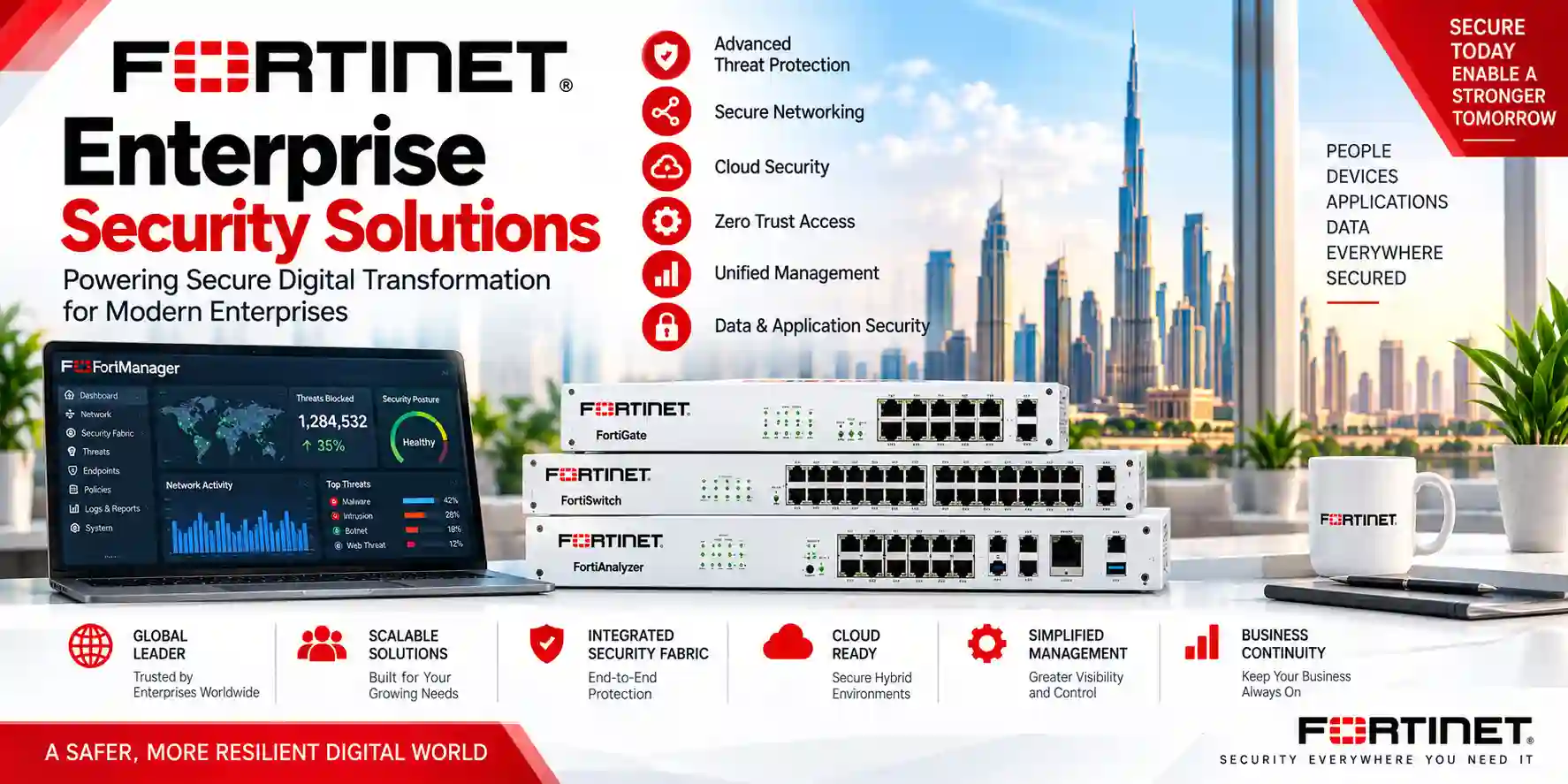
What does Fortinet threat detection and response cover?
Fortinet’s current Security Operations portfolio is designed around several layers of detection and response rather than one isolated control. FortiEDR focuses on endpoints and servers with real-time breach protection, behavioral detection and automated incident response. FortiNDR analyzes network activity and can be deployed as a cloud service or in local environments, including use cases that require on-premises or air-gapped operation. FortiSIEM correlates enterprise-wide IT and OT security and operational data, combining analytics, incident management and automation. FortiSOAR orchestrates response workflows across Fortinet and third-party tools. FortiAnalyzer centralizes telemetry and security operations capabilities around a unified data lake, reporting, threat intelligence and automation. FortiDeceptor adds deception-based detection for suspicious in-network activity. FortiGuard MDR services can augment teams using FortiEDR or FortiXDR with continuous monitoring, investigation and guidance.
This layered approach matters because threats do not stay in one technical domain. A compromised user device may become a point for credential abuse, lateral movement, command-and-control traffic or data exfiltration. Endpoint telemetry can show process behavior, network analytics can reveal unusual communication patterns, SIEM can connect activity across multiple systems, and SOAR can turn an approved response procedure into a repeatable workflow. The architecture should therefore start with business risk and visibility gaps, then select the Fortinet components that close those gaps without creating unnecessary operational complexity.
FortiEDR
Endpoint detection and response for workstations, servers and workloads, with behavioral protection, attack-surface reduction, customizable incident-response playbooks and integration into the Fortinet Security Fabric.
FortiNDR
Network detection and response using network traffic analytics, AI/ML and behavioral analysis to identify suspicious activity that may have passed perimeter controls, with cloud and local deployment choices.
FortiSIEM
Enterprise-wide event collection and correlation for IT and OT, with analytics, asset context, incident handling and automation that can support a larger security-operations program.
FortiSOAR
Security orchestration, automation and response for coordinating analyst tasks, investigations and approved playbooks across security tools, teams and operational workflows.
FortiAnalyzer
Centralized security telemetry, analytics, reporting, threat intelligence and automation for Fortinet Security Fabric environments and selected third-party data sources.
FortiDeceptor & Managed Detection
Deception technology can expose suspicious in-network behavior, while FortiGuard MDR and SOC-oriented services can add expert monitoring and response assistance when internal staffing is limited.
How to design a Fortinet detection-and-response architecture
A practical design begins by mapping what must be seen, what can generate trusted telemetry and what actions the organization is prepared to automate. Endpoints may require FortiEDR, while east-west traffic or unmanaged devices may justify NDR. A SOC that needs broad log correlation across firewalls, servers, identity systems, cloud platforms and operational technology may need FortiSIEM or a FortiAnalyzer-led approach depending on scale, data diversity and workflow requirements. FortiSOAR becomes relevant when repeatable investigations, enrichment, approvals and response actions need orchestration across multiple products. Deception can be useful when early warning for lateral movement, credential abuse or activity around hard-to-instrument assets is a priority.
The integration plan is as important as product selection. Security teams should identify which systems will be authoritative for asset inventory, identity, logs, alerts, cases and response actions. They should also decide where data will be stored, what retention is required, which teams own triage and escalation, and how automated actions are governed. For example, isolating an endpoint or blocking an IP address can be valuable, but automation should reflect the organization’s tolerance for business disruption, the confidence of the detection and the availability of an analyst approval path.
Organizations that already operate FortiGate, FortiSwitch, FortiAP or FortiClient can review the broader Security Fabric relationship as part of the project. A buyer can start from the FourTeck Tanzania technology overview to place threat detection within the wider network, endpoint and infrastructure architecture, then use the FourTeck Tanzania services overview to consider deployment, integration and lifecycle requirements around the selected controls.
Selection, licensing and procurement checklist
List endpoints, servers, network segments, cloud workloads, identity sources, business applications and OT assets that must contribute to detection.
Define which incidents require alerting, isolation, blocking, account action, ticket creation, enrichment or human approval before containment.
Confirm cloud, on-premises, hybrid or air-gapped constraints, including where security data may be processed and stored.
Decide whether internal staff, a managed service or a blended model will own monitoring, investigations, tuning, escalation and reporting.
Licensing should be quoted against the exact Fortinet product, edition, deployment model, protected asset count and required services. Subscription structure can differ across endpoint, analytics, orchestration and managed offerings, so procurement teams should avoid assuming that one license metric applies to the full portfolio. Before requesting a commercial proposal, prepare endpoint counts, server counts, approximate daily log or event volumes where known, branch count, network topology, current security products, required integrations, retention expectations and the preferred support model. Buyers can also review the FourTeck Tanzania product-selection guidance for broader compatibility, capacity and lifecycle planning.
Fortinet Threat Detection and Response Solutions Tanzania
For organizations in Tanzania, a Fortinet threat detection and response project should begin with the systems that create the highest operational and business risk. That can include employee endpoints, finance and ERP servers, internet-facing services, branch connectivity, remote access, data-center networks, cloud workloads, wireless infrastructure and operational systems. A Tanzanian enterprise that already uses FortiGate at the perimeter may want to extend security visibility beyond firewall events, while an organization with a mixed vendor estate may prioritize enterprise-wide correlation and third-party integration. The objective is to identify which security signals are missing today and how those signals can support faster, more consistent decisions during an incident.
FortiEDR can be evaluated where workstations, servers and workloads require deeper behavioral protection and automated endpoint response. FortiNDR is relevant when network activity needs additional visibility, especially for lateral movement, unmanaged devices or environments where installing an endpoint agent is not practical. FortiSIEM can support organizations that need broader event correlation across IT and OT systems, while FortiAnalyzer can centralize telemetry and analytics within a Fortinet-heavy environment. FortiSOAR may be justified when the security team has repeatable incident procedures that can be enriched, coordinated and partially automated. FortiDeceptor adds another layer by creating deceptive assets and signals that can expose suspicious reconnaissance or in-network movement.
Procurement in Tanzania should be tied to the real environment rather than a generic security bundle. Important inputs include the number of endpoints and servers, the number of branches, internet capacity, whether logs must stay on premises, how long event data must be retained, whether OT or IoT networks are in scope, and which third-party products require integration. The security team should also document who will monitor alerts during and outside normal working hours. Where staffing is constrained, managed detection can be considered alongside internal capabilities rather than purchasing tools that no one has time to operate.
A good quotation therefore connects commercial licensing to architecture, deployment and operating process. FourTeck can use this requirement set to help structure product selection, integration questions and an implementation sequence. The strongest outcome is not simply more alerts; it is useful detection coverage, clear ownership, repeatable investigation and controlled response that fits the organization’s risk profile and resources.
Fortinet Threat Detection and Response Solutions Dar es Salaam
Dar es Salaam organizations often operate dense business networks where headquarters users, internet services, remote workers, branch connectivity, collaboration systems and business applications converge. In that type of environment, detection-and-response planning should focus on visibility across both north-south internet traffic and internal east-west movement. A firewall may identify suspicious traffic at the boundary, but endpoint and network telemetry can provide the additional context needed to determine what happened after a user device, credential or internal service is compromised. FortiEDR and FortiNDR can therefore address different but complementary parts of the problem.
For larger offices, financial operations, logistics environments, professional services, hospitality groups or multi-site businesses, the design question is usually how to consolidate security information without overwhelming a small operations team. FortiAnalyzer can provide centralized visibility in Fortinet-focused deployments, while FortiSIEM is suited to broader enterprise event collection and correlation across IT and OT systems. FortiSOAR can then be considered where incident processes involve several steps such as collecting enrichment, opening a case, notifying an owner, isolating an endpoint, blocking an indicator or gathering evidence. Automation should be staged carefully so business-critical systems are not disrupted by overly aggressive response logic.
A Dar es Salaam procurement brief should identify business-critical locations, endpoint counts, server platforms, remote-access methods, cloud services, existing Fortinet products, identity infrastructure and current logging. Network diagrams are particularly useful because they show where FortiNDR sensors or mirrored traffic could provide useful coverage and where segmentation may limit visibility. If the business has branch offices elsewhere in Tanzania, the design should also decide which data and response functions remain local and which are centralized.
The commercial request should ask for product editions, subscription terms, implementation scope, supported integrations, data-retention assumptions, administrator training and ongoing operational responsibilities. This avoids comparing quotations that look similar in price but include very different levels of licensing and deployment work. A detection platform becomes valuable only when it is connected to people, processes and response authority.
Fortinet Threat Detection and Response Solutions Mwanza
Businesses in Mwanza may need to secure a combination of offices, warehouses, retail points, service locations, hospitality properties or operational facilities where the security team is not physically present at every site. Threat detection should therefore be designed for remote visibility and efficient escalation. FortiEDR can provide endpoint-level detection and response for managed user devices and servers, while FortiNDR can provide network-focused analytics for traffic patterns that may indicate lateral movement, data exfiltration or communication with malicious infrastructure. These layers can be useful when local sites contain devices that are difficult to instrument individually.
The first planning exercise should separate sites by criticality. A small branch with ordinary office endpoints does not necessarily need the same collection architecture as a site hosting application servers or industrial systems. Central monitoring can reduce operational fragmentation, but the available WAN capacity and reliability should be considered before sending large volumes of telemetry away from a site. Where local data-processing or air-gapped conditions matter, on-premises NDR options can be assessed rather than assuming all security analytics must be cloud hosted. Log sources should also be prioritized so the project captures meaningful signals instead of every possible event without a use case.
For Mwanza procurement, a useful bill of requirements includes site count, critical applications, endpoint quantity, network segmentation, existing switches and firewalls, internet links, retention needs and local IT support arrangements. If FortiSIEM is being considered, estimate which event sources will be onboarded first and which will follow in later phases. If FortiSOAR is part of the design, document existing incident-response steps and approvals so playbooks reflect real responsibilities rather than generic automation.
The recommended rollout is often phased: establish endpoint and network visibility, validate detection quality, integrate central analytics, then automate only well-understood response tasks. This allows a Mwanza-based organization to improve detection maturity without creating an operations platform that is too complex for the available staff.
Fortinet Threat Detection and Response Solutions Arusha
Arusha organizations can have a particularly varied technology footprint, from offices and professional environments to hospitality, education, non-governmental operations and distributed service locations. This diversity affects threat-detection design because the mix of user devices, guest networks, servers, cloud applications and third-party access can create different security signals. A solution should begin by separating trusted business systems from guest, contractor and device networks, then define which events indicate a meaningful threat in each area. Good detection depends on knowing what normal activity looks like and where privileged access exists.
FortiEDR is relevant for managed endpoints and servers that require real-time behavioral monitoring and containment options. FortiNDR can add visibility when the network includes unmanaged devices, shared infrastructure or segments where endpoint software is unavailable. FortiDeceptor may be useful when the organization wants high-confidence signals around reconnaissance, credential misuse or lateral movement. FortiAnalyzer or FortiSIEM can centralize incidents and telemetry depending on the breadth of data sources, while FortiSOAR can automate enrichment and case handling once the operational process is defined.
For an Arusha buyer, the architecture discussion should include seasonal user changes, remote access, shared Wi-Fi, third-party maintenance accounts, cloud-admin credentials and any public-facing reservation, payment or customer-service systems. Security teams should review whether incident response can be performed remotely, who has authority to isolate a device, and how evidence will be preserved if a serious event occurs. These procedural details are often more important than buying the largest license tier.
Quotation requests should describe the environment clearly: number of users, number of locations, endpoint operating systems, server roles, firewall estate, network topology, identity provider, cloud applications and desired monitoring hours. With those inputs, product selection can be tied to measurable detection gaps and realistic operations rather than a generic feature checklist.
Fortinet Threat Detection and Response Solutions Dodoma
In Dodoma, threat detection and response may be required for offices, institutions, public-facing services and multi-department environments where access rights, shared infrastructure and auditability matter as much as malware blocking. A well-planned Fortinet architecture should therefore connect endpoint, network and event data with identity and asset context. FortiEDR can show activity on protected devices, while FortiNDR can observe suspicious communication patterns across network segments. FortiSIEM can correlate signals from security tools and operational systems, helping analysts see whether separate alerts belong to the same incident.
Governance should be built into the response design. Automated containment is useful only when the organization knows which systems may be safely isolated and which require an approval path. An administrative workstation, a public kiosk, a file server and a mission-critical application server should not necessarily have identical response rules. FortiSOAR can formalize these differences through controlled playbooks, while FortiAnalyzer can support reporting and analytics where the environment is centered on Fortinet infrastructure. Deception can also add early warning for suspicious internal movement without depending entirely on endpoint agents.
Dodoma procurement teams should ask how data retention, role-based access, integration, backup and audit reporting are handled. They should also confirm whether the organization needs local deployment for sensitive telemetry, cloud-based analytics for easier operations, or a hybrid model. If security monitoring must continue outside normal office hours, responsibilities should be explicit: internal team, managed service or shared model. FortiGuard MDR can be assessed where FortiEDR or FortiXDR users need expert monitoring and investigation support.
A successful project should leave the organization with more than licenses. It should include a documented telemetry map, incident severity model, escalation contacts, tested response actions, administrator handover and a schedule for tuning. Those operational elements turn threat-detection tools into an accountable security capability.
Fortinet Threat Detection and Response Solutions UAE
UAE enterprises often operate hybrid cloud, branch, data-center and remote-user environments with strong expectations around centralized visibility, rapid response and policy consistency. Fortinet threat detection and response can be designed around the same principle: collect the right telemetry, correlate activity across layers and automate only actions that have clear governance. FortiEDR addresses endpoints and workloads, FortiNDR adds network-focused detection, FortiSIEM expands correlation across enterprise data sources, and FortiSOAR coordinates incident workflows across Fortinet and third-party technologies.
Organizations with an established FortiGate footprint can consider FortiAnalyzer as a security-operations hub for logs, analytics and automation, while larger or highly heterogeneous environments may require the broader event-correlation and asset context provided by FortiSIEM. FortiDeceptor can support proactive detection of suspicious in-network behavior, including lateral movement and credential-focused activity. Managed detection services can be considered where internal SOC coverage needs augmentation rather than replacing the organization’s own response authority.
UAE procurement teams should distinguish between endpoint count, data-ingestion scale, deployment form factor, integrations, retention and service coverage when comparing proposals. A single line item described as “SOC solution” can hide major differences in what is licensed and who is responsible for operation. Buyers should also confirm where telemetry is stored, how cloud and on-premises workloads are connected, how privileged identities are monitored and how response automation integrates with change-control processes. High-availability and disaster-recovery requirements should be documented for security-management platforms that themselves become critical operational infrastructure.
For customers coordinating UAE and African environments, the FourTeck Fortinet UAE resource provides regional Fortinet context, while a shared architecture can preserve consistent incident categories, log standards and response processes across countries without assuming that every site has identical infrastructure.
Fortinet Threat Detection and Response Solutions Uganda
Organizations in Uganda evaluating Fortinet threat detection and response should first decide whether their biggest gap is endpoint visibility, network visibility, centralized correlation, response automation or round-the-clock monitoring. Smaller teams may benefit from beginning with the controls that provide immediate visibility into their most exposed assets, then expanding into broader SOC capabilities. FortiEDR can cover managed endpoints and servers, while FortiNDR can help identify suspicious network behavior and devices that do not run endpoint agents. FortiAnalyzer can centralize Fortinet-centric security data, and FortiSIEM can integrate a wider set of enterprise events when the environment becomes more complex.
For organizations with branches, a central monitoring design can reduce the need for full security expertise at every location. However, connectivity should be considered before assuming that all telemetry can be transported continuously without affecting business traffic. The deployment may need local collection, filtered forwarding or staged onboarding of log sources. Security teams should prioritize identity systems, perimeter controls, critical servers, endpoint detections and important cloud platforms before adding low-value event sources.
Operational process should be defined alongside product selection. When an alert indicates ransomware behavior, credential misuse or suspicious lateral movement, who validates it? Who can isolate an endpoint? Who contacts the business owner? What evidence must be preserved? FortiSOAR can help coordinate these steps through playbooks, but automation should reflect the organization’s actual authority model. Where internal monitoring capacity is limited, managed detection can be evaluated as an operational layer rather than expecting the software to run itself.
Uganda buyers should request proposals that separate license, deployment, integration, training and recurring support. This makes it easier to compare the real lifecycle cost and identify what is needed after go-live. The goal is a sustainable security-operations process that can grow as new branches, users, cloud workloads and compliance needs are added.
Fortinet Threat Detection and Response Solutions Kampala
Kampala businesses often combine headquarters networks, cloud applications, remote users, internet-facing services and connections to branches or partner sites. This makes correlation important because a suspicious event on one endpoint may only become meaningful when combined with identity activity, firewall logs or unusual network traffic. FortiSIEM can provide enterprise-wide event correlation, while FortiAnalyzer can be a strong fit for organizations with a significant Fortinet estate. FortiEDR and FortiNDR contribute deeper endpoint and network telemetry that helps investigations move beyond basic perimeter alerts.
Security teams should decide early whether the project is intended primarily to prevent endpoint compromise, detect lateral movement, improve SOC visibility, support compliance reporting, automate response, or provide all of these in phases. Trying to deploy every capability at once can create alert and workflow overload. A phased approach may start with endpoint and central log visibility, add network analytics for high-risk segments, then introduce orchestration after the team has learned which incidents repeat and which actions are safe to automate.
Kampala procurement requirements should include protected endpoint quantities, server platforms, event-source inventory, estimated retention, branch count, cloud providers, existing SIEM or ticketing tools, privileged-access systems and any OT or IoT networks. If the company has strict data-residency or isolation requirements, this should be stated before selecting between cloud-managed and on-premises components. The design should also consider administrator access to the security platforms themselves, backup of configuration and logs, and escalation if the management infrastructure is affected during an incident.
A well-scoped quote should identify which integrations are included, who performs policy and use-case tuning, how false positives will be reviewed, and what knowledge transfer is provided to the internal team. This prevents a technically capable platform from being underused after deployment.
Fortinet Threat Detection and Response Solutions Arua
For organizations in Arua, threat detection may need to work across smaller sites, branch networks or operational locations where technical staff and connectivity are not identical to a major-city headquarters. This makes simplicity and remote manageability important design criteria. FortiEDR can provide centralized endpoint protection and response for managed devices, while network-level detection can add visibility where there are unmanaged systems or where endpoint agents are not practical. Centralized analytics can then help a remote security team review alerts without requiring a specialist at every site.
The architecture should account for bandwidth and service continuity. Security telemetry should not compete unnecessarily with business applications on constrained links. Buyers can prioritize the most valuable logs and consider local collection or on-premises analysis where appropriate. If FortiNDR is being assessed, network tap or mirror-point planning is important because the quality of network visibility depends on where traffic is observed. For branch designs, the project should identify which traffic returns to a central site and which exits locally to the internet or cloud.
Incident response in a remote site requires clear procedures. A central analyst may identify a suspicious device, but local operations staff may need to verify whether it can be disconnected without affecting service. FortiSOAR can document and coordinate these steps, including notifications and approvals, while FortiEDR can provide controlled endpoint-response actions where supported. If 24-hour monitoring is required, buyers should determine whether managed detection is necessary to complement internal staff.
Arua procurement should therefore emphasize manageable scope, remote administration, bandwidth-aware telemetry, clear escalation and phased growth. Start with the critical assets and high-confidence detections, then expand as the organization gains operational experience. The result should be a system that can be maintained consistently rather than a large platform that exceeds local support capacity.
Fortinet Threat Detection and Response Solutions Mbarara
Mbarara organizations may combine office users, distributed facilities, hospitality, healthcare, education, retail or operational systems where a security incident can interrupt daily service even if the affected network is not large. Detection-and-response planning should therefore prioritize continuity and rapid triage. FortiEDR can identify malicious or suspicious endpoint behavior and support automated response, while FortiNDR can observe network activity across systems that may not provide rich endpoint telemetry. These capabilities can reduce dependence on a single security layer.
For sites with important local servers or business applications, security teams should identify what a containment action would mean operationally. Automatically isolating a workstation may be acceptable; isolating a server that supports transactions, clinical systems or production activity may require approval. FortiSOAR can help implement different response paths based on asset value and incident type. FortiSIEM can add correlation across security and operational data, while FortiAnalyzer may be suitable where centralized Fortinet telemetry and reporting are the main requirement.
A procurement brief should include the number of protected devices, server roles, network segments, business-critical applications, internet and WAN links, cloud services, administrator accounts and current backup process. Backup and recovery are relevant to response because ransomware containment is only one part of resilience. The organization should also confirm whether incident evidence must be retained for internal investigation, insurance, audit or regulatory purposes and size storage accordingly.
Mbarara buyers can improve project value by defining measurable use cases before purchasing. Examples include detecting suspicious PowerShell behavior, identifying unauthorized lateral movement, correlating repeated failed logins with endpoint alerts, or automating the enrichment of a suspected malicious IP. Clear use cases guide product choice, tuning and testing and make it easier to verify that the deployed solution delivers the expected security outcome.
Fortinet Threat Detection and Response Solutions Gulu
In Gulu, a practical Fortinet threat detection and response design may need to support branches, institutions, service organizations or operational sites with limited on-site security specialization. The architecture should make central monitoring possible while keeping local requirements simple. FortiEDR can provide endpoint-level detection and containment, FortiNDR can monitor suspicious network activity, and centralized analytics can consolidate alerts for a remote team. The most important decision is not how many products to deploy, but which telemetry sources can reliably reveal the threats that matter to the organization.
A small site may not need a complex SIEM deployment by itself. Instead, logs can be forwarded to a central FortiAnalyzer or FortiSIEM environment where analysts compare activity across multiple locations. That can help identify patterns such as the same suspicious indicator appearing in different branches. If a local site contains OT, IoT or specialist equipment, FortiNDR or FortiDeceptor may provide valuable visibility without requiring software installation on every device. The exact approach depends on network topology and how much traffic can be observed from appropriate collection points.
Gulu procurement should consider power reliability, network availability, equipment environment and remote-access security for administrators. The security platform itself should not introduce a management dependency that becomes difficult to support. Where cloud-delivered services are considered, buyers should validate connectivity and data-handling requirements. Where local systems are preferred, rack space, compute resources, backup and secure administrator access should be included in the design.
Implementation should end with tested procedures. Staff should know what happens when an endpoint is isolated, when a suspicious account is identified, when network traffic indicates exfiltration, or when a deception asset is touched. Testing those scenarios creates more value than simply confirming that dashboards load. The security capability becomes dependable when alerts lead to understood actions.
Fortinet Threat Detection and Response Solutions Kenya
Kenyan organizations evaluating Fortinet threat detection and response may have complex mixtures of headquarters infrastructure, branch networks, cloud services, mobile users and third-party applications. A strong architecture separates detection domains while ensuring that incidents can be correlated centrally. FortiEDR supplies endpoint context, FortiNDR exposes suspicious network behavior, FortiSIEM correlates data across enterprise sources, and FortiSOAR automates or coordinates response workflows. FortiAnalyzer can support centralized logging and SOC functions in environments where Fortinet technologies are already extensively deployed.
The most useful starting point is a use-case workshop. Security teams can list the incidents they most need to detect: ransomware activity, credential misuse, lateral movement, suspicious outbound traffic, malicious files, cloud-account anomalies or attacks on systems that cannot run an endpoint agent. Each use case should identify the required data source and the desired response. This prevents unnecessary log ingestion and helps the team understand whether a problem requires EDR, NDR, SIEM, deception, orchestration or a combination.
Kenya procurement teams should also plan for multi-site administration. Policies, collector placement, update windows, role-based access and incident ownership should be standardized where possible, while allowing local exceptions for critical systems. When comparing quotes, separate subscription cost from implementation, integration, data-retention storage, training and managed monitoring. It is also useful to define whether the supplier is expected to perform ongoing detection tuning after go-live, because tuning is essential for maintaining useful signal quality as the environment changes.
For customers coordinating East African requirements, FourTeck’s broader Africa technology resource can provide a regional reference point, while the security architecture itself should be based on the customer’s actual sites, applications, data flows and staffing model rather than country labels alone.
Fortinet Threat Detection and Response Solutions Kuwait
Kuwait organizations may need threat detection across office networks, data centers, cloud workloads, remote access, branch sites and specialized infrastructure. The design should begin with telemetry coverage and operational responsibilities. FortiEDR can protect and monitor managed endpoints, FortiNDR can provide network-based detection, and FortiSIEM can correlate a wider range of IT and OT events. FortiSOAR can help security teams move from alert handling to structured incident workflows, while FortiAnalyzer may be appropriate for centralized Fortinet telemetry, reporting and automation.
Data location and deployment model can be particularly important in regulated or sensitive environments. FortiNDR includes cloud-delivered and local deployment options, and Fortinet’s security-operations portfolio includes both appliance, virtual and service-oriented choices depending on product. The procurement team should establish whether telemetry may be processed in cloud services, whether particular systems require on-premises analysis, and how backup and disaster recovery will be handled for management components. These requirements should be resolved before comparing license prices.
Kuwait buyers should also review integration with existing firewalls, identity services, email security, endpoint tools, ticketing systems and cloud platforms. The business value of SIEM and SOAR depends heavily on integration quality. A platform with hundreds of connectors is still only useful if the customer’s priority systems are correctly connected, normalized and tested. Response actions should use change-control and approval appropriate to each asset class.
A phased rollout can lower risk: onboard core security telemetry, validate high-priority detections, establish case and escalation workflows, then automate repetitive tasks and expand data sources. This sequence gives analysts time to learn the platform and refine response criteria. The end state should reduce investigation friction and make security actions more consistent, not simply add dashboards and alerts.
Fortinet Threat Detection and Response Solutions Ghana
Ghanaian businesses planning a Fortinet detection-and-response project should connect the technology to business-critical assets such as finance systems, productivity platforms, customer applications, branch connectivity and privileged administration. Endpoint, network and log visibility each answer different questions. FortiEDR helps show what a protected device is doing, FortiNDR helps reveal suspicious activity across network communications, and FortiSIEM can correlate events across multiple systems to build a broader incident picture. FortiAnalyzer can provide a more Fortinet-centered operations approach, while FortiSOAR can coordinate repeatable response tasks.
A common challenge is alert volume. Organizations should not assume that adding more security tools automatically improves detection. The design should define which alerts are high confidence, how they are enriched, what business context is added, and when they should become incidents. Asset value, identity privilege, exposed services and network segment can all influence severity. Deception technology can be useful because interaction with a decoy can provide a high-signal indicator of suspicious internal activity, but its placement still needs to reflect real network architecture.
Ghana procurement teams should provide accurate counts and architecture information. Useful inputs include endpoints, servers, branch sites, network segments, cloud workloads, existing firewalls and security tools, desired log retention, support hours and integration requirements. Licensing should be mapped to those quantities and validated against the selected Fortinet editions. If managed detection is being considered, clarify what the service monitors, how incidents are communicated, what actions can be taken, and what remains the customer’s responsibility.
The implementation should include tuning and handover, not only installation. Administrators need to know how to investigate alerts, add exclusions safely, update playbooks, review integrations and measure whether detection coverage is improving. A threat-detection platform is an operational system, and its value grows when the team regularly tests it against realistic scenarios.
Fortinet Threat Detection and Response Solutions Nigeria
Nigeria’s large and diverse business environments can create significant variation in security-operations requirements, from small corporate offices to complex multi-site enterprises, service providers, data centers and industrial environments. A Fortinet threat detection and response architecture should therefore be modular. FortiEDR can be used for managed endpoints and servers, FortiNDR for suspicious network behavior, FortiSIEM for broad event correlation, FortiSOAR for automation and incident orchestration, FortiAnalyzer for centralized telemetry and reporting, and FortiDeceptor for deception-based detection where early visibility of lateral activity is important.
Scale should be planned from operational data rather than company size alone. A business with many lightweight endpoints may generate less relevant security data than a smaller but highly instrumented environment with cloud platforms, identity systems, servers, applications and OT devices. SIEM sizing should therefore consider the intended event sources, retention and search requirements. Network detection should be placed where it can observe important traffic paths, not simply at one convenient switch. Endpoint rollout should account for legacy operating systems, server maintenance windows and application compatibility.
Nigeria procurement teams should ask vendors to document architecture assumptions in the quotation. That includes license metrics, support entitlement, virtual or hardware requirements, cloud dependencies, data retention, integrations, high availability, professional services and renewal terms. If a managed detection service is included, response authority should be clear. The provider may investigate and recommend action, but the customer must still define which systems can be isolated automatically and which require approval from application owners.
A mature rollout can use phased use cases: endpoint ransomware protection, suspicious network movement, privileged-account anomalies, centralized firewall and identity correlation, then automated enrichment and containment. This gives the SOC a controlled path to expand capability while learning how the environment behaves. The goal is faster, better-supported decisions during incidents, not maximum alert count.
Fortinet Threat Detection and Response Solutions Seychelles
Organizations in Seychelles may need enterprise-grade security operations while working with relatively compact local IT teams and geographically separated sites. That makes integration and operational simplicity important. FortiEDR can give centralized visibility into managed endpoints and servers, while FortiNDR can add network-based detection for traffic that cannot be understood from endpoint agents alone. FortiAnalyzer or FortiSIEM can consolidate alerts and telemetry so security events are reviewed from a common operational view instead of through several disconnected consoles.
Hospitality, financial services, professional offices and service organizations can all depend heavily on internet connectivity and cloud applications. A detection design should therefore include identity events, remote-access activity, cloud administration, server logs, endpoint behavior and network traffic. If sites are separated across islands or locations, WAN reliability and central-log forwarding should be assessed. Cloud-delivered detection can simplify some operational tasks, but organizations should validate data-location, connectivity and retention needs before selecting the deployment model.
Seychelles procurement should focus on the lifecycle. Who will monitor alerts when local staff are unavailable? Who tunes rules after software changes? How are licenses renewed? What happens if an integration stops sending logs? FortiGuard managed detection options can be evaluated where continuous expert monitoring is required, while FortiSOAR can help a small internal team reduce repetitive investigation work through controlled playbooks. Deception can add a high-confidence signal for suspicious activity around internal assets without requiring agents everywhere.
A useful request for quotation should include users, devices, servers, site count, critical applications, cloud platforms, network layout, existing Fortinet products, third-party controls, monitoring hours and desired response actions. This allows the solution to be sized around the real estate and operational model. For a compact team, the best architecture is usually the one that delivers clear signals and manageable workflows rather than the one with the largest number of components.
Compatibility, integration and deployment considerations
Fortinet threat detection products are designed to integrate within the Fortinet Security Fabric, and several also support third-party integrations. The exact integration should always be validated against the current product release and customer environment. Important categories include next-generation firewalls, endpoint controls, identity platforms, SIEM/SOAR systems, cloud services, ticketing tools and operational technologies. Integration does not simply mean that a connector exists; it should be tested to confirm that the required events, fields and response actions are available and that permissions are limited appropriately.
For FortiNDR, deployment planning should identify where meaningful network traffic can be observed and whether cloud, local, virtual or appliance-based sensors are appropriate. For FortiEDR, endpoint compatibility, deployment groups, policy mode, exclusions and staged rollout are important. For SIEM, data onboarding should be prioritized according to detection use cases rather than collecting everything at once. For SOAR, playbooks should begin with low-risk enrichment and case-handling tasks before high-impact automated containment. For FortiAnalyzer, storage, log volume, reporting and management integration should be sized against the actual Fortinet estate.
Threat detection should also be integrated with security fundamentals: network segmentation, strong authentication, least privilege, secure configuration, vulnerability management, backups and tested recovery. Detection and response do not replace these controls. They provide visibility and coordinated action when preventive controls are bypassed or when suspicious behavior occurs inside the environment.
Industries and use cases
Correlate endpoint, firewall, identity and network activity across headquarters and branches, then standardize incident handling.
Focus on privileged identity, endpoint behavior, server protection, data movement and audit-ready incident records.
Protect user devices, payment-related systems, guest/business separation and distributed sites while keeping operations manageable.
Use network analytics, SIEM correlation and deception where endpoint agents may be unsuitable and uptime must be protected.
Frequently asked questions
What is the difference between FortiEDR and FortiNDR?
FortiEDR focuses on endpoint activity and response on protected devices such as workstations and servers. FortiNDR analyzes network traffic to identify suspicious behavior and can provide visibility into devices or segments where endpoint agents may not be available. They can be complementary rather than interchangeable.
When should an organization consider FortiSIEM?
FortiSIEM is relevant when the organization needs to collect and correlate security and operational data from many systems, apply analytics and asset context, manage incidents and support automated response across a broader IT or OT environment.
Is FortiAnalyzer the same as FortiSIEM?
They overlap in security-operations capabilities but are not identical. FortiAnalyzer is strongly aligned to centralized Fortinet telemetry, analytics, reporting and automation, while FortiSIEM is positioned for enterprise-wide SIEM with broad IT/OT event collection, correlation, incident management and integrations. Selection depends on the existing environment and operational scope.
What does FortiSOAR add?
FortiSOAR coordinates security workflows across tools and teams. It can enrich alerts, manage cases, execute approved playbooks, request analyst input and automate repetitive response tasks. The best candidates for automation are repeatable processes with clear decision points and known business impact.
Can Fortinet threat detection work in air-gapped or OT environments?
Fortinet provides local FortiNDR deployment options suited to environments such as OT or air-gapped networks, and FortiDeceptor is designed for deception across IT, OT and IoT contexts. The exact architecture should be validated against the site’s network topology, operational constraints and supported protocols.
Does Fortinet provide managed detection and response?
FortiGuard MDR is available for customers using FortiEDR and FortiXDR and provides continuous monitoring, investigation, threat hunting and guidance from Fortinet experts. Buyers should confirm the current service scope, regional availability and response responsibilities during quotation.
Related FourTeck guidance
Threat detection performs best when it is connected to secure networking, endpoint control, identity, segmentation and well-planned infrastructure. Review the FourTeck Tanzania integrated technology overview for the wider architecture, the FourTeck Tanzania services page for deployment and lifecycle planning, and the technology purchasing guide for compatibility and capacity considerations. Regional Fortinet buyers can also reference the FourTeck Fortinet UAE specialist site and the FourTeck Africa resource when coordinating multi-country requirements.
These links provide supporting context rather than a substitute for solution design. Product selection should still be based on the customer’s current Fortinet release, device counts, event sources, operating systems, network architecture, cloud usage, data-residency needs, required integrations and internal response process.
Quotation checklist for Fortinet Threat Detection and Response Solutions
For a more accurate proposal, prepare the following information before requesting pricing or implementation guidance:
- Number of user endpoints, servers and protected workloads.
- Number of branches, offices, data centers and important network segments.
- Existing FortiGate, FortiClient, FortiAnalyzer, FortiManager or other Fortinet products.
- Existing third-party endpoint, SIEM, identity, cloud and ticketing platforms.
- Required retention period and known daily log or event volume where available.
- Need for cloud, on-premises, hybrid or air-gapped deployment.
- OT, IoT or other devices that cannot run endpoint agents.
- Priority detection use cases and desired response actions.
- Internal SOC staffing hours and whether managed detection is required.
- Implementation, migration, training and ongoing tuning expectations.
Decision recap
Choose FortiEDR when endpoint behavior and automated host response are the main gap. Add FortiNDR when network visibility, unmanaged assets or lateral-movement detection are priorities. Evaluate FortiAnalyzer when centralized Fortinet telemetry and turnkey SOC functions align with the environment, and FortiSIEM when broader enterprise-wide event correlation, IT/OT visibility and SIEM use cases are required. Use FortiSOAR when the team needs repeatable incident workflows and cross-tool automation. Consider FortiDeceptor when high-confidence deception signals can strengthen early detection. Assess FortiGuard MDR when continuous monitoring and expert investigation are needed to augment internal resources.
The final architecture may use only one of these components or combine several. The right answer depends on the assets being protected, the telemetry already available, the incidents the business most needs to detect, the data-handling requirements and the people responsible for response.
Consultation panel
A useful first conversation does not require a finished bill of materials. Share the current firewall and endpoint environment, approximate user and server counts, the number of sites, important cloud or business applications, known security pain points and the type of incidents you want to detect faster. From there, the solution can be narrowed into endpoint, network, SIEM, SOAR, analytics, deception or managed-detection requirements.
FourTeck can help turn those inputs into a structured comparison and quotation request while avoiding unsupported assumptions about licensing, performance or compatibility. Current Fortinet documentation and exact product editions should be validated during final design and ordering.