
FortiSASE Secure Access Service Edge
FortiSASE is Fortinet’s cloud-delivered security service edge platform for organisations that need consistent protection for remote users, branch users and distributed devices accessing the web, SaaS applications and private business resources. It combines security and networking functions in a unified Fortinet architecture so policy can follow the user rather than depend entirely on a traditional office perimeter.
For organisations in Tanzania, the practical buying question is not simply whether SASE is useful. The important questions are how many users must be protected, which applications they access, how identity will be verified, whether endpoints can run FortiClient, how branches connect, which subscription tier is suitable, and how internet performance will affect the user experience. This page explains those decisions without assuming stock, pricing, delivery dates or entitlement details that must be confirmed in a current quotation.
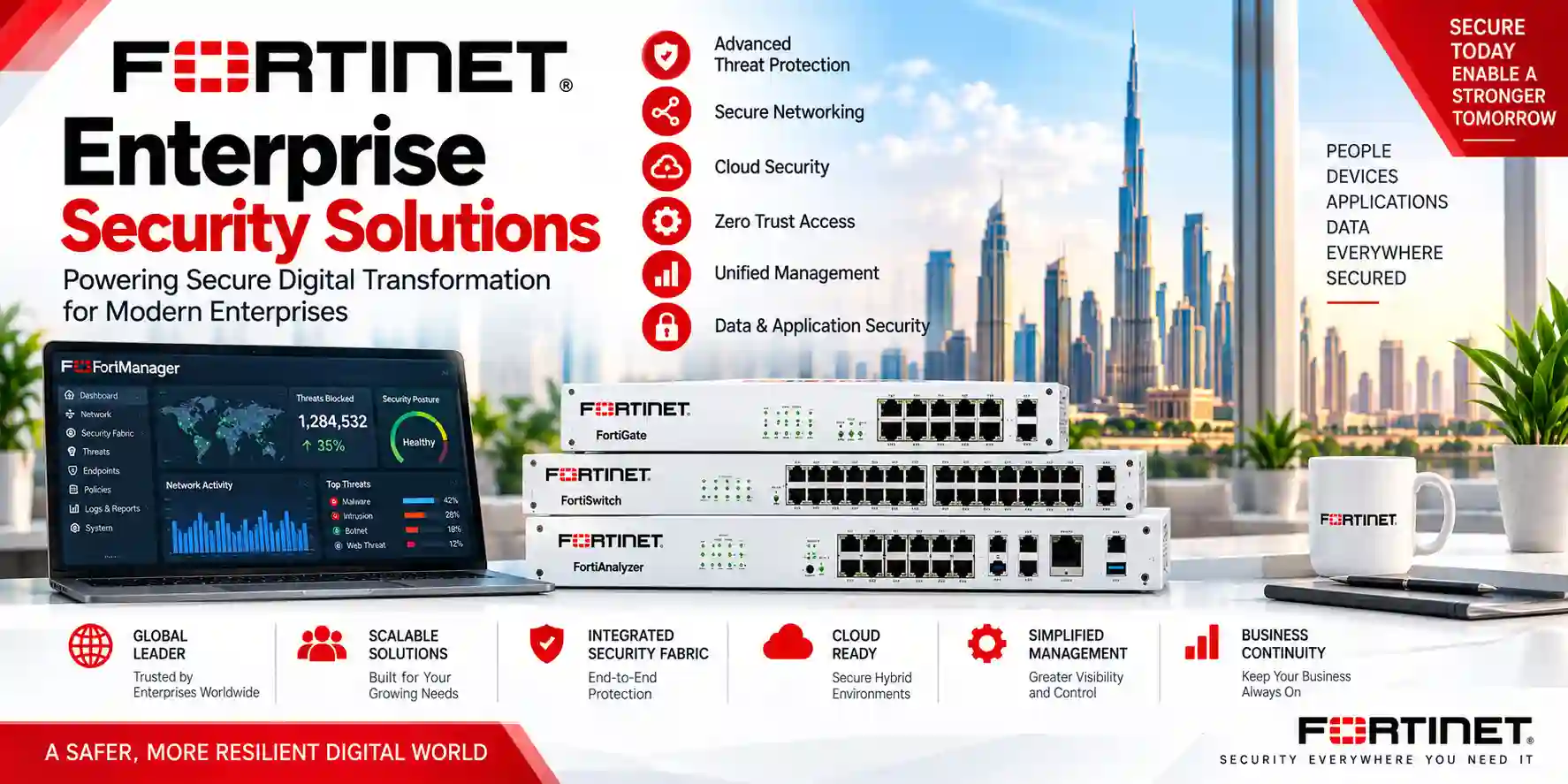
Fortinet security portfolio illustration. FortiSASE itself is a cloud-delivered service and should be scoped by users, applications, connectivity and subscription requirements rather than treated as a hardware appliance.
Cloud-delivered security
Security inspection is delivered through FortiSASE security points of presence rather than requiring every remote user to backhaul traffic through one corporate firewall.
Zero-trust access
ZTNA capabilities can evaluate user identity and device context before granting access to private applications, reducing reliance on broad network-level remote access.
Web and SaaS control
SWG, CASB, DLP and related controls help organisations apply policy to web and cloud application use, including managed and selected unmanaged access scenarios.
Digital experience visibility
Fortinet includes digital experience monitoring in its current FortiSASE positioning to help teams investigate whether performance problems originate at the endpoint, network path, PoP or application.
What FortiSASE is designed to solve
Traditional security designs were built around offices where users, servers and applications sat behind a known perimeter. Hybrid work changes that model. Employees may work from homes, customer sites, airports, hotels or branch offices. Business applications may be spread across private data centres, public cloud and software-as-a-service platforms. Sending every connection back through one central location can increase latency, while allowing remote users to connect directly to the internet without consistent inspection creates policy gaps. Secure Access Service Edge addresses this by placing security services closer to the user and applying access policy based on identity, device posture, destination and business context.
Fortinet positions FortiSASE as the Security Service Edge component of its Unified SASE architecture. Current Fortinet material describes one operating system, one client and a unified management approach spanning secure internet access, private application access and SaaS access. The service includes capabilities such as secure web gateway, firewall-as-a-service, zero-trust network access, cloud access security broker, software-as-a-service security posture management, secure browser functions, secure SD-WAN integration and end-to-end digital experience monitoring. Fortinet also highlights FortiGuard Labs threat intelligence and FortiAI-Assist for security operations and troubleshooting.
Fortinet currently states that FortiSASE operates through a global network of more than 200 points of presence and can extend coverage through integrations with major cloud infrastructure providers. The number and suitability of available PoPs should still be validated against the user locations in a specific deployment. The nearest or best-performing location is a technical design consideration, not a reason to assume identical latency in every country or city.
Core FortiSASE capabilities
Secure Internet Access
Internet and web traffic can be steered through FortiSASE for policy enforcement, secure web gateway controls, firewall-as-a-service and FortiGuard security services. Fortinet documents both agent-based and agentless approaches for appropriate use cases.
Secure Private Access
Universal ZTNA supports identity- and context-aware access to private applications. It can reduce the need to provide a remote user with broad visibility to an entire private network when the business requirement is access to specific applications.
Secure SaaS Access
Inline and API-oriented cloud access security controls can improve visibility into SaaS usage, support data policy and help detect risky or unauthorised cloud activity. Exact functions depend on the subscription and configuration.
Remote and Thin-Edge Locations
FortiSASE supports remote locations through branch on-ramp options and Fortinet thin-edge products such as selected FortiAP, FortiExtender and FortiBranchSASE devices, providing options where endpoint agents are not suitable for every device.
FortiSASE licensing and subscription planning
Fortinet documentation currently identifies Standard, Advanced and Comprehensive user-based FortiSASE subscriptions. FortiSASE also supports FortiFlex licensing for organisations that require a more flexible usage model. The commercial details, minimum quantities, feature entitlements and term options can change, so a quotation should identify the exact subscription tier, number of users, term, included endpoint capabilities, branch requirements and any additional services rather than relying on a generic description such as “FortiSASE licence.”
A buyer should separate platform licensing from implementation effort. Identity integration, policy migration, private-application publishing, endpoint rollout, branch onboarding, testing, user communication and ongoing operations can represent a significant part of the project. Existing Fortinet customers should also document current FortiGate, FortiClient, EMS, SD-WAN and identity components so the design can reuse compatible investments where appropriate. Organisations with strict data-residency requirements can separately evaluate FortiSASE Sovereign, which Fortinet positions as a customer-controlled deployment for jurisdictional data and policy requirements; it is not the same deployment model as standard FortiSASE.
Deployment decisions before you request a quote
Count employees, contractors and other identities that need access. Document identity providers, MFA requirements, device ownership and role-based access groups.
List internet, SaaS and private applications, including where private resources are hosted and whether any applications have fixed-IP, latency or protocol requirements.
Identify managed Windows, macOS and mobile endpoints, personal devices and browser-only use cases. Confirm where FortiClient can be deployed and where agentless access is required.
Record FortiGate, FortiAP, FortiExtender, third-party branch devices, WAN links and SD-WAN architecture. This determines the most appropriate traffic-steering method.
Define web categories, SaaS controls, data handling, private-application access, SSL inspection expectations and exceptions rather than attempting to copy legacy firewall rules without review.
Decide who will administer the service, review incidents, maintain user groups, handle change requests and monitor user experience after the initial deployment.
FortiSASE Secure Access Service Edge Tanzania
FortiSASE Secure Access Service Edge Tanzania is most relevant to organisations whose users and applications are no longer contained inside one office perimeter. A company may have employees in Dar es Salaam, managers travelling between regions, contractors using personal devices, branch staff accessing a cloud ERP platform, and administrators connecting to private systems hosted in a local data centre or another country. In that environment, a conventional model that sends every user through one central VPN gateway can become difficult to scale and can create inconsistent security for direct internet and SaaS traffic. FortiSASE offers an alternative in which users connect to a cloud-delivered security service and receive policy based on identity, device context and destination.
For Tanzanian buyers, the first stage should be discovery rather than licence ordering. Document the approximate number of protected users, the cities where they work, major internet providers, common cloud applications, private applications, identity systems, endpoint ownership and branch architecture. A financial organisation with managed laptops and strict data controls will have a different policy design from a hospitality group that has office users, property networks, guest services and seasonal contractors. The subscription tier should therefore be selected after the security and access requirements are clear. Standard, Advanced and Comprehensive subscription names exist in current Fortinet documentation, but the exact included capabilities and commercial terms should be confirmed in the live quotation.
Connectivity quality also matters. A SASE service cannot create bandwidth that is not available. Organisations should test latency, packet loss and application responsiveness from the actual locations where users work. Where branch offices already use FortiGate Secure SD-WAN, FortiSASE can be evaluated as part of a unified architecture rather than as an isolated cloud product. Where users require private-application access, ZTNA policy should be mapped to business roles so employees receive only the applications necessary for their work. FortiClient can support agent-based connectivity and endpoint context, while browser-based or thin-edge patterns may be appropriate for other scenarios.
A useful Tanzania quotation should state user quantity, requested term, subscription tier, identity integration, endpoint deployment scope, private applications, branch sites, traffic-steering design, policy configuration, testing, documentation and ongoing support expectations. It should also state assumptions about user migration and change windows. FourTeck can help turn those details into a structured requirement so the project is measured by secure user access and operational simplicity rather than by the number of security features listed on a datasheet.
FortiSASE Secure Access Service Edge Dar es Salaam
FortiSASE Secure Access Service Edge Dar es Salaam can fit organisations with headquarters teams, professional services staff, financial operations, logistics users, retail administration, technology companies and regional offices that rely heavily on internet and SaaS platforms. In a large commercial centre, users often move between office networks, home connections, customer locations and mobile hotspots. If security controls apply only when a laptop is physically inside the office, the organisation can end up with different protection depending on where the employee happens to work. FortiSASE is designed to apply cloud-delivered controls more consistently and can combine secure web access, zero-trust private-application access and SaaS visibility within the same service architecture.
A Dar es Salaam deployment should begin with a traffic map. Identify which applications are local, which are hosted in another region and which are public SaaS services. A user accessing Microsoft 365, a cloud CRM and a private finance application may require three different policy paths even though the experience should feel simple from the endpoint. Direct internet and SaaS access can be inspected through the FortiSASE service, while private resources can be exposed through ZTNA policies rather than giving the user unrestricted access to the full internal network. This is especially useful for contractors or departments that require narrowly defined access.
Organisations should also test the user experience across the ISPs and access technologies used by their staff. The best PoP selection and traffic steering should be verified using real application measurements instead of assuming that geographic proximity guarantees the best route. Digital experience monitoring can help identify whether slow performance is caused by the endpoint, local Wi-Fi, ISP path, security path or application. If the head office already operates FortiGate, FortiSwitch and FortiAP infrastructure, the SASE plan can be coordinated with the existing Fortinet environment, but the project should not force every remote-user use case into a branch-firewall model.
For quotation preparation, include the number of users based in Dar es Salaam, expected roaming users, managed versus unmanaged devices, identity provider, MFA requirements, private applications, SaaS services, data-loss concerns and any fixed public-IP requirements. State whether the rollout will replace a legacy VPN, complement an existing remote-access system or form part of a larger SD-WAN refresh. This makes the implementation scope clearer and helps procurement compare proposals on architecture, subscription and service rather than on a single licence price.
FortiSASE Secure Access Service Edge Mwanza
FortiSASE Secure Access Service Edge Mwanza is useful to consider for distributed businesses that need users in a regional office to reach cloud and private applications without creating a different security stack for every site. Trading companies, healthcare organisations, education institutions, hospitality operations and branch-based enterprises may have a small local IT team while still needing strong access control and consistent policy. A cloud-delivered service can reduce the dependence on building a complete stack of separate web filtering, remote access and SaaS security products at each location, provided that internet connectivity is adequate and the deployment is designed around the actual applications.
Mwanza planning should pay particular attention to connectivity resilience. If a branch depends on one last-mile connection, SASE security may be technically correct but the user experience can still suffer when that circuit is congested or unavailable. Where two WAN services are practical, a secure SD-WAN design can improve path selection and availability. For users at the branch, traffic may be directed through FortiSASE using a branch on-ramp method. For roaming employees, an endpoint agent can provide direct connection to the service. For devices where software cannot be installed, thin-edge or selected agentless approaches may be evaluated. These are different operational patterns and should not be treated as one generic configuration.
Private applications deserve their own assessment. A branch may need access to ERP, file systems, inventory platforms, medical systems or internal web applications hosted at headquarters or in cloud infrastructure. ZTNA is most effective when access is defined at the application level and mapped to identity groups. This reduces the amount of internal network exposure given to remote users. The organisation should also identify applications that are sensitive to latency or use unusual protocols, because these may require special testing during a pilot.
A Mwanza FortiSASE quote should therefore include user counts, branch architecture, WAN links, critical application list, endpoint types, identity integration and migration expectations. Buyers should request a pilot plan for representative users instead of relying only on a feature presentation. Testing should include normal office work, large downloads, collaboration calls, private application access and failover scenarios. A successful rollout is one in which users can work consistently while administrators gain clearer policy and visibility across both branch and remote access.
FortiSASE Secure Access Service Edge Arusha
FortiSASE Secure Access Service Edge Arusha can support organisations with staff who move between office, hospitality, field and travel environments. Tourism operators, NGOs, professional services firms, schools, healthcare providers and regional businesses may have users who spend significant time away from a fixed corporate network. The main security challenge is consistency: the same person may access email and SaaS applications from an office LAN in the morning, a hotel network in the afternoon and a home connection later. A SASE approach allows security policy to follow the identity and endpoint more closely than a model based only on where the device is connected.
For Arusha deployments, endpoint classification is a useful early task. Corporate laptops can normally support a managed agent and posture assessment. Contractors may use unmanaged devices where browser-based access to specific applications is safer than broad network connectivity. Operational devices or shared workstations at remote sites may require a branch or thin-edge pattern rather than an individual-user agent. FortiSASE supports several steering approaches, and choosing the correct one for each user group is more important than forcing every device through the same method.
SaaS governance can also be significant. Organisations frequently discover that employees use multiple cloud storage, messaging, file-transfer or AI services that were never formally approved. CASB and data controls can help improve visibility and apply policy, but implementation should start with business understanding. Blocking every unfamiliar application immediately can disrupt real workflows, while allowing every service creates uncontrolled data movement. A staged approach can classify sanctioned applications, identify sensitive data categories, monitor usage, educate users and then enforce stronger controls where justified.
When requesting an Arusha quotation, specify the number of employees, contractors and seasonal users; the devices they use; the identity platform; the SaaS services that matter most; and the private applications that require controlled access. Include any existing FortiGate, FortiClient or SD-WAN deployment so integration can be assessed. Ask for clear separation between subscription costs, implementation, migration, training and ongoing operational support. For organisations with international travellers, include those user locations in pilot testing so PoP selection and application performance are validated beyond the office itself.
FortiSASE Secure Access Service Edge Dodoma
FortiSASE Secure Access Service Edge Dodoma is relevant to government-facing organisations, institutions, NGOs, project offices, education environments, professional firms and businesses that need controlled remote access to internal and cloud resources. These organisations may have formal approval processes, defined user roles and stronger requirements for documentation than a small informal network. SASE can support that operating model by making identity and application policy central to access decisions, but governance must be designed alongside the technical deployment.
A Dodoma project should classify applications and information before configuring controls. Public web browsing, collaboration applications, internal portals, finance systems and administrative platforms do not necessarily need the same access conditions. High-sensitivity applications may require managed devices, multifactor authentication and device-posture checks. Lower-risk browser applications may be suitable for controlled agentless access. If users currently connect through a broad VPN tunnel, the migration provides an opportunity to replace network-wide privileges with application-specific access. That is a policy redesign, not simply a change of remote-access technology.
Logging and change management should also be considered early. Decide which events security teams need to review, how long records should be retained according to organisational and legal requirements, who can modify policies and how emergency changes will be approved. FortiSASE provides centralized management and visibility, but a platform cannot create governance by itself. Administrative roles should be separated where practical, and configuration changes should be documented. If the organisation has data-residency requirements, standard FortiSASE should be assessed against those requirements and FortiSASE Sovereign can be considered separately where a customer-controlled regional model is necessary.
A useful Dodoma quote request will include user groups, identity and MFA architecture, required private applications, SaaS platforms, branch sites, endpoint ownership, logging expectations and project governance. Ask the supplier to describe the pilot, migration sequence, rollback method, training and handover documents. Where users work from multiple Tanzanian cities, the pilot should include representative connectivity from each location. This produces evidence about application experience and avoids treating a successful test from one office connection as proof of performance everywhere.
FortiSASE Secure Access Service Edge UAE
FortiSASE Secure Access Service Edge UAE can be part of a regional architecture for organisations whose headquarters, finance teams, shared services or branch operations span the UAE and East Africa. A multi-country company often accumulates different firewalls, VPN clients and web-security tools as sites are added. FortiSASE can help standardise user security across locations while Fortinet Secure SD-WAN addresses branch connectivity, but procurement teams should keep user licensing, branch networking and implementation services clearly separated in the bill of materials.
The UAE is also a useful design reference for users who travel frequently between offices and customer locations. High-capacity internet at headquarters does not automatically mean remote workers receive the same performance. User traffic may traverse different ISPs and international routes before reaching a SASE PoP. A pilot should therefore include office users, home users and travelling staff. Digital experience monitoring can help teams distinguish application delay from local Wi-Fi, ISP routing or endpoint issues. Where an organisation needs fixed egress addresses for SaaS allow-lists, the licensing and dedicated-IP options should be checked against the current FortiSASE entitlement documentation.
Cross-border access policy requires careful identity design. An employee in Dubai may need access to a finance application hosted elsewhere, while a contractor in another country may need only one project portal. ZTNA policy can express these differences more cleanly than a full network tunnel, provided the applications and user groups are documented. SaaS controls should also consider data location, business approvals and regulatory requirements. Where data sovereignty is a major concern, FortiSASE Sovereign is a distinct option that should be assessed separately rather than assuming standard cloud SASE automatically satisfies every jurisdictional requirement.
For regional procurement, align renewal dates, user definitions, identity groups, naming standards and support responsibilities. The FourTeck Fortinet UAE resource can provide additional Fortinet-focused context for UAE requirements, while the Tanzania project should still be scoped according to its own users and connectivity. A regional design should create consistency where useful without assuming that every office has the same ISP performance, compliance obligations or application dependencies.
FortiSASE Secure Access Service Edge Uganda
FortiSASE Secure Access Service Edge Uganda can support organisations that operate across Kampala, regional cities and cross-border East African locations while using a common set of SaaS and private applications. The architecture is especially relevant when users are no longer served well by a central VPN concentrator. Instead of forcing all internet and cloud traffic through headquarters, security can be delivered through the SASE service while private application access is granted according to identity and context. This can reduce unnecessary backhaul, but the design must be validated against actual connectivity and application behaviour.
Uganda deployments should inventory branch devices and WAN services. Some locations may already run FortiGate with SD-WAN, while others may use third-party routers or simple internet handoffs. FortiSASE supports branch on-ramp and thin-edge patterns in addition to endpoint agents, so the right method can vary by site. A customer-service office full of managed PCs may use agent-based protection. A remote site with shared devices may use a network-level on-ramp. A contractor accessing one web application may be better served by an agentless approach. The architecture should be built around these real user patterns.
Licensing should follow the defined population. Count named users carefully, include expected growth and separate remote-user subscriptions from any branch-related entitlement required by the selected tier. If the organisation already holds older FortiSASE subscriptions, Fortinet documentation notes that migration between legacy and current subscription types can require assistance from Fortinet or a partner. Do not assume licences can simply be pooled or converted without review. Renewal dates, seat usage and rollout timing should be part of the commercial plan.
For a Uganda quotation, provide the city list, user count, branch count, identity system, private applications, SaaS platforms, endpoint mix, existing Fortinet estate and desired support model. The deployment plan should include pilot users, failover testing, user communication, help-desk preparation and rollback steps. Cross-border organisations should agree a common policy baseline while allowing site-specific exceptions for network conditions. This creates a practical standard that can be operated by a central IT team without ignoring the realities of each branch.
FortiSASE Secure Access Service Edge Kampala
FortiSASE Secure Access Service Edge Kampala is a strong architectural consideration for headquarters and branch-heavy organisations that depend on cloud productivity, SaaS business systems and private applications used by mobile staff. Kampala users may work from corporate offices with managed networks during part of the week and from homes, customer sites or mobile connections at other times. If web filtering, malware inspection and application access policy disappear when the employee leaves the office, the business inherits an inconsistent security posture. A SASE service can apply a more uniform control model regardless of where the user connects.
Kampala projects should pay close attention to identity integration and endpoint posture. Identity groups can map access to departments or job functions, while device checks can distinguish managed corporate endpoints from unknown devices. A finance user on a compliant company laptop may receive access to sensitive private applications, while the same identity on an unmanaged device could be restricted to browser-based services. The aim is to make access decisions based on business risk instead of treating a successful password login as sufficient evidence of trust.
SaaS visibility is another useful requirement. Businesses often know which major cloud platforms are approved but have limited awareness of file-sharing, messaging or AI tools used by employees. CASB and data controls can help discover and govern this activity. The first phase can be visibility and classification rather than immediate blocking. Security teams can identify business-essential services, unsanctioned applications and data flows before introducing enforcement that might interrupt operations.
A Kampala pilot should use representative application workloads and different access networks. Include video meetings, large file transfers, SaaS platforms, web browsing and private application access. Measure both security outcomes and user experience. If the organisation runs branch SD-WAN, include path changes and WAN failures in testing. Procurement should request clear licensing, implementation and support line items, with named assumptions for identity integration, endpoint rollout and policy migration. This makes the solution easier to compare and gives the IT team a defined handover target instead of a vague promise of “secure access everywhere.”
FortiSASE Secure Access Service Edge Arua
FortiSASE Secure Access Service Edge Arua can be evaluated for organisations with remote operations, project teams, education sites, healthcare users or distributed branch staff that need the same security policy used by a larger headquarters. In smaller or more remote locations, the challenge is often not a lack of security features but a lack of local infrastructure and specialist administration. Deploying many separate appliances and software products can increase support overhead. A cloud-delivered security service can centralise more of that control while still allowing users to access public and private applications.
Connectivity must be treated as a first-class design input in Arua. Before selecting a SASE rollout method, record the available internet services, expected bandwidth, periods of congestion, failover options and whether users commonly work through mobile connectivity. A pilot should run during normal busy hours, not only during a quiet demonstration. If the organisation has two links, test both planned failover and degraded performance. SASE can improve policy consistency, but it cannot compensate for a severely constrained or unstable local connection.
For branch devices that cannot run FortiClient, a network-based approach may be more practical than endpoint software. Fortinet documents branch on-ramp and thin-edge options using supported Fortinet platforms. Remote employees with managed laptops may use the unified FortiClient agent. Users on personal devices may be limited to agentless browser access for selected applications. Separating these populations helps security teams avoid giving broad access simply because one connection method is easier to deploy.
Arua procurement requests should include not only user counts but also the practical operational model. Who will install endpoint software? Who will onboard users? Which team will respond when a user cannot reach an application? How will changes be requested? Which locations have local hands available for branch-device issues? A complete FortiSASE proposal should account for these questions. Centralised cloud management is valuable only when responsibilities are clear, users know how to report problems and the support team has enough visibility to determine whether an issue belongs to the endpoint, local access network, ISP route, SASE policy or application.
FortiSASE Secure Access Service Edge Mbarara
FortiSASE Secure Access Service Edge Mbarara may suit growing businesses, healthcare groups, education institutions, regional offices and multi-branch companies that want enterprise security policy without building a large security stack at every location. A regional branch increasingly depends on web applications, SaaS collaboration, cloud storage and private systems hosted elsewhere. If each branch uses a different VPN and filtering method, central IT teams lose visibility and users receive inconsistent protection. FortiSASE provides a common cloud-delivered security layer that can be combined with branch connectivity and endpoint-based controls.
The design should separate branch traffic from roaming-user traffic. Staff working inside the Mbarara office can be protected through a branch on-ramp or supported edge device, while users who travel can connect through FortiClient. The security policy can remain aligned even though the traffic-steering method changes. This is useful for organisations that want one policy intent across multiple access situations rather than separate rule sets for office, home and travel. Device posture and user identity should be integrated into access decisions for sensitive applications.
A private-application migration deserves careful planning. Many organisations have older systems that were designed with the assumption that users sit on the internal LAN. Those applications may use hard-coded addresses, non-web protocols or broad dependencies on internal DNS and file services. Before replacing a traditional VPN, test these applications through the proposed ZTNA or secure private access architecture. Where an application cannot be modernised immediately, maintain a controlled transition path rather than forcing a cutover that disrupts operations.
For Mbarara quotations, include a list of legacy applications as well as modern SaaS services. State the number of branch users, roaming users and unmanaged devices. Document existing firewalls, routers, Wi-Fi and identity platforms. Ask whether the proposal includes policy discovery, application testing, user migration, endpoint deployment, administrator training and documentation. This makes the commercial scope realistic. FortiSASE can simplify operations when implemented as an architecture, but a licence purchase alone does not resolve application compatibility, network quality or user-change requirements.
FortiSASE Secure Access Service Edge Gulu
FortiSASE Secure Access Service Edge Gulu can help organisations standardise security for field teams, branch staff, project offices and distributed users who connect over a variety of local networks. NGOs, education providers, healthcare groups, logistics businesses and commercial organisations may have users who move frequently between offices and remote work sites. In these scenarios, the endpoint cannot always rely on an office firewall for protection. A SASE architecture creates a security layer in the cloud so web, SaaS and private application access can be evaluated consistently even when the user is away from a corporate site.
The pilot should reflect the reality of Gulu connectivity. Test managed laptops from the branch LAN, home connections and mobile access where these are common. Record latency and packet loss to important applications. Some workloads, such as web browsing and email, may tolerate higher variation, while video meetings, voice and interactive virtual desktops can be more sensitive. Digital experience monitoring is useful because it gives operations teams evidence when users report that “the internet is slow.” Troubleshooting can then focus on the endpoint, local Wi-Fi, ISP route, security service or destination application.
Security teams should also decide which controls are appropriate for low-bandwidth links. Full inspection of all encrypted traffic may have privacy, performance and certificate-management implications that require careful policy. Exceptions should be documented rather than created informally. Users need clear communication about acceptable web use, personal devices and what happens if their device fails a posture check. A technically correct policy can still fail operationally if users do not understand why access changed.
A Gulu FortiSASE request should state whether the goal is remote-user protection, VPN replacement, branch security, SaaS governance or a combination. Include identity and MFA details, managed-device count, private applications, SaaS platforms, WAN links and support expectations. Ask for a phased rollout with acceptance criteria. Start with a representative group, confirm application access and user experience, then expand. This approach reduces deployment risk and produces a reusable pattern for additional regional sites.
FortiSASE Secure Access Service Edge Kenya
FortiSASE Secure Access Service Edge Kenya can be considered by companies with Nairobi headquarters, regional branches, remote employees or East African operations that need a common security model across users and sites. A regional enterprise may already have FortiGate firewalls and SD-WAN at branches while remote staff still rely on traditional VPN access. FortiSASE can extend the Fortinet architecture from branch edges to users, applying cloud-delivered protection to web, SaaS and private application access. The strongest business case often appears where the company wants to reduce separate security products and manage user access more consistently.
Kenya planning should include cloud application geography. If business applications are hosted in local, regional or international cloud regions, user traffic may take different network paths. PoP selection should be validated using real measurements. Organisations should test interactive SaaS, video meetings, file transfers and private application access from the actual ISP networks used by staff. The advertised global PoP count is useful for scale, but the practical question is whether the path serving a particular user delivers acceptable latency, stability and inspection performance.
For multi-country companies, identity and policy standardisation can simplify operations. A finance group can have the same access rules in Kenya and Tanzania while network routing is optimised locally. ZTNA policies can make application access portable across countries without exposing entire internal networks. CASB and DLP policy can be aligned to corporate data-handling rules, while local legal requirements are reviewed separately. This division between global security intent and local network implementation is a useful way to scale.
A Kenya quotation should specify user quantity, subscription tier under consideration, branch on-ramp needs, endpoint deployment, identity integration, private applications and expected support. If the project is coordinated from Tanzania, define which team owns policy and which team handles local user support. Cross-border rollouts benefit from one naming convention, one documentation template and one renewal calendar. Where existing Fortinet infrastructure differs between countries, document those differences rather than forcing identical technical designs. The goal is consistent security outcomes with local performance appropriate to each user population.
FortiSASE Secure Access Service Edge Kuwait
FortiSASE Secure Access Service Edge Kuwait can support organisations with Gulf and African operations that want one secure-access policy for employees moving between countries, branches and remote work environments. Such businesses may use cloud ERP, collaboration suites, HR platforms and privately hosted applications that must remain available regardless of where the user works. A SASE architecture can reduce the need to route all traffic through a distant headquarters, while zero-trust access can provide narrower application permissions than a traditional full-tunnel VPN.
Kuwait procurement teams should evaluate identity, data policy and fixed egress requirements early. Some SaaS providers restrict access by source address, and some business processes depend on allow-listed IPs. FortiSASE licensing and dedicated-IP functionality should be reviewed against the current Fortinet documentation and the selected subscription tier. Do not assume a particular address feature is included simply because another customer or older licence had it. The quote should state the entitlement explicitly.
Data handling is equally important. CASB and DLP can support controls over cloud applications, but policies must match business reality. A legal department, engineering team and sales group may handle different information and use different SaaS services. Broad rules that treat all files identically can create false positives and user frustration. Start with classification, approved application lists and monitoring, then introduce enforcement around well-understood risks. For highly regulated information, confirm applicable residency and processing requirements and evaluate whether standard or sovereign SASE models are appropriate.
For a Kuwait quote connected to a Tanzania or Africa rollout, include all user locations, application hosting regions, identity platforms and branch security devices. Ask for PoP and performance testing from representative ISPs. Document how policies will be administered across time zones and who handles after-hours incidents. Subscription terms should be aligned where practical so renewals do not become fragmented across countries. The technical platform is only one part of a successful regional SASE programme; consistent operating processes, documentation and ownership are equally important.
FortiSASE Secure Access Service Edge Ghana
FortiSASE Secure Access Service Edge Ghana is relevant to distributed enterprises, professional firms, education organisations, financial businesses and multi-country operations that want to protect users beyond the office firewall. Remote work, cloud applications and contractor access all weaken the usefulness of a security model that assumes every trusted user sits on a corporate LAN. FortiSASE shifts more control to identity, device context and cloud-delivered inspection so the same user can receive consistent security whether working at headquarters, a branch or another internet-connected location.
Ghana deployments should identify the mix of corporate and personal devices. Managed laptops can use the FortiClient agent and participate in posture-based access decisions. Personal or partner devices may need a more restricted approach, particularly for sensitive private applications. Agentless web access can be useful where installation is not possible, but the application must be suitable for that access method. Shared branch devices and IoT endpoints may instead be protected through network-level traffic steering. Treating every device class separately allows security to be strong without creating unnecessary operational complexity.
A second priority is SaaS governance. Business teams often adopt cloud tools faster than IT can review them. FortiSASE capabilities such as CASB, SWG and DLP can help security teams understand and control usage. The rollout should begin with discovery: which applications are sanctioned, which are tolerated, which are risky, and what data categories may be uploaded. This produces a policy based on business value rather than a generic block list.
When requesting a Ghana quotation, provide user counts, endpoint ownership, identity provider, major SaaS services, private applications, branch locations, current remote-access method and support expectations. Ask the supplier to define licensing, deployment and ongoing management separately. If the organisation is part of an Africa-wide network, align policy names and identity groups across countries but test performance locally. Internet routing, cloud regions and user behaviour differ, so each country should have its own acceptance testing even when the security platform and subscription are standardised.
FortiSASE Secure Access Service Edge Nigeria
FortiSASE Secure Access Service Edge Nigeria can address the complexity created by large user populations, branch networks, cloud applications and mobile workforces. An organisation may have headquarters teams, sales users, regional branches, contractors and outsourced service providers, all requiring different levels of access. Legacy VPN solutions often provide broad network connectivity after authentication, while separate web-security tools create fragmented administration. FortiSASE brings multiple controls into one cloud-delivered architecture and can use zero-trust principles to give each user access to specific resources according to identity and device context.
Scale makes migration planning especially important. Large Nigerian deployments should not move every user at once. Segment the population by location, department, device type and application dependency. Start with users who rely mainly on SaaS, then test private applications, specialist protocols and high-volume workflows. Legacy applications that assume LAN access may need additional work before they are ready for ZTNA. The migration plan should preserve business continuity while moving security policy into the new model.
Connectivity diversity should also influence design. Users may connect through fibre, enterprise broadband, mobile networks and home internet with different performance characteristics. FortiSASE’s global service footprint gives options for distributed access, but each major user population should be tested. Performance acceptance should include collaboration calls, file transfers, SaaS transactions, browser use and private applications. Digital experience monitoring can improve troubleshooting after rollout by showing where degradation occurs.
Commercially, large deployments require disciplined licensing. Count active users, expected growth and special branch requirements. Confirm whether Standard, Advanced or Comprehensive entitlements best match the planned controls. If flexible consumption is important, FortiFlex can be evaluated. Ask for user onboarding, endpoint deployment, identity integration, policy migration, training and operational support as named work packages. For cross-border organisations, coordinate renewal and policy governance but avoid assuming identical internet performance across Nigeria, Tanzania and other markets. A well-structured SASE programme combines platform consistency with local testing and support procedures.
FortiSASE Secure Access Service Edge Seychelles
FortiSASE Secure Access Service Edge Seychelles can be useful for hospitality groups, financial services, professional organisations and multi-island or multi-country businesses whose staff depend on cloud applications and secure remote access. In island environments, international network paths can be a critical part of user experience, so the decision should be based on measured application performance rather than only on product features. A cloud-delivered security platform can provide consistent control for users outside the office, but it must be aligned with the available internet connectivity and the location of the applications those users depend on.
A Seychelles pilot should include realistic external routes. Test the applications hosted in Europe, the Middle East, Africa or other regions that staff use every day. Record baseline performance before enabling the new path, then compare application responsiveness after FortiSASE steering and inspection. If video meetings or voice services are business-critical, include sustained calls rather than a simple speed test. The objective is to confirm that security policy and user experience remain acceptable together.
Hospitality and tourism organisations may also have a mixture of corporate users, shared front-desk devices, property systems and guest networks. FortiSASE is primarily an enterprise secure-access platform, so the project should identify which populations actually belong in the SASE design. Corporate laptops and business applications may be ideal candidates, while guest internet traffic may be better handled through the property network’s firewall and wireless architecture. Separating these scopes prevents licensing from being applied to the wrong devices and keeps policy understandable.
When requesting a Seychelles quote, include the number of corporate users, managed devices, property or office sites, identity platform, private applications and SaaS services. Explain whether the requirement is remote-user protection, branch security, VPN replacement or regional standardisation. Ask for pilot methodology, PoP selection, endpoint rollout, policy design and support. For organisations managed from Tanzania or another country, define who owns central policy and who handles local connectivity problems. This division of responsibility is important because a SASE provider can secure and steer traffic, but local access reliability remains dependent on the underlying network service.
Related FourTeck resources for FortiSASE planning
FortiSASE works best when it is planned as part of the wider network, identity and endpoint environment. The FourTeck Tanzania services page explains how firewall, switching, Wi-Fi and broader infrastructure requirements can be coordinated instead of treated as unrelated purchases. This is useful when a SASE project also changes branch connectivity or local network segmentation.
Procurement teams comparing security and network options can use the Tanzania technology shop for practical buying guidance around capacity, compatibility, licensing and lifecycle considerations. Customers that still need a compact physical firewall at a branch can also review the FortiGate 30G Tanzania page as an example of how branch firewall sizing differs from cloud-delivered SASE user security.
For project scoping, the FourTeck Tanzania contact page provides the current enquiry route. Include user count, branch locations, private applications, SaaS services, identity platform, endpoint types and existing Fortinet components to make the initial discussion more productive.
FortiSASE quotation checklist
FortiSASE FAQ
What is FortiSASE?
FortiSASE is Fortinet’s cloud-delivered Security Service Edge platform and a core component of Fortinet Unified SASE. It secures access to the internet, SaaS and private applications using capabilities that include SWG, ZTNA, CASB, FWaaS, data controls and digital experience monitoring.
Does FortiSASE replace a VPN?
It can replace or reduce traditional VPN use for many private-application access scenarios by using zero-trust network access, but migration depends on application compatibility and user requirements. Legacy protocols and applications should be tested before removing an existing VPN service.
Can FortiSASE work with FortiGate Secure SD-WAN?
Yes. Fortinet’s Unified SASE positioning combines FortiSASE with Fortinet Secure SD-WAN so organisations can coordinate branch networking with cloud-delivered security. The exact branch on-ramp design and entitlement should be confirmed for the chosen subscription.
Does FortiSASE support users without an endpoint agent?
Fortinet documents agentless browser access and network-based steering methods in addition to FortiClient-based access. The suitable method depends on the destination, device ownership, application type and security policy.
How is FortiSASE licensed?
Current Fortinet documentation identifies user-based Standard, Advanced and Comprehensive subscriptions and also supports FortiFlex licensing. Exact feature entitlements, quantities and terms should be confirmed in the current Fortinet ordering information and quotation.
What information is needed for a FortiSASE quote in Tanzania?
Provide the number of users, locations, endpoint types, identity provider, private applications, SaaS services, branch architecture, current Fortinet products, internet links, subscription term preference and the required deployment and support scope.
Decision recap
FortiSASE is a strong fit when the security problem is distributed users, branch connectivity, cloud application access and fragmented policy rather than a need for one more perimeter appliance. Its value comes from the combination of cloud-delivered security, zero-trust access, SaaS controls, Fortinet networking integration and centralized visibility. The deployment still depends on good identity design, application discovery, suitable internet connectivity and disciplined operational ownership.
Before purchasing, validate the subscription tier, user quantity, supported access methods, branch requirements, private application compatibility and desired support model. Run a pilot with representative users and locations. Compare proposals by scope and outcome, not only by licence cost. This makes FortiSASE easier to operate after the initial deployment and reduces the risk of discovering important application or connectivity constraints during production rollout.
Plan your FortiSASE requirement
A useful consultation starts with users and applications, not licence codes. Prepare your user count, branch list, remote-work profile, identity platform, SaaS services, private applications and existing Fortinet environment. FourTeck can use that information to structure a FortiSASE requirement for Tanzania or a broader multi-region deployment.