
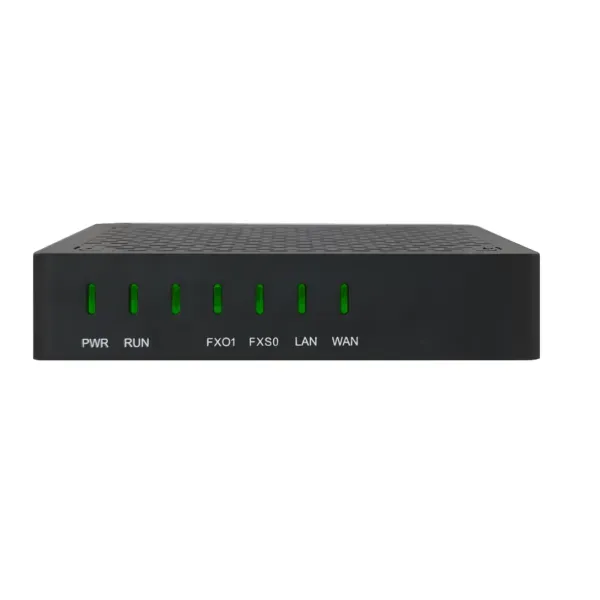
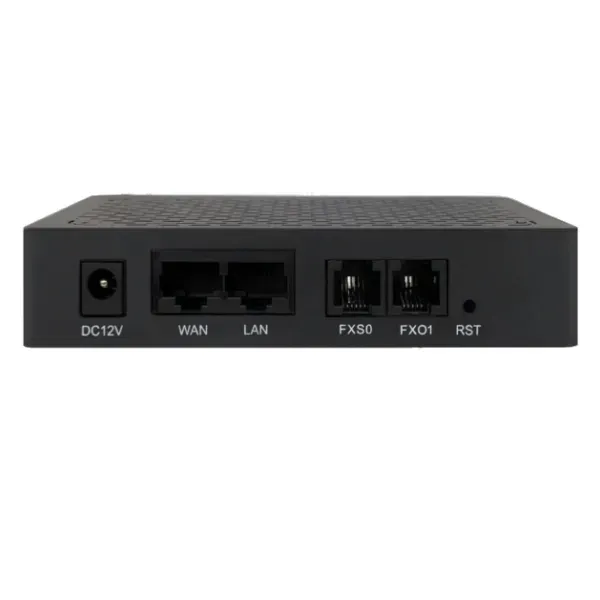
Dinstar DAG1000-1S1O Hybrid VoIP Gateway
The Dinstar DAG1000-1S1O is a compact hybrid analog voice gateway designed for organizations that need to bridge traditional analog telephony with SIP-based IP communications. With one FXS interface for an analog telephone or fax device and one FXO interface for an analog PSTN line or PBX connection, it provides a practical migration path for small businesses, branch offices, remote sites and environments where a limited number of legacy analog connections must continue operating alongside modern IP telephony.
Official Dinstar documentation identifies the DAG1000-1S1O as a multipurpose IP voice and fax gateway supporting standard SIP, IMS/NGN interoperability, mainstream IP-PBX and softswitch platforms, network and power-failure lifeline functions, T.38 fax, TLS/SRTP security, SNMP/TR-069 management, automated provisioning, routing and dial-plan functions, IPv4/IPv6, VLAN/QoS controls and multiple common voice codecs. For Tanzanian businesses evaluating a small hybrid gateway, the most important value is not simply the port count: it is the ability to preserve a useful analog endpoint or line while moving call control toward an IP-based platform.
1 FXS + 1 FXO, 1 WAN + 1 LAN, SIP/IMS, T.38 fax, TLS/SRTP, IPv4/IPv6, SNMP/TR-069, web management, flexible dial plan, call features, VLAN/QoS and lifeline behavior for power or network failure.
What the Dinstar DAG1000-1S1O solves
Many businesses do not replace every analog telephone, fax machine, PSTN line and legacy PBX connection at the same time. A migration may begin with an IP PBX while one analog device must remain in service, or an organization may want an analog outside line available as a fallback path. The DAG1000-1S1O is built for exactly this type of small hybrid requirement. Its FXS interface can present an analog subscriber connection to a conventional telephone or fax device, while its FXO interface can connect to an analog exchange line or appropriate analog PBX port. SIP then links the gateway to the IP telephony environment.
This architecture can be useful when a customer wants to retain investment in an existing device, phase an IP migration gradually, connect a remote analog endpoint to centralized call control, or maintain a simple PSTN path in a small office. The gateway is not a complete PBX by itself; it is a bridge between analog and IP domains. Correct solution design therefore depends on the surrounding PBX, SIP server, network, line characteristics, dial plan and user workflow.
Verified key features
1 FXS + 1 FXO
A mixed analog interface set supports one analog subscriber-side connection and one analog trunk-side connection, making the model suitable for small hybrid telephony requirements.
SIP and IMS
Dinstar specifies standard SIP support and compatibility with mainstream IP-PBX, softswitch and SIP-based platforms, including IMS/NGN environments.
Fax support
T.38 fax and pass-through functions support migration scenarios where fax services or analog fax devices remain part of the communications environment.
Lifeline operation
Power-failure and network-failure lifeline capability can help preserve an analog calling path when the IP path is unavailable, subject to correct physical design and configuration.
Security
TLS/SRTP support provides protocol options for protecting SIP signaling and voice media when the connected telephony platform supports compatible security settings.
Management
Web management, SNMP, TR-069, automated provisioning, configuration backup/restore and diagnostic tools are intended to simplify administration and repeatable deployment.
Technical capability overview
| Analog interfaces | 1 FXS and 1 FXO |
| Ethernet | 1 WAN and 1 LAN |
| Signaling | SIP v2.0; SIP/IMS; UDP/TCP/TLS support |
| Voice codecs | Dinstar lists G.711, G.729, G.723, G.726 and AMR |
| Fax | T.38 and pass-through |
| Networking | IPv4/IPv6, VLAN tagging and QoS functions |
| Management | Web interface, SNMP, TR-069, provisioning, backup/restore and logs/CDR |
| Call features | Call waiting, transfer, forwarding, speed dial, DND, 3-way conference, hunting group, voicemail/MWI-related support and flexible routing/dial plan |
| Resilience | Power/network failure lifeline and SIP failover functions documented by Dinstar |
Compatibility and exact behavior depend on the connected PBX, SIP server, PSTN service, firmware and configuration. Final design should be validated against the customer’s live environment.
Integration and deployment guidance
A successful DAG1000-1S1O deployment starts with mapping the analog and IP sides. The FXS port should be assigned to the analog endpoint that needs station service, while the FXO port should connect to the relevant analog trunk source. On the IP side, the gateway needs addressing, SIP registration or trunk configuration, routing rules and a dial plan that is consistent with the PBX. Before deployment, identify which calls should use VoIP, which calls should use the analog line, what should happen during an outage and whether incoming PSTN calls need to reach specific extensions, a receptionist, an IVR or another destination.
Network design matters even for a one-port gateway. Voice quality can be affected by packet loss, latency, jitter, overloaded links and poorly designed VLANs. Where the business already uses managed switching, voice traffic can be coordinated with VLAN and QoS policy. Firewall rules should permit only the traffic required for the SIP architecture rather than exposing unnecessary management services. If TLS/SRTP is selected, certificates, compatible cipher support and PBX-side settings must be considered as part of the solution.
For broader telephony planning, FourTeck Tanzania describes IP PBX, SIP, branch telephony, call routing and IP phone integration on its business technology services page. Customers that are building a complete network and voice environment can also review the FourTeck Tanzania technology shop to evaluate related infrastructure alongside the gateway.
Who should consider the DAG1000-1S1O?
The strongest fit is a small requirement where one analog endpoint and one analog trunk-side connection must be integrated into an IP telephony design. Typical examples include a branch retaining a single PSTN line while adopting an IP PBX, a small office that wants an analog telephone available as a fallback path, a site that needs to attach an analog fax device to a SIP environment, or a migration project where legacy equipment cannot be removed immediately. Because the port density is intentionally low, larger installations should compare higher-port Dinstar gateways or other appropriately sized platforms rather than multiplying small units without considering manageability.
Dinstar DAG1000-1S1O Tanzania
For organizations searching for the Dinstar DAG1000-1S1O in Tanzania, the key procurement question is whether the site genuinely needs a mixed one-FXS/one-FXO gateway rather than a pure FXS or pure FXO device. The model is particularly relevant when an IP PBX migration needs to retain both an analog station-side device and an analog trunk-side path in a compact form factor. A customer may have a single analog fax machine, conventional telephone or legacy PBX extension that must continue working, while also wanting to connect one analog public telephone line to a SIP platform. The hybrid port arrangement addresses that narrow but common migration scenario without requiring a larger gateway than the site needs.
Tanzania deployments should be evaluated around the existing telephone service, network quality and power environment. The gateway’s lifeline behavior can be valuable, but a design should confirm exactly which analog devices and lines will be interconnected during power or network failure. If the IP PBX, switch or upstream connectivity also requires backup power, those dependencies should be included in the plan. A resilient calling design is a chain: the gateway, PBX, switching, router, internet or SIP service and any UPS all contribute to the final outcome.
Before requesting a quotation, list the number of analog lines, analog phones or fax devices, the current PBX model if one exists, the intended SIP/IP-PBX platform and the desired call flow. Also note whether the site needs faxing, encrypted SIP, VLANs, remote management or failover. FourTeck Tanzania can then evaluate whether DAG1000-1S1O is the correct density or whether another gateway architecture fits better. For wider regional communications requirements, the FourTeck IT Solutions Africa communications portfolio provides context on IP PBX and VoIP system planning across African business environments.
Dinstar DAG1000-1S1O Dar es Salaam
Dar es Salaam businesses evaluating the Dinstar DAG1000-1S1O often have a practical integration objective rather than a requirement for a large carrier gateway. A professional office, retail location, logistics facility, clinic, hospitality site or branch may already use IP networking while retaining one analog telephone device or one traditional outside line. In that situation, the DAG1000-1S1O can bridge the analog and SIP worlds in a compact way. The design should begin by deciding whether the FXS side will serve a telephone or fax device and whether the FXO side will terminate a PSTN line or an appropriate analog PBX interface.
In a busy commercial environment, call continuity is often more important than adding unused features. Dinstar’s documented power/network-failure lifeline capability can support a continuity strategy, but the physical line path must be planned correctly and tested. Customers should also define how incoming calls are routed through the IP PBX, whether outbound calls require prefix-based routing, whether the analog line is primary or backup and what should happen when SIP registration is unavailable. Testing these scenarios during commissioning is more useful than relying on default settings.
Network readiness should also be checked. Even a small voice gateway benefits from stable Ethernet, appropriate IP addressing, controlled firewall rules and consistent QoS settings. Where the site uses voice VLANs, the gateway’s network placement should align with the wider telephony architecture. For quotation planning in Dar es Salaam, provide the current analog line type, PBX or SIP server, number of endpoints, intended fax use and any continuity requirement. That information helps distinguish a straightforward gateway purchase from a small telephony-integration project requiring configuration and testing.
Dinstar DAG1000-1S1O Mwanza
In Mwanza, the DAG1000-1S1O can be appropriate for branch offices, service businesses, hospitality environments, clinics, trading operations and other sites that want to modernize voice communications without discarding every analog component at once. The device’s value comes from controlled coexistence: one analog station-side port and one analog trunk-side port can be connected to a SIP system, allowing a gradual transition to IP telephony. This can be more practical than replacing a functional analog device or changing all telephone services simultaneously.
A Mwanza deployment should consider connectivity and supportability. If the gateway registers to a local IP PBX in the same building, call traffic may remain largely inside the LAN. If it connects to a remote PBX or hosted SIP platform, WAN reliability and firewall configuration become more significant. The customer should document the SIP server address, registration method, codec policy, DTMF method, numbering plan and fallback logic. Where fax is required, T.38 support is available, but end-to-end fax success depends on the upstream SIP service and receiving side as well as the gateway configuration.
Procurement teams should avoid choosing the model solely because it is compact. First verify that exactly one FXS and one FXO are sufficient for current and near-term needs. If another analog line or device is likely to be added soon, a higher-density gateway can be easier to manage and more scalable. Include future port growth in the quotation discussion, together with the IP PBX platform, line count, endpoint count and expected support model. The objective is to buy a gateway that matches the real migration plan rather than only today’s minimum connection count.
Dinstar DAG1000-1S1O Arusha
Arusha organizations looking for a small hybrid VoIP gateway may be balancing modern IP communications with older analog equipment that is still useful. Hotels, tour operators, professional offices, training centers, NGOs, clinics and branch sites can all encounter situations where a legacy analog line or device must remain connected during a VoIP migration. The DAG1000-1S1O provides one FXS and one FXO interface, allowing a carefully scoped analog requirement to be integrated with a SIP-based PBX or softswitch.
The most effective implementation starts from the call flow. Determine whether inbound PSTN calls should ring a reception group, specific extension or automated attendant. Decide whether outbound calls use the analog line by default, only for selected prefixes or only as a backup when the SIP service is unavailable. If an analog phone is attached to the FXS port, identify the extension number and any calling restrictions that should apply. If a fax device is connected, test actual send and receive behavior with the chosen T.38 or pass-through configuration.
Management planning is useful for Arusha sites that are part of a larger organization. Dinstar supports web management, SNMP, TR-069 and automated provisioning capabilities, giving integrators several ways to administer the device according to the operating model. Access to management interfaces should be restricted to trusted networks or secure administrative paths. Configuration backups should be retained after commissioning so recovery is faster if the unit is reset or replaced. A clear extension plan, IP address record and dial-plan note can make later troubleshooting much more efficient.
Dinstar DAG1000-1S1O Dodoma
For Dodoma offices and institutions considering the Dinstar DAG1000-1S1O, the product fits situations where a limited analog requirement must be preserved inside an IP-focused communications strategy. One FXS port can support a conventional analog endpoint, while one FXO port can connect a suitable analog trunk source. Standard SIP enables the gateway to participate in a modern IP-PBX design, helping organizations transition incrementally instead of treating voice modernization as an all-at-once replacement project.
Procurement should focus on compatibility and operational process. Confirm the PBX or hosted SIP platform, analog line characteristics, required codecs, DTMF behavior and any regulatory or carrier-specific requirements that affect the connected service. Define administrator ownership after installation: who will maintain SIP credentials, firmware, configuration backups and dial plans? A small gateway is easy to overlook once installed, yet configuration drift or undocumented changes can complicate future troubleshooting.
For offices that need high availability, the gateway’s documented lifeline and SIP failover features are relevant, but they should be tested as part of an end-to-end continuity plan. Power backup for network equipment, availability of the analog line, PBX redundancy and alternative routing all matter. When requesting a Dodoma quotation, provide the exact use case rather than simply the model name. Explain what will connect to FXS, what will connect to FXO, which SIP system will control calls and what fallback behavior is required. This makes it easier to validate that DAG1000-1S1O is the right device before deployment.
Dinstar DAG1000-1S1O UAE
In the UAE, the DAG1000-1S1O can suit small branch, retail, service and remote-site telephony requirements where an analog endpoint and an analog line must coexist with SIP communications. The gateway is particularly useful during phased migration projects, where an organization may already operate an IP PBX but still requires a legacy device, analog fax path or specific PSTN connection. The mixed FXS/FXO design helps avoid over-sizing when only one interface of each type is required.
UAE projects often involve centralized communications across several branches, so deployment consistency is important. A standard template can define IP addressing, SIP server settings, codec order, dial rules, security options and management access. Dinstar’s automated provisioning, SNMP/TR-069 and backup/restore functions can support repeatable administration, although the exact management architecture should be aligned with the customer’s IT policies. If TLS/SRTP is required, verify compatibility with the PBX and certificate-management approach rather than enabling encryption independently on one device.
For organizations comparing regional suppliers or planning a UAE-led multi-country rollout, FourTeck UAE can provide related regional technology context. A procurement request should state the number of locations, whether each site needs one gateway, which analog carrier services are used and whether configuration should be standardized across branches. This makes the discussion about architecture and maintainability, not only unit price.
Dinstar DAG1000-1S1O Uganda
Ugandan organizations considering the DAG1000-1S1O can use it as a compact bridge between traditional analog telephony and SIP-based communications. The model is most appropriate when one analog telephone or fax device and one analog line-side connection must be integrated. This could support an office moving toward IP PBX, a branch that needs a controlled PSTN fallback, or a site retaining a legacy endpoint for a specific operational purpose.
Deployment planning should include the quality and topology of the site network. If the SIP server is remote, voice traffic depends on WAN availability and firewall behavior; if it is local, LAN switching and PBX availability become the primary IP dependencies. VLAN and QoS capabilities can help align the gateway with managed voice networks, while TLS/SRTP can be considered where the upstream PBX supports secure signaling and media. Management access should be limited and documented, and a configuration backup should be retained after testing.
For a wider Uganda rollout, organizations can compare related ICT and communications services through FourTeck Uganda. Procurement teams should share branch count, analog line quantity, endpoint requirements, central PBX details and expected growth. If several sites will each use the same gateway, a consistent dial-plan and provisioning template can reduce support effort and make troubleshooting easier across the estate.
Dinstar DAG1000-1S1O Kampala
Kampala businesses with mixed legacy and IP voice environments may find the DAG1000-1S1O useful when the requirement is deliberately small. A reception office, retail branch, clinic, professional practice or service center may still depend on one analog outside line while using an IP PBX for extensions and call handling. Alternatively, one analog telephone or fax machine may need to remain operational after the rest of the organization has moved to SIP. The device’s one-FXS/one-FXO configuration addresses those scenarios directly.
Configuration should be driven by the customer journey. Incoming callers may need to reach reception, a ring group or a specific extension. Outbound calls may need route preferences between SIP and PSTN. Emergency or continuity calling may require a tested lifeline path. The administrator should document dial prefixes, caller-ID behavior, DTMF settings and any restrictions on the analog port. These operational details determine whether the gateway feels seamless to users.
Kampala sites that rely on internet-hosted PBX services should also validate WAN stability and consider how voice traffic is prioritized. Packet loss and jitter can affect call quality even when bandwidth appears adequate. If the analog line is intended as fallback, test the exact failure conditions that should trigger the alternative path. A quotation request should include the current telephone arrangement and intended future state so the gateway can be sized and configured as part of a coherent migration rather than as an isolated adapter.
Dinstar DAG1000-1S1O Arua
Arua branches and remote operations may need a telephony design that continues to work with existing analog services while introducing centralized IP call control. The DAG1000-1S1O is relevant where the site needs only one analog endpoint connection and one analog line connection. That compact scope can be appropriate for a small branch that does not justify a high-density gateway but still needs the management and routing flexibility of a SIP-integrated device.
For remote sites, simplicity and documentation are especially important. The initial deployment should record the IP address, SIP account or trunk parameters, analog-port purpose, dial plan and fallback behavior. Remote management can reduce unnecessary site visits, but access should be secured and limited. Dinstar’s web interface, SNMP/TR-069 and provisioning functions provide several administration options; the selected method should match the organization’s support capability rather than enabling every available service.
Power and connectivity planning should be considered together. The gateway offers lifeline functionality, yet other components in the call path may still depend on power or IP access. If reliable calling during an outage is a business requirement, simulate the failure scenarios during acceptance testing. Confirm what happens when WAN connectivity fails, when the PBX is unreachable and when local power is removed. This approach turns a product feature into a verified operational outcome and helps identify any additional UPS or line-routing requirement before the system is relied upon.
Dinstar DAG1000-1S1O Mbarara
In Mbarara, organizations modernizing business telephony may prefer to keep a proven analog line or device while introducing SIP. The DAG1000-1S1O supports that transition by providing one port on each side of the analog gateway role: FXS for an analog station-side device and FXO for an analog trunk-side source. The result can be a straightforward bridge between older telephony components and a newer IP-PBX environment.
The gateway should be selected with near-term capacity in mind. If a business expects to add multiple analog lines, elevator phones, fax devices or legacy extensions, a single 1S1O unit may be too small. Conversely, if only one of each interface is genuinely required, a compact hybrid gateway can avoid unnecessary complexity. The decision should therefore include a simple port-growth forecast, not just current quantity.
For configuration, establish a numbering plan before connecting users. Define the extension assigned to the FXS port, any PSTN access prefix, inbound destination and fallback logic. Voice codecs should be coordinated with the PBX and network. Fax requirements should be tested end to end. Security settings should reflect the organization’s SIP platform and management policy. A concise acceptance checklist covering inbound calls, outbound calls, caller ID, DTMF, fax where applicable and failover behavior provides stronger assurance than installation alone.
Dinstar DAG1000-1S1O Gulu
Gulu offices and institutional sites may encounter mixed communications environments where analog telephony cannot be retired immediately. A small hybrid gateway can help integrate those existing assets into a SIP architecture while preserving a clear migration path. The DAG1000-1S1O’s one-FXS and one-FXO interfaces make it best suited to a controlled, low-density use case rather than a multi-line analog estate.
Use-case clarity should come before configuration. If the goal is to connect a fax machine, confirm fax behavior with the upstream SIP service. If the objective is a PSTN fallback, document when calls should move to the FXO path and test that condition. If an analog telephone is being retained, map it to an extension and verify supplementary calling features required by the user. Dinstar supports common call features such as transfer, forwarding, call waiting and three-way conferencing, but actual user experience may depend on the attached analog device and PBX.
A Gulu quotation should include more than model and quantity. State whether the gateway will connect to an on-premises PBX or remote SIP platform, identify the analog line provider or interface type, describe the intended endpoint and note any VLAN, encryption, provisioning or monitoring requirement. This lets the integrator identify dependencies early and avoid discovering compatibility or network issues during installation.
Dinstar DAG1000-1S1O Kenya
Kenyan businesses deploying SIP communications across branches can use a compact hybrid gateway where only a small amount of analog connectivity remains. The DAG1000-1S1O can support one analog endpoint and one analog trunk-side connection while linking those resources to an IP-PBX or softswitch. This is useful for phased migrations where the organization wants to standardize on IP telephony but has a practical reason to retain a particular analog line or device.
A multi-branch design should emphasize consistent templates. If several Kenyan sites use the same model, standard IP plans, SIP naming, dial rules and management controls can simplify support. Central administrators can document each unit by branch and preserve configuration backups. If a hosted PBX is used, bandwidth and WAN quality should be evaluated alongside voice requirements. Where voice VLANs are deployed, the gateway can be positioned according to the organization’s segmentation and QoS policies.
The one-FXS/one-FXO density should also be compared against growth expectations. It may be ideal for a small satellite office but inefficient for a location that will soon need multiple analog lines. Procurement should therefore look at total deployment architecture, not only the lowest initial unit count. Include branch count, line count, expected extensions, PBX platform and business-continuity requirements in the request so the recommended gateway family can match both today’s needs and planned expansion.
Dinstar DAG1000-1S1O Kuwait
Kuwait customers evaluating the DAG1000-1S1O are typically looking for a compact way to preserve analog telephony inside a SIP-based environment. One FXS and one FXO interface make the unit suitable for small offices, remote rooms, branch counters or specialized systems where a single analog station-side device and single analog trunk-side source must be bridged to IP. This can reduce the need to replace functional legacy equipment purely because the PBX architecture has changed.
Technical planning should verify the SIP platform and analog service before deployment. The gateway supports standard SIP, multiple common codecs, T.38 fax, TLS/SRTP and management protocols, but interoperability still depends on compatible settings at both ends. For hosted or centralized systems, firewall traversal and routing should be designed deliberately. Management interfaces should not be left openly reachable from untrusted networks.
Kuwait procurement teams should also consider lifecycle support. Keep configuration files, firmware references, port assignments and dial rules documented. If a replacement device is ever required, clear records can significantly reduce recovery time. Where multiple branches use the same design, maintain a standard configuration template with site-specific variables. This discipline is more valuable than treating each gateway as a one-off box.
Dinstar DAG1000-1S1O Ghana
Ghanaian organizations can consider the DAG1000-1S1O when moving from traditional analog services toward SIP without eliminating every existing endpoint or line. The gateway’s mixed interface set gives a small site a controlled way to connect one analog device and one analog line to a modern IP-PBX. This is especially useful where a business wants to migrate gradually, maintain a fallback path or preserve a specialized analog device.
Because the gateway is part of a larger communications chain, procurement should include network and PBX readiness. Confirm the SIP server, codec policy, dialing format and inbound routing. Determine whether the analog line provides caller ID in a format supported by the overall design and test it during commissioning. If faxing is required, verify T.38 behavior through the complete service path. If encrypted SIP is required, coordinate TLS/SRTP settings with the PBX rather than configuring the gateway in isolation.
Ghana deployments should also define who owns support after installation. Assign responsibility for credentials, configuration backup and future changes. Document the analog port purpose and any failover rule. A small gateway can remain reliable for years when it is properly recorded as part of the network; unmanaged devices are harder to troubleshoot when staff or service providers change.
Dinstar DAG1000-1S1O Nigeria
Nigerian businesses with distributed offices frequently need communications systems that can evolve without forcing every site to change at the same time. The DAG1000-1S1O can support a small branch migration where one analog telephone or fax device remains and one analog line must connect to a SIP platform. By handling both FXS and FXO roles in one compact device, it can simplify edge integration where port requirements are limited.
The design should account for power and network dependencies. Dinstar documents power/network-failure lifeline functions, but organizations should verify how that behavior interacts with their actual PBX, line and local power arrangement. If the objective is to maintain calling during internet loss, test WAN failure. If the objective is to preserve a basic analog path during power loss, test that condition too. Any UPS used for the PBX, router or switch should be sized according to the wider communications load.
For large organizations, central standards are useful. Define approved firmware, SIP security policy, codec order, dial plan, logging and backup procedure. Where monitoring is required, SNMP may be integrated into the relevant management approach. TR-069 or provisioning functions can be considered for repeatable deployment. These capabilities become more valuable when many small sites use the same edge gateway design.
Dinstar DAG1000-1S1O Seychelles
Seychelles businesses, hospitality properties and remote operational sites may need compact telephony integration where analog services remain useful alongside IP communications. The DAG1000-1S1O offers one FXS and one FXO interface, making it appropriate for tightly scoped requirements such as retaining an analog telephone or fax device while connecting an analog line into an IP-PBX environment. It can support a phased transition without requiring a high-density gateway at a small site.
Island and remote-site support considerations make documentation particularly important. A commissioning record should include the gateway IP address, SIP server, credentials-management process, analog-port assignments, dial plan and fallback behavior. Configuration backup should be stored securely. Remote administration can be useful, but access must be restricted and protected rather than exposed broadly to the internet.
When continuity matters, test the full call path under realistic failure conditions. A gateway feature alone cannot guarantee communication if upstream services, PBX components or network devices are unavailable. Determine which calls must continue, what alternate line exists and what user action is expected. This produces a practical business-continuity design rather than an assumption that failover will work automatically.
Related voice, network and infrastructure planning
A hybrid VoIP gateway performs best when the surrounding network is designed for voice. Managed switches, appropriate VLANs, QoS, secure firewall policy, stable routing and reliable power can all affect call quality and availability. FourTeck Tanzania’s integrated business technology overview explains how IP telephony relates to switching, firewalls, Wi-Fi, structured cabling and support. These surrounding systems are relevant when the DAG1000-1S1O is part of a broader office or branch modernization project.
For multi-country deployment, standardize gateway configuration while allowing site-specific line and numbering details. The goal is consistent security, monitoring and support without forcing every branch into an identical carrier setup. The gateway should be treated as a managed network and voice component, with firmware, credentials, backups and ownership documented as part of the technology lifecycle.
Buying and sizing guidance
Choose 1S1O when
You genuinely need one analog station-side interface and one analog trunk-side interface, and near-term expansion is limited. This keeps the design compact and easy to understand.
Consider a larger gateway when
More analog lines or devices are already required, expansion is likely, or centralized management of several small units would be less practical than using a higher-density platform.
Validate interoperability
Confirm the PBX or SIP service, analog line behavior, codecs, DTMF, fax method, caller ID, security settings and dial plan before full rollout.
Quotation checklist
For a useful Dinstar DAG1000-1S1O quotation, provide the quantity required, installation country and city, the device that will connect to the FXS port, the analog line or PBX interface that will connect to FXO, the IP-PBX or SIP platform, whether fax is required, whether TLS/SRTP is required, the intended inbound and outbound call flow, whether PSTN fallback is needed, and any request for configuration, testing or integration. If the project includes several branches, include the number of sites and whether a common configuration template should be used.
Dinstar DAG1000-1S1O FAQs
What is the Dinstar DAG1000-1S1O?
It is a hybrid analog VoIP gateway with one FXS port and one FXO port. It connects analog telephony equipment and analog line-side services with SIP-based IP telephony systems.
What is the difference between FXS and FXO on this gateway?
FXS is the station-side interface used to provide analog service to a telephone or similar device. FXO is the line-side interface used to connect to an analog PSTN line or suitable analog PBX interface. Correct cabling and port assignment are essential.
Does the DAG1000-1S1O support SIP?
Yes. Dinstar documents SIP v2.0 support and compatibility with mainstream SIP-based IP telephony systems, IP-PBX platforms, softswitches and IMS/NGN environments.
Can it support fax?
Dinstar lists T.38 fax and pass-through support. Actual fax success depends on the complete SIP path, codec and fax configuration, so end-to-end testing is recommended.
Does it provide failover?
Dinstar documents power/network-failure lifeline functions and SIP failover capabilities. The intended continuity behavior should be validated in the exact customer topology because upstream PBX, network and line availability also affect the result.
Can it be managed remotely?
The product supports web management, SNMP, TR-069, provisioning, logs, configuration backup and restore. Remote access should be secured according to the organization’s network policy.
Is the DAG1000-1S1O suitable for a large office?
It can be suitable for a large organization only when the specific analog requirement is still one FXS and one FXO. If many analog ports are needed, a higher-density gateway is usually easier to scale and manage.
What information is needed before buying?
Confirm the analog endpoint, analog line, SIP/IP-PBX platform, required call flow, fax requirement, codec and DTMF expectations, security policy, network design, fallback requirement and expected future port growth.
Decision recap
Choose the Dinstar DAG1000-1S1O when the requirement is specifically to bridge one analog endpoint and one analog line into a SIP environment, especially during phased migration from traditional telephony to an IP PBX. Its strengths are the hybrid port arrangement, documented SIP/IMS interoperability, fax support, flexible routing, management tools, security options and lifeline behavior. Do not choose it only because it is inexpensive or compact; validate the analog port count, PBX compatibility, network design and future expansion first. A correctly sized and documented gateway can provide a clean transition path, while an undersized or poorly planned deployment can create unnecessary support work.
Talk to FourTeck about your gateway requirement
Share your country, site, gateway quantity, analog line count, analog endpoint type, IP-PBX or SIP platform and expected call flow. FourTeck can use those details to discuss product fit, related network requirements and quotation scope without assuming stock, delivery or compatibility before the requirement is checked.



Reviews
There are no reviews yet.