
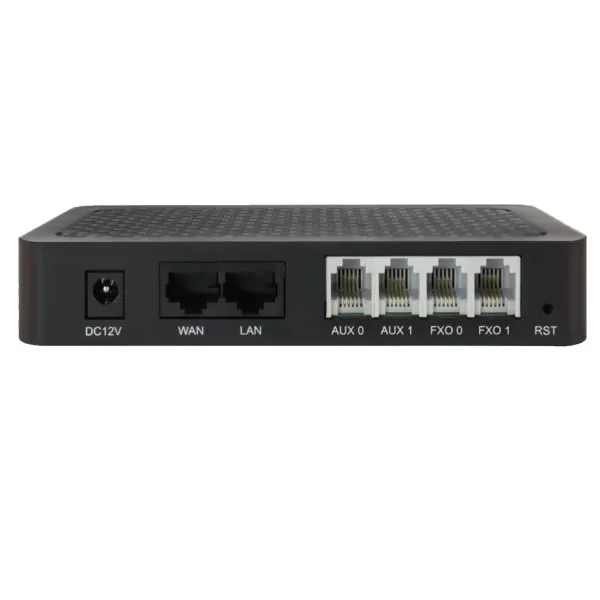
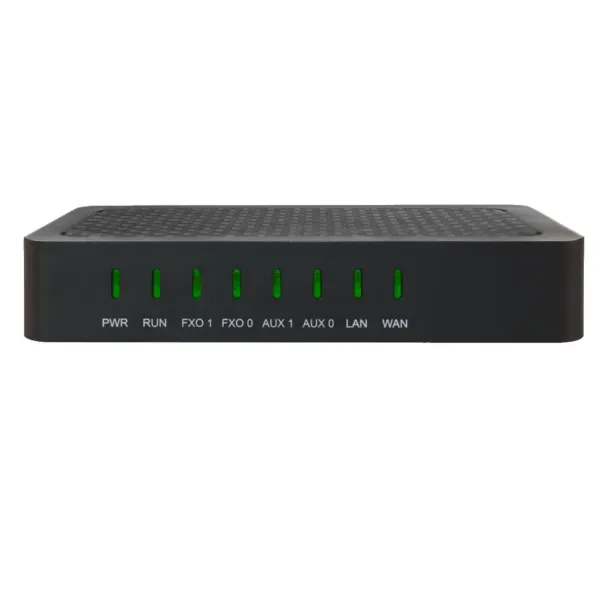
Dinstar DAG1000-2O FXO VoIP Gateway
The Dinstar DAG1000-2O is designed for organizations that need to connect two traditional analog PSTN lines or compatible analog PBX interfaces to a SIP-based IP telephony environment. It gives small offices, branch sites, retail locations, service desks and distributed businesses a controlled path from legacy voice circuits into modern IP-PBX, SIP-server and IMS/NGN deployments without forcing an immediate replacement of every existing telephony component.
2 FXO RJ11 ports, 1 WAN and 1 LAN 10/100 Mbps Ethernet, SIP v2.0, T.38 fax and pass-through, TLS/SRTP, IPv4/IPv6, VLAN/QoS features, flexible routing and dial plan, SNMP/TR-069, automated provisioning and web/cloud management.
What the DAG1000-2O Does
An FXO gateway is the bridge used when a business has analog public telephone network lines or an analog PBX trunk interface but wants those lines to participate in an IP-based voice system. On the DAG1000-2O, two FXO interfaces accept analog line connections and the gateway translates call signaling and audio into SIP/RTP traffic for an IP-PBX, softswitch or SIP server. This architecture can be useful when a company wants to retain existing PSTN numbers, preserve an analog fallback path, connect a small branch to centralized IP telephony, or migrate in phases rather than replacing all voice infrastructure at once.
Dinstar positions the model for small businesses, SOHO users, remote offices and enterprises with multiple branches. Its compact two-port capacity makes it particularly appropriate where only one or two analog carrier lines need to be integrated. The official product data lists support for SIP/IMS, SIP v2.0 over UDP/TCP/TLS, T.38 fax, multiple voice codecs, routing rules, number manipulation, Caller ID methods, busy-tone detection, polarity reversal and management through web, SNMP, TR-069 and cloud-based tools.
For buyers, the most important planning question is not simply whether a gateway has two ports. The analog line type, PBX or SIP platform, expected call routes, codec policy, fax requirements, firewall/NAT behavior, VLAN design, power protection and failover expectations should all be checked before deployment. A correct design reduces one-way audio, failed inbound routes, wrong disconnect detection and other issues that can occur when analog and IP telephony are joined without sufficient line and SIP planning.
2 FXO Ports
Two RJ11 FXO interfaces are intended for PSTN lines or compatible analog PBX trunk connections.
SIP Integration
Standard SIP v2.0 supports interoperability planning with IP-PBX systems, softswitches, SIP servers and IMS/NGN platforms.
Fax and Voice
T.38 and fax pass-through are supported alongside common codecs including G.711, G.723.1, G.729A/B and G.726.
Security & Management
TLS/SRTP, web management, SNMP, TR-069, provisioning, configuration backup/restore and cloud management support ongoing administration.
Verified Technical Specifications
| FXO capacity | 2 × FXO, RJ11 |
| Ethernet | 1 × WAN and 1 × LAN, 10/100 Mbps RJ45 |
| SIP | SIP v2.0, UDP/TCP/TLS; SIP trunk; outbound proxy; session timer; IMS support |
| Voice codecs | G.711 A-law/µ-law, G.723.1, G.729A/B, G.726 |
| Fax | T.38 and pass-through |
| DTMF | Signal, RFC2833 and in-band |
| Voice quality | G.168 echo cancellation up to 128 ms, adaptive jitter buffer, VAD, CNG, programmable gain control |
| Networking | IPv4/IPv6, DHCP client, PPPoE, static/dynamic IP, VLAN 802.1P/802.1Q, Layer 3 QoS/DiffServ, STUN, NAT functions |
| Management | Web/Telnet, SNMP v1/v2/v3, TR-069/TR-181, auto provisioning, syslog, CDR, capture tools, firmware upgrade, backup/restore, cloud management |
| Power | External 12 V DC adapter; adapter input 100–240 VAC, 50–60 Hz; published consumption 5 W |
| Environment | Operating 0°C to 45°C; storage -20°C to 80°C; 10%–90% non-condensing humidity |
| Dimensions / weight | 195 × 135 × 35 mm; 0.6 kg in the published datasheet |
Deployment and Buying Guidance
Before ordering, confirm that the two incoming circuits are ordinary analog PSTN lines or supported analog PBX interfaces intended for FXO termination. An FXO port is not the same as an FXS port: FXO typically receives battery and ringing from an analog line, while an FXS port supplies line service to an analog endpoint such as a phone or fax device. Selecting the wrong interface type is a common procurement error.
Next, confirm the SIP platform, addressing method, codec preferences, DTMF mode, NAT/firewall rules and call-routing plan. For fax workloads, test T.38 with the upstream SIP environment because successful fax over IP depends on end-to-end support and network conditions. For voice, configure VLAN and QoS where the LAN design supports them, and use stable power with suitable UPS protection if the gateway is part of a critical reception or service-desk path.
For broader telephony planning in Tanzania, FourTeck’s business technology solutions cover IP PBX, IP phones, switching, Wi-Fi, firewalls and supporting infrastructure. Regional projects can also reference the FourTeck Uganda, FourTeck Kenya, FourTeck Africa and FourTeck UAE sites when a project spans multiple operating regions.
Dinstar DAG1000-2O FXO VoIP Gateway Tanzania
In Tanzania, the DAG1000-2O is most relevant to organizations that still depend on one or two analog telephone lines but want those lines to participate in a modern SIP-based phone system. Typical scenarios include a small business migrating from a conventional PBX, a branch office joining a centralized IP-PBX, a reception desk that must preserve an existing public number, or a site that wants to keep an analog carrier circuit while internal extensions move to IP phones. The two FXO ports keep the design deliberately focused: buyers should choose this model when the requirement is for a small number of analog trunks rather than a large multi-line gateway.
A Tanzania deployment should begin with a line audit. Confirm how many active PSTN circuits exist, whether caller ID is required, how disconnect supervision behaves, whether the provider uses polarity reversal or tone-based call clearing, and how inbound numbers should reach extensions, ring groups, IVR menus or a receptionist. The gateway supports useful analog-side features such as FSK/DTMF caller ID, busy-tone detection, no-current detection, polarity reversal, configurable impedance and DTMF/pulse dialing. Those capabilities give an installer tools to tune integration, but the correct values should be tested against the actual line behavior rather than copied blindly from another site.
On the IP side, the SIP server or IP-PBX should be documented before configuration. Administrators need the registrar or server address, authentication details, transport choice, codec policy, DTMF mode, NAT method, dial plan and route priorities. VLAN tagging and Layer 3 QoS support can help place the gateway in a voice-aware LAN design. If the gateway sits behind a firewall, SIP and RTP handling should be planned carefully to avoid intermittent registration, one-way audio or unreachable inbound calls. TLS and SRTP are available where the connected SIP platform supports the same security methods.
For procurement, request a quote based on the exact model DAG1000-2O, the number of analog lines, the target IP-PBX or SIP platform, site power conditions and whether installation or configuration support is needed. Do not assume stock, lead time or compatibility solely from the model name. A concise pre-sales checklist makes the purchasing process faster and helps distinguish a straightforward two-line deployment from a project that actually needs four, eight or more FXO ports.
Dinstar DAG1000-2O FXO VoIP Gateway Dar es Salaam
Dar es Salaam businesses often operate mixed communications environments: newer offices may use SIP trunks and IP phones while an older public number, analog PBX line or specialized analog circuit remains important. The DAG1000-2O provides a practical bridge when only two FXO interfaces are required. It can allow an office to preserve analog carrier access while using an IP-PBX for extensions, call groups, voicemail and centralized administration. This is particularly useful for small professional offices, retail branches, service operations and distributed companies that want a phased voice migration instead of a disruptive all-at-once replacement.
For a Dar es Salaam site, network preparation matters as much as gateway selection. Voice packets share the same switching and routing infrastructure as business data, so the LAN should be checked for congestion, unstable links and poor segmentation. The DAG1000-2O supports 802.1P/802.1Q VLAN functions and Layer 3 DiffServ QoS, which can be incorporated into a managed network design. Where the IP-PBX is hosted at another site or in a data center, firewall policies, NAT behavior, latency and internet stability should be evaluated before deployment. Main/secondary SIP server failover support can also be considered where the PBX architecture provides redundant server endpoints.
Analog line behavior must be tested locally. Disconnect detection, caller ID signaling and impedance settings can differ between circuits and PBX interfaces. The gateway provides configurable parameters for busy-tone detection, no-current detection, polarity reversal and call detection methods, but successful commissioning depends on matching the connected line characteristics. For fax use, T.38 or pass-through should be tested end to end because the gateway alone cannot guarantee successful fax transmission when the SIP provider or IP-PBX does not support the same method.
Buyers in Dar es Salaam should provide a clear quotation brief: two-line or one-line requirement, PSTN provider or analog PBX source, destination IP-PBX, expected inbound and outbound call flows, fax requirement, security policy and installation preference. This helps verify whether the compact DAG1000-2O is the correct capacity and prevents unnecessary cost or redesign later.
Dinstar DAG1000-2O FXO VoIP Gateway Mwanza
For businesses in Mwanza, a two-port FXO gateway can make sense where an office or branch has a limited number of analog carrier lines but wants the management benefits of an IP-based phone system. The DAG1000-2O can connect those analog lines to a SIP environment while preserving the option to route calls through existing public circuits. A common branch design is to register the gateway to a local or centralized IP-PBX, then create inbound routes to reception or departments and outbound rules that decide when calls should use the analog lines.
The planning emphasis in a branch environment should be resilience and supportability. Document WAN and LAN addressing, SIP registration details, codec policy, dial patterns, line order and fallback rules. The gateway supports configuration backup and restore, system logs, call detail records, web diagnostics, network capture, SNMP and TR-069, which can make troubleshooting more structured. Keeping a known-good configuration backup is especially useful when a site is remote from the team that manages the PBX.
Power protection also deserves attention. The published DAG1000-2O power consumption is modest, but a voice path can still fail if the gateway, network switch, router or IP-PBX loses power. Where business continuity is important, size UPS coverage for the complete voice chain rather than the gateway alone. If the IP-PBX is reached across the internet, the router and access circuit become part of the same service dependency.
Mwanza buyers should treat the DAG1000-2O as a specific integration component rather than a standalone replacement for the entire phone system. Confirm that two FXO ports are enough for present and near-term needs. If more simultaneous analog lines are expected, a higher-port model may be operationally cleaner than deploying multiple small gateways. If two lines are sufficient, the DAG1000-2O offers a compact way to link those circuits to SIP while retaining routing, management and security features appropriate for a business deployment.
Dinstar DAG1000-2O FXO VoIP Gateway Arusha
In Arusha, the DAG1000-2O can serve hospitality offices, travel businesses, professional services, branch sites and other organizations that have a small analog-line footprint but want to use SIP phones or an IP-PBX. The model is most appropriate when exactly one or two FXO connections are needed. It gives the organization a migration tool: legacy PSTN access can remain in service while extension management, internal dialing and user features move to an IP platform.
A well-designed Arusha deployment starts from the call flow. Decide what should happen when a customer calls each analog number, which extension or group answers, what occurs after business hours, and which users are allowed to make outbound calls through each line. The DAG1000-2O supports routing rules based on prefixes, caller/called-number manipulation, port grouping and flexible dial planning. These functions are valuable only when the organization has a clear numbering plan; excessive rules without documentation can make future support difficult.
Voice quality should be checked across the complete path. The gateway supports G.711, G.723.1, G.729A/B and G.726 codecs, echo cancellation, adaptive jitter buffering, silence suppression, comfort noise and programmable gain control. The installer should select codecs that are supported by the IP-PBX or SIP service and suitable for available bandwidth. When WAN links are variable, monitoring packet loss and latency is more useful than repeatedly changing gateway settings without evidence.
For purchasing, specify whether the project is new IP-PBX deployment, legacy PBX integration, PSTN retention or branch connectivity. Include the number of users, phone system brand/model, analog line count, fax requirement and any remote-management policy. This information allows the gateway to be quoted as part of a complete solution rather than as an isolated appliance whose role is not fully defined.
Dinstar DAG1000-2O FXO VoIP Gateway Dodoma
Dodoma organizations evaluating a move toward IP telephony may still have working analog carrier circuits, legacy PBX interfaces or public numbers they do not want to abandon immediately. The DAG1000-2O is suited to small-scale integration because it provides two FXO ports and standard SIP connectivity in a compact device. Rather than replacing the whole telephony estate, a business can use the gateway to convert analog trunk access into SIP traffic that an IP-PBX can route to extensions, departments or other configured destinations.
The decision to use this model should be based on simultaneous call requirements. Two FXO ports generally mean up to two analog line connections, so a site with higher inbound or outbound concurrency should assess a larger gateway. For a small office, reception point or branch with limited line demand, two ports may be exactly the right size. Capacity planning should also allow for growth: it is easier to select an appropriately sized gateway at procurement stage than to redesign routing after the line count increases.
Security and administration should be included in the implementation plan. SIP TLS and SRTP are supported, as are access-control functions for web/Telnet management, SNMP and provisioning. Administrative interfaces should not be exposed unnecessarily to the public internet. Strong credentials, restricted management networks, configuration backups and firmware management form part of a sound operational policy.
For a Dodoma quotation, provide the PSTN or analog PBX details, intended SIP server, local network topology, power environment, call-routing objectives and expected support scope. If fax is part of the requirement, state the device and expected traffic so T.38/pass-through testing can be planned. This turns the procurement conversation from “we need a gateway” into a precise integration request that is easier to design, price and commission correctly.
Dinstar DAG1000-2O FXO VoIP Gateway UAE
In the UAE, the DAG1000-2O is relevant for offices and branches that maintain one or two analog telephone lines while operating a SIP-based PBX or unified communications environment. Businesses may encounter mixed estates after office moves, mergers or phased upgrades, where new IP phones coexist with older PSTN connectivity. A two-port FXO gateway offers a controlled transition point and can keep analog lines available for specific inbound numbers, outbound routes or contingency use, subject to the design of the local telephony service.
UAE procurement teams should confirm the exact service type presented by the telecom provider or PBX. The DAG1000-2O is an FXO device, so it expects the electrical and signaling characteristics associated with analog line service. It should not be selected merely because a cable uses an RJ11 connector. The service must be technically suitable for an FXO interface. Once confirmed, the installer can tune caller ID detection, busy tone, no-current detection, polarity reversal and impedance parameters as required.
The SIP environment should be equally well defined. The gateway supports SIP over UDP, TCP and TLS, SRTP, NAT mechanisms, STUN, DNS-related functions, VLAN tagging and QoS. Organizations with centralized PBX services should verify firewall rules and WAN path quality. Administration can be handled through the web interface and supported management protocols, with logging and capture tools available for diagnostics.
For multi-country organizations, the UAE gateway may be one node within a broader voice design that also includes Tanzania, Uganda, Kenya or other offices. Standardizing documentation, dial plans and configuration backup practices can make such deployments easier to support. Request quotations with the exact DAG1000-2O model, line count, PBX platform, location context and implementation scope rather than assuming one configuration template will suit every site.
Dinstar DAG1000-2O FXO VoIP Gateway Uganda
Uganda businesses with one or two analog carrier lines can use the DAG1000-2O as an edge gateway between those circuits and a SIP-based phone system. It is particularly useful when a company wants to modernize internal telephony while keeping legacy public lines active. The two-port design suits small offices, branch locations and focused migration projects, while larger sites should calculate concurrent call demand before deciding whether more FXO capacity is needed.
Deployment planning should start with the existing line environment and the target IP-PBX. Incoming call routes need to map each analog line to the right receptionist, department, IVR or ring group. Outbound rules may prioritize one line, distribute calls across ports or reserve a circuit for particular users. The DAG1000-2O’s routing and number-manipulation features provide flexibility, but every rule should be documented so support teams understand why a call takes a particular path.
Where the PBX is centralized, WAN reliability becomes part of the voice service. Quality of Service can help within managed networks, but it cannot eliminate problems caused by severe packet loss or unstable internet access. Codec selection should therefore reflect network conditions and PBX support. Logging, CDR and network capture tools can help distinguish an analog-line issue from a SIP or IP-network issue during troubleshooting.
Uganda buyers should also confirm operational management. SNMP, TR-069, provisioning and cloud management features can support centralized administration where the organization has the corresponding management workflow. Configuration backups should be retained after commissioning. For a regional project, the FourTeck Uganda site provides a relevant regional point of reference for PBX, networking and associated IT infrastructure planning.
Dinstar DAG1000-2O FXO VoIP Gateway Kampala
Kampala offices frequently need practical integration between existing telecom services and newer IP communications. The DAG1000-2O fits a narrow but common requirement: converting up to two analog lines into SIP connectivity for an IP-PBX or SIP server. A professional services office might retain its long-used public telephone numbers while moving staff to IP phones; a branch might keep analog PSTN access while registering the gateway to a central PBX; a retail or service location might use the analog lines as a route for selected calls.
Before installation, inspect the physical line presentation, cable condition and demarcation point. Connect each supported analog line to an FXO port, then verify line detection, ringing and disconnect behavior. Caller ID signaling should be tested rather than assumed. The gateway supports FSK and DTMF caller ID methods as well as multiple call-detection options, which gives flexibility for different analog environments.
On the LAN, assign a controlled IP configuration, place the device in the intended voice VLAN if used, and register it to the SIP platform. Confirm DTMF behavior for IVR navigation, codec negotiation for clear audio, and RTP reachability through any firewall or NAT device. If TLS/SRTP are required, both sides of the connection must be configured consistently. For fax, complete real transmission tests using T.38 or pass-through as appropriate.
A Kampala quotation should therefore include more than the model number. State whether the job includes supply only, remote configuration, onsite integration or a wider PBX project. List the analog line count, IP-PBX brand/model, desired inbound routes and any fax requirements. This makes it easier to verify the product fit and reduces configuration surprises during commissioning.
Dinstar DAG1000-2O FXO VoIP Gateway Arua
For a small branch or distributed organization in Arua, the DAG1000-2O can provide a simple interface between local analog telephone lines and a SIP-based communications platform. The gateway’s two FXO ports make it suitable where call demand is modest and there is value in retaining existing PSTN access. A branch may use local lines for incoming customer calls while extensions are managed through a central IP-PBX, giving the business a combination of familiar local connectivity and modern internal telephony features.
Remote-site design should prioritize recoverability. Record the gateway IP address, SIP credentials, line-to-port mapping, codec policy, DTMF method and route logic. Keep a configuration backup after commissioning, and document how to restore service after equipment replacement or a major configuration change. The DAG1000-2O supports configuration backup/restore, logs, CDR, SNMP and web diagnostics that can assist a support team even when the site is far from the main office.
If the gateway depends on a central PBX reached over the internet, confirm that the branch router and firewall permit the required SIP and RTP traffic and that NAT handling is stable. Use VLAN and QoS policies where the network design supports them, but remember that local QoS cannot repair an unreliable external circuit. UPS protection should include the gateway, router and any switch or PBX component needed to complete the call path.
Arua buyers should also consider future line requirements. If there is a planned expansion to more than two analog circuits, a larger FXO gateway may be more efficient. If the requirement is stable at one or two lines, the DAG1000-2O keeps the hardware footprint small while providing the management and routing functions needed for a professionally documented SIP integration.
Dinstar DAG1000-2O FXO VoIP Gateway Mbarara
Businesses in Mbarara that are upgrading their phone systems can use the DAG1000-2O when legacy analog lines remain part of the communications plan. Two FXO ports allow up to two supported analog line connections to feed a SIP environment. This can be useful for clinics, offices, education sites, retail businesses and branch operations that want modern extension management but still need existing PSTN connectivity for customers, suppliers or contingency calling.
Selection should begin with a concurrency question: how many analog calls must occur at the same time? If the answer is one or two, this model may fit. If several departments require independent analog lines or there is heavy inbound call volume, a four-, eight- or higher-port model may be a better architectural choice. Correct sizing avoids adding gateways later simply because line capacity was underestimated.
During commissioning, test both directions of calling, caller ID, call clearing, DTMF and audio. Analog environments can have region-specific tones and signaling behavior, so busy-tone and impedance settings should be validated against actual service. For SIP, verify registration stability, codec negotiation, firewall/NAT traversal and number formatting. The gateway’s diagnostic capture and logging features are valuable during this stage.
Mbarara procurement requests should specify the purpose of each analog line and the destination PBX. If one port is intended for general outbound use and the other for an incoming public number, that requirement affects routing. If both are pooled, hunting logic may be appropriate. By supplying those details before purchase, the organization can receive a more accurate solution recommendation and avoid treating the gateway as a generic plug-and-play adapter.
Dinstar DAG1000-2O FXO VoIP Gateway Gulu
In Gulu, the DAG1000-2O can be a suitable component for organizations that are retaining a small number of analog lines while introducing IP phones or a SIP-based PBX. The product is designed as an access gateway rather than a full PBX, so it should be positioned in the architecture between the analog line side and the IP telephony side. This distinction is important for budgeting because the gateway handles media and signaling conversion but does not replace all call-management functions of the PBX.
A branch deployment may register the DAG1000-2O to a central SIP server and use two local PSTN lines for specific inbound or outbound routes. This can help preserve local telephone access while allowing staff to share extension dialing, voicemail and other features hosted by the main PBX. The final behavior depends on the PBX design, not only the gateway.
Technical preparation includes assigning IP settings, applying appropriate VLAN/QoS policy, selecting SIP transport, configuring codecs and DTMF, and tuning analog-line detection. Security settings should restrict administrative access and use TLS/SRTP where supported by both ends. Logs, CDR and backups should be retained as part of handover documentation. This is especially useful for sites where troubleshooting may need to be performed remotely.
Gulu buyers should provide line-provider details, PBX platform, expected call routes and any fax use in the quotation request. If the gateway will be installed in a location with frequent power interruptions, consider UPS sizing for the entire voice chain. A device with low power draw still cannot keep calls working if the router, switch or PBX is unpowered.
Dinstar DAG1000-2O FXO VoIP Gateway Kenya
Kenyan organizations with analog PSTN circuits can use the DAG1000-2O to bridge two lines into a SIP-based telephony environment. This is useful during staged migrations where existing public numbers or analog carrier services must remain in operation while internal extensions move to IP. The gateway can register with a compatible IP-PBX or SIP server and translate calls between the analog and IP domains.
A Kenyan deployment should be scoped by line count and call concurrency. Two FXO ports are appropriate for small offices, branches and limited-line applications. Larger call centers or multi-line reception environments should consider higher-capacity gateways rather than assuming multiple two-port devices are always the best solution. Operational simplicity, rack space, management overhead and growth should all influence sizing.
Network teams should document SIP server addressing, VLAN, QoS, NAT/firewall rules and remote-management access. Voice quality tools such as jitter buffering and echo cancellation are built into the gateway, but the wider network still has to provide stable connectivity. For remote PBX registration, monitor latency and packet loss and test failover behavior if secondary SIP servers are configured.
Procurement in Kenya should include compatibility validation with the specific PBX and analog service. Do not assume that every telephone-like port is suitable for FXO connection. The electrical and signaling role of the interface must be confirmed. For regional solution planning, FourTeck Kenya provides a relevant reference for VoIP PBX, networking and security requirements that may surround a gateway deployment.
Dinstar DAG1000-2O FXO VoIP Gateway Kuwait
In Kuwait, the DAG1000-2O can support offices that need to integrate a pair of analog lines with an IP-PBX or SIP server. This type of requirement appears when organizations retain traditional public lines for specific numbers, business continuity or legacy integration while using IP phones for day-to-day extensions. The gateway offers a compact entry point without requiring an eight- or sixteen-port platform where only two lines are needed.
The technical design should verify analog line compatibility and PBX interoperability before purchase. The gateway supports standard SIP and common codecs, but each deployment has its own number formats, route permissions, codec preferences and firewall environment. Test inbound ringing, outbound seizure, caller ID, disconnect behavior and DTMF with the actual telecom service. For fax, validate T.38 or pass-through with real devices and destinations rather than relying only on configuration screens.
Security-conscious organizations can incorporate SIP TLS and SRTP when the connected platform supports them. Administrative access should be restricted to trusted networks, and SNMP or TR-069 should be enabled only as part of an approved management design. Configuration backups, logs and CDR can support change control and troubleshooting.
When requesting a Kuwait quotation, state whether the requirement is a new voice deployment, a legacy PBX migration, branch integration or analog-line retention. Include the line count, IP-PBX make/model, local network details and support scope. This provides enough context to confirm that the DAG1000-2O is the right capacity and interface type before hardware is ordered.
Dinstar DAG1000-2O FXO VoIP Gateway Ghana
Ghanaian businesses modernizing telephony may need to keep existing analog carrier lines while introducing SIP-based call control. The DAG1000-2O supports that transition with two FXO ports and an IP interface for SIP registration. It can be suitable for a small branch, reception desk, retail outlet or professional office where the line requirement is limited and a compact gateway is easier to deploy than a high-density chassis.
A good Ghana deployment plan should explain what each analog line does today and what it should do after migration. Inbound calls may need to reach reception, an IVR or a hunt group, while outbound calls may require prefixes or route priorities. The gateway supports flexible routing, digit maps, number manipulation and port grouping, allowing the PBX designer to create a clear transition between analog circuits and SIP extensions.
Operational support should be considered from day one. Assign clear device naming, document passwords securely, save the final configuration and record the line mapping. Use logs and CDR when diagnosing failed calls, and use packet capture carefully when SIP troubleshooting requires it. If the PBX is hosted remotely, make WAN availability and firewall configuration part of the acceptance test.
Ghana buyers should avoid choosing the model solely because it appears inexpensive or compact. Confirm two-port capacity, analog electrical compatibility, SIP platform support and future growth. If the requirements are understood and fit within two FXO ports, the DAG1000-2O can provide a focused and manageable analog-to-IP bridge without unnecessary complexity.
Dinstar DAG1000-2O FXO VoIP Gateway Nigeria
Nigeria has a wide range of business telephony environments, from small offices with a few analog lines to multi-site enterprises using SIP and centralized call platforms. The DAG1000-2O is intended for the smaller end of that requirement: two FXO lines integrated into an IP-based voice system. It is useful where a business wants to retain existing analog circuits or numbers while adopting IP-PBX features and SIP endpoints.
Capacity planning is essential. An FXO port corresponds to an analog line interface, so two ports cannot satisfy a requirement for many concurrent PSTN calls. Branches with modest traffic may find two ports appropriate, while larger offices should examine four-, eight- or sixteen-port alternatives. The correct choice should be based on call concurrency and growth, not merely on the number of employees.
Network and power resilience are also important. The gateway can support QoS, VLANs, secondary SIP server configuration and remote management, but surrounding routers, switches, internet links and power systems must also be dependable. A UPS protecting only the gateway will not preserve service if the broadband router or PBX loses power. For centralized deployments, test failover and recovery procedures so staff know what happens when the primary SIP path is unavailable.
Nigerian procurement teams should provide a clear technical brief including analog service type, line count, PBX platform, call flow, fax usage and installation scope. This allows compatibility questions to be answered before purchase and supports a cleaner commissioning process. The gateway’s value is highest when it is treated as part of a planned voice architecture rather than a standalone converter added without network or dial-plan design.
Dinstar DAG1000-2O FXO VoIP Gateway Seychelles
For Seychelles organizations with compact office environments, the DAG1000-2O can be a practical choice when only one or two analog telephone lines need to connect to a SIP system. Small hotels, service businesses, administrative offices and branch operations may want to retain established public lines while modernizing internal extensions. The gateway makes that possible without requiring a high-density FXO platform.
Because island and remote-site operations often value straightforward support, configuration documentation should be prioritized. Record WAN/LAN addressing, port-to-line assignments, SIP account settings, codec choices, DTMF mode, caller ID method and all routing rules. Store a configuration backup after successful testing. These simple practices can shorten recovery time if the device is replaced or reset.
The gateway’s environmental operating range and external power adapter should be considered in the equipment-room design. Keep the unit in a ventilated, dry location within the published temperature and humidity limits, and use appropriate surge/UPS protection as part of the wider voice system. Network connectivity to any remote SIP server should be monitored, particularly when the same internet circuit carries other business traffic.
Seychelles buyers should confirm whether the intended analog service presents a true FXO-compatible line and whether two simultaneous analog calls are sufficient. If those conditions are met, the DAG1000-2O can provide a compact bridge between legacy connectivity and modern IP telephony. A quotation should include the PBX or SIP platform, line count, call-routing objectives and desired support level so the solution can be validated before deployment.
Compatibility and Integration Checklist
Analog side
Confirm PSTN or compatible analog PBX interface, caller ID method, line polarity behavior, busy/disconnect tone, impedance and dial method. Label each physical line and confirm which public number maps to each FXO port.
SIP side
Confirm registrar or SIP server address, credentials, transport, codecs, DTMF, RTP port handling, NAT/firewall policy, outbound proxy if used and any secondary SIP server configuration.
Call-flow side
Document inbound destinations, outbound prefixes, line priority, port groups, after-hours behavior, number manipulation and any emergency or fallback rules supported by the overall PBX design.
Frequently Asked Questions
What is the Dinstar DAG1000-2O used for?
It is a 2-port FXO analog VoIP gateway used to connect analog PSTN lines or compatible analog PBX interfaces to SIP-based IP telephony networks such as IP-PBX systems, SIP servers and softswitches.
Does the DAG1000-2O have FXS ports?
This model is identified by Dinstar as a 2-FXO gateway. Buyers who need to connect analog phones or fax endpoints directly should verify whether an FXS or hybrid model is more appropriate for their application.
Can it connect to an IP-PBX?
Yes. Dinstar specifies standard SIP support and interoperability with SIP-based IP telephony systems. Exact compatibility should still be validated against the PBX version, authentication method, codecs, DTMF handling and network design.
Does it support fax?
The product supports T.38 and fax pass-through. Successful fax operation depends on the complete end-to-end environment, so real transmission tests are recommended during commissioning.
How many simultaneous analog lines can it connect?
The DAG1000-2O provides two FXO ports for two analog line connections. If the project needs more analog trunks or higher PSTN concurrency, consider a higher-port gateway after confirming the full call-capacity requirement.
Does it support secure SIP?
Dinstar lists SIP TLS and SRTP support. Both the gateway and the connected PBX or SIP service must be configured for compatible secure signaling and media settings.
Can the gateway be managed remotely?
Management capabilities include web access, SNMP, TR-069, provisioning, configuration backup/restore, system logs, CDR, diagnostic tools and Dinstar cloud-management support. Remote access should be secured according to the organization’s network policy.
Quotation Checklist
For an accurate Dinstar DAG1000-2O quotation, provide the exact model name, project location, number of analog PSTN lines, source telecom service or PBX interface, target SIP/IP-PBX platform, expected inbound and outbound call routes, fax requirement, remote-management requirement and whether installation/configuration support is needed.
Also state whether the requirement is immediate replacement, a new deployment or part of a phased migration. If more than two analog lines may be added soon, mention the expected growth so a higher-capacity model can be evaluated before purchase.
Decision Recap
Choose the Dinstar DAG1000-2O when the project genuinely needs two FXO analog line interfaces connected to a SIP-based voice environment. Its strengths are compact capacity, standard SIP, analog-line control features, T.38 fax support, TLS/SRTP, VLAN/QoS options and practical management tools.
Do not select it simply because a project mentions “analog phones” or “RJ11.” Determine whether the required interface is FXO or FXS, confirm line count and concurrency, verify the PBX and network environment, and build a documented call-routing plan. That preparation is what turns a gateway into a reliable part of the communications system.
Consult FourTeck for Product Fit and Integration
FourTeck Tanzania can evaluate the Dinstar DAG1000-2O within the wider IP-PBX, IP-phone, switching, routing, firewall and power environment. Share the analog line details, intended SIP platform and call-flow requirements so the gateway capacity and integration approach can be checked before deployment.


Reviews
There are no reviews yet.