
FortiGate 400F (FG-400F) Tanzania
FortiGate 400F is an enterprise next-generation firewall for organizations that need substantial interface density, high-speed 10GbE connectivity, secure SD-WAN, VPN, segmentation and consolidated security controls. Fortinet positions the 400F series around converged networking and security, AI/ML-powered protection and Security Fabric integration. For Tanzania projects, the important purchasing question is not only whether the appliance has enough headline throughput; it is whether the proposed design fits real inspected traffic, encrypted sessions, WAN links, branch connectivity, high-availability requirements, logging, subscriptions and expected growth.
FortiGate 400F overview and verified hardware
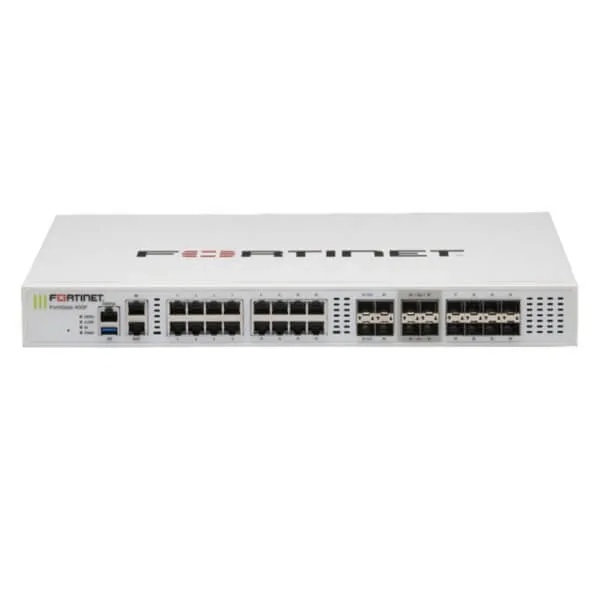
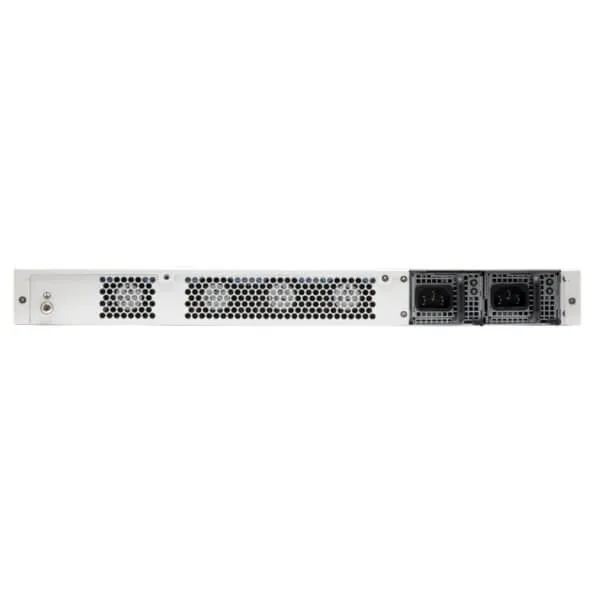
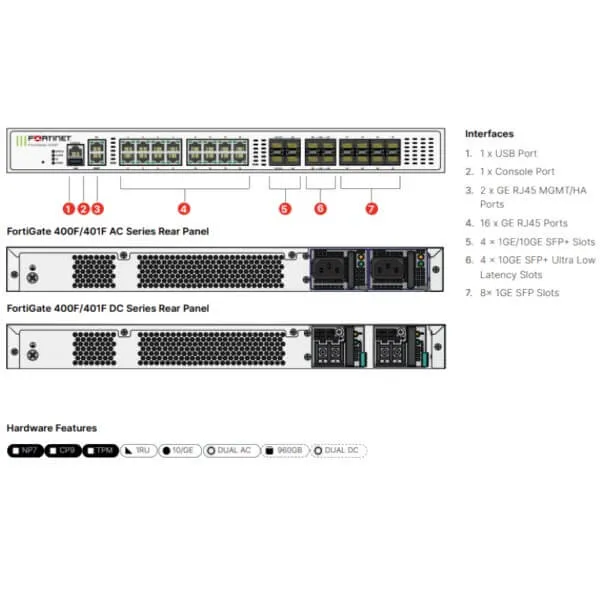
The FG-400F is a 1RU rack-mount FortiGate appliance. Fortinet documents 18 GE RJ45 ports, comprising one management port, one HA port and sixteen switch ports; eight GE SFP slots; and eight 10GE SFP+ slots. It uses Fortinet SPU NP7 and CP9 hardware acceleration and ships with dual AC power supplies. Fortinet also documents four of the 10GE interfaces, X5 through X8, as ultra-low-latency interfaces connected directly to the NP7 path. These physical characteristics make the model relevant to headquarters, larger campuses, data-centre edges and aggregation points where copper access, fibre handoffs and multiple 10GbE links may need to coexist.
FortiOS provides the operating environment for firewall policy, routing, SD-WAN, VPN, segmentation and security services. FortiGuard subscriptions and FortiCare should be selected according to the required security functions and support term rather than assumed to be included with every hardware quote. Buyers should specify whether the project needs appliance-only pricing, a security bundle, support, implementation, high availability, optics, DAC cables, logging or centralized management. This prevents comparisons between quotations that appear similar but contain materially different entitlements.
Interfaces
16 GE RJ45 switch ports, dedicated GE management and HA ports, eight GE SFP slots and eight 10GE SFP+ slots support mixed copper and fibre designs.
Acceleration
NP7 and CP9 hardware acceleration is part of the FG-400F architecture. Correct policy and feature design remains essential when estimating production performance.
Resilience
Dual AC power supplies support resilient power design. Projects requiring firewall high availability should scope a second appliance and the surrounding switching, addressing and failover design.
Sizing, licensing and integration guidance
A firewall should be sized from the traffic that will actually cross security policies. Document internet circuit speeds, east-west traffic, site-to-site VPN, remote access, expected concurrent users, public services, VLAN count, encrypted inspection requirements and projected bandwidth growth. Security inspection can change effective throughput, so procurement should not rely on the largest firewall-throughput figure in isolation. Where a business expects faster WAN services during the appliance lifecycle, reserve capacity for that upgrade rather than sizing only for today’s circuit.
Interface planning is equally important. Confirm which links are copper, which are fibre, required transceiver types, switch uplink speeds, ISP handoffs and whether 10GbE is required toward core switches or server networks. For resilient designs, map both power feeds, UPS capacity, HA links, upstream/downstream switch redundancy and the behaviour expected during an ISP or appliance failure. For multi-site organizations, define route exchange, SD-WAN rules, VPN topology, addressing standards and centralized logging before deployment.
FourTeck Tanzania’s firewall, VPN and network-security portfolio places the firewall within the wider LAN, WAN and infrastructure design. The same site also covers network switching and routing, business Wi-Fi planning, servers and storage, structured cabling, racks and UPS, IP PBX and VoIP, and integrated IT lifecycle services. These dependencies matter because firewall performance and resilience are affected by the network, power, cabling and applications around it.
FortiGate 400F (FG-400F) Tanzania
Organizations evaluating the FortiGate 400F in Tanzania commonly need an enterprise perimeter platform that can connect multiple WAN services, segment internal networks and provide controlled connectivity between headquarters, branches, data-centre resources and cloud applications. The 400F’s mixture of GE copper, GE SFP and 10GE SFP+ interfaces gives architects flexibility when an existing environment contains several generations of switching and carrier handoffs. A sound Tanzania deployment starts with a traffic map: identify internet circuits, MPLS or private WAN connections, server networks, user VLANs, voice, CCTV, guest access, management networks and any public-facing services. The firewall policy can then be designed around business flows instead of accumulated rules.
For procurement, request a bill of materials that separates hardware, FortiGuard services, FortiCare term, optics, cables, implementation and optional management or logging components. If high availability is required, include the second firewall and confirm switch-port, IP-address and power requirements on both sides of the pair. Businesses with geographically distributed operations should also document which sites need site-to-site VPN, which users require remote access, and which applications need predictable performance during WAN failover. This creates a clearer basis for sizing and avoids selecting an appliance only from user count.
Environmental preparation deserves attention. The FG-400F is a rack appliance, so the project should provide suitable rack space, airflow, clean power and UPS protection. Fibre projects should identify connector and transceiver requirements before installation. Change windows, configuration backups, rollback plans and acceptance tests should be agreed before replacing an existing perimeter firewall. Tests can include internet access, DNS, published applications, VPN, SD-WAN path selection, failover, logging and access between security zones. For wider regional resources, customers can also review FourTeck Africa technology coverage when coordinating multi-country requirements.
FortiGate 400F (FG-400F) Dar es Salaam
Dar es Salaam organizations may use the FG-400F at a headquarters, larger commercial site, data-centre edge or aggregation point where several business systems converge. A useful design exercise is to separate north-south internet traffic from internal inter-zone traffic and determine which flows genuinely need security inspection. Corporate users, guest Wi-Fi, IP telephony, cameras, servers and management devices should not automatically share one trust zone. VLAN and policy segmentation can reduce unnecessary lateral access while preserving the services each group needs.
Connectivity planning should record every provider handoff and its physical media. The 400F has a broad interface mix, but the correct SFP/SFP+ optics still need to match the switch or carrier link. If two internet services are present, define whether the objective is active-active utilization, application steering, failover, or a combination through SD-WAN. Critical SaaS, voice and VPN traffic can have different path priorities from bulk downloads. Testing should include loss of each WAN path and recovery, not only normal-state connectivity.
For a Dar es Salaam quotation, provide current and planned bandwidth, approximate concurrent users, major applications, VLANs, VPN peers, remote-access users, public IP requirements and preferred subscription term. Mention whether the firewall will replace another FortiGate or migrate from a different vendor, because configuration conversion and policy cleanup can change the project scope. Include rack and UPS details and whether centralized monitoring is already present. Buyers can use the FourTeck Tanzania contact page to submit these requirements and obtain a project-specific discussion rather than relying on an unqualified appliance-only comparison.
FortiGate 400F (FG-400F) Mwanza
For Mwanza deployments, the FortiGate 400F can be evaluated where a regional office, institution, industrial operation, hospitality property or multi-branch organization needs a substantial security gateway with fibre and 10GbE options. The model should be chosen after understanding traffic patterns rather than simply matching the number of employees. A site with fewer users but large server transfers, VPN replication, CCTV flows or extensive SSL inspection can place different demands on a firewall than an office with many light web users.
Branch connectivity is often central to the architecture. Document all remote sites, their subnets, internet providers and applications that traverse tunnels. Decide whether branches connect directly to Mwanza, to Dar es Salaam, to cloud environments, or through a mixed topology. Route summarization and consistent addressing can simplify the policy base. If SD-WAN is used, define measurable health checks and business rules for failover rather than treating every path as equivalent. Logging should provide enough visibility to diagnose path changes and blocked traffic.
Operational continuity should be planned from the physical layer upward. The rack needs appropriate ventilation, UPS-backed power and documented cabling. Dual power supplies are useful only when power feeds are arranged sensibly. For HA pairs, upstream and downstream dependencies should not leave a hidden single point of failure. Before procurement, list required SFP and SFP+ modules, patch leads, rack accessories, support subscriptions and implementation services. A staged migration can validate routing, NAT, VPN and security rules before final cutover. This approach gives Mwanza buyers a more complete cost and risk picture than purchasing the firewall chassis without the components and services needed to operate it.
FortiGate 400F (FG-400F) Arusha
Arusha businesses considering the FG-400F may include hospitality groups, larger offices, institutions and organizations that connect multiple properties or branches. In these environments, the firewall can become the control point between business systems, guest services, administration, voice, surveillance and external connectivity. Segmentation should reflect operational roles. Guest traffic, for example, normally should not have the same access as finance or server networks, while cameras and building systems can be restricted to the destinations they actually require.
The 400F’s interface density is valuable when several fibre uplinks, core switches or provider circuits terminate at the security layer. Still, port count alone does not determine architecture. Confirm link speeds, transceiver compatibility, redundancy, routing protocols and whether switch stacks or separate cores are used. For organizations operating more than one property, standardized naming, VPN templates, address plans and security objects can reduce support complexity. Centralized logging and management may also be considered when the number of Fortinet devices grows.
A practical Arusha procurement brief should include internet speeds, business-critical cloud applications, peak user levels, expected encrypted traffic, VPN requirements, desired web and threat-security services, and the term for subscriptions and support. If hospitality or customer-facing services are involved, define acceptable downtime and schedule migration outside critical operating periods. Acceptance testing should cover both security and user experience, including DNS, application access, voice quality, guest internet, VPN and failover. When coordinating related network upgrades, review switching, Wi-Fi, cabling and UPS requirements at the same time so the firewall is not constrained by an undersized uplink or unmanaged physical infrastructure.
FortiGate 400F (FG-400F) Dodoma
Dodoma organizations assessing the FortiGate 400F can approach the project as a security-architecture exercise rather than a box replacement. Start by identifying protected services, user groups, branch links, public systems and administrative access. Translate those into zones and explicit policies. This is particularly important when legacy networks have grown over time and contain broad rules that no longer reflect business requirements. A migration is an opportunity to remove obsolete objects, document ownership and introduce clearer segmentation.
The appliance’s GE and 10GE connectivity supports designs that bridge older access infrastructure with faster core or server links. When fibre is involved, specify the exact optical requirements and distance. For WAN resilience, record provider diversity and physical paths; two logical circuits that share the same upstream dependency may not provide the resilience expected. SD-WAN policies should align with application priorities, and failover tests should be performed under controlled conditions. Site-to-site VPN should use a documented addressing and routing plan to reduce overlap problems as new branches are added.
For budgeting, compare like with like. A hardware-only FG-400F price is not equivalent to a quote that includes FortiGuard services, FortiCare, transceivers, a second HA unit, configuration, migration and post-cutover support. State the required contract duration and whether renewal budgeting is important. Also identify logging retention and reporting expectations, because these can influence the broader solution. FourTeck’s Tanzania infrastructure approach links firewall projects with switching, wireless, servers, racks and power planning, which is useful when a Dodoma site is being built or modernized rather than merely replacing one appliance.
FortiGate 400F (FG-400F) UAE
UAE projects involving the FG-400F often need clear coordination between high-speed internet, data-centre connectivity, branch VPN and enterprise security services. The model’s eight 10GE SFP+ interfaces can support fast upstream and downstream connections, while GE copper and SFP ports provide flexibility for management, WAN and legacy integration. Architects should identify which traffic requires inspection and which interfaces connect to core, distribution, carrier or server environments. Fortinet’s NP7 architecture and ultra-low-latency X5-X8 interfaces are relevant technical characteristics, but production design still depends on policy features and traffic mix.
When procuring for the UAE, request a detailed bill of materials with the exact FG-400F appliance, subscription bundle and term, support, optics and any HA requirement. If the device is part of a wider Fortinet Security Fabric, include management, analytics, switching, wireless or endpoint integrations that are genuinely required. For migrations, inventory existing NAT, VIPs, VPNs, routing, certificates and authentication dependencies before cutover. This reduces the risk of discovering undocumented application flows during the maintenance window.
Multi-country customers can coordinate standards between UAE headquarters and African branches by defining reusable policy naming, VPN parameters, logging, administrative roles and change control. The FourTeck UAE site provides a regional point of reference, while FourTeck’s Fortinet-focused UAE resource can support Fortinet-specific solution exploration. Regional coordination is most effective when each site’s local circuits and operational constraints are documented instead of forcing identical configurations onto different network conditions.
FortiGate 400F (FG-400F) Uganda
Uganda organizations considering the FortiGate 400F may be connecting a headquarters, data-centre edge or central site to multiple branches. The first step is to quantify inspected traffic and define what must remain available during a circuit or appliance failure. Where branches depend on central ERP, voice, file services or authentication, VPN and SD-WAN behaviour should be tested as business processes, not just as tunnel status. Application-aware path rules can be planned around critical services while less-sensitive traffic uses available bandwidth efficiently.
Security segmentation can separate staff, servers, guest access, cameras, voice and management systems. Policies should use least necessary access and be documented with purpose and ownership. Remote administration should be restricted and protected, while configuration backups and controlled firmware processes support recoverability. If the project includes FortiGuard security services, select the service bundle and term according to required protections and renewal planning rather than assuming all services are perpetual with the appliance.
A complete Uganda RFQ should identify appliance quantity, HA requirement, AC power design, optics, WAN circuits, core-switch uplinks, subscription term and implementation scope. Include existing firewall information if migration is required. For cross-border or Uganda-specific project coordination, the FourTeck Uganda technology site can complement the Tanzania team when a customer has sites in both markets. Standardized documentation across countries can simplify troubleshooting while still allowing each site to use the WAN providers, addressing and failover rules appropriate to its environment.
FortiGate 400F (FG-400F) Kampala
Kampala enterprises evaluating an FG-400F can use its mixed GE and 10GE connectivity at a central office where several network domains meet. Before purchase, map the current topology and identify core-switch links, ISP handoffs, server networks, DMZ services, VPN peers and management paths. This reveals whether the interface mix fits without unnecessary media converters or unplanned optics. It also highlights where redundancy should be introduced around the firewall rather than only inside it.
High availability requires more than buying two appliances. The design should consider HA heartbeat connectivity, synchronized configuration, upstream/downstream switching, duplicate power paths and how public addressing or dynamic routing behaves during failover. Test cases should include appliance failure, WAN failure and recovery. If users depend heavily on cloud applications, SD-WAN health checks should represent actual service quality rather than simple gateway reachability. Logging should make it possible to see why traffic moved between links.
For Kampala procurement teams, ask suppliers to state exactly what is included: FG-400F hardware, FortiCare, FortiGuard bundle, subscription length, SFP/SFP+ modules, rack accessories, professional services and any centralized management or logging. This makes commercial comparisons more meaningful. Migration planning should also include a rule review so outdated policies are not copied blindly from the previous firewall. A documented handover should capture interface assignments, VLANs, routing, VPN, administrators, backup procedure and renewal dates, giving the operations team a maintainable platform after the installation project is complete.
FortiGate 400F (FG-400F) Arua
For an Arua deployment, resilience and remote manageability can be as important as raw firewall capacity. Organizations connecting a regional operation to central systems should define what happens if the primary WAN path becomes unavailable and which services must continue over backup connectivity. The FG-400F can participate in SD-WAN and VPN architectures, but effective continuity depends on having viable alternate circuits, correct routing and policies that have been tested under failure conditions.
A remote or regional site should also have strong operational documentation. Record interface labels, IP addressing, VLANs, provider details, VPN peers, power connections and escalation contacts. Configuration backups should be maintained securely. Administrative access should be limited to approved management paths. Where local users need internet access as well as centralized applications, policy and routing can be designed so that an outage does not create unexpected exposure or send all traffic through an unsuitable backup link.
Before quoting the 400F for Arua, verify that its capacity and interface density are justified by the actual site. Some projects may be better served by another FortiGate model; model selection should follow measured or well-estimated requirements. If the 400F is appropriate, include necessary optics, subscription services, support term, UPS/rack preparation and implementation. For organizations operating Arua as part of a national branch network, consistency in templates and monitoring can simplify support, while local WAN characteristics and available bandwidth should still be reflected in the site’s SD-WAN and traffic-shaping policies.
FortiGate 400F (FG-400F) Mbarara
Mbarara customers can evaluate the FortiGate 400F for central security, branch aggregation or larger campus requirements where several VLANs and WAN links need coordinated policy. A sizing worksheet should capture peak internet use, internal routed traffic, VPN load, expected security inspection and growth. User count alone is a weak sizing metric because application behaviour differs significantly between organizations. Backups, cloud synchronization, video, large file transfers and encrypted inspection can create short periods of high demand that should be understood.
Network segmentation can improve both security and troubleshooting. Separate user, server, guest, CCTV, voice and management zones where appropriate, then permit only required flows. This creates clearer logs and limits accidental cross-network access. If the firewall also provides SD-WAN, define application priorities and path-health thresholds. For sites with multiple providers, confirm that physical diversity exists where continuity is important. A backup circuit that shares the same last-mile dependency may not deliver the resilience expected.
Commercial planning should include lifecycle costs. FortiGuard security services and FortiCare are term-based elements that should be selected and budgeted alongside the hardware. Ask for renewal dates and entitlement details to be documented at handover. For an HA deployment, budget for two appropriately licensed units plus the network and power infrastructure around them. Installation scope can include migration, policy cleanup, VPN recreation, testing and documentation. A clear Mbarara RFQ with these items reduces ambiguity and allows suppliers to respond against the same technical requirement.
FortiGate 400F (FG-400F) Gulu
Gulu deployments should begin by deciding the role the FG-400F will play: internet edge, central VPN hub, segmentation firewall, data-centre perimeter or a combination. Each role produces a different traffic profile and availability requirement. A central VPN hub, for example, must account for aggregate branch traffic and tunnel growth, while a segmentation firewall may process significant east-west traffic even when internet bandwidth is modest. Documenting these flows is essential before model confirmation.
The appliance’s range of copper and fibre ports can simplify connectivity, but every physical link should be specified. Record whether the ISP presents RJ45 or fibre, core-switch speeds, optic types and whether link aggregation is planned. For HA, avoid connecting both firewalls through a single unprotected dependency if the objective is true service continuity. Power should be UPS-backed, rack airflow maintained and cabling labelled. Operationally, administrators need secure access, backups and a controlled process for firmware and policy changes.
For Gulu branch networks, VPN addressing and routing should be standardized enough to scale. Avoid overlapping subnets where possible, use clear object naming and document the purpose of security policies. If SD-WAN is used, test failover with actual business applications. The quotation should clearly identify hardware, support, FortiGuard services, optics and implementation. This prevents a low appliance-only price from being mistaken for the full project cost. Where future branches are expected, include that expansion in sizing and license planning so the initial design does not need immediate rework.
FortiGate 400F (FG-400F) Kenya
Kenya organizations can consider the FortiGate 400F for enterprise sites requiring high interface density, 10GbE connectivity and integrated firewall, SD-WAN and VPN functions. The technical assessment should identify whether the appliance is protecting a single office, acting as a national hub, or connecting data-centre and cloud resources. Each scenario changes the mix of internet traffic, VPN throughput, internal routing and security inspection. Capacity should be reserved for growth and for the security features that will actually be enabled.
Multi-site customers operating in Kenya and Tanzania can benefit from common design standards. Use consistent naming for interfaces, address objects and VPNs; define administrator roles; and establish shared logging and backup practices. At the same time, avoid assuming WAN services are identical in every country or city. Local circuit speeds, latency, provider handoffs and backup options should drive SD-WAN thresholds and traffic steering at each site. Cross-border applications should be tested from the user perspective.
A Kenya quotation should specify the exact FG-400F hardware, FortiGuard/FortiCare term, HA quantity, transceivers, cabling and services. Where the project spans multiple countries, shipping, tax, warranty handling and service responsibilities should be confirmed in the commercial proposal rather than assumed. The FourTeck Kenya site provides a regional reference for Kenya requirements. Coordinated architecture can reduce configuration drift across sites while allowing each location to retain appropriate local connectivity and operational procedures.
FortiGate 400F (FG-400F) Kuwait
Kuwait projects evaluating the FG-400F should match its interface and security capabilities to the actual enterprise topology. With GE copper, GE SFP and 10GE SFP+ connectivity, the appliance can sit between carrier services, core switching and protected networks without forcing every link onto one media type. The architecture should still document link speed, optic requirements, routing, VLANs and resilience. For data-centre or server-edge use, internal traffic may be as important as internet bandwidth when estimating capacity.
Security services should be chosen according to policy objectives. Organizations may require intrusion prevention, web and application controls, malware protection and other FortiGuard capabilities, but the exact bundle and contract term should be confirmed in the quotation. If encrypted inspection is planned, include it in performance sizing and deployment preparation. Certificates, application compatibility and exception handling should be considered before enabling broad inspection in production.
For organizations with Kuwait and African operations, standardized VPN, logging and administrative practices can make support easier. The FourTeck Kuwait site provides a regional reference for Kuwait technology requirements. Procurement teams should request clear separation of hardware, licensing, support, optics and professional services, and should verify renewal dates and responsibilities at handover. High-availability designs should include redundant surrounding infrastructure where appropriate, because a firewall pair cannot compensate for every upstream switch, power or carrier single point of failure.
FortiGate 400F (FG-400F) Ghana
Ghana enterprises assessing the FortiGate 400F can use a requirements-led process that begins with applications and network flows. Identify critical cloud platforms, internal servers, branch traffic, remote users, guest access and public services. Then estimate peak and future bandwidth with the required security functions enabled. This avoids over-reliance on one datasheet throughput number and produces a more defensible model selection for procurement and technical review.
For branch-heavy environments, the firewall can form part of an SD-WAN and VPN design. Document provider circuits, health-check targets, path preferences and what should happen when a link recovers. Flapping or unstable circuits need sensible thresholds so applications are not moved unnecessarily. VPN addressing should avoid overlap, and route design should be planned before dozens of tunnels are created. Logging and centralized visibility can help operations teams understand both security events and connectivity changes.
The bill of materials should include the exact appliance count, FortiCare and FortiGuard terms, optics, HA requirements and implementation. If the firewall connects to 10GbE core infrastructure, specify SFP+ module or DAC requirements explicitly. Rack, cooling and UPS readiness should be checked before installation. Customers with Ghana and Tanzania operations can reference the FourTeck Ghana site for regional coordination. Shared documentation and security standards can reduce support effort while still accommodating differences in local WAN services and business applications.
FortiGate 400F (FG-400F) Nigeria
Nigeria deployments of the FG-400F may involve headquarters, financial or commercial operations, larger campuses and organizations with many branch connections. The design should distinguish between internet-edge throughput, VPN aggregation and internal segmentation because these workloads can overlap. If the appliance is expected to carry substantial east-west server traffic as well as inspected internet traffic, both should be included in capacity planning. Future bandwidth upgrades should also be considered over the intended lifecycle.
Multiple WAN links can improve resilience when provider diversity and routing are designed correctly. SD-WAN rules should reflect application importance and real path quality. For example, latency-sensitive voice or interactive business applications may need different thresholds from software downloads or backups. Security policies should separate business zones and avoid broad any-to-any access. Administrative interfaces should be protected, and configuration backups, logging and change control should be part of normal operations.
Procurement teams should compare complete solutions rather than headline hardware prices. Confirm whether a quote includes the FG-400F chassis, FortiGuard bundle, FortiCare, support duration, optics, a second HA appliance, configuration and migration. For organizations spanning Nigeria and East Africa, common templates can improve consistency, but every site still requires local circuit and addressing validation. The FourTeck Nigeria site can be used for Nigeria-side technology coordination while the Tanzania site supports requirements centered on Tanzania. Clear ownership across regions is particularly useful for renewals, escalation and planned changes.
FortiGate 400F (FG-400F) Seychelles
Seychelles organizations considering the FortiGate 400F should place connectivity resilience and operational support high on the design checklist. Hotels, enterprises, institutions and distributed properties may depend heavily on cloud services, remote management and inter-site connectivity. The firewall can consolidate security and WAN functions, but continuity still depends on available carrier options, correct failover policy and a network design that does not hide single points of failure outside the appliance.
A site assessment should document WAN links, internal VLANs, guest services, business systems, voice, cameras, servers and remote-access requirements. Guest and operational networks can be separated with policies that permit only necessary communication. Where the firewall connects to high-speed core switching, specify 10GbE optics or DACs and confirm compatibility. For HA, include duplicate power and switching paths where the business impact justifies them. UPS capacity and rack cooling are also practical parts of firewall availability.
For quotation, provide expected traffic, user profile, security services, VPN peers, subscription term and migration scope. If remote administration will be important, define secure management access and logging from the outset. Documentation should include configuration backups, interface maps, provider details and renewal dates so the environment remains supportable after installation. For regional organizations, a common Fortinet architecture across Seychelles, Tanzania and other markets can simplify policy governance, but local WAN characteristics and operational constraints should remain visible in each site’s design rather than being hidden by a generic template.
Related network and security planning
A FortiGate deployment is strongest when adjacent systems are included in the design. Core and access switches need adequate uplink capacity and VLAN configuration. Wireless networks should map staff, guest and device SSIDs into appropriate security zones. Servers and storage need explicit access policies rather than broad trusted-network rules. Voice platforms may require predictable routing and QoS. Racks, fibre and UPS infrastructure affect physical reliability. FourTeck Tanzania’s broader integrated IT and infrastructure overview helps procurement teams consider these dependencies together.
For firewall-specific preparation, an existing configuration export, topology diagram and recent traffic statistics can accelerate discovery. List all public IP addresses, inbound NAT, VPN tunnels, routing protocols, authentication integrations and certificates. Identify rules that are temporary, obsolete or undocumented. A migration should preserve necessary business access without preserving years of configuration clutter. Where a new network is being built, define IP addressing and VLAN standards before firewall rules are created.
Quotation checklist for FG-400F
To prepare a useful quotation, provide: appliance quantity; whether HA is required; current and planned internet bandwidth; WAN providers and handoff types; number and speed of core links; SFP/SFP+ requirements; approximate concurrent users; important applications; VLAN and security-zone count; site-to-site VPN peers; remote-access needs; public services; required FortiGuard functions; preferred support/subscription term; logging or centralized management requirements; existing firewall model; migration window; rack and UPS readiness; and whether implementation, testing and documentation are required. This information allows the commercial proposal to reflect the project rather than only the appliance.
FortiGate 400F FAQs
What ports does the FG-400F provide?
Fortinet documents 18 GE RJ45 ports including dedicated management and HA plus 16 switch ports, eight GE SFP slots and eight 10GE SFP+ slots. Optics and cabling should be selected for the actual connected equipment.
Does the FortiGate 400F support redundant power?
Yes. Fortinet specifies dual AC power supplies for the FG-400F. Resilient deployment also requires appropriate upstream power, UPS and network design.
Should I buy one FG-400F or an HA pair?
That depends on the acceptable downtime and surrounding architecture. If firewall availability is business-critical, evaluate an HA pair together with redundant switching, power and WAN dependencies. Buying two appliances alone does not remove every single point of failure.
Are FortiGuard services included forever with the hardware?
No assumption should be made from the hardware name alone. FortiGuard security services and FortiCare are offered with defined entitlements and terms. Confirm the exact bundle and duration on the quotation and record renewal dates.
How should the FG-400F be sized?
Use real requirements: internet and internal traffic, enabled security inspection, encrypted traffic, VPN, applications, concurrent sessions, interface speeds, HA and growth. Datasheet figures are useful reference points but should not replace workload-based sizing.
Decision recap and consultation
FortiGate 400F is a 1RU enterprise firewall with a broad GE/10GE interface mix, NP7/CP9 acceleration and dual AC power. It can be a strong architectural fit for demanding perimeter, SD-WAN, VPN and segmentation roles when the real workload justifies the model. Before ordering, confirm throughput requirements under the intended security services, physical interfaces and optics, subscription term, HA design, migration scope and lifecycle support. FourTeck can use that information to prepare a more precise product and implementation discussion for Tanzania and coordinated regional projects.




Reviews
There are no reviews yet.