
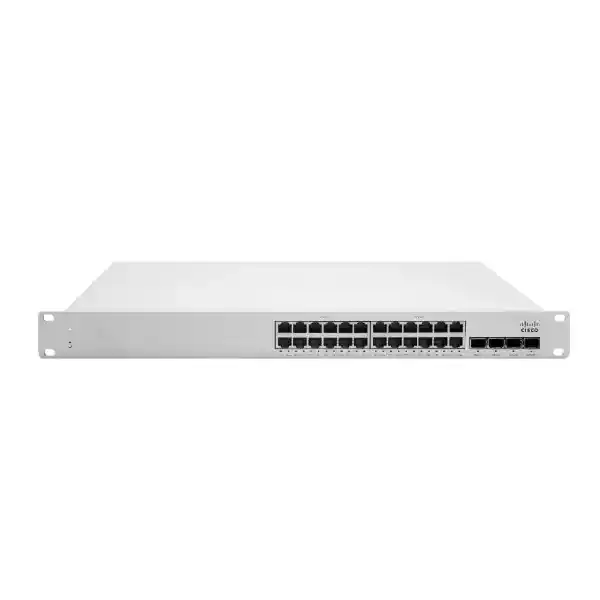
Cisco Meraki MS150-24T-4G Tanzania
The Cisco Meraki MS150-24T-4G is a cloud-managed access switch for organizations that want straightforward Gigabit Ethernet connectivity, fiber uplink flexibility, physical stacking and centralized visibility through the Meraki management platform. This specific model provides 24 x 1 GbE RJ45 access ports and 4 x 1 GbE SFP uplinks and is the non-PoE version in the MS150 family. For Tanzanian businesses, the value is less about adding unnecessary hardware complexity and more about building a manageable switching layer that can support user devices, servers, printers, access points with separate power arrangements, IP endpoints, edge appliances and uplinks to distribution infrastructure.
Cisco Meraki MS150-24T-4G overview
Cisco positions the MS150 family as a stackable cloud-managed access switching platform for branch and campus environments. Within that family, the MS150-24T-4G is the straightforward data-only 24-port model: twenty-four 1 Gigabit Ethernet RJ45 ports for connected devices, four 1 Gigabit SFP interfaces for fiber or supported optical uplinks, a dedicated management interface and two dedicated stacking ports. The model does not provide Power over Ethernet, so it is best selected when endpoint power is already handled separately or when the access layer primarily serves workstations, printers, servers, uplinked devices and other non-PoE equipment.
The switch is managed through the Cisco Meraki cloud platform, which is designed to simplify provisioning, monitoring, firmware management and troubleshooting across distributed sites. That operating model can be especially useful where an IT team needs one operational view across multiple branches rather than maintaining each switch as an isolated device. Before purchase, buyers should confirm the required Meraki licensing model and organization-wide license compatibility, identify the correct SFP optics for each uplink, confirm rack and power requirements, and verify whether the non-PoE design matches the endpoint plan.
24-port access layer
Twenty-four 1 GbE copper interfaces make the MS150-24T-4G suitable for a conventional office or branch access layer where most connected devices use standard Gigabit Ethernet.
Four SFP uplinks
Four fixed 1 GbE SFP uplink interfaces provide fiber-connectivity options for inter-rack, distribution or building links when paired with supported optics and suitable cabling.
Cloud operations
Meraki Dashboard management is designed around centralized visibility, zero-touch deployment workflows, firmware management and remote troubleshooting for connected sites.
Stackable design
Dedicated stacking ports allow MS150 switches to be combined into a resilient, scalable access-layer design where a single switch no longer provides enough port density.
Verified technical specification snapshot
| Model | Cisco Meraki MS150-24T-4G |
| Access ports | 24 x 1 GbE RJ45 |
| Uplink ports | 4 x 1 GbE SFP |
| PoE | No integrated PoE on this T model |
| Management interface | Dedicated management interface |
| Stacking | 2 dedicated stacking ports; MS150 family supports physical stacking |
| Power input | 100–240 VAC according to the current Cisco Meraki installation guide |
| Management model | Cisco Meraki cloud-managed switching with licensing requirements |
Where the MS150-24T-4G fits best
The MS150-24T-4G makes the most sense when an organization needs a managed access switch but does not need the switch itself to power phones, cameras or wireless access points. Typical examples include office floors where endpoints are predominantly desktop computers and printers, equipment rooms where powered endpoints connect elsewhere, branch networks with separate PoE injectors or dedicated PoE switches, and mixed environments where the MS150-24T-4G handles conventional data access while another switch family serves higher-power edge devices.
The four SFP uplinks also make it useful when copper access ports terminate locally but upstream connectivity runs over fiber. Buyers should plan optics deliberately: link speed, fiber type, connector type, distance and compatibility should be checked before ordering transceivers. If 10 GbE uplinks, multigigabit access or integrated PoE are required, other MS150 variants may be a better technical fit than this 4G non-PoE model.
Licensing and deployment planning
A Cisco Meraki switch deployment is not only a hardware purchase. The organization should confirm the applicable Meraki license model, term and feature tier before procurement. Cisco documentation notes that licensing compatibility can depend on the licensing model and the licenses already used within the Meraki organization. This matters when adding MS150 switches to an established environment because the new hardware should be planned as part of the existing management and licensing structure rather than as an isolated device.
For deployment, prepare the Dashboard organization and network, identify management IP requirements, confirm uplink connectivity, define VLAN and addressing standards, document trunk/access port roles, check spanning-tree design, select supported optics, and decide whether physical stacking is required. This planning reduces rework during installation and makes remote administration easier once the switch is active.
Related FourTeck network resources
FourTeck KenyaUseful for organizations coordinating regional IT procurement or deployments that also include Kenya.
FourTeck UgandaRegional reference for customers planning connected branch environments across Uganda and East Africa.
FourTeck AfricaA broader regional resource for multi-country technology planning and infrastructure enquiries in Africa.
FourTeck UAERelevant for businesses coordinating technology requirements between East Africa and the UAE.
Cisco Meraki MS150-24T-4G Tanzania
Organizations searching for Cisco Meraki MS150-24T-4G in Tanzania are usually balancing three practical needs: dependable Gigabit access connectivity, simpler centralized administration and a clear path for connecting branch or campus access switches to upstream network infrastructure. This model addresses that requirement with 24 Gigabit Ethernet copper ports, four 1 GbE SFP uplinks and Meraki cloud management. It is particularly relevant where the network does not require integrated PoE at every access port. A buyer can therefore focus the switch on data connectivity while separately planning power for wireless access points, cameras or IP phones when those endpoints are part of the design.
For Tanzanian procurement, the first step should be to map the actual endpoint count rather than buying purely on headline port density. Count current wired endpoints, planned growth, uplinks, printers, servers, building-management interfaces and any devices that will need dedicated VLANs. Keep spare ports for operational flexibility. The second step is to determine whether fiber is required between the access switch and the distribution layer. If it is, specify the fiber type, distance and compatible SFP modules before ordering. The third step is to verify licensing, Dashboard organization requirements and the operational model for remote administration.
The MS150-24T-4G can suit professional offices, financial operations, education environments, hospitality administration, healthcare back-office networks, retail sites, warehouses and distributed enterprises in Tanzania, provided the non-PoE design aligns with the endpoint mix. When preparing a quotation, include the switch hardware, relevant Meraki licensing, required SFP modules, stacking accessories if stacking is planned, patching, rack allocation and installation scope. This creates a more accurate procurement picture than comparing switch hardware alone. FourTeck can use the project brief to help structure a quotation around the actual access-port, uplink, licensing and deployment requirements without assuming unnecessary features.
Cisco Meraki MS150-24T-4G Dar es Salaam
For businesses evaluating Cisco Meraki MS150-24T-4G in Dar es Salaam, network design often needs to support dense office environments, multi-floor facilities, branch operations and business systems that depend on predictable wired connectivity. The 24-port format can be a sensible building block for departments or floors that do not need a large 48-port access switch. Four fixed SFP uplinks provide a practical way to connect the access layer to distribution switches or fiber runs, while cloud management can reduce the need to treat every switch as a standalone device.
A Dar es Salaam deployment should begin with a port schedule. Identify user ports, printers, local servers, uplink paths, guest or operational devices, and spare capacity. If the site uses IP phones, access points or cameras, remember that the MS150-24T-4G is not a PoE model. Power must therefore come from injectors, endpoint power supplies or a separate PoE-capable switch. That distinction is important because a low-cost hardware choice can become inefficient if a project later needs many separately powered endpoints.
Organizations with several Dar es Salaam branches can also benefit from standardizing VLAN names, port templates and monitoring procedures before rollout. The Meraki operating model is designed to support centralized visibility and remote troubleshooting, which can be valuable when IT staff oversee more than one site. Procurement teams should request the exact switch model, licensing term, compatible optics, stacking components if required and professional installation scope as separate line items. For office relocations or network refreshes, it is also useful to confirm rack depth, power availability, labeling and fiber termination before delivery. The objective is a deployment that is operationally consistent from the first switch onward rather than a collection of independently configured devices.
Cisco Meraki MS150-24T-4G Mwanza
Customers looking for Cisco Meraki MS150-24T-4G in Mwanza may be building or refreshing branch networks for offices, education sites, healthcare facilities, logistics operations, retail locations or growing enterprises. The switch is well suited to conventional wired access where endpoints connect at 1 GbE and where integrated PoE is not a requirement. Its 24-port size can help organizations avoid overprovisioning while still leaving room for controlled expansion when the port plan is prepared carefully.
The four 1 GbE SFP uplinks are especially useful when the access switch must connect over fiber to another room, floor or distribution point. Before procurement, confirm whether the site uses single-mode or multimode fiber, what distance must be covered, and which optic types are appropriate. Do not treat every SFP module as interchangeable. Compatibility and optical specifications should be checked against the planned link. If more than one MS150 is needed in the same rack or access layer, physical stacking can be considered as part of the resilience and management design.
Mwanza buyers should also plan the operational side of Meraki cloud management. Define who will administer the Dashboard organization, how access will be controlled, how configuration changes will be approved, and how license renewals will be tracked. For a new branch, prepare VLANs, IP subnets, DHCP responsibilities, uplink configuration, access policies and monitoring requirements before installation day. For a replacement project, audit the existing switch configuration and connected-device list first. A structured quotation should therefore include hardware, licensing, optics, patching, installation and any migration work rather than only the switch unit. This approach helps ensure that the selected MS150-24T-4G meets the real network requirement and that the deployment can be supported consistently after go-live.
Cisco Meraki MS150-24T-4G Arusha
The Cisco Meraki MS150-24T-4G can serve Arusha organizations that need a manageable wired network for business systems without paying for PoE capacity they do not intend to use. Hotels, tourism operators, schools, professional offices, clinics, administrative facilities and multi-site businesses can use a 24-port access switch as a controlled edge for desktop systems, printers, local appliances, servers and other wired devices. The central question is whether 24 copper access ports and 1 GbE SFP uplinks match the site design.
Arusha projects often benefit from separating access-switch selection from wireless and surveillance power planning. If wireless access points or cameras are powered through Ethernet, the MS150-24T-4G should not be mistaken for a PoE switch. A mixed-switch design may be more appropriate: use PoE-capable switches where powered endpoints are concentrated and use the 24T-4G where data-only ports dominate. This can keep the access layer aligned to actual power requirements while preserving a consistent Meraki operational model across compatible switching hardware.
For an Arusha branch or campus, document the upstream topology before specifying optics. Determine whether uplinks are copper or fiber, whether redundancy is required, whether multiple switches will be stacked, and what VLAN trunks will cross the uplink. Also confirm licensing and Dashboard administration before the hardware arrives. When requesting a quote, provide the number of switches, required license duration, approximate connected-device count, fiber requirements, rack location and whether configuration or migration services are needed. This allows the proposal to reflect a complete deployment rather than a bare hardware line. For organizations with future growth, reserve practical port headroom and define how additional access switches would be integrated so the network can scale without redesigning the branch from scratch.
Cisco Meraki MS150-24T-4G Dodoma
Businesses and institutions researching Cisco Meraki MS150-24T-4G in Dodoma may need a dependable access-switch platform for administrative offices, education, public-facing facilities, professional services, healthcare operations or distributed branches. The model gives network designers a 24-port Gigabit Ethernet access layer with four 1 GbE SFP uplinks and cloud-based operational visibility. Its non-PoE configuration makes it best for sites where connected devices have their own power or where a separate PoE layer is already planned.
A well-designed Dodoma deployment should begin by classifying every wired device by function and VLAN. User devices, printers, voice equipment, CCTV, access points, servers and management interfaces should not simply be placed on one flat network. Even when the switch is selected primarily for access connectivity, VLAN and uplink planning influence the entire branch architecture. If the switch will connect to a firewall or distribution layer over fiber, identify supported SFP modules and document both ends of the link before procurement.
Operational planning is equally important. Meraki cloud management is built around centralized configuration and monitoring, so organizations should decide who owns Dashboard administration, what change-control process will be used and how licensing will be maintained. For multi-site organizations, standard naming conventions and repeatable port profiles can simplify support across Dodoma and other Tanzanian locations. The quotation request should state whether the requirement is for a single switch, a stacked pair or a larger access layer; whether optics and stacking accessories are needed; and whether installation, configuration or migration support is expected. This level of detail helps procurement teams compare complete solutions and reduces the risk of missing essential components after the switch has been ordered.
Cisco Meraki MS150-24T-4G UAE
Organizations coordinating Cisco Meraki MS150-24T-4G requirements in the UAE may be standardizing network infrastructure across headquarters, branches, warehouses, customer sites or regional offices. The 24-port data-only model is useful where conventional 1 GbE access remains the main requirement and where the access switch does not need to provide PoE. Four 1 GbE SFP uplinks can connect the access layer to distribution or fiber infrastructure, while Meraki cloud management provides a consistent operational framework for remote administration.
For UAE-based regional businesses with sites in East Africa, standardization can be more valuable than selecting hardware independently for each country. The same VLAN naming, switch templates, monitoring practices and licensing governance can reduce configuration drift. However, buyers should still confirm the correct model for every site. Locations with high-density Wi-Fi, IP telephony or CCTV may require PoE-capable MS150 models instead of the 24T-4G, while sites needing 10 GbE uplinks may be better served by a 4X variant.
A procurement brief should include the site count, switch quantities, desired license term, whether new or existing Meraki organizations will be used, the fiber specification, optic requirements and any stacking plan. If the MS150-24T-4G will be integrated into an existing Meraki environment, licensing compatibility should be checked as part of the design. Regional projects also benefit from documenting firmware policy, administrative roles and remote troubleshooting procedures before deployment. These steps help the MS150 operate as part of a repeatable network architecture rather than as an isolated hardware purchase, which is particularly important for organizations linking UAE operations with Tanzania, Uganda, Kenya or other regional markets.
Cisco Meraki MS150-24T-4G Uganda
For buyers considering Cisco Meraki MS150-24T-4G in Uganda, the switch can provide a standardized access layer for offices, education, healthcare, retail, logistics and other distributed business environments. The 24 copper Gigabit ports are appropriate for conventional endpoint connectivity, while four 1 GbE SFP uplinks provide options for fiber connections to upstream network equipment. Because the model is non-PoE, deployment planning should clearly separate data-port requirements from endpoint power requirements.
Ugandan organizations with multiple branches can benefit from the centralized operational model of Meraki switching. Rather than managing every site independently, teams can use a consistent approach to monitoring, configuration and troubleshooting. That advantage is strongest when the underlying branch design is standardized: common VLAN IDs, access-port profiles, uplink conventions, IP plans and naming standards should be agreed before rollout. For sites with limited on-site IT support, good preconfiguration and documentation are particularly important.
Procurement teams should ask for an itemized proposal covering the exact MS150-24T-4G hardware, relevant licensing, supported SFP modules, stacking accessories when required, rack installation and configuration services. The optics decision should be based on actual fiber type and distance rather than generic “SFP” terminology. If a location has extensive wireless, voice or surveillance endpoints, assess whether a PoE-capable switch is needed alongside or instead of this model. For multi-country organizations, the MS150-24T-4G can fit a broader East African standard where site needs are similar, but each deployment should still be validated against local endpoint counts, uplink capacity and power design.
Cisco Meraki MS150-24T-4G Kampala
Cisco Meraki MS150-24T-4G buyers in Kampala often need to support headquarters, corporate offices, branches, professional services, education facilities, retail operations or technology environments that depend on centrally managed wired connectivity. The 24-port format is useful for access closets where a 48-port switch would be unnecessary, and the four SFP uplinks give designers additional flexibility for building or distribution links. The non-PoE design should be considered a deliberate choice, not a limitation discovered after purchase.
Before selecting the switch for a Kampala site, identify how many endpoints actually require PoE. If many devices are wireless access points, IP phones or cameras, use a PoE-capable model for those ports. If the majority are workstations, printers, servers or data-only devices, the MS150-24T-4G can be efficient. For uplinks, identify fiber medium, connector requirements, distance and redundancy strategy. When two or more MS150 switches are deployed together, evaluate whether physical stacking adds operational or resilience benefits for the site.
Kampala deployments can also benefit from a documented Meraki Dashboard governance model. Assign administrators by role, establish configuration standards, track licensing and define how alerts are handled. When adding the switch to an existing organization, confirm compatibility with the organization’s licensing approach. A complete quotation should state switch quantity, license duration, optics, stacking components, patching, rack work, configuration and migration requirements. This reduces the risk of comparing incomplete offers and helps the project team see the full implementation cost. For businesses linking Kampala to other East African sites, standardizing access-layer design can make troubleshooting and expansion significantly easier over the life of the network.
Cisco Meraki MS150-24T-4G Arua
For an Arua branch, campus or business site, the Cisco Meraki MS150-24T-4G can act as a compact managed access layer where 24 standard Gigabit Ethernet ports are sufficient. Cloud-based administration can be valuable in locations where a central IT team wants visibility without maintaining a full network operations function at every branch. The model’s four SFP uplinks allow fiber-based connectivity when the access switch must reach an upstream rack or distribution point.
Arua customers should pay close attention to deployment preparation. Create a port map before installation, labeling each intended endpoint and whether it belongs to users, printers, servers, wireless, CCTV, voice or management. This immediately reveals whether a non-PoE model is appropriate. If many endpoints need power over Ethernet, the MS150-24T-4G should be paired with or replaced by a PoE-capable alternative. If most ports are conventional data connections, it can be a straightforward fit.
Fiber uplinks also need precise planning. Specify the actual fiber type, distance and optic requirement rather than ordering transceivers generically. For distributed organizations, standardize VLANs, branch naming and switch-management procedures so remote troubleshooting remains consistent. When requesting a quote for Arua, include the intended port count, future growth allowance, license term, SFP requirements, stacking needs and whether installation or configuration support is required. If the site will be integrated with Kampala, Gulu, Mbarara or cross-border offices, document the WAN handoff and local LAN responsibilities separately. The result is a cleaner implementation where the MS150-24T-4G is selected because it matches the site architecture, not simply because it is a 24-port managed switch.
Cisco Meraki MS150-24T-4G Mbarara
The Cisco Meraki MS150-24T-4G can support Mbarara organizations that need a business-grade access switch for conventional wired devices and a cloud-managed operating model. Its 24 Gigabit Ethernet copper interfaces are suitable for branch offices, education facilities, healthcare environments, hospitality administration, retail, warehouses and professional organizations where endpoint density is moderate. Four 1 GbE SFP uplinks can be used for supported fiber connections to upstream infrastructure.
For Mbarara projects, the most important design question is endpoint power. This is a data-only switch, so it does not deliver PoE to connected devices. A site that expects a large number of access points, IP phones or cameras should plan PoE separately. In mixed environments, one practical architecture is to reserve PoE-capable switching for powered devices and use the MS150-24T-4G for desktop, printer, server and other data-only ports. That keeps power capacity aligned with actual demand.
Cloud management can simplify support when the network is administered from another city or country, but good configuration standards remain essential. Define VLANs, uplink trunks, access policies, management addressing, alerts and administrative roles before deployment. If fiber uplinks are involved, match the SFP modules to the cable plant and required link distance. A purchasing request should include the exact model, license requirement, optics, stacking accessories if applicable, rack and patching needs and any professional services. By documenting these items at the quotation stage, Mbarara buyers can avoid unexpected follow-on purchases and can compare proposals on the basis of a complete network deployment rather than hardware price alone.
Cisco Meraki MS150-24T-4G Gulu
Organizations searching for Cisco Meraki MS150-24T-4G in Gulu may be planning branch connectivity, institutional networks, education facilities, healthcare sites, retail operations or other environments where a centrally managed 24-port access switch is appropriate. The model supplies 24 x 1 GbE copper access ports and four 1 GbE SFP uplinks. It also supports the broader MS150 physical stacking design, giving customers a path to expand access-port capacity without treating every switch as an unrelated device.
A Gulu deployment should be sized around both present and future port demand. Start with an endpoint inventory and reserve sensible spare capacity for growth. Then separate powered endpoints from data-only devices because the 24T-4G does not provide PoE. If cameras, phones or access points are part of the project, determine whether power will come from separate hardware or another switch model. This single decision can materially affect the architecture and budget.
The uplink design should also be explicit. If fiber is needed, record the fiber type, distance, connector and required optic on the bill of materials. If redundant uplinks or stacking are planned, document the topology before installation. Meraki Dashboard management can support remote administration, but the organization should still define user roles, licensing responsibilities, alert handling and configuration standards. A complete Gulu quotation should therefore include switch hardware, licensing, optics, stacking accessories where needed, rack and patching requirements and optional configuration or migration services. For businesses with several Ugandan branches, consistency across these design elements can make remote operations more predictable and can simplify future expansion.
Cisco Meraki MS150-24T-4G Kenya
For Kenya-based businesses, the Cisco Meraki MS150-24T-4G provides a cloud-managed 24-port access-switch option for sites that need standard Gigabit Ethernet and fiber uplinks without integrated PoE. It can fit branch offices, corporate floors, education, retail, hospitality administration, logistics and other environments where centralized management is valuable. Four 1 GbE SFP uplinks allow supported fiber connectivity, while physical stacking offers a structured path for growth across multiple switches.
Kenyan organizations with regional operations can use this model as part of a standardized access architecture across Tanzania, Uganda and other markets, provided each site has similar technical requirements. Standardization should cover more than the hardware model: VLAN schemes, switch naming, configuration templates, licensing practices, uplink conventions and monitoring procedures should be documented. That makes central support more consistent and reduces configuration drift when new branches are commissioned.
The non-PoE design requires careful endpoint planning. If a site has many phones, wireless access points or cameras, consider PoE-capable MS150 alternatives. If the access layer is mostly desktop and data connectivity, the 24T-4G may be appropriate. Confirm the fiber type and optic requirement for each SFP link, and evaluate whether stacking is needed for port density or resilience. For quotation purposes, request hardware, licenses, optics, stacking accessories, patching and services as separate line items. Where the switch will be added to an existing Meraki organization, verify the licensing framework and administrative model before deployment. These steps help ensure that the procurement decision is based on lifecycle operation as well as initial hardware requirements.
Cisco Meraki MS150-24T-4G Kuwait
Businesses considering Cisco Meraki MS150-24T-4G in Kuwait may need a cloud-managed access switch for offices, branch locations, retail environments, education, logistics or enterprise facilities. The model offers 24 standard Gigabit Ethernet ports and four 1 GbE SFP uplinks, making it suitable for conventional access connectivity and fiber uplinks where 10 GbE is not required. Its non-PoE design is a good fit when endpoints are powered independently or when PoE is handled by separate switching.
Kuwait deployments should be planned around operating conditions, rack organization and upstream topology. Confirm the switch location, available power, cable-management approach and fiber paths before installation. The Meraki cloud model can simplify management across multiple sites, but the organization should define administrative roles, licensing ownership, firmware policy and change control. If the switch is being added to an existing Meraki environment, verify that the proposed licensing aligns with the organization’s current model.
For regional businesses coordinating Kuwait with UAE or African branches, a common switching standard can simplify support, but the exact model should still be validated for each site. A high-PoE location or a site requiring 10 GbE uplinks may need another variant. For the MS150-24T-4G, the procurement request should specify quantity, license term, required SFP optics, stacking components where applicable, and professional services if configuration or migration is needed. Document VLANs, trunk requirements and IP plans before rollout. This turns the purchase into a repeatable network deployment rather than an isolated hardware transaction and makes future expansion easier to manage.
Cisco Meraki MS150-24T-4G Ghana
Cisco Meraki MS150-24T-4G customers in Ghana may be looking for a centrally managed access switch that supports conventional Gigabit Ethernet endpoints while providing fiber-uplink options for branch or campus connectivity. With 24 x 1 GbE RJ45 ports and four 1 GbE SFP uplinks, the switch can serve professional offices, education, healthcare, retail, logistics and other distributed business networks. The data-only design means PoE should be planned separately for powered endpoints.
A strong Ghana deployment starts with an endpoint and uplink inventory. Count desktop users, printers, servers, management devices and other wired systems, then identify phones, cameras and wireless devices that may require PoE. If a large percentage of endpoints need power, use a PoE model where appropriate. For fiber links, document single-mode or multimode cable, expected distance and compatible SFP modules. This avoids last-minute optic changes and helps ensure the uplink design is technically correct.
Cloud management can be particularly useful for organizations with sites spread across different regions because configuration, visibility and troubleshooting can be standardized. That advantage depends on consistent governance: define Dashboard administrators, licensing responsibilities, configuration naming and alert handling before rollout. A Ghana quotation should therefore include the exact MS150-24T-4G hardware, license term, optics, stacking components if needed, rack/patching items and any configuration or migration services. For businesses extending an existing Meraki estate, verify how the new switch will fit the organization’s current licensing arrangement and network templates. The result should be a solution designed for operational continuity, not merely a one-time switch purchase.
Cisco Meraki MS150-24T-4G Nigeria
The Cisco Meraki MS150-24T-4G is relevant to Nigerian organizations that need scalable cloud-managed access switching for offices, branches, financial operations, education, healthcare, retail, logistics and enterprise environments. Its 24 1 GbE copper ports support standard wired endpoints, while four 1 GbE SFP uplinks can connect the access layer to upstream fiber infrastructure. As the non-PoE model, it should be selected when power delivery over Ethernet is not required on the majority of access ports.
For larger Nigerian deployments, network standards should be set before hardware rollout. Define VLANs, branch naming, uplink configurations, management addressing, access policies and monitoring practices. If multiple MS150 switches are used in a site, consider how physical stacking fits the resilience and port-density design. Where 10 GbE uplinks are required, evaluate an MS150 4X model rather than assuming that the 4G uplinks can meet higher-speed requirements.
Procurement should include licensing and optics from the beginning. Confirm the Meraki licensing model and term, especially when adding switches to an existing organization. Match SFP modules to actual fiber type and distance. For locations using access points, phones or CCTV, calculate PoE requirements separately and select PoE switching where necessary. A complete quotation should cover hardware, licenses, optics, stacking accessories, installation, configuration and migration tasks. For multi-country companies operating in Nigeria, Ghana, Kenya, Uganda or Tanzania, a standardized Meraki design can improve operational consistency, but each site still needs a model-level validation against endpoint count, PoE demand and uplink bandwidth.
Cisco Meraki MS150-24T-4G Seychelles
For organizations evaluating Cisco Meraki MS150-24T-4G in Seychelles, the switch can provide a compact, cloud-managed access layer for offices, hospitality administration, education, professional services, healthcare and distributed business locations. Twenty-four 1 GbE RJ45 ports cover conventional wired endpoint needs, while four 1 GbE SFP uplinks allow supported fiber connectivity where buildings, racks or distribution points require optical links.
Seychelles deployments should place particular emphasis on pre-installation planning so all required components are specified together. The MS150-24T-4G does not supply PoE, so a project with access points, cameras or IP phones must account for endpoint power through appropriate switching or power equipment. Fiber links should be designed with known distances, cable types and compatible optics. If the site needs more than 24 access ports, physical stacking can be considered as part of the scale-out plan.
Cloud management can reduce the dependence on local switch-by-switch administration when IT staff support several sites. To take advantage of that model, define Dashboard administrators, configuration standards, license ownership and remote support procedures before commissioning. A quotation request should identify switch quantity, licensing term, optics, stacking accessories, rack requirements and whether configuration or migration support is needed. For hospitality or multi-property operations, standard port templates and VLAN conventions can simplify future rollouts. The goal is to procure the MS150-24T-4G as one element of a complete, supportable access-network design rather than treating the switch as a standalone device with unspecified licensing and uplink requirements.
Buying and sizing checklist
- Confirm that 24 x 1 GbE access ports provide enough capacity for current endpoints plus realistic growth.
- Confirm that a non-PoE switch is suitable; identify any phones, cameras or wireless access points that need PoE.
- Document each fiber uplink, including fiber type, distance, optic requirement and upstream device.
- Confirm whether 1 GbE SFP uplinks are sufficient or whether a 10 GbE 4X model is needed.
- Determine whether one switch is enough or whether physical stacking is part of the access design.
- Verify the Meraki licensing model, term and compatibility with any existing Dashboard organization.
- Include rack, patching, optics, stacking accessories, installation and configuration scope in the quotation request.
Frequently asked questions
Does the Cisco Meraki MS150-24T-4G provide PoE?
No. The MS150-24T-4G is the non-PoE 24-port model. If the deployment needs to power access points, cameras or IP phones from the switch, evaluate a PoE-capable MS150 variant or provide power separately.
How many uplink ports does it have?
It has four 1 GbE SFP uplink interfaces. Optics should be selected according to supported compatibility, fiber type and required distance.
Can the MS150-24T-4G be stacked?
Yes. Cisco documents dedicated physical stacking for the MS150 family, and the MS150-24T-4G includes two dedicated stacking ports. Plan stacking cables and topology as part of the bill of materials.
Does the switch require a Meraki license?
Meraki cloud-managed switching is licensed. The correct license type and term depend on the organization’s licensing model and deployment. Confirm licensing before purchase, especially when adding the switch to an existing Meraki organization.
Is the MS150-24T-4G suitable for Wi-Fi access points?
It can carry network traffic for access points, but it does not power them. If APs require PoE from the access switch, select a PoE-capable model or use a separate power method.
What information should I provide for a quotation?
Provide the switch quantity, desired licensing term, number and type of uplinks, fiber details, optic requirements, whether stacking is needed, estimated endpoint count and whether installation, configuration or migration services are required.
Decision recap
Choose the MS150-24T-4G when you need 24 standard Gigabit Ethernet access ports, four 1 GbE SFP uplinks, Meraki cloud management and stackable access switching without integrated PoE. Choose another MS150 variant if the project requires PoE, multigigabit access or 10 GbE SFP+ uplinks.
Consultation panel
For an accurate quotation, share your endpoint count, PoE requirements, uplink speed, fiber type, number of sites, desired licensing term and whether the new switch will join an existing Meraki organization. This makes it easier to validate the exact hardware and accessory list before procurement.




Reviews
There are no reviews yet.