
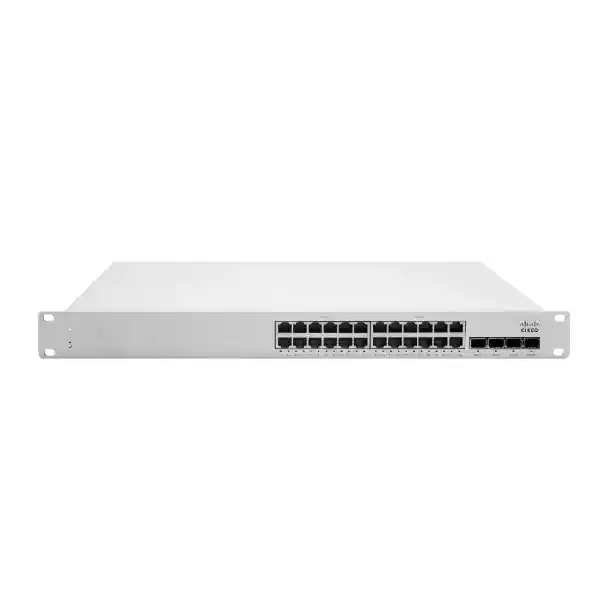
Cisco Meraki cloud-managed switching for business networks
Cisco Meraki MS150-24P-4G Tanzania
The Cisco Meraki MS150-24P-4G is a 24-port stackable access switch designed for organizations that want Gigabit Ethernet access, PoE+ power, fiber uplink flexibility and centralized cloud operations in one manageable platform. The model provides 24 x 1 GbE RJ45 access ports, four 1 GbE SFP uplinks, a 370W total PoE budget, two dedicated stacking ports with 80 Gbps stacking bandwidth, 56 Gbps switching capacity and static routing. For offices, branches, schools, healthcare facilities, retail environments, hospitality properties and distributed enterprises, it can form a practical access layer for computers, IP phones, cameras, wireless access points and other connected equipment while giving IT teams Meraki Dashboard visibility and remote management.
What the Cisco Meraki MS150-24P-4G delivers
The MS150 family is positioned by Cisco Meraki as cloud-managed, stackable access switching for branch and campus deployments. The MS150-24P-4G sits in the Gigabit PoE+ part of the range. Its 24 copper access ports are appropriate for standard Ethernet endpoints, while four SFP uplinks give designers fiber connectivity options for links to an aggregation switch, another rack, another floor or another building when the selected transceiver and fiber plant support the required distance. The 370W switch PoE budget is especially useful where the access layer must power a mixture of IP phones, cameras, wireless access points and other IEEE PoE endpoints without separate local adapters.
Cloud management changes the operational model compared with a traditional individually managed switch. Through the Meraki Dashboard, administrators can apply configuration, monitor switch status, use remote troubleshooting functions and manage firmware. Cisco also documents capabilities including IPv4/IPv6 ACLs, 802.1Q VLAN tagging, 802.1X authentication, Dynamic ARP Inspection, DHCP snooping, broadcast storm control, SNMP/syslog integration, remote packet capture and static routing. These features make the switch more than a port expander: it can become part of a documented access policy for users, voice, surveillance and wireless infrastructure.
PoE access layer
A 370W PoE budget helps consolidate power delivery for phones, cameras, access points and compatible network devices. Project sizing should still total the expected per-device power demand and preserve practical headroom.
Fiber-ready uplinks
Four 1 GbE SFP interfaces support common fiber or copper SFP modules from the Meraki accessory list, making the model suitable where access switching must connect cleanly into an existing fiber backbone.
Physical stacking
Two dedicated stack ports provide 80 Gbps of stacking bandwidth. Organizations can use stacking to simplify management and expand access capacity in suitable rack deployments.
Cloud operations
Meraki Dashboard enables centralized visibility, remote troubleshooting and configuration. This is valuable for IT teams responsible for more than one branch or for sites where local specialist access is limited.
Cisco Meraki MS150-24P-4G technical specifications
| Specification | MS150-24P-4G |
|---|---|
| Access interfaces | 24 × 10/100/1000 Mbps RJ45 |
| Uplinks | 4 × 1 GbE SFP |
| PoE | PoE+, up to 30W per port; 370W switch budget |
| Dedicated management interface | 1 |
| Stacking | 2 dedicated ports; 80 Gbps stacking bandwidth |
| Switching capacity | 56 Gbps |
| Routing | Static routing |
| Power input | 100–240 VAC |
| Documented power load | 22.9W idle / 422.2W maximum |
The MS150-24P-4G uses 1 GbE SFP uplinks. Buyers who specifically need 10 GbE uplinks should compare the MS150-24P-4X instead of assuming the “4G” model provides SFP+. This distinction matters when connecting multiple access switches to a high-throughput aggregation layer.
Licensing and procurement planning
Meraki switching is a licensed platform, so the hardware purchase should be planned together with the correct license. Cisco documentation lists Enterprise and Advanced license options for MS150 hardware and also documents subscription licensing. For organizations using co-termination licensing, license-tier consistency rules can apply across devices that support both Enterprise and Advanced tiers. The Advanced tier adds Adaptive Policy functionality for the MS150 family. Because licensing rules and commercial terms can change, procurement teams should identify their existing Meraki organization and licensing model before ordering. A quote should therefore state the switch model, required license tier, required term, power cord, transceivers and stacking cables where applicable.
Cisco lists supported 1 GbE transceivers including MA-SFP-1GB-SX, MA-SFP-1GB-LX10 and MA-SFP-1GB-TX for the MS150 4G models, while supported stacking accessories include MA-CBL-100G-50CM, MA-CBL-100G-1M and MA-CBL-100G-3M. The switch package includes the switch and rack-mount screw kit; region-specific power cords should be considered separately in procurement. Confirming these items before purchase helps avoid a common deployment delay: receiving the switch but discovering that the selected fiber, stack cable, license or power lead was not included in the bill of materials.
Where this model fits in a network
The MS150-24P-4G is best evaluated as an access-layer switch. It can connect office workstations, VoIP phones, cameras, printers, access points and other edge devices, then uplink toward routing, firewall or aggregation infrastructure. Its PoE capability is especially relevant where network-powered endpoints are concentrated in the same rack area. For deployments with many high-throughput Wi-Fi access points or an aggregation design that needs more than 1 GbE uplinks, compare the 4X or multigigabit MS150 variants before finalizing the bill of materials. The right choice is based on endpoint count, PoE wattage, uplink traffic, fiber type, growth, rack design and Meraki licensing—not simply the number of ports.
Related FourTeck Tanzania network services
A managed PoE switch performs best when the rest of the LAN is designed around it. FourTeck Tanzania’s integrated IT and networking overview explains how switching, firewalls, Wi‑Fi, IP telephony, cameras and structured cabling are planned as connected systems. Buyers can also review the FourTeck Tanzania technology shop for related product categories. For projects spanning East Africa, the FourTeck Kenya and FourTeck Uganda regional sites can support multi-country planning. For quotations and project discussions, use the verified FourTeck Tanzania contact page.
Cisco Meraki MS150-24P-4G Tanzania
For organizations in Tanzania, the Cisco Meraki MS150-24P-4G can serve as a structured access switch for offices, hotels, schools, health facilities, retail sites, warehouses, branch networks and professional environments that need centralized management. A typical Tanzanian deployment may combine staff computers, IP phones, wireless access points and surveillance cameras on the same physical switching platform while separating them logically with VLANs. The 370W PoE budget makes the model practical for consolidated edge power, but a correct design should calculate the real wattage of every powered device and reserve headroom rather than assuming all 24 ports can simultaneously draw the maximum per-port allowance.
Tanzania projects also benefit from disciplined uplink planning. The four SFP ports are 1 GbE, so they can be a good match for fiber links between floors, nearby buildings or distribution points where 1 GbE capacity is sufficient. Sites with high camera traffic, large file transfers, dense Wi‑Fi or multiple access switches feeding one uplink should model aggregate traffic before choosing the 4G variant. If 10 GbE aggregation is required, the MS150 family includes 4X variants that should be compared. This prevents a network from being constrained by an uplink choice made only on initial purchase price.
Power quality, rack ventilation, UPS capacity and cabling discipline are important in Tanzania just as they are in any business environment. A cloud-managed switch still depends on stable local power and connectivity. Rack installation should preserve airflow, label copper and fiber links, document VLAN assignments and protect switching equipment with an appropriately sized UPS where continuity requirements justify it. Procurement should also include the correct region-appropriate power cord, Meraki license, SFP modules and stacking cables if stacking is planned. FourTeck can use that bill of materials approach to help customers request a more accurate quotation rather than buying the switch as an isolated item.
Cisco Meraki MS150-24P-4G Dar es Salaam
Dar es Salaam organizations often manage dense office spaces, multi-floor commercial buildings, hospitality environments, retail operations, logistics sites and branch headquarters where access switching must serve many device types. The MS150-24P-4G can be useful in a rack that supports IP phones at desks, wireless access points across the floor, cameras at entrances and shared business equipment. Central Meraki Dashboard management can reduce the need to treat every switch as a standalone device, especially for IT teams that also administer remote branches. Port naming, VLAN policies and monitoring can be standardized so technicians can identify the function of an endpoint quickly.
For Dar es Salaam deployments, designers should pay particular attention to uplink architecture. A 24-port switch can aggregate substantial traffic when cameras, cloud applications, Wi‑Fi clients and desktop users are all active. The four 1 GbE SFP interfaces offer fiber connectivity, but they are not 10 GbE SFP+ ports. In a multi-floor building, the switch may fit well as an access layer connected over fiber to a distribution point, provided the expected traffic remains within design limits. Where several high-density access switches converge, a 10 GbE uplink model can be a better long-term decision.
A complete quote for a Dar es Salaam business should therefore include more than the switch. Specify endpoint count, anticipated PoE loads, fiber type, optic distance, required Meraki license and term, rack space, UPS strategy and whether physical stacking is needed. If voice, CCTV and Wi‑Fi share the infrastructure, define VLANs and access policy before installation. That preparation gives the switch a clear role in the architecture and makes future troubleshooting simpler as the site adds users, cameras or wireless capacity.
Cisco Meraki MS150-24P-4G Mwanza
Businesses in Mwanza may need reliable access switching for offices, hospitality sites, education facilities, retail branches, warehouses and operational locations where local IT resources can vary. A cloud-managed platform such as the Cisco Meraki MS150-24P-4G offers value when central administrators need visibility into switch ports and device status without being physically present at every site. Remote management does not replace good field installation, but it can make diagnosis and configuration more efficient when a technician is coordinating from another city or supporting several branches.
The PoE capability is useful where endpoint power needs to be centralized. Cameras and wireless access points can often be installed where mains sockets are inconvenient, while IP phones can receive both connectivity and power from the access switch. The correct design should total actual PoE requirements and verify cable quality. Long or poor copper runs can create avoidable problems, so structured cabling, labeling and certification remain important. Fiber uplinks may be appropriate between racks or buildings; the MS150-24P-4G provides four 1 GbE SFP ports and should be paired with a supported optic that matches the fiber plant.
For Mwanza procurement, planning for spares and accessories can be as important as the core switch specification. Confirm the power cord, license, SFP modules and stacking cables before dispatch. Document VLANs, management access, uplink destinations and PoE assignments at handover. If the network is expected to grow rapidly, compare current traffic and future expansion against the 1 GbE uplink design so the chosen switch does not create a bottleneck later. A well-defined bill of materials and configuration plan makes the cloud-managed platform easier to operate over its lifecycle.
Cisco Meraki MS150-24P-4G Arusha
Arusha has a wide range of business environments, including offices, tourism and hospitality operations, education, professional services and distributed organizations. The MS150-24P-4G can be considered where an access switch must support mixed wired and PoE devices under centralized management. In a hotel or lodge administration environment, for example, access points, cameras, phones and staff endpoints may all depend on the same rack. In an office or training facility, the emphasis may instead be on reliable user access, network segmentation and straightforward remote monitoring.
Because the switch offers 24 Gigabit copper ports, the design should reserve ports for growth rather than fill all interfaces on day one. PoE budgeting should similarly allow headroom for future wireless or surveillance expansion. If an access point or camera replacement later draws more power than the original unit, spare PoE capacity reduces redesign pressure. The four 1 GbE SFP uplinks can support fiber connections to other network areas, but traffic modeling remains essential where high-resolution surveillance or many Wi‑Fi users generate sustained uplink demand.
Cloud management can be particularly useful for Arusha sites that are part of a broader Tanzanian or regional organization. Standard port profiles, VLAN approaches and naming conventions can help an IT team keep branch configurations consistent. A procurement discussion should include the existing Meraki licensing model, required term, desired segmentation features, number of switches in a stack, fiber distances and supported transceiver choice. FourTeck can then align the switch with firewall, Wi‑Fi and structured cabling requirements instead of treating it as a standalone purchase.
Cisco Meraki MS150-24P-4G Dodoma
Dodoma organizations evaluating the Cisco Meraki MS150-24P-4G may include government-related offices, professional services, education, healthcare, branch operations and growing enterprises that need a manageable access layer. The switch combines 24 Gigabit Ethernet access ports with PoE+, four SFP uplinks and physical stacking. That combination can support a conventional business LAN where staff endpoints, phones, cameras and wireless infrastructure need to share switching hardware while remaining logically separated through VLANs and policy.
Central cloud management can help teams that want consistent configuration across offices. Instead of depending on a unique local configuration process at each location, administrators can use Meraki Dashboard to monitor and manage the switch. Security features such as 802.1X, ACLs, DHCP snooping and Dynamic ARP Inspection can contribute to a more controlled access environment when implemented as part of a broader network design. These features still require planning: identity systems, address allocation, VLAN structure and upstream firewall policy should be considered together.
For Dodoma projects, the quotation should reflect the real deployment. Identify how many devices need PoE, whether fiber uplinks already exist, which SFP types match that fiber, how many switches may be stacked and what licensing model is used by the organization. If UPS-backed operation is required, account for the switch’s maximum documented power load and connected infrastructure when sizing power protection. Proper rack ventilation and cable management should also be part of installation. This approach turns a hardware purchase into a maintainable network component with clear documentation and room for expansion.
Cisco Meraki MS150-24P-4G UAE
UAE businesses often operate multi-site office, retail, hospitality, warehouse and service environments where centralized visibility is valuable. The Cisco Meraki MS150-24P-4G can serve as a 24-port PoE+ access switch for organizations already using Meraki or planning a cloud-managed network standard. IT teams can manage switch configuration and troubleshooting through Dashboard, which is useful when a central operations team supports sites in Dubai, Abu Dhabi or other emirates alongside branches in Africa or elsewhere.
The key procurement question is whether the 4G uplink design matches the network architecture. The model has four 1 GbE SFP ports. For conventional access switching, this can be sufficient, especially where each switch has a modest traffic profile. For dense Wi‑Fi, high-volume video or environments with fast upstream infrastructure, a 4X version with 10 GbE SFP+ uplinks may be more appropriate. Evaluating this before purchase avoids replacing otherwise capable access hardware purely because uplink capacity was underestimated.
The 370W PoE budget can support access points, phones, cameras and compatible IoT devices, provided power requirements are calculated correctly. Buyers should include the correct license tier and term, supported optics, local power cord and stacking cables where required. Multi-country organizations can also standardize naming, VLANs, port profiles and documentation between UAE and Tanzanian sites while allowing local differences in ISP connectivity and building infrastructure. FourTeck’s regional network can support that style of coordinated procurement without making unverified claims about local stock or delivery timing.
Cisco Meraki MS150-24P-4G Uganda
Ugandan organizations with branch offices, schools, clinics, hospitality sites, retail locations and growing enterprise networks can use the MS150-24P-4G as a centrally managed access switch where Gigabit connectivity and PoE are required. It is especially relevant when a site needs one switch to power and connect a mixture of phones, cameras and access points while also serving conventional wired endpoints. Through the Meraki Dashboard, central IT teams can monitor and configure switches across different locations, which can reduce dependence on site-by-site manual administration.
A correct Uganda deployment should start by documenting the endpoints. Count wired users, Wi‑Fi access points, cameras, IP phones and infrastructure devices. Record the PoE requirement of each powered endpoint and leave capacity for expansion. Then assess uplinks. The four SFP ports operate at 1 GbE, making them suitable for many access-layer fiber links, but they should not be confused with the 10 GbE SFP+ interfaces on 4X variants. If multiple access switches feed a busy core, aggregate traffic may justify choosing a faster uplink model.
Licensing and accessories need equal attention. Meraki hardware depends on the correct licensing model, and the project may require specific SFPs, stacking cables and power cords. For organizations operating both Uganda and Tanzania sites, consistent templates for VLANs, port naming, switch roles and documentation can simplify support. The FourTeck Uganda regional site can be used alongside the Tanzania site when procurement or project planning spans both markets.
Cisco Meraki MS150-24P-4G Kampala
Kampala businesses frequently need switching for offices, commercial buildings, hotels, education, healthcare, technology teams and retail operations. The MS150-24P-4G can provide a manageable access layer for these environments when 24 Gigabit copper ports and PoE+ are an appropriate fit. A typical deployment may dedicate ports to desk users, IP phones, surveillance cameras and access points, then use VLANs to keep those services organized. The result is easier to operate when the port plan and device roles are documented before cabling begins.
The switch’s cloud-management model is useful for central administrators supporting several Kampala branches or a wider East African network. Remote packet capture, configuration visibility and firmware management can shorten troubleshooting cycles because IT staff can inspect switch state without first travelling to the site. However, cloud management depends on a stable underlying WAN path, so local internet resilience and upstream firewall design remain part of the solution. The switch is not a substitute for good connectivity planning.
Kampala buyers should also consider the physical installation. Rack depth, ventilation, UPS power, patch panels, fiber termination and cable labels affect long-term reliability. If stacking is planned, include supported stacking cables and confirm the desired switch count. If fiber uplinks are required, select supported SFPs according to fiber type and distance. For procurement, state whether the organization uses co-term, per-device or subscription licensing so the correct license can be quoted. This prevents a common mismatch between hardware purchase and operational readiness.
Cisco Meraki MS150-24P-4G Arua
For businesses and institutions in Arua, remote manageability can be an important factor when specialist IT staff are not always located at the site. The Cisco Meraki MS150-24P-4G allows a central team to manage and observe the switch through the Meraki Dashboard, while the local rack provides 24 Gigabit access ports, PoE power and fiber uplink capability. This can suit branch offices, education facilities, hospitality sites, clinics and distributed organizations that want a common network standard across several locations.
Good design should minimize the need for emergency field changes. Before installation, define the port map, VLANs, management addressing, PoE endpoints and uplink path. The switch’s 370W PoE budget can support many powered devices, but the correct figure comes from adding their real maximum draw rather than counting ports alone. Copper cabling should be tested and labeled, and any fiber link should use an SFP compatible with both the switch and the installed fiber. These preparation steps make remote troubleshooting far more useful because the central team can trust the physical documentation.
Arua projects should also account for power continuity and environmental conditions in the equipment area. Use appropriate UPS protection where business requirements justify it and ensure the rack has adequate ventilation. Meraki licensing must be included in the procurement plan, along with the correct power cord and any stacking accessories. If the site is expected to expand substantially, compare future port and uplink requirements with alternative MS150 models before purchase. The goal is to choose a switch that supports both current deployment and realistic growth.
Cisco Meraki MS150-24P-4G Mbarara
Mbarara organizations looking for managed PoE switching can consider the MS150-24P-4G for branch offices, hotels, campuses, healthcare facilities, retail sites and business premises that combine data, voice, surveillance and wireless access. Twenty-four Gigabit ports provide a useful access density for a small or medium rack, while PoE reduces the number of separate endpoint power supplies. The four SFP ports can connect the switch to fiber infrastructure where the installed backbone and transceiver selection match the design.
Operational simplicity is one of the strongest reasons to choose a Meraki switch. Central IT teams can use the Dashboard for monitoring, remote troubleshooting and configuration, which is helpful when Mbarara is one of several sites. A repeatable configuration template can keep VLAN numbering, voice settings, camera networks and management access aligned across branches. This is particularly valuable when staff turnover or changes in local contractors might otherwise create inconsistent switch configurations over time.
The model should still be sized carefully. A network with many cameras or Wi‑Fi users can place more load on uplinks than a conventional office network. Because the MS150-24P-4G has 1 GbE SFP uplinks, organizations expecting heavy aggregation traffic should compare the 4X options. Likewise, PoE sizing should allow for expansion. Procurement should bundle the proper Meraki license, supported optics, power cord and stacking cables where needed. Documenting those choices at quotation stage reduces uncertainty at installation and helps the site maintain a consistent support record.
Cisco Meraki MS150-24P-4G Gulu
In Gulu, a cloud-managed access switch can be useful for organizations that want centralized control over a site without maintaining a large local networking team. The MS150-24P-4G gives branch and campus environments 24 Gigabit RJ45 ports, PoE+, four SFP uplinks and physical stacking capability. Offices, schools, healthcare sites, hospitality operations and other businesses can use the switch to connect staff devices while powering IP phones, cameras and wireless access points from the network rack.
Remote visibility is most effective when the physical layer is well organized. The installer should label patch panels and cables, record endpoint names, define VLAN assignments and document fiber paths. If a device later fails or a user reports connectivity trouble, the central team can compare Dashboard information with an accurate port map instead of guessing which cable serves which room. That can reduce unnecessary site visits and make maintenance more predictable.
For Gulu procurement, confirm whether the existing network already uses Meraki and which licensing method applies. If there is no existing organization, license selection should be planned as part of the initial deployment. The 370W PoE budget and 1 GbE uplinks should be assessed against the endpoint mix and future growth. Where multiple switches will be installed, physical stacking can simplify design, but supported stack cables need to be included. Reliable power, UPS sizing and rack ventilation should be considered as infrastructure requirements rather than afterthoughts.
Cisco Meraki MS150-24P-4G Kenya
Kenyan businesses evaluating the Cisco Meraki MS150-24P-4G may be standardizing a branch network, expanding office access, refreshing PoE switching or building a multi-country Meraki deployment. The model combines 24 Gigabit copper ports, four 1 GbE SFP uplinks, a 370W PoE budget and cloud management. This is a practical combination for many access-layer deployments where desktop users, IP phones, cameras and wireless access points share the same rack but require separate logical networks.
For Nairobi and other Kenyan locations with larger campus or office deployments, uplink sizing deserves special attention. The four SFP ports on this model are 1 GbE. If a switch carries a large amount of Wi‑Fi, CCTV or server-bound traffic, a 10 GbE-capable MS150 variant may offer more headroom. The right decision comes from expected traffic patterns rather than port count alone. Designers should also examine whether multiple switches will be physically stacked and whether redundancy is needed higher in the network.
Procurement should include the correct Meraki license, power cord, optics and stacking cables. Organizations with locations in Kenya and Tanzania can standardize configuration templates while allowing each site to use the uplink and PoE design appropriate to its size. The FourTeck Kenya site provides a regional path for Kenyan requirements, while the Tanzania team can coordinate related projects for Tanzania-based locations. This approach is useful for procurement groups that need consistent model selection and documentation across East African branches.
Cisco Meraki MS150-24P-4G Kuwait
Kuwait organizations can consider the MS150-24P-4G for branch, office, retail, education and hospitality access networks where centralized cloud administration is desired. The 24 Gigabit access ports provide conventional wired connectivity, while PoE+ can power compatible phones, cameras and access points. Central Meraki Dashboard management is useful for IT departments that support multiple sites and want a consistent configuration and monitoring experience rather than separate management methods for each location.
Environmental and rack planning matter in Kuwait because network equipment should be installed in a controlled, ventilated communications area rather than exposed to unsuitable heat or dust. The switch accepts 100–240 VAC, but the correct region-appropriate power cord must be included in procurement. UPS sizing should account for the switch and connected critical devices according to the organization’s continuity requirements. Structured cabling and fiber termination should be completed and tested before commissioning.
The four uplinks are 1 GbE SFP, so network architects should decide whether that is sufficient for the expected traffic. A typical office access layer may fit comfortably, while high-density wireless, surveillance and large data flows may justify an MS150 4X model with 10 GbE SFP+. Meraki licensing should also be specified explicitly, including tier and term. By reviewing hardware, license, optics, stacking and power as one bill of materials, the buyer can avoid fragmented purchasing and reduce the risk that a required accessory is missing at installation.
Cisco Meraki MS150-24P-4G Ghana
Ghanaian organizations operating offices, schools, clinics, retail branches, hotels and multi-site businesses can use the Cisco Meraki MS150-24P-4G as a cloud-managed access switch where 24 Gigabit ports and PoE+ match the endpoint requirement. The switch can consolidate connectivity for staff workstations and network-powered devices, while VLANs and access policy help separate user, voice, camera and wireless infrastructure traffic. Meraki Dashboard then provides central visibility for the switching layer.
For sites outside the main IT operations center, remote troubleshooting can improve support efficiency. Features such as remote packet capture and centralized monitoring give administrators additional information before dispatching a technician. That benefit increases when the installation is carefully documented: ports should be named, cabling labeled, VLANs recorded and fiber links identified. Cloud tools cannot compensate for undocumented physical infrastructure, so both digital management and field discipline are important.
Ghana procurement teams should verify the complete configuration before ordering. The MS150-24P-4G has four 1 GbE SFP ports, not 10 GbE SFP+, and a 370W PoE budget. If the application is high-density wireless or heavy video, compare these limits against expected traffic. Select supported optics for the installed fiber, include the proper Meraki license and term, choose stacking cables if required and specify the correct power cord. A complete specification allows commercial quotations to be compared on equivalent scope instead of just headline hardware price.
Cisco Meraki MS150-24P-4G Nigeria
Nigeria’s large and diverse business environment includes corporate offices, financial services, retail, hospitality, education, healthcare, logistics and distributed branch networks. The Cisco Meraki MS150-24P-4G can fit access-layer projects where centralized management, PoE+ and Gigabit connectivity are more important than multigigabit access. Twenty-four copper ports support common endpoints, while four 1 GbE SFP interfaces can provide fiber uplinks to upstream switching infrastructure.
For multi-site Nigerian organizations, one of the platform’s main benefits is operational consistency. IT administrators can monitor and configure Meraki switches through Dashboard, making it easier to apply standard practices across branches. A common design might define separate VLANs for corporate users, voice, cameras, guest Wi‑Fi and infrastructure management. Security capabilities such as 802.1X, ACLs, DHCP snooping and Dynamic ARP Inspection can then be used where appropriate as part of the access policy.
Network size and traffic remain decisive. A branch with moderate user and camera traffic may be well served by 1 GbE uplinks, while a larger office with dense Wi‑Fi or heavy centralized applications may benefit from 10 GbE SFP+ models. PoE should be calculated from the actual powered endpoints, and the rack should have appropriate cooling and UPS protection. Procurement should include licensing, supported transceivers, power cord and stack cables if required. This complete approach reduces deployment surprises and supports more consistent lifecycle management across branches.
Cisco Meraki MS150-24P-4G Seychelles
Seychelles businesses in hospitality, professional services, retail and distributed operations may value cloud-managed switching because local sites can be supported by centralized IT teams. The MS150-24P-4G provides 24 Gigabit Ethernet access ports, PoE+, four SFP uplinks and physical stacking. In a hotel or resort support environment, for example, it may connect access points, cameras, phones and staff systems from a network rack while providing the management team with remote visibility through Meraki Dashboard.
Island deployments can make procurement planning especially important because missing accessories can delay commissioning. A complete bill of materials should identify the correct power cord, Meraki license, SFP transceivers and stacking cables in addition to the switch itself. If fiber runs link different buildings or communications rooms, confirm the installed fiber type, distance and optic compatibility. The MS150-24P-4G supports 1 GbE SFP uplinks, so higher-capacity requirements should be evaluated against the 4X alternatives before purchase.
PoE planning should also reflect the actual site. Wireless access points, cameras and IP phones can have different power requirements, and the total should remain within the switch’s 370W budget with reasonable growth allowance. Environmental protection belongs at the infrastructure level: switches should be installed in suitable indoor racks with adequate cooling, clean power and organized cabling. When these physical requirements are combined with standardized cloud configuration and documentation, the MS150 can become a manageable foundation for a business network rather than simply another switch in the rack.
Selection and sizing checklist
Before requesting a Cisco Meraki MS150-24P-4G quotation, confirm the number of active wired endpoints and the number expected during the next expansion cycle. Separate powered from non-powered devices, then calculate PoE requirements for access points, cameras, phones and other equipment. Identify every fiber uplink and note whether the installed cabling is multimode, single-mode or copper-based so the correct supported SFP can be chosen. Estimate uplink traffic and determine whether 1 GbE is sufficient or whether a 4X model is a safer choice.
Next, document the Meraki organization and licensing model. Confirm whether Enterprise or Advanced functionality is required and select the correct licensing term. If the switch will join a physical stack, specify the number and length of supported stack cables. Confirm rack space, ventilation, patch panels and UPS capacity. Finally, prepare a logical design showing VLANs, port roles, management addressing, upstream firewall or routing relationship and any 802.1X or security controls. These details make the quotation more accurate and turn installation into a controlled implementation rather than trial-and-error configuration.
Frequently asked questions
Does the MS150-24P-4G provide PoE?
Yes. Cisco documents the MS150-24P-4G as a PoE+ model with up to 30W per port and a 370W total switch PoE budget. The deployment should still calculate actual endpoint power needs and maintain headroom.
Are the uplinks 10 GbE?
No. The MS150-24P-4G has four 1 GbE SFP uplinks. The MS150-24P-4X is the related 24-port PoE+ model with four 10 GbE SFP+ uplinks.
Can the switch be physically stacked?
Yes. Cisco documents two dedicated stacking ports and 80 Gbps stacking bandwidth for the MS150-24P-4G. Supported stacking cable lengths include 50 cm, 1 m and 3 m accessories.
Does the MS150-24P-4G require a Meraki license?
Yes. The MS150 platform is licensed. Cisco documents Enterprise and Advanced tiers as well as subscription licensing. The appropriate option depends on the organization’s licensing model and required features.
Which SFP modules are supported on the 4G model?
Cisco documentation lists MA-SFP-1GB-SX, MA-SFP-1GB-LX10 and MA-SFP-1GB-TX among supported modules for MS150 4G models. Selection should match fiber type, link distance and the device at the far end.
Is the switch suitable for cameras and Wi‑Fi access points?
It can be, provided the connected devices are compatible with its Ethernet and PoE capabilities and the total PoE demand fits within the 370W budget. Uplink capacity should also be checked for high-volume camera or wireless traffic.
Quotation checklist for Cisco Meraki MS150-24P-4G
For a clear commercial quotation, provide the required quantity of MS150-24P-4G switches, the Meraki licensing model and desired term, number and type of SFP modules, stacking cable requirements, power-cord requirement, endpoint count, total estimated PoE demand, rack location and expected uplink topology. If the switch will connect IP phones, cameras or wireless access points, include those device models where possible so power and port requirements can be reviewed together. If the deployment is part of a larger refresh, note the existing core switch, firewall, VLAN scheme and fiber plant.
Decision recap
Choose the Cisco Meraki MS150-24P-4G when you need a cloud-managed 24-port Gigabit access switch with PoE+, four 1 GbE SFP uplinks and physical stacking. Its strongest fit is branch and campus access where centralized management and a 370W PoE budget match the endpoint design. Compare another MS150 model if you need multigigabit access, 10 GbE SFP+ uplinks, a larger 48-port footprint or higher PoE capacity. The correct decision should be based on the full topology, not on model naming alone.
Plan the switch as part of the complete network
FourTeck can help structure the procurement discussion around switch quantity, PoE demand, fiber uplinks, licensing, stacking, VLAN design, Wi‑Fi, IP telephony, CCTV, firewall integration, rack infrastructure and UPS requirements. This produces a more useful bill of materials than choosing the switch in isolation. Use the FourTeck Tanzania contact page to request a quotation or discuss a network requirement.



Reviews
There are no reviews yet.