
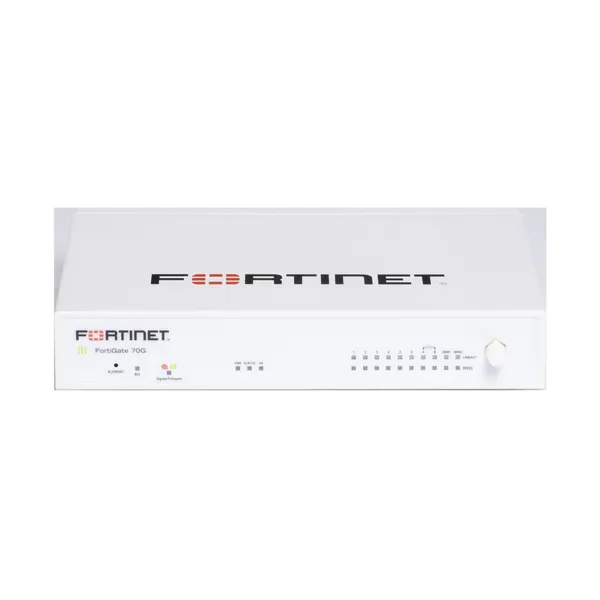
FortiGate 71G PoE (FG-71G-POE) Tanzania
FortiGate 71G PoE is a compact Fortinet next-generation firewall for organizations that want security and networking functions consolidated at the branch edge. The FG-71G-POE belongs to the FortiGate 70G family and combines FortiOS, secure SD-WAN capabilities, Gigabit Ethernet connectivity, integrated PoE/+ interfaces and local SSD storage. For Tanzanian businesses evaluating a firewall for a branch, retail location, professional office, clinic, school, hospitality site or distributed enterprise environment, the practical buying question is not simply how fast the firewall is. The right decision also considers inspected traffic, WAN design, VPN demand, endpoint count, PoE power needs, logging strategy, subscription requirements, future growth and how the appliance will integrate with switching, wireless and remote-site operations.
Ten Gigabit Ethernet RJ45 data interfaces provide flexible branch connectivity.
Four PoE/+ interfaces can simplify suitable powered-device deployments.
The 71G PoE variant includes 64GB internal SSD storage.
FortiOS converges networking and security functions in one platform.
FortiGate 71G PoE Overview
Fortinet positions the FortiGate 70G series as converged NGFW and SD-WAN appliances for distributed enterprise sites. Within that family, FG-71G-POE adds a 64GB SSD and PoE-capable Ethernet ports. Official 70G-series information identifies two hardware-accelerated GE WAN ports, two GE RJ45 FortiLink ports by default, four GE RJ45 PoE/+ ports on the PoE model, USB and RJ45 console connectivity. Fortinet also documents the 70G and 71G architecture around its SOC5/SP5 platform. These characteristics make the appliance relevant where a site needs an edge firewall but also benefits from reducing separate power injectors for compatible access devices.
Performance must be interpreted by workload rather than by the largest headline number. Published 70G-series figures include firewall throughput up to 10 Gbps, IPS throughput of 2.5 Gbps, NGFW throughput of 1.5 Gbps and threat-protection throughput of 1.3 Gbps under Fortinet’s stated test conditions. Real deployment results depend on enabled inspection, traffic profile, packet size, VPN usage, security services, firmware and configuration. FourTeck therefore recommends sizing around the intended security policy and growth horizon instead of treating raw firewall throughput as the only procurement metric.
Key Features and Business Value
Integrated PoE edge design
Four PoE/+ interfaces can support a cleaner branch topology when compatible access points, IP phones, cameras or other powered devices are part of the design. The PoE requirement should be checked against endpoint power classes and the appliance power budget before purchase.
Security-driven networking
FortiOS brings firewalling, routing, SD-WAN, VPN and security policy into a common operating environment. This is useful for distributed organizations seeking consistent controls between headquarters and branches.
Local storage
The FG-71G-POE includes 64GB SSD storage, distinguishing it from models selected without local storage. Buyers should still define their logging, analytics and retention requirements separately.
Branch-friendly form factor
The compact platform is aimed at edge environments where rack space, operational simplicity and consolidated networking functions matter. Physical placement, ventilation, cabling and power protection remain important deployment considerations.
Technical Specification Snapshot
| Model | FortiGate 71G PoE / FG-71G-POE |
| Ethernet interfaces | 10 × GE RJ45 total |
| PoE | 4 × GE RJ45 PoE/+ ports |
| WAN | 2 × GE WAN ports |
| FortiLink | 2 × GE RJ45 FortiLink ports by default |
| Storage | 64GB SSD |
| Firewall throughput | Up to 10 Gbps under vendor test conditions |
| IPS throughput | 2.5 Gbps under vendor test conditions |
| NGFW throughput | 1.5 Gbps under vendor test conditions |
| Threat protection | 1.3 Gbps under vendor test conditions |
Deployment, Licensing and Selection Guidance
A successful FG-71G-POE deployment starts with a traffic and service inventory. Record primary and backup internet circuits, expected encrypted traffic, remote-access and site-to-site VPN requirements, public-facing applications, VLANs, wireless networks, voice systems and any PoE endpoints. Decide which traffic requires deep inspection and which FortiGuard security services are expected. Hardware and subscription bundles can differ, so procurement teams should request an exact bill of materials rather than assuming every security service is included with an appliance-only SKU.
For multi-site organizations, consider how policies will be standardized and how changes, logs and incidents will be managed. FortiGate can participate in the wider Fortinet Security Fabric, while FortiLink can be relevant when compatible FortiSwitch infrastructure is part of the design. The right architecture may therefore include firewall, switching, wireless, endpoint and centralized-management decisions rather than an isolated firewall purchase.
Related FourTeck Security Resources
Organizations planning broader regional security can review FourTeck Fortinet UAE solutions for Fortinet-focused solution context, FourTeck Uganda for neighboring East African procurement discussions, FourTeck Kenya for Kenya-focused requirements, and FourTeck Africa when planning multi-country infrastructure. For Tanzania enquiries, use the FourTeck Tanzania contact page to share the intended topology and request a quotation.
FortiGate 71G PoE Tanzania
For organizations in Tanzania, FortiGate 71G PoE is most relevant when the firewall must do more than basic perimeter filtering. A branch or headquarters edge may need dual-WAN policy, secure site-to-site connectivity, controlled internet access, application visibility, segmentation and direct PoE connectivity for selected edge devices. The FG-71G-POE combines those requirements in a compact platform, but correct sizing should start from inspected traffic rather than nominal ISP speed alone. A business with a 1 Gbps circuit can still have very different firewall requirements depending on TLS inspection, IPS, VPN, application control and the number of simultaneous users and cloud applications.
Tanzanian procurement teams should prepare a clear topology before requesting pricing. Identify each internet circuit, VLAN, server segment, guest network, voice network and remote site. If the four PoE/+ ports are intended for access points, phones or cameras, list the exact endpoint models and their power requirements so the total design can be validated. Where more powered ports are required, a dedicated managed PoE switch may be the cleaner architecture. The firewall can then concentrate on security, WAN policy and segmentation while the switching layer handles access density.
Subscription planning is equally important. The appliance SKU describes the hardware; security services and support should be selected according to the required protection and lifecycle. Ask for a quotation that separates appliance, relevant FortiGuard services, FortiCare, configuration requirements and any related switching or wireless components. This makes comparisons easier and reduces the risk of purchasing hardware without the services expected by the security policy. For a multi-branch Tanzanian deployment, also define whether centralized management and consistent policy templates are needed from the beginning.
FourTeck can use the design brief to help frame a suitable bill of materials without assuming stock, lead time or service coverage. Include current firewall model, user count, WAN bandwidth, VPN users, number of sites, PoE devices and desired security functions when contacting sales. That information supports a more useful FG-71G-POE quotation and makes it easier to determine whether this model or another FortiGate capacity tier better fits the intended Tanzanian environment.
FortiGate 71G PoE Dar es Salaam
Dar es Salaam businesses often evaluate branch firewalls in environments where internet connectivity, cloud applications, voice, wireless access and inter-office VPNs converge at the same edge. The FortiGate 71G PoE can suit an office that wants to combine security-driven networking with four PoE/+ access ports and local SSD storage. A professional office, retailer, hospitality property, clinic or distributed enterprise branch can use the platform as the policy enforcement point between WAN services and segmented internal networks.
The first design decision should be WAN architecture. If two service-provider links are available, document their bandwidth, handoff type and intended role. FortiOS SD-WAN capabilities can support policy-based use of multiple links, but the configuration should reflect application priorities and failover objectives. Business-critical SaaS, voice and VPN traffic may need different health checks and path rules from ordinary browsing. The firewall specification should therefore be considered together with the intended routing and security policy.
PoE can simplify a compact Dar es Salaam branch when only a small number of compatible powered devices are required. Before relying on the firewall for access-device power, validate endpoint standards, per-device consumption and total power budget. Larger wireless or surveillance deployments normally benefit from a dedicated PoE switching layer, while the FG-71G-POE remains the secure edge. Segmentation should also be planned so staff, guest, voice, server and IoT traffic are not placed into one undifferentiated LAN.
When requesting a quote, provide the current topology, internet speeds, expected user growth, remote-access requirements, site-to-site VPN count, security inspection needs and PoE endpoint list. Ask that subscriptions and support be stated clearly rather than treating the appliance price as the entire security solution. This gives Dar es Salaam IT teams a stronger basis for comparing lifecycle cost, operational requirements and future expansion.
FortiGate 71G PoE Mwanza
In Mwanza, the FG-71G-POE can be considered for branch networks that need a compact security gateway with secure WAN connectivity and limited integrated PoE. Typical design priorities may include dependable access to cloud business systems, secure connectivity to another office, controlled guest access and separation of operational devices from user endpoints. The appliance offers a useful foundation, but the final architecture should be based on the number of users, applications and security services rather than the city or branch size alone.
A Mwanza deployment should begin by classifying traffic. Identify applications that are latency-sensitive, business critical or subject to stricter security inspection. If a secondary internet link is planned, define what should happen when the primary path degrades rather than waiting for a complete outage. SD-WAN policy can then be aligned to measurable link health and application needs. Site-to-site VPN requirements should include peer locations, expected encrypted throughput and any overlapping network ranges that may complicate deployment.
The four PoE/+ ports may reduce equipment at a small branch, but they should not be treated as a substitute for access switching in every scenario. Count the powered endpoints, check their standards and calculate their demand. If expansion is expected, design for a managed PoE switch from the outset and reserve the firewall interfaces for logical and physical roles that support the wider topology. Local SSD storage is useful, while organizations with longer retention or centralized analytics requirements should plan those separately.
For procurement, include installation objectives and renewal expectations in the initial request. Security subscriptions are an operational component, not a one-time hardware characteristic. A useful quotation should make the chosen service term visible and identify any optional management, switching or wireless components. Providing FourTeck with the planned WAN, user, VPN and PoE profile helps make the Mwanza proposal more precise and avoids choosing a firewall solely from a headline throughput figure.
FortiGate 71G PoE Arusha
Arusha organizations in tourism, professional services, education, healthcare and multi-site operations may need an edge platform that supports secure internet access while keeping branch infrastructure manageable. The FortiGate 71G PoE brings NGFW, SD-WAN and four PoE/+ interfaces into one compact appliance. That combination can be useful where an office needs to power a few compatible edge devices while maintaining security policies between users, guest services, servers and external networks.
Guest and operational traffic deserve particular attention in environments that serve visitors or temporary users. Rather than allowing every endpoint to share the same network, plan VLANs and policies around trust level and business purpose. Guest internet, staff systems, payment-related devices, voice and building or IoT equipment can have different access requirements. Firewall policy should be explicit about which segments can communicate and which should be isolated. This improves security clarity and makes troubleshooting easier.
If the Arusha site connects to a head office or cloud-hosted applications, define VPN and WAN objectives before deployment. The security team should know how many tunnels are expected, whether remote users also require VPN access, and what traffic must continue during a link failure. Where dual internet circuits are available, SD-WAN design can incorporate performance and availability criteria. These capabilities are valuable only when the policy reflects real business priorities.
A quotation request should therefore include more than the model number. State internet speeds, number of users, endpoint types, required PoE devices, VPN topology, expected security services and whether centralized management is planned. Also identify the preferred subscription term so hardware and service costs can be evaluated together. FourTeck can then discuss the FG-71G-POE in the context of the complete Arusha branch design rather than as an isolated appliance.
FortiGate 71G PoE Dodoma
For Dodoma offices, institutions and distributed organizations, the FortiGate 71G PoE can provide a consolidated edge for secure internet access, inter-site connectivity and policy enforcement. The model’s ten GE RJ45 interfaces, four PoE/+ ports and 64GB SSD give designers flexibility for a compact branch. The practical fit depends on the inspection profile, WAN bandwidth, number of segments and expected growth, so sizing should be performed against the actual workload.
Network segmentation is a strong starting point. Administrative users, guests, servers, voice systems, cameras and other IoT devices should be reviewed as separate security zones where appropriate. The firewall can enforce policy between those zones and the internet, while compatible switching can extend VLANs across the site. If the integrated PoE ports are used, validate the powered devices and total demand. For a larger endpoint estate, dedicated PoE switching is usually easier to scale and operate.
Organizations with multiple Dodoma and regional locations should also decide how configuration consistency will be maintained. A single branch can be administered locally, but larger estates benefit from standardized naming, addressing, VPN templates and security rules. Logging and monitoring requirements should be written into the design so the 64GB local SSD is understood as one part of the operational model rather than the complete analytics strategy.
Procurement teams can improve quotation accuracy by supplying a concise network schedule: ISP bandwidth, secondary link plans, VLAN count, users, remote VPN users, site-to-site tunnels, PoE endpoints and required FortiGuard services. Specify whether the request is for appliance-only comparison or a complete supported security bundle. This helps avoid mismatched quotes and gives decision-makers a clearer lifecycle view of the FG-71G-POE deployment.
FortiGate 71G PoE UAE
Organizations evaluating FortiGate 71G PoE for the UAE may be supporting branch offices, retail sites, professional workplaces or distributed operations that need a compact security and SD-WAN edge. The model’s combination of Gigabit Ethernet, four PoE/+ ports and 64GB SSD can reduce device sprawl at smaller sites, particularly when only a few compatible powered endpoints are needed. Procurement should nevertheless be driven by security workload, topology and service requirements.
For a branch with high-speed internet, headline firewall throughput should not be confused with full-security performance. IPS, NGFW and threat-protection figures are lower because those measurements include more inspection. The design team should identify which services will be enabled, whether encrypted traffic inspection is planned, and how much VPN traffic is expected. This produces a more realistic capacity decision and leaves room for growth.
The UAE branch design may also involve redundant internet circuits and centralized connectivity to other countries. FortiOS SD-WAN capabilities can be used to build policies around link health and application requirements, while IPsec VPN can support secure site-to-site connectivity. Addressing, routing, tunnel topology and failover behavior should be documented before rollout, especially for organizations deploying the same standard across many sites.
Buyers can review FourTeck’s Fortinet UAE resource when planning UAE-focused requirements. A quotation request should identify appliance quantity, subscription term, required FortiGuard services, PoE endpoint models and any FortiSwitch or FortiAP integration. This makes the procurement conversation about a complete operational design rather than only an appliance part number.
FortiGate 71G PoE Uganda
For Uganda deployments, FortiGate 71G PoE can be evaluated as a secure branch platform for organizations that need WAN control, segmentation, VPN and a small number of directly powered network devices. The integrated PoE/+ ports are particularly useful when the branch topology is compact, but designers should validate endpoint power and future expansion. The 64GB SSD adds local storage while FortiOS provides the common networking and security environment.
A multi-country organization connecting Uganda and Tanzania should standardize addressing, VPN naming and security policy wherever practical. Consistency reduces configuration drift and makes support easier as the estate grows. SD-WAN can help manage multiple WAN paths, but policies should be based on application importance and measurable link quality. Business systems, voice and interactive cloud applications may need different path selection from bulk or guest traffic.
Security subscription planning should be completed before the purchase order. Decide which FortiGuard capabilities are required and the intended support term. Ask suppliers to identify appliance-only and bundled options clearly so comparisons use equivalent service coverage. If the branch requires more PoE ports than the firewall provides, include a suitable managed switch in the bill of materials rather than overloading the firewall design.
The FourTeck Uganda website can provide regional context for Uganda requirements. When requesting a proposal, include ISP speeds, user count, VLANs, VPN peers, PoE devices, desired security services and expected growth. That information makes it easier to determine whether FG-71G-POE is appropriately sized for the branch and to prepare a consistent regional architecture.
FortiGate 71G PoE Kampala
Kampala businesses considering the FG-71G-POE often need to balance secure cloud access with branch connectivity and operational simplicity. The platform can combine firewall, SD-WAN and VPN roles while providing four PoE/+ ports for compatible devices. This can suit a compact office where a few access points, phones or other powered endpoints are part of the edge design, although power and port requirements must be checked before procurement.
Start with user and application demand. Count staff, guest and device populations separately, then identify applications that require inspection or priority handling. A branch with heavy cloud usage can create substantial encrypted traffic even when user count is modest. VPN users and site-to-site tunnels add another workload dimension. Capacity should therefore be based on the expected security profile and peak traffic, with margin for growth.
Kampala sites with dual internet links can plan SD-WAN rules around availability and application experience. Define what constitutes a degraded link, which traffic can use a backup service and whether critical applications need preferred paths. For internal networks, segment staff, guest, voice and IoT traffic and write policies that allow only required communication. This reduces unnecessary lateral reach and makes security intent easier to audit.
A complete quotation request should state the desired subscription and support term, not just FG-71G-POE. Include PoE device models, expected WAN speeds, number of sites and any centralized management requirement. Where additional access ports are needed, request compatible switching as a separate design component. This gives Kampala buyers a clearer picture of the total branch solution and renewal obligations.
FortiGate 71G PoE Arua
An Arua branch may prioritize resilient connectivity and straightforward remote administration because local IT resources can vary by organization. FortiGate 71G PoE can provide the security gateway, VPN termination and SD-WAN functions required to connect the branch securely to central systems. Four integrated PoE/+ interfaces can simplify a small installation where only a few compatible powered endpoints are required.
Resilience planning should consider both internet availability and equipment dependencies. If two WAN services are used, document the preferred path and failover behavior for each important application. If the firewall directly powers an access point or phone, understand how maintenance or a firewall outage affects that device. Larger or more critical environments may prefer independent PoE switching so access-layer power is separated from the security appliance.
For security policy, avoid a flat LAN. Separate business users, guest access, voice, cameras and other operational technology where appropriate. Site-to-site VPN rules should expose only the networks and services that the remote branch genuinely needs. Logging requirements should also be defined so security events can be reviewed centrally when the organization operates multiple locations.
Before requesting an Arua quote, prepare the current and target topology, WAN bandwidth, expected users, PoE devices, VPN peers and subscription requirements. Include growth assumptions for the next procurement cycle. This allows the FG-71G-POE to be assessed as part of a complete branch standard and helps prevent under-sizing or buying unnecessary capacity based on raw throughput alone.
FortiGate 71G PoE Mbarara
Mbarara organizations can consider the FortiGate 71G PoE when a branch needs consolidated network security, VPN and WAN control with modest integrated PoE capability. The ten GE RJ45 interfaces support flexible physical connectivity, while the four PoE/+ ports can serve selected compatible endpoints. The built-in SSD distinguishes the 71G variant for buyers who value local storage in the appliance.
The deployment should be mapped before hardware is ordered. Identify every WAN handoff, internal VLAN, switch uplink and powered endpoint. Decide whether FortiLink integration with compatible switching is part of the plan and whether wireless access will be managed as part of a broader Fortinet environment. A diagram prevents port-allocation surprises and gives installers a clearer target configuration.
Security sizing should account for enabled services. Firewall throughput represents a different workload from IPS, NGFW or threat protection, and real traffic can include significant encrypted content. Define what needs inspection and how much growth is expected. If the site supports remote workers or connects to other offices, add VPN traffic to the capacity discussion and document authentication and access-control requirements.
For procurement, request equivalent subscription terms when comparing offers. Appliance-only pricing and a security bundle are not like-for-like. State the required FortiGuard services, FortiCare level, term, deployment assistance and any related switching or wireless products. This gives Mbarara decision-makers a more complete view of initial and recurring requirements while keeping unsupported assumptions about stock or delivery out of the evaluation.
FortiGate 71G PoE Gulu
In Gulu, the FG-71G-POE may fit a compact branch that needs a secure edge and direct power for a limited set of compatible network devices. It combines FortiGate security and networking functions with PoE/+ connectivity and 64GB SSD storage. The value is strongest when the topology is deliberately designed around segmentation, resilient WAN access and clear security policies rather than treating the appliance as a simple internet router.
For remote or distributed operations, centralized visibility can be as important as local performance. Establish naming conventions, addressing plans and policy templates that can be reused across sites. Determine where logs will be reviewed and how configuration changes will be controlled. A standardized branch design can reduce troubleshooting time and make future expansion easier even when individual locations have different ISP services.
PoE planning should remain conservative. List every device intended to draw power from the firewall and validate its requirements. If more powered endpoints are likely later, a dedicated PoE switch gives the access layer more headroom. The firewall can then focus on WAN, VPN, inspection and segmentation. This separation can also simplify maintenance in environments where wireless or voice services must remain organized independently of firewall port availability.
A Gulu quotation request should include WAN speeds, users, VLANs, remote sites, VPN demand, PoE endpoints and the desired security-service term. Ask for clearly identified hardware and subscriptions. This approach gives procurement teams a more accurate comparison and helps determine whether the FortiGate 71G PoE is the right capacity tier for current needs and planned expansion.
FortiGate 71G PoE Kenya
Kenyan organizations can evaluate FortiGate 71G PoE as a branch NGFW and SD-WAN appliance where compact form factor, Gigabit Ethernet and limited integrated PoE are useful. Multi-site businesses connecting Kenya with Tanzania or Uganda should consider the device as part of a repeatable branch architecture. Standardizing policy and VPN design across countries can simplify operations while allowing each location to use the WAN services available to it.
Capacity planning should use the intended security profile. Published firewall, IPS, NGFW and threat-protection figures represent different test conditions and should not be treated as interchangeable. Determine internet speed, peak traffic, encrypted inspection, VPN load and expected growth. If the branch is likely to exceed the model’s comfortable inspected-traffic range, select a higher tier before deployment rather than relying on the largest raw throughput figure.
The integrated PoE/+ interfaces can power selected compatible devices, but a Kenyan office with many access points, phones or cameras will usually need a dedicated PoE switch. The design should define VLANs and trust zones for staff, guests, voice and IoT devices. FortiLink may be relevant where compatible FortiSwitch products are selected, allowing the access layer to participate in the broader Fortinet architecture.
For Kenya-focused discussions, visit FourTeck Kenya. A useful request for quotation includes quantity, site list, ISP speeds, VPN requirements, PoE endpoint models, security subscriptions and support term. For regional standardization, provide the Tanzania and Uganda requirements at the same time so the design can be evaluated consistently across sites.
FortiGate 71G PoE Kuwait
FortiGate 71G PoE can be considered for Kuwait branch offices that need integrated security, SD-WAN and a small PoE footprint. The compact appliance offers ten GE RJ45 interfaces, four PoE/+ ports and 64GB SSD storage. It is particularly relevant where a site wants to consolidate edge functions, but procurement should still distinguish between the hardware appliance and the FortiGuard and support services required for the intended security posture.
High-speed connectivity makes workload-based sizing important. Security inspection, application control, IPS and encrypted traffic can place different demands on the platform than basic stateful firewalling. Record expected internet throughput and peak utilization, then map the security functions that will be enabled. This gives a more meaningful comparison with Fortinet’s published NGFW and threat-protection measurements.
For multi-country enterprises, the Kuwait site may need secure tunnels to UAE, Tanzania or other locations. Plan routing and IP addressing so VPNs can be deployed without avoidable overlap. If dual WAN links are available, define SD-WAN service-level objectives and application priorities. Consistent policy templates and centralized operational processes can reduce configuration drift across the regional estate.
The PoE ports should be allocated only after checking the attached device requirements. A branch expecting substantial wireless, voice or camera growth should use scalable PoE switching. When seeking pricing, provide the complete bill-of-material requirements, desired service term and any management or access-layer components. This makes the Kuwait FG-71G-POE proposal easier to compare on a like-for-like basis.
FortiGate 71G PoE Ghana
Ghana deployments of FortiGate 71G PoE can focus on secure branch connectivity, controlled cloud access and segmentation. The appliance’s integrated PoE/+ interfaces are useful for small edge designs, while the SSD-equipped 71G variant supports local storage requirements. A successful deployment should be based on a documented traffic profile and network diagram rather than selecting a firewall only by employee count.
Define the site’s internet services, VPN topology and critical applications. If multiple WAN links are used, decide how the branch should react to latency, packet loss or outage conditions. FortiOS SD-WAN policies can then be designed around business intent. For internal security, separate staff, guest, server, voice and IoT networks where appropriate and permit only the flows required for operations.
Security-service selection is part of the architecture. Clarify which FortiGuard services are needed and for how long, then compare equivalent bundles. Renewal planning should be recorded with the initial purchase so future operating costs are visible. Organizations with several Ghana locations should also consider how configuration, logging and policy changes will be coordinated across the estate.
PoE demand deserves its own checklist: endpoint model, power requirement, quantity and growth. If four powered ports are insufficient, add a suitable PoE switch rather than forcing the firewall to become the entire access layer. A complete quotation request containing these details enables a more accurate assessment of whether FG-71G-POE fits the Ghana branch requirement and what related components are needed.
FortiGate 71G PoE Nigeria
Nigerian businesses evaluating the FortiGate 71G PoE may be seeking a compact platform for branch security, multi-WAN connectivity, VPN and segmented access. The model provides ten GE RJ45 interfaces, including four PoE/+ ports, together with 64GB SSD storage. These features can simplify a smaller branch, but the architecture should leave room for growth in bandwidth, users and powered endpoints.
Where multiple internet services are used, document the role of each connection. SD-WAN can support path selection and failover, but useful policies require defined application priorities and link-health criteria. Voice, payment, ERP and interactive SaaS traffic may need different treatment from guest browsing or bulk downloads. Site-to-site VPNs should be planned with routing and security zones so remote networks receive only the access they require.
A Nigerian deployment with many access points, IP phones or cameras should generally plan dedicated PoE switching. The firewall’s integrated PoE is best viewed as a useful capability for a limited number of compatible devices, not unlimited access-layer capacity. Validate endpoint power needs and reserve physical interfaces according to the network diagram. Segmentation and access policy should be established before endpoints are connected.
Procurement should compare complete configurations. Specify appliance quantity, FortiGuard services, FortiCare term, VPN requirements, switching and wireless components and any deployment assistance. Avoid comparing hardware-only pricing with a bundled security offer. With these inputs, the FG-71G-POE can be evaluated against actual Nigerian branch requirements and the organization’s broader regional security standard.
FortiGate 71G PoE Seychelles
For Seychelles organizations, FortiGate 71G PoE can provide a compact security and networking edge for offices, hospitality environments and distributed operations that need secure internet access, VPN and segmentation. Four PoE/+ ports can be useful when a site has a small number of compatible powered devices, while the 64GB SSD provides local storage on the 71G variant.
Connectivity resilience can be important for island operations, so the WAN plan should document primary and secondary services where available. Define which applications must remain usable during a degraded path and configure SD-WAN policy around measurable link quality. If the site connects to a regional headquarters, document tunnel bandwidth, routing and access requirements before installation. This helps prevent ad-hoc VPN policy and overlapping network issues.
Hospitality or guest-facing networks should be separated from internal business systems. Staff, guest, voice, payment-related and IoT devices may require different trust levels and access rules. The firewall can enforce policy between those segments, while managed switching and wireless infrastructure extend the design throughout the site. Integrated PoE may support a few endpoints, but larger properties should plan dedicated PoE switching for scale.
A Seychelles quotation request should state WAN bandwidth, users, guest demand, VPN peers, VLANs, PoE devices and the desired FortiGuard and FortiCare term. Include expected growth and any centralized management requirement. This allows the FG-71G-POE to be assessed on operational fit and inspected traffic needs rather than only the raw firewall throughput specification.
Frequently Asked Questions
What is the FortiGate 71G PoE?
FG-71G-POE is a Fortinet FortiGate 70G-series next-generation firewall variant with ten GE RJ45 interfaces, four PoE/+ ports and 64GB SSD storage. It runs FortiOS and is positioned for converged security and networking at distributed sites.
How many PoE ports does FG-71G-POE have?
The model has four GE RJ45 PoE/+ ports. Confirm the power requirements of intended endpoints and the platform’s PoE budget before finalizing the design.
Does the FG-71G-POE include storage?
Yes. Fortinet’s ordering information identifies 64GB SSD storage for the FG-71G-POE.
Is FortiGate 71G PoE suitable for dual-WAN?
The platform includes two GE WAN ports and FortiOS SD-WAN capabilities. The actual design should define link health, routing, application priorities and failover behavior.
What should I provide for a quotation?
Provide quantity, site locations, ISP speeds, user count, VPN requirements, VLANs, PoE endpoint models, required security services, preferred subscription term and any switching or wireless integration needs.
Quotation Checklist
Prepare the appliance quantity, WAN bandwidth, backup-link requirements, users, VLANs, VPN peers, remote-access users, PoE endpoint list, FortiGuard services, support term, logging needs, switching, wireless integration and growth expectations. A complete brief produces a more meaningful bill of materials than a model-only enquiry.
Decision Recap
Choose FG-71G-POE when its inspected-traffic capacity, Gigabit interface layout, four PoE/+ ports and 64GB SSD align with the intended branch architecture. Validate subscriptions, PoE demand and growth before purchase. For larger access-layer or throughput requirements, compare an appropriately sized FortiGate and managed PoE switching design.
Discuss Your FortiGate 71G PoE Requirement
Share your Tanzania or multi-region topology with FourTeck, including WAN links, users, VPNs, security services and PoE devices. The resulting discussion can focus on the correct hardware and service configuration without assuming price, stock or delivery conditions.



Reviews
There are no reviews yet.